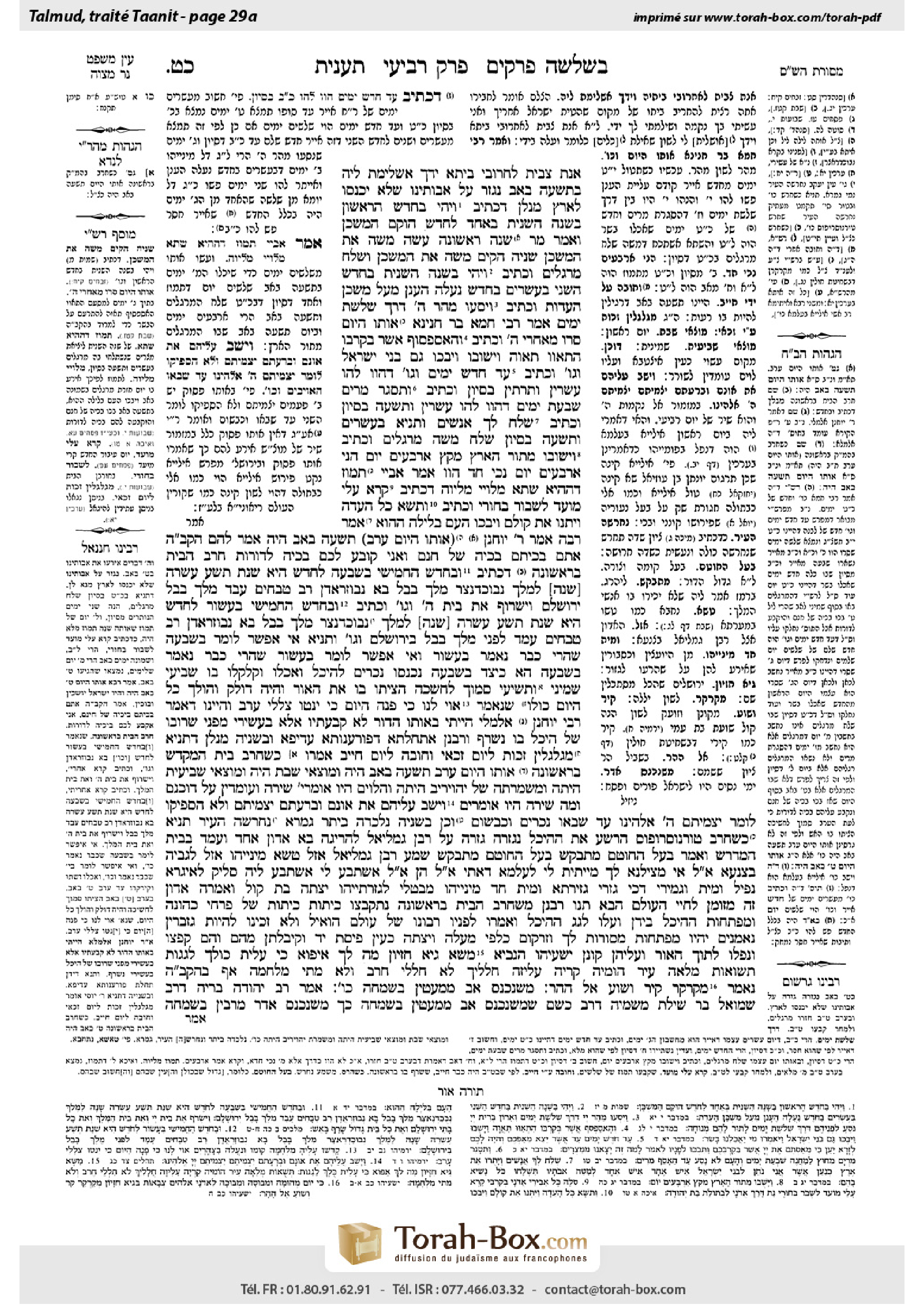
Taanit 29a: Talmud study for Daf Yomi
Daf Yomi is the daily study of one Talmud folio. Explore 37 tractates with scans, Hebrew text, Sefaria English and AI-generated French translations where annotated.
Passage selection and English or AI-generated French translation are available where the scan has annotations. Daf Study is independent of Torah-Box and Sefaria.
Browse Taanit · תענית · All tractatesTaanit 29a text and translations
This page of Taanit includes the Aramaic text, an English translation and an AI-generated French translation, alongside the scan above.
תענית כ״ט א · Aramaic and Hebrew text
אַנְתְּ צְבֵית לְ[אַ]חְרוֹבֵי בֵּיתָא — יְדָךְ אַשְׁלֵימְתְּ לֵיהּ.
בְּתִשְׁעָה בְּאָב נִגְזַר עַל אֲבוֹתֵינוּ שֶׁלֹּא יִכָּנְסוּ לָאָרֶץ, מְנָלַן — דִּכְתִיב: ״וַיְהִי בַּחֹדֶשׁ הָרִאשׁוֹן בַּשָּׁנָה הַשֵּׁנִית בְּאֶחָד לַחֹדֶשׁ הוּקַם הַמִּשְׁכָּן״. וְאָמַר מָר: שָׁנָה רִאשׁוֹנָה עָשָׂה מֹשֶׁה אֶת הַמִּשְׁכָּן, שְׁנִיָּה הֵקִים מֹשֶׁה אֶת הַמִּשְׁכָּן, וְשָׁלַח מְרַגְּלִים. וּכְתִיב: ״וַיְהִי בַּשָּׁנָה הַשֵּׁנִית בַּחֹדֶשׁ הַשֵּׁנִי בְּעֶשְׂרִים בַּחֹדֶשׁ נַעֲלָה הֶעָנָן מֵעַל מִשְׁכָּן הָעֵדֻת״.
וּכְתִיב: ״וַיִּסְעוּ מֵהַר ה׳ דֶּרֶךְ שְׁלֹשֶׁת יָמִים״. אָמַר רַבִּי חָמָא בַּר חֲנִינָא: אוֹתוֹ הַיּוֹם סָרוּ מֵאַחֲרֵי ה׳. וּכְתִיב: ״וְהָאסַפְסֻף אֲשֶׁר בְּקִרְבּוֹ הִתְאַוּוּ תַּאֲוָה וַיָּשֻׁבוּ וַיִּבְכּוּ גַּם בְּנֵי יִשְׂרָאֵל וְגוֹ׳״, וּכְתִיב: ״עַד חֹדֶשׁ יָמִים וְגוֹ׳״ — דְּהָווּ לְהוּ עֶשְׂרִין וְתַרְתֵּין בְּסִיוָן,
וּכְתִיב: ״וַתִּסָּגֵר מִרְיָם שִׁבְעַת יָמִים״ — דְּהָווּ לְהוּ עֶשְׂרִין וְתִשְׁעָה בְּסִיוָן, וּכְתִיב: ״שְׁלַח לְךָ אֲנָשִׁים״,
וְתַנְיָא: בְּעֶשְׂרִים וְתִשְׁעָה בְּסִיוָן שָׁלַח מֹשֶׁה מְרַגְּלִים, וּכְתִיב: ״וַיָּשֻׁבוּ מִתּוּר הָאָרֶץ מִקֵּץ אַרְבָּעִים יוֹם״. הָנֵי אַרְבָּעִים יוֹם נְכֵי חַד הָווּ!
אָמַר אַבָּיֵי: תַּמּוּז דְּהַהִיא שַׁתָּא מַלּוֹיֵי מַלְּיוּהּ, דִּכְתִיב: ״קָרָא עָלַי מוֹעֵד לִשְׁבֹּר בַּחוּרָי״.
וּכְתִיב: ״וַתִּשָּׂא כׇּל הָעֵדָה וַיִּתְּנוּ אֶת קוֹלָם וַיִּבְכּוּ הָעָם בַּלַּיְלָה הַהוּא״, אָמַר רַבָּה אָמַר רַבִּי יוֹחָנָן: אוֹתוֹ לַיְלָה לֵיל תִּשְׁעָה בְּאָב הָיָה. אָמַר לָהֶם הַקָּדוֹשׁ בָּרוּךְ הוּא: אַתֶּם בְּכִיתֶם בְּכִיָּה שֶׁל חִנָּם — וַאֲנִי קוֹבֵעַ לָכֶם בְּכִיָּה לְדוֹרוֹת.
חָרַב הַבַּיִת בָּרִאשׁוֹנָה, דִּכְתִיב: ״וּבַחֹדֶשׁ הַחֲמִישִׁי בְּשִׁבְעָה לַחֹדֶשׁ הִיא שְׁנַת תְּשַׁע עֶשְׂרֵה שָׁנָה לַמֶּלֶךְ נְבֻכַדְנֶאצַּר מֶלֶךְ בָּבֶל בָּא נְבוּזַרְאֲדָן רַב טַבָּחִים עֶבֶד מֶלֶךְ בָּבֶל יְרוּשָׁלִָם וַיִּשְׂרֹף אֶת בֵּית ה׳ וְגוֹ׳״, וּכְתִיב: ״וּבַחֹדֶשׁ הַחֲמִישִׁי בֶּעָשׂוֹר לַחֹדֶשׁ הִיא שְׁנַת תְּשַׁע עֶשְׂרֵה שָׁנָה לַמֶּלֶךְ נְבוּכַדְנֶאצַּר מֶלֶךְ בָּבֶל בָּא נְבוּזַרְאֲדָן רַב טַבָּחִים עָמַד לִפְנֵי מֶלֶךְ בָּבֶל בִּירוּשָׁלִָם וְגוֹ׳״.
וְתַנְיָא: אִי אֶפְשָׁר לוֹמַר בְּשִׁבְעָה, שֶׁהֲרֵי כְּבָר נֶאֱמַר ״בֶּעָשׂוֹר״. וְאִי אֶפְשָׁר לוֹמַר בֶּעָשׂוֹר, שֶׁהֲרֵי כְּבָר נֶאֱמַר ״בְּשִׁבְעָה״, הָא כֵּיצַד? בְּשִׁבְעָה נִכְנְסוּ נׇכְרִים לַהֵיכָל, וְאָכְלוּ וְקִלְקְלוּ בּוֹ שְׁבִיעִי שְׁמִינִי.
וּתְשִׁיעִי סָמוּךְ לַחֲשֵׁיכָה הֵצִיתוּ בּוֹ אֶת הָאוּר, וְהָיָה דּוֹלֵק וְהוֹלֵךְ כׇּל הַיּוֹם כּוּלּוֹ, שֶׁנֶּאֱמַר: ״אוֹי לָנוּ כִּי פָנָה הַיּוֹם כִּי יִנָּטוּ צִלְלֵי עָרֶב״. וְהַיְינוּ דְּאָמַר רַבִּי יוֹחָנָן: אִלְמָלֵי הָיִיתִי בְּאוֹתוֹ הַדּוֹר לֹא קְבַעְתִּיו אֶלָּא בָּעֲשִׂירִי, מִפְּנֵי שֶׁרוּבּוֹ שֶׁל הֵיכָל בּוֹ נִשְׂרַף. וְרַבָּנַן — אַתְחַלְתָּא דְפוּרְעֲנוּתָא עֲדִיפָא.
וּבַשְּׁנִיָּה מְנָלַן, דְּתַנְיָא: מְגַלְגְּלִין זְכוּת לְיוֹם זַכַּאי, וְחוֹבָה לְיוֹם חַיָּיב.
אָמְרוּ: כְּשֶׁחָרַב בֵּית הַמִּקְדָּשׁ בָּרִאשׁוֹנָה, אוֹתוֹ הַיּוֹם תִּשְׁעָה בְּאָב הָיָה, וּמוֹצָאֵי שַׁבָּת הָיָה, וּמוֹצָאֵי שְׁבִיעִית הָיְתָה, וּמִשְׁמַרְתָּהּ שֶׁל יְהוֹיָרִיב הָיְתָה. וְהַלְּוִיִּם הָיוּ אוֹמְרִים שִׁירָה, וְעוֹמְדִין עַל דּוּכָנָם. וּמָה שִׁירָה הָיוּ אוֹמְרִים? ״וַיָּשֶׁב עֲלֵיהֶם אֶת אוֹנָם וּבְרָעָתָם יַצְמִיתֵם״, וְלֹא הִסְפִּיקוּ לוֹמַר ״יַצְמִיתֵם ה׳ אֱלֹהֵינוּ״, עַד שֶׁבָּאוּ נׇכְרִים וּכְבָשׁוּם. וְכֵן בַּשְּׁנִיָּה.
נִלְכְּדָה בֵּיתֵּר — גְּמָרָא.
נֶחֶרְשָׁה הָעִיר — תַּנְיָא: כְּשֶׁחָרַשׁ טוֹרָנוּסְרוּפוּס הָרָשָׁע אֶת הַהֵיכָל, נִגְזְרָה גְּזֵרָה עַל רַבָּן גַּמְלִיאֵל לַהֲרִיגָה. בָּא אוֹתוֹ הֶגְמוֹן וְעָמַד בְּבֵית הַמִּדְרָשׁ, וְאָמַר: בַּעַל הַחוֹטֶם מִתְבַּקֵּשׁ, בַּעַל הַחוֹטֶם מִתְבַּקֵּשׁ. שָׁמַע רַבָּן גַּמְלִיאֵל, אֲזַל טְשָׁא מִינַּיְיהוּ.
אֲזַל לְגַבֵּיהּ בְּצִנְעָא אֲמַר לֵיהּ: אִי מַצֵּילְנָא לָךְ מַיְיתֵית לִי לְעָלְמָא דְּאָתֵי? אֲמַר לֵיהּ: הֵן. אָמַר לֵיהּ: אִשְׁתְּבַע לִי. אִשְׁתְּבַע לֵיהּ. סְלֵיק לְאִיגָּרָא נָפֵיל וּמִית. וּגְמִירִי, דְּכִי גָּזְרִי גְּזֵירְתָּא וּמִית חַד מִינַּיְיהוּ מְבַטְּלִי לִגְזֵרְתַּיְיהוּ. יָצְתָה בַּת קוֹל וְאָמְרָה: אוֹתוֹ הֶגְמוֹן מְזוּמָּן לְחַיֵּי הָעוֹלָם הַבָּא.
תָּנוּ רַבָּנַן: מִשֶּׁחָרַב הַבַּיִת בָּרִאשׁוֹנָה, נִתְקַבְּצוּ כִּיתּוֹת כִּיתּוֹת שֶׁל פִּרְחֵי כְּהוּנָּה וּמַפְתְּחוֹת הַהֵיכָל בְּיָדָן, וְעָלוּ לְגַג הַהֵיכָל, וְאָמְרוּ לְפָנָיו: רִבּוֹנוֹ שֶׁל עוֹלָם! הוֹאִיל וְלָא זָכִינוּ לִהְיוֹת גִּזְבָּרִין נֶאֱמָנִים — יִהְיוּ מַפְתְּחוֹת מְסוּרוֹת לָךְ. וּזְרָקוּם כְּלַפֵּי מַעְלָה. וְיָצְתָה כְּעֵין פִּיסַּת יָד וְקִיבְּלָתַן מֵהֶם. וְהֵם קָפְצוּ וְנָפְלוּ לְתוֹךְ הָאוּר.
וַעֲלֵיהֶן קוֹנֵן יְשַׁעְיָהוּ הַנָּבִיא: ״מַשָּׂא גֵּיא חִזָּיוֹן מַה לָּךְ אֵפוֹא כִּי עָלִית כֻּלָּךְ לַגַּגּוֹת. תְּשֻׁאוֹת מְלֵאָה עִיר הוֹמִיָּה קִרְיָה עַלִּיזָה חֲלָלַיִךְ לֹא חַלְלֵי חֶרֶב וְלֹא מֵתֵי מִלְחָמָה״. אַף בְּהַקָּדוֹשׁ בָּרוּךְ הוּא נֶאֱמַר: ״מְקַרְקַר קִר וְשׁוֹעַ אֶל הָהָר״.
מִשֶּׁנִּכְנַס אָב מְמַעֲטִין בְּשִׂמְחָה וְכוּ׳. אָמַר רַב יְהוּדָה בְּרֵיהּ דְּרַב שְׁמוּאֵל בַּר שִׁילַת מִשְּׁמֵיהּ דְּרַב: כְּשֵׁם שֶׁמִּשֶּׁנִּכְנַס אָב מְמַעֲטִין בְּשִׂמְחָה — כָּךְ מִשֶּׁנִּכְנַס אֲדָר מַרְבִּין בְּשִׂמְחָה.
Taanit 29a · English translation
You want to destroy the Temple; I have given you your hand. It is as though one idol said to the other: You are seeking to destroy the Temple by causing Israel to pray to you; I, too, give you a hand to assist you.
§ The mishna taught: On the Ninth of Av, it was decreed upon our ancestors that they would not enter Eretz Yisrael. The Gemara asks: From where do we derive this? As it is written: “And it came to pass in the first month in the second year, on the first day of the month, that the Tabernacle was erected” (Exodus 40:17). And the Master said: In the first year after leaving Egypt, Moses built the Tabernacle. At the beginning of the second year, Moses erected the Tabernacle and sent the spies. And it is written: “And it came to pass in the second year in the second month, on the twentieth day of the month, that the cloud was taken up from the Tabernacle of the Testimony” (Numbers 10:11).
And it is further written: “And they set forward from the mount of the Lord three days’ journey” (Numbers 10:33). Rabbi Ḥama bar Ḥanina said: That very day, they turned away from God by displaying their anxiety about leaving Mount Sinai. And it is written: “And the mixed multitude that was among them fell a lusting, and the children of Israel also wept on their part, and said: Would that we were given flesh to eat” (Numbers 11:4). And it is written that the Jews ate the meat “for an entire month” (Numbers 11:20). If one adds to the first twenty days an additional three days’ journey, these are twenty-three days. Consequently, the subsequent month of twenty-nine days of eating meat ended on the twenty-second of Sivan.
After this, the Jews traveled to Hazeroth, where Miriam was afflicted with leprosy, and it is written: “And Miriam was shut out of the camp for seven days, and the people did not journey until Miriam was brought in again” (Numbers 12:15). Including these seven days, they remained in Hazeroth until the twenty-ninth of Sivan before traveling on to Paran, and it is written immediately afterward: “Send you men, that they may spy out the land of Canaan” (Numbers 13:2).
And this calculation is taught in a baraita: On the twenty-ninth of Sivan, Moses sent the spies. And it is written: “And they returned from spying out the land at the end of forty days” (Numbers 13:25), which means that they came back on the Ninth of Av. The Gemara asks: These are forty days minus one. The remaining days of the days of Sivan, the entire month of Tammuz, and eight days of Av add up to a total of thirty-nine days, not forty.
Abaye said: The month of Tammuz of that year was a full month of thirty days. Accordingly, there are exactly forty days until the Ninth of Av. And this is alluded to in the following verse, as it is written: “He has called an appointed time against me to crush my young men” (Lamentations 1:15). This indicates that an additional appointed day, i.e., a New Moon, was added so that this calamity would fall specifically on the Ninth of Av.
And it is further written: “And all the congregation lifted up their voice and cried and the people wept that night” (Numbers 14:1). Rabba said that Rabbi Yoḥanan said: That night was the night of the Ninth of Av. The Holy One, Blessed be He, said to them: You wept needlessly that night, and I will therefore establish for you a true tragedy over which there will be weeping in future generations.
§ The mishna further taught that on the Ninth of Av the Temple was destroyed the first time. The Gemara explains that this is as it is written: “And in the fifth month, on the seventh day of the month, which was the nineteenth year of King Nebuchadnezzar, king of Babylon, Nebuzaradan, captain of the guard, a servant of the King of Babylon, came to Jerusalem. And he burnt the house of the Lord” (II Kings 25:8–9). And it is also written: “And in the fifth month, on the tenth day of the month, which was the nineteenth year of King Nebuchadnezzar, king of Babylon, Nebuzaradan, captain of the guard, who served the king of Babylon, came into Jerusalem. And he burnt the house of the Lord” (Jeremiah 52:12–13).
And it is taught in a baraita: It is impossible to say that the Temple was burned on the seventh of Av, as it has already been stated, in Jeremiah, that it was destroyed on the tenth. And it is also impossible to say that the Temple was burned on the tenth of Av, as it has already been stated that it was destroyed on the seventh, in II Kings 25:8–9. How so; what actually occurred? On the seventh of Av, gentiles entered the Sanctuary, and on the seventh and the eighth they ate there and desecrated it, by engaging in acts of fornication.
And on the ninth, adjacent to nightfall, they set fire to it, and it continuously burned the entire day, as it is stated: “Woe unto us, for the day has declined, for the shadows of the evening are stretched out” (Jeremiah 6:4). This verse is interpreted as a prophecy about the evening when the Temple was burned. And this is what Rabbi Yoḥanan meant when he said: Had I been alive in that generation, I would have established the fast only on the tenth of Av because most of the Sanctuary was burned on that day. And the Sages, who established the fast on the ninth, how do they respond to that comment? They maintain that it is preferable to mark the beginning of the tragedy.
And the mishna further taught that the Temple was destroyed for the second time also on the Ninth of Av. The Gemara asks: From where do we derive that the Second Temple was destroyed on this date? It is taught in a baraita: A meritorious matter is brought about on an auspicious day, and a deleterious matter on an inauspicious day, e.g., the Ninth of Av, on which several tragedies had already occurred.
The Sages said: When the Temple was destroyed for the first time, that day was the Ninth of Av; and it was the conclusion of Shabbat; and it was the year after a Sabbatical Year; and it was the week of the priestly watch of Jehoiarib; and the Levites were singing the song and standing on their platform. And what song were they singing? They were singing the verse: “And He brought upon them their own iniquity, and He will cut them off in their own evil” (Psalms 94:23). And they did not manage to recite the end of the verse: “The Lord our God will cut them off,” before gentiles came and conquered them. And likewise, the same happened when the Second Temple was destroyed.
The mishna teaches that Beitar was captured on the Ninth of Av. The Gemara explains that this is known by tradition.
§ The mishna taught that on the Ninth of Av the city of Jerusalem was plowed. It is taught in a baraita: When the wicked Turnus Rufus plowed the Sanctuary, a decree was issued against Rabban Gamliel for execution. A certain Roman officer came and stood in the study hall and said surreptitiously: The man with the nose is wanted; the man with the nose is wanted. This was a hint that Rabban Gamliel, who stood out in his generation like a nose protruding from a face, was sought by the government. Rabban Gamliel heard and went into hiding.
The Roman officer went to him in private, and said to him: If I save you from death, will you bring me into the World-to-Come? Rabban Gamliel said to him: Yes. The officer said to Rabban Gamliel: Swear to me. He swore to him. The officer ascended to the roof, fell, and died. And the Romans had a tradition that when they issued a decree and one of their advisors died, they would cancel the decree. The officer’s sacrifice saved Rabban Gamliel’s life. A Divine Voice emerged and said: That officer is designated for the life of the World-to-Come.
The Sages taught: When the Temple was destroyed for the first time, many groups of young priests gathered together with the Temple keys in their hands. And they ascended to the roof of the Sanctuary and said before God: Master of the Universe, since we did not merit to be faithful treasurers, and the Temple is being destroyed, let the Temple keys be handed to You. And they threw them upward, and a kind of palm of a hand emerged and received the keys from them. And the young priests jumped from the roof and fell into the fire of the burning Temple.
And the prophet Isaiah lamented over them: “The burden of the Valley of Vision. What ails you now that you have all gone up to the roofs? You that were full of uproar, a tumultuous city, a joyous town, your slain are not slain with the sword, nor dead in battle” (Isaiah 22:1–2). This is referring to the young priests who died by throwing themselves off the roof into the fire. And even with regard to the Holy One, Blessed be He, it is stated: “For it is a day of trouble, and of trampling, and of confusion for the Lord of hosts, in the Valley of Vision; a shouting over walls and a cry to the mountain” (Isaiah 22:5). This verse indicates that even God shouts over the destruction of the Temple.
§ The mishna teaches that from when the month of Av begins, one decreases acts of rejoicing. Rav Yehuda, son of Rav Shmuel bar Sheilat, said in the name of Rav: Just as when Av begins one decreases rejoicing, so too when the month of Adar begins, one increases rejoicing.
Taanit 29a · Traduction française (IA)
Tu veux détruire le Temple ; je te prête main-forte. C’est comme si une idole disait à l’autre : « Tu cherches à détruire le Temple en incitant Israël à t’adresser ses prières ; moi aussi, je te prête main-forte. »
§ La Michna enseignait : Le neuf Av, il fut décrété contre nos ancêtres qu’ils n’entreraient pas en Eretz Yisrael. La Guemara demande : D’où le savons-nous ? Car il est écrit : « Et il arriva, le premier mois de la deuxième année, le premier jour du mois, que le Tabernacle fut érigé » (Exode 40, 17). Or le Maître a dit : Au cours de la première année après la sortie d’Égypte, Moïse construisit le Tabernacle. Au début de la deuxième année, Moïse érigea le Tabernacle et envoya les explorateurs. Et il est écrit : « Et il arriva, la deuxième année, le deuxième mois, le vingtième jour du mois, que la nuée se souleva de dessus le Tabernacle du Témoignage » (Nombres 10, 11).
Il est également écrit : « Ils partirent de la montagne de l’Éternel pour trois jours de marche » (Nombres 10, 33). Rabbi Ḥama bar Ḥanina dit : Ce jour même, ils se détournèrent de Dieu en manifestant leur inquiétude à l’idée de quitter le mont Sinaï. Et il est écrit : « Le ramassis de gens qui se trouvait parmi eux fut saisi de convoitise ; les enfants d’Israël aussi se mirent à pleurer et dirent : “Ah ! Si nous avions de la viande à manger !” » (Nombres 11, 4). Et il est écrit que les Juifs mangèrent de la viande « pendant un mois entier » (Nombres 11, 20). Si l’on ajoute aux vingt premiers jours les trois jours de marche supplémentaires, on obtient vingt-trois jours. Par conséquent, le mois suivant, pendant lequel ils mangèrent de la viande durant vingt-neuf jours, prit fin le vingt-deux Sivan.
Après cela, les Juifs se rendirent à Ḥatserot, où Myriam fut frappée de lèpre, et il est écrit : « Myriam fut exclue du camp pendant sept jours, et le peuple ne partit pas avant que Myriam y fût réintégrée » (Nombres 12, 15). En comptant ces sept jours, ils restèrent à Ḥatserot jusqu’au vingt-neuf Sivan, avant de poursuivre leur route vers Paran ; et immédiatement après, il est écrit : « Envoie des hommes afin qu’ils explorent le pays de Canaan » (Nombres 13, 2).
Ce calcul est enseigné dans une baraïta : Le vingt-neuf Sivan, Moïse envoya les explorateurs. Et il est écrit : « Ils revinrent d’explorer le pays au bout de quarante jours » (Nombres 13, 25), ce qui signifie qu’ils revinrent le neuf Av. La Guemara demande : Cela fait quarante jours moins un. Les jours restants de Sivan, tout le mois de Tamouz et les huit jours d’Av totalisent trente-neuf jours, et non quarante.
Abayé dit : Cette année-là, le mois de Tamouz comptait trente jours. Il y a donc exactement quarante jours jusqu’au neuf Av. Cela est suggéré par le verset suivant, car il est écrit : « Il a fixé un jour contre moi pour écraser mes jeunes hommes » (Lamentations 1, 15). Cela indique qu’un jour fixé supplémentaire, c’est-à-dire une nouvelle lune, fut ajouté afin que cette calamité tombe précisément le neuf Av.
Il est également écrit : « Toute l’assemblée éleva la voix, et le peuple pleura cette nuit-là » (Nombres 14, 1). Rabba dit au nom de Rabbi Yoḥanan : Cette nuit-là était celle du neuf Av. Le Saint, béni soit-Il, leur dit : « Vous avez pleuré cette nuit-là sans raison ; c’est pourquoi je vous réserverai une véritable tragédie, sur laquelle les générations futures pleureront. »
§ La Michna enseignait également que le Temple fut détruit pour la première fois le neuf Av. La Guemara explique que cela ressort de ce qui est écrit : « Le cinquième mois, le septième jour du mois, la dix-neuvième année du règne de Nebucadnetsar, roi de Babylone, Nebuzaradan, chef des gardes, serviteur du roi de Babylone, vint à Jérusalem. Il brûla la Maison de l’Éternel » (II Rois 25, 8-9). Et il est également écrit : « Le cinquième mois, le dixième jour du mois, la dix-neuvième année du règne de Nebucadnetsar, roi de Babylone, Nebuzaradan, chef des gardes, au service du roi de Babylone, vint à Jérusalem. Il brûla la Maison de l’Éternel » (Jérémie 52, 12-13).
Et une baraïta enseigne : Il est impossible de dire que le Temple fut brûlé le sept Av, car il a déjà été dit, dans Jérémie, qu’il fut détruit le dix. Il est également impossible de dire que le Temple fut brûlé le dix Av, puisqu’il a déjà été dit qu’il fut détruit le sept, dans II Rois 25, 8-9. Que s’est-il donc passé ? Le sept Av, des non-Juifs pénétrèrent dans le Sanctuaire ; les sept et huit Av, ils y mangèrent et le profanèrent en se livrant à des actes de débauche.
Le neuf, à l’approche de la nuit, ils y mirent le feu, et il brûla sans discontinuer toute la journée, comme il est dit : « Malheur à nous, car le jour décline, les ombres du soir s’allongent » (Jérémie 6, 4). Ce verset est interprété comme une prophétie sur le soir où le Temple fut brûlé. C’est ce que voulait dire Rabbi Yoḥanan lorsqu’il dit : « Si j’avais vécu à cette génération, je n’aurais fixé le jeûne que le dix Av, car c’est ce jour-là que la majeure partie du Sanctuaire fut brûlée. » Que répondent à cette remarque les Sages, qui fixèrent le jeûne le neuf ? Ils estiment qu’il est préférable de marquer le début de la tragédie.
La Michna enseignait également que le Temple fut détruit pour la deuxième fois, lui aussi, le neuf Av. La Guemara demande : D’où savons-nous que le Second Temple fut détruit à cette date ? Une baraïta enseigne : Un événement heureux survient un jour propice, et un événement malheureux un jour défavorable, comme le neuf Av, où plusieurs tragédies s’étaient déjà produites.
Les Sages ont dit : Lorsque le Temple fut détruit pour la première fois, ce jour était le neuf Av ; c’était la fin du Chabbat ; c’était l’année suivant une année sabbatique ; c’était la semaine de la garde sacerdotale de Yehoïariv ; et les Lévites chantaient, debout sur leur estrade. Quel chant chantaient-ils ? Ils chantaient le verset : « Il fera retomber sur eux leur propre iniquité, il les anéantira par leur propre méchanceté » (Psaumes 94, 23). Ils n’eurent pas le temps de réciter la fin du verset : « L’Éternel, notre Dieu, les anéantira », avant que des non-Juifs ne viennent les conquérir. Il en fut de même lorsque le Second Temple fut détruit.
La Michna enseigne que Beitar fut prise le neuf Av. La Guemara explique qu’on le sait par tradition.
§ La Michna enseignait que le neuf Av, la ville de Jérusalem fut labourée. Une baraïta enseigne : Lorsque le méchant Turnus Rufus laboura le Sanctuaire, un décret de mise à mort fut prononcé contre Rabban Gamliel. Un officier romain se rendit dans la maison d’étude et dit à voix basse : « L’homme au nez est recherché ; l’homme au nez est recherché. » C’était une allusion à Rabban Gamliel, qui se distinguait dans sa génération comme un nez saillant sur un visage et que le gouvernement recherchait. Rabban Gamliel l’entendit et se cacha.
L’officier romain alla le voir en privé et lui dit : « Si je te sauve de la mort, me feras-tu entrer dans le Monde à venir ? » Rabban Gamliel lui répondit : « Oui. » L’officier dit à Rabban Gamliel : « Jure-le-moi. » Il le lui jura. L’officier monta sur le toit, se jeta dans le vide et mourut. Les Romains avaient pour coutume d’annuler un décret lorsqu’ils en avaient prononcé un et que l’un de leurs conseillers mourait. Le sacrifice de l’officier sauva la vie de Rabban Gamliel. Une Voix céleste se fit entendre et dit : « Cet officier est destiné à la vie du Monde à venir. »
Les Sages enseignèrent : Lorsque le Temple fut détruit pour la première fois, de nombreux groupes de jeunes prêtres se rassemblèrent, les clés du Temple à la main. Ils montèrent sur le toit du Sanctuaire et dirent devant Dieu : « Maître de l’Univers, puisque nous n’avons pas mérité d’être des trésoriers fidèles et que le Temple est en train d’être détruit, que les clés du Temple Te soient remises. » Ils les lancèrent vers le haut, et une sorte de paume apparut et reçut les clés. Les jeunes prêtres sautèrent alors du toit et tombèrent dans le feu du Temple en flammes.
Le prophète Isaïe se lamenta sur eux : « Oracle sur la vallée de la Vision. Qu’as-tu donc, maintenant, pour que vous soyez tous montés sur les toits ? Ville pleine de tumulte, cité bruyante et joyeuse : tes morts ne sont pas morts par l’épée, ni tombés au combat » (Isaïe 22, 1-2). Cela fait référence aux jeunes prêtres qui moururent en se jetant du toit dans les flammes. Et au sujet du Saint, béni soit-Il, il est également écrit : « Car c’est un jour de trouble, de piétinement et de confusion pour le Seigneur des armées, dans la vallée de la Vision ; des cris sur les remparts et des clameurs vers la montagne » (Isaïe 22, 5). Ce verset indique que Dieu lui aussi crie à cause de la destruction du Temple.
§ La Michna enseigne que dès le début du mois d’Av, on réduit les manifestations de joie. Rav Yehouda, fils de Rav Shmuel bar Sheilat, dit au nom de Rav : De même qu’au début d’Av on réduit les manifestations de joie, au début du mois d’Adar, on les augmente.
Traduction française générée par IA à partir de l’édition anglaise de Sefaria. Vérifie toujours un passage avec le texte source.
Text from Sefaria: William Davidson Edition - Vocalized Aramaic (CC BY NC); William Davidson Edition - English (CC BY NC).