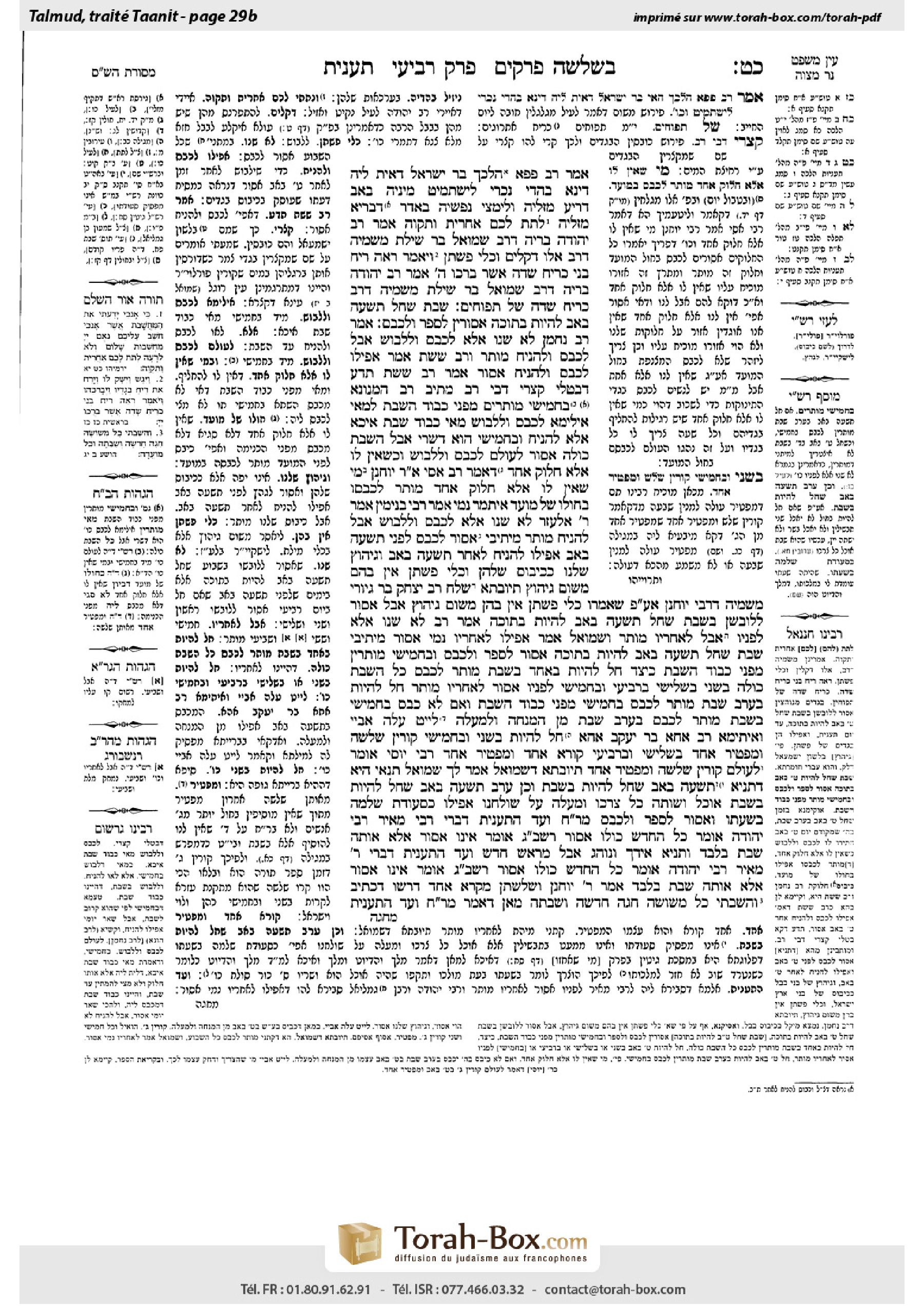
Taanit 29b: Talmud study for Daf Yomi
Daf Yomi is the daily study of one Talmud folio. Explore 37 tractates with scans, Hebrew text, Sefaria English and AI-generated French translations where annotated.
Passage selection and English or AI-generated French translation are available where the scan has annotations. Daf Study is independent of Torah-Box and Sefaria.
Browse Taanit · תענית · All tractatesTaanit 29b text and translations
This page of Taanit includes the Aramaic text, an English translation and an AI-generated French translation, alongside the scan above.
תענית כ״ט ב · Aramaic and Hebrew text
אָמַר רַב פָּפָּא: הִלְכָּךְ בַּר יִשְׂרָאֵל דְּאִית לֵיהּ דִּינָא בַּהֲדֵי נׇכְרִי, לִישְׁתְּמִיט מִינֵּיהּ בְּאָב — דְּרִיעַ מַזָּלֵיהּ, וְלַימְצֵי נַפְשֵׁיהּ בַּאֲדָר — דְּבָרִיא מַזָּלֵיהּ.
״לָתֵת לָכֶם אַחֲרִית וְתִקְוָה״, אָמַר רַב יְהוּדָה בְּרֵיהּ דְּרַב שְׁמוּאֵל בַּר שִׁילַת מִשְּׁמֵיהּ דְּרַב: אֵלּוּ דְּקָלִים וּכְלֵי פִשְׁתָּן. ״וַיֹּאמֶר רְאֵה רֵיחַ בְּנִי כְּרֵיחַ שָׂדֶה אֲשֶׁר בֵּרְכוֹ ה׳״, אָמַר רַב יְהוּדָה בְּרֵיהּ דְּרַב שְׁמוּאֵל בַּר שִׁילַת מִשְּׁמֵיהּ דְּרַב: כְּרֵיחַ שָׂדֶה שֶׁל תַּפּוּחִים.
שַׁבָּת שֶׁחָל תִּשְׁעָה בְּאָב לִהְיוֹת בְּתוֹכָהּ, אֲסוּרִין לְסַפֵּר וּלְכַבֵּס. אָמַר רַב נַחְמָן: לֹא שָׁנוּ אֶלָּא לְכַבֵּס וְלִלְבּוֹשׁ, אֲבָל לְכַבֵּס וּלְהַנִּיחַ — מוּתָּר. וְרַב שֵׁשֶׁת אָמַר: אֲפִילּוּ לְכַבֵּס וּלְהַנִּיחַ אָסוּר. אָמַר רַב שֵׁשֶׁת: תֵּדַע, דְּבָטְלִי קַצָּרֵי דְּבֵי רַב.
מֵתִיב רַב הַמְנוּנָא: בַּחֲמִישִׁי מוּתָּרִים, מִפְּנֵי כְּבוֹד הַשַּׁבָּת. לְמַאי? אִילֵימָא לְכַבֵּס וְלִלְבּוֹשׁ — מַאי כְּבוֹד שַׁבָּת אִיכָּא?
אֶלָּא לְהַנִּיחַ. וּבַחֲמִישִׁי הוּא דִּשְׁרֵי, אֲבָל הַשַּׁבָּת כּוּלָּהּ — אָסוּר! לְעוֹלָם לְכַבֵּס וְלִלְבּוֹשׁ, וּכְשֶׁאֵין לוֹ אֶלָּא חָלוּק אֶחָד. דְּאָמַר רַב אַסִּי אָמַר רַבִּי יוֹחָנָן: מִי שֶׁאֵין לוֹ אֶלָּא חָלוּק אֶחָד מוּתָּר לְכַבְּסוֹ בְּחוּלּוֹ שֶׁל מוֹעֵד. אִיתְּמַר נָמֵי, אָמַר רַבִּי בִּנְיָמִין אָמַר רַבִּי אֶלְעָזָר: לֹא שָׁנוּ אֶלָּא לְכַבֵּס וְלִלְבּוֹשׁ, אֲבָל לְהַנִּיחַ — מוּתָּר.
מֵיתִיבִי: אָסוּר לְכַבֵּס לִפְנֵי תִּשְׁעָה בְּאָב, אֲפִילּוּ לְהַנִּיחַ לְאַחַר תִּשְׁעָה בְּאָב. וְגִיהוּץ שֶׁלָּנוּ, כְּכִיבּוּס שֶׁלָּהֶן. וּכְלֵי פִשְׁתָּן אֵין בָּהֶם מִשּׁוּם גִּהוּץ. תְּיוּבְתָּא.
שְׁלַח רַב יִצְחָק בַּר גִּיּוֹרֵי מִשְּׁמֵיהּ דְּרַבִּי יוֹחָנָן: אַף עַל פִּי שֶׁאָמְרוּ כְּלֵי פִשְׁתָּן אֵין בָּהֶם מִשּׁוּם גִּהוּץ, אֲבָל אָסוּר לְלוֹבְשָׁן בְּשַׁבָּת שֶׁחָל תִּשְׁעָה בְּאָב לִהְיוֹת בְּתוֹכָהּ.
אָמַר רַב: לֹא שָׁנוּ אֶלָּא לְפָנָיו, אֲבָל לְאַחֲרָיו — מוּתָּר. וּשְׁמוּאֵל אָמַר: אֲפִילּוּ לְאַחֲרָיו נָמֵי אָסוּר. מֵיתִיבִי: שַׁבָּת שֶׁחָל תִּשְׁעָה בְּאָב לִהְיוֹת בְּתוֹכָהּ — אָסוּר לְסַפֵּר וּלְכַבֵּס, וּבַחֲמִישִׁי — מוּתָּרִין מִפְּנֵי כְּבוֹד הַשַּׁבָּת. כֵּיצַד? חָל לִהְיוֹת בְּאֶחָד בְּשַׁבָּת — מוּתָּר לְכַבֵּס כׇּל הַשַּׁבָּת כּוּלָּהּ.
בַּשֵּׁנִי בַּשְּׁלִישִׁי בָּרְבִיעִי וּבַחֲמִישִׁי, לְפָנָיו — אָסוּר, לְאַחֲרָיו — מוּתָּר. חָל לִהְיוֹת בְּעֶרֶב שַׁבָּת — מוּתָּר לְכַבֵּס בַּחֲמִישִׁי מִפְּנֵי כְּבוֹד הַשַּׁבָּת. וְאִם לֹא כִּבֵּס בַּחֲמִישִׁי בְּשַׁבָּת — מוּתָּר לְכַבֵּס בְּעֶרֶב שַׁבָּת מִן הַמִּנְחָה וּלְמַעְלָה. לָיֵיט עֲלַהּ אַבָּיֵי וְאִיתֵּימָא רַב אַחָא בַּר יַעֲקֹב, אַהָא.
חָל לִהְיוֹת בְּשֵׁנִי וּבַחֲמִישִׁי — קוֹרִין שְׁלֹשָׁה וּמַפְטִיר אֶחָד. בַּשְּׁלִישִׁי וּבָרְבִיעִי — קוֹרֵא אֶחָד וּמַפְטִיר אֶחָד. רַבִּי יוֹסֵי אוֹמֵר: לְעוֹלָם קוֹרִין שְׁלֹשָׁה וּמַפְטִיר אֶחָד. תְּיוּבְתָּא דִּשְׁמוּאֵל!
אָמַר לְךָ שְׁמוּאֵל: תַּנָּאֵי הִיא. דְּתַנְיָא: תִּשְׁעָה בְּאָב שֶׁחָל לִהְיוֹת בְּשַׁבָּת, וְכֵן עֶרֶב תִּשְׁעָה בְּאָב שֶׁחָל לִהְיוֹת בְּשַׁבָּת — אוֹכֵל וְשׁוֹתֶה כׇּל צָרְכּוֹ, וּמַעֲלֶה עַל שׁוּלְחָנוֹ אֲפִילּוּ כִּסְעוּדַת שְׁלֹמֹה בִּשְׁעָתוֹ. וְאָסוּר לְסַפֵּר וּלְכַבֵּס מֵרֹאשׁ חֹדֶשׁ וְעַד הַתַּעֲנִית, דִּבְרֵי רַבִּי מֵאִיר. רַבִּי יְהוּדָה אוֹמֵר: כׇּל הַחֹדֶשׁ כּוּלּוֹ אָסוּר. רַבָּן שִׁמְעוֹן בֶּן גַּמְלִיאֵל אוֹמֵר: אֵינוֹ אָסוּר אֶלָּא אוֹתָהּ שַׁבָּת בִּלְבָד.
וְתַנְיָא אִידַּךְ: וְנוֹהֵג אֵבֶל מֵרֹאשׁ חֹדֶשׁ וְעַד הַתַּעֲנִית, דִּבְרֵי רַבִּי מֵאִיר. רַבִּי יְהוּדָה אוֹמֵר: כׇּל הַחֹדֶשׁ כּוּלּוֹ אָסוּר, רַבָּן שִׁמְעוֹן בֶּן גַּמְלִיאֵל אוֹמֵר: אֵינוֹ אָסוּר אֶלָּא אוֹתָהּ שַׁבָּת בִּלְבָד.
אָמַר רַבִּי יוֹחָנָן: וּשְׁלׇשְׁתָּן מִקְרָא אֶחָד דָּרְשׁוּ, דִּכְתִיב: ״וְהִשְׁבַּתִּי כׇּל מְשׂוֹשָׂהּ חַגָּהּ חׇדְשָׁהּ וְשַׁבַּתָּהּ״. מַאן דְּאָמַר מֵרֹאשׁ חֹדֶשׁ וְעַד הַתַּעֲנִית —
Taanit 29b · English translation
Rav Pappa said: Therefore, in the case of a Jew who has litigation with a gentile, let him avoid him in the month of Av, when the Jews’ fortune is bad, and he should make himself available in Adar, when his fortune is good.
The Gemara mentions a couple of other statements in the name of the same Sages mentioned above. First, it cites a verse that is referring to the Babylonian exile. “To give to you a future and a hope” (Jeremiah 29:11). Rav Yehuda, son of Rav Shmuel bar Sheilat, said in the name of Rav: These are palm trees and garments of linen, which are long-lasting and bring benefit as long as they exist. With regard to Isaac’s comment about Jacob: “And he said: See, the smell of my son is as the smell of a field which the Lord has blessed” (Genesis 27:27), Rav Yehuda, son of Rav Shmuel bar Sheilat, said in the name of Rav: This smell was like that of a field of apple trees.
§ The mishna taught: During the week in which the Ninth of Av occurs, it is prohibited to cut one’s hair and to launder clothes. Rav Naḥman said: They taught that it is prohibited only to launder and to wear clean clothes before the Ninth of Av; however, if one wishes to launder garments and to set them aside, this is permitted. And Rav Sheshet said: Even to launder them and to set them aside is prohibited. Rav Sheshet said: Know that I am correct, as the launderers of Rav’s household were idle during this week, which shows that laundering in and of itself is prohibited.
Rav Hamnuna raised an objection against Rav Naḥman’s ruling from the mishna: On Thursday, these actions are permitted in deference to Shabbat. The Gemara clarifies: To which actions is this referring? If we say that it is permitted to launder and to wear clothing immediately, what deference to Shabbat is there in wearing a garment on Thursday?
Rather, it must mean that one can wash and set aside the garment until Shabbat, and this washing is permitted only on Thursday; however, during the rest of the entire week it is prohibited. The Gemara rejects this contention: Actually, the mishna permits one to launder and wear a garment immediately on Thursday, and this ruling is referring to one who has only one shirt [ḥaluk]. This laundering is also considered in deference to Shabbat because if one does not wash his shirt now, on Thursday, he will not have the opportunity to do so later, as the mishna is referring to a case when the Ninth of Av occurs on a Friday. As Rabbi Asi said that Rabbi Yoḥanan said: One who has only one shirt is permitted to launder it on the intermediate days of a Festival, when it is normally prohibited to do so. It was also stated that Rabbi Binyamin said that Rabbi Elazar said: They taught that it is prohibited only to launder and to wear immediately; however, if one launders to set it aside, this is permitted.
The Gemara raises an objection from a baraita: It is prohibited to launder before the Ninth of Av, even if one intends to set aside the clothes until after the Ninth of Av. And our fine laundering [gihutz] in Babylonia is like their plain laundering in Eretz Yisrael. But our plain washing in Babylonia is not considered laundering at all, and it is permitted. And with regard to linen garments, the process of fine laundry does not apply to them, as this category applies only to woolen garments. In any case, this baraita indicates that laundering clothes and setting them aside is prohibited, which means it is a conclusive refutation of the opinion of Rav Naḥman.
Rav Yitzḥak bar Giyorei sent in the name of Rabbi Yoḥanan: Although the Sages said that with regard to linen garments, the process of fine laundry does not apply to them; still, it is prohibited to wear them during the week in which the Ninth of Av occurs.
With regard to these restrictions and prohibitions, which apply during the week of the Ninth of Av, Rav said: They taught that these prohibitions apply only before the Ninth of Av, but after the fast laundering is permitted. And Shmuel said: Even after the Ninth of Av, laundering is also prohibited until the end of the week. The Gemara raises an objection: During the week in which the Ninth of Av occurs, it is prohibited to cut one’s hair and to launder clothes, but on Thursday these actions are permitted in deference to Shabbat. How so? If the Ninth of Av occurs on a Sunday, it is permitted to launder the entire preceding week.
If the Ninth of Av occurs on a Monday, Tuesday, Wednesday, or Thursday, on the days before the Ninth of Av, laundering is prohibited, but after the fast it is permitted. If the Ninth of Av occurs on a Friday, it is permitted to launder on Thursday in deference to Shabbat. And if, for whatever reason, one did not launder on the Thursday of that week, he is permitted to launder on Friday from minḥa time onward, despite the fact that it is the Ninth of Av. Abaye, and some say Rav Aḥa bar Ya’akov, cursed those who do this.
The Gemara resumes its citation of the baraita: If the Ninth of Av occurs on a Monday or on a Thursday, three people are called to read from the Torah, as on a regular week, and one of them recites the portion from the Prophets. If the Ninth of Av occurs on a Tuesday or on a Wednesday, one individual reads the Torah and the same one recites the portion from the Prophets. Rabbi Yosei says: Actually, three people are called to read, no matter what day of the week it is, and one of them recites the portion from the Prophets for the Ninth of Av. In any case, the baraita apparently presents a conclusive refutation of the opinion of Shmuel, as it clearly states that one is permitted to launder during the weekdays following the Ninth of Av.
Shmuel could have said to you: This is a dispute between tanna’im, as it is taught in a baraita: In the case of the Ninth of Av that occurs on Shabbat, and so too, on the eve of the Ninth of Av that occurs on Shabbat, one need not reduce the amount of food he eats; rather, he may eat and drink as much as he requires and put on his table a meal even like that of King Solomon in his time. And it is prohibited to cut one’s hair and to launder from the New Moon until after the fast. This is the statement of Rabbi Meir. Rabbi Yehuda says: These activities are prohibited throughout the entire month. Rabban Shimon ben Gamliel says: They are prohibited only during that week of the Ninth of Av.
And it is taught in another baraita: And one must observe the rites of mourning from the New Moon until after the fast; this is the statement of Rabbi Meir. Rabbi Yehuda says: These activities are prohibited throughout the entire month. Rabban Shimon ben Gamliel says: They are prohibited only during that week. These baraitot show that there are at least two tanna’im, Rabbi Yehuda and Rabban Shimon ben Gamliel, who prohibit certain activities even after the fast, like Shmuel.
Rabbi Yoḥanan said: And all three of these tanna’im derived their opinions from one verse, from which they drew different conclusions, as it is written: “And I will cause all her mirth to cease, her Festival, her New Moon, and her Shabbat” (Hosea 2:13). The one who said that these activities are prohibited from the New Moon until after the fast, Rabbi Meir,
Taanit 29b · Traduction française (IA)
Rav Pappa dit : Par conséquent, si un Juif a un litige avec un non-Juif, qu’il l’évite pendant le mois d’Av, lorsque la fortune des Juifs est mauvaise, et qu’il se rende disponible en Adar, lorsque leur fortune est bonne.
La Guemara mentionne quelques autres déclarations au nom des mêmes Sages que ceux cités précédemment. Elle cite d’abord un verset qui fait référence à l’exil de Babylone : « Pour vous donner un avenir et une espérance » (Jérémie 29,11). Rav Yehouda, fils de Rav Shmuel bar Sheilat, dit au nom de Rav : Il s’agit des palmiers et des vêtements de lin, qui durent longtemps et procurent un bienfait aussi longtemps qu’ils existent. À propos de la remarque d’Isaac au sujet de Jacob : « Il dit : Vois, l’odeur de mon fils est comme l’odeur d’un champ que l’Éternel a béni » (Genèse 27,27), Rav Yehouda, fils de Rav Shmuel bar Sheilat, dit au nom de Rav : Cette odeur était celle d’un champ de pommiers.
§ La Michna a enseigné : Durant la semaine où tombe le Neuf Av, il est interdit de se couper les cheveux et de laver ses vêtements. Rav Naḥman dit : Ils ont enseigné que l’interdiction concerne uniquement le fait de laver des vêtements et d’en porter de propres avant le Neuf Av ; toutefois, si l’on souhaite laver des vêtements et les mettre de côté, cela est permis. Rav Sheshet dit : Même les laver et les mettre de côté est interdit. Rav Sheshet dit : Sachez que j’ai raison, car les blanchisseurs de la maison de Rav étaient inactifs durant cette semaine, ce qui montre que le lavage est interdit en soi.
Rav Hamnouna objecta à la décision de Rav Naḥman en citant la Michna : Le jeudi, ces actes sont permis en l’honneur du Chabbat. La Guemara précise : À quels actes cela fait-il référence ? Si l’on dit qu’il est permis de laver un vêtement et de le porter immédiatement, en quoi le fait de le porter le jeudi honore-t-il le Chabbat ?
Il faut plutôt comprendre qu’on peut laver le vêtement et le mettre de côté jusqu’au Chabbat, et que ce lavage n’est permis que le jeudi ; toutefois, il est interdit durant tout le reste de la semaine. La Guemara rejette cette explication : En réalité, la Michna permet de laver un vêtement et de le porter immédiatement le jeudi, et cette décision concerne celui qui ne possède qu’une seule chemise [ḥaluk]. Ce lavage est également considéré comme accompli en l’honneur du Chabbat, car s’il ne lave pas sa chemise maintenant, le jeudi, il n’aura pas l’occasion de le faire plus tard, puisque la Michna parle d’un cas où le Neuf Av tombe un vendredi. Car Rabbi Assi a dit que Rabbi Yoḥanan a dit : Celui qui ne possède qu’une seule chemise est autorisé à la laver pendant les jours intermédiaires d’une fête, alors que cela est normalement interdit. Il a également été enseigné que Rabbi Binyamin a dit que Rabbi Elazar a dit : Ils ont enseigné que l’interdiction concerne uniquement le fait de laver et de porter immédiatement ; toutefois, si l’on lave un vêtement pour le mettre de côté, cela est permis.
La Guemara soulève une objection à partir d’une baraïta : Il est interdit de laver avant le Neuf Av, même si l’on a l’intention de mettre les vêtements de côté jusqu’après le Neuf Av. Et notre blanchissage raffiné [gihutz] en Babylonie équivaut à leur blanchissage ordinaire en Terre d’Israël. En revanche, notre lavage ordinaire en Babylonie n’est pas du tout considéré comme du blanchissage et est permis. Quant aux vêtements de lin, le procédé de blanchissage raffiné ne s’applique pas à eux, car cette catégorie ne concerne que les vêtements de laine. Quoi qu’il en soit, cette baraïta indique qu’il est interdit de laver des vêtements et de les mettre de côté, ce qui constitue une réfutation décisive de l’opinion de Rav Naḥman.
Rav Yitzḥak bar Giyorei transmit au nom de Rabbi Yoḥanan : Bien que les Sages aient dit que le procédé de blanchissage raffiné ne s’applique pas aux vêtements de lin, il est néanmoins interdit de les porter durant la semaine où tombe le Neuf Av.
Au sujet de ces restrictions et interdictions qui s’appliquent durant la semaine du Neuf Av, Rav dit : Ils ont enseigné que ces interdictions ne s’appliquent qu’avant le Neuf Av, mais qu’après le jeûne, le lavage est permis. Shmuel dit : Même après le Neuf Av, le lavage reste interdit jusqu’à la fin de la semaine. La Guemara soulève une objection : Durant la semaine où tombe le Neuf Av, il est interdit de se couper les cheveux et de laver ses vêtements, mais le jeudi, ces actes sont permis en l’honneur du Chabbat. Comment faut-il comprendre cela ? Si le Neuf Av tombe un dimanche, il est permis de laver toute la semaine précédente.
Si le Neuf Av tombe un lundi, un mardi, un mercredi ou un jeudi, le lavage est interdit les jours qui précèdent le Neuf Av, mais il est permis après le jeûne. Si le Neuf Av tombe un vendredi, il est permis de laver le jeudi en l’honneur du Chabbat. Et si, pour une raison quelconque, on n’a pas lavé le jeudi de cette semaine, il est permis de laver le vendredi à partir de l’heure de minḥa, bien que ce soit le Neuf Av. Abaye — et certains disent Rav Aḥa bar Ya’akov — maudit ceux qui agissent ainsi.
La Guemara reprend sa citation de la baraïta : Si le Neuf Av tombe un lundi ou un jeudi, trois personnes sont appelées à lire la Torah, comme durant une semaine ordinaire, et l’une d’elles lit le passage des Prophètes. Si le Neuf Av tombe un mardi ou un mercredi, une seule personne lit la Torah et cette même personne lit le passage des Prophètes. Rabbi Yosei dit : En réalité, trois personnes sont appelées à lire, quel que soit le jour de la semaine, et l’une d’elles lit le passage des Prophètes pour le Neuf Av. Quoi qu’il en soit, la baraïta semble constituer une réfutation décisive de l’opinion de Shmuel, car elle affirme clairement qu’il est permis de laver durant les jours de la semaine qui suivent le Neuf Av.
Shmuel aurait pu te répondre : Il s’agit d’un désaccord entre tannaïm, comme il est enseigné dans une baraïta : Lorsque le Neuf Av tombe un Chabbat — et de même la veille du Neuf Av lorsqu’il tombe un Chabbat — il n’est pas nécessaire de réduire la quantité de nourriture que l’on mange ; on peut plutôt manger et boire autant qu’on le souhaite et servir à sa table un repas semblable à celui du roi Salomon en son temps. Il est interdit de se couper les cheveux et de laver ses vêtements depuis la nouvelle lune jusqu’après le jeûne. Telle est la déclaration de Rabbi Meir. Rabbi Yehouda dit : Ces activités sont interdites durant tout le mois. Rabban Shimon ben Gamliel dit : Elles ne sont interdites que pendant cette semaine du Neuf Av.
Et il est enseigné dans une autre baraïta : On doit observer les rites de deuil depuis la nouvelle lune jusqu’après le jeûne ; telle est la déclaration de Rabbi Meir. Rabbi Yehouda dit : Ces activités sont interdites durant tout le mois. Rabban Shimon ben Gamliel dit : Elles ne sont interdites que pendant cette semaine. Ces baraïtot montrent qu’il y a au moins deux tannaïm, Rabbi Yehouda et Rabban Shimon ben Gamliel, qui interdisent certaines activités même après le jeûne, comme le fait Shmuel.
Rabbi Yoḥanan dit : Ces trois tannaïm ont tous tiré leurs opinions d’un même verset, dont ils ont déduit des conclusions différentes, comme il est écrit : « Je ferai cesser toute sa joie, sa fête, sa nouvelle lune et son Chabbat » (Osée 2,13). Celui qui dit que ces activités sont interdites depuis la nouvelle lune jusqu’après le jeûne, Rabbi Meir,
Traduction française générée par IA à partir de l’édition anglaise de Sefaria. Vérifie toujours un passage avec le texte source.
Text from Sefaria: William Davidson Edition - Vocalized Aramaic (CC BY NC); William Davidson Edition - English (CC BY NC).