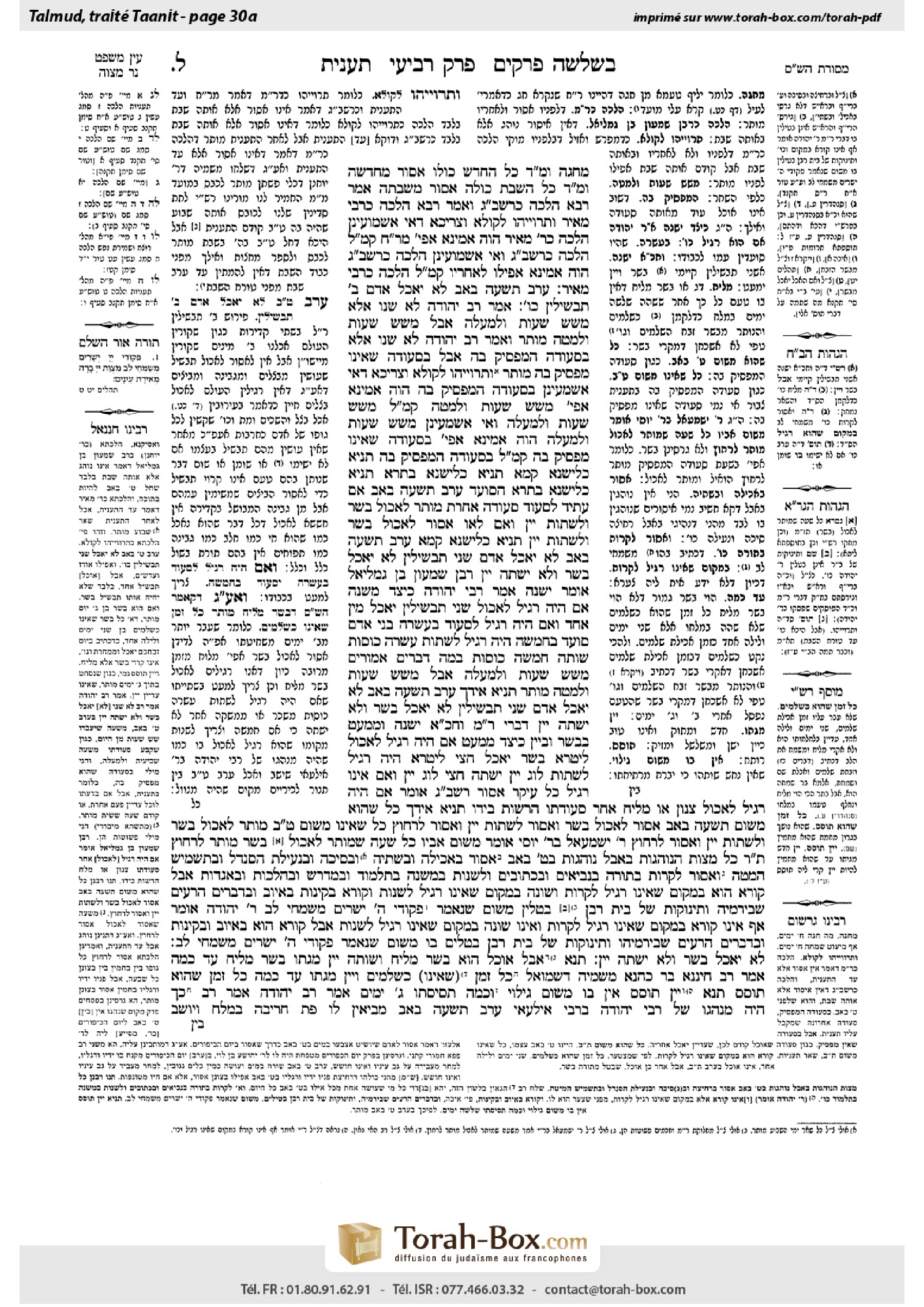
Taanit 30a: Talmud study for Daf Yomi
Daf Yomi is the daily study of one Talmud folio. Explore 37 tractates with scans, Hebrew text, Sefaria English and AI-generated French translations where annotated.
Passage selection and English or AI-generated French translation are available where the scan has annotations. Daf Study is independent of Torah-Box and Sefaria.
Browse Taanit · תענית · All tractatesTaanit 30a text and translations
This page of Taanit includes the Aramaic text, an English translation and an AI-generated French translation, alongside the scan above.
תענית ל׳ א · Aramaic and Hebrew text
מֵ״חַגָּה״. וּמַאן דְּאָמַר כּוּלּוֹ אָסוּר — מֵ״חׇדְשָׁהּ״, וּמַאן דְּאָמַר כׇּל הַשַּׁבָּת כּוּלָּהּ אָסוּר — מִ״שַּׁבַּתָּהּ״.
אָמַר רָבָא: הֲלָכָה כְּרַבָּן שִׁמְעוֹן בֶּן גַּמְלִיאֵל. וְאָמַר רָבָא: הֲלָכָה כְּרַבִּי מֵאִיר. וְתַרְוַיְיהוּ לְקוּלָּא, וּצְרִיכָא. דְּאִי אַשְׁמוֹעִינַן הֲלָכָה כְּרַבִּי מֵאִיר, הֲוָה אָמֵינָא: אֲפִילּוּ מֵרֹאשׁ חֹדֶשׁ, קָמַשְׁמַע לַן הֲלָכָה כְּרַבָּן שִׁמְעוֹן בֶּן גַּמְלִיאֵל.
וְאִי אַשְׁמוֹעִינַן הֲלָכָה כְּרַבָּן שִׁמְעוֹן בֶּן גַּמְלִיאֵל, הֲוָה אָמֵינָא: אֲפִילּוּ לְאַחֲרָיו, קָמַשְׁמַע לַן הֲלָכָה כְּרַבִּי מֵאִיר.
עֶרֶב תִּשְׁעָה בְּאָב לֹא יֹאכַל אָדָם שְׁנֵי תַבְשִׁילִין כּוּ׳. אָמַר רַב יְהוּדָה: לֹא שָׁנוּ אֶלָּא מִשֵּׁשׁ שָׁעוֹת וּלְמַעְלָה, אֲבָל מִשֵּׁשׁ שָׁעוֹת וּלְמַטָּה — מוּתָּר. וְאָמַר רַב יְהוּדָה: לֹא שָׁנוּ אֶלָּא בִּסְעוּדָה הַמַּפְסִיק בָּהּ, אֲבָל בִּסְעוּדָה שֶׁאֵינוֹ מַפְסִיק בָּהּ — מוּתָּר.
וְתַרְוַיְיהוּ לְקוּלָּא, וּצְרִיכָא. דְּאִי אַשְׁמְעִינַן בִּסְעוּדָה הַמַּפְסִיק בָּהּ, הֲוָה אָמֵינָא: אֲפִילּוּ מִשֵּׁשׁ שָׁעוֹת וּלְמַטָּה — קָמַשְׁמַע לַן מִשֵּׁשׁ שָׁעוֹת וּלְמַעְלָה. וְאִי אַשְׁמְעִינַן מִשֵּׁשׁ שָׁעוֹת וּלְמַעְלָה, הֲוָה אָמֵינָא: אֲפִילּוּ בִּסְעוּדָה שֶׁאֵינוֹ מַפְסִיק בָּהּ — קָמַשְׁמַע לַן בִּסְעוּדָה הַמַּפְסִיק בָּהּ.
תַּנְיָא כְּלִישָּׁנָא קַמָּא. תַּנְיָא כְּלִישָּׁנָא בָּתְרָא. תַּנְיָא כְּלִישָּׁנָא בָּתְרָא: הַסּוֹעֵד עֶרֶב תִּשְׁעָה בְּאָב, אִם עָתִיד לִסְעוֹד סְעוּדָה אַחֶרֶת — מוּתָּר לֶאֱכוֹל בָּשָׂר וְלִשְׁתּוֹת יַיִן, וְאִם לָאו — אָסוּר לֶאֱכוֹל בָּשָׂר וְלִשְׁתּוֹת יַיִן.
תַּנְיָא כְּלִישָּׁנָא קַמָּא: עֶרֶב תִּשְׁעָה בְּאָב לֹא יֹאכַל אָדָם שְׁנֵי תַבְשִׁילִין, לֹא יֹאכַל בָּשָׂר וְלֹא יִשְׁתֶּה יַיִן. רַבָּן שִׁמְעוֹן בֶּן גַּמְלִיאֵל אוֹמֵר: יְשַׁנֶּה. אָמַר רַבִּי יְהוּדָה: כֵּיצַד מְשַׁנֶּה? אִם הָיָה רָגִיל לֶאֱכוֹל שְׁנֵי תַבְשִׁילִין — יֹאכַל מִין אֶחָד, וְאִם הָיָה רָגִיל לִסְעוֹד בַּעֲשָׂרָה בְּנֵי אָדָם — סוֹעֵד בַּחֲמִשָּׁה, הָיָה רָגִיל לִשְׁתּוֹת עֲשָׂרָה כּוֹסוֹת — שׁוֹתֶה חֲמִשָּׁה כּוֹסוֹת. בַּמֶּה דְּבָרִים אֲמוּרִים מִשֵּׁשׁ שָׁעוֹת וּלְמַעְלָה, אֲבָל מִשֵּׁשׁ שָׁעוֹת וּלְמַטָּה — מוּתָּר.
תַּנְיָא אִידַּךְ: עֶרֶב תִּשְׁעָה בְּאָב לֹא יֹאכַל אָדָם שְׁנֵי תַבְשִׁילִין, לֹא יֹאכַל בָּשָׂר וְלֹא יִשְׁתֶּה יַיִן, דִּבְרֵי רַבִּי מֵאִיר. וַחֲכָמִים אוֹמְרִים: יְשַׁנֶּה. וּמְמַעֵט בַּבָּשָׂר וּבַיַּיִן. כֵּיצַד מְמַעֵט? אִם הָיָה רָגִיל לֶאֱכוֹל לִיטְרָא בָּשָׂר — יֹאכַל חֲצִי לִיטְרָא, הָיָה רָגִיל לִשְׁתּוֹת לוֹג יַיִן — יִשְׁתֶּה חֲצִי לוֹג יַיִן, וְאִם אֵינוֹ רָגִיל כׇּל עִיקָּר — אָסוּר. רַבָּן שִׁמְעוֹן בֶּן גַּמְלִיאֵל אוֹמֵר: אִם הָיָה רָגִיל לֶאֱכוֹל צְנוֹן אוֹ מָלִיחַ אַחַר סְעוּדָּתוֹ — הָרְשׁוּת בְּיָדוֹ.
תַּנְיָא אִידַּךְ: כֹּל שֶׁהוּא מִשּׁוּם תִּשְׁעָה בְּאָב — אָסוּר לֶאֱכוֹל בָּשָׂר וְאָסוּר לִשְׁתּוֹת יַיִן וְאָסוּר לִרְחוֹץ. כׇּל שֶׁאֵינוֹ מִשּׁוּם תִּשְׁעָה בְּאָב — מוּתָּר לֶאֱכוֹל בָּשָׂר וְלִשְׁתּוֹת יַיִן וְאָסוּר לִרְחוֹץ. רַבִּי יִשְׁמָעֵאל בְּרַבִּי יוֹסֵי אוֹמֵר מִשּׁוּם אָבִיו: כׇּל שָׁעָה שֶׁמּוּתָּר לֶאֱכוֹל בָּשָׂר — מוּתָּר לִרְחוֹץ.
תָּנוּ רַבָּנַן: כׇּל מִצְוֹת הַנּוֹהֲגוֹת בְּאָבֵל — נוֹהֲגוֹת בְּתִשְׁעָה בְּאָב; אָסוּר בַּאֲכִילָה וּבִשְׁתִיָּה, וּבְסִיכָה, וּבִנְעִילַת הַסַּנְדָּל, וּבְתַשְׁמִישׁ הַמִּטָּה. וְאָסוּר לִקְרוֹת בַּתּוֹרָה בַּנְּבִיאִים וּבַכְּתוּבִים, וְלִשְׁנוֹת בַּמִּשְׁנָה בַּתַּלְמוּד וּבַמִּדְרָשׁ וּבָהֲלָכוֹת וּבָאַגָּדוֹת.
אֲבָל קוֹרֵא הוּא בִּמְקוֹם שֶׁאֵינוֹ רָגִיל לִקְרוֹת, וְשׁוֹנֶה בִּמְקוֹם שֶׁאֵינוֹ רָגִיל לִשְׁנוֹת, וְקוֹרֵא בְּקִינוֹת בְּאִיּוֹב, וּבִדְבָרִים הָרָעִים שֶׁבְּיִרְמְיָה. וְתִינוֹקוֹת שֶׁל בֵּית רַבָּן בְּטֵלִין, מִשּׁוּם שֶׁנֶּאֱמַר: ״פִּקּוּדֵי ה׳ יְשָׁרִים מְשַׂמְּחֵי לֵב״.
רַבִּי יְהוּדָה אוֹמֵר: אַף אֵינוֹ קוֹרֵא בִּמְקוֹם שֶׁאֵינוֹ רָגִיל לִקְרוֹת, וְאֵינוֹ שׁוֹנֶה בִּמְקוֹם שֶׁאֵינוֹ רָגִיל לִשְׁנוֹת. אֲבָל קוֹרֵא הוּא בְּאִיּוֹב וּבְקִינוֹת וּבִדְבָרִים הָרָעִים שֶׁבְּיִרְמְיָהוּ. וְתִינוֹקוֹת שֶׁל בֵּית רַבָּן בְּטֵלִים בּוֹ, מִשּׁוּם שֶׁנֶּאֱמַר: ״פִּקּוּדֵי ה׳ יְשָׁרִים מְשַׂמְּחֵי לֵב״.
לֹא יֹאכַל בָּשָׂר וְלֹא יִשְׁתֶּה יַיִן. תָּנָא: אֲבָל אוֹכֵל הוּא בָּשָׂר מָלִיחַ וְשׁוֹתֶה יַיִן מִגִּתּוֹ. בָּשָׂר מָלִיחַ עַד כַּמָּה? אָמַר רַב חִינָּנָא בַּר כָּהֲנָא מִשְּׁמֵיהּ דִּשְׁמוּאֵל: כׇּל זְמַן שֶׁהוּא כִּשְׁלָמִים.
וְיַיִן מִגִּתּוֹ עַד כַּמָּה? כׇּל זְמַן שֶׁהוּא תּוֹסֵס. תָּנָא: יַיִן תּוֹסֵס אֵין בּוֹ מִשּׁוּם גִּילּוּי, וְכַמָּה תְּסִיסָתוֹ — שְׁלֹשָׁה יָמִים.
אָמַר רַב יְהוּדָה אָמַר רַב: כָּךְ הָיָה מִנְהָגוֹ שֶׁל רַבִּי יְהוּדָה בְּרַבִּי אִילְעַאי: עֶרֶב תִּשְׁעָה בְּאָב מְבִיאִין לוֹ פַּת חֲרֵבָה בְּמֶלַח, וְיוֹשֵׁב
Taanit 30a · English translation
derives from the phrase “her Festival” that acts of mirth and rejoicing are prohibited from the New Moon, which is considered like a Festival. And the one who said that these activities are prohibited during the entire month learns this from the phrase “her New Moon.” And the one who said that acts of rejoicing are prohibited during the entire week of the Ninth of Av, derives this from the phrase “her Shabbat,” which also means a week.
With regard to the halakha itself, Rava said: The halakha is in accordance with the opinion of Rabban Shimon ben Gamliel. And Rava also said that the halakha is in accordance with the opinion of Rabbi Meir. The Gemara remarks: And both of these rulings are intended as a leniency. And it is necessary for Rava to state both rulings, for had he taught us only that the halakha is in accordance with the opinion of Rabbi Meir, I would have said that the mourning practices are obligatory even from the New Moon, as maintained by Rabbi Meir. Therefore, Rava teaches us that the halakha is in accordance with the opinion of Rabban Shimon ben Gamliel, that the restrictions of mourning do not apply until the week of the Ninth of Av.
And had he taught us only that the halakha is in accordance with the opinion of Rabban Shimon ben Gamliel, I would have said that the prohibitions apply even after the fast, until the end of the week. Consequently, Rava teaches us that the halakha is in accordance with the opinion of Rabbi Meir. The prohibitions apply only until the Ninth of Av itself, not afterward.
§ The mishna taught: On the eve of the Ninth of Av, a person may not eat two cooked dishes in one meal. Rav Yehuda said: They taught that one may not partake of a meal with two dishes only from six hours of the day and onward, but from six hours and earlier it is permitted. And Rav Yehuda also said: They taught that it is prohibited to eat two dishes only in the concluding meal before beginning the fast. However, in a non-concluding meal it is permitted to eat two cooked dishes.
The Gemara comments: And both of these rulings are intended as a leniency. And it is necessary for Rav Yehuda to state them both, for had he taught us that this halakha is referring only to the concluding meal, I would have said that this applies even from six hours and earlier. Rav Yehuda therefore teaches us that it applies only from six hours and onward. And had he taught us only that it is prohibited to eat two dishes from six hours and onward, I would have said that this applies even to a meal by which he does not stop eating. Rav Yehuda therefore teaches us that it applies only to the concluding meal.
The Gemara comments: It is taught in a baraita in accordance with the first version, and it is taught in a baraita in accordance with the second version. The Gemara elaborates: It is taught in a baraita in accordance with the second version, as follows: With regard to one who dines on the eve of the Ninth of Av, if he will eat another meal, he is permitted to eat meat and to drink wine during this first meal. But if he does not intend to eat another meal, he is prohibited to eat meat and to drink wine.
It is taught in a baraita in accordance with the first version: On the eve of the Ninth of Av, a person may not eat two cooked dishes. Furthermore, one may neither eat meat nor drink wine. Rabban Shimon ben Gamliel says: One must adjust and decrease the amount he eats. Rabbi Yehuda said: How should one adjust his meal? If he is accustomed to eat two cooked dishes at each meal, he should eat only one type of food; and if he is accustomed to dine in the company of ten people, he should dine with only five; and if he is accustomed to drinking ten cups of wine, he should drink only five cups. In what case is this statement said? From six hours and onward; however, from six hours and earlier all these practices are permitted.
It is taught in another baraita: On the eve of the Ninth of Av, a person may not eat two cooked dishes, and he may neither eat meat nor drink wine; this is the statement of Rabbi Meir. And the Rabbis say: One must adjust and reduce his consumption of meat and wine. How does one reduce his meat and wine? If he is accustomed to eating a liter of meat in his meal, he should eat half a liter; if he is accustomed to drinking a log of wine, he should drink half a log of wine; and if he is not accustomed to eating meat or drinking wine at all, it is prohibited for him to do so at all. Rabban Shimon ben Gamliel says: If he is accustomed to eating a radish or a salted dish after his meal, he has permission to do so on the eve of the Ninth of Av, as they are not considered an additional dish.
It is taught in another baraita: In any meal that is eaten due to the fast of the Ninth of Av, it is prohibited to eat meat; and it is prohibited to drink wine; and it is likewise prohibited to bathe in anticipation of the fast. However, in any meal that is not due to the Ninth of Av, i.e., one is eating the meal in order that he shouldn’t be hungry on the Ninth of Av, it is permitted to eat meat and to drink wine, but it is nevertheless prohibited to bathe at that time. Rabbi Yishmael, son of Rabbi Yosei, said in the name of his father: For the entire time that one is permitted to eat meat, he is likewise permitted to bathe.
The Sages taught: All mitzvot practiced by a mourner are likewise practiced on the Ninth of Av: It is prohibited to engage in eating, and in drinking, and in smearing oil on one’s body, and in wearing shoes, and in conjugal relations. It is prohibited to read from the Torah, from the Prophets, and from the Writings, or to study from the Mishna, from the Gemara, and from midrash, and from collections of halakhot, and from collections of aggadot.
However, one may read from a place in the Bible that he is unaccustomed to reading, as it will be difficult for him and he will not derive pleasure from it, and he may likewise study from a place of the Talmud that he is unaccustomed to studying. And one may read from the book of Lamentations; from the book of Job; and from the evil matters in Jeremiah, i.e., his prophecies of doom. And schoolchildren interrupt their studies for the day because it is stated: “The precepts of the Lord are right, rejoicing the heart” (Psalms 19:9).
Rabbi Yehuda says: One may not even read from a place in the Bible that he is unaccustomed to reading, nor may one study from a place of the Talmud that he is unaccustomed to studying. However, one may read from Job, and from Lamentations, and from the evil matters of Jeremiah. And schoolchildren interrupt their studies on that day because it is stated: “The precepts of the Lord are right, rejoicing the heart” (Psalms 19:9).
§ The mishna taught that one may neither eat meat nor drink wine. A tanna taught in the Tosefta: However, one may eat heavily salted meat and drink wine from his press, i.e., wine that has not finished fermenting. The Gemara inquires: With regard to salted meat, how long must this meat remain in salt before it is permitted? Rav Ḥinnana bar Kahana said in the name of Shmuel: As long as it is like peace-offerings, which could be eaten for two days and one night after they were sacrificed. After this time has passed, it is no longer called meat. Therefore, if it was salted for longer than this, it may be eaten on the eve of the Ninth of Av.
The Gemara asks: And with regard to wine from his press, until when is wine considered from his press? As long as it is fermenting. A tanna taught in a baraita: Wine that is fermenting does not have a problem with regard to exposed liquids, as there is no concern that a snake will leave its venom in that wine. And how long is its fermenting period? Three days from the time the grapes were pressed.
Rav Yehuda said that Rav said: This was the custom of Rabbi Yehuda, son of Rabbi Ilai. On the eve of the Ninth of Av, near the evening, they would bring him stale bread with salt, and he would sit
Taanit 30a · Traduction française (IA)
déduit de l’expression « sa fête » que les marques de gaieté et de réjouissance sont interdites dès la nouvelle lune, considérée comme une fête. Celui qui affirme que ces pratiques sont interdites pendant tout le mois le déduit de l’expression « sa nouvelle lune ». Et celui qui affirme que les réjouissances sont interdites pendant toute la semaine du Neuf Av le déduit de l’expression « son Chabbat », qui désigne également une semaine.
Concernant la halakha elle-même, Rava a dit : La halakha est conforme à l’opinion de Rabban Chimon ben Gamliel. Rava a également dit que la halakha est conforme à l’opinion de Rabbi Meïr. La Guemara fait remarquer que ces deux décisions visent à alléger la règle. Rava devait énoncer les deux décisions, car s’il nous avait enseigné seulement que la halakha est conforme à l’opinion de Rabbi Meïr, j’aurais dit que les pratiques de deuil sont obligatoires dès la nouvelle lune, comme le soutient Rabbi Meïr. Rava nous enseigne donc que la halakha est conforme à l’opinion de Rabban Chimon ben Gamliel : les restrictions du deuil ne s’appliquent qu’à partir de la semaine du Neuf Av.
Et s’il nous avait enseigné seulement que la halakha est conforme à l’opinion de Rabban Chimon ben Gamliel, j’aurais dit que les interdits s’appliquent même après le jeûne, jusqu’à la fin de la semaine. Rava nous enseigne donc que la halakha est conforme à l’opinion de Rabbi Meïr : les interdits ne s’appliquent que jusqu’au Neuf Av lui-même, et non au-delà.
§ La Michna enseigne : La veille du Neuf Av, on ne peut pas manger deux plats cuits au cours d’un même repas. Rav Yehouda a dit : Ils ont enseigné qu’il est interdit de prendre un repas composé de deux plats seulement à partir de la sixième heure du jour ; avant cela, c’est permis. Rav Yehouda a également dit : Ils ont enseigné qu’il est interdit de manger deux plats seulement lors du repas précédant immédiatement le jeûne. En revanche, lors d’un repas qui n’est pas le dernier, il est permis de manger deux plats cuits.
La Guemara fait remarquer que ces deux décisions visent à alléger la règle. Rav Yehouda devait les énoncer toutes les deux, car s’il nous avait enseigné que cette halakha ne concerne que le repas précédant immédiatement le jeûne, j’aurais dit qu’elle s’applique même avant la sixième heure. Rav Yehouda nous enseigne donc qu’elle ne s’applique qu’à partir de la sixième heure. Et s’il nous avait enseigné seulement qu’il est interdit de manger deux plats à partir de la sixième heure, j’aurais dit que cela s’applique même à un repas après lequel on ne cesse pas de manger. Rav Yehouda nous enseigne donc que cela ne s’applique qu’au repas précédant immédiatement le jeûne.
La Guemara fait remarquer : une baraïta est enseignée conformément à la première version, et une baraïta est enseignée conformément à la seconde version. La Guemara précise : une baraïta est enseignée conformément à la seconde version, comme suit : Celui qui prend un repas la veille du Neuf Av, s’il doit manger un autre repas, peut manger de la viande et boire du vin lors de ce premier repas. Mais s’il n’a pas l’intention de manger un autre repas, il lui est interdit de manger de la viande et de boire du vin.
Une baraïta est enseignée conformément à la première version : La veille du Neuf Av, on ne peut pas manger deux plats cuits. De plus, on ne peut ni manger de viande ni boire de vin. Rabban Chimon ben Gamliel dit : Il faut modérer et réduire ce que l’on mange. Rabbi Yehouda a dit : Comment doit-on modérer son repas ? S’il a l’habitude de manger deux plats cuits à chaque repas, il ne doit manger qu’un seul type d’aliment ; s’il a l’habitude de prendre son repas en compagnie de dix personnes, il ne doit le prendre qu’avec cinq personnes ; et s’il a l’habitude de boire dix coupes de vin, il ne doit en boire que cinq. Dans quel cas cette déclaration s’applique-t-elle ? À partir de la sixième heure ; avant la sixième heure, toutes ces pratiques sont permises.
Une autre baraïta est enseignée : La veille du Neuf Av, on ne peut pas manger deux plats cuits, ni manger de viande ni boire de vin ; telle est la déclaration de Rabbi Meïr. Les Sages disent : Il faut modérer et réduire sa consommation de viande et de vin. Comment réduire sa consommation de viande et de vin ? S’il a l’habitude de manger une livre de viande à son repas, il doit en manger une demi-livre ; s’il a l’habitude de boire un log de vin, il doit en boire un demi-log ; et s’il n’a pas du tout l’habitude de manger de viande ou de boire du vin, il lui est tout à fait interdit de le faire. Rabban Chimon ben Gamliel dit : S’il a l’habitude de manger un radis ou un plat salé après son repas, il est autorisé à le faire la veille du Neuf Av, car ces aliments ne sont pas considérés comme un plat supplémentaire.
Une autre baraïta est enseignée : Lors de tout repas pris en raison du jeûne du Neuf Av, il est interdit de manger de la viande, de boire du vin et également de se baigner en prévision du jeûne. En revanche, lors d’un repas qui n’est pas pris en raison du Neuf Av, c’est-à-dire un repas que l’on prend afin de ne pas avoir faim le Neuf Av, il est permis de manger de la viande et de boire du vin, mais il est néanmoins interdit de se baigner à ce moment-là. Rabbi Yichmaël, fils de Rabbi Yossi, a dit au nom de son père : Tant qu’il est permis de manger de la viande, il est également permis de se baigner.
Les Sages ont enseigné : Toutes les mitsvot observées par une personne en deuil s’appliquent également le Neuf Av. Il est interdit de manger, de boire, de s’enduire le corps d’huile, de porter des chaussures et d’avoir des relations conjugales. Il est interdit de lire la Torah, les Prophètes et les Écrits, ou d’étudier la Michna, la Guemara, le midrach, les recueils de halakhot et les recueils d’aggadot.
Toutefois, on peut lire un passage de la Bible qu’on n’a pas l’habitude de lire, car cela lui sera difficile et ne lui procurera pas de plaisir ; de même, il peut étudier un passage du Talmud qu’il n’a pas l’habitude d’étudier. On peut lire le livre des Lamentations, le livre de Job et les passages de Jérémie qui annoncent le malheur, c’est-à-dire ses prophéties de malheur. Les écoliers interrompent leurs études pour la journée, car il est dit : « Les préceptes de l’Éternel sont droits, ils réjouissent le cœur » (Psaumes 19:9).
Rabbi Yehouda dit : On ne peut même pas lire un passage de la Bible qu’on n’a pas l’habitude de lire, ni étudier un passage du Talmud qu’on n’a pas l’habitude d’étudier. Toutefois, on peut lire le livre de Job, le livre des Lamentations et les passages de Jérémie qui annoncent le malheur. Les écoliers interrompent leurs études ce jour-là, car il est dit : « Les préceptes de l’Éternel sont droits, ils réjouissent le cœur » (Psaumes 19:9).
§ La Michna enseigne qu’on ne peut ni manger de viande ni boire de vin. Un tanna a enseigné dans la Tossefta : Toutefois, on peut manger de la viande fortement salée et boire du vin de son pressoir, c’est-à-dire du vin dont la fermentation n’est pas achevée. La Guemara demande : Combien de temps la viande doit-elle rester dans le sel avant qu’il soit permis de la manger ? Rav Ḥinnana bar Kahana a dit au nom de Chmouel : Aussi longtemps que la durée pendant laquelle les sacrifices de paix pouvaient être consommés, soit deux jours et une nuit après leur sacrifice. Une fois ce délai écoulé, on ne l’appelle plus de la viande. Par conséquent, si elle a été salée plus longtemps, on peut la manger la veille du Neuf Av.
La Guemara demande : Et concernant le vin de son pressoir, jusqu’à quand le vin est-il considéré comme provenant de son pressoir ? Tant qu’il fermente. Un tanna a enseigné dans une baraïta : Le vin en fermentation ne pose pas de problème au regard des liquides laissés à découvert, car on ne craint pas qu’un serpent y ait laissé son venin. Combien de temps dure sa fermentation ? Trois jours à compter du pressurage des raisins.
Rav Yehouda a dit au nom de Rav : Telle était la coutume de Rabbi Yehouda, fils de Rabbi Ilaï. La veille du Neuf Av, à l’approche du soir, on lui apportait du pain rassis avec du sel, et il s’asseyait
Traduction française générée par IA à partir de l’édition anglaise de Sefaria. Vérifie toujours un passage avec le texte source.
Text from Sefaria: William Davidson Edition - Vocalized Aramaic (CC BY NC); William Davidson Edition - English (CC BY NC).