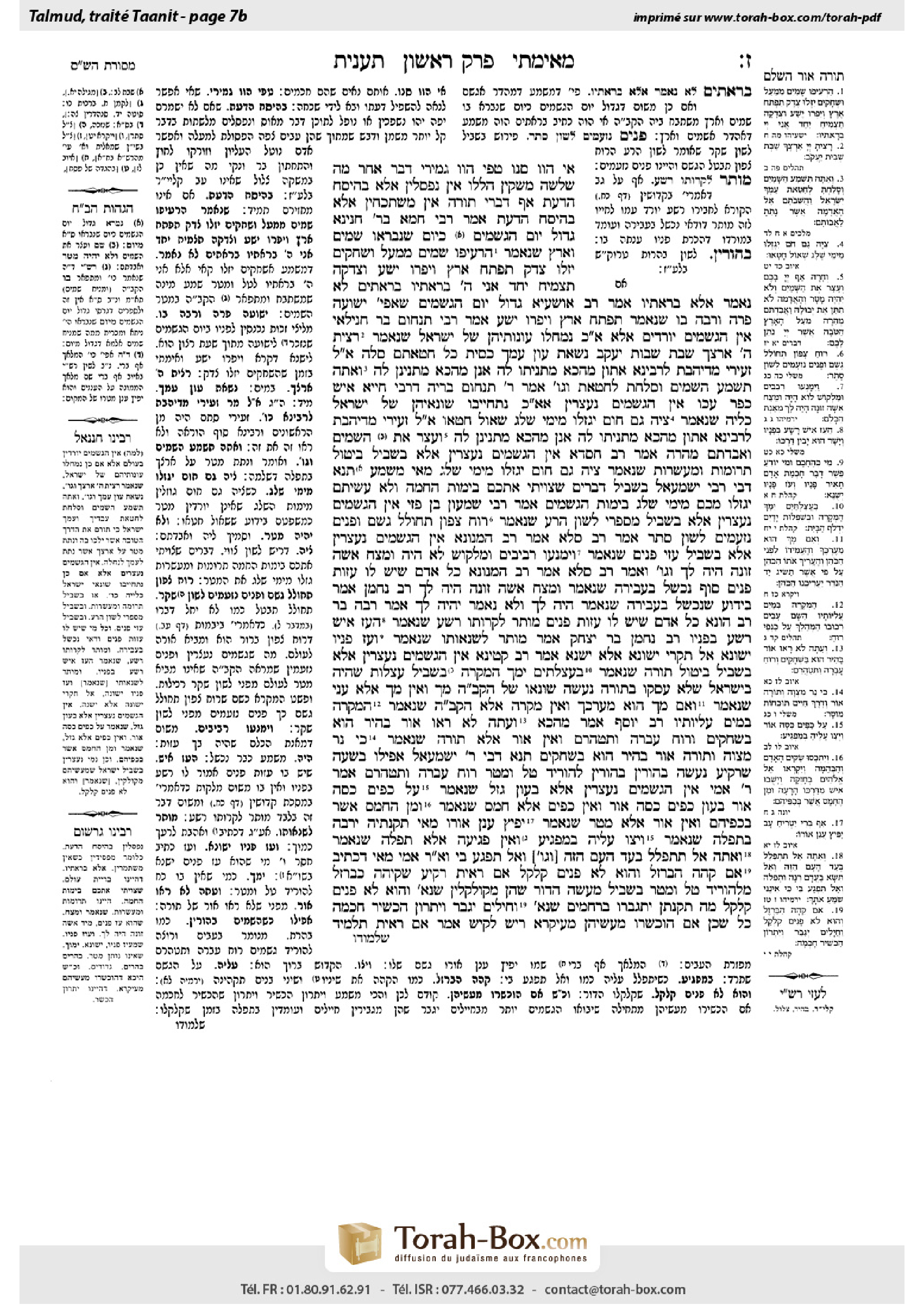
Taanit 7b: Talmud study for Daf Yomi
Daf Yomi is the daily study of one Talmud folio. Explore 37 tractates with scans, Hebrew text, Sefaria English and AI-generated French translations where annotated.
Passage selection and English or AI-generated French translation are available where the scan has annotations. Daf Study is independent of Torah-Box and Sefaria.
Browse Taanit · תענית · All tractatesTaanit 7b text and translations
This page of Taanit includes the Aramaic text, an English translation and an AI-generated French translation, alongside the scan above.
תענית ז׳ ב · Aramaic and Hebrew text
אִי הֲווֹ סְנוּ — טְפֵי הֲווֹ גְּמִירִי. דָּבָר אַחֵר: מָה שְׁלֹשָׁה מַשְׁקִין הַלָּלוּ אֵין נִפְסָלִין אֶלָּא בְּהֶיסַּח הַדַּעַת — אַף דִּבְרֵי תוֹרָה אֵין מִשְׁתַּכְחִין אֶלָּא בְּהֶיסַּח הַדַּעַת.
אָמַר רַבִּי חָמָא בְּרַבִּי חֲנִינָא: גָּדוֹל יוֹם הַגְּשָׁמִים כְּיוֹם שֶׁנִּבְרְאוּ שָׁמַיִם וָאָרֶץ, שֶׁנֶּאֱמַר: ״הַרְעִיפוּ שָׁמַיִם מִמַּעַל וּשְׁחָקִים יִזְּלוּ צֶדֶק תִּפְתַּח אֶרֶץ וְיִפְרוּ יֶשַׁע וּצְדָקָה תַצְמִיחַ יַחַד אֲנִי ה׳ בְּרָאתִיו״. ״בְּרָאתִים״ לֹא נֶאֱמַר, אֶלָּא ״בְּרָאתִיו״.
אָמַר רַב אוֹשַׁעְיָא: גָּדוֹל יוֹם הַגְּשָׁמִים, שֶׁאֲפִילּוּ יְשׁוּעָה פָּרָה וְרָבָה בּוֹ, שֶׁנֶּאֱמַר: ״תִּפְתַּח אֶרֶץ וְיִפְרוּ יֶשַׁע״. אָמַר רַבִּי תַּנְחוּם בַּר חֲנִילַאי: אֵין הַגְּשָׁמִים יוֹרְדִים אֶלָּא אִם כֵּן נִמְחֲלוּ עֲוֹנוֹתֵיהֶן שֶׁל יִשְׂרָאֵל, שֶׁנֶּאֱמַר: ״רָצִיתָ ה׳ אַרְצֶךָ שַׁבְתָּ שְׁבִית יַעֲקֹב. נָשָׂאתָ עֲוֹן עַמֶּךָ כִּסִּיתָ כׇל חַטָּאתָם סֶלָה״.
אֲמַר לֵיהּ זְעֵירִי מִדִּיהֲבַת לְרָבִינָא: אַתּוּן, מֵהָכָא מַתְנִיתוּ לַהּ. אֲנַן, מֵהָכָא מַתְנֵינַן לַהּ: ״וְאַתָּה תִּשְׁמַע הַשָּׁמַיִם וְסָלַחְתָּ לְחַטָּאת וְגוֹ׳״.
אָמַר רַבִּי תַּנְחוּם בְּרֵיהּ דְּרַבִּי חִיָּיא אִישׁ כְּפַר עַכּוֹ: אֵין הַגְּשָׁמִים נֶעֱצָרִין אֶלָּא אִם כֵּן נִתְחַיְּיבוּ שׂוֹנְאֵיהֶן שֶׁל יִשְׂרָאֵל כְּלָיָה, שֶׁנֶּאֱמַר: ״צִיָּה גַם חֹם יִגְזְלוּ מֵימֵי שֶׁלֶג שְׁאוֹל חָטָאוּ״. אֲמַר לֵיהּ זְעֵירִי מִדִּיהֲבַת לְרָבִינָא: אַתּוּן, מֵהָכָא מַתְנִיתוּ לַהּ. אֲנַן, מֵהָכָא מַתְנֵינַן לַהּ: ״וְעָצַר אֶת הַשָּׁמַיִם וַאֲבַדְתֶּם מְהֵרָה״.
אָמַר רַב חִסְדָּא: אֵין הַגְּשָׁמִים נֶעֱצָרִין אֶלָּא בִּשְׁבִיל בִּיטּוּל תְּרוּמוֹת וּמַעַשְׂרוֹת, שֶׁנֶּאֱמַר: ״צִיָּה גַם חֹם יִגְזְלוּ מֵימֵי שֶׁלֶג״. מַאי מַשְׁמַע? תָּנָא דְּבֵי רַבִּי יִשְׁמָעֵאל: בִּשְׁבִיל דְּבָרִים שֶׁצִּוִּיתִי אֶתְכֶם בִּימוֹת הַחַמָּה וְלֹא עֲשִׂיתֶם — יִגָּזְלוּ מִכֶּם מֵימֵי שֶׁלֶג בִּימוֹת הַגְּשָׁמִים.
אָמַר רַבִּי שִׁמְעוֹן בֶּן פַּזִּי: אֵין הַגְּשָׁמִים נֶעֱצָרִין אֶלָּא בִּשְׁבִיל מְסַפְּרֵי לָשׁוֹן הָרָע, שֶׁנֶּאֱמַר: ״רוּחַ צָפוֹן תְּחוֹלֵל גָּשֶׁם וּפָנִים נִזְעָמִים לְשׁוֹן סָתֶר״.
אָמַר רַב סַלָּא אָמַר רַב הַמְנוּנָא: אֵין הַגְּשָׁמִים נֶעֱצָרִין אֶלָּא בִּשְׁבִיל עַזֵּי פָנִים, שֶׁנֶּאֱמַר: ״וַיִּמָּנְעוּ רְבִבִים וּמַלְקוֹשׁ לוֹא הָיָה וּמֵצַח אִשָּׁה זוֹנָה הָיָה לָךְ וְגוֹ׳״. וְאָמַר רַב סַלָּא אָמַר רַב הַמְנוּנָא: כׇּל אָדָם שֶׁיֵּשׁ לוֹ עַזּוּת פָּנִים — סוֹף נִכְשָׁל בַּעֲבֵירָה, שֶׁנֶּאֱמַר: ״וּמֵצַח אִשָּׁה זוֹנָה הָיָה לָךְ״. רַב נַחְמָן אָמַר: בְּיָדוּעַ שֶׁנִּכְשַׁל בַּעֲבֵירָה, שֶׁנֶּאֱמַר: ״הָיָה לָךְ״, וְלֹא נֶאֱמַר ״יִהְיֶה לָּךְ״.
אָמַר רַבָּה בַּר רַב הוּנָא: כׇּל אָדָם שֶׁיֵּשׁ לוֹ עַזּוּת פָּנִים — מוּתָּר לִקְרוֹתוֹ רָשָׁע, שֶׁנֶּאֱמַר: ״הֵעֵז אִישׁ רָשָׁע בְּפָנָיו״. רַב נַחְמָן בַּר יִצְחָק אָמַר: מוּתָּר לִשְׂנאוֹתוֹ, שֶׁנֶּאֱמַר: ״וְעֹז פָּנָיו יְשֻׁנֶּא״. אַל תִּקְרֵי ״יְשֻׁנֶּא״, אֶלָּא ״יִשָּׂנֵא״.
אָמַר רַב קַטִּינָא: אֵין הַגְּשָׁמִים נֶעֱצָרִין אֶלָּא בִּשְׁבִיל בִּיטּוּל תּוֹרָה, שֶׁנֶּאֱמַר: ״בַּעֲצַלְתַּיִם יִמַּךְ הַמְּקָרֶה״ — בִּשְׁבִיל עַצְלוּת שֶׁהָיָה בְּיִשְׂרָאֵל שֶׁלֹּא עָסְקוּ בַּתּוֹרָה — נַעֲשֶׂה שׂוֹנְאוֹ שֶׁל הַקָּדוֹשׁ בָּרוּךְ הוּא מָךְ. וְאֵין ״מָךְ״ אֶלָּא עָנִי, שֶׁנֶּאֱמַר: ״וְאִם מָךְ הוּא מֵעֶרְכֶּךָ״. וְאֵין ״מְקָרֶה״ אֶלָּא הַקָּדוֹשׁ בָּרוּךְ הוּא, שֶׁנֶּאֱמַר: ״הַמְקָרֶה בַמַּיִם עֲלִיּוֹתָיו״.
רַב יוֹסֵף אָמַר, מֵהָכָא: ״וְעַתָּה לֹא רָאוּ אוֹר בָּהִיר הוּא בַּשְּׁחָקִים וְרוּחַ עָבְרָה וַתְּטַהֲרֵם״, וְאֵין ״אוֹר״ אֶלָּא תּוֹרָה, שֶׁנֶּאֱמַר: ״כִּי נֵר מִצְוָה וְתוֹרָה אוֹר״ — ״בָּהִיר הוּא בַּשְּׁחָקִים״. תָּנָא דְּבֵי רַבִּי יִשְׁמָעֵאל: אֲפִילּוּ בְּשָׁעָה שֶׁרָקִיעַ נַעֲשֶׂה בְּהוֹרִין בְּהוֹרִין לְהוֹרִיד טַל וּמָטָר — ״רוּחַ עָבְרָה וַתְּטַהֲרֵם״.
אָמַר רַבִּי אַמֵּי: אֵין הַגְּשָׁמִים נֶעֱצָרִין אֶלָּא בַּעֲוֹן גָּזֵל, שֶׁנֶּאֱמַר: ״עַל כַּפַּיִם כִּסָּה אוֹר״. בַּעֲוֹן כַּפַּיִם — כִּסָּה אוֹר. וְאֵין ״כַּפַּיִם״ אֶלָּא חָמָס, שֶׁנֶּאֱמַר: ״וּמִן הֶחָמָס אֲשֶׁר בְּכַפֵּיהֶם״, וְאֵין ״אוֹר״ אֶלָּא מָטָר, שֶׁנֶּאֱמַר: ״יָפִיץ עֲנַן אוֹרוֹ״.
מַאי תַּקַּנְתֵּיהּ — יַרְבֶּה בִּתְפִלָּה, שֶׁנֶּאֱמַר: ״וַיְצַו עָלֶיהָ בְּמַפְגִּיעַ״, וְאֵין ״פְּגִיעָה״ אֶלָּא תְּפִלָּה, שֶׁנֶּאֱמַר: ״וְאַתָּה אַל תִּתְפַּלֵּל בְּעַד הָעָם הַזֶּה וְגוֹ׳ וְאַל תִּפְגַּע בִּי״.
וְאָמַר רַבִּי אַמֵּי, מַאי דִּכְתִיב: ״אִם קֵהָה הַבַּרְזֶל וְהוּא לֹא פָנִים קִלְקַל״, אִם רָאִיתָ רָקִיעַ שֶׁקֵּיהָה כַּבַּרְזֶל מִלְּהוֹרִיד טַל וּמָטָר — בִּשְׁבִיל מַעֲשֵׂה הַדּוֹר שֶׁהֵן מְקוּלְקָלִין, שֶׁנֶּאֱמַר: ״וְהוּא לֹא פָנִים קִלְקַל״.
מָה תַּקָּנָתָן — יִתְגַּבְּרוּ בְּרַחֲמִים, שֶׁנֶּאֱמַר: ״וַחֲיָלִים יְגַבֵּר וְיִתְרוֹן הַכְשֵׁיר חׇכְמָה״, כׇּל שֶׁכֵּן אִם הוּכְשְׁרוּ מַעֲשֵׂיהֶן מֵעִיקָּרָא.
רֵישׁ לָקִישׁ אָמַר: אִם רָאִיתָ תַּלְמִיד
Taanit 7b · English translation
Rabbi Yehoshua replied: Had they been ugly, they would have been even more learned. Alternatively, the Torah is likened to water, wine, and milk because just as these three liquids are spoiled only by diversion of attention, so too, are Torah matters forgotten only through diversion of attention. If water, wine and milk are guarded, they will not spoil or have dirty objects fall into them.
§ The Gemara returns to the issue of rain. Rabbi Ḥama, son of Rabbi Ḥanina, said: The day of the rains is as great as the day on which the heavens and earth were created, as it is stated: “Drop down, heavens, from above, let the skies pour down righteousness; let the earth open that they may bring forth salvation, and let it cause righteousness to spring up together; I, the Lord, have created it” (Isaiah 45:8). The Gemara explains that the verse does not say: I have created them, in the plural, but: I have created it. In other words, the verse is referring to rain, rather than to the heavens and the earth, which indicates that rainfall is as important as the creation of the world.
Rabbi Oshaya likewise said: The day of rain is great, as rain even facilitates salvation, which is fruitful and multiplies on that day. It is a time of God’s favor, when salvation is brought forth into the world, as it is stated: “Let the earth open that they may bring forth salvation” (Isaiah 45:8). Rabbi Tanḥum bar Ḥanilai said: Rain falls only if the Jewish people’s transgressions have been forgiven, as it is stated: “Lord, You have been favorable to Your land; You have turned the captivity of Jacob; You have forgiven the iniquity of Your people; You have pardoned all their sin. Selah” (Psalms 85:2–3). This chapter proceeds to discuss rainfall: “And righteousness has looked down from Heaven” (Psalms 85:12), in the form of rain.
The Sage Ze’iri from the town of Dihavat said to Ravina: You learned this idea from here, whereas we learned it from here, a different verse: “When heaven is closed up, and there is no rain, when they sin against You, if they pray toward this place and confess Your name and turn from their sin, when You afflict them, then You, hear in heaven and forgive the sin of Your servants and of Your people Israel, when You teach them the good way in which they should walk, and send rain upon Your land, which You have given to Your people as an inheritance” (I Kings 8:35–36).
Rabbi Tanḥum, son of Rabbi Ḥiyya of the village of Akko, said: The rains are withheld only if the enemies of the Jewish people, a euphemism for the Jewish people, have been sentenced to destruction for their sins, as it is stated: “Drought and heat will steal the snow waters; to the grave those who have sinned” (Job 24:19). According to this interpretation, snow water will be stolen by drought, i.e., there will be none available, when people have sinned to the point that they deserve the grave. Ze’iri from Dihavat said to Ravina: You learned this idea from here; we learned it from here: “And the anger of the Lord will be kindled against you, and He will close up the heavens, and there will be no rain, and the earth will not give its fruit, and you will perish quickly” (Deuteronomy 11:17).
Rav Ḥisda said: The rains are withheld only due to the sin of the nullification of teruma and tithes, as it is stated: “Drought and heat will steal the snow waters” (Job 24:19). The Gemara asks: From where in the verse may this idea be inferred from the verse? The school of Rabbi Yishmael taught: Due to matters that I have commanded you to do in the summer, e.g., take teruma and tithes from the summer produce, and that you did not do, the snow waters will be stolen from you in the rainy season.
Rabbi Shimon ben Pazi said: The rains are withheld only due to the sin of those who speak slander, as it is stated: “The north wind brings forth rain, but a backbiting tongue, an angry countenance” (Proverbs 25:23). This verse indicates that if the countenance of the heavens is angry, with neither clouds nor rain, it is due to slanderous speech.
Rav Salla said that Rav Hamnuna said: The rains are withheld only due to impudent people, as it is stated: “Therefore the showers have been withheld, and there has been no last rain, yet you had a harlot’s forehead, you refused to be ashamed” (Jeremiah 3:3). And Rav Salla said that Rav Hamnuna said, with regard to the same verse: Any man who is insolent will ultimately stumble over the transgression of prostitution, as it is stated: “Yet you had a prostitute’s forehead.” Rav Naḥman said: The verse does not mean that he will commit a sexual transgression in the future; rather, it is known that he has already stumbled over this transgression, as it is stated: “You had,” in the past tense, and it is not stated: You will.
Rabba bar Rav Huna said: With regard to any man who is insolent, it is permitted to call him wicked to his face, as it is stated: “A wicked man makes his face insolent” (Proverbs 21:29). Rav Naḥman bar Yitzḥak said: It is permitted to hate him, as it is stated: “And the insolence of his face is changed” (Ecclesiastes 8:1). Do not read it as: “Is changed [yeshunne]”; rather, read it as: Is hated [yissane], as the two words are spelled the same way in Hebrew, albeit with different vocalization and pronunciation.
Rav Ketina said: The rains are withheld only due to the sin of dereliction in the study of Torah, as it is stated: “By slothfulness the rafters [hamekare] will sink in [yimakh], and through idleness of the hands the house leaks” (Ecclesiastes 10:18). Due to slothfulness that was present amongst the Jewish people, that they did not occupy themselves with Torah, the enemy of the Holy One, Blessed be He, a euphemism for God Himself, has sunk. And sunk [makh] means nothing other than poor, as it is stated: “But if he is too poor [makh] for your valuation” (Leviticus 27:8). And “rafters [mekare]” means nothing other than a reference to the Holy One, Blessed be He, as it is stated: “Who lays the beams [hamekare] of Your upper chambers in the water” (Psalms 104:3).
Rav Yosef said that this idea is derived from here: “And now that men do not see the light, it is bright in the skies, but the wind passes and cleanses them” (Job 37:21). And “light” means nothing other than Torah, as it is stated: “For a mitzva is a lamp and Torah is a light” (Proverbs 6:23). According to this interpretation, the verse means that when “men do not see the light,” i.e., when they are not occupied with Torah, “it is bright in the skies,” as there are no rainclouds. With regard to this verse, the school of Rabbi Yishmael taught: Even when the sky is comprised of bright clouds that serve to bring down dew and rain, no rain will fall, as “the wind passes and cleanses them.”
Rabbi Ami said: The rains are withheld only due to the sin of robbery, as it is stated: “He covers His hands with the light, and He has commanded it due to imploring” (Job 36:32). This means that due to the sin of stealing hands, God has covered the light and no rain will fall. And Rabbi Ami adds that the term “hand” means nothing other than a sin of violence, as it is stated: “And from the violence that is in their hands” (Jonah 3:8). And “light” means nothing other than rain, as it is stated: “He spreads abroad the cloud of His light” (Job 37:11).
What is the remedy of one who has caused the rain to be withheld? He should increase his prayers, as it is stated in the same chapter: “And He has commanded it due to imploring” (Job 36:32), and “imploring” means nothing other than prayer, as it is stated: “Therefore, do not pray you for this nation, neither lift up cry nor prayer for them, neither implore Me” (Jeremiah 7:16).
And Rabbi Ami said: What is the meaning of that which is written: “If the iron is blunt, and does not whet the edge” (Ecclesiastes 10:10)? If you see a sky that is blunt as iron, in that it does not bring down dew and rain, this is due to the deeds of the generation, which are corrupt, as it is stated: “And does not whet [kilkal] the edge [panim].” Panim, which also means face, is often used in reference to the leaders of a generation, while the term kilkal is similar to the word for corrupt, mekulkalin.
What is their remedy? They must increase their prayers for mercy, as it is stated in the same verse: “Then must he increase his strength, but wisdom is profitable to direct” (Ecclesiastes 10:10). This verse hints that rain will fall if one increases his strength, i.e., his prayers for mercy. The last part of the verse means that, all the more so, if their deeds had been righteous and direct from the beginning, the rains would not have been withheld.
The Gemara cites a different interpretation of the same verse. Reish Lakish said: If you see a student
Taanit 7b · Traduction française (IA)
Rabbi Yehoshua répondit : S’ils avaient été laids, ils auraient été encore plus instruits. Autre explication : la Torah est comparée à l’eau, au vin et au lait, car, de même que ces trois liquides ne s’altèrent que si l’on cesse d’y prêter attention, de même les paroles de Torah ne sont oubliées que si l’on cesse d’y prêter attention. Si l’eau, le vin et le lait sont protégés, ils ne s’altèrent pas et aucun objet sale n’y tombe.
§ La Guemara revient à la question de la pluie. Rabbi Ḥama, fils de Rabbi Ḥanina, a dit : Le jour de la pluie est aussi grand que le jour où le ciel et la terre ont été créés, comme il est dit : « Cieux, répandez d’en haut, et que les nuées fassent couler la justice ; que la terre s’ouvre, qu’ils portent le salut et qu’elle fasse germer la justice ; moi, l’Éternel, je l’ai créé » (Isaïe 45:8). La Guemara explique que le verset ne dit pas : « Je les ai créés », au pluriel, mais : « Je l’ai créé ». Autrement dit, le verset parle de la pluie, et non du ciel et de la terre, ce qui indique que la pluie est aussi importante que la création du monde.
Rabbi Oshaya a également dit : Le jour de la pluie est grand, car la pluie contribue même au salut, qui se multiplie et porte ses fruits ce jour-là. C’est un moment de faveur divine, où le salut est amené dans le monde, comme il est dit : « Que la terre s’ouvre, qu’ils portent le salut » (Isaïe 45:8). Rabbi Tanḥum bar Ḥanilai a dit : La pluie ne tombe que si les transgressions du peuple juif ont été pardonnées, comme il est dit : « Éternel, tu as été favorable à ton pays ; tu as ramené la captivité de Jacob ; tu as pardonné l’iniquité de ton peuple, tu as couvert tous ses péchés. Sélah » (Psaumes 85:2–3). Ce chapitre poursuit en parlant de la pluie : « Et la justice a regardé du haut des cieux » (Psaumes 85:12), sous la forme de la pluie.
Le Sage Ze’iri, de la ville de Dihavat, dit à Ravina : Tu as appris cette idée à partir de ce verset, tandis que nous l’avons apprise à partir d’un autre verset, celui-ci : « Quand le ciel sera fermé et qu’il n’y aura pas de pluie, parce qu’ils auront péché contre toi, s’ils prient en direction de ce lieu, confessent ton nom et se détournent de leur péché, lorsque tu les affligeras, alors toi, écoute des cieux et pardonne le péché de tes serviteurs et de ton peuple Israël, en leur enseignant la bonne voie qu’ils doivent suivre, et en envoyant la pluie sur ton pays, que tu as donné en héritage à ton peuple » (I Rois 8:35–36).
Rabbi Tanḥum, fils de Rabbi Ḥiyya, du village d’Akko, a dit : La pluie n’est retenue que si les ennemis du peuple juif — expression euphémique désignant le peuple juif — ont été condamnés à la destruction pour leurs péchés, comme il est dit : « La sécheresse et la chaleur volent les eaux de neige ; au tombeau, ceux qui ont péché » (Job 24:19). Selon cette interprétation, les eaux de neige seront dérobées par la sécheresse, c’est-à-dire qu’il n’y en aura pas, lorsque les gens auront péché au point de mériter le tombeau. Ze’iri, de Dihavat, dit à Ravina : Tu as appris cette idée à partir de ce verset ; nous l’avons apprise à partir de celui-ci : « La colère de l’Éternel s’enflammera contre vous, il fermera les cieux et il n’y aura pas de pluie ; la terre ne donnera pas ses produits, et vous périrez rapidement » (Deutéronome 11:17).
Rav Ḥisda a dit : La pluie n’est retenue qu’à cause du péché consistant à négliger la terouma et les dîmes, comme il est dit : « La sécheresse et la chaleur volent les eaux de neige » (Job 24:19). La Guemara demande : Où peut-on déduire cette idée dans le verset ? L’école de Rabbi Yishmael enseignait : À cause des choses que je vous ai ordonné de faire en été, par exemple prélever la terouma et les dîmes sur les produits de l’été, et que vous n’avez pas faites, les eaux de neige vous seront retirées pendant la saison des pluies.
Rabbi Shimon ben Pazi a dit : La pluie n’est retenue qu’à cause du péché de ceux qui profèrent des calomnies, comme il est dit : « Le vent du nord amène la pluie, mais une langue médisante, un visage irrité » (Proverbes 25:23). Ce verset indique que si le visage des cieux est irrité, sans nuages ni pluie, c’est à cause des propos calomnieux.
Rav Salla a dit au nom de Rav Hamnuna : La pluie n’est retenue qu’à cause des gens impudents, comme il est dit : « C’est pourquoi les averses ont été retenues, et il n’y a pas eu de pluie tardive ; pourtant, tu as eu un front de prostituée, tu as refusé d’avoir honte » (Jérémie 3:3). Rav Salla a également dit au nom de Rav Hamnuna, au sujet du même verset : Tout homme insolent finira par trébucher dans la faute de prostitution, comme il est dit : « Pourtant, tu as eu un front de prostituée. » Rav Naḥman a dit : Le verset ne signifie pas qu’il commettra une transgression sexuelle à l’avenir ; on sait plutôt qu’il a déjà trébuché dans cette faute, comme le montre « tu as eu », au passé, et non « tu auras ».
Rabba bar Rav Huna a dit : Tout homme insolent peut être traité de méchant en face, comme il est dit : « Le méchant affiche un visage insolent » (Proverbes 21:29). Rav Naḥman bar Yitzḥak a dit : Il est permis de le haïr, comme il est dit : « Et l’insolence de son visage est changée » (Ecclésiaste 8:1). Ne lis pas : « est changée [yeshunne] » ; lis plutôt : « est haïe [yissane] », car les deux mots s’écrivent de la même manière en hébreu, bien qu’ils aient une vocalisation et une prononciation différentes.
Rav Ketina a dit : La pluie n’est retenue qu’à cause du péché de négligence dans l’étude de la Torah, comme il est dit : « Par la paresse, les poutres [hamekare] s’affaissent [yimakh], et, par l’inactivité des mains, la maison fuit » (Ecclésiaste 10:18). À cause de la paresse qui régnait parmi le peuple juif, qui ne s’adonnait pas à la Torah, l’ennemi du Saint, béni soit-Il — expression euphémique désignant Dieu lui-même — s’est affaissé. Et « s’affaisser » [makh] signifie uniquement être pauvre, comme il est dit : « Mais s’il est trop pauvre [makh] pour ton estimation » (Lévitique 27:8). Et « les poutres [mekare] » désigne uniquement le Saint, béni soit-Il, comme il est dit : « Lui qui pose les poutres [hamekare] de ses chambres supérieures dans les eaux » (Psaumes 104:3).
Rav Yosef a dit que cette idée se déduit de ce verset : « Et maintenant, les hommes ne voient pas la lumière ; elle brille dans les cieux, mais le vent passe et les nettoie » (Job 37:21). Et « lumière » désigne uniquement la Torah, comme il est dit : « Car une mitsva est une lampe, et la Torah est une lumière » (Proverbes 6:23). Selon cette interprétation, le verset signifie que lorsque « les hommes ne voient pas la lumière », c’est-à-dire lorsqu’ils ne s’adonnent pas à la Torah, « elle brille dans les cieux », car il n’y a pas de nuages de pluie. À propos de ce verset, l’école de Rabbi Yishmael enseignait : Même lorsque le ciel est formé de nuages lumineux qui apportent la rosée et la pluie, aucune pluie ne tombera, car « le vent passe et les nettoie ».
Rabbi Ami a dit : La pluie n’est retenue qu’à cause du péché de vol, comme il est dit : « Il couvre ses mains de lumière, et il lui enjoint de supplier » (Job 36:32). Cela signifie qu’à cause du péché des mains qui volent, Dieu a couvert la lumière et aucune pluie ne tombera. Rabbi Ami ajoute que le terme « main » désigne uniquement un péché de violence, comme il est dit : « Et de la violence qui est dans leurs mains » (Jonas 3:8). Et « lumière » désigne uniquement la pluie, comme il est dit : « Il répand au loin le nuage de sa lumière » (Job 37:11).
Quel est le remède pour celui qui a provoqué la retenue de la pluie ? Il doit multiplier ses prières, comme il est dit dans le même chapitre : « Et il lui enjoint de supplier » (Job 36:32), et « supplier » désigne uniquement la prière, comme il est dit : « Ne prie donc pas pour cette nation, ne fais monter pour elle ni cri ni prière, ne m’implore pas » (Jérémie 7:16).
Rabbi Ami a également dit : Quel est le sens de ce qui est écrit : « Si le fer est émoussé et que l’on n’en aiguise pas le tranchant » (Ecclésiaste 10:10) ? Si tu vois un ciel émoussé comme du fer, en ce qu’il ne fait tomber ni rosée ni pluie, cela est dû aux actes corrompus de la génération, comme il est dit : « et que l’on n’aiguise pas [kilkal] le tranchant [panim] ». Panim, qui signifie également « visage », désigne souvent les dirigeants d’une génération, tandis que le terme kilkal ressemble au mot mekulkalin, qui signifie « corrompus ».
Quel est leur remède ? Ils doivent multiplier leurs prières pour obtenir miséricorde, comme il est dit dans le même verset : « Alors il doit redoubler de force, mais la sagesse est utile pour diriger » (Ecclésiaste 10:10). Ce verset suggère que la pluie tombera si l’on redouble de force, c’est-à-dire si l’on multiplie ses prières pour obtenir miséricorde. La dernière partie du verset signifie que, à plus forte raison, si leurs actes avaient été justes et droits dès le commencement, la pluie n’aurait pas été retenue.
La Guemara cite une autre interprétation du même verset. Reish Lakish a dit : Si tu vois un étudiant
Traduction française générée par IA à partir de l’édition anglaise de Sefaria. Vérifie toujours un passage avec le texte source.
Text from Sefaria: William Davidson Edition - Vocalized Aramaic (CC BY NC); William Davidson Edition - English (CC BY NC).