Taanit 8a: Talmud study for Daf Yomi
Daf Yomi is the daily study of one Talmud folio. Explore 37 tractates with scans, Hebrew text, Sefaria English and AI-generated French translations where annotated.
Passage selection and English or AI-generated French translation are available where the scan has annotations. Daf Study is independent of Torah-Box and Sefaria.
Browse Taanit · תענית · All tractatesTaanit 8a text and translations
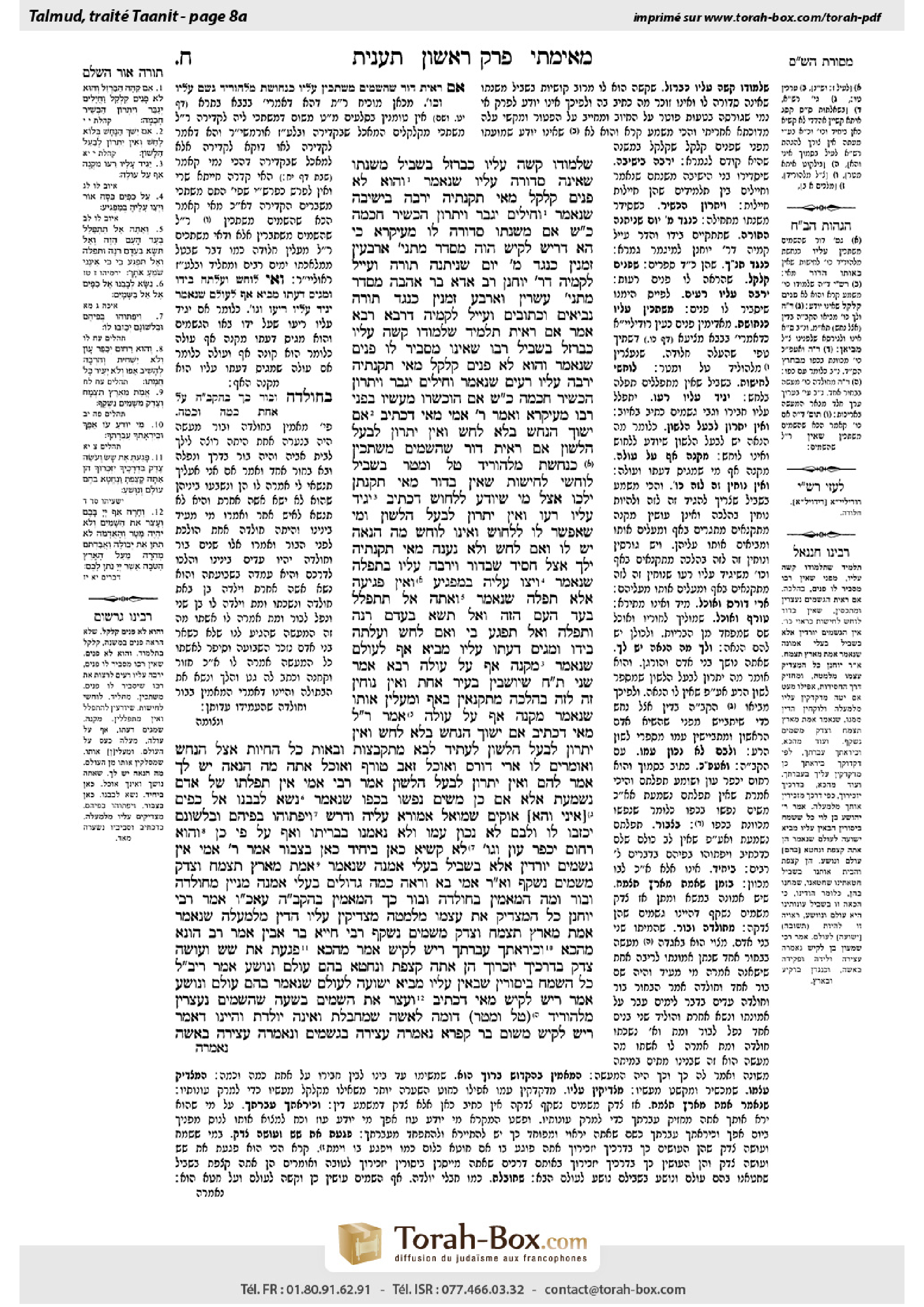
This page of Taanit includes the Aramaic text, an English translation and an AI-generated French translation, alongside the scan above.
תענית ח׳ א · Aramaic and Hebrew text
שֶׁתַּלְמוּדוֹ קָשֶׁה עָלָיו כַּבַּרְזֶל — בִּשְׁבִיל מִשְׁנָתוֹ שֶׁאֵינָהּ סְדוּרָה עָלָיו, שֶׁנֶּאֱמַר: ״וְהוּא לֹא פָנִים קִלְקַל״.
מַאי תַּקַּנְתֵּיהּ — יַרְבֶּה בִּישִׁיבָה, שֶׁנֶּאֱמַר: ״וַחֲיָלִים יְגַבֵּר וְיִתְרוֹן הַכְשֵׁיר חׇכְמָה״. כׇּל שֶׁכֵּן אִם מִשְׁנָתוֹ סְדוּרָה לוֹ מֵעִיקָּרָא.
כִּי הָא דְּרֵישׁ לָקִישׁ הֲוָה מְסַדַּר מַתְנִיתֵיהּ אַרְבְּעִין זִמְנִין, כְּנֶגֶד אַרְבָּעִים יוֹם שֶׁנִּיתְּנָה תּוֹרָה, וְעָיֵיל לְקַמֵּיהּ דְּרַבִּי יוֹחָנָן. רַב אַדָּא בַּר אַהֲבָה מְסַדַּר מַתְנִיתֵיהּ עֶשְׂרִין וְאַרְבַּע זִמְנִין, כְּנֶגֶד תּוֹרָה נְבִיאִים וּכְתוּבִים, וְעָיֵיל לְקַמֵּיהּ דְּרָבָא.
רָבָא אָמַר: אִם רָאִיתָ תַּלְמִיד שֶׁתַּלְמוּדוֹ קָשֶׁה עָלָיו כַּבַּרְזֶל — בִּשְׁבִיל רַבּוֹ שֶׁאֵינוֹ מַסְבִּיר לוֹ פָּנִים, שֶׁנֶּאֱמַר: ״וְהוּא לֹא פָנִים קִלְקַל״.
מַאי תַּקַּנְתֵּיהּ — יַרְבֶּה עָלָיו רֵעִים, שֶׁנֶּאֱמַר: ״וַחֲיָלִים יְגַבֵּר וְיִתְרוֹן הַכְשֵׁיר חׇכְמָה״. כׇּל שֶׁכֵּן אִם הוּכְשְׁרוּ מַעֲשָׂיו בִּפְנֵי רַבּוֹ מֵעִיקָּרָא.
וְאָמַר רַבִּי אַמֵּי, מַאי דִּכְתִיב: ״אִם יִשֹּׁךְ הַנָּחָשׁ בְּלוֹא לָחַשׁ וְאֵין יִתְרוֹן לְבַעַל הַלָּשׁוֹן״, אִם רָאִיתָ דּוֹר שֶׁהַשָּׁמַיִם מִשְׁתַּכִּין כִּנְחֹשֶׁת מִלְּהוֹרִיד טַל וּמָטָר — בִּשְׁבִיל לוֹחֲשֵׁי לְחִישׁוֹת שֶׁאֵין בַּדּוֹר.
מַאי תַּקָּנָתָן — יֵלְכוּ אֵצֶל מִי שֶׁיּוֹדֵעַ לִלְחוֹשׁ, דִּכְתִיב: ״יַגִּיד עָלָיו רֵעוֹ״, ״וְאֵין יתְרוֹן לְבַעַל הַלָּשׁוֹן״. וּמִי שֶׁאֶפְשָׁר לוֹ לִלְחוֹשׁ וְאֵינוֹ לוֹחֵשׁ, מָה הֲנָאָה יֵשׁ לוֹ?
וְאִם לָחַשׁ וְלֹא נַעֲנָה, מַאי תַּקַּנְתֵּיהּ? יֵלֵךְ אֵצֶל חָסִיד שֶׁבַּדּוֹר, וְיַרְבֶּה עָלָיו בִּתְפִלָּה, שֶׁנֶּאֱמַר: ״וַיְצַו עָלֶיהָ בְּמַפְגִּיעַ״, וְאֵין פְּגִיעָה אֶלָּא תְּפִילָּה, שֶׁנֶּאֱמַר: ״וְאַתָּה אַל תִּתְפַּלֵּל בְּעַד הָעָם הַזֶּה וְאַל תִּשָּׂא בַעֲדָם רִנָּה וּתְפִלָּה וְאַל תִּפְגַּע בִּי״.
וְאִם לָחַשׁ וְעָלְתָה בְּיָדוֹ, וּמֵגִיס דַּעְתּוֹ עָלָיו — מֵבִיא אַף לָעוֹלָם, שֶׁנֶּאֱמַר: ״מִקְנֶה אַף עַל עוֹלֶה״.
רָבָא אָמַר: שְׁנֵי תַּלְמִידֵי חֲכָמִים שֶׁיּוֹשְׁבִין בְּעִיר אַחַת וְאֵין נוֹחִין זֶה לָזֶה בַּהֲלָכָה — מִתְקַנְּאִין בָּאַף וּמַעֲלִין אוֹתוֹ, שֶׁנֶּאֱמַר: ״מִקְנֶה אַף עַל עוֹלֶה״.
אָמַר רֵישׁ לָקִישׁ, מַאי דִּכְתִיב: ״אִם יִשֹּׁךְ הַנָּחָשׁ בְּלוֹא לָחַשׁ וְאֵין יִתְרוֹן לְבַעַל הַלָּשׁוֹן״, לְעָתִיד לָבוֹא מִתְקַבְּצוֹת וּבָאוֹת כׇּל הַחַיּוֹת אֵצֶל הַנָּחָשׁ, וְאוֹמְרִים לוֹ: אֲרִי דּוֹרֵס וְאוֹכֵל, זְאֵב טוֹרֵף וְאוֹכֵל, אַתָּה מָה הֲנָאָה יֵשׁ לְךָ? אֹמֵר לָהֶם: ״וְאֵין יִתְרוֹן לְבַעַל הַלָּשׁוֹן״.
אָמַר רַבִּי אַמֵּי: אֵין תְּפִלָּתוֹ שֶׁל אָדָם נִשְׁמַעַת אֶלָּא אִם כֵּן מֵשִׂים נַפְשׁוֹ בְּכַפּוֹ, שֶׁנֶּאֱמַר: ״נִשָּׂא לְבָבֵנוּ אֶל כַּפָּיִם״, אִינִי?! וְהָא אוֹקֵים שְׁמוּאֵל אָמוֹרָא עֲלֵיהּ וּדְרַשׁ: ״וַיְפַתּוּהוּ בְּפִיהֶם וּבִלְשׁוֹנָם יְכַזְּבוּ לוֹ וְלִבָּם לֹא נָכוֹן עִמּוֹ וְלֹא נֶאֶמְנוּ בִּבְרִיתוֹ״, וְאַף עַל פִּי כֵן — ״וְהוּא רַחוּם יְכַפֵּר עָוֹן וְגוֹ׳״!
לָא קַשְׁיָא: כָּאן בְּיָחִיד, כָּאן בְּצִבּוּר.
אָמַר רַבִּי אַמֵּי: אֵין גְּשָׁמִים יוֹרְדִין אֶלָּא בִּשְׁבִיל בַּעֲלֵי אֲמָנָה, שֶׁנֶּאֱמַר: ״אֱמֶת מֵאֶרֶץ תִּצְמָח וְצֶדֶק מִשָּׁמַיִם נִשְׁקָף״.
וְאָמַר רַבִּי אַמֵּי: בֹּא וּרְאֵה כַּמָּה גְּדוֹלִים בַּעֲלֵי אֲמָנָה, מִנַּיִין — מֵחוּלְדָּה וּבוֹר. וּמָה הַמַּאֲמִין בְּחוּלְדָּה וּבוֹר — כָּךְ, הַמַּאֲמִין בְּהַקָּדוֹשׁ בָּרוּךְ הוּא — עַל אַחַת כַּמָּה וְכַמָּה.
אָמַר רַבִּי יוֹחָנָן: כׇּל הַמַּצְדִּיק אֶת עַצְמוֹ מִלְּמַטָּה — מַצְדִּיקִין עָלָיו הַדִּין מִלְּמַעְלָה, שֶׁנֶּאֱמַר: ״אֱמֶת מֵאֶרֶץ תִּצְמָח וְצֶדֶק מִשָּׁמַיִם נִשְׁקָף״. רַבִּי חִיָּיא בַּר אָבִין אָמַר רַב הוּנָא, מֵהָכָא: ״וּכְיִרְאָתְךָ עֶבְרָתֶךָ״.
רֵישׁ לָקִישׁ אָמַר מֵהָכָא: ״פָּגַעְתָּ אֶת שָׂשׂ וְעֹשֵׂה צֶדֶק בִּדְרָכֶיךָ יִזְכְּרוּךָ הֵן אַתָּה קָצַפְתָּ וַנֶּחֱטָא בָּהֶם עוֹלָם וְנִוָּשֵׁעַ״. אָמַר רַבִּי יְהוֹשֻׁעַ בֶּן לֵוִי: כׇּל הַשָּׂמֵחַ בְּיִסּוּרִין שֶׁבָּאִין עָלָיו — מֵבִיא יְשׁוּעָה לָעוֹלָם, שֶׁנֶּאֱמַר: ״בָּהֶם עוֹלָם וְנִוָּשֵׁעַ״.
אָמַר רֵישׁ לָקִישׁ, מַאי דִּכְתִיב: ״וְעָצַר אֶת הַשָּׁמַיִם״, בְּשָׁעָה שֶׁהַשָּׁמַיִם נֶעֱצָרִין מִלְּהוֹרִיד טַל וּמָטָר — דּוֹמֶה לְאִשָּׁה שֶׁמְּחַבֶּלֶת וְאֵינָהּ יוֹלֶדֶת. וְהַיְינוּ דְּאָמַר רֵישׁ לָקִישׁ מִשּׁוּם בַּר קַפָּרָא: נֶאֶמְרָה עֲצִירָה בִּגְשָׁמִים וְנֶאֶמְרָה עֲצִירָה בְּאִשָּׁה,
Taanit 8a · English translation
whose studies are hard as iron for him, i.e., difficult to understand, this is due to his lack of familiarity with the Mishna, which is not organized for him. If the Mishna is unclear, any further study of Gemara is rendered all the more difficult, as it is stated: “And does not whet [kilkal] the edge [panim]” (Ecclesiastes 10:10). As panim can also mean surface, this indicates that the surface, i.e., the basic statements of the Mishna, is corrupted. As stated previously, kilkal can also mean corrupted.
What is his remedy? He must increase the time he sits and studies, as it is stated: “Then must he increase his strength” (Ecclesiastes 10:10). The last part of the verse: “But wisdom is profitable to direct,” means that all the more so, if his study of the Mishna is organized for him from the beginning, he will avoid this trouble.
That is like this practice of Reish Lakish, who would review his studies forty times, corresponding to the forty days in which the Torah was given to Moses at Sinai, and only afterward would he go before Rabbi Yoḥanan to study from his teacher. Similarly, Rav Adda bar Ahava would review his learning twenty-four times, corresponding to the twenty-four books in the Torah, Prophets, and Writings, i.e., the Bible, and only afterward go before Rava to study with him.
With regard to the aforementioned verse from Ecclesiastes, Rava said: If you see a student whose studies are as difficult for him as iron, this is due to his teacher, who does not show him a friendly countenance, but is overly strict with him. This practice inhibits the student’s learning, as it is stated: “And it has not whetted the surface [panim]” (Ecclesiastes 10:10). As explained previously, panim can also mean countenance.
What is the remedy for this student? He must increase the number of friends he sends to the teacher to intercede for him, as it is stated: “Then must he increase his strength.” The term used for strength, ḥayalim, can also mean soldiers or colleagues. Nevertheless: “But wisdom is profitable to direct,” meaning that all the more so would he be spared this trouble if his deeds were properly directed before his teacher from the beginning.
§ The Gemara returns to the topic of rain. And Rabbi Ami said: What is the meaning of that which is written: “If the serpent [naḥash] bites [yishokh] before it is charmed [laḥash], then the charmer has no advantage” (Ecclesiastes 10:11)? If you see a generation for whom the heavens corrode [meshatkhin] like copper [neḥoshet], which prevents them from bringing down dew and rain, this is due to the lack of those who whisper quiet [loḥashei leḥishot] prayers in the generation.
What is their remedy? They should go to one who knows how to whisper prayers in the proper manner, as it is written: “Its noise tells concerning it” (Job 36:33). As for the phrase: “Then the charmer has no advantage,” this is referring to one who is able to whisper his prayers correctly and yet does not whisper them correctly. In this case, of what benefit to him is his ability to pray?
And if he whispered his prayers and yet was not answered, what is his remedy? He should go to the most pious individual of the generation, and this pious individual will increase his prayers on his behalf, as it is stated one verse earlier: “And He has commanded it due to imploring” (Job 36:32). And “imploring” means nothing other than prayer, as it is stated: “Therefore, do not pray you for this nation, neither lift up cry nor prayer for them, neither implore Me” (Jeremiah 7:16).
And if he whispered his prayers for rain, and his prayers were successful, i.e., rain fell as he requested, and he becomes prideful as a result, he brings anger into the world, as it is stated: “The cattle [mikne] also [af ] concerning the rising storm [al oleh]” (Job 36:33). This verse can be read homiletically as: Anger [af ] is acquired [mikne] by one who raises [al oleh] his pride.
Following the same interpretation of this verse, Rava said: If there are two Torah scholars who live in one city, and they are not courteous with one another in their discussions of halakha, they arouse anger upon the world and cause it to rise up, as it is stated: “Anger is acquired by one who raises his pride.”
The Gemara cites another interpretation of the aforementioned verse. Reish Lakish said: What is the meaning of that which is written: “If the snake bites before it is charmed, then the charmer has no advantage” (Ecclesiastes 10:11)? In the future, all the animals will gather together and come to the snake and say to him: A lion mauls its prey and eats it; a wolf tears apart its prey and eats it; but you, what pleasure do you have when you bite a person, as you are incapable of eating him? The snake will say to them: “The charmer has no advantage.” The Hebrew phrase for snake charmer literally means the master of the tongue, and therefore the snake is saying that he has a more difficult question: What pleasure does a slanderer receive, as he inflicts more harm for which he obtains no physical enjoyment.
Rabbi Ami said: A person’s prayer is heard only if he places his soul in his palm, i.e., one must submit his entire soul with sincerity in his outstretched hands as he prays, as it is stated: “Let us lift up our heart with our hands” (Lamentations 3:41). The Gemara raises an objection: Is that so? But Shmuel once established for himself an interpreter to teach in public, and interpreted homiletically the verse: “But they beguiled Him with their mouth and lied to Him with their tongue, for their heart was not steadfast with Him, neither were they faithful to His covenant” (Psalms 78:36–37), and nevertheless the psalm continues: “But He, being full of compassion, forgives iniquity, and does not destroy” (Psalms 78:38). This indicates that all prayers are accepted, even if they lack sincerity.
The Gemara responds: This is not difficult, as here Rabbi Ami is referring to an individual who prays without sincerity and consequently his prayer goes unheard, whereas there Shmuel is saying that when one prays with the community, even if his prayers are deficient, they are accepted in the merit of the congregation.
Rabbi Ami further said: Rain falls only due to faithful people, as it is stated: “Truth springs out of the earth, and righteousness has looked down from heaven” (Psalms 85:12). When “truth springs out of the earth,” i.e., if people are faithful, they will find that “righteousness,” in the form of rain “has looked down from heaven.”
And Rabbi Ami said: Come and see how great the faithful people are, and how God assists them. From where is it derived? From the story of the marten [ḥulda] and the pit. Once a young man saved a girl who had fallen into a pit. After rescuing her they swore to remain faithful to each other, and they declared the pit and a passing marten their witnesses. As time went by the young man forgot his vow and married another woman. They had two children, both of whom died tragically, one by falling into a pit and the other when he was bitten by a marten. Their unusual deaths led the young man to realize his error and he returned to the first woman. And if this is the outcome for one who believes in signs from a pit and a marten, all the more so for one who has faith in the Holy One, Blessed be He.
§ Rabbi Yoḥanan said: Whoever is exacting with himself, by striving to act righteously in every way on earth below, he is judged in an exact manner in Heaven above, in order to improve him further still, as it is stated: “Truth springs out of the earth, and righteousness has looked down from heaven” (Psalms 85:12). Rabbi Ḥiyya bar Avin said that Rav Huna said that this idea is derived from here: “And Your wrath is according to the fear that is due to You” (Psalms 90:11). The level of God’s wrath correlates with the offender’s fear of God.
Reish Lakish said that this principle is derived from here: “You took him away who joyfully performed righteousness, those who remembered You in Your ways, behold You were wroth, and we sinned, upon them have we stayed of old, that we might be saved” (Isaiah 64:4). This verse also teaches that God displays wrath specifically due to the transgressions of those who are accustomed to acting righteously. Rabbi Yehoshua ben Levi said concerning the same verse: Whoever is joyful in the suffering that comes upon him brings salvation to the world [olam], as it is stated: “Upon them have we stayed of old [olam], that we might be saved.”
§ Returning to the topic of rain, Reish Lakish said: What is the meaning of that which is written: “And He will close up the heavens” (Deuteronomy 11:17)? This verse teaches that when the heavens are closed up from bringing down dew and rain, this is similar to a woman who has the pangs of labor and yet does not give birth, as the heavens themselves suffer from their inability to bring down rain and dew. And this is what Reish Lakish said in the name of bar Kappara: Closing up is stated with regard to rains, and closing up is likewise stated with regard to a woman.
Taanit 8a · Traduction française (IA)
Celui dont l’étude est dure comme le fer, c’est-à-dire difficile à comprendre, le doit à son manque de familiarité avec la Michna, dont l’enseignement n’est pas ordonné pour lui. Si la Michna n’est pas claire, toute étude ultérieure de Guemara n’en est que plus difficile, comme il est dit : « Et il n’a pas aiguisé [kilkal] le tranchant [panim] » (Ecclésiaste 10,10). Puisque panim peut aussi signifier « surface », cela indique que la surface, c’est-à-dire les énoncés fondamentaux de la Michna, est altérée. Comme indiqué précédemment, kilkal peut également signifier « altéré ».
Quel est son remède ? Il doit consacrer davantage de temps à s’asseoir pour étudier, comme il est dit : « Alors il devra redoubler de force » (Ecclésiaste 10,10). La dernière partie du verset, « mais la sagesse est profitable pour diriger », signifie qu’à plus forte raison, si son étude de la Michna est ordonnée pour lui dès le départ, il évitera cette difficulté.
Cela correspond à la pratique de Reish Lakish, qui révisait ses études quarante fois, en référence aux quarante jours durant lesquels la Torah fut donnée à Moïse au Sinaï ; ce n’est qu’ensuite qu’il se rendait auprès de Rabbi Yoḥanan pour étudier avec son maître. De même, Rav Adda bar Ahava révisait son étude vingt-quatre fois, en référence aux vingt-quatre livres de la Torah, des Prophètes et des Écrits, c’est-à-dire la Bible ; ce n’est qu’ensuite qu’il se rendait auprès de Rava pour étudier avec lui.
À propos du verset précité de l’Ecclésiaste, Rava dit : Si tu vois un étudiant pour qui l’étude est dure comme le fer, cela est dû à son maître, qui ne lui témoigne pas de bienveillance, mais se montre excessivement sévère avec lui. Cette attitude entrave l’étude de l’étudiant, comme il est dit : « Et il n’a pas aiguisé la surface [panim] » (Ecclésiaste 10,10). Comme expliqué précédemment, panim peut également signifier « visage ».
Quel est le remède pour cet étudiant ? Il doit augmenter le nombre d’amis qu’il envoie auprès de son maître pour intercéder en sa faveur, comme il est dit : « Alors il devra accroître ses forces. » Le terme employé pour « forces », ḥayalim, peut aussi désigner des soldats ou des collègues. Néanmoins, « la sagesse est profitable pour diriger » signifie qu’à plus forte raison, il aurait été épargné de cette difficulté si, dès le début, sa conduite avait été correctement orientée auprès de son maître.
§ La Guemara revient au sujet de la pluie. Rabbi Ami dit : Quel est le sens de ce qui est écrit : « Si le serpent [naḥash] mord [yishokh] avant d’être charmé [laḥash], le charmeur n’a aucun avantage » (Ecclésiaste 10,11) ? Si tu vois une génération dont les cieux se corrodent [meshatkhin] comme du cuivre [neḥoshet], ce qui les empêche de faire tomber la rosée et la pluie, c’est parce que cette génération manque de personnes qui murmurent des prières à voix basse [loḥashei leḥishot].
Quel est leur remède ? Ils doivent se rendre auprès de quelqu’un qui sait murmurer des prières de la manière appropriée, comme il est écrit : « Son bruit en témoigne » (Job 36,33). Quant à l’expression « le charmeur n’a aucun avantage », elle désigne celui qui est capable de murmurer correctement ses prières, mais ne le fait pas. Dans ce cas, à quoi lui sert sa capacité à prier ?
Et s’il a murmuré ses prières sans être exaucé, quel est son remède ? Il doit se rendre auprès de l’homme le plus pieux de sa génération, qui intensifiera ses prières en sa faveur, comme il est dit au verset précédent : « Il l’a ordonné à cause de l’imploration » (Job 36,32). Or, « imploration » ne désigne rien d’autre que la prière, comme il est dit : « Ne prie donc pas pour ce peuple, ne fais monter ni cri ni prière en sa faveur, ne M’implore pas » (Jérémie 7,16).
Et s’il a murmuré ses prières pour obtenir la pluie, que celles-ci ont été exaucées — c’est-à-dire que la pluie est tombée comme il l’avait demandé — et qu’il devient orgueilleux en conséquence, il suscite la colère dans le monde, comme il est dit : « Le bétail [mikne] aussi [af] au sujet de la tempête qui s’élève [al oleh] » (Job 36,33). Ce verset peut être interprété de manière homilétique ainsi : la colère [af] est acquise [mikne] par celui qui élève [al oleh] son orgueil.
Selon la même interprétation de ce verset, Rava dit : Si deux érudits de la Torah vivent dans une même ville et ne se montrent pas courtois l’un envers l’autre dans leurs discussions de halakha, ils suscitent la colère dans le monde et la font s’élever, comme il est dit : « La colère est acquise par celui qui élève son orgueil. »
La Guemara cite une autre interprétation du verset mentionné précédemment. Reish Lakish dit : Quel est le sens de ce qui est écrit : « Si le serpent mord avant d’être charmé, le charmeur n’a aucun avantage » (Ecclésiaste 10,11) ? À l’avenir, tous les animaux se rassembleront et viendront trouver le serpent pour lui dire : « Le lion déchire sa proie et la mange ; le loup met sa proie en pièces et la mange ; mais toi, quel plaisir éprouves-tu à mordre un être humain, puisque tu es incapable de le manger ? » Le serpent leur répondra : « Le charmeur n’a aucun avantage. » L’expression hébraïque désignant le charmeur de serpents signifie littéralement « maître de la langue » ; le serpent soulève donc une question plus difficile : quel plaisir un calomniateur retire-t-il de ses actes, puisqu’il cause davantage de tort sans en tirer aucun plaisir physique ?
Rabbi Ami dit : La prière d’une personne n’est entendue que si elle place son âme dans sa paume, c’est-à-dire si, lorsqu’elle prie, elle remet toute son âme avec sincérité dans ses mains tendues, comme il est dit : « Élevons notre cœur avec nos mains » (Lamentations 3,41). La Guemara soulève une objection : En est-il ainsi ? Pourtant, Shmuel avait un jour engagé un interprète pour enseigner en public et avait interprété de manière homilétique le verset : « Mais ils le trompaient de leur bouche et lui mentaient de leur langue ; leur cœur n’était pas ferme envers lui et ils n’étaient pas fidèles à son alliance » (Psaumes 78,36–37). Néanmoins, le psaume poursuit : « Mais lui, plein de compassion, pardonne l’iniquité et ne détruit pas » (Psaumes 78,38). Cela indique que toutes les prières sont acceptées, même si elles manquent de sincérité.
La Guemara répond : Il n’y a pas de difficulté, car ici Rabbi Ami parle d’un individu qui prie sans sincérité et dont la prière n’est donc pas entendue, tandis que là, Shmuel dit que lorsqu’on prie avec la communauté, les prières sont acceptées grâce au mérite de l’assemblée, même si elles sont imparfaites.
Rabbi Ami dit encore : La pluie ne tombe que grâce aux personnes fidèles, comme il est dit : « La vérité germe de la terre, et la justice regarde du haut des cieux » (Psaumes 85,12). Lorsque « la vérité germe de la terre », c’est-à-dire si les gens sont fidèles, ils verront alors que « la justice », sous la forme de la pluie, « regarde du haut des cieux ».
Et Rabbi Ami dit : Viens voir combien les personnes fidèles sont grandes et combien Dieu les assiste. D’où le déduit-on ? De l’histoire de la fouine [ḥulda] et du puits. Un jour, un jeune homme sauva une jeune fille qui était tombée dans un puits. Après l’avoir secourue, ils jurèrent de rester fidèles l’un à l’autre et prirent à témoin le puits et une fouine qui passait par là. Au fil du temps, le jeune homme oublia son serment et épousa une autre femme. Ils eurent deux enfants, qui moururent tous deux tragiquement : l’un en tombant dans un puits, l’autre après avoir été mordu par une fouine. Ces morts inhabituelles amenèrent le jeune homme à comprendre son erreur, et il retourna auprès de la première femme. Et si telle est l’issue pour celui qui croit aux signes d’un puits et d’une fouine, à plus forte raison en est-il ainsi de celui qui a foi dans le Saint, béni soit-Il.
§ Rabbi Yoḥanan dit : Quiconque se montre exigeant envers lui-même, en s’efforçant d’agir avec droiture à tous égards ici-bas, est jugé avec exactitude dans les Cieux, afin d’être encore davantage amélioré, comme il est dit : « La vérité germe de la terre, et la justice regarde du haut des cieux » (Psaumes 85,12). Rabbi Ḥiyya bar Avin dit au nom de Rav Huna que cette idée se déduit d’ici : « Et ta colère est à la mesure de la crainte qui t’est due » (Psaumes 90,11). L’intensité de la colère de Dieu correspond à la crainte de Dieu éprouvée par le fautif.
Reish Lakish dit que ce principe se déduit d’ici : « Tu as emporté celui qui accomplissait la justice avec joie, ceux qui se souvenaient de toi dans tes voies ; voici que tu étais irrité, et nous avons péché ; c’est en eux que nous sommes demeurés depuis longtemps, afin que nous soyons sauvés » (Isaïe 64,4). Ce verset enseigne également que Dieu manifeste sa colère précisément à cause des transgressions de ceux qui ont coutume d’agir avec droiture. Rabbi Yehoshua ben Levi dit au sujet de ce même verset : Quiconque accueille avec joie les souffrances qui lui surviennent apporte le salut au monde [olam], comme il est dit : « C’est en eux que nous sommes demeurés depuis longtemps [olam], afin que nous soyons sauvés. »
§ Revenant au sujet de la pluie, Reish Lakish dit : Quel est le sens de ce qui est écrit : « Et il fermera les cieux » (Deutéronome 11,17) ? Ce verset enseigne que lorsque les cieux sont fermés et ne laissent tomber ni rosée ni pluie, la situation ressemble à celle d’une femme qui éprouve les douleurs de l’accouchement sans mettre au monde son enfant ; les cieux eux-mêmes souffrent de ne pouvoir faire tomber la pluie et la rosée. Et c’est ce que Reish Lakish dit au nom de bar Kappara : Le terme « fermeture » est employé à propos des pluies, et le même terme est également employé à propos d’une femme.
Traduction française générée par IA à partir de l’édition anglaise de Sefaria. Vérifie toujours un passage avec le texte source.
Text from Sefaria: William Davidson Edition - Vocalized Aramaic (CC BY NC); William Davidson Edition - English (CC BY NC).