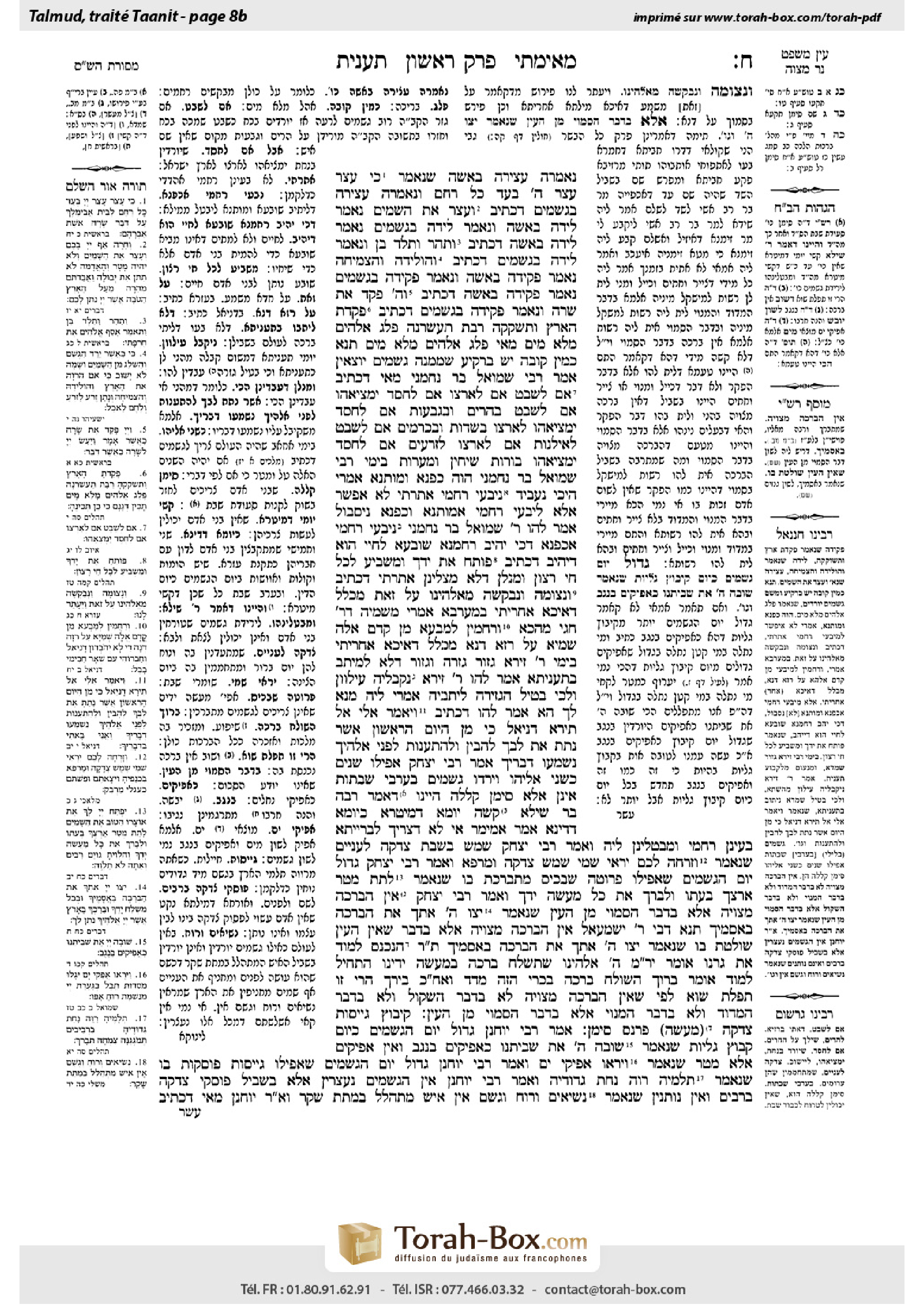
Taanit 8b: Talmud study for Daf Yomi
Daf Yomi is the daily study of one Talmud folio. Explore 37 tractates with scans, Hebrew text, Sefaria English and AI-generated French translations where annotated.
Passage selection and English or AI-generated French translation are available where the scan has annotations. Daf Study is independent of Torah-Box and Sefaria.
Browse Taanit · תענית · All tractatesTaanit 8b text and translations
This page of Taanit includes the Aramaic text, an English translation and an AI-generated French translation, alongside the scan above.
תענית ח׳ ב · Aramaic and Hebrew text
נֶאֶמְרָה עֲצִירָה בְּאִשָּׁה, שֶׁנֶּאֱמַר: ״כִּי עָצֹר עָצַר ה׳ בְּעַד כׇּל רֶחֶם״, וְנֶאֶמְרָה עֲצִירָה בִּגְשָׁמִים, דִּכְתִיב: ״וְעָצַר אֶת הַשָּׁמַיִם״.
נֶאֱמַר לֵידָה בְּאִשָּׁה וְנֶאֱמַר לֵידָה בִּגְשָׁמִים, נֶאֱמַר לֵידָה בְּאִשָּׁה, דִּכְתִיב: ״וַתַּהַר וַתֵּלֶד בֵּן״, וְנֶאֱמַר לֵידָה בִּגְשָׁמִים, דִּכְתִיב: ״וְהוֹלִידָהּ וְהִצְמִיחָהּ״.
נֶאֱמַר פְּקִידָה בְּאִשָּׁה, וְנֶאֱמַר פְּקִידָה בִּגְשָׁמִים. נֶאֱמַר פְּקִידָה בְּאִשָּׁה, דִּכְתִיב: ״וַה׳ פָּקַד אֶת שָׂרָה״, וְנֶאֱמַר פְּקִידָה בִּגְשָׁמִים, דִּכְתִיב: ״פָּקַדְתָּ הָאָרֶץ וַתְּשֹׁקְקֶהָ רַבַּת תַּעְשְׁרֶנָּה פֶּלֶג אֱלֹהִים מָלֵא מָיִם״.
מַאי ״פֶּלֶג אֱלֹהִים מָלֵא מַיִם״? תָּנָא: כְּמִין קוּבָּה יֵשׁ בָּרָקִיעַ, שֶׁמִּמֶּנָּה גְּשָׁמִים יוֹצְאִין.
אָמַר רַבִּי שְׁמוּאֵל בַּר נַחְמָנִי, מַאי דִּכְתִיב: ״אִם לְשֵׁבֶט אִם לְאַרְצוֹ אִם לְחֶסֶד יַמְצִאֵהוּ״. ״אִם לְשֵׁבֶט״ — בְּהָרִים וּבִגְבָעוֹת, ״אִם לְחֶסֶד יַמְצִאֵהוּ לְאַרְצוֹ״ — בְּשָׂדוֹת וּבִכְרָמִים.
״אִם לְשֵׁבֶט״ — לְאִילָנוֹת, ״אִם לְאַרְצוֹ״ — לִזְרָעִים, ״אִם לְחֶסֶד יַמְצִאֵהוּ״ — בּוֹרוֹת שִׁיחִין וּמְעָרוֹת.
בִּימֵי רַבִּי שְׁמוּאֵל בַּר נַחְמָנִי הֲוָה כַּפְנָא וּמוֹתָנָא, אָמְרִי: הֵיכִי נַעֲבֵיד? נִיבְעֵי רַחֲמֵי אַתַּרְתֵּי — לָא אֶפְשָׁר. אֶלָּא לִיבְעֵי רַחֲמֵי אַמּוֹתָנָא, וְכַפְנָא נִיסְבּוֹל. אֲמַר לְהוּ רַבִּי שְׁמוּאֵל בַּר נַחְמָנִי: נִיבְעֵי רַחֲמֵי אַכַּפְנָא, דְּכִי יָהֵיב רַחֲמָנָא שׂוּבְעָא — לְחַיֵּי הוּא דְּיָהֵיב, דִּכְתִיב: ״פּוֹתֵחַ אֶת יָדֶךָ וּמַשְׂבִּיעַ לְכׇל חַי רָצוֹן״.
וּמְנָלַן דְּלָא מְצַלִּינַן אַתַּרְתֵּי — דִּכְתִיב: ״וַנָּצוּמָה וַנְּבַקְשָׁה מֵאֱלֹהֵינוּ עַל זֹאת״, מִכְּלָל דְּאִיכָּא אַחֲרִיתִי. בְּמַעְרְבָא אָמְרִי מִשְּׁמֵיהּ דְּרַבִּי חַגַּי מֵהָכָא: ״וְרַחֲמִין לְמִבְעֵא מִן קֳדָם אֱלָהּ שְׁמַיָּא עַל רָזָא דְּנָה״, מִכְּלָל דְּאִיכָּא אַחֲרִיתִי.
בִּימֵי רַבִּי זֵירָא גְּזוּר שְׁמָדָא, וּגְזוּר דְּלָא לְמֵיתַב בְּתַעֲנִיתָא. אֲמַר לְהוּ רַבִּי זֵירָא: נְקַבְּלֵיהּ עִילָּוַון, וּלְכִי בָּטֵיל שְׁמָדָא לֵיתְבֵיהּ.
אָמְרִי לֵיהּ: מְנָא לָךְ הָא? אֲמַר לְהוּ, דִּכְתִיב: ״וַיֹּאמֶר אֵלַי אַל תִּירָא דָנִיֵּאל כִּי מִן הַיּוֹם הָרִאשׁוֹן אֲשֶׁר נָתַתָּ אֶת לִבְּךָ לְהָבִין וּלְהִתְעַנּוֹת לִפְנֵי אֱלֹהֶיךָ נִשְׁמְעוּ דְבָרֶיךָ״.
אָמַר רַבִּי יִצְחָק: אֲפִילּוּ שָׁנִים כִּשְׁנֵי אֵלִיָּהוּ, וְיָרְדוּ גְּשָׁמִים בְּעַרְבֵי שַׁבָּתוֹת — אֵינָן אֶלָּא סִימַן קְלָלָה. הַיְינוּ דְּאָמַר רַבָּה בַּר שֵׁילָא: קָשֶׁה יוֹמָא דְמִיטְרָא כְּיוֹמָא דְּדִינָא. אָמַר אַמֵּימָר: אִי לָא דִּצְרִיךְ לִבְרִיָּיתָא, בָּעֵינַן רַחֲמֵי וּמְבַטְּלִינַן לֵיהּ.
וְאָמַר רַבִּי יִצְחָק: שֶׁמֶשׁ בְּשַׁבָּת — צְדָקָה לַעֲנִיִּים, שֶׁנֶּאֱמַר: ״וְזָרְחָה לָכֶם יִרְאֵי שְׁמִי שֶׁמֶשׁ צְדָקָה וּמַרְפֵּא״. וְאָמַר רַבִּי יִצְחָק: גָּדוֹל יוֹם הַגְּשָׁמִים, שֶׁאֲפִילּוּ פְּרוּטָה שֶׁבַּכִּיס מִתְבָּרֶכֶת בּוֹ, שֶׁנֶּאֱמַר: ״לָתֵת מְטַר אַרְצְךָ בְּעִתּוֹ וּלְבָרֵךְ אֵת כׇּל מַעֲשֵׂה יָדֶךָ״.
וְאָמַר רַבִּי יִצְחָק: אֵין הַבְּרָכָה מְצוּיָה אֶלָּא בְּדָבָר הַסָּמוּי מִן הָעַיִן, שֶׁנֶּאֱמַר: ״יְצַו ה׳ אִתְּךָ אֶת הַבְּרָכָה בַּאֲסָמֶיךָ״. תָּנָא דְּבֵי רַבִּי יִשְׁמָעֵאל: אֵין הַבְּרָכָה מְצוּיָה אֶלָּא בְּדָבָר שֶׁאֵין הָעַיִן שׁוֹלֶטֶת בּוֹ, שֶׁנֶּאֱמַר: ״יְצַו ה׳ אִתְּךָ אֶת הַבְּרָכָה בַּאֲסָמֶיךָ״.
תָּנוּ רַבָּנַן: הַנִּכְנָס לָמוֹד אֶת גׇּרְנוֹ, אוֹמֵר: ״יְהִי רָצוֹן מִלְּפָנֶיךָ ה׳ אֱלֹהֵינוּ שֶׁתִּשְׁלַח בְּרָכָה בְּמַעֲשֵׂה יָדֵנוּ״. הִתְחִיל לָמוֹד, אוֹמֵר: ״בָּרוּךְ הַשּׁוֹלֵחַ בְּרָכָה בַּכְּרִי הַזֶּה״. מָדַד וְאַחַר כָּךְ בֵּירַךְ — הֲרֵי זוֹ תְּפִלַּת שָׁוְא, לְפִי שֶׁאֵין הַבְּרָכָה מְצוּיָה לֹא בְּדָבָר הַשָּׁקוּל, וְלֹא בְּדָבָר הַמָּדוּד, וְלֹא בְּדָבָר הַמָּנוּי, אֶלָּא בְּדָבָר הַסָּמוּי מִן הָעַיִן.
קִבּוּץ, גְּיָיסוֹת, צְדָקָה, מַעֲשֵׂר, פַּרְנָס סִימָן. אָמַר רַבִּי יוֹחָנָן: גָּדוֹל יוֹם הַגְּשָׁמִים כְּיוֹם קִבּוּץ גָּלִיּוֹת, שֶׁנֶּאֱמַר: ״שׁוּבָה ה׳ אֶת שְׁבִיתֵנוּ כַּאֲפִיקִים בַּנֶּגֶב״, וְאֵין ״אֲפִיקִים״ אֶלָּא מָטָר, שֶׁנֶּאֱמַר: ״וַיֵּרָאוּ אֲפִקֵי יָם״.
וְאָמַר רַבִּי יוֹחָנָן: גָּדוֹל יוֹם הַגְּשָׁמִים, שֶׁאֲפִילּוּ גְּיָיסוֹת פּוֹסְקוֹת בּוֹ, שֶׁנֶּאֱמַר: ״תְּלָמֶיהָ רַוֵּה נַחֵת גְּדוּדֶיהָ״. וְאָמַר רַבִּי יוֹחָנָן: אֵין הַגְּשָׁמִים נֶעֱצָרִין אֶלָּא בִּשְׁבִיל פּוֹסְקֵי צְדָקָה בָּרַבִּים וְאֵין נוֹתְנִין, שֶׁנֶּאֱמַר: ״נְשִׂיאִים וְרוּחַ וְגֶשֶׁם אָיִן אִישׁ מִתְהַלֵּל בְּמַתַּת שָׁקֶר״.
וְאָמַר רַבִּי יוֹחָנָן, מַאי דִּכְתִיב:
Taanit 8b · English translation
Reish Lakish elaborates: Closing up is stated with regard to a woman who cannot give birth, as it is stated: “For the Lord has fast closed up all the wombs” (Genesis 20:18), and closing up is stated with regard to rains, as it is written: “And He will close up the heavens” (Deuteronomy 11:17).
Likewise, an expression of giving birth is stated with regard to a woman, and an expression of giving birth is also stated with regard to rain. Specifically, giving birth is stated with regard to a woman, as it is written in the case of Rachel, when God had mercy on her: “And she conceived and gave birth to a son” (Genesis 30:23). And giving birth is stated with regard to rain, as it is written: “For as the rain comes down, and the snow from heaven, and does not return there, except it waters the earth and causes it to give birth and bud” (Isaiah 55:10).
Lastly, an expression of remembering is stated in connection with a woman, and an expression of remembering is also stated in connection to rain. Remembering is stated in connection with a woman, as it is written: “And the Lord remembered Sarah” (Genesis 21:1), and remembering is stated in connection to rain, as it is written: “You have remembered the earth and have watered it; greatly enriching it, with the pool of God that is full of water” (Psalms 65:10).
The Gemara asks a question with regard to this verse. What is the meaning of the phrase: “With the pool of God that is full of water”? The Gemara answers that it was taught in a baraita: There is a kind of vault [kuba] in the sky, out of which the rain falls.
Rabbi Shmuel bar Naḥmani said: What is the meaning of that which is written: “Whatever he commands them upon the face of the habitable world, whether it is for correction, or for His earth, or for mercy that He causes it to come” (Job 37:12–13)? The phrase “whether it is for correction” means that if the people are judged unfavorably, the rain will fall on the mountains and on the hills. The phrase “or for His earth” indicates that if they have been judged “for mercy,” He will cause it to come “for His earth,” on the fields and on the vineyards.
Alternatively, the phrase “whether it is for correction” means that the rain will provide benefit only for the trees; “or for His earth” indicates that rain will fall solely for the benefit of seeds; and “or for mercy that He causes it to come” means that rain will fill the cisterns, ditches, and caves with enough water to last the dry season.
§ The Gemara relates: In the days of Rabbi Shmuel bar Naḥmani there was a famine and a plague. The Sages said: What should we do? Should we pray for mercy for two troubles, both the famine and the plague? This is not possible, as it is improper to pray for the alleviation of two afflictions at once. Rather, let us pray for mercy for the plague, and as for the famine, we must bear it. Rabbi Shmuel bar Naḥmani said to them: On the contrary, let us pray for mercy for the famine, as when the Merciful One provides plenty, He gives it for the sake of the living, i.e., if God answers this prayer then he will certainly bring an end to the plague as well, as it is written: “You open Your hand and satisfy every living thing with favor” (Psalms 145:16).
The Gemara explains: And from where do we derive that one should not pray for two troubles simultaneously? As it is written: “So we fasted and beseeched our God for this” (Ezra 8:23). From the fact that the verse states: “For this,” it may be inferred that there is another trouble about which the people did not pray. In the West, Eretz Yisrael, they say in the name of Rabbi Ḥaggai that this idea comes from here: “That they might ask mercy of the God of Heaven concerning this secret” (Daniel 2:18). From the fact that the verse states: “This secret,” it may be inferred that there is another trouble about which they did not pray.
In a similar vein, the Gemara relates: In the days of Rabbi Zeira a decree of religious persecution was decreed against the Jews. And as the decree was that they were not allowed to fast, the Jews were certainly unable to fast and pray for the nullification of the decree itself. Rabbi Zeira said to the people: Let us take a fast upon ourselves, despite the fact that in practice we cannot observe it, and when the decree of religious persecution is annulled we will observe the fast.
They said to him: From where do you know this, the fact that one may take a fast upon himself that he cannot observe? Rabbi Zeira said to them that the reason is as it is written: “Then he said to me: Fear not, Daniel, for from the first day that you set your heart to understand, and to fast before your God, your words were heard” (Daniel 10:12). This verse indicates that from the moment one turns his heart to fast, his prayers are heard.
The Gemara returns to the topic of rain. Rabbi Yitzḥak said: Even in years like the years of Elijah, when God decreed that no rain would fall, if rain falls on Shabbat eves it is nothing other than a sign of a curse, as the rain disrupts the preparations for Shabbat. This is the same as that which Rabba bar Sheila said: A rainy day is as difficult as a judgment day. Ameimar even said: Were it not for the fact that rain is needed by people, we would pray for mercy and to annul it, due to the nuisances that rain causes.
And Rabbi Yitzḥak said: Sun on Shabbat is charity for the poor, who are then able to enjoy the outdoors without suffering from cold. As it is stated: “But for you who fear My name, the sun of righteousness shall arise with healing in its wings” (Malachi 3:20). And Rabbi Yitzḥak further said: The day of the rains is great, as even a peruta in one’s pocket is blessed on it, as it is stated: “To give the rain of your land in its due time, and to bless all the work of your hand” (Deuteronomy 28:12).
And apropos blessings, Rabbi Yitzḥak said: A blessing is found only in an object that is hidden [samui] from the eye, not in an item visible to all, as public miracles are exceedingly rare. As it is stated: “The Lord will command His blessing upon you in your barns [ba’asamekha]” (Deuteronomy 28:8). Rabbi Yitzḥak’s exposition is based on the linguistic similarity between samui and asamekha. Likewise, the school of Rabbi Yishmael taught: A blessing is found only in an object that is not exposed to the eye, as it is stated: “The Lord will command His blessing upon you in your barns.”
The Sages taught: One who enters to measure produce in his granary recites: May it be Your will, Lord our God, that You send a blessing upon the work of our hands. After he has begun to measure, he recites: Blessed is He who sends a blessing upon this pile. If one first measured and afterward recited the blessing, it is a prayer in vain, as a blessing is not found either in an object that is weighed or in an object that is measured or in an object that is counted, as these would constitute open miracles. Rather, a blessing is found only in an object that is hidden from the eye.
§ The Gemara cites five statements of Rabbi Yoḥanan, in accordance with the following mnemonic: Ingathering; armies; charity; tithe; sustainer. Rabbi Yoḥanan said: The day of the rains is as great as the day of the ingathering of the exiles, as it is stated: “Turn our captivity, O Lord, as the streams in the dry land” (Psalms 126:4), and “streams” means nothing other than rain, as it is stated: “And the streams of the sea appeared” (II Samuel 22:16).
And Rabbi Yoḥanan said: The day of the rains is great, as even armies stop fighting on it due to the rain and mud. As it is stated: “Watering its ridges abundantly; settling down its furrows [gedudeha]” (Psalms 65:11). As the word gedudim can mean both furrows or armies and is spelled identically with each meaning, this alludes to the idea that during the rainy season soldiers become entrenched in place. And Rabbi Yoḥanan further said: Rain is withheld only due to those who pledge charity in public but do not give it, as it is stated: “As vapors and wind without rain, so is he who boasts of a false gift” (Proverbs 25:14).
And Rabbi Yoḥanan said: What is the meaning of that which is written:
Taanit 8b · Traduction française (IA)
Reish Lakish développe : Le terme « fermer » est employé à propos d’une femme qui ne peut pas enfanter, comme il est dit : « Car le Seigneur avait complètement fermé toutes les matrices » (Genèse 20:18), et le même terme est employé à propos des pluies, comme il est écrit : « Il fermera les cieux » (Deutéronome 11:17).
De même, une expression évoquant l’enfantement est employée à propos d’une femme, et une autre à propos de la pluie. Une expression évoquant l’enfantement est employée à propos d’une femme, comme il est écrit au sujet de Rachel, lorsque Dieu eut pitié d’elle : « Elle conçut et enfanta un fils » (Genèse 30:23). Une expression de même sens est employée à propos de la pluie, comme il est écrit : « Car la pluie descend, ainsi que la neige du ciel, et n’y retourne pas sans avoir arrosé la terre, l’avoir fait enfanter et germer » (Isaïe 55:10).
Enfin, une expression évoquant le souvenir est employée à propos d’une femme, et une autre à propos de la pluie. Une expression évoquant le souvenir est employée à propos d’une femme, comme il est écrit : « Le Seigneur se souvint de Sarah » (Genèse 21:1), et une expression de même sens est employée à propos de la pluie, comme il est écrit : « Tu as pris soin de la terre et tu l’as arrosée ; tu l’enrichis abondamment, avec le bassin de Dieu, plein d’eau » (Psaumes 65:10).
La Guemara pose une question au sujet de ce verset. Que signifie l’expression : « Avec le bassin de Dieu, plein d’eau » ? La Guemara répond qu’il a été enseigné dans une baraïta : Il existe dans le ciel une sorte de voûte [kuba], d’où tombe la pluie.
Rabbi Shmuel bar Naḥmani dit : Que signifie ce qui est écrit : « Tout ce qu’Il leur commande à la surface du monde habité, que ce soit pour correction, pour sa terre ou par miséricorde, Il le fait venir » (Job 37:12–13) ? L’expression « que ce soit pour correction » signifie que si les gens sont jugés défavorablement, la pluie tombera sur les montagnes et les collines. L’expression « ou pour sa terre » indique que s’ils sont jugés dignes de miséricorde, Il fera tomber la pluie « pour sa terre », sur les champs et les vignobles.
Autre interprétation : l’expression « que ce soit pour correction » signifie que la pluie ne profitera qu’aux arbres ; « ou pour sa terre » indique que la pluie ne tombera qu’au bénéfice des semences ; et « ou par miséricorde, Il la fait venir » signifie que la pluie remplira les citernes, les fossés et les grottes d’une quantité d’eau suffisante pour toute la saison sèche.
§ La Guemara rapporte : À l’époque de Rabbi Shmuel bar Naḥmani, il y eut une famine et une épidémie. Les Sages dirent : Que devons-nous faire ? Prier pour obtenir miséricorde au sujet de deux malheurs, la famine et l’épidémie ? Cela n’est pas possible, car il ne convient pas de prier pour être délivré de deux afflictions à la fois. Prions plutôt pour obtenir miséricorde au sujet de l’épidémie et, quant à la famine, nous devons la supporter. Rabbi Shmuel bar Naḥmani leur dit : Au contraire, prions pour obtenir miséricorde au sujet de la famine, car lorsque le Miséricordieux accorde l’abondance, Il le fait pour les êtres vivants. Autrement dit, si Dieu exauce cette prière, Il mettra certainement aussi fin à l’épidémie, comme il est écrit : « Tu ouvres ta main et rassasies avec faveur tout être vivant » (Psaumes 145:16).
La Guemara explique : D’où déduisons-nous qu’on ne doit pas prier simultanément pour deux malheurs ? Comme il est écrit : « Nous jeûnâmes et suppliâmes notre Dieu à ce sujet » (Esdras 8:23). Puisque le verset dit « à ce sujet », on peut en déduire qu’il existe un autre malheur au sujet duquel le peuple n’a pas prié. En Occident, c’est-à-dire en Terre d’Israël, on dit au nom de Rabbi Ḥaggai que cette idée vient de ce verset : « Afin qu’ils implorent la miséricorde du Dieu du ciel au sujet de ce mystère » (Daniel 2:18). Puisque le verset dit « ce mystère », on peut en déduire qu’il existe un autre malheur au sujet duquel ils n’ont pas prié.
Dans le même ordre d’idées, la Guemara rapporte : À l’époque de Rabbi Zeira, un décret de persécution religieuse fut prononcé contre les Juifs. Comme ce décret leur interdisait de jeûner, les Juifs ne pouvaient évidemment pas jeûner et prier pour l’annulation du décret lui-même. Rabbi Zeira dit au peuple : Prenons sur nous un jeûne, même si nous ne pouvons pas le respecter en pratique ; lorsque le décret de persécution religieuse sera annulé, nous observerons le jeûne.
Ils lui dirent : D’où sais-tu qu’on peut s’imposer un jeûne qu’on ne peut pas observer ? Rabbi Zeira leur répondit que cela ressort de ce qui est écrit : « Il me dit alors : Ne crains pas, Daniel, car dès le premier jour où tu as résolu de comprendre et de jeûner devant ton Dieu, tes paroles ont été entendues » (Daniel 10:12). Ce verset indique que dès l’instant où quelqu’un décide dans son cœur de jeûner, ses prières sont entendues.
La Guemara revient au sujet de la pluie. Rabbi Yitzḥak dit : Même durant des années semblables à celles d’Élie, lorsque Dieu décréta qu’aucune pluie ne tomberait, si la pluie tombe la veille du Chabbat, elle n’est rien d’autre qu’un signe de malédiction, car elle perturbe les préparatifs du Chabbat. Cela correspond à ce que Rabba bar Sheila a dit : Un jour de pluie est aussi pénible qu’un jour de jugement. Ameimar a même dit : Si les gens n’avaient pas besoin de la pluie, nous prierions pour obtenir miséricorde et pour qu’elle cesse, en raison des désagréments qu’elle cause.
Et Rabbi Yitzḥak dit : Le soleil le Chabbat est une aumône pour les pauvres, qui peuvent alors profiter du plein air sans souffrir du froid. Comme il est dit : « Mais pour vous qui craignez mon nom, le soleil de justice se lèvera, avec la guérison dans ses ailes » (Malachie 3:20). Rabbi Yitzḥak dit également : Le jour de la pluie est grand, car même une perouta dans sa poche est bénie ce jour-là, comme il est dit : « Pour donner la pluie de ton pays en son temps et bénir tout le travail de tes mains » (Deutéronome 28:12).
Et à propos des bénédictions, Rabbi Yitzḥak dit : La bénédiction ne se trouve que dans une chose cachée [samui] aux regards, et non dans un objet visible de tous, car les miracles publics sont extrêmement rares. Comme il est dit : « Le Seigneur ordonnera sa bénédiction pour toi dans tes greniers [ba’asamekha] » (Deutéronome 28:8). L’interprétation de Rabbi Yitzḥak repose sur la ressemblance linguistique entre samui et asamekha. De même, l’école de Rabbi Yishmael a enseigné : La bénédiction ne se trouve que dans une chose qui n’est pas exposée aux regards, comme il est dit : « Le Seigneur ordonnera sa bénédiction pour toi dans tes greniers. »
Les Sages ont enseigné : Celui qui entre dans son grenier pour mesurer sa récolte récite : Que telle soit Ta volonté, Seigneur notre Dieu, d’envoyer une bénédiction sur l’œuvre de nos mains. Après avoir commencé à mesurer, il récite : Béni soit Celui qui envoie une bénédiction sur ce tas. Si quelqu’un mesure d’abord, puis récite la bénédiction, sa prière est vaine, car la bénédiction ne se trouve ni dans ce qui est pesé, ni dans ce qui est mesuré, ni dans ce qui est compté, car il s’agirait là de miracles manifestes. La bénédiction ne se trouve, au contraire, que dans une chose cachée aux regards.
§ La Guemara cite cinq déclarations de Rabbi Yoḥanan, selon le moyen mnémotechnique suivant : rassemblement ; armées ; aumône ; dîme ; soutien. Rabbi Yoḥanan dit : Le jour de la pluie est aussi grand que le jour du rassemblement des exilés, comme il est dit : « Rétablis notre captivité, Seigneur, comme les cours d’eau dans le pays aride » (Psaumes 126:4), et « cours d’eau » ne désigne rien d’autre que la pluie, comme il est dit : « Les cours d’eau de la mer apparurent » (II Samuel 22:16).
Et Rabbi Yoḥanan dit : Le jour de la pluie est grand, car même les armées cessent de combattre ce jour-là, à cause de la pluie et de la boue. Comme il est dit : « En arrosant abondamment ses sillons, en aplanissant ses mottes [gedudeha] » (Psaumes 65:11). Puisque le mot gedudim peut désigner aussi bien des sillons que des armées et s’écrit de la même manière dans les deux sens, cela fait allusion au fait que, pendant la saison des pluies, les soldats restent retranchés sur place. Rabbi Yoḥanan dit également : La pluie n’est retenue qu’à cause de ceux qui promettent publiquement de faire l’aumône mais ne la donnent pas, comme il est dit : « Des nuages et du vent sans pluie, tel est celui qui se vante d’un don mensonger » (Proverbes 25:14).
Et Rabbi Yoḥanan dit : Que signifie ce qui est écrit :
Traduction française générée par IA à partir de l’édition anglaise de Sefaria. Vérifie toujours un passage avec le texte source.
Text from Sefaria: William Davidson Edition - Vocalized Aramaic (CC BY NC); William Davidson Edition - English (CC BY NC).