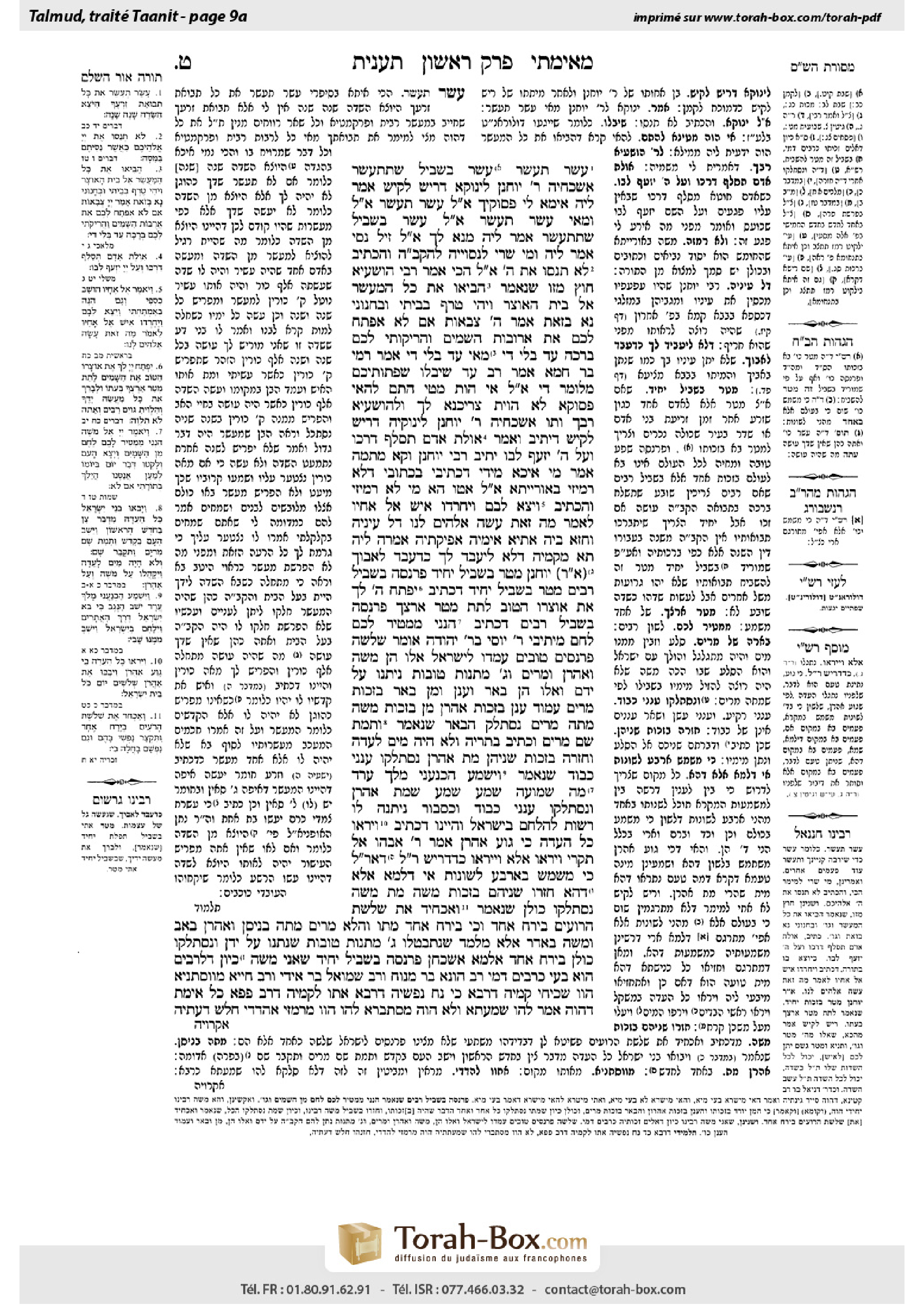
Taanit 9a: Talmud study for Daf Yomi
Daf Yomi is the daily study of one Talmud folio. Explore 37 tractates with scans, Hebrew text, Sefaria English and AI-generated French translations where annotated.
Passage selection and English or AI-generated French translation are available where the scan has annotations. Daf Study is independent of Torah-Box and Sefaria.
Browse Taanit · תענית · All tractatesTaanit 9a text and translations
This page of Taanit includes the Aramaic text, an English translation and an AI-generated French translation, alongside the scan above.
תענית ט׳ א · Aramaic and Hebrew text
״עַשֵּׂר תְּעַשֵּׂר״ — עַשֵּׂר בִּשְׁבִיל שֶׁתִּתְעַשֵּׁר.
אַשְׁכְּחֵיהּ רַבִּי יוֹחָנָן לְיָנוֹקָא דְּרֵישׁ לָקִישׁ, אֲמַר לֵיהּ: אִימָּא לִי פְּסוּקָיךְ! אֲמַר לֵיהּ: ״עַשֵּׂר תְּעַשֵּׂר״. אֲמַר לֵיהּ: וּמַאי ״עַשֵּׂר תְּעַשֵּׂר״? אֲמַר לֵיהּ: עַשֵּׂר בִּשְׁבִיל שֶׁתִּתְעַשֵּׁר, אֲמַר לֵיהּ: מְנָא לָךְ? אֲמַר לֵיהּ: זִיל נַסִּי.
אֲמַר לֵיהּ: וּמִי שְׁרֵי לְנַסּוֹיֵיהּ לְהַקָּדוֹשׁ בָּרוּךְ הוּא? וְהָכְתִיב: ״לֹא תְנַסּוּ אֶת ה׳״! אֲמַר לֵיהּ, הָכִי אָמַר רַבִּי הוֹשַׁעְיָא: חוּץ מִזּוֹ, שֶׁנֶּאֱמַר: ״הָבִיאוּ אֶת כׇּל הַמַּעֲשֵׂר אֶל בֵּית הָאוֹצָר וִיהִי טֶרֶף בְּבֵיתִי וּבְחָנוּנִי נָא בָּזֹאת אָמַר ה׳ צְבָאוֹת אִם לֹא אֶפְתַּח לָכֶם אֵת אֲרֻבּוֹת הַשָּׁמַיִם וַהֲרִיקֹתִי לָכֶם בְּרָכָה עַד בְּלִי דָי״.
מַאי ״עַד בְּלִי דָי״? אָמַר רָמֵי בַּר חָמָא אָמַר רַב: עַד שֶׁיִּבְלוּ שִׂפְתוֹתֵיכֶם מִלּוֹמַר ״דַּי״. אֲמַר לֵיהּ: אִי הֲוָת מָטֵי הָתָם לְהַאי פְּסוּקָא, לָא הֲוֵית צְרִיכְנָא לָךְ וּלְהוֹשַׁעְיָא רַבָּךְ.
וְתוּ אַשְׁכְּחֵיהּ רַבִּי יוֹחָנָן לְיָנוֹקֵיהּ דְּרֵישׁ לָקִישׁ דְּיָתֵיב וְאָמַר: ״אִוֶּלֶת אָדָם תְּסַלֵּף דַּרְכּוֹ וְעַל ה׳ יִזְעַף לִבּוֹ״.
יְתֵיב רַבִּי יוֹחָנָן וְקָא מַתְמַהּ. אָמַר: מִי אִיכָּא מִידֵּי דִּכְתִיבִי בִּכְתוּבֵי דְּלָא רְמִיזִי בְּאוֹרָיְיתָא? אָמַר לֵיהּ: אַטּוּ הָא מִי לָא רְמִיזִי, וְהָכְתִיב: ״וַיֵּצֵא לִבָּם וַיֶּחֶרְדוּ אִישׁ אֶל אָחִיו לֵאמֹר מַה זֹּאת עָשָׂה אֱלֹהִים לָנוּ״.
דַּל עֵינֵיהּ וַחֲזָא בֵּיהּ, אָתְיָא אִימֵּיהּ אַפֵּיקְתֵּיהּ, אֲמַרָה לֵיהּ: תָּא מִקַּמֵּיהּ, דְּלָא לֶיעְבַּד לָךְ כְּדַעֲבַד לַאֲבוּךְ.
אָמַר רַבִּי יוֹחָנָן: מָטָר בִּשְׁבִיל יָחִיד, פַּרְנָסָה בִּשְׁבִיל רַבִּים. מָטָר בִּשְׁבִיל יָחִיד, דִּכְתִיב: ״יִפְתַּח ה׳ לְךָ אֶת אוֹצָרוֹ הַטּוֹב לָתֵת מְטַר אַרְצְךָ״. פַּרְנָסָה בִּשְׁבִיל רַבִּים, דִּכְתִיב: ״הִנְנִי מַמְטִיר לָכֶם לֶחֶם״.
מֵיתִיבִי, רַבִּי יוֹסֵי בְּרַבִּי יְהוּדָה אוֹמֵר: שְׁלֹשָׁה פַּרְנָסִים טוֹבִים עָמְדוּ לְיִשְׂרָאֵל, אֵלּוּ הֵן: מֹשֶׁה וְאַהֲרֹן וּמִרְיָם. וְשָׁלֹשׁ מַתָּנוֹת טוֹבוֹת נִיתְּנוּ עַל יָדָם, וְאֵלּוּ הֵן: בְּאֵר, וְעָנָן, וּמָן. בְּאֵר — בִּזְכוּת מִרְיָם, עַמּוּד עָנָן — בִּזְכוּת אַהֲרֹן, מָן — בִּזְכוּת מֹשֶׁה. מֵתָה מִרְיָם — נִסְתַּלֵּק הַבְּאֵר, שֶׁנֶּאֱמַר: ״וַתָּמׇת שָׁם מִרְיָם״, וּכְתִיב בָּתְרֵיהּ: ״וְלֹא הָיָה מַיִם לָעֵדָה״, וְחָזְרָה בִּזְכוּת שְׁנֵיהֶן.
מֵת אַהֲרֹן — נִסְתַּלְּקוּ עַנְנֵי כָּבוֹד, שֶׁנֶּאֱמַר: ״וַיִּשְׁמַע הַכְּנַעֲנִי מֶלֶךְ עֲרָד״, מָה שְׁמוּעָה שָׁמַע? שָׁמַע שֶׁמֵּת אַהֲרֹן וְנִסְתַּלְּקוּ עַנְנֵי כָּבוֹד, וּכְסָבוּר נִיתְּנָה לוֹ רְשׁוּת לְהִלָּחֵם בְּיִשְׂרָאֵל. וְהַיְינוּ דִּכְתִיב: ״וַיִּרְאוּ כׇּל הָעֵדָה כִּי גָוַע אַהֲרֹן״.
אָמַר רַבִּי אֲבָהוּ: אַל תִּקְרֵי ״וַיִּרְאוּ״, אֶלָּא ״וַיִּירָאוּ״. כִּדְדָרֵישׁ רֵישׁ לָקִישׁ, דְּאָמַר רֵישׁ לָקִישׁ: ״כִּי״ מְשַׁמֵּשׁ בְּאַרְבַּע לְשׁוֹנוֹת: אִי, דִּלְמָא, אֶלָּא, דְּהָא.
חָזְרוּ שְׁנֵיהֶם בִּזְכוּת מֹשֶׁה, מֵת מֹשֶׁה נִסְתַּלְּקוּ כּוּלָּן, שֶׁנֶּאֱמַר: ״וָאַכְחִד אֶת שְׁלֹשֶׁת הָרֹעִים בְּיֶרַח אֶחָד״, וְכִי בְּיֶרַח אֶחָד מֵתוּ? וַהֲלֹא מִרְיָם מֵתָה בְּנִיסָן, וְאַהֲרֹן בְּאָב, וּמֹשֶׁה בַּאֲדָר! אֶלָּא, מְלַמֵּד שֶׁנִּתְבַּטְּלוּ שָׁלֹשׁ מַתָּנוֹת טוֹבוֹת שֶׁנִּתְּנוּ עַל יָדָן, וְנִסְתַּלְּקוּ כּוּלָּן בְּיֶרַח אֶחָד.
אַלְמָא אַשְׁכְּחַן פַּרְנָסָה בִּשְׁבִיל יָחִיד! שָׁאנֵי מֹשֶׁה, כֵּיוָן דִּלְרַבִּים הוּא בָּעֵי — כְּרַבִּים דָּמֵי.
רַב הוּנָא בַּר מָנוֹחַ וְרַב שְׁמוּאֵל בַּר אִידִי וְרַב חִיָּיא מִוּוֹסְתַּנְיָא הֲווֹ שְׁכִיחִי קַמֵּיהּ דְּרָבָא. כִּי נָח נַפְשֵׁיהּ דְּרָבָא, אֲתוֹ לְקַמֵּיהּ דְּרַב פָּפָּא, כׇּל אֵימַת דַּהֲוָה אָמַר לְהוּ שְׁמַעְתָּא וְלָא הֲוָה מִסְתַּבְּרָא לְהוּ, הֲווֹ מְרַמְּזִי אַהֲדָדֵי. חֲלַשׁ דַּעְתֵּיהּ.
Taanit 9a · English translation
“A tithe shall you tithe [te’aser]” (Deuteronomy 14:22)? This phrase can be interpreted homiletically: Take a tithe [asser] so that you will become wealthy [titasher], in the merit of the mitzva.
Rabbi Yoḥanan found the young son of Reish Lakish. He said to the boy: Recite to me your verse, i.e., the verse you studied today in school. The boy said to him: “A tithe shall you tithe.” The boy further said to Rabbi Yoḥanan: But what is the meaning of this phrase: “A tithe shall you tithe”? Rabbi Yoḥanan said to him: The verse means: Take a tithe so that you will become wealthy. The boy said to Rabbi Yoḥanan: From where do you derive that this is so? Rabbi Yoḥanan said to him: Go and test it.
The boy said to him: And is it permitted to test the Holy One, Blessed be He? But isn’t it written: “You shall not test the Lord your God” (Deuteronomy 6:16)? Rabbi Yoḥanan said to the boy that Rabbi Hoshaya said as follows: It is prohibited to test God in any way, except in this case of tithes, as it is stated: “Bring the whole tithe into the storeroom, that there may be food in My house, and test Me now by this, said the Lord of hosts, if I will not open for you the windows of heaven, and pour out for you a blessing that there shall be more than sufficiency” (Malachi 3:10).
In relation to the above verse, the Gemara asks: What is the meaning of the phrase: “That there shall be more than sufficiency [ad beli dai]”? Rami bar Ḥama said that Rav said: It means that the abundance will be so great that your lips will be worn out [yivlu], similar to the word beli, from saying enough [dai]. Returning to the above incident, the Gemara adds that the boy said to Rabbi Yoḥanan: Your claim appears explicitly in a verse. If I had arrived there, at this verse, I would not have needed you or Hoshaya your teacher, as I could have understood it on my own.
The Gemara relates another story about the precociousness of this child. And furthermore, on a different occasion Rabbi Yoḥanan found the young son of Reish Lakish, when he was sitting and studying and he was reciting the verse: “The foolishness of man perverts his way, and his heart frets against the Lord” (Proverbs 19:3). This verse means that when someone sins and every manner of mishap befalls him, he complains and wonders why these things are happening to him.
Rabbi Yoḥanan sat down and wondered aloud about this verse, saying: Is there anything that is written in the Writings that is not alluded to in the Torah at all? I cannot think of any hint of this idea in the Torah itself. The child said to him: Is that to say that this idea is really not alluded to in the Torah? But isn’t it written, with regard to Joseph’s brothers: “And their heart failed them and they turned trembling to one to another, saying: What is this that God has done to us?” (Genesis 42:28). This verse exemplifies the notion that when one sins and encounters troubles, he wonders why it is happening to him.
Impressed by the youth’s wisdom, Rabbi Yoḥanan raised his eyes and stared at the boy. At this point, the boy’s mother came and took him away, saying to him: Come away from Rabbi Yoḥanan, so that he does not do to you as he did to your father. Reish Lakish, the boy’s father, died during a heated dispute with Rabbi Yoḥanan over a Torah matter. The argument ended with an offended look from Rabbi Yoḥanan which caused Reish Lakish’s death, and the boy’s mother was afraid that her son might suffer the same fate.
§ After this brief digression, the Gemara turns to the fifth in the series of statements by Rabbi Yoḥanan concerning rain. Rabbi Yoḥanan said: Rain falls even for the sake of an individual, in response to the petition of a single person in need of rain, whereas a blessing of sustenance comes only for the sake of many. Rain falls even for the sake of an individual, as it is written: “The Lord will open for you His good treasure, the heavens, to give the rain of your land” (Deuteronomy 28:12). The fact that this verse is written in the second person singular demonstrates that rain can fall even for the sake of an individual. Rabbi Yoḥanan further proves that sustenance comes for the sake of many, as it is written: “Behold I will cause to rain bread from the heavens for you” (Exodus 16:4). Here, God is referring to the people in the plural form.
The Gemara raises an objection from a baraita: Rabbi Yosei, son of Rabbi Yehuda, says: Three good sustainers rose up for the Jewish people during the exodus from Egypt, and they are: Moses, Aaron and Miriam. And three good gifts were given from Heaven through their agency, and these are they: The well of water, the pillar of cloud, and the manna. He elaborates: The well was given to the Jewish people in the merit of Miriam; the pillar of cloud was in the merit of Aaron; and the manna in the merit of Moses. When Miriam died the well disappeared, as it is stated: “And Miriam died there” (Numbers 20:1), and it says thereafter in the next verse: “And there was no water for the congregation” (Numbers 20:2). But the well returned in the merit of both Moses and Aaron.
When Aaron died the clouds of glory disappeared, as it is stated: “And the Canaanite, the king of Arad heard” (Numbers 33:40). What report did he hear? He heard that Aaron had died and the clouds of glory had disappeared, and he thought that the Jewish people were no longer protected by Heaven and therefore he had been given permission to go to war against the Jewish people. And this disappearance of the clouds is the meaning of that which is written: “And all the congregation saw that [ki] Aaron was dead” (Numbers 20:29).
Rabbi Abbahu said: Do not read the verse as: “And they saw [va’yiru]”; rather, read it as: And they were seen [va’yera’u], as the clouds which had concealed the Jewish people were temporarily removed. This is as Reish Lakish taught. As Reish Lakish said: The term ki actually has at least four distinct meanings: If; perhaps; but; because, or that. According to this interpretation, the verse would be rendered: And all the congregation was seen, because [ki] Aaron was dead.
The baraita continues: Both the well and the clouds of glory returned in the merit of Moses. However, when Moses died all of them disappeared. As it is stated: “And I cut off the three shepherds in one month” (Zechariah 11:8). But did the three shepherds really die in one month? Didn’t Miriam die in the month of Nisan, and Aaron in Av and Moses in Adar? Rather, this verse teaches us that with the death of Moses the three good gifts that were given through their agency were annulled, and all three gifts disappeared in one month, which made it seem as though all three leaders had died at the same time.
The Gemara explains the difficulty from this baraita. Apparently, we find that sustenance can come for the sake of an individual, as the baraita states that sustenance in the form of manna came for the sake of Moses. The Gemara answers: Moses is different, since he requested the manna for many, and therefore he was considered like many, not as an individual.
The Gemara relates a story concerning the aforementioned verse from Zechariah. Rav Huna bar Manoaḥ, Rav Shmuel bar Idi, and Rav Ḥiyya from Vastanya were often found before Rava, as they were among his most distinguished students. When Rava died, they came before Rav Pappa to learn from him. However, as also they were great Sages, whenever Rav Pappa would say a halakha that did not sound reasonable to them, they would gesture to each other that Rav Pappa was not equal in stature to Rava. Rav Pappa was offended by their behavior.
Taanit 9a · Traduction française (IA)
« Tu prélèveras une dîme [te’aser] » (Deutéronome 14,22) ? Cette expression peut s’interpréter de manière homilétique : prélève une dîme [asser] afin de devenir riche [titasher], par le mérite de la mitsva.
Rabbi Yoḥanan rencontra le jeune fils de Reish Lakish. Il lui dit : « Récite-moi ton verset », c’est-à-dire le verset que tu as étudié aujourd’hui à l’école. Le garçon lui répondit : « Tu prélèveras une dîme. » Puis il demanda à Rabbi Yoḥanan : « Mais que signifie cette expression : “Tu prélèveras une dîme” ? » Rabbi Yoḥanan lui répondit : « Le verset signifie : prélève une dîme afin de devenir riche. » Le garçon demanda à Rabbi Yoḥanan : « D’où déduis-tu cela ? » Rabbi Yoḥanan lui répondit : « Va vérifier. »
Le garçon lui dit : « Est-il permis de mettre à l’épreuve le Saint, béni soit-Il ? N’est-il pas écrit : “Vous ne mettrez pas à l’épreuve le Seigneur votre Dieu” (Deutéronome 6,16) ? » Rabbi Yoḥanan lui répondit que Rabbi Hoshaya avait enseigné ceci : il est interdit de mettre Dieu à l’épreuve de quelque manière que ce soit, sauf dans le cas des dîmes, comme il est dit : « Apportez toute la dîme au dépôt, afin qu’il y ait de la nourriture dans Ma maison, et mettez-Moi à l’épreuve par cela, dit le Seigneur des armées : vous verrez si Je ne vous ouvre pas les fenêtres du ciel et ne déverse pas sur vous une bénédiction au-delà de toute mesure » (Malachie 3,10).
À propos du verset précédent, la Guemara demande : que signifie l’expression « au-delà de toute mesure » [ad beli dai] ? Rami bar Ḥama a dit au nom de Rav : cela signifie que l’abondance sera si grande que vos lèvres s’useront [yivlu], comme l’évoque le mot beli, à force de dire : « Assez » [dai]. Revenant à l’incident précédent, la Guemara ajoute que le garçon dit à Rabbi Yoḥanan : « Ce que tu affirmes apparaît explicitement dans un verset. Si j’étais arrivé jusqu’à ce verset, je n’aurais eu besoin ni de toi ni de ton maître Hoshaya, car j’aurais pu le comprendre par moi-même. »
La Guemara rapporte une autre histoire illustrant la précocité de cet enfant. Une autre fois, Rabbi Yoḥanan rencontra le jeune fils de Reish Lakish alors qu’il était assis à étudier et récitait le verset : « La folie de l’homme pervertit sa voie, et son cœur s’irrite contre le Seigneur » (Proverbes 19,3). Ce verset signifie que lorsqu’un homme faute et que toutes sortes de malheurs s’abattent sur lui, il se plaint et se demande pourquoi ces choses lui arrivent.
Rabbi Yoḥanan s’assit et s’interrogea à voix haute au sujet de ce verset : « Y a-t-il donc quelque chose qui soit écrit dans les Écrits sans être aucunement suggéré dans la Torah ? Je ne trouve aucune allusion à cette idée dans la Torah elle-même. » Le garçon lui dit : « Veux-tu dire que cette idée n’est vraiment pas suggérée dans la Torah ? N’est-il pas écrit, au sujet des frères de Joseph : “Leur cœur défaillit, et ils se tournèrent tremblants les uns vers les autres, en disant : Qu’est-ce que Dieu nous a fait là ?” (Genèse 42,28). » Ce verset illustre l’idée que lorsqu’on faute et qu’on rencontre des difficultés, on se demande pourquoi cela nous arrive.
Impressionné par la sagesse du jeune garçon, Rabbi Yoḥanan leva les yeux et le fixa. À ce moment, la mère du garçon vint le chercher et lui dit : « Éloigne-toi de Rabbi Yoḥanan, de peur qu’il ne te fasse ce qu’il a fait à ton père. » Reish Lakish, le père du garçon, était mort au cours d’une vive dispute avec Rabbi Yoḥanan au sujet de la Torah. Leur discussion s’était achevée sur un regard offensé de Rabbi Yoḥanan, qui avait causé la mort de Reish Lakish, et la mère du garçon craignait que son fils ne subisse le même sort.
§ Après cette brève digression, la Guemara passe à la cinquième des déclarations de Rabbi Yoḥanan au sujet de la pluie. Rabbi Yoḥanan dit : la pluie tombe même pour un individu, en réponse à la requête d’une seule personne qui a besoin de pluie, tandis qu’une bénédiction de subsistance ne vient qu’en faveur de plusieurs personnes. La pluie tombe même pour un individu, comme il est écrit : « Le Seigneur ouvrira pour toi Son bon trésor, les cieux, afin de donner la pluie à ton pays » (Deutéronome 28,12). Le fait que ce verset soit formulé à la deuxième personne du singulier montre que la pluie peut tomber même pour un individu. Rabbi Yoḥanan prouve également que la subsistance vient en faveur de plusieurs personnes, comme il est écrit : « Voici, Je vais faire pleuvoir pour vous du pain depuis les cieux » (Exode 16,4). Ici, Dieu s’adresse au peuple à la deuxième personne du pluriel.
La Guemara soulève une objection à partir d’une baraïta : Rabbi Yosei, fils de Rabbi Yehuda, dit : « Trois bons dispensateurs de subsistance se levèrent pour le peuple juif lors de la sortie d’Égypte : Moïse, Aaron et Miriam. Trois bons dons leur furent accordés du Ciel par leur intermédiaire : le puits d’eau, la colonne de nuée et la manne. » Il précise : le puits fut accordé au peuple juif par le mérite de Miriam, la colonne de nuée par le mérite d’Aaron et la manne par le mérite de Moïse. Lorsque Miriam mourut, le puits disparut, comme il est dit : « Et Miriam mourut là » (Nombres 20,1), puis, au verset suivant : « Et il n’y avait pas d’eau pour l’assemblée » (Nombres 20,2). Mais le puits revint par le mérite de Moïse et d’Aaron.
Lorsque Aaron mourut, les nuées de gloire disparurent, comme il est dit : « Le Cananéen, roi d’Arad, entendit » (Nombres 33,40). Qu’apprit-il ? Il apprit qu’Aaron était mort et que les nuées de gloire avaient disparu. Il pensa que le peuple juif n’était plus protégé par le Ciel et qu’il avait donc reçu la permission de lui faire la guerre. C’est cette disparition des nuées que désigne le verset : « Toute l’assemblée vit [ki] qu’Aaron était mort » (Nombres 20,29).
Rabbi Abbahu dit : « Ne lis pas le verset comme suit : “Ils virent [va’yiru]” ; lis plutôt : “Ils furent vus [va’yera’u]”, car les nuées qui avaient caché le peuple juif furent temporairement retirées. » C’est ce qu’enseigna Reish Lakish. En effet, Reish Lakish dit que le terme ki a au moins quatre sens distincts : « si », « peut-être », « mais », « parce que » ou « que ». Selon cette interprétation, le verset se lirait ainsi : « Toute l’assemblée fut vue, parce que [ki] Aaron était mort. »
La baraïta poursuit : le puits et les nuées de gloire revinrent tous deux par le mérite de Moïse. Cependant, lorsque Moïse mourut, ils disparurent tous. Comme il est dit : « J’ai supprimé les trois bergers en un seul mois » (Zacharie 11,8). Mais les trois bergers sont-ils réellement morts au cours d’un seul mois ? Miriam n’est-elle pas morte au mois de Nisan, Aaron au mois d’Av et Moïse au mois d’Adar ? Ce verset nous enseigne plutôt qu’à la mort de Moïse, les trois bons dons accordés par leur intermédiaire furent annulés et disparurent au cours d’un seul mois, ce qui donna l’impression que les trois dirigeants étaient morts en même temps.
La Guemara explique la difficulté que pose cette baraïta. Apparemment, la subsistance peut venir en faveur d’un individu, puisque la baraïta affirme que la manne, qui constituait une subsistance, fut accordée par le mérite de Moïse. La Guemara répond : Moïse est différent, car il demanda la manne pour plusieurs personnes ; il était donc considéré comme plusieurs, et non comme un individu.
La Guemara rapporte une histoire à propos du verset de Zacharie mentionné précédemment. Rav Huna bar Manoaḥ, Rav Shmuel bar Idi et Rav Ḥiyya de Vastanya se trouvaient souvent auprès de Rava, car ils comptaient parmi ses disciples les plus éminents. Lorsque Rava mourut, ils se présentèrent devant Rav Pappa pour étudier auprès de lui. Cependant, eux aussi étant de grands sages, chaque fois que Rav Pappa énonçait une halakha qui ne leur semblait pas raisonnable, ils se faisaient signe pour indiquer que Rav Pappa n’avait pas le même rang que Rava. Rav Pappa fut offensé par leur comportement.
Traduction française générée par IA à partir de l’édition anglaise de Sefaria. Vérifie toujours un passage avec le texte source.
Text from Sefaria: William Davidson Edition - Vocalized Aramaic (CC BY NC); William Davidson Edition - English (CC BY NC).