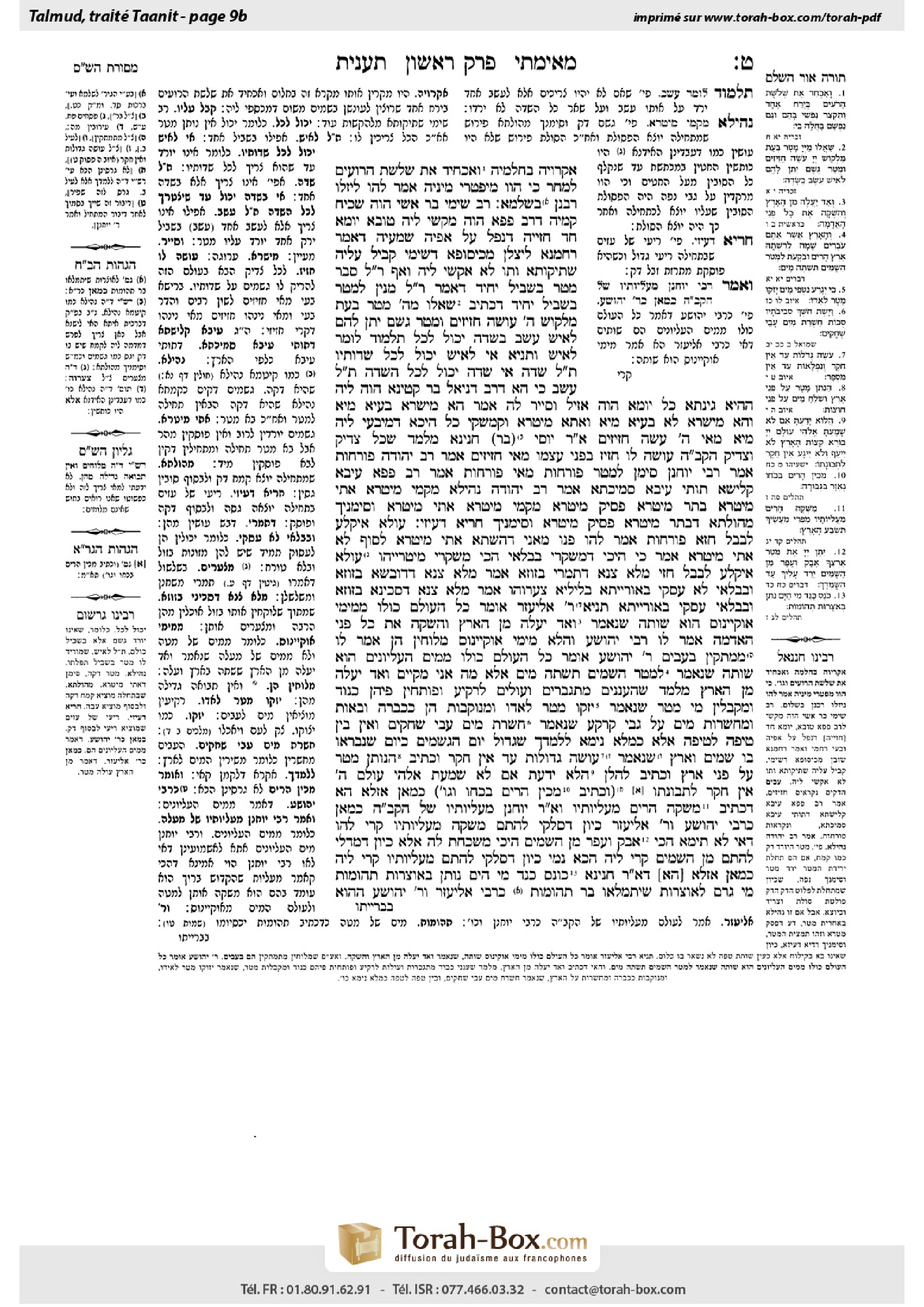
Taanit 9b: Talmud study for Daf Yomi
Daf Yomi is the daily study of one Talmud folio. Explore 37 tractates with scans, Hebrew text, Sefaria English and AI-generated French translations where annotated.
Passage selection and English or AI-generated French translation are available where the scan has annotations. Daf Study is independent of Torah-Box and Sefaria.
Browse Taanit · תענית · All tractatesTaanit 9b text and translations
This page of Taanit includes the Aramaic text, an English translation and an AI-generated French translation, alongside the scan above.
תענית ט׳ ב · Aramaic and Hebrew text
אַקְרְיוּהּ בְּחֶלְמֵיהּ: ״וָאַכְחִד אֶת שְׁלֹשֶׁת הָרֹעִים״. לִמְחַר, כִּי הֲווֹ מִיפַּטְרִי מִינֵּיהּ, אֲמַר לְהוּ: לֵיזְלוּ רַבָּנַן בִּשְׁלָמָא.
רַב שִׁימִי בַּר אָשֵׁי הֲוָה שְׁכִיחַ קַמֵּיהּ דְּרַב פָּפָּא, הֲוָה מַקְשֵׁי לֵיהּ טוּבָא. יוֹמָא חַד חַזְיֵיהּ דִּנְפַל עַל אַפֵּיהּ, שַׁמְעֵיהּ דְּאָמַר: רַחֲמָנָא לִיצְּלַן מִכִּיסּוּפָא דְשִׁימִי. קַבֵּיל עֲלֵיהּ שְׁתִיקוּתָא, וְתוּ לָא אַקְשִׁי לֵיהּ.
וְאַף רֵישׁ לָקִישׁ סָבַר מָטָר בִּשְׁבִיל יָחִיד, דְּאָמַר רֵישׁ לָקִישׁ: מִנַּיִן לַמָּטָר בִּשְׁבִיל יָחִיד, דִּכְתִיב: ״שַׁאֲלוּ מֵה׳ מָטָר בְּעֵת מַלְקוֹשׁ ה׳ עֹשֶׂה חֲזִיזִים וּמְטַר גֶּשֶׁם יִתֵּן לָהֶם לְאִישׁ עֵשֶׂב בַּשָּׂדֶה״.
יָכוֹל לַכֹּל — תַּלְמוּד לוֹמַר ״לְאִישׁ״. וְתַנְיָא: אִי לְאִישׁ, יָכוֹל לְכׇל שְׂדוֹתָיו — תַּלְמוּד לוֹמַר: ״שָׂדֶה״. אִי שָׂדֶה, יָכוֹל לְכׇל הַשָּׂדֶה — תַּלְמוּד לוֹמַר: ״עֵשֶׂב״.
כִּי הָא דְּרַב דָּנִיאֵל בַּר קַטִּינָא הֲוָה לֵיהּ הָהִיא גִּינְּתָא. כׇּל יוֹמָא הֲוָה אָזֵיל וְסָיַיר לַהּ. אָמַר: הָא מֵישְׁרָא בָּעֲיָא מַיָּא, וְהָא מֵישְׁרָא לָא בָּעֲיָא מַיָּא. וַאֲתָא מִיטְרָא וְקָמַשְׁקֵי כׇּל הֵיכָא דְּמִיבְּעֵי לֵיהּ מַיָּא.
מַאי ״ה׳ עֹשֶׂה חֲזִיזִים״? אָמַר רַבִּי יוֹסֵי בְּרַבִּי חֲנִינָא: מְלַמֵּד שֶׁכׇּל צַדִּיק הַקָּדוֹשׁ בָּרוּךְ הוּא עוֹשֶׂה לוֹ חֲזִיז בִּפְנֵי עַצְמוֹ. מַאי ״חֲזִיזִים״? אָמַר רַב יְהוּדָה: פּוֹרְחוֹת. אָמַר רַבִּי יוֹחָנָן: סִימָן לַמָּטָר — פּוֹרְחוֹת. מַאי פּוֹרְחוֹת? אָמַר רַב פָּפָּא: עֵיבָא קְלִישָׁא תּוּתֵי עֵיבָא סְמִיכְתָּא.
אָמַר רַב יְהוּדָה: נְהִילָא מִקַּמֵּי מִיטְרָא — אָתֵי מִיטְרָא. בָּתַר מִיטְרָא — פָּסֵיק מִיטְרָא. מִקַּמֵּי מִיטְרָא — אָתֵי מִיטְרָא. וְסִימָנָיךְ: מַהוֹלְתָּא. דְּבָתַר מִיטְרָא — פָּסֵיק מִיטְרָא. וְסִימָנָיךְ: חַרְיָא דְעִיזֵּי.
עוּלָּא אִיקְּלַע לְבָבֶל, חֲזָא פּוֹרְחוֹת, אֲמַר לְהוּ: פַּנּוּ מָאנֵי, דְּהַשְׁתָּא אָתֵי מִיטְרָא. לְסוֹף לָא אָתֵי מִיטְרָא. אָמַר: כִּי הֵיכִי דִּמְשַׁקְּרִי בַּבְלָאֵי, הָכִי מְשַׁקְּרִי מִיטְרַיְיהוּ.
עוּלָּא אִיקְּלַע לְבָבֶל, חָזֵי מְלָא צַנָּא דְתַמְרֵי בְּזוּזָא. אֲמַר: מְלָא צַנָּא דְּדוּבְשָׁא בְּזוּזָא, וּבַבְלָאֵי לָא עָסְקִי בְּאוֹרָיְיתָא? בְּלֵילְיָא צַעֲרוּהוּ, אָמַר: מְלָא צַנָּא דְסַכִּינֵי בְּזוּזָא, וּבַבְלָאֵי עָסְקִי בְּאוֹרָיְיתָא!
תַּנְיָא, רַבִּי אֱלִיעֶזֶר אוֹמֵר: כׇּל הָעוֹלָם כּוּלּוֹ מִמֵּימֵי אוֹקְיָינוֹס הוּא שׁוֹתֶה, שֶׁנֶּאֱמַר: ״וְאֵד יַעֲלֶה מִן הָאָרֶץ וְהִשְׁקָה אֶת כׇּל פְּנֵי הָאֲדָמָה״. אָמַר לוֹ רַבִּי יְהוֹשֻׁעַ: וַהֲלֹא מֵימֵי אוֹקְיָינוֹס מְלוּחִין הֵן! אָמַר לוֹ: מִתְמַתְּקִין בֶּעָבִים.
רַבִּי יְהוֹשֻׁעַ אוֹמֵר: כׇּל הָעוֹלָם כּוּלּוֹ מִמַּיִם הָעֶלְיוֹנִים הוּא שׁוֹתֶה, שֶׁנֶּאֱמַר: ״לִמְטַר הַשָּׁמַיִם תִּשְׁתֶּה מָּיִם״, אֶלָּא מָה אֲנִי מְקַיֵּים ״וְאֵד יַעֲלֶה מִן הָאָרֶץ״? מְלַמֵּד שֶׁהָעֲנָנִים מִתְגַּבְּרִים וְעוֹלִים לָרָקִיעַ, וּפוֹתְחִין פִּיהֶן כְּנוֹד, וּמְקַבְּלִין מֵי מָטָר, שֶׁנֶּאֱמַר: ״יָזֹקּוּ מָטָר לְאֵדוֹ״.
וּמְנוּקָּבוֹת הֵן כִּכְבָרָה, וּבָאוֹת וּמְחַשְּׁרוֹת מַיִם עַל גַּבֵּי קַרְקַע, שֶׁנֶּאֱמַר: ״חַשְׁרַת מַיִם עָבֵי שְׁחָקִים״. וְאֵין בֵּין טִיפָּה לְטִיפָּה אֶלָּא כִּמְלֹא נִימָא, לְלַמֶּדְךָ שֶׁגָּדוֹל יוֹם הַגְּשָׁמִים כְּיוֹם שֶׁנִּבְרְאוּ בּוֹ שָׁמַיִם וָאָרֶץ.
שֶׁנֶּאֱמַר: ״עֹשֶׂה גְדֹלוֹת וְאֵין חֵקֶר״, וּכְתִיב: ״הַנֹּתֵן מָטָר עַל פְּנֵי אָרֶץ״, וּכְתִיב לְהַלָּן: ״הֲלוֹא יָדַעְתָּ אִם לֹא שָׁמַעְתָּ אֱלֹהֵי עוֹלָם ה׳ אֵין חֵקֶר לִתְבוּנָתוֹ״, וּכְתִיב: ״מֵכִין הָרִים בְּכֹחוֹ וְגוֹ׳״.
כְּמַאן אָזְלָא הָא דִּכְתִיב: ״מַשְׁקֶה הָרִים מֵעֲלִיּוֹתָיו״, וְאָמַר רַבִּי יוֹחָנָן: מֵעֲלִיּוֹתָיו שֶׁל הַקָּדוֹשׁ בָּרוּךְ הוּא, כְּמַאן — כְּרַבִּי יְהוֹשֻׁעַ.
וְרַבִּי אֱלִיעֶזֶר, כֵּיוָן דְּסָלְקִי לְהָתָם — ״מַשְׁקֶה מֵעֲלִיּוֹתָיו״ קָרֵי לְהוּ. דְּאִי לָא תֵּימָא הָכִי, ״אָבָק וְעָפָר מִן הַשָּׁמַיִם״ הֵיכִי מַשְׁכַּחַתְּ לַהּ? אֶלָּא כֵּיוָן דְּמִדְּלֵי לְהָתָם — ״מִן הַשָּׁמַיִם״ קָרֵי לֵיהּ. הָכִי נָמֵי: דְּסָלְקִי לְהָתָם — ״מֵעֲלִיּוֹתָיו״ קָרֵי לֵיהּ.
כְּמַאן אָזְלָא הָא דְּאָמַר רַבִּי חֲנִינָא: ״כֹּנֵס כַּנֵּד מֵי הַיָּם נֹתֵן בְּאוֹצָרוֹת תְּהוֹמוֹת״. מִי גָּרַם לָאוֹצָרוֹת שֶׁיִּתְמַלְּאוּ בָּר — תְּהוֹמוֹת, כְּרַבִּי אֱלִיעֶזֶר. וְרַבִּי יְהוֹשֻׁעַ: הָהוּא
Taanit 9b · English translation
A verse was read to Rav Pappa in a dream: “And I cut off the three shepherds in one month” (Zechariah 11:8). The next day, when they took their leave from him, Rav Pappa said to them: May the Rabbis go in peace, a hint that this would be their final parting. Rav Pappa thought that the three Sages would die as punishment for their behavior and he would never see them again.
The Gemara relates a similar incident: Rav Shimi bar Ashi was often found before Rav Pappa and would raise many objections against the opinions of Rav Pappa. One day Rav Shimi bar Ashi saw Rav Pappa fall on his face after prayer. He heard him say: May the Merciful One save me from the embarrassment of Shimi, and as a result Rav Shimi bar Ashi resolved to be silent and not to raise any further objections against Rav Pappa, as he saw how greatly they pained his teacher.
§ The Gemara returns to the issue of rain. And Reish Lakish also maintains that rain can fall for the sake of an individual, as Reish Lakish said: From where is it derived that rain falls even for the sake of an individual? As it is written: “Ask of the Lord rain at the time of the last rain; even of the Lord who makes thunderclouds, and He will give them showers of rain; for a man grass in the field” (Zechariah 10:1).
One might have thought that rain falls for the sake of all the Jewish people. The verse therefore states: “For a man,” i.e., for the needs of an individual And it was further taught in a baraita: If rain falls “for a man,” one might have thought that the rain is for all his fields. Therefore the verse states: “Field,” which indicates that at times it rains on only one field. If it rains on one field, one might have thought that the rain is for the entire field. This is why the verse states: “Grass”; rain can fall for the sake of even a single plant in the field.
This is like the practice of Rav Daniel bar Ketina, who had a certain garden. Every day he would go and inspect it, to see what it needed. He would say: This bed requires water and this bed does not require water, and rain would come and water everywhere that required water, but nowhere else.
With regard to the aforementioned verse, the Gemara asks: What is the meaning of the phrase: “The Lord Who makes thunderclouds”? Rabbi Yosei, son of Rabbi Ḥanina, said: This teaches that for every righteous person, the Holy One, Blessed be He, prepares a separate thundercloud. The Gemara asks: What is the precise meaning of “thunderclouds”? Rav Yehuda said: Flying clouds. Rabbi Yoḥanan said: A sign of approaching rain is flying clouds. The Gemara asks: What are flying clouds? Rav Pappa said: A flying cloud is a thin cloud under a thick cloud.
Rav Yehuda said that there is another sign of imminent rain: Drizzle before rain means that rain is coming. However, drizzle that falls after rain is a sign that the rain is stopping. Rav Yehuda provides an analogy by way of explanation: Drizzle before rain means that rain is coming, and your mnemonic is a sieve: Just as small quantities of flour drop from the sieve even before one begins to actively sift it, so too drizzle falls before rain. Conversely, drizzle that falls after rain signifies that the rain is stopping, and your mnemonic is goat dung. A goat’s initial droppings are large, whereas its latter droppings are small.
The Gemara relates that when Ulla happened to come to Babylonia, he saw flying clouds. He said to the local residents: Put away your vessels, as the rain is coming now. Ultimately, despite the presence of flying clouds, rain did not fall. He said: Just as Babylonians are liars, so too, their rains are liars, as flying clouds are a reliable sign of rain in Eretz Yisrael, but not in Babylonia.
The Gemara recounts another incident that occurred when Ulla happened to come to Babylonia. He saw a basket full of dates on sale for one dinar, and he said: One can buy a basket full of honey dates for a dinar, and yet these Babylonians do not occupy themselves with Torah. In a place where excellent food is so inexpensive, and where there is no need to engage in hard labor for one’s material needs, the inhabitants should be able to occupy themselves with Torah. Ulla himself ate many dates, but during the night they caused him pain and diarrhea. He subsequently said: A basket full of knives for a dinar, and yet somehow these Babylonians are able to occupy themselves with Torah, despite the trouble these dates cause.
§ The Gemara discusses the source of rain. It is taught in a baraita that Rabbi Eliezer says: The entire world drinks from the waters of the ocean [okeyanos], i.e., evaporated ocean water is the source of rain. As it is stated: “And there went up a mist from the earth and watered the whole face of the ground” (Genesis 2:6). Rabbi Yehoshua said to him: But the waters of the ocean are salty, whereas rainwater is sweet. Rabbi Eliezer said to Rabbi Yehoshua: The waters are sweetened in the clouds, before they fall to the earth.
In contrast, Rabbi Yehoshua says: The entire world drinks from the upper waters, as it is stated: “And it drinks water as the rain of heaven comes down” (Deuteronomy 11:11). The baraita asks: But according to the opinion of Rabbi Yehoshua, how do I uphold the verse: “And there went up a mist from the earth”? Rabbi Yehoshua could answer that this verse teaches that the clouds grow stronger, and rise to the firmament, and open their mouths like a leather bottle, and receive the rain waters from above, as it is stated: “For He draws away the drops of water, which distill rain from His vapor” (Job 36:27).
And the clouds are perforated like a sieve, and they come and sprinkle water onto the ground, as it is stated: “Gathering of waters, thick clouds of the skies” (II Samuel 22:12). And between each and every drop there is only a hairbreadth, and yet each drop emerges individually. This serves to teach you that the day of rains is as great as the day on which Heaven and Earth were created, i.e., rainfall is as miraculous as creation.
As it is stated, with regard to the creation of the world: “Who does great things past finding out” (Job 9:10), and as an example of this it is written: “Who gives rain upon the earth” (Job 5:9–10). And it is written below: “Have you not known? Have you not heard that the everlasting God, the Lord, the Creator of the ends of the earth, does not faint and is not weary; His discernment is past finding out” (Isaiah 40:28). The repetition of “past finding out” indicates that rainfall is as wondrous as the creation of the world. The Gemara adds: And it is written in a psalm that deals with rainfall: “Who by Your strength sets fast the mountains; Who is girded about with might” (Psalms 65:7).
The Gemara asks: In accordance with whose opinion is that verse which is written: “Who waters the mountains from His upper chambers” (Psalms 104:13)? And Rabbi Yoḥanan said: This phrase indicates that the water comes from the upper chambers of the Holy One, Blessed be He. In accordance with whose opinion is this statement? It is in accordance with the opinion of Rabbi Yehoshua, who maintains that rain falls from above the sky.
The Gemara asks: And Rabbi Eliezer, how does he explain this verse? The Gemara answers: According to Rabbi Eliezer, since the clouds ascend there, to the heavens, the verse “who waters the mountains from His upper chambers” calls and describes rainfall as descending from the heavens. As, if you do not say so, with regard to the verse: “Powder and dust from the heavens” (Deuteronomy 28:24), where do you find this phenomenon? Is there powder and dust in Heaven? Rather, you must say that since dust rises up there, they are called dust: “From the heavens.” So too, as the clouds ascend there, they are called and described: “Who waters the mountains from His upper chambers.”
The Gemara asks: In accordance with whose opinion is that which Rabbi Ḥanina said, concerning the verse: “He gathers the waters of the sea together as a heap; he lays up the deep in storerooms” (Psalms 33:7): What caused the storerooms to be filled with produce? It was the deep, which is the source of the water that nourishes the produce. The Gemara answers: This explanation is in accordance with the opinion of Rabbi Eliezer. And Rabbi Yehoshua, how does he explain this verse? Rabbi Yehoshua would say: That
Taanit 9b · Traduction française (IA)
Un verset fut lu à Rav Pappa dans un rêve : « J’ai retranché les trois bergers en un mois » (Zacharie 11,8). Le lendemain, au moment où ils prirent congé de lui, Rav Pappa leur dit : « Que les Rabbins s’en aillent en paix », laissant entendre que ce serait leur dernier adieu. Rav Pappa pensa que les trois Sages mourraient en punition de leur comportement et qu’il ne les reverrait jamais.
La Guemara rapporte un incident similaire : Rav Shimi bar Ashi se trouvait souvent auprès de Rav Pappa et soulevait de nombreuses objections contre ses opinions. Un jour, Rav Shimi bar Ashi vit Rav Pappa se prosterner après la prière. Il l’entendit dire : « Que le Miséricordieux me préserve de l’humiliation causée par Shimi. » En conséquence, Rav Shimi bar Ashi décida de garder le silence et de ne plus soulever d’objections contre Rav Pappa, car il avait vu à quel point cela faisait souffrir son maître.
§ La Guemara revient à la question de la pluie. Reish Lakish soutient également que la pluie peut tomber pour le bien d’un individu, car il a dit : D’où déduit-on que la pluie tombe même pour le bien d’un individu ? Du verset : « Demandez à l’Éternel la pluie au temps de la pluie tardive ; c’est l’Éternel qui forme les nuages d’orage, et Il leur donnera des averses de pluie, de l’herbe dans les champs à chaque homme » (Zacharie 10,1).
On aurait pu penser que la pluie tombe pour le bien de tout le peuple juif. Le verset précise donc : « Pour un homme », c’est-à-dire pour les besoins d’un individu. Il est également enseigné dans une baraïta : si la pluie tombe « pour un homme », on aurait pu penser qu’elle tombe sur tous ses champs. Le verset précise donc : « Champ », ce qui indique qu’il arrive qu’elle ne tombe que sur un seul champ. Si elle tombe sur un seul champ, on aurait pu penser qu’elle tombe sur l’ensemble du champ. C’est pourquoi le verset précise : « Herbe » ; la pluie peut tomber pour le bien d’une seule plante dans le champ.
Cela rappelle la pratique de Rav Daniel bar Ketina, qui possédait un jardin. Chaque jour, il allait l’inspecter pour voir ce dont il avait besoin. Il disait : « Cette plate-bande a besoin d’eau et celle-ci n’en a pas besoin », et la pluie tombait pour arroser tous les endroits qui en avaient besoin, mais aucun autre.
À propos du verset cité plus haut, la Guemara demande : Que signifie l’expression « l’Éternel qui forme les nuages d’orage » ? Rabbi Yosei, fils de Rabbi Ḥanina, dit : Cela enseigne que le Saint, béni soit-Il, prépare un nuage d’orage distinct pour chaque juste. La Guemara demande : Que désigne précisément l’expression « nuages d’orage » ? Rav Yehuda dit : Des nuages qui filent. Rabbi Yoḥanan dit : Les nuages qui filent sont un signe annonciateur de pluie. La Guemara demande : Que sont ces nuages qui filent ? Rav Pappa dit : Un nuage qui file est un nuage fin sous un nuage épais.
Rav Yehuda dit qu’il existe un autre signe de pluie imminente : une bruine avant la pluie signifie que celle-ci arrive. En revanche, une bruine qui tombe après la pluie indique que celle-ci s’arrête. Rav Yehuda l’explique par une analogie : une bruine avant la pluie signifie que celle-ci arrive, et le moyen mnémotechnique est un tamis. De même que de petites quantités de farine tombent du tamis avant même qu’on commence à tamiser, de même une bruine tombe avant la pluie. À l’inverse, une bruine qui tombe après la pluie signifie que celle-ci s’arrête, et le moyen mnémotechnique est la fiente de chèvre : les premières déjections d’une chèvre sont grosses, tandis que les dernières sont petites.
La Guemara rapporte qu’Ulla, étant venu par hasard en Babylonie, vit des nuages qui filaient. Il dit aux habitants du lieu : « Rangez vos récipients, car la pluie va tomber maintenant. » Pourtant, malgré la présence de nuages qui filaient, la pluie ne tomba pas. Il dit : « De même que les Babyloniens sont des menteurs, leurs pluies sont également menteuses », car les nuages qui filent annoncent de façon fiable la pluie en Eretz Yisrael, mais pas en Babylonie.
La Guemara rapporte un autre incident survenu lorsqu’Ulla vint par hasard en Babylonie. Il vit un panier rempli de dattes vendu un dinar et dit : « On peut acheter un panier rempli de dattes de miel pour un dinar, et pourtant ces Babyloniens ne s’adonnent pas à la Torah ! Dans un endroit où la nourriture excellente est si bon marché et où il n’est pas nécessaire de travailler dur pour subvenir à ses besoins matériels, les habitants devraient pouvoir s’adonner à la Torah. » Ulla mangea lui-même beaucoup de dattes, mais celles-ci lui causèrent des douleurs et de la diarrhée pendant la nuit. Il dit ensuite : « Un panier rempli de couteaux pour un dinar, et pourtant ces Babyloniens parviennent à s’adonner à la Torah malgré les troubles que causent ces dattes. »
§ La Guemara examine la source de la pluie. Une baraïta enseigne que Rabbi Eliezer dit : Le monde entier boit des eaux de l’océan [okeyanos], c’est-à-dire que l’eau de pluie provient de l’évaporation des eaux de l’océan. Comme il est dit : « Une vapeur monta de la terre et arrosa toute la surface du sol » (Genèse 2,6). Rabbi Yehoshua lui dit : Mais les eaux de l’océan sont salées, alors que l’eau de pluie est douce. Rabbi Eliezer dit à Rabbi Yehoshua : Les eaux sont adoucies dans les nuages avant de tomber sur la terre.
À l’inverse, Rabbi Yehoshua dit : Le monde entier boit des eaux supérieures, comme il est dit : « Elle boit l’eau que la pluie du ciel fait descendre » (Deutéronome 11,11). La baraïta demande : Mais, selon l’opinion de Rabbi Yehoshua, comment comprendre le verset « Une vapeur monta de la terre » ? Rabbi Yehoshua pourrait répondre que ce verset enseigne que les nuages se renforcent, montent au firmament, ouvrent leur bouche comme une outre en cuir et reçoivent d’en haut les eaux de pluie, comme il est dit : « Car Il attire les gouttes d’eau, qui distillent la pluie de Sa vapeur » (Job 36,27).
Les nuages sont perforés comme un tamis et viennent répandre l’eau sur le sol, comme il est dit : « Des eaux accumulées, d’épais nuages des cieux » (II Samuel 22,12). Entre chaque goutte, il n’y a que l’épaisseur d’un cheveu, et pourtant chaque goutte sort séparément. Cela vient t’enseigner que le jour des pluies est aussi grand que le jour où le Ciel et la Terre furent créés, c’est-à-dire que les précipitations sont aussi miraculeuses que la création.
Comme il est dit à propos de la création du monde : « Lui qui accomplit de grandes choses insondables » (Job 9,10) ; et, comme exemple de cela, il est écrit : « Lui qui donne la pluie sur la terre » (Job 5,9-10). Il est également écrit plus loin : « Ne le sais-tu pas ? Ne l’as-tu pas entendu ? L’Éternel est le Dieu éternel, le Créateur des extrémités de la terre ; Il ne faiblit pas et ne se fatigue pas, Son intelligence est insondable » (Isaïe 40,28). La répétition de « insondable » indique que la pluie est aussi merveilleuse que la création du monde. La Guemara ajoute : Il est également écrit dans un psaume consacré à la pluie : « Toi qui affermis les montagnes par Ta force, Toi qui es ceint de puissance » (Psaumes 65,7).
La Guemara demande : Selon l’opinion de qui faut-il comprendre le verset : « Lui qui abreuve les montagnes depuis Ses chambres supérieures » (Psaumes 104,13) ? Rabbi Yoḥanan dit : Cette expression indique que l’eau vient des chambres supérieures du Saint, béni soit-Il. Selon l’opinion de qui est cette déclaration ? Elle est conforme à l’opinion de Rabbi Yehoshua, qui soutient que la pluie tombe d’au-dessus du ciel.
La Guemara demande : Et comment Rabbi Eliezer explique-t-il ce verset ? La Guemara répond : Selon Rabbi Eliezer, puisque les nuages montent là-haut, dans les cieux, le verset « Lui qui abreuve les montagnes depuis Ses chambres supérieures » présente et décrit la pluie comme descendant des cieux. En effet, si l’on ne l’interprétait pas ainsi, où trouverait-on le phénomène évoqué dans le verset « Poussière et cendre venant des cieux » (Deutéronome 28,24) ? Y a-t-il de la poussière et de la cendre dans les cieux ? Il faut plutôt dire que, puisque la poussière monte là-haut, elle est appelée « poussière venant des cieux ». De même, puisque les nuages montent là-haut, on les appelle et les décrit par ces mots : « Lui qui abreuve les montagnes depuis Ses chambres supérieures. »
La Guemara demande : Selon l’opinion de qui faut-il comprendre la déclaration de Rabbi Ḥanina à propos du verset : « Il rassemble les eaux de la mer comme un monceau ; Il met les profondeurs dans des réserves » (Psaumes 33,7) : Qu’est-ce qui a rempli les réserves de produits ? Ce sont les profondeurs, qui sont la source de l’eau nourrissant les produits. La Guemara répond : Cette explication est conforme à l’opinion de Rabbi Eliezer. Et comment Rabbi Yehoshua explique-t-il ce verset ? Rabbi Yehoshua dirait : Cela
Traduction française générée par IA à partir de l’édition anglaise de Sefaria. Vérifie toujours un passage avec le texte source.
Text from Sefaria: William Davidson Edition - Vocalized Aramaic (CC BY NC); William Davidson Edition - English (CC BY NC).