Taanit 10a: Talmud study for Daf Yomi
Daf Yomi is the daily study of one Talmud folio. Explore 37 tractates with scans, Hebrew text, Sefaria English and AI-generated French translations where annotated.
Passage selection and English or AI-generated French translation are available where the scan has annotations. Daf Study is independent of Torah-Box and Sefaria.
Browse Taanit · תענית · All tractatesTaanit 10a text and translations
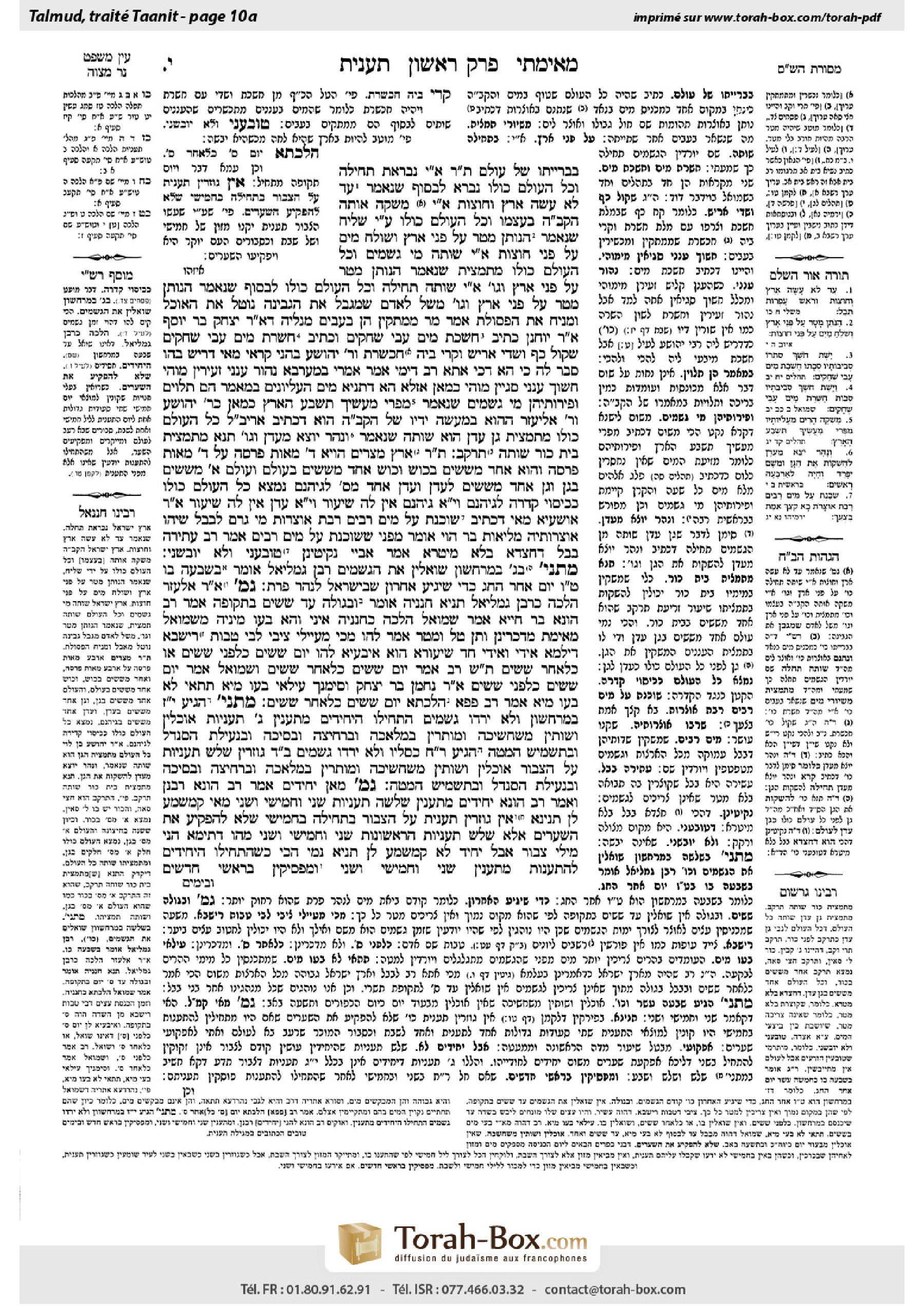
This page of Taanit includes the Aramaic text, an English translation and an AI-generated French translation, alongside the scan above.
תענית י׳ א · Aramaic and Hebrew text
בִּבְרִיָּיתוֹ שֶׁל עוֹלָם.
תָּנוּ רַבָּנַן: אֶרֶץ יִשְׂרָאֵל נִבְרֵאת תְּחִילָּה וְכׇל הָעוֹלָם כּוּלּוֹ נִבְרָא לְבַסּוֹף, שֶׁנֶּאֱמַר: ״עַד לֹא עָשָׂה אֶרֶץ וְחוּצוֹת״. אֶרֶץ יִשְׂרָאֵל מַשְׁקֶה אוֹתָהּ הַקָּדוֹשׁ בָּרוּךְ הוּא בְּעַצְמוֹ, וְכׇל הָעוֹלָם כּוּלּוֹ עַל יְדֵי שָׁלִיחַ, שֶׁנֶּאֱמַר: ״הַנֹּתֵן מָטָר עַל פְּנֵי אָרֶץ וְשֹׁלֵחַ מַיִם עַל פְּנֵי חוּצוֹת״.
אֶרֶץ יִשְׂרָאֵל שׁוֹתָה מֵי גְשָׁמִים, וְכׇל הָעוֹלָם כּוּלּוֹ מִתַּמְצִית, שֶׁנֶּאֱמַר: ״הַנֹּתֵן מָטָר עַל פְּנֵי אָרֶץ וְגוֹ׳״. אֶרֶץ יִשְׂרָאֵל שׁוֹתָה תְּחִילָּה, וְכׇל הָעוֹלָם כּוּלּוֹ לְבַסּוֹף, שֶׁנֶּאֱמַר: ״הַנֹּתֵן מָטָר עַל פְּנֵי אָרֶץ וְגוֹ׳״ — מָשָׁל לְאָדָם שֶׁמְּגַבֵּל אֶת הַגְּבִינָה, נוֹטֵל אֶת הָאוֹכֵל וּמַנִּיחַ אֶת הַפְּסוֹלֶת.
אָמַר מָר: מִמַּתְּקִין הֵן בְּעָבִים. מְנָלֵיהּ? דְּאָמַר רַב יִצְחָק בַּר יוֹסֵף אָמַר רַבִּי יוֹחָנָן, כְּתִיב: ״חֶשְׁכַת מַיִם עָבֵי שְׁחָקִים״, וּכְתִיב: ״חַשְׁרַת מַיִם עָבֵי שְׁחָקִים״.
שְׁקוֹל כָּף וּשְׁדִי אַרֵישׁ וּקְרִי בֵּיהּ ״חַכְשָׁרַת״.
וְרַבִּי יְהוֹשֻׁעַ, בְּהָנֵי קְרָאֵי מַאי דָּרֵישׁ בְּהוּ? סָבַר לַהּ כִּי הָא דְּכִי אֲתָא רַב דִּימִי אֲמַר, אָמְרִי בְּמַעְרְבָא: נְהוּר עֲנָנֵי — זְעֵירִין מוֹהִי. חֲשׁוּךְ עֲנָנֵי — סַגִּיִּין מוֹהִי.
כְּמַאן אָזְלָא הָא דְּתַנְיָא: מַיִם הָעֶלְיוֹנִים בְּמַאֲמָר הֵם תְּלוּיִם, וּפֵירוֹתֵיהֶן מֵי גְשָׁמִים, שֶׁנֶּאֱמַר: ״מִפְּרִי מַעֲשֶׂיךָ תִּשְׂבַּע הָאָרֶץ״, כְּמַאן — כְּרַבִּי יְהוֹשֻׁעַ. וְרַבִּי אֱלִיעֶזֶר: הָהוּא, בְּמַעֲשֵׂה יָדָיו שֶׁל הַקָּדוֹשׁ בָּרוּךְ הוּא הוּא דִּכְתִיב.
אָמַר רַבִּי יְהוֹשֻׁעַ בֶּן לֵוִי: כׇּל הָעוֹלָם כּוּלּוֹ מִתַּמְצִית גַּן עֵדֶן הוּא שׁוֹתֶה, שֶׁנֶּאֱמַר: ״וְנָהָר יֹצֵא מֵעֵדֶן וְגוֹ׳״, תָּנָא: מִתַּמְצִית בֵּית כּוֹר שׁוֹתֶה תַּרְקַב.
תָּנוּ רַבָּנַן: אֶרֶץ מִצְרַיִם הָוְיָא אַרְבַּע מֵאוֹת פַּרְסָה עַל אַרְבַּע מֵאוֹת פַּרְסָה, וְהוּא אֶחָד מִשִּׁשִּׁים בְּכוּשׁ, וְכוּשׁ — אֶחָד מִשִּׁשִּׁים בָּעוֹלָם, וְעוֹלָם — אֶחָד מִשִּׁשִּׁים בַּגָּן, וְגַן — אֶחָד מִשִּׁשִּׁים לְעֵדֶן, וְעֵדֶן — אֶחָד מִשִּׁשִּׁים לְגֵיהִנָּם, נִמְצָא כׇּל הָעוֹלָם כּוּלּוֹ כְּכִיסּוּי קְדֵרָה לְגֵיהִנָּם. וְיֵשׁ אוֹמְרִים: גֵּיהִנָּם אֵין לָהּ שִׁיעוּר, וְיֵשׁ אוֹמְרִים: עֵדֶן אֵין לָהּ שִׁיעוּר.
אָמַר רַבִּי אוֹשַׁעְיָא, מַאי דִּכְתִיב: ״שֹׁכַנְתְּ עַל מַיִם רַבִּים רַבַּת אוֹצָרֹת״, מִי גָּרַם לְבָבֶל שֶׁיְּהוּ אוֹצְרוֹתֶיהָ מְלֵאוֹת בָּר, הֱוֵי אוֹמֵר: מִפְּנֵי שֶׁשּׁוֹכֶנֶת עַל מַיִם רַבִּים. אָמַר רַב: עַתִּירָה בָּבֶל דְּחָצְדָא בְּלָא מִיטְרָא. אָמַר אַבָּיֵי: נְקִיטִינַן, טוֹבְעָנִי וְלֹא יוֹבְשָׁנִי.
מַתְנִי׳ בִּשְׁלֹשָׁה בִּמְרַחְשְׁוָן שׁוֹאֲלִין אֶת הַגְּשָׁמִים. רַבָּן גַּמְלִיאֵל אוֹמֵר: בְּשִׁבְעָה בּוֹ, חֲמִשָּׁה עָשָׂר יוֹם אַחַר הֶחָג. כְּדֵי שֶׁיַּגִּיעַ אַחֲרוֹן שֶׁבְּיִשְׂרָאֵל לִנְהַר פְּרָת.
גְּמָ׳ אָמַר רַבִּי אֶלְעָזָר: הֲלָכָה כְּרַבָּן גַּמְלִיאֵל. תַּנְיָא, חֲנַנְיָה אוֹמֵר: וּבַגּוֹלָה, עַד שִׁשִּׁים בַּתְּקוּפָה. אָמַר רַב הוּנָא בַּר חִיָּיא אָמַר שְׁמוּאֵל: הֲלָכָה כַּחֲנַנְיָה.
אִינִי?! וְהָא בְּעוֹ מִינֵּיהּ מִשְּׁמוּאֵל: מֵאֵימַת מַדְכְּרִינַן ״וְתֵן טַל וּמָטָר״? אֲמַר לְהוּ: מִכִּי מְעַיְּילִי צִיבֵי לְבֵי טָבוּת רִישְׁבָּא! דִּילְמָא אִידֵּי וְאִידֵּי חַד שִׁיעוּרָא הוּא.
אִיבַּעְיָא לְהוּ: יוֹם שִׁשִּׁים, כְּלִפְנֵי שִׁשִּׁים אוֹ כִּלְאַחַר שִׁשִּׁים? תָּא שְׁמַע, רַב אָמַר: יוֹם שִׁשִּׁים כִּלְאַחַר שִׁשִּׁים, וּשְׁמוּאֵל אָמַר: יוֹם שִׁשִּׁים כְּלִפְנֵי שִׁשִּׁים.
אָמַר רַב נַחְמָן בַּר יִצְחָק: וְסִימָנָךְ עִלָּאֵי בָּעוּ מַיָּא, תַּתָּאֵי לָא בָּעוּ מַיָּא. אָמַר רַב פָּפָּא, הִלְכְתָא: יוֹם שִׁשִּׁים כִּלְאַחַר שִׁשִּׁים.
מַתְנִי׳ הִגִּיעַ שִׁבְעָה עָשָׂר בְּמַרְחֶשְׁוָן וְלֹא יָרְדוּ גְּשָׁמִים — הִתְחִילוּ הַיְּחִידִים מִתְעַנִּין שָׁלֹשׁ תַּעֲנִיּוֹת. אוֹכְלִין וְשׁוֹתִין מִשֶּׁחָשֵׁיכָה, וּמוּתָּרִין בִּמְלָאכָה וּבִרְחִיצָה וּבְסִיכָה וּבִנְעִילַת הַסַּנְדָּל וּבְתַשְׁמִישׁ הַמִּטָּה. הִגִּיעַ רֹאשׁ חֹדֶשׁ כִּסְלֵיו וְלֹא יָרְדוּ גְּשָׁמִים — בֵּית דִּין גּוֹזְרִין שָׁלֹשׁ תַּעֲנִיּוֹת עַל הַצִּבּוּר. אוֹכְלִין וְשׁוֹתִין מִשֶּׁחָשֵׁיכָה, וּמוּתָּרִין בִּמְלָאכָה וּבִרְחִיצָה וּבְסִיכָה וּבִנְעִילַת הַסַּנְדָּל וּבְתַשְׁמִישׁ הַמִּטָּה.
גְּמָ׳ מַאן ״יְחִידִים״? אָמַר רַב הוּנָא: רַבָּנַן. וַאֲמַר רַב הוּנָא: יְחִידִים מִתְעַנִּין שָׁלֹשׁ תַּעֲנִיּוֹת, שֵׁנִי וַחֲמִישִׁי וְשֵׁנִי.
מַאי קָמַשְׁמַע לַן? תְּנֵינָא: אֵין גּוֹזְרִין תַּעֲנִית עַל הַצִּבּוּר בַּתְּחִילָּה בַּחֲמִישִׁי, שֶׁלֹּא לְהַפְקִיעַ אֶת הַשְּׁעָרִים, אֶלָּא שָׁלֹשׁ תַּעֲנִיּוֹת הָרִאשׁוֹנוֹת שֵׁנִי וַחֲמִישִׁי וְשֵׁנִי!
מַהוּ דְּתֵימָא: הָנֵי מִילֵּי צִבּוּר, אֲבָל יָחִיד לָא, קָמַשְׁמַע לַן. תַּנְיָא נָמֵי הָכִי: כְּשֶׁהִתְחִילוּ הַיְּחִידִים לְהִתְעַנּוֹת, מִתְעַנִּין שֵׁנִי וַחֲמִישִׁי וְשֵׁנִי, וּמַפְסִיקִין בְּרָאשֵׁי חֳדָשִׁים
Taanit 10a · English translation
verse deals with the creation of the world, when all the water was contained in the deep.
The Sages taught in a baraita: Eretz Yisrael was created first and the rest of the entire world was created afterward, as it is stated: “While as yet He had not made the land, nor the fields” (Proverbs 8:26). Here, and in the following statements, the term “land” is understood as a reference to the Land of Israel, while “the fields” means all the fields in other lands. Furthermore, Eretz Yisrael is watered by the Holy One, Blessed be He, Himself, and the rest of the entire world is watered through an intermediary, as it is stated: “Who gives rain upon the land, and sends water upon the fields” (Job 5:10).
Additionally, Eretz Yisrael drinks rainwater and the rest of the entire world drinks from the remaining residue of rainwater left in the clouds, as it is stated that God is He “who gives rain upon the land” and only afterward takes what is left “and sends water upon the fields.” Eretz Yisrael drinks first, and the rest of the entire world afterward, as it is stated: “Who gives rain upon the land and sends water upon the fields.” There is a parable that illustrates this: A person who kneads his cheese after it has curdled takes the food and leaves the refuse.
The Master said above: The ocean waters are sweetened in the clouds. The Gemara asks: From where does Rabbi Eliezer derive this? The Gemara answers that Rav Yitzḥak bar Yosef said that Rabbi Yoḥanan said that it is written: “Darkness [ḥeshkhat] of waters, thick clouds of the skies” (Psalms 18:12). And it is written, in a similar verse: “Gathering of [ḥashrat] waters, thick clouds of the skies” (II Samuel 22:12).
The Gemara explains the significance of this minor variation. These two phrases vary in only one word, which themselves differ by only one letter, a kaf for a reish. If you join the two versions together, and take the letter kaf from the first version and place it with the second version of the word, which has a reish, you can read into the verse a new word meaning rendering fit [ḥakhsharat]. Accordingly, the verse can be interpreted as: The rendering fit of water is performed in the clouds of the sky.
The Gemara asks: And Rabbi Yehoshua, with regard to these verses, what does he learn from them? The Gemara answers that Rabbi Yehoshua holds in accordance with the opinion of this Sage, Rav Dimi. As when Rav Dimi came from Eretz Yisrael to Babylonia, he said that they say in the West, Eretz Yisrael: When clouds are bright, they have little water; when clouds are dark, they have much water. Accordingly, Rabbi Yehoshua explains that when there is “a darkness of waters” in the clouds, there is also “a gathering of waters,” as rain will fall from them.
The Gemara asks: In accordance with whose opinion is that which is taught in a baraita: The upper waters do not stand in any defined place; rather, they are suspended by the word of God, and their fruit is rainwater, as it is stated: “Who waters the mountains from His upper chambers; the earth is full of the fruit of Your works” (Psalms 104:13). In accordance with whose opinion is this statement? It is in accordance with the opinion of Rabbi Yehoshua. And Rabbi Eliezer, how does he explain this verse? Rabbi Eliezer could say: That verse from Psalms is written with regard to the handiwork of the Holy One, Blessed be He, not the upper waters.
Rabbi Yehoshua ben Levi said: The entire world drinks from the runoff of the Garden of Eden, as it is stated: “And a river went out of Eden to water the garden” (Genesis 2:10). It was taught in a baraita: From the runoff of a beit kor, a field in which a kor of seed can be planted, which is approximately seventy-five thousand square cubits, a field in which a half-se’a [tarkav], of seed can be sown, i.e. one-sixtieth the size of a beit kor, can be watered. If the runoff from a beit kor is sufficient for a field one-sixtieth its size, it can be inferred that the rest of the world is one-sixtieth the size of the Garden of Eden.
The Sages taught in a baraita: The area of the land of Egypt is four hundred parasangs [parsa] by four hundred parasangs. And this is one sixtieth the size of Cush, and Cush itself is one sixtieth the size of the rest of the world. And the world is one sixtieth of the Garden of Eden, and the Garden of Eden is one sixtieth of Eden itself, and Eden is one sixtieth of Gehenna. You find that the entire world is like a pot cover for Gehenna, as Eden, which is far larger than the rest of the world, is only one sixtieth the size of Gehenna. And some say: Gehenna has no measure. And some say that Eden has no measure.
Rabbi Oshaya said: What is the meaning of that which is written about Babylonia: “You who dwells on many waters, abundant in storehouses” (Jeremiah 51:13)? What caused Babylonia to have storehouses full of grain? You must say that it is due to the fact that it resides on many waters, the Tigris and the Euphrates Rivers, which render its land easy to irrigate. Similarly, Rav said: Babylonia is wealthy since it can grow crops for harvest even without rain. Abaye said: We hold that it is better for a land to be swampy like Babylonia, and not dry, as crops in Babylonia grow all year.
MISHNA: On the third of the month of Marḥeshvan one starts to request rain by inserting the phrase: And give dew and rain, in the blessing of the years, the ninth blessing of the Amida. Rabban Gamliel says: One starts to request rain on the seventh of Marḥeshvan, which is fifteen days after the festival of Sukkot. Rabban Gamliel explains that one waits these extra four days so that the last pilgrim of the Jewish people, who traveled to Jerusalem on foot for the Festival, can reach the Euphrates River without being inconvenienced by rain on his journey home.
GEMARA: Rabbi Elazar said: The halakha is in accordance with the opinion of Rabban Gamliel, that one does not begin to request rain until the seventh of Marḥeshvan. It is taught in a baraita that Ḥananya says: And in the Diaspora one does not begin to request rain until sixty days into the season, i.e., sixty days after the autumnal equinox. Rav Huna bar Ḥiyya said that Shmuel said: The halakha is in accordance with the opinion of Ḥananya.
The Gemara asks: Is that so? But they raised a dilemma before Shmuel: From when does one mention: And give dew and rain? He said to them: From when they bring wood into the house of Tavut the bird hunter [rishba]. This is apparently a different date than that mentioned by Ḥananya. The Gemara suggests: Perhaps this and that are one measure of time, i.e., Shmuel merely provided a sign of sixty days after the autumnal equinox.
A dilemma was raised before the Sages: Is the sixtieth day itself treated as part of the period before the sixtieth day or is it included in the period after the sixtieth day? The Gemara answers. Come and hear that there is a dispute in this regard. Rav said: The sixtieth day is part of the period after the sixtieth day, and Shmuel said: The sixtieth day is part of the period before the sixtieth.
Rav Naḥman bar Yitzḥak said: And your mnemonic to remember the divergent opinions is: Those above require water; those below do not require water. Since water flows downward, those who live in low places receive their water from above and are generally in less need of additional water. Accordingly, Shmuel, who lived in the lowlands of Babylonia, ruled that one begins to request for rain later, whereas Rav, who studied in Eretz Yisrael, which is higher in elevation and has a greater need for rain, stated an earlier date. Rav Pappa said: The halakha is that the sixtieth day is part of the period after the sixtieth day, as stated by Rav, and therefore one begins to mention the request for rain on the sixtieth day after the autumnal equinox.
MISHNA: If the seventeenth of Marḥeshvan arrived and rain has not fallen, individuals, but not the entire community, begin to fast three fasts for rain. How are these fasts conducted? As the fast begins in the morning, one may eat and drink after dark, and one is permitted during the days of the fasts themselves to engage in the performance of work, in bathing, in smearing oil on one’s body, in wearing shoes, and in conjugal relations. If the New Moon of Kislev arrived and rain has still not fallen, the court decrees three fasts on the entire community. Similar to the individual fasts, everyone may eat and drink after dark, and they are permitted to engage in the performance of work, in bathing, in smearing one’s body with oil, in wearing shoes, and in conjugal relations.
GEMARA: The Gemara asks: Who are these individuals mentioned in the mishna? Rav Huna said: This is referring to the Sages, who are held to a higher standard and are expected to undertake fasts even when ordinary people do not. And Rav Huna further said: The individuals who fast the three fasts do so on a Monday, and on the next Thursday, and again on the following Monday.
The Gemara asks: What is Rav Huna teaching us? We already learned this (15b): The court may not decree a fast on the community starting from a Thursday, so as not to cause an increase in prices. Rather, the first three fasts are established on Monday, and Thursday, and Monday. What does Rav Huna’s statement add to this ruling?
The Gemara answers: Rav Huna’s comment is necessary, lest you say that this applies only to a community, but that in the case of an individual, no, the series of three fasts does not have to start on a Monday. This opinion is also taught in a baraita with regard to those mentioned in the mishna: When the individuals begin to fast, they fast on a Monday, a Thursday, and a Monday. And if one of the fast days occurs on a day with special observances, they interrupt the sequence for New Moons,
Taanit 10a · Traduction française (IA)
Le verset traite de la création du monde, lorsque toutes les eaux étaient contenues dans les profondeurs.
Les Sages ont enseigné dans une baraïta : Eretz Israël fut créée en premier, et le reste du monde entier fut créé ensuite, comme il est dit : « Alors qu’Il n’avait pas encore fait la terre ni les champs » (Proverbes 8:26). Ici, comme dans les déclarations qui suivent, le terme « terre » désigne Eretz Israël, tandis que les « champs » désignent tous les champs des autres pays. De plus, Eretz Israël est arrosée par le Saint, béni soit-Il, Lui-même, tandis que le reste du monde entier est arrosé par un intermédiaire, comme il est dit : « Lui qui donne la pluie sur la terre et envoie l’eau sur les champs » (Job 5:10).
En outre, Eretz Israël reçoit l’eau de pluie, tandis que le reste du monde entier reçoit les eaux de pluie résiduelles laissées dans les nuages, comme il est dit que Dieu est Celui « qui donne la pluie sur la terre », puis prend ce qui reste « et envoie l’eau sur les champs ». Eretz Israël est arrosée en premier, et le reste du monde entier ensuite, comme il est dit : « Lui qui donne la pluie sur la terre et envoie l’eau sur les champs. » Une parabole l’illustre : celui qui presse son fromage après qu’il a caillé prend la nourriture et laisse les déchets.
Le Maître a dit plus haut : les eaux de l’océan sont adoucies dans les nuages. La Guemara demande : De quoi Rabbi Eliezer déduit-il cela ? La Guemara répond que Rav Yitzḥak bar Yosef a dit au nom de Rabbi Yoḥanan qu’il est écrit : « Ténèbres [ḥeshkhat] des eaux, nuages épais des cieux » (Psaumes 18:12). Et il est écrit, dans un verset similaire : « Rassemblement [ḥashrat] des eaux, nuages épais des cieux » (II Samuel 22:12).
La Guemara explique la portée de cette légère variante. Ces deux expressions ne diffèrent que par un mot, et ces mots ne diffèrent eux-mêmes que par une lettre : un kaf au lieu d’un reish. Si l’on assemble les deux versions et que l’on prend la lettre kaf de la première pour l’ajouter au mot de la seconde, qui contient un reish, on peut lire dans le verset un nouveau mot signifiant « rendre apte » [ḥakhsharat]. Ainsi, le verset peut être interprété comme suit : l’aptitude de l’eau est réalisée dans les nuages du ciel.
La Guemara demande : Et Rabbi Yehoshua, que déduit-il de ces versets ? La Guemara répond que Rabbi Yehoshua suit l’avis de ce Sage, Rav Dimi. En effet, lorsque Rav Dimi vint d’Eretz Israël en Babylonie, il dit qu’en Occident, c’est-à-dire en Eretz Israël, on dit : quand les nuages sont clairs, ils contiennent peu d’eau ; quand ils sont sombres, ils en contiennent beaucoup. Ainsi, Rabbi Yehoshua explique que lorsque les nuages sont « ténébreux d’eaux », ils sont aussi un « rassemblement d’eaux », car la pluie en tombera.
La Guemara demande : De quel avis relève l’enseignement d’une baraïta selon lequel les eaux supérieures ne se trouvent dans aucun lieu défini, mais sont suspendues par la parole de Dieu, et leur fruit est l’eau de pluie, comme il est dit : « Lui qui abreuve les montagnes depuis ses chambres supérieures ; la terre est pleine du fruit de tes œuvres » (Psaumes 104:13) ? Cet enseignement suit l’avis de Rabbi Yehoshua. Et comment Rabbi Eliezer explique-t-il ce verset ? Rabbi Eliezer pourrait répondre : ce verset des Psaumes concerne l’œuvre du Saint, béni soit-Il, et non les eaux supérieures.
Rabbi Yehoshua ben Levi a dit : le monde entier boit des eaux de ruissellement du jardin d’Éden, comme il est dit : « Un fleuve sortait d’Éden pour arroser le jardin » (Genèse 2:10). Il a été enseigné dans une baraïta : les eaux de ruissellement d’un beit kor, un champ dans lequel on peut semer un kor de semences, soit environ soixante-quinze mille coudées carrées, suffisent à arroser un champ dans lequel on peut semer un demi-sé’a [tarkav], c’est-à-dire un champ soixante fois plus petit qu’un beit kor. Puisque les eaux de ruissellement d’un beit kor suffisent à arroser un champ soixante fois plus petit, on peut en déduire que le reste du monde est soixante fois plus petit que le jardin d’Éden.
Les Sages ont enseigné dans une baraïta : la superficie du pays d’Égypte est de quatre cents parasanges [parsa] sur quatre cents parasanges. Elle représente un soixantième de la superficie de Kouch, et Kouch elle-même représente un soixantième de la superficie du reste du monde. Le monde représente un soixantième du jardin d’Éden, le jardin d’Éden un soixantième d’Éden lui-même, et Éden un soixantième de la Géhenne. On en conclut que le monde entier est comme un couvercle de marmite posé sur la Géhenne, puisque Éden, bien plus vaste que le reste du monde, ne représente qu’un soixantième de la superficie de la Géhenne. Certains disent que la Géhenne n’a pas de mesure. D’autres disent qu’Éden n’a pas de mesure.
Rabbi Oshaya a dit : que signifie ce qui est écrit au sujet de la Babylonie : « Toi qui habites sur de nombreuses eaux, abondante en réserves » (Jérémie 51:13) ? Qu’est-ce qui a permis à la Babylonie d’avoir des réserves pleines de céréales ? Il faut dire que c’est parce qu’elle se trouve sur de nombreuses eaux — le Tigre et l’Euphrate — qui rendent ses terres faciles à irriguer. De même, Rav a dit : la Babylonie est riche parce qu’on peut y faire pousser des cultures à récolter même sans pluie. Abaye a dit : nous considérons qu’il vaut mieux qu’un pays soit marécageux comme la Babylonie plutôt que sec, car les cultures y poussent toute l’année.
Michna : Le trois Marḥeshvan, on commence à demander la pluie en insérant la formule « Et donne la rosée et la pluie » dans la bénédiction des années, la neuvième bénédiction de l’Amida. Rabban Gamliel dit : on commence à demander la pluie le sept Marḥeshvan, soit quinze jours après la fête de Soukkot. Rabban Gamliel explique que l’on attend ces quatre jours supplémentaires afin que le dernier pèlerin du peuple juif, qui s’est rendu à pied à Jérusalem pour la fête, puisse atteindre le fleuve Euphrate sans être gêné par la pluie sur le chemin du retour.
Guemara : Rabbi Elazar a dit : la halakha est conforme à l’avis de Rabban Gamliel, selon lequel on ne commence à demander la pluie que le sept Marḥeshvan. Une baraïta enseigne que Ḥananya dit : en Diaspora, on ne commence à demander la pluie que soixante jours après le début de la saison, c’est-à-dire soixante jours après l’équinoxe d’automne. Rav Huna bar Ḥiyya a dit au nom de Shmuel : la halakha est conforme à l’avis de Ḥananya.
La Guemara demande : Est-ce bien le cas ? On a pourtant posé cette question à Shmuel : À partir de quand mentionne-t-on « Et donne la rosée et la pluie » ? Il leur répondit : à partir du moment où l’on apporte du bois dans la maison de Tavout, le chasseur d’oiseaux [rishba]. Cela semble indiquer une date différente de celle mentionnée par Ḥananya. La Guemara propose : Peut-être s’agit-il de deux façons d’indiquer la même période, Shmuel donnant simplement un signe correspondant aux soixante jours après l’équinoxe d’automne.
Une question fut soulevée devant les Sages : le soixantième jour lui-même est-il considéré comme faisant partie de la période qui précède le soixantième jour, ou est-il inclus dans la période qui suit le soixantième jour ? La Guemara répond : Viens et entends qu’il existe un désaccord à ce sujet. Rav a dit : le soixantième jour fait partie de la période qui suit le soixantième jour ; Shmuel a dit : le soixantième jour fait partie de la période qui précède le soixantième jour.
Rav Naḥman bar Yitzḥak a dit : voici un moyen mnémotechnique pour retenir les avis divergents : ceux d’en haut ont besoin d’eau ; ceux d’en bas n’en ont pas besoin. Comme l’eau s’écoule vers le bas, ceux qui vivent dans les régions basses reçoivent leur eau d’en haut et ont généralement moins besoin d’eau supplémentaire. Ainsi, Shmuel, qui vivait dans les basses terres de Babylonie, a statué que l’on commence à demander la pluie plus tard, tandis que Rav, qui étudiait en Eretz Israël, située à une altitude plus élevée et ayant davantage besoin de pluie, a fixé une date plus précoce. Rav Pappa a dit : la halakha est que le soixantième jour fait partie de la période qui suit le soixantième jour, comme l’a affirmé Rav ; on commence donc à mentionner la demande de pluie le soixantième jour après l’équinoxe d’automne.
Michna : Si le dix-sept Marḥeshvan est arrivé sans qu’il soit tombé de pluie, les particuliers, mais pas la communauté tout entière, commencent à observer trois jeûnes pour la pluie. Comment ces jeûnes sont-ils observés ? Comme le jeûne commence le matin, on peut manger et boire après la tombée de la nuit ; pendant les jours de jeûne eux-mêmes, il est permis de travailler, de se baigner, de s’enduire le corps d’huile, de porter des chaussures et d’avoir des relations conjugales. Si la nouvelle lune de Kislev est arrivée et qu’il n’est toujours pas tombé de pluie, le tribunal décrète trois jeûnes pour toute la communauté. Comme pour les jeûnes des particuliers, chacun peut manger et boire après la tombée de la nuit, et il est permis de travailler, de se baigner, de s’enduire le corps d’huile, de porter des chaussures et d’avoir des relations conjugales.
Guemara : La Guemara demande : Qui sont les particuliers mentionnés dans la Michna ? Rav Huna a dit : il s’agit des Sages, auxquels on impose une norme plus stricte et dont on attend qu’ils jeûnent même lorsque les gens ordinaires ne le font pas. Rav Huna a également dit : les particuliers qui observent les trois jeûnes jeûnent un lundi, puis le jeudi suivant, puis de nouveau le lundi d’après.
La Guemara demande : Qu’est-ce que Rav Huna nous apprend ? Nous l’avons déjà appris (15b) : le tribunal ne peut pas décréter pour la communauté un jeûne commençant un jeudi, afin de ne pas provoquer une hausse des prix. Les trois premiers jeûnes sont donc fixés au lundi, au jeudi et au lundi. Qu’ajoute la déclaration de Rav Huna à cette règle ?
La Guemara répond : la remarque de Rav Huna est nécessaire, de peur que tu ne dises que cela ne s’applique qu’à une communauté, mais que, dans le cas d’un particulier, la série de trois jeûnes n’a pas à commencer un lundi. Cette opinion est également enseignée dans une baraïta à propos des personnes mentionnées dans la Michna : lorsque les particuliers commencent à jeûner, ils jeûnent un lundi, un jeudi et un lundi. Et si l’un des jours de jeûne tombe un jour marqué par des observances particulières, ils interrompent la série pour les nouvelles lunes,
Traduction française générée par IA à partir de l’édition anglaise de Sefaria. Vérifie toujours un passage avec le texte source.
Text from Sefaria: William Davidson Edition - Vocalized Aramaic (CC BY NC); William Davidson Edition - English (CC BY NC).