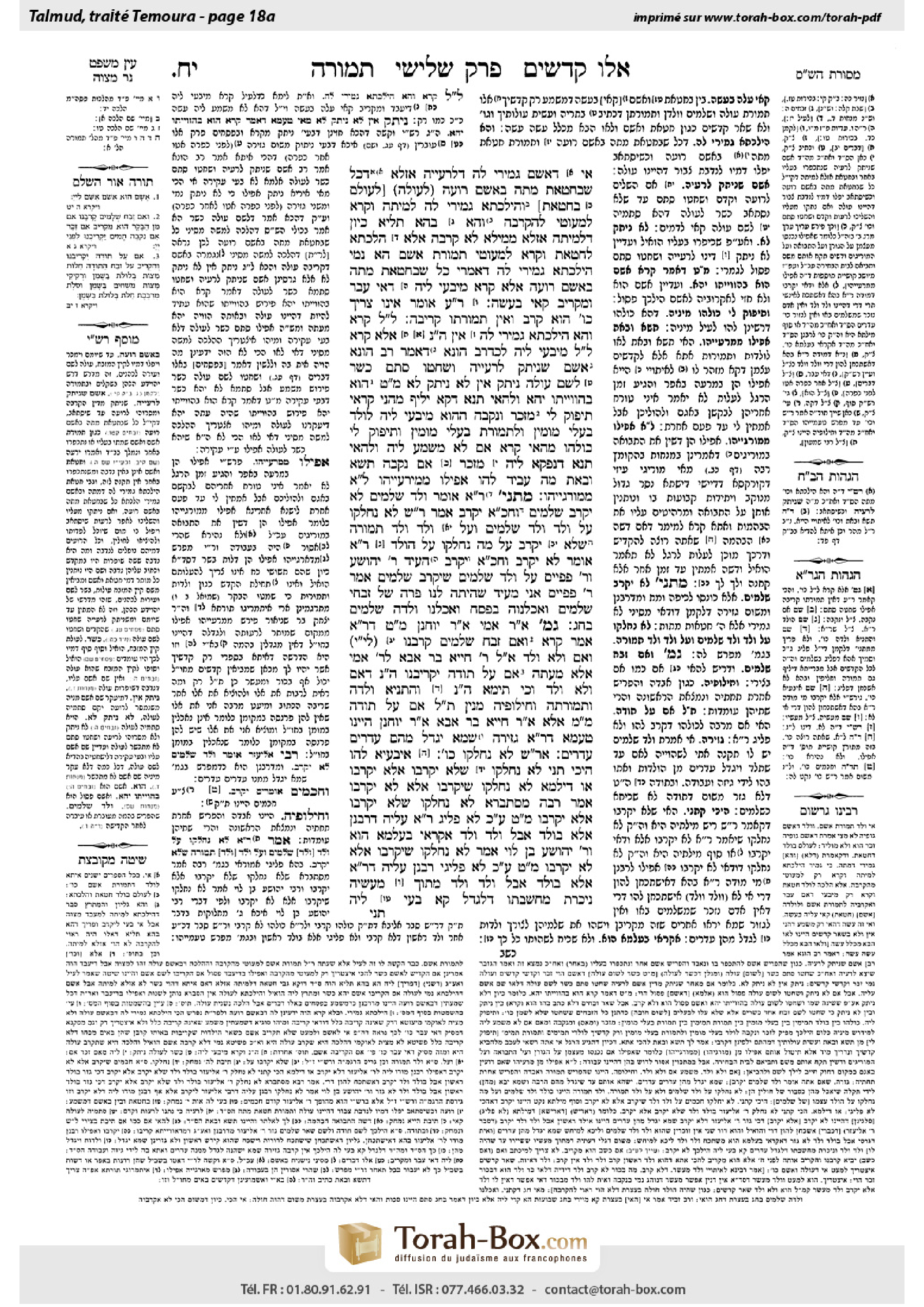
Temurah 18a: Talmud study for Daf Yomi
Daf Yomi is the daily study of one Talmud folio. Explore 37 tractates with scans, Hebrew text, Sefaria English and AI-generated French translations where annotated.
Passage selection and English or AI-generated French translation are available where the scan has annotations. Daf Study is independent of Torah-Box and Sefaria.
Browse Temurah · תמורה · All tractatesTemurah 18a text and translations
This page of Temurah includes the Aramaic text, an English translation and an AI-generated French translation, alongside the scan above.
תמורה י״ח א · Aramaic and Hebrew text
אִי דְּאָשָׁם — גְּמִירִי לַהּ דְּלִרְעִיָּיה אָזְלָא, דְּכֹל שֶׁבַּחַטָּאת מֵתָה בָּאָשָׁם רוֹעֶה. לְעוֹלָם בְּחַטָּאת, וְהִילְכְתָא גְּמִירִי לַהּ לְמִיתָה, וּקְרָא לְמַעוֹטֵי לְהַקְרָבָה.
וְהָא בְּהָא תַּלְיָא, כֵּיוָן דִּלְמִיתָה אָזְלָא — מִמֵּילָא לָא קָרְבָה! אֶלָּא הִלְכְתָא לְחַטָּאת, וְקָרָא לְמַעוֹטֵי תְּמוּרַת אָשָׁם.
הָא נָמֵי הִילְכְתָא גְּמִירִי לַהּ, דְּאָמְרִי: כֹּל שֶׁבַּחַטָּאת מֵתָה, בָּאָשָׁם רוֹעֶה. אֶלָּא קְרָא מִיבְּעֵי לֵיהּ, דְּאִי עָבַר וּמַקְרֵיב — קָאֵי בַּעֲשֵׂה.
רַבִּי עֲקִיבָא אוֹמֵר: אֵינוֹ צָרִיךְ כּוּ׳. הוּא קָרֵב וְאֵין תְּמוּרָתוֹ קְרֵיבָה. לְמָה לִי קְרָא, וְהָא הִילְכְתָא גְּמִירִי לָהּ!
אִין הָכִי נָמֵי, אֶלָּא קְרָא לְמָה לִי? מִיבְּעֵי לֵיהּ לְכִדְרַב הוּנָא, דְּאָמַר רַב הוּנָא: אָשָׁם שֶׁנִּיתַּק לִרְעִיָּיה וּשְׁחָטוֹ סְתָם — כָּשֵׁר לְשֵׁם עוֹלָה.
נִיתַּק — אִין, לֹא נִיתַּק — לָא. מַאי טַעְמָא? הוּא — בַּהֲוָויָיתוֹ יְהֵא.
וּלְהַאי תַּנָּא דְּקָא יָלֵיף מֵהָנֵי קְרָאֵי, תִּיפּוֹק לִי מִ״זָּכָר״ וּ״נְקֵבָה״? הַהוּא מִיבְּעֵי לֵיהּ לִוְלַד בַּעֲלֵי מוּמִין, וְלִתְמוּרַת בַּעֲלֵי מוּמִין.
וְתִיפּוֹק לִי כּוּלְּהוּ מֵהַאי קְרָא? ״אִם״ לָא מַשְׁמַע לֵיהּ.
וּלְהַאי תַּנָּא דְּנָפְקָא לֵיהּ מִ״זָּכָר״ ״אִם נְקֵבָה״, תִּשָּׂא וּבָאתָ מָה עָבֵיד לְהוּ! אֲפִילּוּ מִמִּירְעַיְיהוּ. לִישָּׁנָא אַחְרִינָא: מִמּוֹרִגַּיְיהוּ.
מַתְנִי׳ רַבִּי אֱלִיעֶזֶר אוֹמֵר: וְלַד שְׁלָמִים לֹא יִקְרַב שְׁלָמִים, וַחֲכָמִים אוֹמְרִים: יִקְרַב.
אָמַר רַבִּי שִׁמְעוֹן: לֹא נֶחְלְקוּ עַל וְלַד וְלַד שְׁלָמִים, וְעַל וְלַד וְלַד תְּמוּרָה שֶׁלֹּא יִקְרַב. עַל מָה נֶחְלְקוּ? עַל הַוָּלָד, רַבִּי אֱלִיעֶזֶר אוֹמֵר: לֹא יִקְרַב, וַחֲכָמִים אוֹמְרִים: יִקְרַב.
הֵעִיד רַבִּי יְהוֹשֻׁעַ וְרַבִּי פַּפְּיָיס עַל וְלַד שְׁלָמִים שֶׁיִּקְרַב שְׁלָמִים. אָמַר רַבִּי פַּפְּיָיס: אֲנִי מֵעִיד שֶׁהָיְתָה לָנוּ פָּרָה שֶׁל זִבְחֵי שְׁלָמִים, וַאֲכַלְנוּהָ בַּפֶּסַח, וְאָכַלְנוּ וְלָדָהּ שְׁלָמִים בֶּחָג.
גְּמָ׳ אָמַר רַבִּי אַמֵּי אָמַר רַבִּי יוֹחָנָן: מַאי טַעְמָא דְּרַבִּי אֱלִיעֶזֶר? אֲמַר קְרָא ״וְאִם זֶבַח שְׁלָמִים קׇרְבָּנוֹ לַה׳״, וְאֵם — וְלֹא וָלָד.
אֲמַר לֵיהּ רַבִּי חִיָּיא בַּר אַבָּא לְרַבִּי אַמֵּי: אֶלָּא מֵעַתָּה, ״אִם עַל תּוֹדָה יַקְרִיבֶנּוּ״, הָכִי נָמֵי דְּאֵם וְלֹא וָלָד? וְכִי תֵימָא הָכִי נָמֵי, וְהָתַנְיָא: וְלָדָהּ, וּתְמוּרָתָהּ, וְחִילּוּפֶיהָ — מִנַּיִן? תַּלְמוּד לוֹמַר ״אִם עַל תּוֹדָה״ — מִכׇּל מָקוֹם.
אֶלָּא אָמַר רַבִּי חִיָּיא בַּר אַבָּא, אָמַר רַבִּי יוֹחָנָן: הַיְינוּ טַעְמָא דְּרַבִּי אֱלִיעֶזֶר, גְּזֵירָה שֶׁמָּא יְגַדֵּל מֵהֶם עֲדָרִים עֲדָרִים.
אָמַר רַבִּי שִׁמְעוֹן: לֹא נֶחְלְקוּ כּוּ׳.
אִיבַּעְיָא לְהוּ: הֵיכִי תָּנֵי? ״לֹא נֶחְלְקוּ שֶׁלֹּא יִקְרְבוּ, אֶלָּא יִקְרְבוּ״, אוֹ דִילְמָא: ״לֹא נֶחְלְקוּ שֶׁיִּקְרְבוּ, אֶלָּא לֹא יִקְרְבוּ״?
אָמַר רַבָּה: מִסְתַּבְּרָא ״לֹא נֶחְלְקוּ שֶׁלֹּא יִקְרְבוּ, אֶלָּא יִקְרְבוּ״. מַאי טַעְמָא? עַד כָּאן לָא פְּלִיג רַבִּי אֱלִיעֶזֶר עֲלֵיהּ דְּרַבָּנַן אֶלָּא בְּוָלָד, אֲבָל וְלַד וָלָד — אַקְרַאי בְּעָלְמָא הוּא.
וְרַבִּי יְהוֹשֻׁעַ בֶּן לֵוִי אָמַר: ״לֹא נֶחְלְקוּ שֶׁיִּקְרְבוּ, אֶלָּא לֹא יִקְרְבוּ״. מַאי טַעְמָא? עַד כָּאן לָא פְּלִיגִי רַבָּנַן עֲלֵיהּ דְּרַבִּי אֱלִיעֶזֶר אֶלָּא בְּוָלָד, אֲבָל וְלַד וָלָד — מִתּוֹךְ (מַעֲשֶׂיהָ) [מַעֲשָׂיו] נִיכֶּרֶת מַחְשַׁבְתּוֹ דִּלְגַדֵּל קָא בָעֵי לֵיהּ.
Temurah 18a · English translation
And if it is referring to the substitute of a guilt offering, it is learned as a tradition that this offering goes out to graze, as in any case where a sin offering is left to die, in the parallel case involving a guilt offering, the animal is left to graze until it develops a blemish, after which it is redeemed and the money is used to purchase a burnt offering. Therefore, there is no need for a verse to exclude the substitute of a guilt offering. The Gemara explains: Actually, the baraita is referring to the offspring and substitute of a sin offering, and a verse is required to exclude them, despite the halakha that was learned as a tradition in their regard, for this halakha was learned only with regard to letting the animal die, and the verse serves to exclude them from being sacrificed on the altar.
The Gemara objects: But this, the halakha of sacrificing the animal upon the altar, depends on that, the halakha of letting it die. Since it goes to its death, it is clearly self-evident that it is not sacrificed. The Gemara offers a different resolution: Rather, the halakha transmitted to Moses from Sinai is referring to a sin offering, and the verse serves to exclude the case of a substitute of a guilt offering.
The Gemara asks: But this halakha with regard to the substitute of a guilt offering was also learned by the Sages as a tradition transmitted to Moses from Sinai, as they said that in any case where a sin offering is left to die, in the parallel case involving a guilt offering, the animal is left to graze. Rather, the verse is necessary to teach an additional halakha, that if one transgressed and sacrificed the offspring of a sin offering or a guilt offering, or the substitute of a sin offering or a guilt offering, he stands in violation of a prohibition inferred from a positive mitzva. Since the verse teaches that only the offspring of a burnt offering or a peace offering may be offered, it may be inferred that the offspring of a guilt offering or a sin offering may not be offered, and the violation of a prohibition stemming from a command formulated as a positive mitzva is considered the violation of a positive mitzva.
§ The baraita stated that in contrast to Rabbi Yishmael, Rabbi Akiva says that the word “only” is unnecessary to exclude the offspring and substitutes of other sacrificial animals from being sacrificed upon the altar, as the verse that discusses guilt offerings: “It is a guilt offering” (Leviticus 5:19), teaches that only it, the guilt offering itself, is sacrificed, but its substitute is not offered. The Gemara asks: Why do I need a verse to teach this? Didn’t the Sages learn this halakha, that the substitute of a guilt offering is left to graze, as a tradition transmitted to Moses from Sinai, since they said that in any case where a sin offering is left to die, in the parallel case involving a guilt offering, the animal is not sacrificed but rather left to graze?
The Gemara answers: Yes, it is indeed so, that the verse is unnecessary for that purpose. Rather, why do I need the verse? It is necessary to teach the halakha that Rav Huna stated, as Rav Huna said: With regard to a guilt offering that was consigned to grazing, i.e., it had been ruled that the animal may not be sacrificed as a guilt offering, it must be left to graze until it develops a blemish, at which point it is sold and the proceeds used for voluntary burnt offerings. An example of this is where the owner had already fulfilled his obligation with the sacrifice of a different animal. If the owner nevertheless transgressed and slaughtered it before it developed a blemish as an unspecified offering, it is valid and sacrificed for the sake of a burnt offering.
The Gemara infers: If the animal was consigned to grazing, yes, it is valid as a burnt offering, but if it was not consigned to grazing, no, it is disqualified as a burnt offering. What is the reason? It is that the verse states with regard to a guilt offering: “It is a guilt offering,” meaning that it shall remain in its present state of a guilt offering.
§ The Gemara previously (17b) cited two baraitot that stated that the offspring of a peace offering has the status of a peace offering. According to one, this is derived from the phrase in the verse in Leviticus “if male if female,” while according to the other it is derived from the phrase in the verse in Deuteronomy “You shall take and go.” The Gemara objects: And according to this tanna of the second baraita, who derives this halakha from these verses: “You shall take and go,” and: “And you shall offer your burnt offerings, the flesh and the blood,” let him derive it from the words “male” and “female.” The Gemara explains: He requires that verse to teach the halakha of the offspring of a blemished animal and to teach the halakha of the substitute of a blemished animal.
The Gemara asks: And let him derive all of the halakhot, that of the offspring and the substitute of an unblemished peace offering as well as that of the offspring and the substitute of a blemished offering, from this verse: “If male if female,” in the same manner that the tanna of the first baraita derived them from that verse. The Gemara answers: He does not learn anything from the word “if,” which is a common term and is not considered superfluous.
The Gemara asks: And according to this tanna of the first baraita, who derives all of the halakhot from the words “if male if female,” what does he do with the phrase in the verse “You shall take and go”? The Gemara answers: That verse is necessary to teach that one must bring his offerings to the Temple when he ascends to Jerusalem for the Festival even if he must take them from their place of grazing, and he should not delay bringing them until the following Festival. Another version of this answer is that the verse is necessary to teach that one must bring the animals he intends to consecrate even if he must take them from their place of threshing, i.e., even if they are currently being used to thresh, rather than delay bringing the animals to Jerusalem until a later stage.
MISHNA: Although the previous mishna stated plainly that the offspring of a peace offering is itself sacrificed as a peace offering, its status is actually subject to a dispute between the tanna’im. Rabbi Eliezer says: The offspring of a peace offering is not sacrificed on the altar as a peace offering; rather it is sequestered and left to die. And the Rabbis say: It is sacrificed as a peace offering.
Rabbi Shimon said: Rabbi Eliezer and the Rabbis do not disagree with regard to the status of the offspring of the offspring of a peace offering or with regard to the status of the offspring of the offspring of the substitute of a peace offering. In those cases, they all agree that the animal is not sacrificed on the altar as a peace offering. With regard to what case do they disagree? They disagree about the case of the offspring of a peace offering itself. Rabbi Eliezer says: It is not sacrificed as a peace offering, whereas the Rabbis say: It is sacrificed.
Rabbi Yehoshua and Rabbi Pappeyas testified about the offspring of a peace offering that it is sacrificed as a peace offering. Rabbi Pappeyas said: I testify that we ourselves had a cow that was a peace offering, and we ate it on Passover, and we ate its offspring as a peace offering on a different Festival.
GEMARA: Rabbi Ami said that Rabbi Yoḥanan said: What is the reason of Rabbi Eliezer, that the offspring of a peace offering does not have the status of a peace offering? It is that the verse states with regard to a peace offering: “And if his offering be a sacrifice of peace offerings for the Lord” (Leviticus 3:1). The term “and if [ve’im],” can be read as: And a mother [ve’em], which teaches that the mother may be offered as a peace offering, but not the offspring.
Rabbi Ḥiyya bar Abba said to Rabbi Ami: If that is so, then with regard to the verse: “If [im] he offer it for a thanksgiving” (Leviticus 7:12), so too one should interpret it to mean that one may sacrifice the mother [em] but not the offspring as a thanks offering. And if you would say that Rabbi Eliezer indeed holds that the offspring of a thanks offering is not sacrificed as a thanks offering, isn’t it taught in a baraita the following halakha with regard to the offspring of a thanks offering and its substitute and its replacement, if the original animal was lost and then found again, rendering both animals suitable for an offering: From where is it derived that all these are sacrificed as thanks offerings? The verse states: “If for a thanksgiving,” which indicates that they may be offered as a thanks offering in any case.
Rather, Rabbi Ḥiyya bar Abba said that Rabbi Yoḥanan said: This is the reason of Rabbi Eliezer, that the offspring of a peace offering is not sacrificed as a peace offering: It is a rabbinic decree that it may not be sacrificed, lest the owner delay sacrificing the peace offerings that he is obligated to bring so that he may raise entire herds from them in order to sell the animals to people who need peace offerings.
§ The mishna teaches: Rabbi Shimon said: Rabbi Eliezer and the Rabbis do not disgree with regard to the status of the offspring of the offspring of a peace offering, or with regard to the status of the offspring of the offspring of the substitute of a peace offering. In those cases, they all agree that the animal is not sacrificed on the altar as a peace offering. With regard to what case do they disagree? They disagree only about the offspring of a peace offering itself.
A dilemma was raised before the Sages: How precisely is the mishna taught? Is it saying that Rabbi Eliezer and the Rabbis do not disagree whether the offspring of the offspring are sacrificed or they are not sacrificed, but rather they all agree, even Rabbi Eliezer, that they are sacrificed? Or perhaps it is saying that they do not disagree whether the offspring of the offspring are sacrificed or they are not sacrificed, but rather they all agree, even the Sages, that they are not sacrificed.
Rabba said: It stands to reason that the mishna is saying that they do not disagree whether the offspring of the offspring are not sacrificed, but rather all agree that they are sacrificed. What is the reason? It is that Rabbi Eliezer disagrees with the Rabbis only with regard to the offspring, but with regard to the offspring of the offspring, Rabbi Eliezer does not render it prohibited to sacrifice them, as it is merely a chance, i.e., an uncommon occurrence, that one delays sacrificing an offering to the point that the offspring of its offspring have already been born.
And Rabbi Yehoshua ben Levi says that the correct reading of the mishna is: They do not disagree whether the offspring of the offspring are sacrificed, but rather all agree that they are not sacrificed. What is the reason? It is that the Rabbis disagree with Rabbi Eliezer only with regard to the offspring, but with regard to the offspring of the offspring, from the result of his actions with regard to it, i.e., that he delayed sacrificing the original offering for such a long period of time, his intention is evident that he wants to raise herds from it. Therefore, the halakha is that the offspring of the offspring may not be sacrificed, in order to deter him from the outset from raising herds.
Temurah 18a · Traduction française (IA)
Et s’il s’agit du substitut d’un sacrifice de culpabilité, une tradition enseigne que cet animal doit être laissé au pâturage. En effet, dans tous les cas où un sacrifice expiatoire est laissé à mourir, l’animal correspondant dans le cas d’un sacrifice de culpabilité est laissé au pâturage jusqu’à ce qu’il développe un défaut ; il est alors racheté, et l’argent sert à acheter un holocauste. Il n’est donc pas nécessaire qu’un verset exclue le substitut d’un sacrifice de culpabilité. La Guemara explique : en réalité, la baraïta parle du petit et du substitut d’un sacrifice expiatoire, et un verset est nécessaire pour les exclure, malgré la halakha apprise par tradition à leur sujet, car celle-ci ne concerne que le cas où l’animal est laissé à mourir ; le verset sert à exclure ces animaux des sacrifices offerts sur l’autel.
La Guemara objecte : mais ceci, la halakha selon laquelle l’animal est offert sur l’autel, dépend de cela, la halakha selon laquelle on le laisse mourir. Puisqu’il est voué à mourir, il va de soi qu’il n’est pas offert. La Guemara propose une autre résolution : il faut plutôt dire que la halakha transmise à Moïse au Sinaï concerne un sacrifice expiatoire, et que le verset sert à exclure le cas du substitut d’un sacrifice de culpabilité.
La Guemara demande : mais cette halakha concernant le substitut d’un sacrifice de culpabilité a elle aussi été apprise par les Sages comme une tradition transmise à Moïse au Sinaï, puisqu’ils ont dit que dans tous les cas où un sacrifice expiatoire est laissé à mourir, l’animal correspondant dans le cas d’un sacrifice de culpabilité est laissé au pâturage. Il faut plutôt dire que le verset est nécessaire pour enseigner une halakha supplémentaire : si quelqu’un transgresse et offre le petit d’un sacrifice expiatoire ou d’un sacrifice de culpabilité, ou le substitut d’un sacrifice expiatoire ou d’un sacrifice de culpabilité, il transgresse une interdiction déduite d’une mitsva positive. Puisque le verset enseigne que seuls le petit d’un holocauste ou celui d’un sacrifice de paix peuvent être offerts, on peut en déduire que le petit d’un sacrifice de culpabilité ou d’un sacrifice expiatoire ne peut pas être offert ; transgresser une interdiction découlant d’un commandement formulé comme une mitsva positive est considéré comme la transgression d’une mitsva positive.
§ La baraïta a indiqué que, contrairement à Rabbi Yishmaël, Rabbi Akiva dit que le mot « seulement » n’est pas nécessaire pour exclure de l’autel les petits et les substituts d’autres animaux consacrés, car le verset qui traite des sacrifices de culpabilité — « C’est un sacrifice de culpabilité » (Lévitique 5:19) — enseigne que seul le sacrifice de culpabilité lui-même est offert, mais pas son substitut. La Guemara demande : pourquoi ai-je besoin d’un verset pour enseigner cela ? Les Sages n’ont-ils pas appris cette halakha — à savoir que le substitut d’un sacrifice de culpabilité est laissé au pâturage — comme une tradition transmise à Moïse au Sinaï, puisqu’ils ont dit que dans tous les cas où un sacrifice expiatoire est laissé à mourir, l’animal correspondant dans le cas d’un sacrifice de culpabilité n’est pas offert, mais est laissé au pâturage ?
La Guemara répond : oui, c’est bien cela, le verset n’est pas nécessaire à cette fin. Alors, pourquoi ai-je besoin du verset ? Il est nécessaire pour enseigner la halakha énoncée par Rav Houna, car Rav Houna a dit : lorsqu’un sacrifice de culpabilité est destiné au pâturage, c’est-à-dire qu’il a été décidé que l’animal ne peut pas être offert comme sacrifice de culpabilité, il faut le laisser paître jusqu’à ce qu’il développe un défaut ; il est alors vendu, et le produit de la vente sert à financer des holocaustes volontaires. C’est le cas, par exemple, lorsque le propriétaire s’est déjà acquitté de son obligation en offrant un autre animal. Si, malgré cela, le propriétaire transgresse et l’égorge avant qu’il ait développé un défaut, comme offrande non spécifiée, elle est valide et est offerte comme holocauste.
La Guemara en déduit : si l’animal était destiné au pâturage, alors il est valide comme holocauste ; mais s’il n’y était pas destiné, il n’est pas valide comme holocauste. Pour quelle raison ? Le verset dit au sujet d’un sacrifice de culpabilité : « C’est un sacrifice de culpabilité », ce qui signifie qu’il doit rester dans son état actuel de sacrifice de culpabilité.
§ La Guemara a précédemment (17b) cité deux baraïtot qui indiquaient que le petit d’un sacrifice de paix a le statut d’un sacrifice de paix. Selon l’une, cela se déduit de l’expression « s’il est mâle ou femelle » dans le verset du Lévitique ; selon l’autre, cela se déduit de l’expression « tu prendras et tu iras » dans le verset du Deutéronome. La Guemara objecte : et selon le tanna de la seconde baraïta, qui déduit cette halakha des versets « tu prendras et tu iras » et « vous offrirez vos holocaustes, la chair et le sang », qu’il la déduise des mots « mâle » et « femelle ». La Guemara explique : il a besoin de ce verset pour enseigner la halakha concernant le petit d’un animal atteint d’un défaut et celle concernant le substitut d’un animal atteint d’un défaut.
La Guemara demande : qu’il déduise donc toutes les halakhot — celle du petit et du substitut d’un sacrifice de paix sans défaut, ainsi que celle du petit et du substitut d’un sacrifice atteint d’un défaut — de ce verset : « s’il est mâle ou femelle », comme le tanna de la première baraïta les déduit de ce verset. La Guemara répond : il ne déduit rien du mot « si », qui est un terme courant et n’est pas considéré comme superflu.
La Guemara demande : et selon le tanna de la première baraïta, qui déduit toutes les halakhot des mots « s’il est mâle ou femelle », que fait-il de l’expression « tu prendras et tu iras » ? La Guemara répond : ce verset est nécessaire pour enseigner qu’on doit apporter ses sacrifices au Temple lorsqu’on monte à Jérusalem pour la fête, même s’il faut les prendre de leur lieu de pâturage, et qu’on ne doit pas en différer l’apport jusqu’à la fête suivante. Selon une autre version de cette réponse, le verset est nécessaire pour enseigner qu’on doit apporter les animaux que l’on entend consacrer même s’il faut les prendre de leur lieu de battage, c’est-à-dire même s’ils sont alors utilisés pour battre le grain, plutôt que de retarder leur transport à Jérusalem jusqu’à une étape ultérieure.
MICHNA : Bien que la Michna précédente ait énoncé clairement que le petit d’un sacrifice de paix est lui-même offert comme sacrifice de paix, son statut fait en réalité l’objet d’un désaccord entre les tannaïm. Rabbi Eliezer dit : le petit d’un sacrifice de paix n’est pas offert sur l’autel comme sacrifice de paix ; il est plutôt mis à l’écart et laissé à mourir. Les Sages disent : il est offert comme sacrifice de paix.
Rabbi Shimon dit : Rabbi Eliezer et les Sages ne sont pas en désaccord sur le statut du petit du petit d’un sacrifice de paix ni sur celui du petit du petit du substitut d’un sacrifice de paix. Dans ces cas, tous conviennent que l’animal n’est pas offert sur l’autel comme sacrifice de paix. Sur quel cas sont-ils en désaccord ? Ils sont en désaccord au sujet du petit d’un sacrifice de paix lui-même. Rabbi Eliezer dit qu’il n’est pas offert comme sacrifice de paix, tandis que les Sages disent qu’il est offert.
Rabbi Yehoshua et Rabbi Pappeyas ont témoigné que le petit d’un sacrifice de paix est offert comme sacrifice de paix. Rabbi Pappeyas a dit : « Je témoigne que nous avions nous-mêmes une vache qui était un sacrifice de paix ; nous l’avons mangée à Pessa’h, et nous avons mangé son petit comme sacrifice de paix lors d’une autre fête. »
GUEMARA : Rabbi Ami a dit au nom de Rabbi Yoḥanan : quelle est la raison de Rabbi Eliezer, selon lequel le petit d’un sacrifice de paix n’a pas le statut d’un sacrifice de paix ? Le verset dit au sujet d’un sacrifice de paix : « Et si son offrande est un sacrifice de paix pour le Seigneur » (Lévitique 3:1). L’expression « et si [ve’im] » peut se lire « et la mère [ve’em] », ce qui enseigne que la mère peut être offerte comme sacrifice de paix, mais pas le petit.
Rabbi Ḥiyya bar Abba dit à Rabbi Ami : si tel est le cas, alors, au sujet du verset « Si [im] quelqu’un l’offre en sacrifice d’action de grâce » (Lévitique 7:12), il faudrait également l’interpréter ainsi : on peut offrir la mère [em], mais pas le petit, comme sacrifice d’action de grâce. Et si tu dis que Rabbi Eliezer pense effectivement que le petit d’un sacrifice d’action de grâce n’est pas offert comme sacrifice d’action de grâce, n’enseigne-t-on pas dans une baraïta la halakha suivante concernant le petit d’un sacrifice d’action de grâce, son substitut et son animal de remplacement — lorsque l’animal d’origine a été perdu puis retrouvé, de sorte que les deux animaux peuvent être offerts : d’où apprend-on qu’ils sont tous offerts comme sacrifices d’action de grâce ? Le verset dit : « Si c’est pour une action de grâce », ce qui indique qu’ils peuvent être offerts comme sacrifices d’action de grâce dans tous les cas.
Rabbi Ḥiyya bar Abba dit plutôt au nom de Rabbi Yoḥanan : voici la raison pour laquelle, selon Rabbi Eliezer, le petit d’un sacrifice de paix n’est pas offert comme sacrifice de paix : un décret rabbinique interdit de l’offrir, de peur que le propriétaire ne retarde l’offrande des sacrifices de paix qu’il est tenu d’apporter afin d’en élever des troupeaux entiers, puis de vendre les animaux à ceux qui ont besoin de sacrifices de paix.
§ La Michna enseigne : Rabbi Shimon dit que Rabbi Eliezer et les Sages ne sont pas en désaccord sur le statut du petit du petit d’un sacrifice de paix ni sur celui du petit du petit du substitut d’un sacrifice de paix. Dans ces cas, tous conviennent que l’animal n’est pas offert sur l’autel comme sacrifice de paix. Sur quel cas sont-ils en désaccord ? Ils ne sont en désaccord qu’au sujet du petit d’un sacrifice de paix lui-même.
Une question fut posée aux Sages : quel est exactement le sens de la Michna ? Dit-elle que Rabbi Eliezer et les Sages ne sont pas en désaccord sur la question de savoir si les petits des petits sont offerts ou non, mais qu’ils conviennent tous, y compris Rabbi Eliezer, qu’ils sont offerts ? Ou bien dit-elle qu’ils ne sont pas en désaccord sur la question de savoir si les petits des petits sont offerts ou non, mais qu’ils conviennent tous, y compris les Sages, qu’ils ne sont pas offerts ?
Rabba dit : il est raisonnable de comprendre que la Michna enseigne qu’ils ne sont pas en désaccord sur le fait que les petits des petits ne sont pas offerts, mais qu’ils conviennent tous qu’ils sont offerts. Pour quelle raison ? Rabbi Eliezer n’est en désaccord avec les Sages qu’au sujet du petit ; mais, en ce qui concerne le petit du petit, Rabbi Eliezer n’interdit pas de l’offrir, car il est peu probable — c’est-à-dire que cela se produit rarement — que l’on retarde l’offrande au point que le petit du petit soit déjà né.
Et Rabbi Yehoshua ben Levi dit que la lecture correcte de la Michna est la suivante : ils ne sont pas en désaccord sur la question de savoir si les petits des petits sont offerts, mais ils conviennent tous qu’ils ne le sont pas. Pour quelle raison ? Les Sages ne sont en désaccord avec Rabbi Eliezer qu’au sujet du petit ; mais, en ce qui concerne le petit du petit, ses actes révèlent son intention : il a retardé l’offrande de l’animal d’origine si longtemps qu’il est manifeste qu’il veut en élever des troupeaux. La halakha est donc que le petit du petit ne peut pas être offert, afin de le dissuader dès le départ d’élever des troupeaux.
Traduction française générée par IA à partir de l’édition anglaise de Sefaria. Vérifie toujours un passage avec le texte source.
Text from Sefaria: William Davidson Edition - Vocalized Aramaic (CC BY NC); William Davidson Edition - English (CC BY NC).