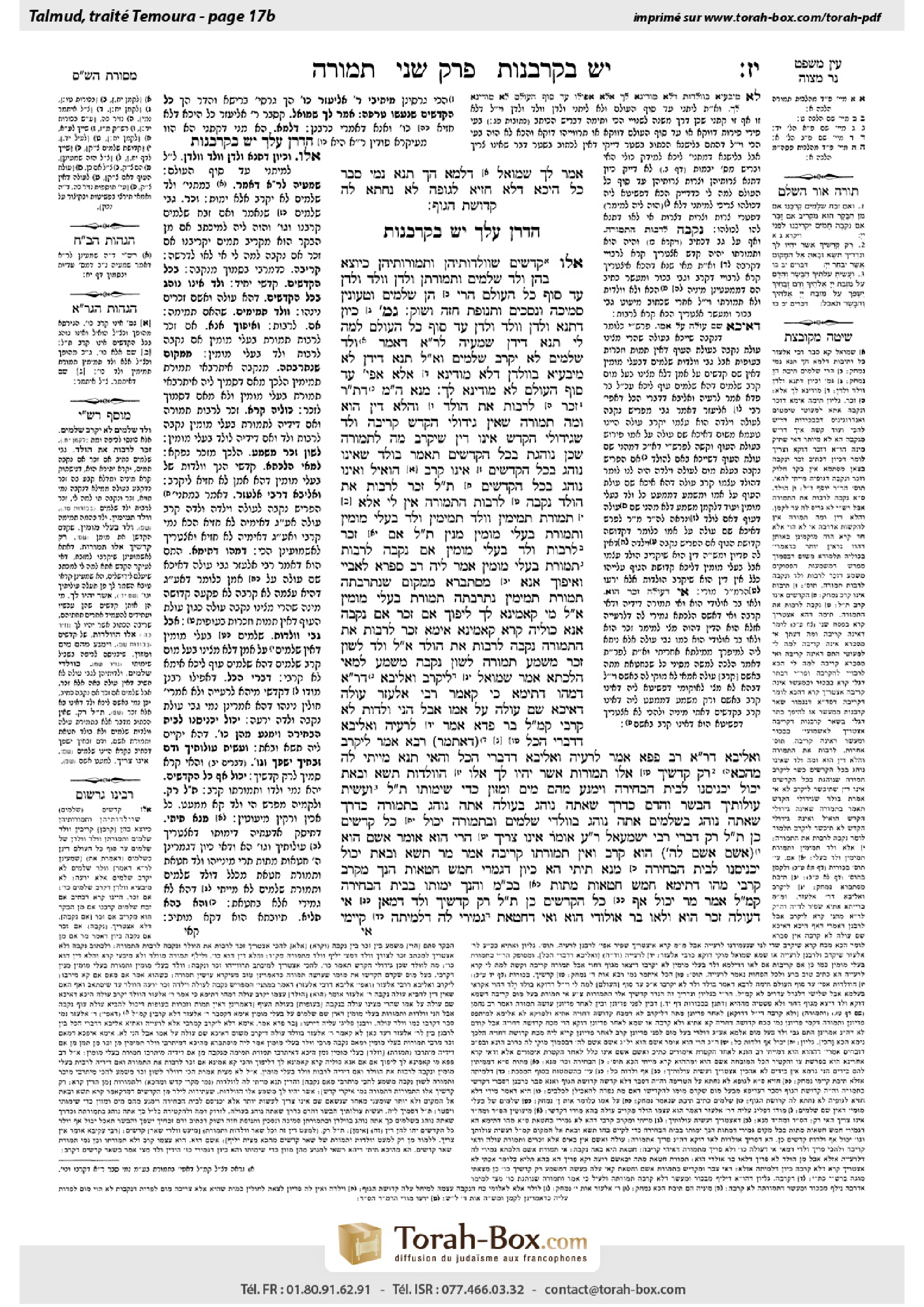
Temurah 17b: Talmud study for Daf Yomi
Daf Yomi is the daily study of one Talmud folio. Explore 37 tractates with scans, Hebrew text, Sefaria English and AI-generated French translations where annotated.
Passage selection and English or AI-generated French translation are available where the scan has annotations. Daf Study is independent of Torah-Box and Sefaria.
Browse Temurah · תמורה · All tractatesTemurah 17b text and translations
This page of Temurah includes the Aramaic text, an English translation and an AI-generated French translation, alongside the scan above.
תמורה י״ז ב · Aramaic and Hebrew text
אָמַר לְךָ שְׁמוּאֵל: דִּלְמָא הָךְ תַּנָּא נָמֵי סָבַר כֹּל הֵיכָא דְּלָא חַזְיָא לְגוּפַהּ — לָא נָחֲתָא לַהּ קְדוּשַּׁת הַגּוּף.
הֲדַרַן עֲלָךְ יֵשׁ בְּקׇרְבְּנוֹת.
מַתְנִי׳ אֵלּוּ קָדָשִׁים שֶׁוַּולְדוֹתֵיהֶן וּתְמוּרוֹתֵיהֶן כַּיּוֹצֵא בָּהֶן, וְלַד שְׁלָמִים וּתְמוּרָתָן, וְלָדָן וּוְלַד וְלָדָן עַד סוֹף כׇּל הָעוֹלָם — הֲרֵי הֵן שְׁלָמִים, וּטְעוּנִין סְמִיכָה וּנְסָכִים וּתְנוּפַת חָזֶה וָשׁוֹק.
גְּמָ׳ כֵּיוָן דִּתְנָא ״וְלָדָן וּוְלַד וְלָדָן״, ״עַד סוֹף כׇּל הָעוֹלָם״ לְמָה לִי? תַּנָּא דִידַן שַׁמְעֵיהּ לְרַבִּי אֶלְעָזָר דְּאָמַר ״וְלַד שְׁלָמִים לֹא יִקְרַב שְׁלָמִים״, וַאֲמַר לֵיהּ תַּנָּא דִידַן: לָא מִיבַּעְיָא בִּוְולָדָן דְּלָא מוֹדֵינָא, אֶלָּא אֲפִילּוּ עַד סוֹף הָעוֹלָם לָא מוֹדֵינָא לָךְ.
מְנָא הָנֵי מִילֵּי? דְּתָנוּ רַבָּנַן: ״זָכָר״ — לְרַבּוֹת אֶת הַוָּלָד.
וַהֲלֹא דִין הוּא: וּמָה תְּמוּרָה, שֶׁאֵין גִּידּוּלֵי הֶקְדֵּשׁ — קְרֵיבָה, וָלָד, שֶׁגִּידּוּלֵי הֶקְדֵּשׁ — אֵינוֹ דִּין שֶׁיִּקְרַב?
מָה לִתְמוּרָה, שֶׁכֵּן נוֹהֶגֶת בְּכׇל הַקֳּדָשִׁים, תֹּאמַר בְּוָלָד, שֶׁאֵינוֹ נוֹהֵג בְּכׇל הַקֳּדָשִׁים? אֵינוֹ קָרֵב הוֹאִיל וְאֵינוֹ נוֹהֵג בְּכׇל הַקֳּדָשִׁים. תַּלְמוּד לוֹמַר ״זָכָר״ — לְרַבּוֹת אֶת הַוָּלָד, ״נְקֵבָה״ — לְרַבּוֹת הַתְּמוּרָה.
אֵין לִי אֶלָּא תְּמוּרַת תְּמִימִין, וּוְלַד תְּמִימִין, וְלַד בַּעֲלֵי מוּמִין וּתְמוּרַת בַּעֲלֵי מוּמִין מִנַּיִן? תַּלְמוּד לוֹמַר ״אִם זָכָר״ לְרַבּוֹת וְלַד בַּעֲלֵי מוּמִין, ״אִם נְקֵבָה״ לְרַבּוֹת תְּמוּרַת בַּעֲלֵי מוּמִין.
אֲמַר לֵיהּ רַב סָפְרָא לְאַבָּיֵי: וְאֵיפוֹךְ אֲנָא! מִסְתַּבְּרָא, מִמָּקוֹם שֶׁנִּתְרַבְּתָה תְּמוּרַת תְּמִימִין נִתְרַבְּתָה תְּמוּרַת בַּעֲלֵי מוּמִין.
אֲמַר לֵיהּ: מִי קָאָמֵינָא לָךְ לֵיפוֹךְ ״אִם זָכָר״ ״אִם נְקֵבָה״? אֲנָא כּוּלֵּיהּ קְרָא קָאָמֵינָא! אֵימָא: ״זָכָר״ לְרַבּוֹת אֶת הַתְּמוּרָה, ״נְקֵבָה״ לְרַבּוֹת אֶת הַוָּלָד. אֲמַר לֵיהּ: ״וָלָד״ לְשׁוֹן זָכָר מַשְׁמַע, ״תְּמוּרָה״ לְשׁוֹן נְקֵבָה מַשְׁמַע.
לְמַאי הִלְכְתָא? אָמַר שְׁמוּאֵל: לִיקְרַב, וְאַלִּיבָּא דְּרַבִּי אֶלְעָזָר.
דְּמַהוּ דְּתֵימָא: כִּי קָאָמַר רַבִּי אֶלְעָזָר עוֹלָה, דְּאִיכָּא שֵׁם עוֹלָה עַל אִמּוֹ, אֲבָל הָנֵי וְלָדוֹת לָא קָרְבִי — קָמַשְׁמַע לַן.
בַּר פְּדָא אָמַר: לִרְעִיָּה, וְאַלִּיבָּא דְּדִבְרֵי הַכֹּל. דְּאִתְּמַר: רָבָא אָמַר: לִיקְרַב, וְאַלִּיבָּא דְּרַבִּי אֶלְעָזָר. רַב פָּפָּא אָמַר: לִרְעִיָּה, וְאַלִּיבָּא דְּדִבְרֵי הַכֹּל.
וְהַאי תַּנָּא מַיְיתֵי לַהּ מֵהָכָא.
״רָק קֳדָשֶׁיךָ״ — אֵלּוּ תְּמוּרוֹת, ״אֲשֶׁר יִהְיוּ לָךְ״ — אֵלּוּ הַוְּולָדוֹת, ״תִּשָּׂא וּבָאת״.
יָכוֹל יַכְנִיסֶנּוּ לְבֵית הַבְּחִירָה, וְיִמְנַע מֵהֶם מַיִם וּמָזוֹן כְּדֵי שֶׁיָּמוּתוּ? תַּלְמוּד לוֹמַר: ״וְעָשִׂיתָ עוֹלוֹתֶיךָ הַבָּשָׂר וְהַדָּם״, כְּדֶרֶךְ שֶׁאַתָּה נוֹהֵג בְּעוֹלָה — אַתָּה נוֹהֵג בִּתְמוּרָה, כְּדֶרֶךְ שֶׁאַתָּה נוֹהֵג בִּשְׁלָמִים — אַתָּה נוֹהֵג בְּוַולְדֵי שְׁלָמִים וּבִתְמוּרָה.
יָכוֹל כׇּל קָדָשִׁים כֵּן? תַּלְמוּד לוֹמַר ״רַק״ — דִּבְרֵי רַבִּי יִשְׁמָעֵאל. רַבִּי עֲקִיבָא אוֹמֵר: אֵינוֹ צָרִיךְ, הֲרֵי הוּא אוֹמֵר ״אָשָׁם הוּא אָשֹׁם אָשַׁם לַה׳״ — הוּא קָרֵב, וְאֵין תְּמוּרָתוֹ קְרֵיבָה.
אָמַר מָר: ״תִּשָּׂא וּבָאת״, יָכוֹל יַכְנִיסֶנּוּ לְבֵית הַבְּחִירָה?
מְנָא תֵּיתֵי הָא? כֵּיוָן דְּגָמְרִי חָמֵשׁ חַטָּאוֹת, הָנָךְ מִקְרָב קָרְבִי!
מַהוּ דְּתֵימָא: חָמֵשׁ חַטָּאוֹת מֵתוֹת בְּכׇל מָקוֹם, וְהָנָךְ יָמוּתוּ בְּבֵית הַבְּחִירָה — קָמַשְׁמַע לַן.
אָמַר מָר: יָכוֹל אַף כָּל הַקֳּדָשִׁים כֵּן? תַּלְמוּד לוֹמַר ״רַק קָדָשֶׁיךָ״. וָלָד דְּמַאן? אִי דְּעוֹלָה — זָכָר הוּא, וְלָאו בַּר אוֹלוֹדֵי הוּא! וְאִי דְּחַטָּאת — גְּמִירִי לַהּ דִּלְמִיתָה קָיְימִי!
Temurah 17b · English translation
The Gemara explains that Shmuel could have said to you: Perhaps this tanna also holds that anywhere that an animal is not fit itself for sacrificing, inherent sanctity does not rest upon it. Shmuel himself holds in accordance with those who disagree with this opinion.
MISHNA: These are the sacrificial animals for which the halakhic status of their offspring and substitutes is like their own halakhic status: The offspring of peace offerings, and their substitute animals, and even the offspring of their offspring or their substitute animals, and even the offspring of their offspring, until the end of all time [ad sof kol ha’olam]. They are all endowed with the sanctity and halakhic status of peace offerings, and therefore they require placing hands on the head of the animal, and libations, and the waving of the breast and the thigh in order to give them to the priest.
GEMARA: The Gemara asks: Since the tanna already taught: The offspring of the offspring or the substitute and the offspring of their offspring, why do I need him to state: Until the end of all time? The Gemara answers: The tanna of our mishna heard that Rabbi Elazar said in the next mishna that the offspring of a peace offering is not sacrificed as a peace offering, but rather it is sequestered and left to die, and the tanna of our mishna said to him: It is not necessary to state with regard to their offspring that I do not concede to you, as I maintain that it is sacrificed upon the altar as a peace offering, but even with regard to all of the offsprings until the end of time I do not concede to you, as I rule that they are all sacrificed as peace offerings.
§ With regard to the mishna’s statement that the halakhic status of the offspring of peace offerings and their substitutes are like that of the peace offering itself, the Gemara asks: From where are these matters derived? The Gemara answers: As the Sages taught in a baraita: “And if his offering be a sacrifice of peace offerings: If he offer of the herd, if male if female, he shall offer it without blemish before the Lord” (Leviticus 3:1). Since the verse already states: “If he offer of the herd,” the words “if male if female” are unnecessary. Rather, the word “male” serves to include the offspring of a peace offering as having the the same halakhic status as a peace offering.
The baraita objects: But could this not be derived through an a fortiori inference: If a substitute of a peace offering, which is lenient in that it is not grown from consecrated property, i.e., it is not the offspring of a sacrifical animal, is sacrificed as a peace offering, then with regard to the offspring of a peace offering, which is more stringent since it is grown from consecrated property, is it not logical that it be sacrificed as a peace offering?
The baraita responds that this a fortiori inference may be refuted: What is unique about the halakhic status of a substitute? It is unique in that the halakha of substitution applies to all sacrificial animals that belong to an individual, and therefore the substitute of a peace offering is offered as a peace offering. Shall you say the same with regard to the offspring, which is more lenient in that it does not apply to all sacrificial animals, as some are male and do not give birth, and therefore there is reason to say that it is not sacrificed as a peace offering, since the halakha with regard to the sanctity of the offspring does not apply to all sacrificial animals? Therefore, the verse states the word “male” to include the offspring, and it states the word “female” to include the substitute of a peace offering, indicating that both have the status of a peace offering.
I have derived only that the substitute of an unblemished peace offering and the offspring of an unblemished peace offering have the status of a peace offering. From where do I derive that the offspring of blemished animals and the substitute of blemished animals which are themselves unblemished have the status of peace offerings? The verse states in a more expanded form: “If male,” to include the offspring of blemished animals, and “if female,” to include the substitute of blemished animals.
The Gemara analyzes the baraita: Rav Safra said to Abaye: But why should I not reverse the interpretations and say that the words “if male” serve to include the substitute of blemished animals, and the words “if female” serve to include the offspring of blemished animals? Abaye responds: It stands to reason that from the same place that the substitute of unblemished animals is included, i.e., from the word “female,” the substitute of blemished animals is also included, i.e., from the expanded form “if female.” Likewise, since the word “male” teaches that the offspring of an unblemished peace offering is included, the offspring of a blemished peace offering is included from the phrase “if male.”
Rav Safra said to Abaye in explanation of his question: Did I say to you to reverse the interpretations of the phrases “if male” and “if female”? I actually said that the interpretation of the entire verse should be reversed as follows: Say that the word “male” serves to include the substitute of both a blemished and an unblemished offering, and the word “female” serves to include the offspring of both a blemished and an unblemished offering. Abaye said to him in response: It is logical to interpret the verse as the baraita does, as the word offspring [valad] indicates a masculine form, while the word substitute [temura] indicates a feminine form.
§ The baraita stated that the offspring of a blemished peace offering has the status of a peace offering. The Gemara asks: For what matter is that halakha relevant? Shmuel said: It is relevant with regard to sacrificing it on the altar as a peace offering, even though its mother is blemished and disqualified for the altar. And the baraita is in accordance with the opinion of Rabbi Elazar, who rules that if one sets aside a female animal for a burnt offering, and that animal gave birth to a male, the offspring is offered as a burnt offering, even though its mother may not be offered as a burnt offering (see 18b).
The baraita therefore teaches that the same is true with regard to the offspring of a blemished peace offering. And although Rabbi Elazar already stated this principle, it was necessary for the baraita to repeat it in this case, lest you say that when Rabbi Elazar says his opinion, it is only with regard to a burnt offering, due to the fact that there the discrepancy between mother and offspring is their sex, and there is burnt offering status for females, i.e., the case of a bird that is the same sex as its mother, as one may sacrifice a female bird burnt offering. But perhaps these offspring of a blemished peace offering are not sacrificed, as there is no case of a blemished animal that may be offered as a peace offering. Therefore, it teaches us that even these offspring may be sacrificed.
Bar Padda said: The statement of the baraita that the offspring of a blemished peace offering has the status of a peace offering is relevant only with regard to grazing the animal until it develops a blemish, after which it may be redeemed and the money used to bring a burnt offering. But the animal itself may not be sacrificed on the altar. And the baraita is in accordance with all opinions. As it was stated that the following amora’im disagreed about the same point as did Shmuel and bar Padda: Rava said that the offspring of a blemished offering is consecrated with regard to sacrificing it upon the altar, and this is in accordance with the opinion of Rabbi Elazar, whereas Rav Pappa said that this halakha applies only with regard to grazing, and this is in accordance with all opinions.
§ In the baraita, the halakha governing the substitute and offspring of a peace offering is derived from the superfluous words “male” and “female.” The Gemara notes: But this tanna cites the source of this halakha from here: “Only the holy things you have, and your vows, you shall take and go to the place which the Lord shall choose; and you shall offer your burnt offerings, the flesh and the blood, upon the altar of the Lord your God; and the blood of your sacrifices shall be poured out against the altar of the Lord your God, and you shall eat the flesh” (Deuteronomy 12:26–27).
With regard to the words: “Only your holy things,” these are the substitutes; “that you have,” these are the offspring. And with regard to these, it states: “You shall take and go to the place which the Lord shall choose,” i.e., they must be brought to the Temple as offerings.
One might have thought that one should bring them into the Temple but withhold water and food from them so that they die. Therefore, the verse states: “And you shall offer your burnt offerings, the flesh and the blood, upon the altar of the Lord your God.” This indicates that in the manner that you treat a burnt offering, you should treat the substitute of a burnt offering, and in the manner that you treat a peace offering, you should treat the offspring of a peace offering and the substitute of a peace offering.
One might have thought that this is the halakha with regard to all sacrificial animals, i.e., that their substitutes and offspring are sacrificed upon the altar. Therefore, the verse states: “Only your holy things,” which, as the Gemara will explain shortly, excludes certain offspring from this principle. This is the statement of Rabbi Yishmael. Rabbi Akiva says: The word “only” is unnecessary, as it states with regard to a guilt offering: “It is a guilt offering; he is certainly guilty before the Lord” (Leviticus 5:19). The term “It is [hu],” indicates that only it, the guilt offering itself, is sacrificed upon the altar, but its substitute is not sacrificed.
§ The Master said above: Due to the phrase in the verse “You shall take and go,” one might have thought that one should bring the substitute and offspring into the Temple but withhold water and food from them so that they die. Therefore, the verse states: “And you shall offer your burnt offerings, the flesh and the blood, upon the altar of the Lord your God.”
The Gemara asks: From where would this be derived, that these animals should be brought into the Temple and then left to die? Since the halakha that five sin offering are left to die is learned through a tradition transmitted to Moses from Sinai, and the offspring of a sin offering and the substitute of a sin offering are included among those five, it would have been reasonable to conclude that only those sin offerings are left to die, but these animals, the offspring of a peace offering and the substitute of a peace offering, are sacrificed upon the altar.
The Gemara answers: The verse is necessary, lest you say that these five sin offerings may be left to die in any location, but these, the offspring and substitute of a peace offering, must be left to die specifically in the Temple. Therefore, the verse teaches us that this is not so, as the offspring and substitute of a peace offering may be offered upon the altar.
§ The master said above: One might have thought that this is the halakha even with regard to all sacrificial animals that their substitutes and offspring may be sacrificed upon the altar just as the sacrificial animals themselves are. Therefore, the verse states: “Only your holy things,” indicating that this principle does not apply equally in all cases. The Gemara asks: The offspring of which offering is referred to here? If it is referring to the offspring of a burnt offering, a burnt offering is male, and is therefore not capable of giving birth. And if it is referring to the offspring or substitute of a sin offering, it is learned as a tradition that such an animal is left to die.
Temurah 17b · Traduction française (IA)
La Guemara explique que Chmouel aurait pu te répondre : peut-être ce tanna aussi soutient-il que la sainteté intrinsèque ne s’attache à un animal que si celui-ci est lui-même apte à être offert en sacrifice. Chmouel lui-même suit l’opinion de ceux qui contestent cette position.
MICHNA : Voici les animaux sacrificiels dont les descendants et les substituts ont le même statut halakhique qu’eux : les descendants des sacrifices de paix, leurs substituts, et même les descendants de leurs descendants ou de leurs substituts, ainsi que les descendants de leurs descendants, jusqu’à la fin des temps [ad sof kol ha’olam]. Tous sont investis de la sainteté et du statut halakhique des sacrifices de paix ; ils nécessitent donc l’imposition des mains sur leur tête, des libations, ainsi que le balancement de la poitrine et de la cuisse, afin de les remettre au prêtre.
GUEMARA : La Guemara demande : puisque le tanna a déjà enseigné qu’il en va ainsi des descendants des descendants ou des substituts, ainsi que des descendants de leurs descendants, pourquoi préciser « jusqu’à la fin des temps » ? La Guemara répond : le tanna de notre Michna a entendu Rabbi Elazar dire, dans la Michna suivante, que le descendant d’un sacrifice de paix n’est pas offert comme sacrifice de paix, mais qu’il est mis à l’écart et laissé à mourir. Le tanna de notre Michna lui a répondu : il n’est pas nécessaire de préciser que je ne suis pas d’accord avec toi au sujet de leurs descendants, car je soutiens qu’ils sont offerts sur l’autel comme sacrifices de paix. Mais je ne suis pas non plus d’accord avec toi au sujet de tous les descendants, jusqu’à la fin des temps : selon moi, ils sont tous offerts comme sacrifices de paix.
§ À propos de l’énoncé de la Michna selon lequel les descendants des sacrifices de paix et leurs substituts ont le même statut halakhique que le sacrifice de paix lui-même, la Guemara demande : de quelle source tire-t-on ces règles ? La Guemara répond : les Sages ont enseigné dans une baraïta : « Et si son offrande est un sacrifice de paix : s’il offre du gros bétail, mâle ou femelle, il l’offrira sans défaut devant l’Éternel » (Lévitique 3, 1). Puisque le verset dit déjà : « s’il offre du gros bétail », les mots « mâle ou femelle » sont superflus. Le mot « mâle » sert plutôt à inclure le descendant d’un sacrifice de paix, qui a le même statut halakhique qu’un sacrifice de paix.
La baraïta objecte : cela ne pourrait-il pas se déduire par un raisonnement a fortiori ? Si le substitut d’un sacrifice de paix, qui est moins strict en ce qu’il ne provient pas d’un bien consacré, c’est-à-dire qu’il n’est pas le descendant d’un animal sacrificiel, est offert comme sacrifice de paix, alors le descendant d’un sacrifice de paix, qui est plus strict puisqu’il provient d’un bien consacré, ne devrait-il pas, à plus forte raison, être offert comme sacrifice de paix ?
La baraïta répond que ce raisonnement a fortiori peut être réfuté : qu’est-ce qui distingue le statut halakhique d’un substitut ? Le fait que la halakha de la substitution s’applique à tous les animaux sacrificiels appartenant à un particulier ; c’est pourquoi le substitut d’un sacrifice de paix est offert comme sacrifice de paix. Peut-on en dire autant du descendant, qui est moins strict puisque cette règle ne s’applique pas à tous les animaux sacrificiels — certains sont mâles et ne mettent pas bas ? Il y a donc lieu de dire qu’il n’est pas offert comme sacrifice de paix, puisque la règle relative à la sainteté des descendants ne s’applique pas à tous les animaux sacrificiels. Le verset emploie donc le mot « mâle » pour inclure le descendant, et le mot « femelle » pour inclure le substitut d’un sacrifice de paix, indiquant que tous deux ont le statut d’un sacrifice de paix.
J’ai seulement déduit que le substitut d’un sacrifice de paix sans défaut et le descendant d’un sacrifice de paix sans défaut ont le statut d’un sacrifice de paix. D’où déduis-je que les descendants d’animaux présentant un défaut et les substituts d’animaux présentant un défaut qui sont eux-mêmes sans défaut ont le statut de sacrifices de paix ? Le verset emploie une formulation plus développée : « mâle », pour inclure les descendants d’animaux présentant un défaut, et « femelle », pour inclure les substituts d’animaux présentant un défaut.
La Guemara analyse la baraïta : Rav Safra dit à Abayé : pourquoi ne pas inverser les interprétations et dire que les mots « mâle » incluent le substitut d’animaux présentant un défaut, et que les mots « femelle » incluent les descendants d’animaux présentant un défaut ? Abayé répond : il est logique que, de même que le substitut d’animaux sans défaut est inclus par le mot « femelle », le substitut d’animaux présentant un défaut soit lui aussi inclus par la formulation développée « si femelle ». De même, puisque le mot « mâle » enseigne que le descendant d’un sacrifice de paix sans défaut est inclus, l’expression « si mâle » inclut le descendant d’un sacrifice de paix présentant un défaut.
Rav Safra dit à Abayé, pour expliquer sa question : t’ai-je demandé d’inverser les interprétations des expressions « si mâle » et « si femelle » ? J’ai en réalité dit qu’il fallait inverser l’interprétation du verset entier ainsi : le mot « mâle » inclut le substitut d’une offrande, qu’elle présente ou non un défaut, et le mot « femelle » inclut le descendant d’une offrande, qu’elle présente ou non un défaut. Abayé lui répond : il est logique d’interpréter le verset comme le fait la baraïta, car le mot « descendant » [valad] est de forme masculine, tandis que le mot « substitut » [temura] est de forme féminine.
§ La baraïta a déclaré que le descendant d’un sacrifice de paix présentant un défaut a le statut d’un sacrifice de paix. La Guemara demande : à quoi cette halakha s’applique-t-elle ? Chmouel dit : elle concerne le fait de l’offrir sur l’autel comme sacrifice de paix, bien que sa mère présente un défaut et soit inapte à l’autel. La baraïta suit l’opinion de Rabbi Elazar, qui statue que si quelqu’un met à part une femelle pour un holocauste et que cet animal donne naissance à un mâle, le descendant est offert comme holocauste, bien que sa mère ne puisse pas être offerte comme holocauste (voir 18b).
La baraïta enseigne donc qu’il en va de même pour le descendant d’un sacrifice de paix présentant un défaut. Bien que Rabbi Elazar ait déjà énoncé ce principe, la baraïta devait le répéter dans ce cas, de peur que l’on dise que son opinion ne concerne qu’un holocauste, car la différence entre la mère et son descendant porte alors sur leur sexe ; or, une femelle peut aussi relever du statut d’holocauste, comme dans le cas d’un oiseau du même sexe que sa mère, puisqu’on peut offrir un oiseau femelle en holocauste. Mais peut-être ces descendants d’un sacrifice de paix présentant un défaut ne sont-ils pas offerts, puisqu’un animal présentant un défaut ne peut jamais être offert comme sacrifice de paix. La baraïta nous enseigne donc que même ces descendants peuvent être offerts.
Bar Padda dit : l’énoncé de la baraïta selon lequel le descendant d’un sacrifice de paix présentant un défaut a le statut d’un sacrifice de paix ne concerne que le fait de laisser paître l’animal jusqu’à ce qu’il développe un défaut ; il peut alors être racheté, et l’argent servir à apporter un holocauste. Mais l’animal lui-même ne peut pas être offert sur l’autel. La baraïta est conforme à toutes les opinions. En effet, il a été rapporté que les amoraïm suivants étaient en désaccord sur le même point que Chmouel et Bar Padda : Rava dit que le descendant d’une offrande présentant un défaut est consacré en vue d’être offert sur l’autel, conformément à l’opinion de Rabbi Elazar ; tandis que Rav Pappa dit que cette halakha ne s’applique qu’au fait de le laisser paître, conformément à toutes les opinions.
§ Dans la baraïta, la halakha qui régit le substitut et le descendant d’un sacrifice de paix est déduite des mots superflus « mâle » et « femelle ». La Guemara relève toutefois que ce tanna tire la source de cette halakha d’ici : « Seules les choses saintes que tu as, ainsi que tes vœux, tu les prendras et tu iras au lieu que l’Éternel choisira ; tu offriras tes holocaustes, la chair et le sang, sur l’autel de l’Éternel ton Dieu ; le sang de tes sacrifices sera répandu contre l’autel de l’Éternel ton Dieu, et tu mangeras la chair » (Deutéronome 12, 26-27).
Les mots « Seules les choses saintes » désignent les substituts ; les mots « que tu as » désignent les descendants. À leur sujet, il est dit : « Tu les prendras et tu iras au lieu que l’Éternel choisira », c’est-à-dire qu’ils doivent être apportés au Temple comme offrandes.
On aurait pu penser qu’il fallait les faire entrer dans le Temple, mais les priver d’eau et de nourriture afin qu’ils meurent. Le verset dit donc : « Tu offriras tes holocaustes, la chair et le sang, sur l’autel de l’Éternel ton Dieu. » Cela indique que tu dois traiter le substitut d’un holocauste comme tu traites un holocauste, et le descendant et le substitut d’un sacrifice de paix comme tu traites un sacrifice de paix.
On aurait pu penser que cette halakha s’applique à tous les animaux sacrificiels, c’est-à-dire que leurs substituts et leurs descendants sont offerts sur l’autel. Le verset dit donc : « Seules les choses saintes que tu as », ce qui, comme la Guemara l’expliquera bientôt, exclut certains descendants de ce principe. Telle est l’opinion de Rabbi Yishmael. Rabbi Akiva dit : le mot « seules » est superflu, car il est dit au sujet d’un sacrifice de culpabilité : « C’est un sacrifice de culpabilité ; il est certainement coupable devant l’Éternel » (Lévitique 5, 19). Le terme « c’est » [hu] indique que seul le sacrifice de culpabilité lui-même est offert sur l’autel, mais pas son substitut.
§ Le Maître a dit plus haut : en raison de l’expression « Tu les prendras et tu iras » dans le verset, on aurait pu penser qu’il fallait faire entrer le substitut et le descendant dans le Temple, mais les priver d’eau et de nourriture afin qu’ils meurent. Le verset dit donc : « Tu offriras tes holocaustes, la chair et le sang, sur l’autel de l’Éternel ton Dieu. »
La Guemara demande : d’où aurait-on déduit que ces animaux devaient être amenés au Temple puis laissés à mourir ? Puisque la halakha selon laquelle cinq sacrifices expiatoires sont laissés à mourir est apprise d’une tradition transmise à Moïse au Sinaï, et que le descendant d’un sacrifice expiatoire et son substitut font partie de ces cinq, on aurait raisonnablement pu conclure que seuls ces sacrifices expiatoires sont laissés à mourir, tandis que ces animaux — le descendant et le substitut d’un sacrifice de paix — sont offerts sur l’autel.
La Guemara répond : le verset est nécessaire, de peur que l’on dise que ces cinq sacrifices expiatoires peuvent être laissés à mourir en n’importe quel lieu, mais que ceux-ci, le descendant et le substitut d’un sacrifice de paix, doivent être laissés à mourir précisément dans le Temple. Le verset nous enseigne qu’il n’en est pas ainsi, car le descendant et le substitut d’un sacrifice de paix peuvent être offerts sur l’autel.
§ Le Maître a dit plus haut : on aurait pu penser que cette halakha s’applique également à tous les animaux sacrificiels, dont les substituts et les descendants pourraient être offerts sur l’autel comme les animaux sacrificiels eux-mêmes. Le verset dit donc : « Seules les choses saintes que tu as », indiquant que ce principe ne s’applique pas uniformément dans tous les cas. La Guemara demande : le descendant de quel sacrifice est-il question ici ? S’il s’agit du descendant d’un holocauste, un holocauste est mâle et ne peut donc pas mettre bas. Et s’il s’agit du descendant ou du substitut d’un sacrifice expiatoire, on a appris par tradition qu’un tel animal est laissé à mourir.
Traduction française générée par IA à partir de l’édition anglaise de Sefaria. Vérifie toujours un passage avec le texte source.
Text from Sefaria: William Davidson Edition - Vocalized Aramaic (CC BY NC); William Davidson Edition - English (CC BY NC).