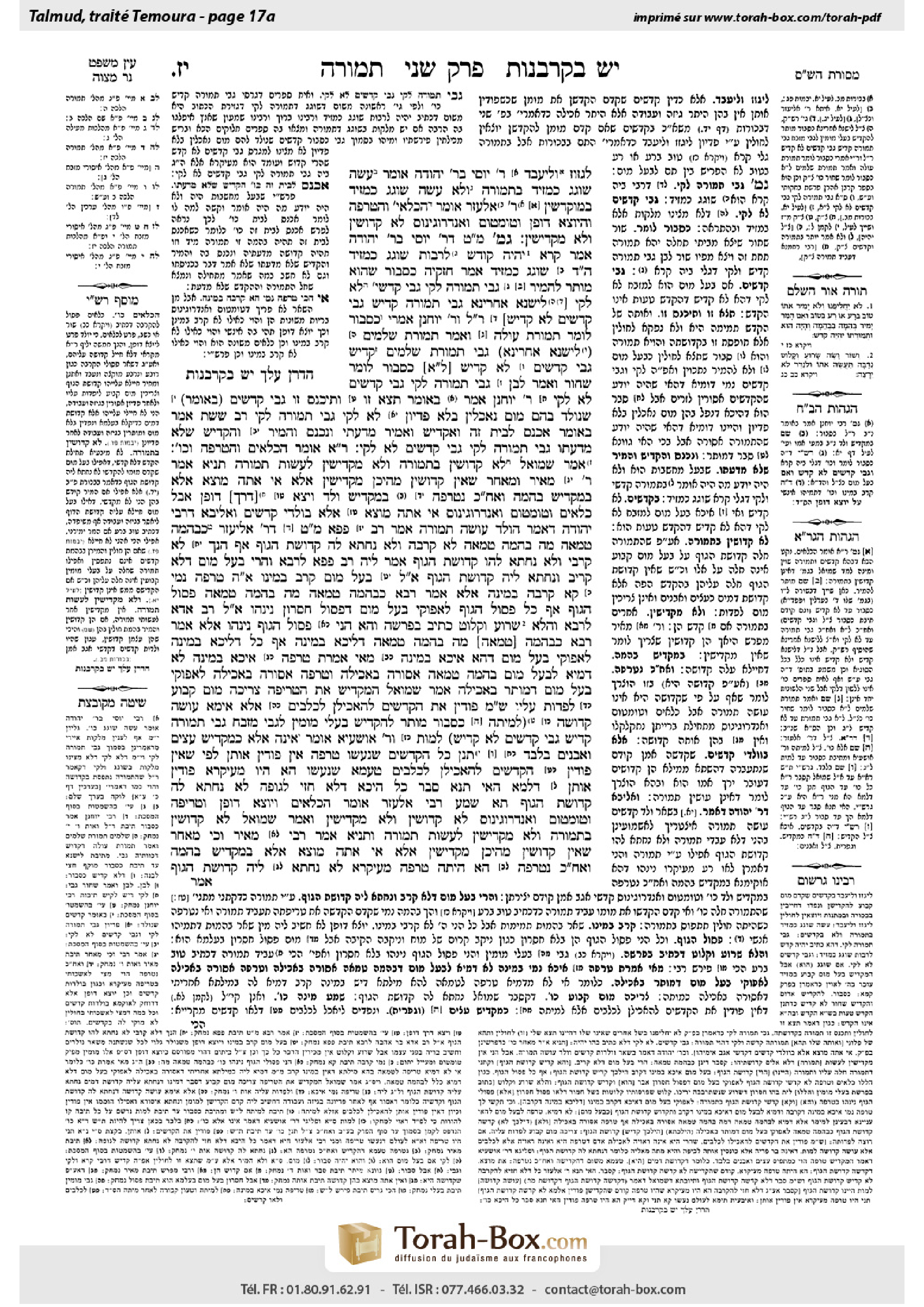
Temurah 17a: Talmud study for Daf Yomi
Daf Yomi is the daily study of one Talmud folio. Explore 37 tractates with scans, Hebrew text, Sefaria English and AI-generated French translations where annotated.
Passage selection and English or AI-generated French translation are available where the scan has annotations. Daf Study is independent of Torah-Box and Sefaria.
Browse Temurah · תמורה · All tractatesTemurah 17a text and translations
This page of Temurah includes the Aramaic text, an English translation and an AI-generated French translation, alongside the scan above.
תמורה י״ז א · Aramaic and Hebrew text
לִיגָּזֵז וְלֵיעָבֵד. רַבִּי יוֹסֵי בְּרַבִּי יְהוּדָה אוֹמֵר: עָשָׂה שׁוֹגֵג כְּמֵזִיד בַּתְּמוּרָה, וְלֹא עָשָׂה שׁוֹגֵג כְּמֵזִיד בַּמּוּקְדָּשִׁין.
רַבִּי אֶלְעָזָר אוֹמֵר: הַכִּלְאַיִם, וְהַטְּרֵפָה, וְהַיּוֹצֵא דּוֹפֶן, וְטוּמְטוּם, וְאַנְדְּרוֹגִינוֹס — לֹא קְדוֹשִׁין, וְלֹא מַקְדִּישִׁין.
גְּמָ׳ מַאי טַעְמָא דְּרַבִּי יוֹסֵי בְּרַבִּי יְהוּדָה? אָמַר קְרָא ״יִהְיֶה קֹּדֶשׁ״, לְרַבּוֹת שׁוֹגֵג כְּמֵזִיד.
הֵיכִי דָמֵי שׁוֹגֵג כְּמֵזִיד? אָמַר חִזְקִיָּה: כְּסָבוּר שֶׁהוּא מוּתָּר לְהָמִיר. גַּבֵּי תְּמוּרָה — לָקֵי, גַּבֵּי קָדָשִׁים — לָא לָקֵי.
לִישָּׁנָא אַחֲרִינָא: גַּבֵּי תְּמוּרָה — קָדֵישׁ, גַּבֵּי קָדָשִׁים — לָא קָדֵישׁ.
רֵישׁ לָקִישׁ וְרַבִּי יוֹחָנָן אָמְרִי: כְּסָבוּר לוֹמַר ״תְּמוּרַת עוֹלָה״, וְאָמַר ״תְּמוּרַת שְׁלָמִים״. לִישָּׁנָא אַחֲרִינָא: גַּבֵּי תְּמוּרַת שְׁלָמִים — קָדֵישׁ, גַּבֵּי קָדָשִׁים — לָא קָדֵישׁ.
לִישָּׁנָא אַחְרִינָא, כְּסָבוּר לוֹמַר ״שָׁחוֹר״ וְאָמַר ״לָבָן״ — גַּבֵּי תְּמוּרָה לָקֵי, גַּבֵּי קָדָשִׁים לָא לָקֵי.
רַבִּי יוֹחָנָן אָמַר: בְּאוֹמֵר ״תֵּצֵא זוֹ וְתִיכָּנֵס זוֹ״. גַּבֵּי קָדָשִׁים, בְּאוֹמֵר שֶׁנּוֹלַד בָּהֶם מוּם נֶאֱכָלִין בְּלֹא פִּדְיוֹן — לָא לָקֵי, גַּבֵּי תְּמוּרָה — לָקֵי.
רַב שֵׁשֶׁת אָמַר: בְּאוֹמֵר ״אֶכָּנֵס לַבַּיִת זֶה וְאַקְדִּישׁ״ וְאָמִיר מִדַּעְתִּי, וְנִכְנַס וְהֵמִיר וְהִקְדִּישׁ שֶׁלֹּא מִדַּעְתּוֹ — גַּבֵּי תְּמוּרָה לָקֵי, גַּבֵּי קָדָשִׁים לָא לָקֵי.
רַבִּי אֶלְעָזָר אוֹמֵר: הַכִּלְאַיִם וְהַטְּרֵפָה וְכוּ׳. אָמַר שְׁמוּאֵל: לֹא קְדוֹשִׁין בִּתְמוּרָה, וְלֹא מַקְדִּישִׁין לַעֲשׂוֹת תְּמוּרָה.
תַּנְיָא, אָמַר רַבִּי מֵאִיר: וּמֵאַחַר שֶׁאֵין קְדוֹשִׁין, מֵהֵיכָן מַקְדִּישִׁין? אֶלָּא אִי אַתָּה מוֹצֵא אֶלָּא בְּמַקְדִּישׁ בְּהֵמָה וְאַחַר כָּךְ נִטְרְפָה, בְּמַקְדִּישׁ וָלָד וְיָצָא [דֶּרֶךְ] דּוֹפֶן. אֲבָל כִּלְאַיִם וְטוּמְטוּם וְאַנְדְּרוֹגִינוֹס, אִי אַתָּה מוֹצֵא אֶלָּא בְּוַלְדֵי קָדָשִׁים, וְאַלִּיבָּא דְּרַבִּי יְהוּדָה דְּאָמַר: הַוָּלָד עוֹשֶׂה תְּמוּרָה.
אָמַר רַב פָּפָּא: מַאי טַעְמָא דְּרַבִּי אֶלְעָזָר? כִּבְהֵמָה טְמֵאָה — מָה בְּהֵמָה טְמֵאָה לָא קָרְבָה וְלָא נָחֲתָא לַהּ קְדוּשַּׁת הַגּוּף, אַף הָנָךְ לָא קָרְבִי וְלָא נָחֲתָא לְהוּ קְדוּשַּׁת הַגּוּף.
אֲמַר לֵיהּ רַב פָּפָּא לְרָבָא: וַהֲרֵי בַּעַל מוּם, דְּלָא קָרֵיב, וְנָחֲתָא לֵיהּ קְדוּשַּׁת הַגּוּף! אֲמַר לֵיהּ: בַּעַל מוּם קָרֵב בְּמִינוֹ. אִי הָכִי, טְרֵפָה נָמֵי קָא קָרְבָה בְּמִינָהּ!
אֶלָּא אָמַר רָבָא: כִּבְהֵמָה טְמֵאָה, מָה בְּהֵמָה טְמֵאָה פְּסוּל הַגּוּף, אַף כֹּל פְּסוּל הַגּוּף, לְאַפּוֹקֵי בַּעַל מוּם דִּפְסוּל חִסָּרוֹן נִינְהוּ.
אֲמַר לֵיהּ רַב אַדָּא לְרָבָא: וַהֲלֹא ״שָׂרוּעַ״ וְ״קָלוּט״ כְּתִיב בַּפָּרָשָׁה, וְהָא הָנֵי פְּסוּל הַגּוּף נִינְהוּ!
אֶלָּא אָמַר רָבָא: כִּבְהֵמָה [טְמֵאָה], מָה בְּהֵמָה טְמֵאָה דְּלֵיכָּא בְּמִינַהּ, אַף כֹּל דְּלֵיכָּא בְּמִינַהּ, לְאַפּוֹקֵי בַּעַל מוּם דְּהָא אִיכָּא בְּמִינַהּ.
מַאי אָמְרַתְּ: טְרֵפָה אִיכָּא בְּמִינַהּ? לָא דָּמְיָא לְבַעַל מוּם, בְּהֵמָה טְמֵאָה אֲסוּרָה בַּאֲכִילָה, וּטְרֵפָה אֲסוּרָה בַּאֲכִילָה, לְאַפּוֹקֵי בַּעַל מוּם דְּמוּתָּר בַּאֲכִילָה.
אָמַר שְׁמוּאֵל: הַמַּקְדִּישׁ אֶת הַטְּרֵיפָה צְרִיכָה מוּם קָבוּעַ לִפְדּוֹת עָלָיו, שְׁמַע מִינַּהּ פּוֹדִין אֶת הַקֳּדָשִׁים לְהַאֲכִילָן לִכְלָבִים?
אֶלָּא אֵימָא: עוֹשָׂה קְדוּשָּׁה (לְמִיתָה, כְּסָבוּר מוּתָּר לְהַקְדִּישׁ בַּעֲלֵי מוּמִין לְגַבֵּי מִזְבֵּחַ, גַּבֵּי תְּמוּרָה — קָדֵישׁ, גַּבֵּי קָדָשִׁים — לָא קָדֵישׁ) לָמוּת, וְרַבִּי אוֹשַׁעְיָא אוֹמֵר: אֵינָהּ אֶלָּא כְּמַקְדִּישׁ עֵצִים וַאֲבָנִים בִּלְבַד.
תְּנַן: כָּל הַקֳּדָשִׁים שֶׁנַּעֲשׂוּ טְרֵפָה, אֵין פּוֹדִין אוֹתָן, לְפִי שֶׁאֵין פּוֹדִין הַקֳּדָשִׁים לְהַאֲכִילָן לִכְלָבִים. טַעְמָא שֶׁנַּעֲשׂוּ, הָא הָיוּ מֵעִיקָּרָא — פּוֹדִין אוֹתָן! דִּלְמָא הַאי תַּנָּא סָבַר: כֹּל הֵיכָא דְּלָא חֲזֵי לְגוּפַהּ, לָא נָחֲתָא לַהּ קְדוּשַּׁת הַגּוּף.
תָּא שְׁמַע: רַבִּי אֶלְעָזָר אוֹמֵר: הַכִּלְאַיִם, וְיוֹצֵא דוֹפֶן, וּטְרֵיפָה, וְטוּמְטוּם וְאַנְדְּרוֹגִינוֹס — לֹא קְדוֹשִׁין וְלֹא מַקְדִּישִׁין. וְאָמַר שְׁמוּאֵל: לֹא קְדוֹשִׁין בִּתְמוּרָה, וְלֹא מַקְדִּישִׁין לַעֲשׂוֹת תְּמוּרָה.
וְתַנְיָא, אָמַר רַבִּי מֵאִיר: וְכִי מֵאַחַר שֶׁאֵין קְדוֹשִׁין, מֵהֵיכָן מַקְדִּישִׁין? אֶלָּא אִי אַתָּה מוֹצֵא אֶלָּא בְּמַקְדִּישׁ בְּהֵמָה וְאַחַר כָּךְ נִטְרְפָה, הָא הָיְתָה טְרֵפָה מֵעִיקָּרָא — לָא נָחֲתָא לֵיהּ קְדוּשַּׁת הַגּוּף.
Temurah 17a · English translation
in terms of it being permitted to shear its wool and to perform labor with it. Rabbi Yosei, son of Rabbi Yehuda, says that there is an additional stringency that applies to substitution but not to consecration: The Torah rendered the status of one who acts unwittingly like that of one who acts intentionally with regard to substitution, as in both cases the substitute is consecrated. But it did not render the status of one who acts unwittingly like that of one who acts intentionally with regard to consecrated items, since unwitting consecration is ineffective.
Rabbi Elazar says: An animal crossbred from diverse kinds, and a tereifa, and an animal born by caesarean section, and a tumtum animal, and a hermaphrodite animal are not sacred through consecration, and if they were sacred beforehand, e.g., one consecrated an animal and it subsequently became a tereifa, they do not sanctify non-sacred animals by means of substitution.
GEMARA: The Gemara asks: What is the reason for the opinion of Rabbi Yosei, son of Rabbi Yehuda, that substitution applies whether one substitutes unwittingly or intentionally? The Gemara answers that the verse states: “He shall not alter it, nor substitute it, a good for a bad, or a bad for a good; and if he shall substitute his animal for an animal, then both it and that for which it is changed shall be holy” (Leviticus 27:10). The apparently superfluous term “shall be” serves to include the case of one who acts unwittingly like that of one who acts intentionally, with regard to substitution.
The Gemara asks: What are the circumstances in which one who acts unwittingly is considered like one who acts intentionally with regard to substitution? Ḥizkiyya said: The circumstances are of one who thinks that it is permitted to substitute one animal for another. With regard to a substitute, the animal becomes consecrated, and the individual is liable to receive lashes for transgressing the Torah’s prohibition, due to the inclusion of “shall be,” despite the fact that he acted unwittingly. But in the equivalent case, where one unwittingly sanctified an animal that was unfit to be an offering, he is not liable to receive lashes, as in this case one is liable to receive lashes only if he acted intentionally and with prior warning.
The Gemara cites an alternative version of Ḥizkiyya’s statement: With regard to a non-sacred animal that was declared a substitute, the animal becomes consecrated, despite the fact that one acted unwittingly. But with regard to sacrificial animals, if it was consecrated unwittingly it is not consecrated.
Reish Lakish and Rabbi Yoḥanan both state a different example of the ruling discussed by Rabbi Yosei, son of Rabbi Yehuda. They say that the case is of one who thinks to say: This animal shall be a substitute for a burnt offering that I own, but he unwittingly said: This animal shall be a substitute for a peace offering that I own. In such a case involving substitution he is liable to receive lashes, but if he erred in this manner with regard to consecration, he is exempt from lashes. The Gemara cites an alternative version: With regard to a substitute of a peace offering, if one unwittingly declared it a substitute, it is consecrated. With regard to sacrificial animals, if the animal was unwittingly consecrated, it is not consecrated.
The Gemara cites another alternative version of the difference between substitution and consecration of an animal: The case is of one who thinks to say: The first black animal that comes out of my house will be a substitute, but he unwittingly said: The first white animal that comes out of my house will be a substitute. With regard to a substitute, the white animal is consecrated, and the individual therefore is liable to receive lashes for transgressing the Torah’s prohibition, despite the fact that he acted unwittingly. Conversely, in a similar case of sacrificial animals, e.g., one meant to say: The first blemished black animal that comes out of my house shall be consecrated, but he unwittingly said: The first blemished white animal shall be consecrated, if a white animal came out of his house, the animal is not consecrated, and therefore he is not liable to receive lashes.
Rabbi Yoḥanan says another case of unwitting substitution of an animal. This is referring to a case of one who says: Let this animal emerge from its sanctity and become non-sacred, and let that animal enter in its place and become consecrated. This person acted unwittingly, because he mistakenly thought that in this manner the consecrated animal would no longer be sacred. With regard to a similar case involving sacrificial animals, where he has a sacrificial animal that developed a blemish and he incorrectly says: Any animals that have developed a blemish may be eaten without redemption, and he proceeded to eat the animal without first redeeming it, he is not liable to receive lashes. But with regard to a substitute, if he did this he would be liable to receive lashes, as stated above.
Rav Sheshet says yet another example of unwittingly performing substitution: It is referring to a case of one who says: I will enter this house and consecrate an animal intentionally, or: I will enter this house and substitute an animal intentionally, and he entered and substituted or consecrated unintentionally, i.e., he acted absentmindedly. For his transgression with regard to substitution he is liable to receive lashes, and for his transgression with regard to sacrificial animals he is not liable to receive lashes.
§ The mishna taught that Rabbi Elazar says: An animal crossbred from diverse kinds, and a tereifa, and an animal born by caesarean section, and a tumtum animal, and a hermaphrodite animal, are neither sacred through consecration nor do they sanctify non-sacred animals by means of substitution. Shmuel says in explanation: They are not sanctified by substitution, i.e., if one said that an animal in any of these categories should be a substitute for a sacrificial animal, it does not become sanctified. And the clause that they do not sanctify non-sacred animals means that if one of these types of animal was sanctified and one attempted to render a non-sacred animal a substitute for it, that non-sacred animal does not become sanctified.
It is taught in a baraita that Rabbi Meir said: But since these animals do not become sanctified, how can it even be suggested that they could sanctify another non-sacred animal? Rather, you find that the ruling of Rabbi Elazar applies only when one sanctifies an animal and afterward it became a tereifa, or when one sanctifies a fetus and it emerged from the womb by caesarean section. But with regard to an animal crossbred from diverse kinds, and a tumtum, and a hermaphrodite, you can find this ruling only in a case of the offspring of consecrated female animals, which have sanctity without an act of consecration. And this is in accordance with the opinion of Rabbi Yehuda, who said that the offspring of a consecrated animal renders a non-sacred animal that is exchanged for it consecrated as a substitute.
Rav Pappa said: What is the reason for the opinion of Rabbi Elazar? He holds that the halakhot of these categories of animal is like that of a non-kosher domesticated animal: Just as a non-kosher domesticated animal is not sacrificed as an offering and inherent sanctity does not rest upon it, so too, these animals in the categories of a tereifa, an animal born by caesarean section, a tumtum, or a hermaphrodite may not be sacrificed as offerings and inherent sanctity does not rest upon them.
Rav Pappa said to Rava: But why aren’t animals in these categories compared to a blemished animal, which may not be sacrificed as an offering but nevertheless inherent sanctity does rest upon it? Rava said to Rav Pappa in response: Although a blemished animal is not sacrificed on the altar, another animal of its same type, i.e., an unblemished animal, is sacrificed as an offering. By contrast, an animal born by caesarean section, a tumtum, and a hermaphrodite may never be sacrificed. Rav Pappa said to Rava: If so, what will you say about a tereifa, as other animals of its type are sacrificed. According to your explanation, why doesn’t inherent sanctity rest upon a tereifa?
Rather, Rava retracts his previous answer and instead says: The halakhot of animals in these categories are like those of a non-kosher domesticated animal, in the following manner: Just as the category of a non-kosher domesticated animal is an inherent disqualification, and such an animal cannot be sanctified or render another animal sanctified, so too the same applies to any other category of animal that is an inherent disqualification, such as a tereifa, an animal born by caesarean section, a tumtum animal, and a hermaphrodite. This serves to exclude blemished animals, which are disqualified only because they lack certain limbs.
Rav Adda raised a difficulty with regard to this answer and said to Rava: Is the disqualification of a blemished animal always because it is lacking a limb? But isn’t the phrase: Too long or closed hooves, written in the passage of the Torah addressing blemishes that disqualify an animal; and these are inherent disqualifications. The verse states: “Either a bull or a lamb that has any limb too long or closed hooves, you may offer for a voluntary offering; but for a vow it shall not be accepted” (Leviticus 22:23).
Rather, Rava again retracted his previous answer and said: The explanation of Rabbi Elazar’s opinion is as I explained initially. The halakhot of animals in these categories are like those of a non-kosher domesticated animal: Just as a non-kosher domesticated animal is not sacrificed on the altar and neither are any animals of its type, so too these halakhot apply to any animal that is not sacrificed on the altar and neither are any animals of its type. This serves to exclude a blemished animal, because other animals of its type are sacrificed on the altar.
What did you say to challenge this explanation? You said that in the case of a tereifa, there are other animals of its type that are sacrificed, and if so, why doesn’t inherent sanctity rest upon a tereifa? The answer is that a tereifa is not similar to a blemished animal, as a non-kosher animal is forbidden for consumption, and a tereifa is forbidden for consumption. This serves to exclude a blemished animal, which is permitted for consumption.
§ With regard to a tereifa, Shmuel says: One who consecrates an animal that is a tereifa is required to wait until it develops a permanent blemish, on account of which he may redeem it. The Gemara raises a difficulty with regard to this statement of Shmuel. Since the meat of a tereifa is unfit for consumption and may only be fed to the dogs, why does it require redemption? Should one learn from this that one redeems sacrificial animals in order to feed them to the dogs? But this is contrary to the accepted halakha (see 31a).
Rather, say that the statement of Shmuel was as follows: If one consecrates an animal that is a tereifa, it becomes sanctified until it is time for the animal to die, so that even after its death it must be buried and may not be redeemed. And Rabbi Oshaya says: If one consecrates an animal that is a tereifa, this is like nothing other than one who consecrates mere wood and stones, which cannot become sanctified with inherent sanctity but only for their value, and which therefore can be redeemed. Consequently, a consecrated tereifa animal may be redeemed even if it is going to be fed to the dogs.
The Gemara raises a difficulty against the opinion of Shmuel. We learned in a mishna (31a): With regard to all sacrificial animals that became tereifa, one may not redeem them and render them non-sacred, because their consumption is forbidden; and one does not redeem sacrificial animals to feed them to the dogs. The Gemara analyzes this ruling: The reason that they may not be redeemed is because they became tereifa after they had already been consecrated. Consequently, if they were already tereifa from the outset, when they were consecrated, one may redeem them. The Gemara answers: Perhaps this tanna holds that anywhere that an animal itself is not fit for sacrifice, inherent sanctity does not rest upon it at all.
The Gemara raises another challenge to Shmuel’s opinion from the mishna. Come and hear, as Rabbi Elazar says: An animal crossbred from diverse kinds, and a tereifa, and an animal born by caesarean section, and a tumtum animal, and a hermaphrodite animal are not sacred through consecration and they do not sanctify non-sacred animals by means of substitution. And Shmuel says in explanation: They are not sacred with regard to substitution, i.e., if one said that any of these animals should be a substitute for a sacrificial animal it does not become sanctified; and they do not sanctify non-sacred animals, i.e., if one of these types of animal was sanctified and one attempted to render a non-sacred animal a substitute for it, that non-sacred animal does not become sanctified.
And it is taught in a baraita that Rabbi Meir said: But since they do not become sanctified, how can they sanctify another non-sacred animal? Rather, you find the ruling of Rabbi Elazar applies only when one sanctifies an animal and afterward it becomes a tereifa. The Gemara explains the difficulty: This indicates that if it was a tereifa from the outset, then inherent sanctity does not rest upon it; this ruling contradicts the opinion of Shmuel, who says that such an animal must be buried when it dies.
Temurah 17a · Traduction française (IA)
en ce qui concerne le fait qu’il soit permis de tondre sa laine et de le faire travailler. Rabbi Yosei, fils de Rabbi Yehuda, dit qu’une rigueur supplémentaire s’applique à la substitution, mais pas à la consécration : la Torah a assimilé, en matière de substitution, le statut de celui qui agit par inadvertance à celui de celui qui agit intentionnellement, car, dans les deux cas, l’animal substitué est consacré. Mais elle n’a pas assimilé, en matière d’objets consacrés, le statut de celui qui agit par inadvertance à celui de celui qui agit intentionnellement, puisque la consécration faite par inadvertance est sans effet.
Rabbi Elazar dit : Un animal issu du croisement d’espèces différentes, un animal tereifa, un animal né par césarienne, un animal tumtum et un animal hermaphrodite ne peuvent pas être consacrés ; et s’ils étaient déjà consacrés, par exemple si quelqu’un a consacré un animal qui est ensuite devenu tereifa, ils ne consacrent pas des animaux non consacrés par substitution.
GUEMARA : La Guemara demande : Pour quelle raison Rabbi Yosei, fils de Rabbi Yehuda, estime-t-il que la substitution s’applique que l’on agisse par inadvertance ou intentionnellement ? La Guemara répond que le verset dit : « Il ne le changera pas et ne le substituera pas, un bon à un mauvais ou un mauvais à un bon ; et s’il substitue un animal à un autre, les deux, lui-même et celui qui lui a été substitué, seront sacrés » (Lévitique 27:10). Le terme apparemment superflu « seront » inclut, en matière de substitution, le cas de celui qui agit par inadvertance au même titre que celui de celui qui agit intentionnellement.
La Guemara demande : Dans quelles circonstances celui qui agit par inadvertance est-il considéré comme celui qui agit intentionnellement en matière de substitution ? Ḥizkiyya dit : Il s’agit de celui qui croit qu’il est permis de substituer un animal à un autre. Dans le cas d’une substitution, l’animal devient consacré, et l’individu est passible de la flagellation pour avoir transgressé l’interdiction de la Torah, en vertu de l’inclusion du terme « seront », bien qu’il ait agi par inadvertance. Mais dans le cas correspondant, où quelqu’un a consacré par inadvertance un animal impropre à être offert en sacrifice, il n’est pas passible de la flagellation, car, dans ce cas, on n’est passible de la flagellation que si l’on a agi intentionnellement et après avoir reçu un avertissement préalable.
La Guemara rapporte une autre version de la déclaration de Ḥizkiyya : Lorsqu’un animal non consacré est déclaré substitut, il devient consacré, bien que l’on ait agi par inadvertance. En revanche, pour les animaux sacrificiels, si un animal a été consacré par inadvertance, il n’est pas consacré.
Reish Lakish et Rabbi Yoḥanan donnent tous deux un autre exemple de la règle évoquée par Rabbi Yosei, fils de Rabbi Yehuda. Ils disent qu’il s’agit de celui qui entend dire : « Cet animal sera un substitut de mon holocauste », mais qui dit par inadvertance : « Cet animal sera un substitut de mon sacrifice de paix ». Dans un tel cas de substitution, il est passible de la flagellation, mais s’il commettait la même erreur en matière de consécration, il serait exempté de la flagellation. La Guemara rapporte une autre version : S’agissant du substitut d’un sacrifice de paix, si quelqu’un le déclare substitut par inadvertance, il est consacré. En revanche, s’agissant des animaux sacrificiels, si un animal a été consacré par inadvertance, il n’est pas consacré.
La Guemara rapporte une autre version de la différence entre la substitution et la consécration d’un animal : Il s’agit de celui qui entend dire : « Le premier animal noir qui sortira de ma maison sera un substitut », mais qui dit par inadvertance : « Le premier animal blanc qui sortira de ma maison sera un substitut ». Dans le cas d’une substitution, l’animal blanc est consacré, et l’individu est donc passible de la flagellation pour avoir transgressé l’interdiction de la Torah, bien qu’il ait agi par inadvertance. À l’inverse, dans un cas semblable concernant des animaux sacrificiels, par exemple s’il entend dire : « Le premier animal noir présentant un défaut qui sortira de ma maison sera consacré », mais qu’il dit par inadvertance : « Le premier animal blanc présentant un défaut sera consacré », si un animal blanc sort de sa maison, celui-ci n’est pas consacré et il n’est donc pas passible de la flagellation.
Rabbi Yoḥanan rapporte un autre cas de substitution d’un animal par inadvertance. Il s’agit de celui qui dit : « Que cet animal sorte de son statut sacré et devienne non consacré, et que cet autre animal prenne sa place et soit consacré. » Cette personne agit par inadvertance, car elle croit à tort que l’animal consacré cessera ainsi d’être sacré. Dans un cas semblable concernant des animaux sacrificiels, où quelqu’un possède un animal sacrificiel qui a développé un défaut et dit à tort : « Tous les animaux qui ont développé un défaut peuvent être consommés sans rachat », puis mange l’animal sans l’avoir d’abord racheté, il n’est pas passible de la flagellation. Mais s’il agissait ainsi dans le cas d’un substitut, il serait passible de la flagellation, comme indiqué plus haut.
Rav Sheshet donne encore un autre exemple de substitution accomplie par inadvertance : Il s’agit de celui qui dit : « J’entrerai dans cette maison et consacrerai intentionnellement un animal », ou : « J’entrerai dans cette maison et substituerai intentionnellement un animal », puis entre et substitue ou consacre un animal par inadvertance, c’est-à-dire par distraction. Pour sa transgression en matière de substitution, il est passible de la flagellation ; pour sa transgression concernant les animaux sacrificiels, il n’est pas passible de la flagellation.
§ La Michna enseignait que Rabbi Elazar dit : Un animal issu du croisement d’espèces différentes, un animal tereifa, un animal né par césarienne, un animal tumtum et un animal hermaphrodite ne peuvent pas être consacrés et ne consacrent pas d’animaux non consacrés par substitution. Shmuel explique : Ils ne peuvent pas être consacrés par substitution, c’est-à-dire que si quelqu’un déclare qu’un animal appartenant à l’une de ces catégories doit être le substitut d’un animal sacrificiel, il ne devient pas consacré. Quant à la clause selon laquelle ils ne consacrent pas des animaux non consacrés, elle signifie que si un animal de l’une de ces catégories a été consacré et que quelqu’un tente de désigner un animal non consacré comme son substitut, cet animal non consacré ne devient pas consacré.
Il est enseigné dans une baraïta que Rabbi Meir a dit : Mais puisque ces animaux ne deviennent pas consacrés, comment peut-on même envisager qu’ils puissent consacrer un autre animal non consacré ? Il faut plutôt comprendre que la règle de Rabbi Elazar ne s’applique que lorsqu’on consacre un animal qui devient ensuite tereifa, ou lorsqu’on consacre un fœtus qui sort de l’utérus par césarienne. En revanche, pour un animal issu du croisement d’espèces différentes, un tumtum et un hermaphrodite, cette règle ne peut s’appliquer que dans le cas des petits d’animaux femelles consacrés, qui possèdent un statut sacré sans qu’un acte de consécration soit nécessaire. Et cela est conforme à l’opinion de Rabbi Yehuda, qui a dit que le petit d’un animal consacré rend consacré, par substitution, l’animal non consacré échangé contre lui.
Rav Pappa dit : Quelle est la raison de l’opinion de Rabbi Elazar ? Il estime que les halakhot de ces catégories d’animaux sont semblables à celles d’un animal domestique non cachère : de même qu’un animal domestique non cachère n’est pas offert en sacrifice et que la sainteté intrinsèque ne repose pas sur lui, de même ces animaux des catégories tereifa, animal né par césarienne, tumtum ou hermaphrodite ne peuvent pas être offerts en sacrifice et la sainteté intrinsèque ne repose pas sur eux.
Rav Pappa dit à Rava : Mais pourquoi ne compare-t-on pas les animaux de ces catégories à un animal présentant un défaut, qui ne peut pas être offert en sacrifice, mais sur lequel la sainteté intrinsèque repose néanmoins ? Rava répondit à Rav Pappa : Bien qu’un animal présentant un défaut ne soit pas offert sur l’autel, un autre animal de son espèce, c’est-à-dire un animal sans défaut, est offert en sacrifice. En revanche, un animal né par césarienne, un tumtum et un hermaphrodite ne peuvent jamais être offerts en sacrifice. Rav Pappa dit à Rava : Dans ce cas, que diras-tu d’un animal tereifa, puisque d’autres animaux de son espèce sont offerts ? Selon ton explication, pourquoi la sainteté intrinsèque ne reposerait-elle pas sur un animal tereifa ?
Rava se rétracte alors de sa réponse précédente et dit plutôt : Les halakhot des animaux de ces catégories sont semblables à celles d’un animal domestique non cachère de la manière suivante : de même que la catégorie des animaux domestiques non cachères constitue une disqualification inhérente et qu’un tel animal ne peut être consacré ni rendre un autre animal consacré, il en va de même de toute autre catégorie d’animaux présentant une disqualification inhérente, comme un animal tereifa, un animal né par césarienne, un animal tumtum et un animal hermaphrodite. Cela permet d’exclure les animaux présentant un défaut, qui sont disqualifiés uniquement parce qu’il leur manque certains membres.
Rav Adda souleva une difficulté contre cette réponse et dit à Rava : L’invalidité d’un animal présentant un défaut tient-elle toujours à l’absence d’un membre ? Pourtant, l’expression « sabots trop longs ou fermés » figure dans le passage de la Torah qui traite des défauts disqualifiant un animal, et il s’agit là de disqualifications inhérentes. Le verset dit : « Un taureau ou un agneau qui a un membre trop long ou des sabots fermés, tu peux l’offrir comme offrande volontaire, mais il ne sera pas accepté pour un vœu » (Lévitique 22:23).
Rava se rétracta de nouveau de sa réponse précédente et dit : L’explication de l’opinion de Rabbi Elazar est celle que j’ai donnée au départ. Les halakhot des animaux de ces catégories sont semblables à celles d’un animal domestique non cachère : de même qu’un animal domestique non cachère n’est pas offert sur l’autel et qu’aucun animal de son espèce ne l’est non plus, la même règle s’applique à tout animal qui n’est pas offert sur l’autel et dont aucun animal de l’espèce ne l’est non plus. Cela permet d’exclure un animal présentant un défaut, car d’autres animaux de son espèce sont offerts sur l’autel.
Que disais-tu pour contester cette explication ? Tu disais que, dans le cas d’un animal tereifa, d’autres animaux de son espèce sont offerts et que, dès lors, on ne comprend pas pourquoi la sainteté intrinsèque ne reposerait pas sur un animal tereifa. La réponse est qu’un animal tereifa ne ressemble pas à un animal présentant un défaut, car un animal non cachère est interdit à la consommation et un animal tereifa est interdit à la consommation. Cela permet d’exclure un animal présentant un défaut, qui est permis à la consommation.
§ À propos d’un animal tereifa, Shmuel dit : Celui qui consacre un animal tereifa doit attendre qu’il développe un défaut permanent qui lui permettra de le racheter. La Guemara soulève une difficulté concernant cette déclaration de Shmuel. Puisque la viande d’un animal tereifa est impropre à la consommation et ne peut servir qu’à nourrir les chiens, pourquoi faut-il le racheter ? Faudrait-il en conclure que l’on rachète des animaux sacrificiels afin de les donner aux chiens ? Mais cela contredit la halakha admise (voir 31a).
Il faut plutôt dire que la déclaration de Shmuel était la suivante : Si quelqu’un consacre un animal tereifa, celui-ci demeure consacré jusqu’au moment où l’animal doit mourir, de sorte que même après sa mort, il doit être enterré et ne peut pas être racheté. Et Rabbi Oshaya dit : Si quelqu’un consacre un animal tereifa, cela revient à consacrer du bois et des pierres, qui ne peuvent recevoir de sainteté intrinsèque, mais seulement une consécration de leur valeur, et qui peuvent donc être rachetés. Par conséquent, un animal tereifa consacré peut être racheté même s’il est destiné à être donné aux chiens.
La Guemara soulève une difficulté contre l’opinion de Shmuel. Nous avons appris dans une Michna (31a) : Parmi tous les animaux sacrificiels qui sont devenus tereifa, on ne peut pas les racheter pour les rendre non consacrés, car leur consommation est interdite ; et on ne rachète pas des animaux sacrificiels pour les donner aux chiens. La Guemara analyse cette règle : La raison pour laquelle ils ne peuvent pas être rachetés est qu’ils sont devenus tereifa après avoir déjà été consacrés. Par conséquent, s’ils étaient déjà tereifa dès le départ, au moment de leur consécration, on pourrait les racheter. La Guemara répond : Peut-être ce tanna estime-t-il que, partout où l’animal lui-même est impropre à être offert en sacrifice, la sainteté intrinsèque ne repose aucunement sur lui.
La Guemara soulève une autre objection à l’opinion de Shmuel à partir de la Michna. Viens et écoute, car Rabbi Elazar dit : Un animal issu du croisement d’espèces différentes, un animal tereifa, un animal né par césarienne, un animal tumtum et un animal hermaphrodite ne peuvent pas être consacrés et ne consacrent pas d’animaux non consacrés par substitution. Shmuel explique : Ils ne peuvent pas être consacrés par substitution, c’est-à-dire que si quelqu’un déclare qu’un de ces animaux doit être le substitut d’un animal sacrificiel, il ne devient pas consacré ; et ils ne consacrent pas d’animaux non consacrés, c’est-à-dire que si un animal de l’une de ces catégories a été consacré et que quelqu’un tente de désigner un animal non consacré comme son substitut, cet animal non consacré ne devient pas consacré.
Et il est enseigné dans une baraïta que Rabbi Meir a dit : Mais puisqu’ils ne deviennent pas consacrés, comment pourraient-ils consacrer un autre animal non consacré ? Il faut plutôt comprendre que la règle de Rabbi Elazar ne s’applique que lorsqu’on consacre un animal qui devient ensuite tereifa. La Guemara explique la difficulté : cela indique que si l’animal était tereifa dès le départ, la sainteté intrinsèque ne repose pas sur lui ; cette règle contredit l’opinion de Shmuel, qui dit qu’un tel animal doit être enterré lorsqu’il meurt.
Traduction française générée par IA à partir de l’édition anglaise de Sefaria. Vérifie toujours un passage avec le texte source.
Text from Sefaria: William Davidson Edition - Vocalized Aramaic (CC BY NC); William Davidson Edition - English (CC BY NC).