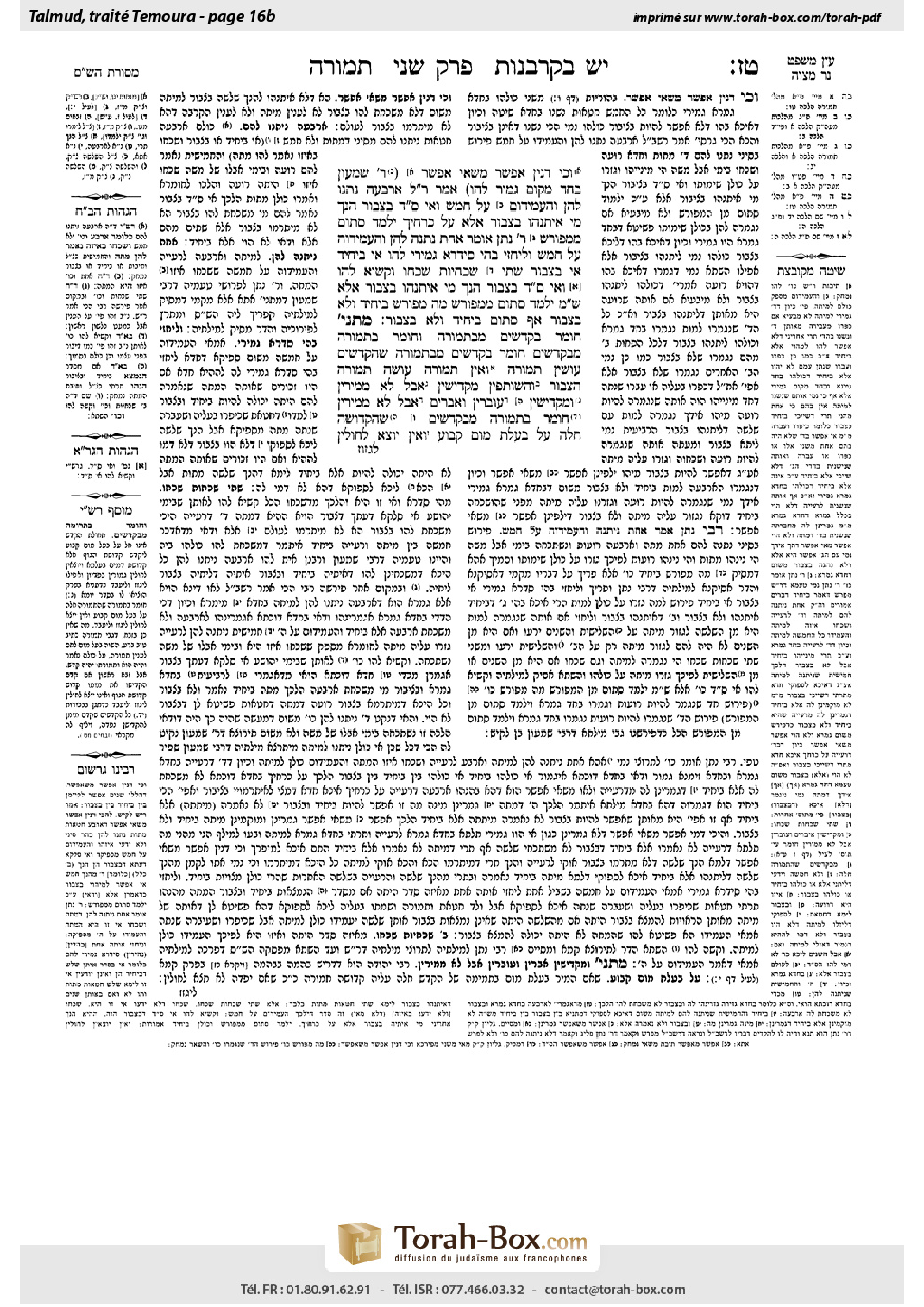
Temurah 16b: Talmud study for Daf Yomi
Daf Yomi is the daily study of one Talmud folio. Explore 37 tractates with scans, Hebrew text, Sefaria English and AI-generated French translations where annotated.
Passage selection and English or AI-generated French translation are available where the scan has annotations. Daf Study is independent of Torah-Box and Sefaria.
Browse Temurah · תמורה · All tractatesTemurah 16b text and translations
This page of Temurah includes the Aramaic text, an English translation and an AI-generated French translation, alongside the scan above.
תמורה י״ו ב · Aramaic and Hebrew text
וְכִי דָּנִין אֶפְשָׁר מִשֶּׁאִי אֶפְשָׁר? רַבִּי שִׁמְעוֹן בְּחַד מָקוֹם גְּמִיר לְהוּ.
אָמַר רֵישׁ לָקִישׁ: אַרְבָּעָה נִתְּנוּ לָהֶן, וְהֶעֱמִידוּם עַל חָמֵשׁ. וְאִי סָלְקָא דַעְתָּךְ בְּצִבּוּר — הָנָךְ מִי אִיתַנְהוּ בְּצִבּוּר? אֶלָּא עַל כׇּרְחָיךְ — יִלְמַד סָתוּם מִמְּפוֹרָשׁ.
רַבִּי נָתָן אוֹמֵר: אַחַת נִתְּנָה לָהֶן, וְהֶעֱמִידוּהָ עַל חָמֵשׁ.
וְלִיחְזֵי בְּהֵי סִידְרָא גְּמִירִי לְהוּ, אִי בְּיָחִיד אִי בְּצִבּוּר?
שְׁתֵּי שִׁכְחָיוֹת שָׁכְחוּ, וְקַשְׁיָא לְהוּ.
וְאִי סָלְקָא דַּעְתָּךְ בְּצִבּוּר, הָנָךְ מִי אִיתַנְהוּ בְּצִבּוּר? אֶלָּא שְׁמַע מִינַּהּ: יִלְמַד סָתוּם מִמְּפוֹרָשׁ — מַה מְפוֹרָשׁ בְּיָחִיד וְלֹא בְּצִבּוּר, אַף סָתוּם בְּיָחִיד וְלֹא בְּצִבּוּר.
מַתְנִי׳ חוֹמֶר בַּקֳּדָשִׁים מִבַּתְּמוּרָה, וְחוֹמֶר בַּתְּמוּרָה מִבַּקֳּדָשִׁים. חוֹמֶר בְּקָדָשִׁים מִבַּתְּמוּרָה — שֶׁהַקֳּדָשִׁים עוֹשִׂין תְּמוּרָה, וְאֵין תְּמוּרָה עוֹשָׂה תְּמוּרָה. הַצִּבּוּר וְהַשּׁוּתָּפִין מַקְדִּישִׁין, אֲבָל לֹא מְמִירִין. וּמַקְדִּישִׁין עוּבָּרִין וְאֵבָרִים, אֲבָל לֹא מְמִירִין.
חוֹמֶר בַּתְּמוּרָה מִבַּקֳּדָשִׁים, שֶׁהַקְּדוּשָּׁה חָלָה עַל בַּעֲלַת מוּם קָבוּעַ, וְאֵין יוֹצְאָה לְחוּלִּין
Temurah 16b · English translation
The Gemara asks: But can one derive the possible from the impossible? Those other cases include offerings that by definition do not apply to a community; how can one learn from them with regard to cases where they are possible? The Gemara answers: Rabbi Shimon learns this tradition as one unit, i.e., all the cases of sin offerings left to die are given as one halakha, and therefore there is no difference in their application.
Reish Lakish says in explanation of this matter: When Moses received this tradition at Sinai, the halakhot of four sin offerings that must be left to die were given to the Jewish people, whereas the fifth sin offering is left to graze until it develops a blemish. But as they did not know which of the sin offerings was the one that should be left to graze, they established these halakhot with regard to all five sin offerings, that they are all left to die. However, given that the four sin offerings were said together, either all four are communal sin offerings, or all four are sin offerings of the individual. And if it enters your mind that the four cases of sin offerings that must be left to die, as stated to Moses, referred to communal offerings, are all of these four sin offerings possible as communal offerings? Rather, the tradition is with regard to sin offerings of the individual. Rather, perforce one must derive the cases that are unspecified in terms of their halakhot from those cases that are specified.
Rabbi Natan says: Only one case of a sin offering that must be left to die was given to them at Sinai, while the other four sin offerings are left to graze until they develop a blemish. But as they did not know which was the sin offering that must be left to die, the Jewish people established it as applying to all five kinds of sin offering.
The Gemara interrupts Rabbi Natan’s statement to raise a difficulty with regard to his explanation: But why didn’t the Jewish people first see with regard to which category they learned that a sin offering must be left to die, whether in reference to one of the three cases that are found only in the offering of an individual, or to one of the two cases that are also found in the offering of a community? If they knew which group of sin offerings must be left to die, they could have kept the other group in accordance with its original halakha, that it is left to graze.
The Gemara answers: They forgot two matters. They did not remember which of the five sin offerings must be left to die, and they also forgot to which category it applied, whether to a communal offering or an offering of an individual. And for this reason it was difficult for them, and they were forced to rule that all of these sin offerings must be left to die.
The Gemara returns to its citation of the statement of Rabbi Natan, who proceeds to explain Rabbi Shimon’s opinion in the mishna in a similar manner to Reish Lakish: And if it enters your mind that the four cases of sin offerings that are left to graze, which were stated to Moses as one unit, involved communal offerings, are all of these five sin offerings applicable in the case of communal offerings? Rather, conclude from it that one learns the cases that are unspecified from those cases that are specified: Just as the specified cases apply only to an offering of an individual and not to a communal offering, so too, the cases that are not specified apply only to an offering of an individual, but not to a communal offering.
MISHNA: There is greater stringency with regard to sacrificial animals than there is with regard to a substitute, and greater stringency with regard to a substitute than there is with regard to sacrificial animals. The Mishna explains: There is greater stringency with regard to sacrificial animals than there is with regard to a substitute, as sacrificial animals render a non-sacred animal exchanged for them a substitute, but a substitute does not render a non-sacred animal exchanged for it a substitute. Furthermore, the community and the partners consecrate animals as offerings, but they do not substitute non-sacred animals for their offerings. And one consecrates fetuses in utero and one can consecrate an animal’s limbs, but one cannot substitute non-sacred animals for them.
There is greater stringency with regard to a substitute than there is with regard to sacrificial animals, as, if one substituted a non-sacred blemished animal for an unblemished sacrificial animal, then the animal with a permanent blemish is imbued with inherent sanctity, which is not the case with regard to consecration. And in addition, those blemished animals consecrated through substitution do not emerge from their consecrated status to assume non-sacred status by means of redemption,
Temurah 16b · Traduction française (IA)
La Guemara demande : Mais peut-on déduire le possible de l’impossible ? Ces autres cas concernent des sacrifices qui, par définition, ne peuvent pas s’appliquer à la collectivité ; comment peut-on en tirer une règle pour les cas où ils sont possibles ? La Guemara répond : Rabbi Shimon considère cette tradition comme un tout, c’est-à-dire que tous les cas de sacrifices expiatoires qu’il faut laisser mourir sont transmis comme une seule halakha ; leur application ne diffère donc pas.
Reish Lakish explique cette question : Lorsque Moïse reçut cette tradition au Sinaï, les halakhot de quatre sacrifices expiatoires qu’il faut laisser mourir furent transmises au peuple juif, tandis que le cinquième sacrifice expiatoire doit être laissé au pâturage jusqu’à ce qu’il développe un défaut. Mais, comme on ne savait pas lequel de ces sacrifices expiatoires devait être laissé au pâturage, on établit ces halakhot pour les cinq sacrifices expiatoires : il fallait tous les laisser mourir. Cependant, puisque les quatre sacrifices expiatoires furent énoncés ensemble, il s’agissait soit de quatre sacrifices expiatoires communautaires, soit de quatre sacrifices expiatoires individuels. Et si l’on devait envisager que les quatre cas de sacrifices expiatoires qu’il faut laisser mourir, tels qu’ils furent transmis à Moïse, concernaient des sacrifices communautaires, ces quatre sacrifices expiatoires peuvent-ils tous être des sacrifices communautaires ? Il s’agit donc d’une tradition portant sur les sacrifices expiatoires individuels. Il faut donc nécessairement déduire les cas dont les halakhot ne sont pas précisées de ceux dont les halakhot sont précisées.
Rabbi Natan dit : Au Sinaï, on ne leur transmit qu’un seul cas de sacrifice expiatoire qu’il faut laisser mourir, tandis que les quatre autres sacrifices expiatoires doivent être laissés au pâturage jusqu’à ce qu’ils développent un défaut. Mais, comme on ne savait pas lequel était le sacrifice expiatoire qu’il fallait laisser mourir, le peuple juif établit cette règle pour les cinq catégories de sacrifices expiatoires.
La Guemara interrompt la déclaration de Rabbi Natan pour soulever une difficulté concernant son explication : Mais pourquoi le peuple juif n’a-t-il pas d’abord cherché à déterminer à quelle catégorie se rapportait la règle qu’il avait apprise, selon laquelle un sacrifice expiatoire doit être laissé mourir : concernait-elle l’un des trois cas qui ne se rencontrent que parmi les sacrifices individuels, ou l’un des deux cas qui se rencontrent aussi parmi les sacrifices communautaires ? S’ils avaient su quel groupe de sacrifices expiatoires devait être laissé mourir, ils auraient pu maintenir l’autre groupe conformément à sa halakha initiale, à savoir qu’il doit être laissé au pâturage.
La Guemara répond : Ils oublièrent deux choses. Ils ne se rappelèrent pas lequel des cinq sacrifices expiatoires devait être laissé mourir, et ils oublièrent aussi à quelle catégorie cette règle s’appliquait : à un sacrifice communautaire ou à un sacrifice individuel. C’est pourquoi la question leur fut difficile et ils furent contraints de statuer que tous ces sacrifices expiatoires devaient être laissés mourir.
La Guemara revient à la citation de la déclaration de Rabbi Natan, qui poursuit en expliquant l’opinion de Rabbi Shimon dans la Michna d’une manière semblable à celle de Reish Lakish : Et si l’on devait envisager que les quatre cas de sacrifices expiatoires qu’il faut laisser au pâturage, transmis à Moïse comme un tout, concernaient des sacrifices communautaires, ces cinq sacrifices expiatoires peuvent-ils tous s’appliquer aux sacrifices communautaires ? Il faut donc en conclure qu’on déduit les cas dont les halakhot ne sont pas précisées de ceux dont les halakhot sont précisées : de même que les cas précisés ne s’appliquent qu’à un sacrifice individuel, et non à un sacrifice communautaire, de même les cas non précisés ne s’appliquent qu’à un sacrifice individuel, et non à un sacrifice communautaire.
Michna : Les animaux consacrés sont soumis à une rigueur plus grande que les animaux substitués, et les animaux substitués à une rigueur plus grande que les animaux consacrés. La Michna explique : Les animaux consacrés sont soumis à une rigueur plus grande que les animaux substitués, car ils font de l’animal non consacré échangé contre eux un substitut, alors qu’un substitut ne fait pas de l’animal non consacré échangé contre lui un substitut. En outre, la collectivité et les associés consacrent des animaux comme sacrifices, mais ils ne substituent pas d’animaux non consacrés à leurs sacrifices. On peut aussi consacrer des fœtus in utero et les membres d’un animal, mais on ne peut pas leur substituer des animaux non consacrés.
Les animaux substitués sont soumis à une rigueur plus grande que les animaux consacrés, car si l’on substitue un animal non consacré présentant un défaut à un animal consacré sans défaut, l’animal atteint d’un défaut permanent acquiert une sainteté intrinsèque, ce qui n’est pas le cas lorsqu’on consacre un animal. En outre, ces animaux présentant un défaut, consacrés par substitution, ne perdent pas leur statut consacré pour acquérir un statut non consacré au moyen d’un rachat,
Traduction française générée par IA à partir de l’édition anglaise de Sefaria. Vérifie toujours un passage avec le texte source.
Text from Sefaria: William Davidson Edition - Vocalized Aramaic (CC BY NC); William Davidson Edition - English (CC BY NC).