Temurah 16a: Talmud study for Daf Yomi
Daf Yomi is the daily study of one Talmud folio. Explore 37 tractates with scans, Hebrew text, Sefaria English and AI-generated French translations where annotated.
Passage selection and English or AI-generated French translation are available where the scan has annotations. Daf Study is independent of Torah-Box and Sefaria.
Browse Temurah · תמורה · All tractatesTemurah 16a text and translations
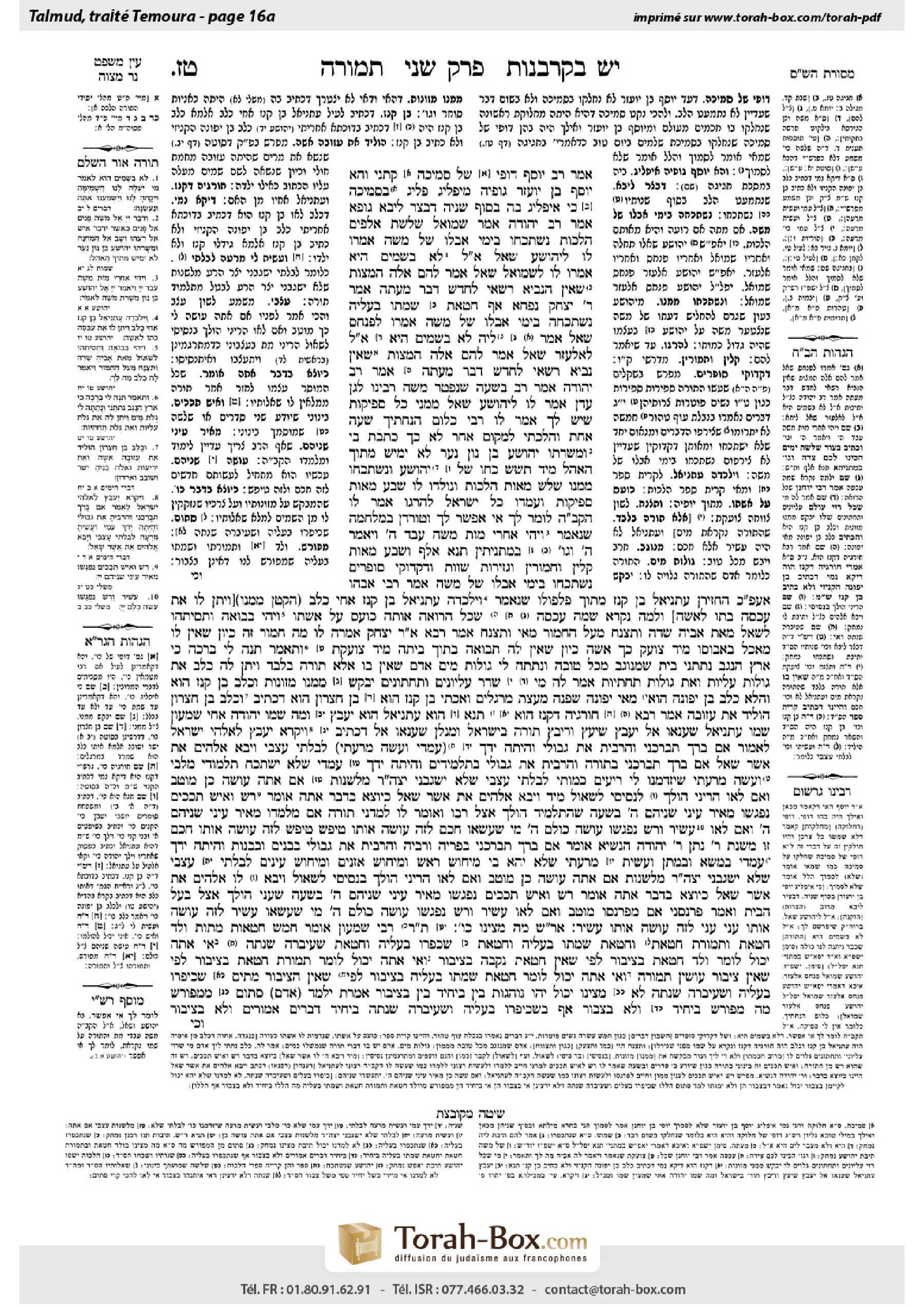
This page of Temurah includes the Aramaic text, an English translation and an AI-generated French translation, alongside the scan above.
תמורה י״ו א · Aramaic and Hebrew text
אָמַר רַב יוֹסֵף: דּוֹפִי שֶׁל סְמִיכָה קָתָנֵי.
וְהָא יוֹסֵף בֶּן יוֹעֶזֶר גּוּפֵיהּ מִיפְלָיג פְּלִיג בִּסְמִיכָה! כִּי אִיפְּלִיג בַּהּ בְּסוֹף שְׁנֵיהּ, דִּבְצַר לִיבָּא.
גּוּפָא, אָמַר רַב יְהוּדָה אָמַר שְׁמוּאֵל: שְׁלֹשֶׁת אֲלָפִים הֲלָכוֹת נִשְׁתַּכְּחוּ בִּימֵי אֶבְלוֹ שֶׁל מֹשֶׁה. אָמְרוּ לוֹ לִיהוֹשֻׁעַ: שְׁאַל! אָמַר לָהֶם: ״לֹא בַשָּׁמַיִם הִיא״.
אָמְרוּ לוֹ לִשְׁמוּאֵל: שְׁאַל! אָמַר לָהֶם: ״אֵלֶּה הַמִּצְוֹת״ — שֶׁאֵין הַנָּבִיא רַשַּׁאי לְחַדֵּשׁ דָּבָר מֵעַתָּה. אָמַר רַבִּי יִצְחָק נַפָּחָא: אַף חַטָּאת שֶׁמֵּתוּ בְּעָלֶיהָ נִשְׁתַּכְּחָה בִּימֵי אֶבְלוֹ שֶׁל מֹשֶׁה.
אָמְרוּ לְפִנְחָס: שְׁאַל! אָמַר לָהֶם: ״לֹא בַשָּׁמַיִם הִיא״. אָמְרוּ לוֹ לְאֶלְעָזָר: שְׁאַל! אָמַר לָהֶם: ״אֵלֶּה הַמִּצְוֹת״, שֶׁאֵין נָבִיא רַשַּׁאי לְחַדֵּשׁ דָּבָר מֵעַתָּה.
אָמַר רַב יְהוּדָה, אָמַר רַב: בְּשָׁעָה שֶׁנִּפְטַר מֹשֶׁה רַבֵּינוּ לְגַן עֵדֶן, אָמַר לוֹ לִיהוֹשֻׁעַ: שְׁאַל מִמֶּנִּי כָּל סְפֵיקוֹת שֶׁיֵּשׁ לָךְ. אָמַר לוֹ: רַבִּי, כְּלוּם הִנַּחְתִּיךָ שָׁעָה אַחַת וְהָלַכְתִּי לְמָקוֹם אַחֵר? לֹא כָּךְ כָּתַבְתָּ בִּי ״וּמְשָׁרְתוֹ יְהוֹשֻׁעַ בִּן נוּן נַעַר לֹא יָמִישׁ מִתּוֹךְ הָאֹהֶל״? מִיָּד תָּשַׁשׁ כֹּחוֹ שֶׁל יְהוֹשֻׁעַ, וְנִשְׁתַּכְּחוּ מִמֶּנּוּ שְׁלֹשׁ מֵאוֹת הֲלָכוֹת, וְנוֹלְדוּ לוֹ שְׁבַע מֵאוֹת סְפֵיקוֹת, וְעָמְדוּ כׇּל יִשְׂרָאֵל לְהׇרְגוֹ.
אָמַר לוֹ הַקָּדוֹשׁ בָּרוּךְ הוּא: לוֹמַר לָךְ אִי אֶפְשָׁר, לֵךְ וְטוֹרְדֵן בְּמִלְחָמָה, שֶׁנֶּאֱמַר: ״וַיְהִי אַחֲרֵי מוֹת מֹשֶׁה עֶבֶד ה׳ וַיֹּאמֶר ה׳ וְגוֹ׳״.
בְּמַתְנִיתִין תָּנָא: אֶלֶף וּשְׁבַע מֵאוֹת קַלִּין וַחֲמוּרִין, וּגְזֵירוֹת שָׁווֹת, וְדִקְִדּוּקֵי סוֹפְרִים נִשְׁתַּכְּחוּ בִּימֵי אֶבְלוֹ שֶׁל מֹשֶׁה.
אָמַר רַבִּי אֲבָהוּ: אַף עַל פִּי כֵן הֶחְזִירָן עׇתְנִיאֵל בֶּן קְנַז מִתּוֹךְ פִּלְפּוּלוֹ, שֶׁנֶּאֱמַר: ״וַיִּלְכְּדָהּ עׇתְנִיאֵל בֶּן קְנַז אֲחִי כָלֵב וַיִּתֶּן לוֹ אֶת עַכְסָה בִתּוֹ לְאִשָּׁה״. וְלָמָּה נִקְרָא שְׁמָהּ ״עַכְסָה״? שֶׁכׇּל הָרוֹאֶה אוֹתָהּ כּוֹעֵס עַל אִשְׁתּוֹ.
וַיְהִי בְּבוֹאָה וַתְּסִיתֵהוּ לִשְׁאֹל מֵאֵת אָבִיהָ שָׂדֶה וַתִּצְנַח מֵעַל הַחֲמוֹר, מַאי ״וַתִּצְנַח״? אָמַר רָבָא אָמַר רַבִּי יִצְחָק: אָמְרָה לוֹ, מָה חֲמוֹר זֶה, כֵּיוָן שֶׁאֵין לוֹ מַאֲכָל בַּאֲבוּסוֹ — מִיָּד צוֹעֵק, כָּךְ אִשָּׁה, כֵּיוָן שֶׁאֵין לָהּ תְּבוּאָה בְּתוֹךְ בֵּיתָהּ — מִיָּד צוֹעֶקֶת.
וַתֹּאמֶר תְּנָה לִּי בְרָכָה כִּי אֶרֶץ הַנֶּגֶב נְתַתָּנִי, בַּיִת שֶׁמְּנוּגָּב מִכׇּל טוֹבָה, ״וְנָתַתָּה לִי גּוּלּוֹת מָיִם״ — אָדָם שֶׁאֵין בּוֹ אֶלָּא תּוֹרָה בִּלְבַד. ״וַיִּתֶּן לָהּ כָּלֵב אֵת גּוּלּוֹת עִלִּיּוֹת וְאֵת גּוּלּוֹת תַּחְתִּיּוֹת״ — אָמַר לָהּ: מִי שֶׁדָּר עֶלְיוֹנִים וְתַחְתּוֹנִים יְבַקֵּשׁ מִמֶּנּוּ מְזוֹנוֹת?!
וְכָלֵב בֶּן קְנַז הוּא? וַהֲלֹא ״כָּלֵב בֶּן יְפוּנֶּה״ הוּא! מַאי ״יְפוּנֶּה״? שֶׁפָּנָה מֵעֲצַת מְרַגְּלִים.
וְאַכַּתִּי בֶּן קְנַז הוּא? בֶּן חֶצְרוֹן הוּא, דִּכְתִיב: ״וְכָלֵב בֶּן חֶצְרוֹן הוֹלִיד אֶת עֲזוּבָה״. אָמַר רָבָא: חוֹרְגֵיהּ דִּקְנַז הוּא.
תַּנָּא: הוּא עׇתְנִיאֵל, הוּא יַעְבֵּץ, וּמָה שְׁמוֹ? יְהוּדָה אָחִי שִׁמְעוֹן שְׁמוֹ. ״עׇתְנִיאֵל״ — שֶׁעֲנָאוֹ אֵל, ״יַעְבֵּץ״ — שֶׁיָּעַץ וְרִיבֵּץ תּוֹרָה בְּיִשְׂרָאֵל.
וּמְנָלַן שֶׁעֲנָאוֹ אֵל? דִּכְתִיב: ״וַיִּקְרָא יַעְבֵּץ לֵאלֹהֵי יִשְׂרָאֵל לֵאמֹר אִם בָּרֵךְ תְּבָרְכֵנִי וְהִרְבִּיתָ אֶת גְּבוּלִי וְהָיְתָה יָדְךָ עִמָּדִי וַעֲשֵׂה מֵרָעָתִי לְבִלְתִּי עׇצְבִּי וַיָּבֵא אֱלֹהִים אֵת אֲשֶׁר שָׁאָל״.
אִם בֵּרַךְ תְּבָרְכֵנִי — בַּתּוֹרָה, ״וְהִרְבִּיתָ אֶת גְּבוּלִי״ — בְּתַלְמִידִים, ״וְהָיְתָה יָדְךָ עִמָּדִי״ — שֶׁלֹּא יִשְׁתַּכֵּחַ תַּלְמוּדִי מִלִּבִּי, ״וַעֲשֵׂה מֵרָעָתִי״ — שֶׁיִּזְדַּמְּנוּ לִי רֵיעִים כְּמוֹתִי, ״לְבִלְתִּי עׇצְבִּי״ — שֶׁלֹּא יְשַׂגְּבֵנִי יֵצֶר הָרָע מִלִּשְׁנוֹת. אִם אַתָּה עוֹשֶׂה כֵּן — מוּטָב, וְאִם לָאו — הֲרֵינִי הוֹלֵךְ (לִנְסִיסִי) [בִּנְסִיסִי] לַשְּׁאוֹל. מִיָּד, ״וַיָּבֵא אֱלֹהִים אֵת אֲשֶׁר שָׁאָל״.
כְּיוֹצֵא בַּדָּבָר אַתָּה אוֹמֵר: ״רָשׁ וְאִישׁ תְּכָכִים נִפְגָּשׁוּ מֵאִיר עֵינֵי שְׁנֵיהֶם ה׳״. בְּשָׁעָה שֶׁהַתַּלְמִיד הוֹלֵךְ אֵצֶל רַבּוֹ וְאוֹמֵר לוֹ: ״לַמְּדֵנִי תּוֹרָה״, אִם מְלַמְּדוֹ — ״מֵאִיר עֵינֵי שְׁנֵיהֶם ה׳״, וְאִם לָאו — ״עָשִׁיר וָרָשׁ נִפְגָּשׁוּ עוֹשֵׂה כֻלָּם ה׳״. מִי שֶׁעֲשָׂאוֹ חָכָם לָזֶה — עוֹשֶׂה אוֹתוֹ טִיפֵּשׁ, טִיפֵּשׁ לָזֶה — עוֹשֶׂה אוֹתוֹ חָכָם. זוֹ מִשְׁנַת רַבִּי נָתָן.
רַבִּי יְהוּדָה הַנָּשִׂיא אוֹמֵר: ״אִם בָּרֵךְ תְּבָרְכֵנִי״ — בִּפְרִיָּה וּרְבִיָּה, ״וְהִרְבִּיתָ אֶת גְּבוּלִי״ — בְּבָנִים וּבְבָנוֹת, ״וְהָיְתָה יָדְךָ עִמָּדִי״ — בְּמַשָּׂא וּבְמַתָּן, ״וְעָשִׂיתָ מֵרָעָתִי״ — שֶׁלֹּא יְהֵא בִּי מֵיחוֹשׁ רֹאשׁ וּמֵיחוֹשׁ אׇזְנַיִם וּמֵיחוֹשׁ עֵינַיִם, ״לְבִלְתִּי עׇצְבִּי״ — שֶׁלֹּא יְשַׂגְּבֵנִי יֵצֶר הָרָע מִלִּשְׁנוֹת. אִם אַתָּה עוֹשֶׂה כֵּן — מוּטָב, וְאִם לָאו — הֲרֵינִי הוֹלֵךְ בִּנְסִיסִי לַשְּׁאוֹל, ״וַיָּבֵא לוֹ אֱלֹהִים אֵת אֲשֶׁר שָׁאָל״.
כְּיוֹצֵא בַּדָּבָר אַתָּה אוֹמֵר: ״רָשׁ וְאִישׁ תְּכָכִים נִפְגָּשׁוּ מֵאִיר עֵינֵי שְׁנֵיהֶם ה׳״, בְּשָׁעָה שֶׁעָנִי הוֹלֵךְ אֵצֶל בַּעַל הַבַּיִת וְאָמַר: פַּרְנְסֵנִי, אִם מְפַרְנְסוֹ — מוּטָב, וְאִם לָאו — ״עָשִׁיר וָרָשׁ נִפְגָּשׁוּ עוֹשֵׂה כֻלָּם ה׳״, מִי שֶׁעֲשָׂאוֹ עָשִׁיר לָזֶה — עוֹשֶׂה אוֹתוֹ עָנִי, עָנִי לָזֶה — עוֹשֶׂה אוֹתוֹ עָשִׁיר.
אָמַר רַבִּי שִׁמְעוֹן: מָה מָצִינוּ כּוּ׳.
תָּנוּ רַבָּנַן: רַבִּי שִׁמְעוֹן אוֹמֵר: חָמֵשׁ חַטָּאוֹת מֵתוֹת, וְלַד חַטָּאת, וּתְמוּרַת חַטָּאת, וְחַטָּאת שֶׁמֵּתוּ בְּעָלֶיהָ, וְחַטָּאת שֶׁכִּפְּרוּ בְּעָלֶיהָ, וְחַטָּאת שֶׁעִיבְּרָה שְׁנָתָהּ.
אִי אַתָּה יָכוֹל לוֹמַר וְלַד חַטָּאת בְּצִיבּוּר — לְפִי שֶׁאֵין חַטָּאת נְקֵבָה בְּצִיבּוּר, וְאִי אַתָּה יָכוֹל לוֹמַר תְּמוּרַת חַטָּאת בְּצִיבּוּר — לְפִי שֶׁאֵין צִיבּוּר עוֹשִׂין תְּמוּרָה, וְאִי אַתָּה יָכוֹל לוֹמַר חַטָּאת שֶׁמֵּתוּ בְּעָלֶיהָ בְּצִיבּוּר — לְפִי שֶׁאֵין הַצִּיבּוּר מֵתִים.
שֶׁכִּיפְּרוּ בְּעָלֶיהָ, וְשֶׁעִיבְּרָה שְׁנָתָהּ — לֹא מָצִינוּ. יָכוֹל יְהוּ נוֹהֲגוֹת בֵּין בְּיָחִיד בֵּין בְּצִיבּוּר?
אָמַרְתָּ: יִלְמַד אָדָם סָתוּם מִמְּפוֹרָשׁ, מָה מְפוֹרָשׁ בְּיָחִיד וְלֹא בְּצִבּוּר, אַף בְּשֶׁכִּיפְּרוּ בְּעָלֶיהָ וְשֶׁעִיבְּרָה שְׁנָתָהּ בְּיָחִיד דְּבָרִים אֲמוּרִים וְלֹא בְּצִיבּוּר.
Temurah 16a · English translation
Rav Yosef said in response: The baraita is not referring to a flaw due to some sin; rather, it is teaching about the flaw of the early dispute over the halakha of placing hands on the head of an animal brought as a Festival peace offering, as taught in tractate Ḥagiga (16a).
The Gemara raises a difficulty: But Yosef ben Yo’ezer himself disputed the halakha of placing hands on the head of an offering. The first Sages to dispute this issue were Yosef ben Yo’ezer and Yosef ben Yoḥanan. The Gemara answers: When they disputed it, that was at the end of the years of Yosef ben Yo’ezer’s life, when the understanding of his heart was limited, due to old age. Therefore, the dispute is considered as though it occurred after his lifetime.
The Gemara returns to the matter itself. Rav Yehuda says that Shmuel says: Three thousand halakhot were forgotten during the days of mourning for Moses. The Jewish people said to Joshua: Ask for guidance from Heaven so that you can reacquire the forgotten halakhot. Joshua said to them: “It is not in heaven” (Deuteronomy 30:12). Once the Torah was given on Sinai, the Sages of each generation must determine the halakha. No new halakhot may be added or subtracted by heavenly instruction or through prophecy.
Many years later the Jewish people again said to Samuel: Ask for halakhic guidance from Heaven. He said to them: This is not possible, as the Torah states: “These are the commandments that the Lord commanded Moses to tell the children of Israel at Mount Sinai” (Leviticus 27:34). The word “these” indicates that from now on a prophet is not permitted to introduce any new element related to the Torah and its mitzvot through prophecy. With regard to the topic of the chapter, Rabbi Yitzḥak Nappaḥa says: Also, the halakha of a sin offering whose owner has died was one of those forgotten during the days of mourning for Moses.
At the time of Moses’ death, the people said to Pinehas: Ask for halakhic guidance from Heaven so that you can relearn the forgotten halakhot. Pinehas said to them: “It is not in heaven” (Deuteronomy 30:12). The people said to Elazar: Ask for halakhic guidance from God. He said to them that the verse states: “These are the commandments,” to teach that a prophet is not permitted to introduce any new element from now on.
§ Rav Yehuda says that Rav says: Just before the time when Moses, our teacher, left this world and went to the Garden of Eden, he said to Joshua: Ask from me all the cases of uncertainty in matters of halakha that you have, so that I can clarify them for you. Joshua said to him: My teacher, did I ever leave you for even one moment and go to another place? Didn’t you write this about me in the Torah: “But his minister, Joshua, son of Nun, a young man, did not depart out of the tent” (Exodus 33:11)? If I would have had any case of uncertainty I would have asked you earlier. Immediately after he said this, Joshua’s strength weakened, and three hundred halakhot were forgotten by him, and seven hundred cases of uncertainty emerged before him, and the entire Jewish people arose to kill him, as he was unable to teach them the forgotten halakhot.
The Holy One, Blessed be He, said to Joshua: It is impossible to tell you these halakhot, as the Torah is not in Heaven. But to save yourself from the Jewish people who want to kill you, go and exhaust them in war, so that they will leave you alone. As it is stated: “Now it came to pass after the death of Moses, the servant of the Lord, that the Lord spoke to Joshua, son of Nun, Moses’ minister, saying: Moses My servant is dead, now therefore arise, go over this Jordan” (Joshua 1:1–2). This shows that immediately after the death of Moses, God commanded Joshua to lead the nation into battle.
§ It is taught in a baraita: One thousand and seven hundred a fortiori inferences, and verbal analogies, and minutiae of the scribes were forgotten during the days of mourning for Moses.
Rabbi Abbahu says: Even so, Othniel, son of Kenaz, restored them through his sharp mind [pilpulo], as it is stated: “And Caleb said: To he who smites Kiriath Sefer, and takes it, to him will I give Achsah my daughter as a wife. And Othniel, son of Kenaz, the brother of Caleb, took it; and he gave him Achsah his daughter as a wife” (Joshua 15:16–17).The name “Kiriath Sefer,” which literally means the village of the book, is homiletically interpreted as a reference to those parts of the Torah that were forgotten, while the phrase “took it” is referring to Othniel’s acumen and learning. The baraita adds: And why is she called Achsah? The reason is that anyone who sees her became angry [ko’es] about his own wife, who was not as beautiful as Achsah.
The Gemara relates another incident involving Achsah. The verse states: “And it came to pass, when she came to him, that she persuaded him to ask of her father a field; and she alighted from off her donkey; and Caleb said to her: What do you want?” (Joshua 15:18). The Gemara asks: What is the meaning of: “And she alighted [vatitznaḥ],” which can also be understood as crying out? Rava says that Rabbi Yitzḥak says: Achsah said to Caleb: Just as in the case of this donkey, when it has no food in its trough it immediately cries out, so too in the case of a woman, when she has no produce in her house she immediately cries out.
The Gemara cites yet another verse involving Achsah: “And she said: Give me a blessing; for that you have set me in the land of the South [negev], and you have given me springs of water. And he gave her the upper springs and the lower springs” (Joshua 15:19). She said to her father: You have given me a home dried [menugav] of all goodness. “And you have given me springs of water”; this is referring to a man who has nothing other than Torah, which is metaphorically called water. But as he is unable to provide me with food, how can I live? “And gave her the upper springs and the lower springs.” Caleb said to her: Does someone learned in Torah, who dwells in the upper worlds and the lower worlds, require that sustenance be requested for him? He certainly does not need it, as God will provide for him in merit of his Torah studies.
The Gemara asks: And Caleb, was he the son of Kenaz? Wasn’t he Caleb, son of Jephunneh (Joshua 15:13)? The Gemara explains that Jephunneh was not the name of his father, but a description of Caleb. What does the word Jephunneh mean? It means that he turned [sheppana] from the advice of the spies and did not join with them in their negative report about Eretz Yisrael.
The Gemara further asks: But still, was he the son of Kenaz? He was the son of Hezron, as it is written: “And Caleb, son of Hezron, begot children of Azubah his wife, and of Jerioth, and these were her sons: Jesher, and Shobab, and Ardon” (I Chronicles 2:18). Rava said: Caleb was actually the son of Hezron, but after his father passed away his mother remarried Kenaz, and consequently he was the stepson of Kenaz. Othniel, son of Kenaz, was therefore his maternal half brother.
A tanna taught in a baraita: The same person is known as Othniel and he is also known as Jabez. And what is his actual name? Judah, brother of Simeon, is his name. He was known as Othniel, as God answered [ana’o El] his prayer. He was also known as Jabez [yabetz] because he advised and spread [ya’atz veribetz] Torah among the Jewish people.
The Gemara asks: And from where do we derive that God answered him? As it is written: “And Jabez called on the God of Israel, saying: If You will bless me indeed, and enlarge my border, and that Your hand may be with me, and that You will work deliverance from evil, that it may not pain me! And God granted him that which he requested” (I Chronicles 4:10).
The Gemara interprets this verse. The phrase: “If You will bless me indeed,” means that he prayed for a blessing with regard to Torah. “And enlarge my border,” means that he prayed for a blessing with regard to students. “And that Your hand be with me,” that my studies not be forgotten from my heart. “And that You will work deliverance from evil [mera’ati],” that I will find friends [re’im] like me. “That it may not pain me,” that the evil inclination should not grow stronger and prevent me from studying Torah. Othniel further prayed: If You do so, good; and if not, I will go depressed [linsisi] to my grave and the netherworld. Immediately, God answered him, as the verse states: “And God granted him that which he requested.”
On a similar note, you say likewise with regard to the following verse: “The poor man and the oppressor [tekhakhim] meet together; the Lord gives light to the eyes of both of them” (Proverbs 29:13). When the student, who is poor in his knowledge, goes to his teacher, i.e., one who knows enough to teach but requires further enlightenment himself, as he is a man between [tokh] the levels of a Sage and a commoner, and says to him: Teach me Torah, if the teacher agrees to teach him, then the Lord gives light to the eyes of both of them, as they both become greater as a result. But if the teacher will not teach the student, then “the rich and the poor meet together; the Lord is the maker of them all” (Proverbs 22:2). This verse teaches that He Who made this one wise now makes him foolish, and He Who made that one foolish now makes him wise. This is the exposition of Rabbi Natan.
Rabbi Yehuda HaNasi says an alternative interpretation of the prayer of Jabez: “If You will bless me indeed” means with procreation. “And enlarge my border” refers to blessing with sons and with daughters. “And that Your hand may be with me,” indicates in business. “And that You will work deliverance from evil,” so that I will not have a headache or an earache or an eye ache. “That it may not pain me,” that the evil inclination will not grow strong against me and prevent me from studying Torah. Jabez then said to God: If you do so, good; and if not, I will go depressed to my grave and the netherworld. Immediately, God answered him: And God granted him that which he requested.
On a similar note, you say an interpretation with regard to the verse: “The poor man and the oppressor meet together; the Lord gives light to the eyes of both of them” (Proverbs 29:13). When a poor person goes to a homeowner and says: Provide for me, if he provides for him, that is good. But if not, then it is stated: “The rich and the poor meet together; the Lord is the maker of them all” (Proverbs 22:2). This verse indicates that He Who made this one wealthy now makes him poor, and He Who made that one poor now makes him wealthy.
§ The mishna taught that Rabbi Shimon says: Just as we found with regard to the offspring of a sin offering, and the substitute for a sin offering, and a sin offering whose owner died, that these matters apply to an individual sin offering but not to a communal sin offering, so too, with regard to a sin offering whose owner achieved atonement with another sin offering, and a sin offering whose year has passed, these matters are stated with regard to an individual sin offering but not with regard to a communal sin offering.
The Sages taught in a baraita that Rabbi Shimon says: Five types of sin offerings are left to die, and one may not sacrifice them, and they are: An offspring born to a sin offering, i.e., if a female animal that was consecrated as a sin offering gave birth, its offspring is sacred but cannot be brought as an offering itself; and the substitution of a sin offering, if one substituted another animal for a sin offering, the same sanctity applies to it, but it cannot be sacrificed; and a sin offering whose owner has died; and a sin offering whose owner achieved atonement by sacrificing another offering; and a sin offering whose first year has passed, as a sin offering must be within its first year.
Rabbi Shimon continues: You cannot say that there could be an offspring of a sin offering in the case of a community, because there are no female sin offerings separated by the community. And likewise you cannot say that there could be a substitution for a sin offering in the case of a community, because a community cannot render a non-sacred animal that is exchanged for its consecrated one as a substitute. And furthermore, you cannot say that there could be a sin offering whose owners have died in the case of a community, because a community cannot die.
With regard to communal offerings whose owners already achieved atonement and a communal offering whose first year has passed, we have not found a similarly clear indication of the halakha. Therefore, one might have thought that these two cases are in effect both for the offering of an individual and a communal offering.
But you must say: A person can learn with regard to a case in which certain details are not specified from a similar case where these details are specified. Just as with regard to those offerings whose details are specified, i.e., an offspring of a sin offering, a substitution for a sin offering, and a sin offering whose owner has died, the halakha that it dies applies only to an offering of an individual and not to a communal offering, so too, with regard to a sin offering whose owner achieved atonement, and a sin offering whose first year has passed, these matters are said with regard to the offering of an individual, but not with regard to a communal offering.
Temurah 16a · Traduction française (IA)
Rav Yosef répondit : La baraïta ne parle pas d’un défaut dû à une faute ; elle enseigne plutôt le défaut que constituait l’ancienne controverse sur la halakha de l’imposition des mains sur la tête d’un animal offert en sacrifice de paix à l’occasion d’une fête, comme il est enseigné dans le traité ‘Haguiga (16a).
La Guemara soulève une difficulté : Pourtant, Yosef ben Yo’ezer lui-même a contesté la halakha de l’imposition des mains sur la tête d’un sacrifice. Les premiers Sages à s’opposer sur cette question furent Yosef ben Yo’ezer et Yosef ben Yoḥanan. La Guemara répond : Leur controverse eut lieu vers la fin de la vie de Yosef ben Yo’ezer, alors que sa compréhension était limitée par la vieillesse. Elle est donc considérée comme ayant eu lieu après sa mort.
La Guemara revient au sujet lui-même. Rav Yehuda dit au nom de Shmuel : Trois mille halakhot furent oubliées pendant les jours de deuil pour Moïse. Le peuple juif dit à Josué : Demande au Ciel de te guider afin que tu puisses retrouver les halakhot oubliées. Josué leur dit : « Elle n’est pas au ciel » (Deutéronome 30,12). Une fois la Torah donnée au Sinaï, il revient aux Sages de chaque génération de déterminer la halakha. Aucune nouvelle halakha ne peut être ajoutée ni retranchée à la suite d’une instruction céleste ou par prophétie.
Bien des années plus tard, le peuple juif dit de nouveau à Samuel : Demande au Ciel de guider la halakha. Il leur répondit que c’était impossible, car la Torah dit : « Telles sont les mitsvot que le Seigneur a ordonné à Moïse de transmettre aux enfants d’Israël, au mont Sinaï » (Lévitique 27,34). Le mot « telles » indique qu’à partir de maintenant, un prophète n’est pas autorisé à introduire par prophétie un élément nouveau concernant la Torah et ses mitsvot. À propos du sujet du chapitre, Rabbi Yitzḥak Nappaḥa dit : La halakha concernant un sacrifice expiatoire dont le propriétaire est mort faisait elle aussi partie des halakhot oubliées pendant les jours de deuil pour Moïse.
À la mort de Moïse, le peuple dit à Pinehas : Demande au Ciel de guider la halakha afin que tu puisses réapprendre les halakhot oubliées. Pinehas leur répondit : « Elle n’est pas au ciel » (Deutéronome 30,12). Le peuple dit à Elazar : Demande à Dieu de guider la halakha. Il leur répondit que le verset dit : « Telles sont les mitsvot », pour enseigner qu’à partir de maintenant, un prophète n’est pas autorisé à introduire aucun élément nouveau.
§ Rav Yehuda dit au nom de Rav : Juste avant que Moïse, notre maître, ne quitte ce monde pour le Jardin d’Éden, il dit à Josué : Demande-moi de clarifier toutes les questions de halakha qui te laissent dans le doute. Josué lui répondit : Mon maître, t’ai-je jamais quitté, ne serait-ce qu’un instant, pour aller ailleurs ? N’as-tu pas écrit à mon sujet dans la Torah : « Mais Josué, son serviteur, fils de Noun, un jeune homme, ne quittait pas la tente » (Exode 33,11) ? Si j’avais eu le moindre doute, je te l’aurais demandé plus tôt. Aussitôt qu’il eut dit cela, les forces de Josué déclinèrent ; il oublia trois cents halakhot, sept cents questions se présentèrent à lui, et tout le peuple juif se leva pour le tuer, car il était incapable de lui enseigner les halakhot oubliées.
Le Saint, béni soit-Il, dit à Josué : Il m’est impossible de te révéler ces halakhot, car la Torah n’est pas au Ciel. Mais, pour te sauver du peuple juif qui veut te tuer, va l’épuiser à la guerre, afin qu’il te laisse tranquille. Comme il est dit : « Après la mort de Moïse, serviteur du Seigneur, le Seigneur parla à Josué, fils de Noun, serviteur de Moïse, en disant : Moïse, mon serviteur, est mort ; maintenant donc, lève-toi, passe ce Jourdain » (Josué 1,1-2). Cela montre qu’immédiatement après la mort de Moïse, Dieu ordonna à Josué de mener le peuple au combat.
§ Il est enseigné dans une baraïta : Mille sept cents raisonnements a fortiori, analogies verbales et détails des scribes furent oubliés pendant les jours de deuil pour Moïse.
Rabbi Abbahu dit : Malgré cela, Othniel, fils de Kenaz, les rétablit grâce à la finesse de son esprit [pilpulo], comme il est dit : « Caleb dit : À celui qui frappera Qiryat-Séfer et la prendra, je donnerai ma fille Aksa pour épouse. Othniel, fils de Kenaz, frère de Caleb, la prit, et Caleb lui donna sa fille Aksa pour épouse » (Josué 15,16-17). Le nom « Qiryat-Séfer », qui signifie littéralement « ville du livre », est interprété de manière homilétique comme faisant référence aux parties de la Torah qui furent oubliées, tandis que l’expression « la prit » renvoie à la perspicacité et au savoir d’Othniel. La baraïta ajoute : Et pourquoi l’appelle-t-on Aksa ? Parce que quiconque la voyait se fâchait [ko’es] contre sa propre épouse, qui n’était pas aussi belle qu’Aksa.
La Guemara rapporte un autre épisode concernant Aksa. Le verset dit : « Lorsqu’elle vint auprès de lui, elle le persuada de demander à son père un champ ; elle descendit de son ânesse, et Caleb lui dit : Que veux-tu ? » (Josué 15,18). La Guemara demande : Que signifie « elle descendit [vatitznaḥ] », expression qui peut aussi s’entendre comme « elle cria » ? Rava dit au nom de Rabbi Yitzḥak : Aksa dit à Caleb : De même que cette ânesse, lorsqu’elle n’a pas de nourriture dans sa mangeoire, se met aussitôt à braire, de même, une femme qui n’a pas de provisions chez elle se met aussitôt à crier.
La Guemara cite encore un verset concernant Aksa : « Elle dit : Accorde-moi une faveur, car tu m’as installée dans le pays du Sud [negev] et tu m’as donné des sources d’eau. Et il lui donna les sources supérieures et les sources inférieures » (Josué 15,19). Elle dit à son père : Tu m’as donné un foyer desséché [menugav], privé de tout bien. « Et tu m’as donné des sources d’eau » : cela désigne un homme qui ne possède rien d’autre que la Torah, métaphoriquement appelée eau. Mais puisqu’il est incapable de me fournir de quoi manger, comment puis-je vivre ? « Et il lui donna les sources supérieures et les sources inférieures. » Caleb lui dit : Un homme versé dans la Torah, qui réside dans les mondes supérieurs et inférieurs, a-t-il besoin qu’on demande sa subsistance ? Certainement pas, car Dieu pourvoira à ses besoins en raison du mérite de son étude de la Torah.
La Guemara demande : Caleb était-il le fils de Kenaz ? N’était-il pas Caleb, fils de Yefounné (Josué 15,13) ? La Guemara explique que Yefounné n’était pas le nom de son père, mais une épithète de Caleb. Que signifie le mot Yefounné ? Il signifie qu’il s’était détourné [sheppana] des conseils des explorateurs et ne s’était pas joint à eux dans leur rapport négatif sur Eretz Israël.
La Guemara demande encore : Mais était-il donc le fils de Kenaz ? Il était fils de Hetsron, comme il est écrit : « Caleb, fils de Hetsron, eut des enfants avec Azouba, sa femme, et avec Yeriot ; voici ses fils : Yécher, Shovav et Ardon » (I Chroniques 2,18). Rava dit : Caleb était bien fils de Hetsron, mais après la mort de son père, sa mère épousa Kenaz ; Caleb était donc le beau-fils de Kenaz. Othniel, fils de Kenaz, était par conséquent son demi-frère utérin.
Un tanna enseigna dans une baraïta : La même personne est connue sous le nom d’Othniel et sous celui de Yabets. Quel est son véritable nom ? Il s’appelle Yehouda, frère de Shim’on. On le connaissait sous le nom d’Othniel, parce que Dieu avait répondu [ana’o El] à sa prière. On le connaissait aussi sous le nom de Yabets [yabetz], parce qu’il conseillait et diffusait [ya’atz veribetz] la Torah parmi le peuple juif.
La Guemara demande : Et d’où savons-nous que Dieu lui a répondu ? Comme il est écrit : « Yabets invoqua le Dieu d’Israël en disant : Si tu me bénis vraiment, si tu élargis mon territoire, si ta main est avec moi et si tu me préserves du mal, afin qu’il ne m’afflige pas ! Et Dieu lui accorda ce qu’il avait demandé » (I Chroniques 4,10).
La Guemara interprète ce verset. L’expression « Si tu me bénis vraiment » signifie qu’il priait pour être béni en matière de Torah. « Et élargis mon territoire » signifie qu’il priait pour être béni par l’intermédiaire d’élèves. « Et que ta main soit avec moi » signifie : que mes études ne soient pas oubliées de mon cœur. « Et que tu me préserves du mal [mera’ati] » signifie : que je trouve des amis [re’im] comme moi. « Afin qu’il ne m’afflige pas » signifie : que le mauvais penchant ne se renforce pas au point de m’empêcher d’étudier la Torah. Othniel pria encore : Si tu fais cela, c’est bien ; sinon, j’irai accablé [linsisi] dans ma tombe et dans le monde inférieur. Aussitôt, Dieu lui répondit, comme le dit le verset : « Et Dieu lui accorda ce qu’il avait demandé. »
Dans le même ordre d’idées, on interprète également ainsi le verset suivant : « Le pauvre et l’oppresseur [tekhakhim] se rencontrent ; le Seigneur éclaire les yeux de l’un et de l’autre » (Proverbes 29,13). Lorsque l’élève, pauvre en savoir, se rend auprès de son maître — c’est-à-dire un homme qui en sait assez pour enseigner, mais a lui-même besoin d’être davantage éclairé, puisqu’il se situe entre [tokh] le niveau d’un Sage et celui d’un homme du commun — et lui dit : « Enseigne-moi la Torah », si le maître accepte de lui enseigner, alors le Seigneur éclaire les yeux de l’un et de l’autre, car tous deux s’élèvent grâce à cela. Mais si le maître refuse d’enseigner à l’élève, alors il est dit : « Le riche et le pauvre se rencontrent ; le Seigneur les a tous faits » (Proverbes 22,2). Ce verset enseigne que Celui qui a rendu cet homme sage le rend maintenant insensé, et que Celui qui a rendu cet autre insensé le rend maintenant sage. Telle est l’interprétation de Rabbi Natan.
Rabbi Yehuda HaNasi propose une autre interprétation de la prière de Yabets : « Si tu me bénis vraiment » signifie : en me donnant une descendance. « Et élargis mon territoire » désigne une bénédiction en fils et en filles. « Et que ta main soit avec moi » concerne les affaires. « Et que tu me préserves du mal » signifie : que je ne souffre ni de maux de tête, ni de maux d’oreille, ni de maux d’yeux. « Afin qu’il ne m’afflige pas » signifie : que le mauvais penchant ne se renforce pas contre moi et ne m’empêche pas d’étudier la Torah. Yabets dit alors à Dieu : Si tu fais cela, c’est bien ; sinon, j’irai accablé dans ma tombe et dans le monde inférieur. Aussitôt, Dieu lui répondit : « Et Dieu lui accorda ce qu’il avait demandé. »
Dans le même ordre d’idées, on interprète le verset suivant : « Le pauvre et l’oppresseur se rencontrent ; le Seigneur éclaire les yeux de l’un et de l’autre » (Proverbes 29,13). Lorsqu’un pauvre se rend chez un propriétaire et lui dit : « Pourvois à mes besoins », si celui-ci le fait, c’est bien. Mais s’il ne le fait pas, alors il est dit : « Le riche et le pauvre se rencontrent ; le Seigneur les a tous faits » (Proverbes 22,2). Ce verset indique que Celui qui a rendu cet homme riche le rend maintenant pauvre, et que Celui qui a rendu cet autre pauvre le rend maintenant riche.
§ La Michna enseignait que Rabbi Shimon dit : De même que nous avons constaté, concernant le petit d’un sacrifice expiatoire, le substitut d’un sacrifice expiatoire et un sacrifice expiatoire dont le propriétaire est mort, que ces règles s’appliquent à un sacrifice expiatoire individuel, mais non à un sacrifice expiatoire communautaire, de même, concernant un sacrifice expiatoire dont le propriétaire a obtenu l’expiation grâce à un autre sacrifice expiatoire et un sacrifice expiatoire dont l’année est révolue, ces règles s’appliquent à un sacrifice expiatoire individuel, mais non à un sacrifice expiatoire communautaire.
Les Sages enseignèrent dans une baraïta que Rabbi Shimon dit : Cinq catégories de sacrifices expiatoires doivent être laissées à la mort et ne peuvent être offertes : le petit d’un sacrifice expiatoire, c’est-à-dire que si une femelle consacrée comme sacrifice expiatoire met bas, son petit est consacré, mais ne peut pas être offert lui-même ; le substitut d’un sacrifice expiatoire, c’est-à-dire qu’un autre animal échangé contre un sacrifice expiatoire acquiert la même sainteté, mais ne peut pas être offert ; un sacrifice expiatoire dont le propriétaire est mort ; un sacrifice expiatoire dont le propriétaire a obtenu l’expiation en offrant un autre sacrifice ; et un sacrifice expiatoire dont la première année est révolue, car un sacrifice expiatoire doit être offert au cours de sa première année.
Rabbi Shimon poursuit : On ne peut pas dire qu’il puisse y avoir un petit d’un sacrifice expiatoire dans le cas d’une communauté, car celle-ci ne met pas à part de sacrifices expiatoires femelles. De même, on ne peut pas dire qu’il puisse y avoir un substitut d’un sacrifice expiatoire dans le cas d’une communauté, car une communauté ne peut pas conférer le statut de substitut à un animal non consacré échangé contre son animal consacré. En outre, on ne peut pas dire qu’il puisse y avoir un sacrifice expiatoire dont les propriétaires sont morts dans le cas d’une communauté, car une communauté ne peut pas mourir.
Concernant les sacrifices expiatoires communautaires dont les propriétaires ont déjà obtenu l’expiation et les sacrifices expiatoires communautaires dont la première année est révolue, nous n’avons pas trouvé d’indication aussi claire sur la halakha. On aurait donc pu penser que ces deux cas s’appliquent aussi bien à un sacrifice individuel qu’à un sacrifice communautaire.
Mais il faut dire qu’on peut déduire le cas dont certains détails ne sont pas précisés à partir d’un cas semblable où ces détails le sont. De même que, pour les sacrifices dont les détails sont précisés — le petit d’un sacrifice expiatoire, le substitut d’un sacrifice expiatoire et un sacrifice expiatoire dont le propriétaire est mort —, la halakha selon laquelle il doit être laissé à la mort ne s’applique qu’à un sacrifice individuel et non à un sacrifice communautaire, de même, concernant un sacrifice expiatoire dont le propriétaire a obtenu l’expiation et un sacrifice expiatoire dont la première année est révolue, ces règles s’appliquent à un sacrifice individuel, mais non à un sacrifice communautaire.
Traduction française générée par IA à partir de l’édition anglaise de Sefaria. Vérifie toujours un passage avec le texte source.
Text from Sefaria: William Davidson Edition - Vocalized Aramaic (CC BY NC); William Davidson Edition - English (CC BY NC).