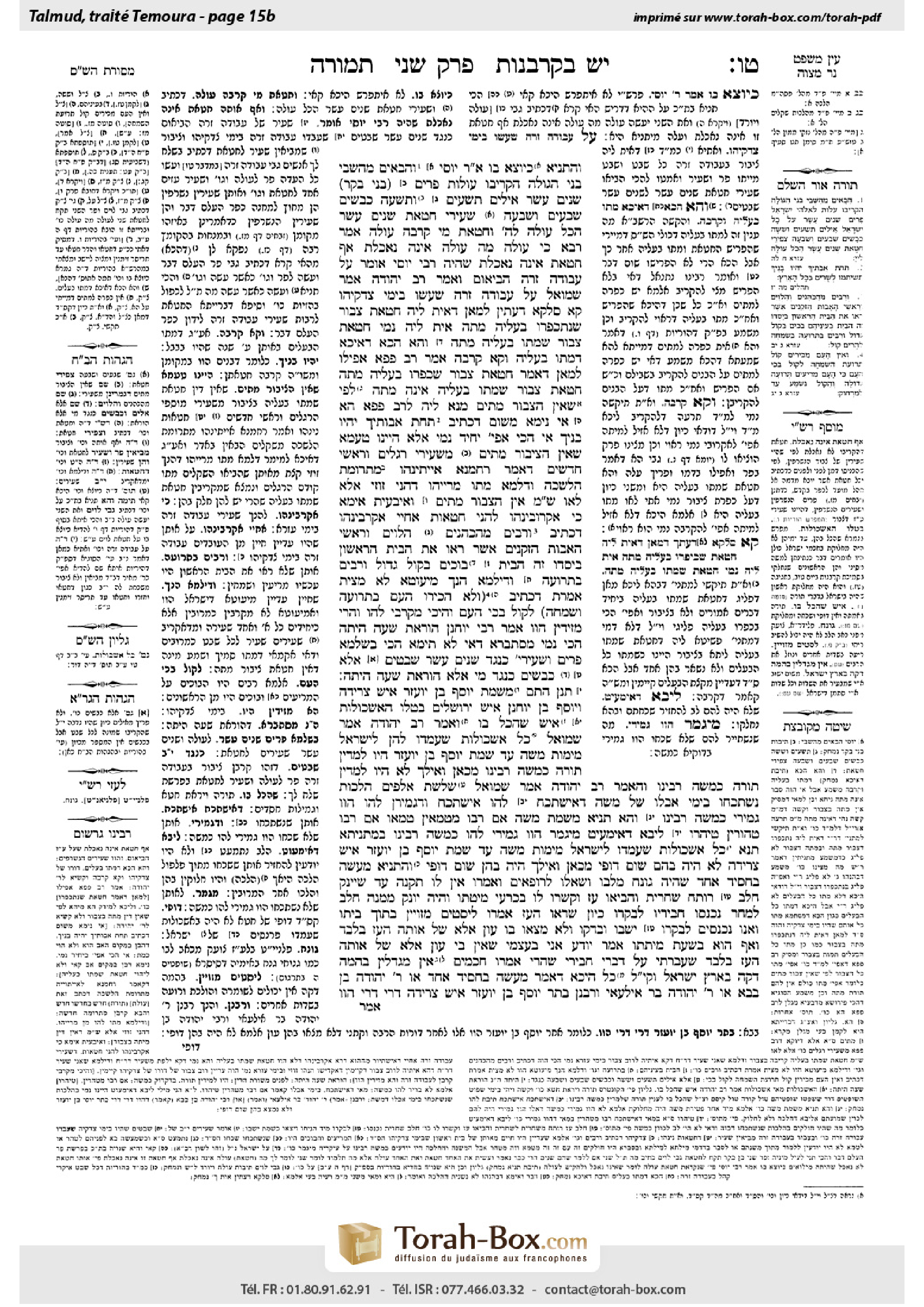
Temurah 15b: Talmud study for Daf Yomi
Daf Yomi is the daily study of one Talmud folio. Explore 37 tractates with scans, Hebrew text, Sefaria English and AI-generated French translations where annotated.
Passage selection and English or AI-generated French translation are available where the scan has annotations. Daf Study is independent of Torah-Box and Sefaria.
Browse Temurah · תמורה · All tractatesTemurah 15b text and translations
This page of Temurah includes the Aramaic text, an English translation and an AI-generated French translation, alongside the scan above.
תמורה י״ה ב · Aramaic and Hebrew text
וְהָתַנְיָא: כַּיּוֹצֵא בּוֹ אָמַר רַבִּי יוֹסֵי: ״וְהַבָּאִים מֵהַשְּׁבִי בְנֵי הַגּוֹלָה הִקְרִיבוּ עוֹלוֹת... פָּרִים בְּנֵי בָקָר שְׁנֵים עָשָׂר... אֵילִים תִּשְׁעִים וְתִשְׁעָה, כְּבָשִׂים שִׁבְעִים וְשִׁבְעָה, שְׂעִירֵי חַטָּאת שְׁנֵים עָשָׂר — הַכֹּל עוֹלָה לַה׳״.
וְחַטָּאת מִי קָרְבָה עוֹלָה? אָמַר רָבָא: כִּי עוֹלָה, מָה עוֹלָה אֵינָהּ נֶאֱכֶלֶת — אַף חַטָּאת אֵינָהּ נֶאֱכֶלֶת, שֶׁהָיָה רַבִּי יוֹסֵי אוֹמֵר: עַל עֲבוֹדָה זָרָה הֱבִיאוּם, וְאָמַר רַב יְהוּדָה אָמַר שְׁמוּאֵל: עַל עֲבוֹדָה זָרָה שֶׁעָשׂוּ בִּימֵי צִדְקִיָּהוּ.
קָא סָלְקָא דַּעְתִּין, לְמַאן דְּאִית לֵיהּ חַטַּאת צִבּוּר שֶׁנִּתְכַּפְּרוּ בְּעָלֶיהָ — מֵתָה, אִית לֵיהּ נָמֵי חַטַּאת צִבּוּר שֶׁמֵּתוּ בְּעָלֶיהָ — מֵתָה, וְהָא הָכָא דְּאִיכָּא דְּמֵתוּ בַּעֲלֵיהּ, וְקָא קָרְבָה!
אָמַר רַב פָּפָּא: אֲפִילּוּ לְמַאן דְּאָמַר חַטַּאת צִבּוּר שֶׁכִּפְּרוּ בְּעָלֶיהָ מֵתָה, חַטַּאת צִבּוּר שֶׁמֵּתוּ בְּעָלֶיהָ אֵינָהּ מֵתָה, לְפִי שֶׁאֵין הַצִּבּוּר מֵתִים.
מְנָא לֵיהּ לְרַב פָּפָּא הָא? אִי נֵימָא מִשּׁוּם דִּכְתִיב ״תַּחַת אֲבוֹתֶיךָ יִהְיוּ בָנֶיךָ״, אִי הָכִי, אֲפִילּוּ יָחִיד נָמֵי!
אֶלָּא הַיְינוּ טַעְמָא, שֶׁאֵין הַצִּיבּוּר מֵתִים, מִשְּׂעִירֵי רְגָלִים וְרָאשֵׁי חֳדָשִׁים, דְּאָמַר רַחֲמָנָא: אַיְיתִינְהוּ מִתְּרוּמַת הַלִּשְׁכָּה. וְדִלְמָא מִתוּ מָרַיְיהוּ דְּהָנֵי זוּזֵי? אֶלָּא לָאו שְׁמַע מִינַּהּ אֵין הַצִּבּוּר מֵתִים.
וְאִיבָּעֵית אֵימָא: כִּי אַקְרוּבִינְהוּ לְהָנֵי חַטָּאוֹת — אַחַיֵּי אַקְרֻבִינְהוּ, דִּכְתִיב: ״וְרַבִּים מֵהַכֹּהֲנִים הַלְוִיִּם וְרָאשֵׁי הָאָבוֹת הַזְּקֵנִים אֲשֶׁר רָאוּ אֶת הַבַּיִת הָרִאשׁוֹן בְּיׇסְדוֹ זֶה הַבַּיִת... בּוֹכִים בְּקוֹל גָּדוֹל וְרַבִּים בִּתְרוּעָה״.
וְדִילְמָא הָנָךְ מִיעוּטָא? לָא מָצֵית אָמְרַתְּ, דִּכְתִיב ״וְלֹא הִכִּירוּ הָעָם בַּתְּרוּעָה וְשִׂמְחָה לְקוֹל בְּכִי הָעָם״.
וְהֵיכִי מַקְרְבִי לְהוּ? וַהֲרֵי מְזִידִין הֲווֹ! אָמַר רַבִּי יוֹחָנָן: הוֹרָאַת שָׁעָה הָיְתָה.
הָכִי נָמֵי מִסְתַּבְּרָא, דְּאִי לָא תֵּימָא הָכִי — בִּשְׁלָמָא פָּרִים וּשְׂעִירִים כְּנֶגֶד שְׁנֵים עָשָׂר שְׁבָטִים, אֶלָּא כְּבָשִׂים כְּנֶגֶד מִי? אֶלָּא הוֹרָאַת שָׁעָה הָיְתָה.
תְּנַן הָתָם: מִשֶּׁמֵּת יוֹסֵף בֶּן יוֹעֶזֶר אִישׁ צְרֵידָה וְיוֹסֵף בֶּן יוֹחָנָן אִישׁ יְרוּשָׁלַיִם, בָּטְלוּ הָאֶשְׁכּוֹלוֹת. אִישׁ שֶׁהַכֹּל בּוֹ.
וְאָמַר רַב יְהוּדָה, אָמַר שְׁמוּאֵל: כׇּל אֶשְׁכּוֹלוֹת שֶׁעָמְדוּ לָהֶן לְיִשְׂרָאֵל מִימוֹת מֹשֶׁה עַד שֶׁמֵּת יוֹסֵף בֶּן יוֹעֶזֶר — הָיוּ לְמֵדִין תּוֹרָה כְּמֹשֶׁה רַבֵּינוּ, מִכָּאן וְאֵילָךְ — לֹא הָיוּ לְמֵדִין תּוֹרָה כְּמֹשֶׁה רַבֵּינוּ.
וְהָאָמַר רַב יְהוּדָה אָמַר שְׁמוּאֵל: שְׁלֹשֶׁת אֲלָפִים הֲלָכוֹת נִשְׁתַּכְּחוּ בִּימֵי אֶבְלוֹ שֶׁל מֹשֶׁה! דְּאִישְׁתְּכֻח לְהוּ — אִישְׁתְּכֻח, וְדִגְמִירָן לְהוּ — הֲווֹ גְּמִירִי כְּמֹשֶׁה רַבֵּינוּ.
וְהָא תַּנְיָא: מִשֶּׁמֵּת מֹשֶׁה, אִם רַבּוּ מְטַמְּאִין — טִמֵּאוּ, אִם רַבּוּ טְהוֹרִין — טִיהֵרוּ!
לִיבָּא דְּאִימְּעִיט, מִיגְמָר הֲווֹ גְּמִירִי לְהוּ כְּמֹשֶׁה רַבֵּינוּ.
בְּמַתְנִיתָא תָּנָא: כׇּל אֶשְׁכּוֹלוֹת שֶׁעָמְדוּ לְיִשְׂרָאֵל מִימוֹת מֹשֶׁה עַד שֶׁמֵּת יוֹסֵף בֶּן יוֹעֶזֶר אִישׁ צְרֵידָה — לֹא הָיָה בָּהֶם שׁוּם דּוֹפִי, מִכָּאן וְאֵילָךְ — הָיָה בָּהֶן שׁוּם דּוֹפִי.
וְהָתַנְיָא: מַעֲשֶׂה בְּחָסִיד אֶחָד שֶׁהָיָה גּוֹנֵחַ מִלִּבּוֹ, וְשָׁאֲלוּ לָרוֹפְאִים, וְאָמְרוּ: אֵין לוֹ תַּקָּנָה עַד שֶׁיִּינַק חָלָב רוֹתֵחַ שַׁחֲרִית, וְהֵבִיאוּ עֵז וְקָשְׁרוּ לוֹ בְּכַרְעֵי מִיטָּתוֹ, וְהָיָה יוֹנֵק מִמֶּנָּה חֵלֶב.
לְמָחָר נִכְנְסוּ חֲבֵירָיו לְבַקְּרוֹ, כֵּיוָן שֶׁרָאוּ הָעֵז אָמְרוּ: לִיסְטִים מְזוּיָּין בְּתוֹךְ בֵּיתוֹ, וְאָנוּ נִכְנָסִים לְבַקְּרוֹ?! יָשְׁבוּ וּבָדְקוּ, וְלֹא מָצְאוּ בּוֹ עָוֹן אֶלָּא שֶׁל אוֹתָהּ הָעֵז בִּלְבַד.
וְאַף הוּא בִּשְׁעַת מִיתָתוֹ אָמַר: יוֹדֵעַ אֲנִי בְּעַצְמִי שֶׁאֵין בִּי עָוֹן, אֶלָּא שֶׁל אוֹתָהּ הָעֵז בִּלְבַד, שֶׁעָבַרְתִּי עַל דִּבְרֵי חֲבֵירַי, שֶׁהֲרֵי אָמְרוּ חֲכָמִים: אֵין מְגַדְּלִין בְּהֵמָה דַּקָּה בְּאֶרֶץ יִשְׂרָאֵל.
וְקַיְימָא לַן, כֹּל הֵיכָא דְּאָמַר ״מַעֲשֶׂה בְּחָסִיד אֶחָד״ — אוֹ רַבִּי יְהוּדָה בֶּן בָּבָא אוֹ רַבִּי יְהוּדָה בַּר אִילְעַאי, וְרַבָּנַן בָּתַר יוֹסֵף בֶּן יוֹעֶזֶר אִישׁ צְרֵידָה דָּרֵי דָּרֵי הֲווֹ.
Temurah 15b · English translation
But isn’t it taught in a baraita: Similarly, Rabbi Yosei said: It is stated with regard to those who returned from Babylonia in the days of Ezra: “The children of the captivity that came out of exile sacrificed burnt offerings to the God of Israel, twelve bulls for all Israel, ninety-six rams, seventy-seven lambs, twelve goats for a sin offering; all this was a burnt offering unto the Lord” (Ezra 8:35).
The Gemara first analyzes this verse: But is it possible for a sin offering to be sacrificed as a burnt offering? Rava said: The verse means that it was all performed in the manner of a burnt offering: Just as a burnt offering may not be eaten, so too, that sin offering was not eaten. As Rabbi Yosei would say: They brought these twelve sin offerings for the sin of idol worship; and Rav Yehuda said that Shmuel said: They were brought for the sin of idol worship they committed in the days of King Zedekiah.
The Gemara explains the difficulty concerning which it cited this verse: It might enter our mind to think that according to the one who holds that a communal sin offering whose owners achieved atonement with another sin offering is left to die, he also holds that a communal sin offering whose owners died is left to die. But here, with regard to the offerings brought by the returning exiles, this is a case of a communal sin offering whose owners died, as the sin was committed in the time of Zedekiah, in the First Temple period, whereas the offerings were brought several generations later by those returning to rebuild the Second Temple. And yet they were sacrificed. This proves that a communal sin offering whose owners achieved atonement with another sin offering is not left to die.
Rav Pappa said in response: Even according to the one who said that a communal sin offering whose owners achieved atonement with another sin offering is left to die, he agrees that a communal sin offering whose owners died is not left to die. This is because a community does not die.
The Gemara asks: From where does Rav Pappa derive this statement? If we say it is because it is written: “Your sons shall be instead of your fathers” (Psalms 45:17), i.e., it is considered as though the fathers are alive, if so, then this should apply even to an individual as well. In other words, sons should be able to sacrifice the sin offerings of their late fathers.
Rather, this is Rav Pappa’s reasoning for his statement that a community does not die. It is derived from the halakha of the goats sacrificed on pilgrimage Festivals and on New Moons, as the Merciful One states: Bring them from the funds of the collection of the Temple treasury chamber, where they kept the half-shekels donated every year in the month of Adar, with which communal offerings were purchased. The Gemara explains: But perhaps the owners of these coins that were used to purchase these offerings have died in the meantime between the month of Adar and when the offerings are sacrificed throughout the year. If so, how can a sin offering be brought on behalf of some of its owners who have already died? Rather, isn’t it correct to conclude from this halakha that a community does not die?
And if you wish, say instead a different answer in response to the earlier difficulty: The sin offerings for idolatry brought by the returning exiles were not in fact sacrificed for people who had died. Rather, when they sacrificed these sin offerings for the idolatry committed in the time of Zedekiah, they sacrificed them for the living, i.e., for those survivors who had worshipped idols in the time of Zedekiah and were still alive many decades later and had returned to rebuild the Second Temple. As it is written: “But many of the priests, Levites, and heads of fathers’ houses, the old men that had seen the first house standing on its foundation, wept with a loud voice when this house was before their eyes; and many shouted aloud for joy” (Ezra 3:12).
The Gemara objects: But perhaps those who remained and remembered the First Temple were the minority, in which case they should have each brought individual sin offerings, rather than a communal sin offering. The fact that they brought communal sacrifices indicates that the sin offering was not brought only on behalf of those few who remained. The Gemara explains: You cannot say that they were the minority, as it is written in the following verse: “So that the people could not discern the noise of the shout of joy from the noise of the weeping of the people; for the people shouted with a loud shout, and the noise was heard afar off” (Ezra 3:13). This verse shows that the people who cried because they remembered the First Temple were not a small minority.
The Gemara asks: But how could they sacrifice sin offerings for the sin of idolatry? After all, they were intentional idol worshippers, and a sin offering is brought only by one who sins unwittingly. Rabbi Yoḥanan says in response: It was a provisional edict issued in exigent circumstances, according to which they were permitted to bring sin offerings even for intentional sins.
The Gemara adds that this also stands to reason, as, if you do not say so, one can object as follows: Granted, they sacrificed twelve bulls and goats, since each tribe must bring a communal sin offering, as stated in the Torah (Numbers, chapter 15), and these offerings correspond to the twelve tribes. But to what do the ninety-six sheep correspond? Rather, it must be that it was a provisional edict.
§ Earlier the Gemara mentioned the halakha of a sin offering whose owner died, which was one of the halakhot forgotten during the mourning period for Moses (see 16a). On this topic the Gemara says that we learned in a mishna there (Sota 47a): From the time when Yosef ben Yo’ezer of Tzereida and Yosef ben Yoḥanan of Jerusalem died, the clusters [eshkolot] ceased, i.e., they were the last of the clusters. The Gemara asks: What is the meaning of eshkolot? It means a man who contains all [ish shehakol bo], i.e., both Torah and mitzvot.
And Rav Yehuda says that Shmuel says: All the clusters who stood at the head of the Jewish people, from the days of Moses until Yosef ben Yo’ezer died, would study Torah in the manner of Moses, our teacher. From that point forward they would not study Torah in the manner of Moses, our teacher.
The Gemara objects: But doesn’t Rav Yehuda say that Shmuel said: Three thousand halakhot were forgotten during the days of mourning for Moses. This suggests that the Sages who came immediately after Moses did not study Torah in the same manner as Moses. The Gemara answers: Those halakhot that they forgot, were forgotten, but with regard to those halakhot that they studied, they would continue to study in the manner of Moses, our teacher.
The Gemara objects: But isn’t it taught in a baraita with regard to the resolution of questions of halakha: From the time when Moses died, if the majority deem an item impure, they have established it as impure, and if the majority deem an item pure, they have established it as pure. If this is the case, then the manner of studying Torah after the death of Moses is based on a majority, whereas when Moses was alive there was no dispute in matters of halakha.
The Gemara explains that this baraita is referring specifically to those halakhot that were forgotten during the mourning period after the death of Moses. Since the understanding of the heart was limited [libba de’ime’it], the Sages were unable to reach a clear ruling on these matters. Consequently, they had to follow the majority. But with regard to all other halakhot they studied, they would study them in the manner of Moses, our teacher.
It was taught in a baraita: All the clusters who stood at the head of the Jewish people from the days of Moses until Yosef ben Yo’ezer died had no flaw in them. From this point forward the clusters, i.e., the leadership of the Jewish people, had flaws in them.
The Gemara raises a difficulty: But isn’t it taught in a baraita: There was an incident involving a certain pious man who was groaning, i.e., suffering, due to a pain in his heart. And they asked the physicians what to do for him, and they said: There is no other remedy for him but that he should suckle warm milk every morning. And they brought him a goat and tied it to the leg of the bed for him, and he would suckle milk from it.
On the following day, his friends entered to visit him. When they saw the goat tied to the leg of the bed they said: There is an armed bandit in this man’s house, and we are entering to visit him? They referred to the goat in this manner because small animals habitually graze on the vegetation of neighbors, stealing their crops. The Sages sat and examined this pious man’s behavior, and they could not find any transgression attributable to him other than the sin of keeping that goat in his house alone.
And that man himself also said at the time of his death: I know for a fact with regard to myself that I have no transgression attributable to me but the sin of keeping that goat in my house alone, as I transgressed the statement of my colleagues, the Sages. As the Sages said in a mishna (Bava Kamma 79b): One may not raise small domesticated animals, i.e., sheep and goats, in inhabited areas of Eretz Yisrael, because they graze on people’s crops.
And we maintain that anywhere that it says: There was an incident involving a certain pious man, the man in question is either Rabbi Yehuda ben Bava or Rabbi Yehuda bar Ilai. And these Sages lived many generations after Yosef ben Yo’ezer of Tzereida. If this is the case, then even in later generations there were Sages without a flaw.
Temurah 15b · Traduction française (IA)
Mais n’est-il pas enseigné dans une baraïta : De même, Rabbi Yosei a dit : Il est dit au sujet de ceux qui revinrent de Babylonie à l’époque d’Ezra : « Les enfants de la déportation revenus d’exil offrirent des holocaustes au Dieu d’Israël : douze taureaux pour tout Israël, quatre-vingt-seize béliers, soixante-dix-sept agneaux, douze boucs en sacrifice expiatoire ; tout cela était un holocauste pour le Seigneur » (Ezra 8:35).
La Guemara examine d’abord ce verset : Est-il possible qu’un sacrifice expiatoire soit offert comme un holocauste ? Rava a dit : Le verset signifie que tout fut accompli selon le rite d’un holocauste : de même qu’un holocauste ne peut être consommé, ce sacrifice expiatoire ne fut pas consommé non plus. Rabbi Yosei disait en effet qu’ils avaient apporté ces douze sacrifices expiatoires pour la faute d’idolâtrie ; et Rav Yehuda a dit au nom de Shmuel qu’ils furent apportés pour la faute d’idolâtrie qu’ils avaient commise à l’époque du roi Sédécias.
La Guemara explique la difficulté pour laquelle elle a cité ce verset : On pourrait penser que, selon celui qui soutient qu’un sacrifice expiatoire communautaire dont les propriétaires ont obtenu l’expiation au moyen d’un autre sacrifice expiatoire doit être laissé à mourir, un sacrifice expiatoire communautaire dont les propriétaires sont morts doit également être laissé à mourir. Or, ici, les sacrifices apportés par les exilés revenus relèvent du cas d’un sacrifice expiatoire communautaire dont les propriétaires étaient morts, car la faute avait été commise à l’époque de Sédécias, pendant la période du Premier Temple, tandis que les sacrifices furent apportés plusieurs générations plus tard par ceux qui revinrent pour reconstruire le Second Temple. Pourtant, ils furent offerts. Cela prouve qu’un sacrifice expiatoire communautaire dont les propriétaires ont obtenu l’expiation au moyen d’un autre sacrifice expiatoire n’est pas laissé à mourir.
Rav Pappa répondit : Même celui qui dit qu’un sacrifice expiatoire communautaire dont les propriétaires ont obtenu l’expiation au moyen d’un autre sacrifice expiatoire doit être laissé à mourir convient qu’un sacrifice expiatoire communautaire dont les propriétaires sont morts n’est pas laissé à mourir. En effet, une communauté ne meurt pas.
La Guemara demande : De quoi Rav Pappa tire-t-il cette affirmation ? Si l’on dit qu’elle découle du verset : « Tes fils prendront la place de tes pères » (Psaumes 45:17), c’est-à-dire qu’on considère que les pères sont encore en vie, alors cela devrait également s’appliquer à un particulier. Autrement dit, les fils devraient pouvoir offrir les sacrifices expiatoires de leurs pères décédés.
Rav Pappa fonde plutôt son affirmation selon laquelle une communauté ne meurt pas sur la halakha des boucs offerts lors des fêtes de pèlerinage et des nouvelles lunes. Le Miséricordieux dit de les apporter avec les fonds recueillis dans la chambre du Trésor du Temple, où étaient conservés les demi-sicles donnés chaque année au mois d’Adar et servant à acheter les sacrifices communautaires. La Guemara explique : Mais peut-être les propriétaires de ces pièces, qui servirent à acheter les sacrifices, sont-ils morts entre le mois d’Adar et le moment où les sacrifices sont offerts au cours de l’année. Si tel est le cas, comment peut-on apporter un sacrifice expiatoire au nom de certains de ses propriétaires déjà morts ? Ne faut-il pas plutôt conclure de cette halakha qu’une communauté ne meurt pas ?
Et si tu le souhaites, on peut donner une autre réponse à la difficulté précédente : En réalité, les sacrifices expiatoires pour idolâtrie apportés par les exilés revenus ne furent pas offerts pour des personnes décédées. Lorsqu’ils offrirent ces sacrifices expiatoires pour l’idolâtrie commise à l’époque de Sédécias, ils les offrirent pour les vivants, c’est-à-dire pour les survivants qui avaient pratiqué l’idolâtrie à l’époque de Sédécias, étaient encore en vie plusieurs décennies plus tard et étaient revenus pour reconstruire le Second Temple. Car il est écrit : « Mais beaucoup de prêtres, de Lévites et de chefs de familles, les vieillards qui avaient vu la première Maison encore debout sur ses fondations, pleurèrent à grands cris lorsque cette Maison se trouva sous leurs yeux ; et beaucoup poussèrent de grands cris de joie » (Ezra 3:12).
La Guemara objecte : Mais peut-être ceux qui étaient restés et se souvenaient du Premier Temple ne formaient-ils qu’une minorité ; chacun aurait alors dû apporter un sacrifice expiatoire individuel plutôt qu’un sacrifice expiatoire communautaire. Le fait qu’ils aient apporté des sacrifices communautaires indique que le sacrifice expiatoire ne fut pas offert uniquement au nom de ces quelques survivants. La Guemara explique : On ne peut pas dire qu’ils formaient une minorité, car il est écrit dans le verset suivant : « Le peuple ne pouvait distinguer le bruit des cris de joie du bruit des pleurs du peuple, car le peuple poussait de grands cris, et le bruit s’entendait au loin » (Ezra 3:13). Ce verset montre que ceux qui pleuraient parce qu’ils se souvenaient du Premier Temple ne formaient pas une petite minorité.
La Guemara demande : Mais comment pouvaient-ils offrir des sacrifices expiatoires pour la faute d’idolâtrie ? Après tout, ils avaient pratiqué l’idolâtrie intentionnellement, alors qu’un sacrifice expiatoire n’est apporté que par celui qui a péché par inadvertance. Rabbi Yoḥanan répond : Il s’agissait d’un décret provisoire promulgué dans une situation d’urgence, qui les autorisait à apporter des sacrifices expiatoires même pour des fautes intentionnelles.
La Guemara ajoute que cela est également logique, car, si l’on ne l’admet pas, on peut objecter ce qui suit : Il est compréhensible qu’ils aient offert douze taureaux et boucs, puisque chaque tribu doit apporter un sacrifice expiatoire communautaire, comme l’indique la Torah (Nombres, chapitre 15), et que ces sacrifices correspondaient aux douze tribus. Mais à quoi correspondaient les quatre-vingt-seize moutons ? Il faut donc conclure qu’il s’agissait d’un décret provisoire.
§ La Guemara a mentionné précédemment la halakha d’un sacrifice expiatoire dont le propriétaire est mort, qui comptait parmi les halakhot oubliées pendant la période de deuil de Moïse (voir 16a). À ce sujet, la Guemara rapporte que nous avons appris dans une Michna, là-bas (Sota 47a) : À partir du moment où Yosef ben Yo’ezer de Tzereida et Yosef ben Yoḥanan de Jérusalem moururent, les grappes [eshkolot] cessèrent, c’est-à-dire qu’ils furent les derniers des grappes. La Guemara demande : Que signifie eshkolot ? Cela désigne un homme qui contient tout [ish shehakol bo], c’est-à-dire la Torah et les mitsvot.
Et Rav Yehuda dit au nom de Shmuel : Toutes les grappes qui furent à la tête du peuple juif depuis l’époque de Moïse jusqu’à la mort de Yosef ben Yo’ezer étudiaient la Torah à la manière de Moïse, notre maître. À partir de ce moment, ils n’étudièrent plus la Torah à la manière de Moïse, notre maître.
La Guemara objecte : Mais Rav Yehuda ne dit-il pas au nom de Shmuel que trois mille halakhot furent oubliées pendant les jours de deuil de Moïse ? Cela suggère que les Sages venus immédiatement après Moïse n’étudiaient pas la Torah de la même manière que lui. La Guemara répond : Les halakhot qu’ils oublièrent furent bel et bien oubliées, mais, pour celles qu’ils étudiaient, ils continuaient à les étudier à la manière de Moïse, notre maître.
La Guemara objecte : Mais n’est-il pas enseigné dans une baraïta, au sujet de la résolution des questions de halakha : Depuis la mort de Moïse, si la majorité juge qu’un élément est impur, il est établi comme impur ; et si la majorité le juge pur, il est établi comme pur. Si tel est le cas, après la mort de Moïse, la manière d’étudier la Torah repose sur la majorité, tandis que, du vivant de Moïse, il n’y avait pas de controverse en matière de halakha.
La Guemara explique que cette baraïta se rapporte précisément aux halakhot oubliées pendant la période de deuil qui suivit la mort de Moïse. Comme la compréhension du cœur était limitée [libba de’ime’it], les Sages ne parvenaient pas à rendre une décision claire sur ces questions. Ils devaient donc suivre la majorité. Mais pour toutes les autres halakhot qu’ils étudiaient, ils procédaient à la manière de Moïse, notre maître.
Il a été enseigné dans une baraïta : Toutes les grappes qui furent à la tête du peuple juif depuis l’époque de Moïse jusqu’à la mort de Yosef ben Yo’ezer étaient sans défaut. À partir de ce moment, les grappes, c’est-à-dire les dirigeants du peuple juif, présentèrent des défauts.
La Guemara soulève une difficulté : Mais n’est-il pas enseigné dans une baraïta : Il arriva qu’un certain homme pieux gémissait, c’est-à-dire souffrait d’une douleur au cœur. On demanda aux médecins ce qu’il fallait faire pour lui, et ils dirent : Il n’y a pas d’autre remède pour lui que de téter du lait chaud chaque matin. On lui amena une chèvre et on l’attacha au pied de son lit ; il en tétait le lait.
Le lendemain, ses amis vinrent lui rendre visite. Lorsqu’ils virent la chèvre attachée au pied du lit, ils dirent : « Il y a un bandit armé dans la maison de cet homme, et nous entrons lui rendre visite ? » Ils parlaient ainsi de la chèvre parce que les petits animaux ont l’habitude de brouter la végétation des voisins et de voler leurs récoltes. Les Sages s’assirent et examinèrent la conduite de cet homme pieux, mais ne trouvèrent aucune transgression qui lui fût imputable, hormis celle d’avoir gardé cette chèvre seule dans sa maison.
Cet homme lui-même dit aussi au moment de sa mort : « Je sais avec certitude que je n’ai commis aucune transgression qui me soit imputable, hormis celle d’avoir gardé cette chèvre seule dans ma maison, car j’ai transgressé la parole de mes collègues, les Sages. » En effet, les Sages ont dit dans une Michna (Bava Kamma 79b) : On ne peut pas élever de petits animaux domestiques, c’est-à-dire des moutons et des chèvres, dans les lieux habités d’Eretz Israël, car ils broutent les récoltes des gens.
Et nous tenons que partout où il est dit : « Il arriva qu’un certain homme pieux », l’homme en question est soit Rabbi Yehuda ben Bava, soit Rabbi Yehuda bar Ilai. Or, ces Sages vécurent plusieurs générations après Yosef ben Yo’ezer de Tzereida. Si tel est le cas, il y eut donc aussi, dans les générations ultérieures, des Sages sans défaut.
Traduction française générée par IA à partir de l’édition anglaise de Sefaria. Vérifie toujours un passage avec le texte source.
Text from Sefaria: William Davidson Edition - Vocalized Aramaic (CC BY NC); William Davidson Edition - English (CC BY NC).