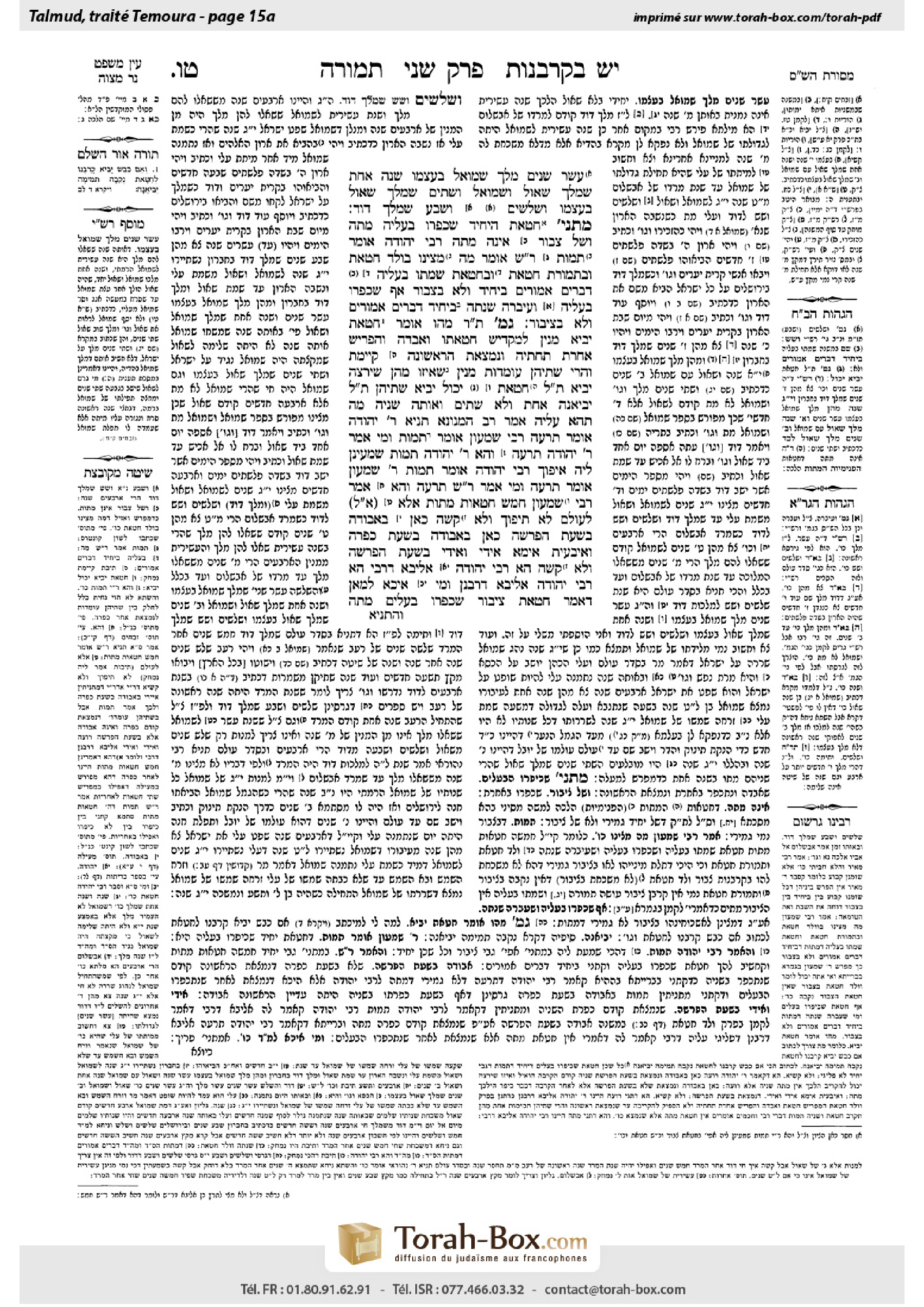
Temurah 15a: Talmud study for Daf Yomi
Daf Yomi is the daily study of one Talmud folio. Explore 37 tractates with scans, Hebrew text, Sefaria English and AI-generated French translations where annotated.
Passage selection and English or AI-generated French translation are available where the scan has annotations. Daf Study is independent of Torah-Box and Sefaria.
Browse Temurah · תמורה · All tractatesTemurah 15a text and translations
This page of Temurah includes the Aramaic text, an English translation and an AI-generated French translation, alongside the scan above.
תמורה י״ה א · Aramaic and Hebrew text
עֶשֶׂר שָׁנִים מָלַךְ שְׁמוּאֵל בְּעַצְמוֹ, שָׁנָה אַחַת שֶׁמָּלַךְ שָׁאוּל וּשְׁמוּאֵל, וּשְׁתַּיִם שֶׁמָּלַךְ שָׁאוּל בְּעַצְמוֹ, וּשְׁלֹשִׁים וָשֶׁבַע שֶׁמָּלַךְ דָּוִד.
מַתְנִי׳ חַטַּאת הַיָּחִיד שֶׁכִּפְּרוּ בְּעָלֶיהָ — מֵתָה, וְשֶׁל צִבּוּר — אֵינָהּ מֵתָה.
רַבִּי יְהוּדָה אוֹמֵר: תָּמוּת. רַבִּי שִׁמְעוֹן אוֹמֵר: מָה מָצִינוּ בִּוְלַד חַטָּאת, וּבִתְמוּרַת חַטָּאת, וּבְחַטָּאת שֶׁמֵּתוּ בְּעָלֶיהָ — דְּבָרִים אֲמוּרִים בְּיָחִיד וְלֹא בְּצִבּוּר, אַף שֶׁכִּפְּרוּ בְּעָלֶיהָ וְעִיבְּרָה שְׁנָתָהּ — בְּיָחִיד דְּבָרִים אֲמוּרִים וְלֹא בְּצִיבּוּר.
גְּמָ׳ תָּנוּ רַבָּנַן: מַהוּ אוֹמֵר חַטָּאת ״יָבִיא״? מִנַּיִן לְמַקְדִּישׁ חַטָּאתוֹ וְאָבְדָה, וְהִפְרִישׁ אַחֶרֶת תַּחְתֶּיהָ, וְנִמְצֵאת הָרִאשׁוֹנָה קַיֶּימֶת, וַהֲרֵי שְׁתֵּיהֶן עוֹמְדוֹת — מִנַּיִן שֶׁאֵיזוֹ מֵהֶן שֶׁיִּרְצֶה יָבִיא? תַּלְמוּד לוֹמַר ״חַטָּאת״. יָכוֹל יָבִיא שְׁתֵּיהֶן? תַּלְמוּד לוֹמַר ״יְבִיאֶנָּה״ — אַחַת וְלֹא שְׁתַּיִם.
וְאוֹתָהּ שְׁנִיָּה מָה תְּהֵא עָלֶיהָ? אָמַר רַב הַמְנוּנָא, תַּנְיָא: רַבִּי יְהוּדָה אוֹמֵר: תִּרְעֶה, רַבִּי שִׁמְעוֹן אוֹמֵר: תָּמוּת.
וּמִי אָמַר רַבִּי יְהוּדָה תִּרְעֶה? וְהָא רַבִּי יְהוּדָה ״תָּמוּת״ שָׁמְעִינַן לֵיהּ! אֵיפוֹךְ: רַבִּי יְהוּדָה אוֹמֵר: תָּמוּת, רַבִּי שִׁמְעוֹן אוֹמֵר: תִּרְעֶה. וּמִי אָמַר רַבִּי שִׁמְעוֹן תִּרְעֶה? וְהָא אָמַר רַבִּי שִׁמְעוֹן: חָמֵשׁ חַטָּאוֹת מֵתוֹת!
אֶלָּא (אֲמַר לֵיהּ) לְעוֹלָם לָא תֵּיפוֹךְ, וְלָא קַשְׁיָא: כָּאן — בַּאֲבוּדָה בִּשְׁעַת הַפְרָשָׁה, כָּאן — בַּאֲבוּדָה בִּשְׁעַת כַּפָּרָה.
וְאִיבָּעֵית אֵימָא: אִידֵּי וְאִידֵּי בִּשְׁעַת הַפְרָשָׁה, וְלָא קַשְׁיָא — הָא רַבִּי יְהוּדָה אַלִּיבָּא דְּרַבִּי, הָא רַבִּי יְהוּדָה אַלִּיבָּא דְּרַבָּנַן.
וּמִי אִיכָּא לְמַאן דְּאָמַר חַטַּאת צִיבּוּר שֶׁכִּפְּרוּ בְּעָלִים מֵתָה?
Temurah 15a · English translation
There were ten years during which Samuel reigned alone, from the death of Eli until the coronation of Saul, and one year that Saul reigned and Samuel was still alive, i.e., Saul reigned for one year during the lifetime of Samuel, and two years that Saul reigned by himself, i.e., after the death of Samuel. In addition, there were thirty-seven years during which David ruled, first in Hebron, and later in Jerusalem. This amounts to a total of forty years from when the Jewish people had first requested a king, and Absalom felt it was now his time to rule over the Jewish people.
MISHNA: There is a halakha transmitted to Moses from Sinai that there are five sin offerings that are unfit for sacrifice on the altar and have no remedy and are therefore left to die. They are: The offspring of a sin offering; the substitute for a sin offering; a sin offering whose owner died; a sin offering whose owner achieved atonement with another sin offering, when the original sin offering was lost or stolen and later recovered; and a sin offering whose year has passed. The mishna continues the discussion of the distinction between individual and communal offerings. An individual sin offering whose owner achieved atonement with another sin offering after it was lost is left to die, but in the case of a communal sin offering it is not left to die.
Rabbi Yehuda says: Even a communal sin offering shall be left to die. Rabbi Shimon says: Just as we found with regard to the offspring of a sin offering, and with regard to the substitute for a sin offering, and with regard to a sin offering whose owner died, that these matters apply to an individual sin offering and not to a communal sin offering, so too, in the cases of a sin offering whose owner achieved atonement with another sin offering, and a sin offering whose first year has passed, the matters are stated with regard to an individual sin offering, and not with regard to a communal sin offering.
GEMARA: The Sages taught in a baraita: What is the verse teaching when it says: “And if he bring a lamb as his offering for a sin offering, he shall bring it a female without blemish” (Leviticus 4:32)? From where is it derived with regard to one who separated his sin offering and it was lost, and he separated another in its place and the first one was found alive, and they both stand fit to be sacrificed, from where is it derived that he may bring whichever of them he wishes? The verse states: “A sin offering.” One might have thought that he must bring both of them. Therefore, the continuation of the verse states: “He shall bring it.” This teaches that he must bring one of the animals but not two of them.
The Gemara asks: And if so, that second animal, what will be with it? Rav Hamnuna says that it is taught in a baraita that Rabbi Yehuda says: It is left to graze until it becomes unfit, and then it is redeemed and the money is used to purchase a gift offering. Rabbi Shimon says: It shall be left to die, as it is an individual sin offering whose owner achieved atonement with another sin offering.
The Gemara asks: But did Rabbi Yehuda actually say that it is left to graze? But didn’t we hear that Rabbi Yehuda rules in the mishna that the animal shall be left to die? The Gemara answers: Reverse the names in the baraita, so that it reads: Rabbi Yehuda says: It shall be left to die; Rabbi Shimon says: It is left to graze. The Gemara asks: But did Rabbi Shimon actually say that it is left to graze? But didn’t Rabbi Shimon say: There are five sin offerings that are left to die, including a sin offering whose owner achieved atonement with another sin offering.
Rather, the Gemara explains: Actually, do not reverse the opinions of Rabbi Yehuda and Rabbi Shimon in the baraita, and it is not difficult. Here, where Rabbi Yehuda says in the baraita that the second animal must be left to graze, it is referring to an animal lost at the time of the separation of a substitute to take its place, but the original animal was found before the second was sacrificed. Since the animal was found before the other was sacrificed, it is left to graze. There, in the mishna where Rabbi Yehuda says that the animal must be left to die, it is referring to an animal that was still lost at the time of atonement, i.e., when the substitute was sacrificed.
And if you wish, say instead: Both this baraita and that mishna are referring to an animal that was lost only at the time of the separation of the second animal, and yet it is not difficult. Here in the mishna, Rabbi Yehuda rules that the animal must be left to die in accordance with the opinion of Rabbi Yehuda HaNasi in a mishna (22b), as he maintains that even if the animal was lost only when the second animal was separated and was found by the time it was sacrificed, it must still be left to die. There in the baraita, Rabbi Yehuda says that the animal is left to graze in accordance with the opinion of the Rabbis in that same mishna. The Rabbis disagree with Rabbi Yehuda HaNasi, and rule that the animal is left to die only if it was not yet found when the replacement animal was sacrificed.
§ The mishna taught that Rabbi Yehuda says: Even a communal sin offering shall be left to die if the community has already achieved atonement through another animal. The Gemara asks: But is there one who said that a communal sin offering whose owners achieved atonement with another sin offering after it was lost is left to die?
Temurah 15a · Traduction française (IA)
Samuel régna seul pendant dix ans, depuis la mort d’Éli jusqu’au couronnement de Saül, puis Saül régna pendant un an alors que Samuel était encore en vie, c’est-à-dire du vivant de Samuel, et pendant deux ans seul, c’est-à-dire après la mort de Samuel. David régna ensuite pendant trente-sept ans, d’abord à Hébron, puis à Jérusalem. Cela fait en tout quarante ans depuis la première demande du peuple juif d’avoir un roi, et Absalom estima que son heure était venue de régner sur le peuple juif.
Michna : Une halakha transmise à Moïse au Sinaï enseigne qu’il existe cinq sacrifices expiatoires impropres à être offerts sur l’autel, qui n’ont aucun recours et doivent donc être laissés à la mort. Ce sont : le petit d’un sacrifice expiatoire ; le substitut d’un sacrifice expiatoire ; un sacrifice expiatoire dont le propriétaire est mort ; un sacrifice expiatoire dont le propriétaire a obtenu l’expiation grâce à un autre sacrifice expiatoire, après que le sacrifice initial, qui avait été perdu ou volé, a été retrouvé ; et un sacrifice expiatoire qui a dépassé l’âge d’un an. La Michna poursuit l’examen de la distinction entre les sacrifices individuels et les sacrifices communautaires. Un sacrifice expiatoire individuel dont le propriétaire a obtenu l’expiation grâce à un autre sacrifice expiatoire après que le premier a été perdu doit être laissé à la mort, mais un sacrifice expiatoire communautaire ne doit pas être laissé à la mort.
Rabbi Yehouda dit : Même un sacrifice expiatoire communautaire doit être laissé à la mort. Rabbi Shimon dit : De même que nous avons établi, au sujet du petit d’un sacrifice expiatoire, du substitut d’un sacrifice expiatoire et d’un sacrifice expiatoire dont le propriétaire est mort, que ces règles s’appliquent à un sacrifice expiatoire individuel et non à un sacrifice expiatoire communautaire, de même, dans les cas d’un sacrifice expiatoire dont le propriétaire a obtenu l’expiation grâce à un autre sacrifice expiatoire et d’un sacrifice expiatoire qui a dépassé sa première année, ces règles concernent un sacrifice expiatoire individuel et non un sacrifice expiatoire communautaire.
Guemara : Les Sages ont enseigné dans une baraïta : Que vient enseigner le verset lorsqu’il dit : « Et s’il présente un agneau comme offrande pour un sacrifice expiatoire, il présentera une femelle sans défaut » (Lévitique 4,32) ? D’où déduit-on que celui qui a mis à part son sacrifice expiatoire, puis l’a perdu, avant d’en mettre un autre à sa place, et que le premier a ensuite été retrouvé vivant, de sorte que les deux sont aptes à être offerts, peut présenter celui des deux qu’il souhaite ? Le verset dit : « Un sacrifice expiatoire. » On aurait pu penser qu’il doit présenter les deux. C’est pourquoi la suite du verset dit : « Il le présentera. » Cela enseigne qu’il doit présenter l’un des animaux, mais pas les deux.
La Guemara demande : Dans ce cas, que faire du second animal ? Rav Hamnouna dit qu’une baraïta enseigne que Rabbi Yehouda dit : On le laisse paître jusqu’à ce qu’il devienne impropre, puis on le rachète et l’argent sert à acheter une offrande volontaire. Rabbi Shimon dit : Il faut le laisser à la mort, car c’est un sacrifice expiatoire individuel dont le propriétaire a obtenu l’expiation grâce à un autre sacrifice expiatoire.
La Guemara demande : Mais Rabbi Yehouda a-t-il vraiment dit qu’on le laisse paître ? N’avons-nous pas entendu Rabbi Yehouda statuer dans la Michna qu’il faut laisser l’animal à la mort ? La Guemara répond : Inverse les noms dans la baraïta, de sorte qu’elle lise : Rabbi Yehouda dit qu’il faut laisser l’animal à la mort ; Rabbi Shimon dit qu’on le laisse paître. La Guemara demande : Mais Rabbi Shimon a-t-il vraiment dit qu’on le laisse paître ? N’a-t-il pas dit qu’il existe cinq sacrifices expiatoires qu’on laisse à la mort, parmi lesquels un sacrifice expiatoire dont le propriétaire a obtenu l’expiation grâce à un autre sacrifice expiatoire ?
La Guemara explique plutôt : En réalité, il ne faut pas inverser les avis de Rabbi Yehouda et de Rabbi Shimon dans la baraïta, et il n’y a pas de difficulté. Dans le cas où Rabbi Yehouda dit dans la baraïta qu’il faut laisser le second animal paître, il s’agit d’un animal perdu au moment où l’on a mis à part un substitut pour le remplacer, mais retrouvé avant le sacrifice du second animal. Puisque l’animal a été retrouvé avant que l’autre soit sacrifié, on le laisse paître. Dans la Michna, où Rabbi Yehouda dit qu’il faut laisser l’animal à la mort, il s’agit d’un animal qui était encore perdu au moment de l’expiation, c’est-à-dire lorsque le substitut a été sacrifié.
Et si tu le souhaites, dis plutôt : La baraïta et la Michna parlent toutes deux d’un animal qui n’était perdu qu’au moment où le second animal a été mis à part, et pourtant il n’y a pas de difficulté. Dans la Michna, Rabbi Yehouda statue qu’il faut laisser l’animal à la mort, conformément à l’avis de Rabbi Yehouda HaNassi dans une Michna (22b), car il estime que même si l’animal n’a été perdu qu’au moment où le second animal a été mis à part et qu’il a été retrouvé avant le sacrifice de celui-ci, il faut tout de même le laisser à la mort. Dans la baraïta, Rabbi Yehouda dit qu’on laisse l’animal paître, conformément à l’avis des Sages dans cette même Michna. Les Sages sont en désaccord avec Rabbi Yehouda HaNassi et statuent qu’on ne laisse l’animal à la mort que s’il n’a pas encore été retrouvé au moment où l’animal de remplacement a été sacrifié.
§ La Michna enseignait que Rabbi Yehouda dit : Même un sacrifice expiatoire communautaire doit être laissé à la mort si la communauté a déjà obtenu l’expiation grâce à un autre animal. La Guemara demande : Mais quelqu’un a-t-il jamais dit qu’un sacrifice expiatoire communautaire dont les propriétaires ont obtenu l’expiation grâce à un autre sacrifice expiatoire après qu’il a été perdu doit être laissé à la mort ?
Traduction française générée par IA à partir de l’édition anglaise de Sefaria. Vérifie toujours un passage avec le texte source.
Text from Sefaria: William Davidson Edition - Vocalized Aramaic (CC BY NC); William Davidson Edition - English (CC BY NC).