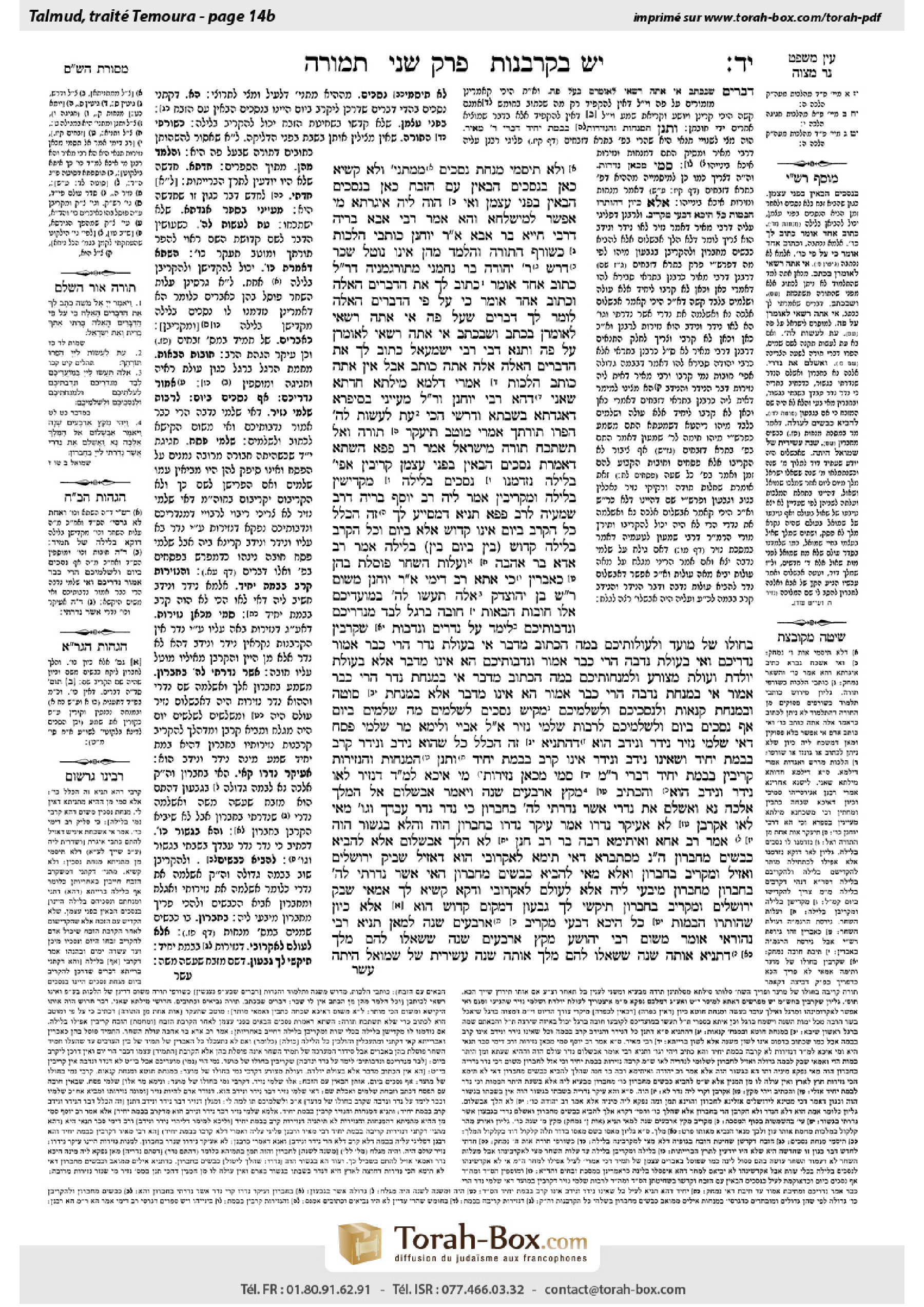
Temurah 14b: Talmud study for Daf Yomi
Daf Yomi is the daily study of one Talmud folio. Explore 37 tractates with scans, Hebrew text, Sefaria English and AI-generated French translations where annotated.
Passage selection and English or AI-generated French translation are available where the scan has annotations. Daf Study is independent of Torah-Box and Sefaria.
Browse Temurah · תמורה · All tractatesTemurah 14b text and translations
This page of Temurah includes the Aramaic text, an English translation and an AI-generated French translation, alongside the scan above.
תמורה י״ד ב · Aramaic and Hebrew text
וְלָא תִּיסְמֵי ״מִנְחַת נְסָכִים״ מִמַּתְנִיתָא. וְלָא קַשְׁיָא — כָּאן בִּנְסָכִים הַבָּאִין עִם הַזֶּבַח, כָּאן בִּנְסָכִים הַבָּאִין בִּפְנֵי עַצְמָן.
וְאִי הֲוָה לֵיהּ אִיגַּרְתָּא, מִי אֶפְשָׁר לְמִישְׁלְחַהּ? וְהָא אָמַר רַבִּי אַבָּא בְּרֵיהּ דְּרַבִּי חִיָּיא בַּר אַבָּא, אָמַר רַבִּי יוֹחָנָן: כּוֹתְבֵי הֲלָכוֹת (כְּשׂוֹרֵף) [כְּשׂוֹרְפֵי] תוֹרָה, וְהַלָּמֵד מֵהֶן אֵינוֹ נוֹטֵל שָׂכָר.
דָּרֵשׁ רַבִּי יְהוּדָה בַּר נַחְמָנִי מְתוּרְגְּמָנֵיהּ דְּרֵישׁ לָקִישׁ: כָּתוּב אֶחָד אוֹמֵר ״כְּתׇב לְךָ אֶת הַדְּבָרִים הָאֵלֶּה״, וְכָתוּב אֶחָד אוֹמֵר ״כִּי עַל פִּי הַדְּבָרִים הָאֵלֶּה״ — לוֹמַר לָךְ: דְּבָרִים שֶׁעַל פֶּה אִי אַתָּה רַשַּׁאי לְאוֹמְרָן בִּכְתָב, וְשֶׁבִּכְתָב אִי אַתָּה רַשַּׁאי לְאוֹמְרָן עַל פֶּה.
וְתָנָא דְּבֵי רַבִּי יִשְׁמָעֵאל: ״כְּתׇב לְךָ אֶת הַדְּבָרִים הָאֵלֶּה״ — אֵלֶּה אַתָּה כּוֹתֵב, אֲבָל אֵין אַתָּה כּוֹתֵב הֲלָכוֹת!
אָמְרִי: דִּלְמָא מִילְּתָא חַדְתָּא שָׁאנֵי, דְּהָא רַבִּי יוֹחָנָן וְרֵישׁ לָקִישׁ מְעַיְּינִי בְּסִיפְרָא דְּאַגַּדְתָּא בְּשַׁבְּתָא, וְדָרְשִׁי הָכִי: ״עֵת לַעֲשׂוֹת לַה׳ הֵפֵרוּ תּוֹרָתֶךָ״, אָמְרִי: מוּטָב תֵּיעָקֵר תּוֹרָה, וְאַל תִּשְׁתַּכַּח תּוֹרָה מִיִּשְׂרָאֵל.
אָמַר רַב פָּפָּא: הַשְׁתָּא דְּאָמְרַתְּ נְסָכִים הַבָּאִין בִּפְנֵי עַצְמָן קְרֵיבִין אֲפִילּוּ בַּלַּיְלָה, נִזְדַּמְּנוּ נְסָכִים בַּלַּיְלָה — מַקְדִּישִׁין בַּלַּיְלָה וּמַקְרִיבִין.
אֲמַר לֵיהּ רַב יוֹסֵף בְּרֵיהּ דְּרַב שְׁמַעְיָה לְרַב פָּפָּא: תַּנְיָא דִּמְסַיַּיע לָךְ, ״זֶה הַכְּלָל: כׇּל הַקָּרֵב בַּיּוֹם — אֵינוֹ קָדוֹשׁ אֶלָּא בַּיּוֹם, וְכׇל הַקָּרֵב בַּלַּיְלָה — קָדוֹשׁ בֵּין בַּיּוֹם בֵּין בַּלַּיְלָה״.
אָמַר רַב אַדָּא בַּר אַהֲבָה: וַעֲלוֹת הַשַּׁחַר פּוֹסֶלֶת בָּהֶן, כְּאֵבָרִין.
כִּי אֲתָא רַב דִּימִי, אָמַר רַבִּי יוֹחָנָן מִשּׁוּם רַבִּי שִׁמְעוֹן בֶּן יְהוֹצָדָק: ״אֵלֶּה תַּעֲשׂוּ לַה׳ בְּמוֹעֲדֵיכֶם״ — אֵלּוּ חוֹבוֹת הַבָּאוֹת חוֹבָה בָּרֶגֶל.
״לְבַד מִנִּדְרֵיכֶם וְנִדְבוֹתֵיכֶם״ — לִימֵּד עַל נְדָרִים וּנְדָבוֹת שֶׁקְּרֵבִין בְּחוּלּוֹ שֶׁל מוֹעֵד.
״וּלְעוֹלוֹתֵיכֶם״ — בְּמָה הַכָּתוּב מְדַבֵּר? אִי בְּעוֹלַת נֶדֶר — הֲרֵי כְּבָר אָמוּר ״נִדְרֵיכֶם״, וְאִי בְּעוֹלַת נְדָבָה — הֲרֵי כְּבָר אָמוּר ״וְנִדְבוֹתֵיכֶם״! הָא אֵינוֹ מְדַבֵּר אֶלָּא בְּעוֹלַת יוֹלֶדֶת וְעוֹלַת מְצוֹרָע.
״וּלְמִנְחוֹתֵיכֶם״ — בְּמָה הַכָּתוּב מְדַבֵּר? אִי בְּמִנְחַת נֶדֶר — הֲרֵי כְּבָר אָמוּר, אִי בְּמִנְחַת נְדָבָה — הֲרֵי כְּבָר אָמוּר! הָא אֵינוֹ מְדַבֵּר אֶלָּא בְּמִנְחַת סוֹטָה וּבְמִנְחַת קְנָאוֹת.
״וּלְנִסְכֵּיכֶם וּלְשַׁלְמֵיכֶם״ — מַקִּישׁ נְסָכִים לִשְׁלָמִים: מָה שְׁלָמִים בַּיּוֹם, אַף נְסָכִים בַּיּוֹם. ״וּלְשַׁלְמֵיכֶם״ — לְרַבּוֹת שַׁלְמֵי נָזִיר.
אֲמַר לֵיהּ אַבָּיֵי: וְלֵימָא מָר שַׁלְמֵי פֶסַח, דְּאִי שַׁלְמֵי נָזִיר — נִידָּר וְנִידָּב הוּא.
דְּהָתַנְיָא זֶה הַכְּלָל: כֹּל שֶׁהוּא נִידָּב וְנִידָּר — קָרֵב בְּבָמַת יָחִיד, וְשֶׁאֵינוֹ נִידָּב וְנִידָּר — אֵינוֹ קָרֵב בְּבָמַת יָחִיד.
וּתְנַן: הַמְּנָחוֹת וְהַנְּזִירוֹת קְרֵיבִין בְּבָמַת יָחִיד, דִּבְרֵי רַבִּי מֵאִיר! סְמִי מִכָּאן ״נְזִירוֹת״.
מִי אִיכָּא לְמַאן דְּאָמַר דְּנָזִיר לָאו נִידָּר וְנִידָּב הוּא? וְהָכְתִיב: ״מִקֵּץ אַרְבָּעִים שָׁנָה וַיֹּאמֶר אַבְשָׁלוֹם אֶל הַמֶּלֶךְ אֵלְכָה נָּא וַאֲשַׁלֵּם אֶת נִדְרִי אֲשֶׁר נָדַרְתִּי לַה׳ בְּחֶבְרוֹן כִּי נֵדֶר נָדַר עַבְדְּךָ וְגוֹ׳״, מַאי לָאו אַקׇּרְבָּן?
לָא, אַעִיקַּר נִדְרוֹ אָמְרִי. עִיקַּר נִדְרוֹ בְּחֶבְרוֹן הֲוָה? וַהֲלֹא בִּגְשׁוּר הֲוָה!
אָמַר רַב אַחָא, וְאִיתֵּימָא רַבָּה בַּר רַב חָנָן: לֹא הָלַךְ אַבְשָׁלוֹם אֶלָּא לְהָבִיא כְּבָשִׂים מֵחֶבְרוֹן. הָכִי נָמֵי מִסְתַּבְּרָא, דְּאִי תֵּימָא לְאַקְרוֹבֵי הוּא דְּאָזֵיל — שָׁבֵיק יְרוּשָׁלַיִם וְאָזֵיל וּמַקְרֵיב בְּחֶבְרוֹן?
וְאֶלָּא מַאי? לְהָבִיא כְּבָשִׂים מֵחֶבְרוֹן? הַאי ״אֲשֶׁר נָדַרְתִּי לַה׳ בְּחֶבְרוֹן״, ״מֵחֶבְרוֹן״ מִיבְּעֵי לֵיהּ!
אֶלָּא לְעוֹלָם לְאַקְרוֹבֵי, וּדְקָא קַשְׁיָא לָךְ: אַמַּאי שָׁבֵק יְרוּשָׁלַיִם וּמַקְרֵיב בְּחֶבְרוֹן? תִּיקְשֵׁי לָךְ גִּבְעוֹן, דְּמָקוֹם קָדוֹשׁ הוּא! אֶלָּא, כֵּיוָן שֶׁהוּתְּרוּ הַבָּמוֹת — כֹּל הֵיכָא דְּבָעֵי מַקְרֵיב.
אַרְבָּעִים שָׁנָה, לְמַאן? תַּנְיָא: רַבִּי נְהוֹרַאי אוֹמֵר מִשּׁוּם רַבִּי יְהוֹשֻׁעַ: ״מִקֵּץ אַרְבָּעִים שָׁנָה״ שֶׁשָּׁאֲלוּ לָהֶם מֶלֶךְ, דְּתַנְיָא: אוֹתָהּ שָׁנָה שֶׁשָּׁאֲלוּ לָהֶם מֶלֶךְ, אוֹתָהּ שָׁנָה עֲשִׂירִית שֶׁל שְׁמוּאֵל הָיְתָה.
Temurah 14b · English translation
and in light of this ruling he will not delete the phrase: The meal offering that accompanies the libations, from the baraita. And instead, the apparent contradiction between the baraitot can be explained as follows: It is not difficult; here, the baraita that states that meal offerings accompanying libations are sacrificed only in the day is referring to libations that come with an animal offering, whereas there, the baraita that permits sacrificing a meal offering that accompanies the libations at night is referring to libations that come to be sacrificed by themselves, i.e., which do not accompany the sacrifice of an offering.
The Gemara raises a difficulty with regard to Rav Dimi’s suggestion to write this opinion in a letter. And even if he had someone to write a letter for him, would it have been possible to send it? But didn’t Rabbi Abba, son of Rabbi Ḥiyya bar Abba, say that Rabbi Yoḥanan said: Those who write halakhot are considered like those who burn the Torah, and one who learns from written halakhot does not receive the reward of studying Torah. Evidently, it is prohibited to send halakhot in letters.
Before resolving the difficulty, the Gemara further discusses the prohibition of writing down the Torah: Rabbi Yehuda bar Naḥmani, the disseminator for Reish Lakish, expounded as follows: One verse says: “Write you these words,” and one verse says, i.e., it states later in that same verse: “For by the mouth of these words” (Exodus 34:27). These phrases serve to say to you: Words that were taught orally you may not recite in writing, and words that are written you may not recite orally, i.e., by heart.
And furthermore, the school of Rabbi Yishmael taught: The word “these” in the command “write you these words” serves to emphasize that these words, i.e., those recorded in the Written Law, you may write, but you may not write halakhot, i.e., the mishnayot and the rest of the Oral Law.
They said in response to the question of how Rav Dimi could propose writing down the halakha in a letter: Perhaps with regard to a new matter it is different, i.e., it might be permitted to write down new material so that it not be forgotten. One proof for this suggestion is that Rabbi Yoḥanan and Reish Lakish would read from a scroll of aggada, containing the words of the Sages, on Shabbat. And they did so because they taught as follows: Since one cannot remember the Oral Law without writing it down, it is permitted to violate the halakha, as derived from the verse: “It is time to work for the Lord; they have made void your Torah” (Psalms 119:126). They said it is better to uproot a single halakha of the Torah, i.e., the prohibition of writing down the Oral Torah, and thereby ensure that the Torah is not forgotten from the Jewish people entirely.
§ With regard to Rav Dimi’s differentiation between libations that come with an animal offering and libations that are sacrificed by themselves, Rav Pappa said: Now that you have said that libations that come by themselves are sacrificed even at night, if one happened to have libations of this kind at night, they may be consecrated by placing them in a service vessel at night and they may be sacrificed at night.
Rav Yosef, son of Rav Shemaya, said to Rav Pappa: A baraita is taught that supports your opinion. This is the principle: Any offering that is sacrificed in the day is consecrated by being placed in a service vessel only in the day; but any offering that is sacrificed at night is consecrated both in the day and at night.
With regard to the topic of libations sacrificed by themselves, Rav Adda bar Ahava says: And dawn disqualifies them, like the halakha of limbs of offerings that have had their blood sprinkled during the day. Such limbs are left to burn on the altar all night long, but at dawn they are disqualified and may no longer be placed on the altar.
§ The Gemara returns to discuss the verse: “These you shall offer to the Lord in your appointed seasons, beside your vows, and your voluntary offerings, and your burnt offerings, and your meal offerings, and your libations, and your peace offerings” (Numbers 29:39). When Rav Dimi came from Eretz Yisrael to Babylonia, he said that Rabbi Yoḥanan said in the name of Rabbi Shimon ben Yehotzadak: “These you shall offer to the Lord in your appointed seasons,” i.e., these are the obligatory offerings that come to be sacrificed as obligatory offerings on the pilgrimage Festival, e.g., the burnt offerings of appearance, the Festival offerings, and the additional offerings.
The verse continues: “Beside your vows and your voluntary offerings.” This teaches with regard to vows and voluntary offerings that they are sacrificed on the intermediate days of a Festival.
The verse further states: “And your burnt offerings.” The Gemara inquires: With regard to what case is the verse speaking? If it is referring to a vow burnt offering, the verse already said: “Your vows.” And if it is referring to a voluntary burnt offering, the verse already said: “Your voluntary offerings.” Consequently, it is speaking of nothing other than a burnt offering of a woman who gave birth, i.e., the lamb that she sacrifices on the forty-first day after giving birth to a son or the eighty-first day after giving birth to a daughter, and a burnt offering of a leper, which is the lamb that is sacrificed after a leper is purified. The verse teaches that these obligatory offerings may be sacrificed on the intermediate days of a Festival.
The verse continues: “And your meal offerings.” The Gemara again asks: With regard to what case is the verse speaking? If it is referring to a meal offering brought in fulfillment of a vow, the verse already said: “Your vows.” If it is referring to a voluntary meal offering, the verse already said: “Your voluntary offerings.” Consequently, it is speaking of nothing other than the meal offering of a sota, and that is the meal offering of jealousy.
The verse further states: “And your libations and your peace offerings.” The Torah here juxtaposes libations to peace offerings: Just as peace offerings are sacrificed only during the day, not at night, so too, libations are sacrificed only during the day, not at night. Finally, the verse states: “And your peace offerings.” This serves to include the peace offering of a nazirite, which he brings at the completion of his term of naziriteship. This offering may also be sacrificed on the intermediate days of a Festival.
With regard to the last halakha, Abaye said to Rav Dimi, when he cited this statement in the name of Rabbi Yoḥanan: But let the Master say that the phrase “and your peace offerings” serves to include the peace offering that is brought together with a Paschal offering. This offering is sacrificed on the fourteenth of Nisan by a large group of people when they will not receive enough meat from their Paschal offering to feed them all. The suggested derivation from the verse is that if a peace offering separated for this purpose was not sacrificed on the fourteenth of Nisan, it may be brought during the intermediate days of the Festival. Abaye further adds: It is more reasonable to include this peace offering, as, if the verse is referring to the peace offering of a nazirite, it is already included by the verse in the categories of offerings that are vowed or contributed voluntarily.
Abaye elaborates: As isn’t it taught in a baraita: This is the principle: Any offering that is vowed or contributed voluntarily, e.g., a burnt offering or a peace offering, is sacrificed on a private altar. And any offering that is not vowed or contributed voluntarily may not be sacrificed on a private altar.
And we learned in another baraita: The meal offerings and the offerings of a nazirite are sacrificed on a private altar; this is the statement of Rabbi Meir. It is clear from these baraitot that the peace offering of a nazirite belongs in the category of offerings that are vowed or contributed voluntarily. If so, there is no need for it to be included separately by the verse. Rav Dimi replied to Abaye: Delete the phrase: Offering of a nazirite from here, i.e., from the baraita that considers it an offering that is vowed or contributed voluntarily. Only the nazirite vow itself is classified as voluntary; once the vow has been uttered, the ensuing offerings are obligatory.
The Gemara asks: Is there one who said that the offering of a nazirite is not vowed or contributed voluntarily? But isn’t it written: “And it came to pass at the end of forty years, that Absalom said to the king: Please let me go and pay my vow, which I have vowed to the Lord, in Hebron. For your servant vowed a vow while I dwelled at Geshur in Aram, saying: If the Lord shall indeed bring me back to Jerusalem, then I will serve the Lord” (II Samuel 15:7–8). The Gemara explains the difficulty: What, is it not the case that Absalom asked his father for permission for him to go to Hebron to sacrifice an offering on a private altar?
The Gemara answers: No, Absalom did not go to Hebron to sacrifice his nazirite offerings. Rather, Absalom actually said that he undertook the principal vow to be a nazirite when he was in Hebron. The Gemara asks: Was his principal vow to be a nazirite in fact uttered in Hebron? But wasn’t the vow made when Absalom was in Geshur? After all, the verse states explicitly: “For your servant vowed a vow while I dwelled at Geshur.”
Rav Aḥa said, and some say that it was Rabba bar Rav Ḥanan who said: The verse means that Absalom went to Hebron only in order to bring sheep specifically from there. The Gemara adds that this also stands to reason, as, if you say that Absalom went to Hebron to sacrifice his offering, would he have abandoned Jerusalem and gone to sacrifice in Hebron?
The Gemara rejects Rabba bar Rav Ḥanan’s answer: But rather, what is our explanation of the verse? That Absalom went to bring sheep from Hebron? If so, this verse that states: “Please let me go and pay my vow, which I have vowed to the Lord, in Hebron” (II Samuel 15:7), should instead have stated: Which I have vowed to the Lord from Hebron.
Rather, the Gemara explains that actually Absalom did go to Hebron to sacrifice his peace offering as a nazirite. And that which is difficult for you, i.e., why Absalom abandoned Jerusalem and sacrificed his offering in Hebron, should not pose a difficulty for you; rather, it is the question of why Absalom did not sacrifice his offering in Gibeon that should pose a difficulty for you, as at that time the Tabernacle and the communal altar were in Gibeon, and it was a sanctified place. Why, then, did Absalom go to Hebron rather than Gibeon? Rather, since the private altars were permitted, he was permitted to sacrifice wherever he wished, and he chose to go to Hebron. There was no reason for him to choose to go to Gibeon rather than any private altar.
The verse states that Absalom submitted his request to his father “at the end of forty years.” The Gemara asks: Forty years, according to whose counting, i.e., forty years from when? It is taught in a baraita that Rabbi Nehorai says in the name of Rabbi Yehoshua: The verse is referring to the end of forty years from when the Jewish people requested for themselves a king, in the days of Samuel (see I Samuel, chapter 8). As it is taught in a baraita: With regard to that year when they requested for themselves a king, that year was the tenth year of the leadership of Samuel.
Temurah 14b · Traduction française (IA)
À la lumière de cette décision, il ne supprimera pas de la baraïta la phrase : « L’oblation qui accompagne les libations ». La contradiction apparente entre les baraïtot peut plutôt s’expliquer ainsi : il n’y a pas de difficulté. Ici, la baraïta qui affirme que les oblations accompagnant des libations ne sont offertes que le jour parle de libations accompagnant une offrande animale, tandis que là, la baraïta qui permet d’offrir la nuit une oblation accompagnant des libations parle de libations offertes seules, c’est-à-dire qui n’accompagnent pas le sacrifice d’une offrande.
La Guemara soulève une difficulté concernant la proposition de Rav Dimi de consigner cet avis dans une lettre. Même s’il avait trouvé quelqu’un pour écrire une lettre à sa place, aurait-il été possible de l’envoyer ? Rabbi Abba, fils de Rabbi Ḥiyya bar Abba, n’a-t-il pas dit au nom de Rabbi Yoḥanan : « Ceux qui écrivent les halakhot sont considérés comme s’ils brûlaient la Torah, et celui qui étudie à partir de halakhot écrites ne reçoit pas la récompense de l’étude de la Torah » ? Il apparaît donc qu’il est interdit d’envoyer des halakhot dans des lettres.
Avant de résoudre cette difficulté, la Guemara approfondit l’interdiction d’écrire la Torah orale. Rabbi Yehuda bar Naḥmani, le prédicateur de Reish Lakish, enseigna ce qui suit : un verset dit : « Écris ces paroles », et un autre verset dit, c’est-à-dire qu’il est écrit plus loin dans ce même verset : « Car c’est par la bouche de ces paroles » (Exode 34:27). Ces expressions viennent t’enseigner que les paroles transmises oralement, tu ne peux pas les réciter par écrit, et que les paroles écrites, tu ne peux pas les réciter oralement, c’est-à-dire de mémoire.
De plus, l’école de Rabbi Yishmael enseigna : le mot « ces », dans l’ordre « Écris ces paroles », souligne que tu peux écrire ces paroles, c’est-à-dire celles qui sont consignées dans la Torah écrite, mais que tu ne peux pas écrire les halakhot, c’est-à-dire les Michnayot et le reste de la Torah orale.
On répondit à la question de savoir comment Rav Dimi pouvait proposer de consigner la halakha dans une lettre : peut-être que, lorsqu’il s’agit d’un enseignement nouveau, la règle est différente, c’est-à-dire qu’il pourrait être permis de l’écrire pour éviter qu’on l’oublie. Une preuve à l’appui de cette hypothèse est que Rabbi Yoḥanan et Reish Lakish lisaient le Chabbat un rouleau d’aggada contenant les paroles des Sages. Ils le faisaient parce qu’ils enseignaient ce qui suit : puisqu’on ne peut pas retenir la Torah orale sans la consigner par écrit, il est permis d’enfreindre la halakha, comme on le déduit du verset : « Il est temps d’agir pour le Seigneur ; ils ont annulé ta Torah » (Psaumes 119:126). Ils ont dit qu’il vaut mieux déraciner une seule halakha de la Torah, à savoir l’interdiction de consigner la Torah orale par écrit, afin que la Torah ne soit pas entièrement oubliée par le peuple juif.
§ Concernant la distinction faite par Rav Dimi entre les libations qui accompagnent une offrande animale et celles qui sont offertes seules, Rav Pappa dit : À présent que tu as dit que les libations offertes seules peuvent l’être même la nuit, si quelqu’un se trouve avoir de telles libations la nuit, elles peuvent être consacrées en étant placées dans un ustensile de service la nuit, et elles peuvent être offertes la nuit.
Rav Yosef, fils de Rav Shemaya, dit à Rav Pappa : une baraïta enseigne un principe qui appuie ton avis. Voici le principe : toute offrande qui est offerte le jour n’est consacrée par son placement dans un ustensile de service que le jour ; mais toute offrande qui est offerte la nuit est consacrée aussi bien le jour que la nuit.
À propos des libations offertes seules, Rav Adda bar Ahava dit : l’aube les rend impropres, conformément à la halakha concernant les membres des offrandes dont le sang a été aspergé pendant la journée. Ces membres sont laissés à brûler sur l’autel toute la nuit, mais à l’aube ils deviennent impropres et ne peuvent plus être placés sur l’autel.
§ La Guemara revient au verset : « Voici ce que vous offrirez au Seigneur aux temps fixés, en plus de vos vœux, de vos offrandes volontaires, de vos holocaustes, de vos oblations, de vos libations et de vos sacrifices de paix » (Nombres 29:39). Lorsque Rav Dimi arriva d’Eretz Israël en Babylonie, il dit que Rabbi Yoḥanan avait dit au nom de Rabbi Shimon ben Yehotzadak : « Voici ce que vous offrirez au Seigneur aux temps fixés », c’est-à-dire : voici les offrandes obligatoires qui doivent être apportées comme telles lors des fêtes de pèlerinage, par exemple les holocaustes de présentation, les sacrifices de fête et les offrandes supplémentaires.
Le verset poursuit : « En plus de vos vœux et de vos offrandes volontaires. » Cela enseigne que les vœux et les offrandes volontaires sont offerts pendant les jours intermédiaires d’une fête.
Le verset poursuit : « Et vos holocaustes. » La Guemara demande : De quel cas le verset parle-t-il ? S’il s’agit d’un holocauste apporté en vertu d’un vœu, le verset a déjà dit : « Vos vœux ». Et s’il s’agit d’un holocauste volontaire, le verset a déjà dit : « Vos offrandes volontaires ». Par conséquent, il ne peut s’agir que de l’holocauste d’une femme qui a accouché, c’est-à-dire l’agneau qu’elle sacrifie le quarante et unième jour après avoir donné naissance à un fils, ou le quatre-vingt-unième jour après avoir donné naissance à une fille, ainsi que de l’holocauste d’un lépreux, c’est-à-dire l’agneau sacrifié après sa purification. Le verset enseigne que ces offrandes obligatoires peuvent être offertes pendant les jours intermédiaires d’une fête.
Le verset poursuit : « Et vos oblations. » La Guemara demande à nouveau : De quel cas le verset parle-t-il ? S’il s’agit d’une oblation apportée pour accomplir un vœu, le verset a déjà dit : « Vos vœux ». S’il s’agit d’une oblation volontaire, le verset a déjà dit : « Vos offrandes volontaires ». Par conséquent, il ne peut s’agir que de l’oblation d’une sota, c’est-à-dire de l’oblation de jalousie.
Le verset poursuit : « Et vos libations et vos sacrifices de paix. » La Torah rapproche ici les libations des sacrifices de paix : de même que les sacrifices de paix ne sont offerts que le jour, et non la nuit, de même les libations ne sont offertes que le jour, et non la nuit. Enfin, le verset dit : « Et vos sacrifices de paix. » Cela inclut le sacrifice de paix d’un nazir, qu’il apporte à la fin de sa période de naziréat. Cette offrande peut également être offerte pendant les jours intermédiaires d’une fête.
À propos de cette dernière halakha, Abaye dit à Rav Dimi, lorsque celui-ci cita cette déclaration au nom de Rabbi Yoḥanan : Mais le Maître devrait dire que l’expression « et vos sacrifices de paix » inclut le sacrifice de paix apporté avec une offrande pascale. Ce sacrifice est offert le quatorze Nissan par un grand groupe de personnes qui ne recevraient pas assez de viande de leur offrande pascale pour nourrir tout le monde. La déduction proposée à partir du verset est que si un sacrifice de paix mis à part à cette fin n’a pas été offert le quatorze Nissan, il peut être apporté pendant les jours intermédiaires de la fête. Abaye ajoute : Il est plus raisonnable d’inclure ce sacrifice de paix, car si le verset parlait du sacrifice de paix d’un nazir, celui-ci serait déjà compris parmi les catégories d’offrandes promises ou offertes volontairement.
Abaye développe : N’est-il pas enseigné dans une baraïta le principe suivant : toute offrande promise ou apportée volontairement, par exemple un holocauste ou un sacrifice de paix, peut être offerte sur un autel privé. Et toute offrande qui n’est ni promise ni apportée volontairement ne peut pas être offerte sur un autel privé.
Et nous avons appris dans une autre baraïta : les oblations et les offrandes d’un nazir peuvent être offertes sur un autel privé ; telle est l’opinion de Rabbi Meir. Ces baraïtot montrent clairement que le sacrifice de paix d’un nazir relève de la catégorie des offrandes promises ou apportées volontairement. Si tel est le cas, il n’est pas nécessaire que le verset le mentionne séparément. Rav Dimi répondit à Abaye : « Supprime l’expression “offrande d’un nazir” d’ici », c’est-à-dire de la baraïta qui la considère comme une offrande promise ou apportée volontairement. Seul le vœu de naziréat lui-même est classé comme volontaire ; une fois le vœu prononcé, les offrandes qui en découlent sont obligatoires.
La Guemara demande : Quelqu’un a-t-il dit que l’offrande d’un nazir n’est pas une offrande promise ou apportée volontairement ? N’est-il pas écrit : « Au bout de quarante ans, Absalom dit au roi : Permets-moi, je te prie, d’aller à Hébron acquitter le vœu que j’ai fait au Seigneur. Car ton serviteur a fait un vœu lorsque je demeurais à Geshur, en Aram, disant : Si le Seigneur me ramène effectivement à Jérusalem, alors je servirai le Seigneur » (II Samuel 15:7–8). La Guemara explique la difficulté : Absalom n’a-t-il pas demandé à son père la permission d’aller à Hébron offrir un sacrifice sur un autel privé ?
La Guemara répond : Non, Absalom ne s’est pas rendu à Hébron pour offrir ses sacrifices de nazir. Absalom a plutôt dit qu’il avait prononcé son vœu initial de devenir nazir alors qu’il était à Hébron. La Guemara demande : Son vœu initial de devenir nazir a-t-il donc été prononcé à Hébron ? Mais le vœu n’a-t-il pas été fait alors qu’Absalom était à Geshur ? Après tout, le verset dit explicitement : « Car ton serviteur a fait un vœu lorsque je demeurais à Geshur ».
Rav Aḥa dit, et certains disent que c’est Rabba bar Rav Ḥanan qui l’a dit : le verset signifie qu’Absalom s’est rendu à Hébron uniquement pour en rapporter des moutons. La Guemara ajoute que cette explication est également plausible : si Absalom s’était rendu à Hébron pour offrir son sacrifice, aurait-il abandonné Jérusalem pour aller sacrifier à Hébron ?
La Guemara rejette la réponse de Rabba bar Rav Ḥanan : Mais alors, comment expliquons-nous le verset ? Absalom serait allé chercher des moutons à Hébron ? Dans ce cas, le verset qui dit : « Permets-moi, je te prie, d’aller à Hébron acquitter le vœu que j’ai fait au Seigneur » (II Samuel 15:7) aurait plutôt dû dire : « le vœu que j’ai fait au Seigneur depuis Hébron ».
La Guemara explique plutôt qu’en réalité Absalom s’est rendu à Hébron pour offrir son sacrifice de paix en tant que nazir. Quant à la difficulté de savoir pourquoi Absalom a abandonné Jérusalem et offert son sacrifice à Hébron, elle ne devrait pas se poser. La question qui devrait plutôt se poser est de savoir pourquoi Absalom n’a pas offert son sacrifice à Gibeon, car à cette époque le Tabernacle et l’autel communautaire se trouvaient à Gibeon, lieu consacré. Pourquoi Absalom s’est-il donc rendu à Hébron plutôt qu’à Gibeon ? En réalité, puisque les autels privés étaient autorisés, il pouvait sacrifier où il le voulait, et il a choisi de se rendre à Hébron. Il n’avait aucune raison de préférer Gibeon à un autel privé.
Le verset dit qu’Absalom présenta sa requête à son père « au bout de quarante ans ». La Guemara demande : Quarante ans selon quel décompte, c’est-à-dire à partir de quand ? Une baraïta enseigne que Rabbi Nehorai dit au nom de Rabbi Yehoshua : le verset désigne la fin des quarante années écoulées depuis que le peuple juif a demandé un roi, à l’époque de Samuel (voir I Samuel, chapitre 8). En effet, une baraïta enseigne que l’année où ils demandèrent un roi était la dixième année de la direction de Samuel.
Traduction française générée par IA à partir de l’édition anglaise de Sefaria. Vérifie toujours un passage avec le texte source.
Text from Sefaria: William Davidson Edition - Vocalized Aramaic (CC BY NC); William Davidson Edition - English (CC BY NC).