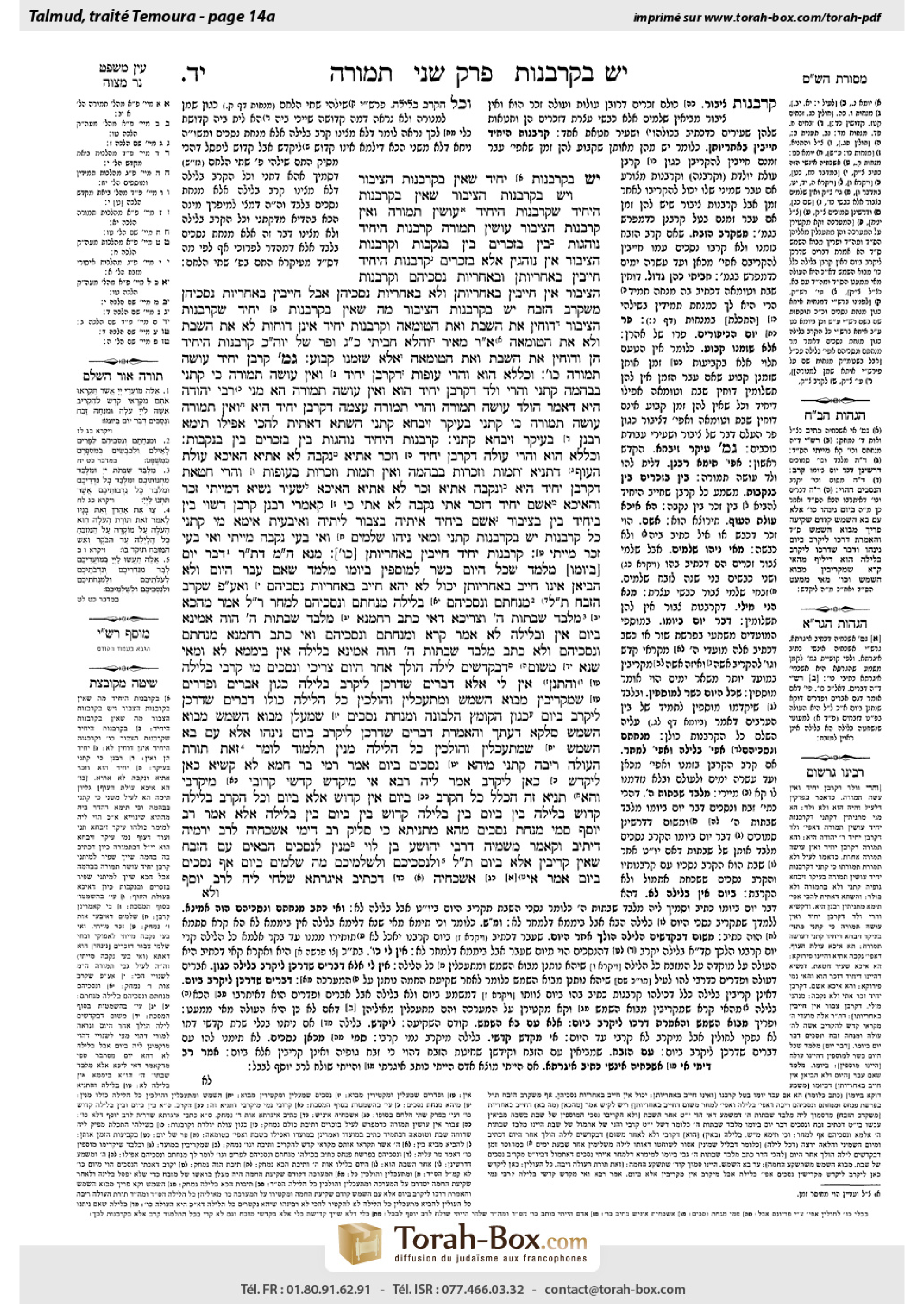
Temurah 14a: Talmud study for Daf Yomi
Daf Yomi is the daily study of one Talmud folio. Explore 37 tractates with scans, Hebrew text, Sefaria English and AI-generated French translations where annotated.
Passage selection and English or AI-generated French translation are available where the scan has annotations. Daf Study is independent of Torah-Box and Sefaria.
Browse Temurah · תמורה · All tractatesTemurah 14a text and translations
This page of Temurah includes the Aramaic text, an English translation and an AI-generated French translation, alongside the scan above.
תמורה י״ד א · Aramaic and Hebrew text
מַתְנִי׳ יֵשׁ בְּקׇרְבְּנוֹת יָחִיד שֶׁאֵין בְּקׇרְבְּנוֹת הַצִּיבּוּר, וְיֵשׁ בְּקׇרְבְּנוֹת הַצִּיבּוּר שֶׁאֵין בְּקׇרְבְּנוֹת הַיָּחִיד, שֶׁקׇּרְבְּנוֹת הַיָּחִיד עוֹשִׂין תְּמוּרָה, וְאֵין קׇרְבְּנוֹת הַצִּיבּוּר עוֹשִׂין תְּמוּרָה.
קׇרְבְּנוֹת הַיָּחִיד נוֹהֲגוֹת בֵּין בִּזְכָרִים בֵּין בִּנְקֵבוֹת, וְקׇרְבְּנוֹת הַצִּיבּוּר אֵין נוֹהֲגִין אֶלָּא בִּזְכָרִים. קׇרְבְּנוֹת הַיָּחִיד חַיָּיבִין בְּאַחְרָיוּתָן וּבְאַחְרָיוּת נִסְכֵּיהֶם, וְקׇרְבְּנוֹת הַצִּיבּוּר אֵין חַיָּיבִין בְּאַחְרָיוּתָן וְלֹא בְּאַחְרָיוּת נִסְכֵּיהֶן, אֲבָל חַיָּיבִין בְּאַחְרָיוּת נִסְכֵּיהֶן מִשֶּׁקָּרַב הַזֶּבַח.
יֵשׁ בְּקׇרְבְּנוֹת הַצִּיבּוּר מַה שֶּׁאֵין בְּקׇרְבְּנוֹת יָחִיד, שֶׁקׇּרְבְּנוֹת הַצִּיבּוּר דּוֹחִין אֶת הַשַּׁבָּת וְאֶת הַטּוּמְאָה, וְקׇרְבְּנוֹת יָחִיד אֵינָן דּוֹחוֹת לֹא אֶת הַשַּׁבָּת וְלֹא אֶת הַטּוּמְאָה.
אָמַר רַבִּי מֵאִיר: וַהֲלֹא חֲבִיתֵּי כֹּהֵן גָּדוֹל, וּפַר שֶׁל יוֹם הַכִּפּוּרִים, קׇרְבְּנוֹת הַיָּחִיד הֵן, וְדוֹחִין אֶת הַשַּׁבָּת וְאֶת הַטּוּמְאָה! אֶלָּא שֶׁזְּמַנּוֹ קָבוּעַ.
גְּמָ׳ קׇרְבַּן יָחִיד עוֹשֶׂה תְּמוּרָה כּוּ׳. וּכְלָלָא הוּא? וַהֲרֵי עוֹפוֹת דְּקׇרְבַּן יָחִיד, וְאֵין עוֹשֶׂה תְּמוּרָה! כִּי קָתָנֵי — בִּבְהֵמָה קָתָנֵי.
וַהֲרֵי וָלָד דְּקָרְבַּן יָחִיד הוּא, וְאֵין עוֹשֶׂה תְּמוּרָה! הָא מַנִּי? רַבִּי יְהוּדָה הִיא, דְּאָמַר: הַוָּלָד עוֹשֶׂה תְּמוּרָה.
וַהֲרֵי תְּמוּרָה עַצְמָהּ, דְּקׇרְבַּן יָחִיד הִיא, וְאֵין תְּמוּרָה עוֹשָׂה תְּמוּרָה! כִּי קָתָנֵי — בְּעִיקַּר זִיבְחָא קָתָנֵי.
הַשְׁתָּא דְּאָתֵית לְהָכִי, אֲפִילּוּ תֵּימָא רַבָּנַן, בְּעִיקַּר זִיבְחָא קָתָנֵי.
קׇרְבְּנוֹת הַיָּחִיד נוֹהֲגוֹת בֵּין בִּזְכָרִים בֵּין בִּנְקֵבוֹת. וּכְלָלָא הוּא? וַהֲרֵי עוֹלָה, דְּקׇרְבַּן יָחִיד, וְזָכָר אָתְיָא, נְקֵבָה לָא אָתְיָא!
הָאִיכָּא עוֹלַת הָעוֹף, דְּתַנְיָא: תַּמּוּת וְזַכְרוּת בִּבְהֵמָה, וְאֵין תַּמּוּת וְזַכְרוּת בָּעוֹפוֹת.
וַהֲרֵי חַטָּאת, דְּקׇרְבַּן יָחִיד הִיא, וּנְקֵבָה אָתְיָא, זָכָר לָא אָתְיָא? הַאִיכָּא שְׂעִיר נָשִׂיא, דְּמַיְיתֵי זָכָר.
וְהָאִיכָּא אֲשַׁם יָחִיד, דְּזָכָר אָתֵי, נְקֵבָה לָא אָתֵי? כִּי קָאָמְרִי רַבָּנַן קׇרְבָּן דְּשָׁוֵי בֵּין בְּיָחִיד בֵּין בְּצִיבּוּר — אָשָׁם בְּיָחִיד אִיתֵיהּ, בְּצִבּוּר לֵיתֵיהּ. וְאִיבָּעֵית אֵימָא: מִי קָתָנֵי ״כׇּל קׇרְבְּנוֹת״? ״יֵשׁ בְּקׇרְבְּנוֹת״ קָתָנֵי, וּמַאי נִיהוּ — שְׁלָמִים, וְאִי בָּעֵי נְקֵבָה מַיְיתֵי, וְאִי בָּעֵי זָכָר מַיְיתֵי.
קׇרְבְּנוֹת יָחִיד חַיָּיבִין בְּאַחְרָיוּתָן [כּוּ׳]. מְנָא לַן?
דְּתָנוּ רַבָּנַן: ״דְּבַר יוֹם״ — מְלַמֵּד שֶׁכׇּל הַיּוֹם כָּשֵׁר לְמוּסָפִין, ״בְּיוֹמוֹ״ — מְלַמֵּד שֶׁאִם עָבַר הַיּוֹם וְלֹא הֱבִיאָן אֵינוֹ חַיָּיב בְּאַחְרָיוּתָן.
יָכוֹל לֹא יְהֵא חַיָּיב בְּאַחְרָיוּת נִסְכֵּיהֶם, וְאַף עַל פִּי שֶׁקָּרַב הַזֶּבַח? תַּלְמוּד לוֹמַר ״מִנְחָתָם וְנִסְכֵּיהֶם״ בַּלַּיְלָה, ״מִנְחָתָם וְנִסְכֵּיהֶם״ לְמָחָר.
רֵישׁ לָקִישׁ אָמַר מֵהָכָא: ״מִלְּבַד שַׁבָּתוֹת ה׳״.
וּצְרִיכָא, דְּאִי כְּתַב רַחֲמָנָא ״מִלְּבַד שַׁבְּתוֹת ה׳״ — הֲוָה אָמֵינָא: בַּיּוֹם — אִין, וּבַלַּיְלָה — לָא. אָמַר קְרָא ״וּמִנְחָתָם וְנִסְכֵּיהֶם״. וְאִי כְּתַב רַחֲמָנָא ״מִנְחָתָם וְנִסְכֵּיהֶם״ וְלָא כְּתַב ״מִלְּבַד שַׁבְּתוֹת ה׳״ — הֲוָה אָמֵינָא: (בלילה) [בְּלֵילְיָה] — אִין, בִּימָמָא — לָא.
וּמַאי שְׁנָא? מִשּׁוּם דִּבְקָדָשִׁים לַיְלָה הוֹלֵךְ אַחַר הַיּוֹם, צְרִיכִי.
וּנְסָכִים מִי קָרְבִי בַּלַּיְלָה? וְהָתְנַן: אֵין לִי אֶלָּא דְּבָרִים שֶׁדַּרְכָּן לִיקְרַב בַּלַּיְלָה, כְּגוֹן אֵבָרִים וּפְדָרִים, שֶׁמַּקְרִיבִין מִבּוֹא הַשֶּׁמֶשׁ וּמִתְעַכְּלִין וְהוֹלְכִין כׇּל הַלַּיְלָה כּוּלּוֹ.
דְּבָרִים שֶׁדַּרְכָּן לִיקְרַב בַּיּוֹם, כְּגוֹן הַקּוֹמֶץ, הַלְּבוֹנָה, וּמִנְחַת נְסָכִים, שֶׁמַּעֲלָן מִבּוֹא הַשֶּׁמֶשׁ. מִבּוֹא הַשֶּׁמֶשׁ סָלְקָא דַּעְתָּךְ?! וְהָאָמְרַתְּ דְּבָרִים שֶׁדַּרְכָּן לִיקְרַב בַּיּוֹם נִינְהוּ! אֶלָּא עִם בֹּא הַשֶּׁמֶשׁ, שֶׁמִּתְעַכְּלִין וְהוֹלְכִין כׇּל הַלַּיְלָה מִנַּיִן? תַּלְמוּד לוֹמַר: ״זֹאת תּוֹרַת הָעֹלָה״ — רִיבָּה.
קָתָנֵי מִיהָא נְסָכִים בַּיּוֹם! אָמַר רָמֵי בַּר חָמָא: לָא קַשְׁיָא — כָּאן לִיקְדַּשׁ, כָּאן לִיקְרַב.
אֲמַר לֵיהּ רָבָא: אִי מִיקְדָּשׁ קָדְשִׁי קָרוֹבֵי מִיקָּרְבִי, וְהָא תַּנְיָא: זֶה הַכְּלָל: כׇּל הַקָּרֵב בַּיּוֹם — אֵין קָדוֹשׁ אֶלָּא בַּיּוֹם, וְכׇל הַקָּרֵב בַּלַּיְלָה — קָדוֹשׁ בַּלַּיְלָה, בֵּין בַּיּוֹם בֵּין בְּלַיְלָה — קָדוֹשׁ בֵּין בַּיּוֹם בֵּין בַּלַּיְלָה! אֶלָּא אָמַר רַב יוֹסֵף: סְמִי ״מִנְחַת נְסָכִים״ מֵהָא מַתְנִיתָא.
כִּי סְלֵיק רַב דִּימִי, אַשְׁכְּחֵיהּ לְרַב יִרְמְיָה דְּיָתֵיב וְקָאָמַר מִשְּׁמֵיהּ דְּרַבִּי יְהוֹשֻׁעַ בֶּן לֵוִי: מִנַּיִן לִנְסָכִים הַבָּאִים עִם הַזֶּבַח שֶׁאֵין קְרֵיבִין אֶלָּא בַּיּוֹם? תַּלְמוּד לוֹמַר ״וּלְנִסְכֵּיכֶם וּלְשַׁלְמֵיכֶם״ — מָה שְׁלָמִים בַּיּוֹם, אַף נְסָכִים בַּיּוֹם.
אָמַר: אִי אַשְׁכְּחֵיהּ דְּכָתֵיב אִיגַּרְתָּא, שְׁלַחִי לֵיהּ לְרַב יוֹסֵף,
Temurah 14a · English translation
MISHNA: There are halakhot in effect with regard to offerings of an individual that are not in effect with regard to communal offerings; and there are halakhot in effect with regard to communal offerings that are not in effect with regard to offerings of an individual. The mishna elaborates: There are halakhot in effect with regard to offerings of an individual that are not in effect with regard to communal offerings, as offerings of an individual render a non-sacred animal exchanged for the offering a substitute, and communal offerings do not render a non-sacred animal exchanged for the offering a substitute.
Offerings of an individual apply to, i.e., can be brought from, both males and females, but communal offerings apply only to males. If offerings of an individual were not brought at the appropriate time, one is obligated to bring their compensation and compensation for their accompanying meal offering and libations at a later date, but if communal offerings were not brought at the appropriate time, one is obligated to bring neither their compensation nor compensation for their accompanying meal offering and libations at a later date. But one is obligated to bring compensation for their accompanying meal offering and libations once the offering is sacrificed.
There are halakhot in effect with regard to communal offerings that are not in effect with regard to offerings of an individual, as communal offerings override Shabbat, in that they are sacrificed on Shabbat, and they override ritual impurity, i.e., they are sacrificed even if the priests are impure with impurity imparted by a corpse; and offerings of an individual override neither Shabbat nor ritual impurity.
Rabbi Meir said: But aren’t the High Priest’s griddle-cake offerings and the bull of Yom Kippur offerings of an individual, and yet they override Shabbat and ritual impurity. Rather, this is the principle: Any offering, individual or communal, whose time is fixed overrides Shabbat and ritual impurity, whereas any offering, individual or communal, whose time is not fixed overrides neither Shabbat nor ritual impurity.
GEMARA: The mishna teaches that offerings of an individual render a non-sacred animal exchanged for the offering a substitute. The Gemara asks: And is this an established principle? Does every offering of an individual render a non-sacred animal exchanged for it a substitute? But what about birds, i.e., a dove or a pigeon, which are brought as an offering of an individual, but they do not render a non-sacred animal exchanged for them a substitute? The Gemara answers: When the mishna teaches that offerings of an individual render a non-sacred animal exchanged for the offering a substitute, it is teaching this only with regard to an animal offering, not a bird offering.
The Gemara objects: But what about the offspring of a sanctified animal, which is brought and sacrificed on the altar as an offering of an individual of the same type as its mother, and yet it does not render a non-sacred animal exchanged for it a substitute? The Gemara explains: In accordance with whose opinion is this mishna? It is in accordance with the opinion of Rabbi Yehuda, who said that the offspring of a sanctified animal renders a non-sacred animal exchanged for it a substitute.
The Gemara objects: But what about a substitute itself, which is brought and sacrificed on the altar as an offering of an individual, and yet a substitute does not render a non-sacred animal exchanged for it a substitute? The Gemara answers: When the mishna teaches that an offering of an individual renders a non-sacred animal exchanged for it a substitute, it is teaching this only with regard to the primary offering, not a substitute of an offering.
The Gemara comments: Now that you have arrived at this answer, you can even say that the mishna is in accordance with the opinion of the Rabbis, who disagree with Rabbi Yehuda and maintain that the offspring of an offering does not render a non-sacred animal exchanged for it a substitute. The reason is that one can explain that the mishna is teaching its halakha only with regard to the primary offering, not the offspring of an offering.
§ The mishna teaches: Offerings of an individual apply to, i.e., can be brought from, both males and females. The Gemara asks: Is this an established principle, that all offerings of an individual may be brought from either a male or female animal? But what about a burnt offering, which is an offering of an individual, and yet it comes as a male animal but does not come as a female animal.
The Gemara answers that there is a bird burnt offering, i.e., there is a type of burnt offering that can be either a female or male bird. As it is taught in a baraita: The requirement of unblemished status and the requirement of male status both apply to a sacrificial animal brought as a burnt offering, but the requirement of unblemished status and the requirement of male status do not apply to sacrificial birds brought as burnt offerings.
The Gemara objects: But what about a sin offering, which is an offering of an individual, and yet comes as a female animal but does not come as a male animal. The Gemara explains: Although burnt offerings of an individual must be female, there is the goat sin offering of a king, which is sacrificed by a specific individual and is brought specifically as a male animal.
The Gemara further objects: But there is the individual guilt offering, which comes as a male animal but does not come as a female animal. The Gemara explains: When the Sages stated this halakha in the mishna they were referring only to an offering that is equivalent, i.e., which is brought both as an offering of an individual and as a communal offering, whereas a guilt offering is brought as an offering of an individual but is not brought as a communal offering. And if you wish, say instead an alternative explanation: Does the mishna teach: All offerings may be brought as either male or female? It does not. Rather, the mishna teaches: There are offerings of an individual that may be brought as male or female; and what are they? Peace offerings; and in the case of such an offering, if one wants he brings a female animal and if he wants he brings a male animal.
§ The mishna teaches: If offerings of an individual were not brought at the appropriate time, one is obligated to bring their compensation and compensation for their accompanying meal offering and libations at a later date, whereas if communal offerings were not brought at the appropriate time, one is obligated to bring neither their compensation nor compensation for their accompanying meal offering and libations at a later date. The Gemara asks: From where do we derive this halakha, that if a communal offering was not sacrificed at the appropriate time it is not brought at a later stage?
The Gemara answers: As the Sages taught in a baraita: The verse states in the section of the Torah dealing with additional offerings: “These are the appointed seasons of the Lord, which you shall proclaim to be holy convocations, to bring an offering made by fire to the Lord, a burnt offering, and a meal offering, a sacrifice, and libations, each day on its own day” (Leviticus 23:37). This teaches that the entire day is fit for bringing the additional offerings. The term: “On its own day,” teaches that if the day has passed and the priests did not bring the additional offerings, one is not obligated to bring their compensation, and the offering cannot be brought at a later date.
The baraita continues: One might have thought that one should not be obligated to bring compensation for their accompanying libations at a later date even if the additional offering has been sacrificed, e.g., if there were no meal offerings or libations available at that time. Therefore, the verse states, in the chapter dealing with the additional offerings of the Festivals: “Their meal offerings and their libations” (Numbers 29:37). It is derived from here that the meal offerings and libations which are brought with the additional animal offerings of the Festivals can be sacrificed even in the night after the animal offering. The phrase “their meal offerings and their libations” further teaches that these meal offerings and libations can be sacrificed even on the following day.
Reish Lakish said that the source is from the following verse: “These are the appointed seasons of the Lord, which you shall proclaim to be holy convocations, to bring an offering made by fire unto the Lord…each on its own day; beside the Shabbatot of the Lord” (Leviticus 23:37–38). The verse is expounded as speaking of a Festival that occurred on a Sunday, and therefore it is teaching that the meal offerings and libations for the additional offerings of the previous Shabbat may be brought on the following Festival day.
And the Gemara notes that both verses are necessary, as if the Merciful One had written only the verse: “Beside the Shabbatot of the Lord,” I would say that on the day following Shabbat, yes, one may bring the offerings, but on the night after Shabbat, no, one may not bring them, just as the offering itself could not have been brought at night. Therefore, the verse states: “And their meal offerings and their libations.” And if the Merciful One had written only: “Their meal offerings and their libations,” and not written: “Beside the Shabbatot of the Lord,” I would say that at night, yes, the offerings may be brought, but on the following day they may not be brought.
The Gemara asks: And in what way is the night different from the day, that one might have thought the outstanding meal offerings and libations may be brought only at night but not during the day? The Gemara explains that one might have thought so because with regard to sacrificial animals and offerings the night follows the day. Therefore, the Torah had to teach that the meal offering and libations may be brought even the following day. The Gemara concludes that indeed both verses are necessary.
The Gemara asks: And libations, may they be sacrificed at night? Didn’t we learn in a baraita: I have derived only with regard to items that are normally sacrificed at night, for example, the limbs of a burnt offering and the fats of burnt offerings and other offerings, that one sacrifices them after sunset and they are consumed throughout the entire night. This is derived from the verse: “This is the law of the burnt offering: It is that which goes up on its firewood upon the altar all night unto the morning” (Leviticus 6:2).
The baraita continues: But with regard to items that are normally sacrificed in the day, for example the handful of the meal offering, and the frankincense, and the meal offering that accompanies the libations, from where is it derived that one may bring them up and burn them after sunset? The Gemara asks: Would it enter your mind that they may be burned after sunset? But didn’t you say that these are items that are normally sacrificed in the day? Rather, the question of the baraita is as follows: From where is it derived that these items may be sacrificed with sunset, i.e., just before sunset, in which case they are consumed throughout the entire night and not during the day? The verse states: “This is the law of the burnt offering” (Leviticus 6:2), a phrase that included everything sacrificed on the altar.
The Gemara reiterates its previous difficulty: In any event, the baraita teaches that the meal offering that accompanies the libations is brought only in the day, not at night. Rami bar Ḥama said that this is not difficult. Here, where the verse states: “Their meal offerings and libations,” it is referring to consecrating the offering if one placed it in a consecrated utensil at night. The offering becomes consecrated and may not be used for non-sacred purposes. There, in the verse cited by the baraita as teaching that it may be brought only in the day and not at night, it is referring to sacrificing the offering on the altar. Even if an offering was consecrated at night, it may not be sacrificed until the following morning.
Rava said to Rami bar Ḥama: If the meal offering accompanying the libations can be consecrated at night, it should also be fit to be sacrificed at night. No distinction can be made between consecrating and sacrificing, as isn’t it taught in a baraita: This is the principle: Any offering that is sacrificed in the day is consecrated only in the day; and any offering that is sacrificed at night is consecrated only at night; and any offering that is sacrificed both in the day and at night is consecrated both in the day and at night. Rather, Rav Yosef said: The meal offering accompanying the libations may be sacrificed at night, and therefore one should delete from this baraita the item: Meal offering that accompanies the libations, from the list of the offerings that may not be brought at night.
With regard to Rav Yosef’s claim that the item: Meal offering that accompanies the libations, should be removed from the baraita, the Gemara states: When Rav Dimi ascended from Babylonia to Eretz Yisrael, he found Rav Yirmeya sitting and saying in the name of Rabbi Yehoshua ben Levi: From where is it derived that libations that come with an animal offering may be sacrificed only in the day? The verse states: “These you shall offer to the Lord in your appointed seasons, beside your vows, and your voluntary offerings, and your burnt offerings, and your meal offerings, and your libations, and your peace offerings” (Numbers 29:39). The juxtaposition of these two items teaches that just as peace offerings may be sacrificed only during the day, so too libations may be sacrificed only during the day.
Rav Dimi said to Rav Yirmeya: If I find someone who can write this opinion in a letter, I will send it to Rav Yosef in Babylonia,
Temurah 14a · Traduction française (IA)
MICHNA : Certaines halakhot s’appliquent aux offrandes individuelles, mais pas aux offrandes communautaires ; d’autres s’appliquent aux offrandes communautaires, mais pas aux offrandes individuelles. La Michna précise : certaines halakhot s’appliquent aux offrandes individuelles, mais pas aux offrandes communautaires, car les offrandes individuelles rendent substitut l’animal non consacré échangé contre l’offrande, tandis que les offrandes communautaires ne rendent pas substitut l’animal non consacré échangé contre elles.
Les offrandes individuelles peuvent être apportées aussi bien à partir d’animaux mâles que femelles, tandis que les offrandes communautaires ne peuvent être apportées qu’à partir d’animaux mâles. Si des offrandes individuelles n’ont pas été apportées au moment prescrit, on est tenu d’en apporter le remplacement ultérieurement, ainsi que le remplacement des oblations et des libations qui les accompagnent. En revanche, si des offrandes communautaires n’ont pas été apportées au moment prescrit, on n’est tenu d’apporter ultérieurement ni leur remplacement ni celui des oblations et des libations qui les accompagnent. Toutefois, une fois l’offrande sacrifiée, on est tenu d’apporter le remplacement des oblations et des libations qui l’accompagnent.
Certaines halakhot s’appliquent aux offrandes communautaires, mais pas aux offrandes individuelles : les offrandes communautaires prévalent sur le Chabbat, en ce qu’elles sont sacrifiées le Chabbat, et sur l’impureté rituelle, c’est-à-dire qu’elles sont sacrifiées même si les prêtres sont impurs en raison d’une impureté transmise par un cadavre. Les offrandes individuelles, elles, ne prévalent ni sur le Chabbat ni sur l’impureté rituelle.
Rabbi Meïr dit : Mais les oblations cuites à la poêle du Grand Prêtre et le taureau de Yom Kippour ne sont-ils pas des offrandes individuelles, et pourtant ne prévalent-ils pas sur le Chabbat et l’impureté rituelle ? Le principe est plutôt le suivant : toute offrande, individuelle ou communautaire, dont le moment est fixé prévaut sur le Chabbat et l’impureté rituelle ; en revanche, toute offrande, individuelle ou communautaire, dont le moment n’est pas fixé ne prévaut ni sur le Chabbat ni sur l’impureté rituelle.
GUEMARA : La Michna enseigne que les offrandes individuelles rendent substitut l’animal non consacré échangé contre elles. La Guemara demande : Est-ce donc un principe établi ? Toute offrande individuelle rend-elle substitut l’animal non consacré échangé contre elle ? Mais qu’en est-il des oiseaux, c’est-à-dire de la tourterelle ou du pigeon, qui sont apportés comme offrande individuelle, mais ne rendent pas substitut l’animal non consacré échangé contre eux ? La Guemara répond : Lorsque la Michna enseigne que les offrandes individuelles rendent substitut l’animal non consacré échangé contre elles, elle ne parle que des offrandes animales, et non des offrandes d’oiseaux.
La Guemara objecte : Mais qu’en est-il du petit d’un animal consacré, qui est apporté et sacrifié sur l’autel comme offrande individuelle du même type que sa mère, et qui pourtant ne rend pas substitut l’animal non consacré échangé contre lui ? La Guemara explique : Selon l’opinion de qui cette Michna est-elle ? Selon l’opinion de Rabbi Yehouda, qui a dit que le petit d’un animal consacré rend substitut l’animal non consacré échangé contre lui.
La Guemara objecte : Mais qu’en est-il d’un substitut lui-même, qui est apporté et sacrifié sur l’autel comme offrande individuelle, et qui pourtant ne rend pas substitut l’animal non consacré échangé contre lui ? La Guemara répond : Lorsque la Michna enseigne qu’une offrande individuelle rend substitut l’animal non consacré échangé contre elle, elle ne parle que de l’offrande initiale, et non du substitut d’une offrande.
Maintenant que cette réponse a été donnée, on peut même dire que la Michna est conforme à l’opinion des rabbins, qui sont en désaccord avec Rabbi Yehouda et soutiennent que le petit d’une offrande ne rend pas substitut l’animal non consacré échangé contre lui. En effet, on peut expliquer que la Michna n’enseigne cette halakha qu’à propos de l’offrande initiale, et non du petit d’une offrande.
§ La Michna enseigne que les offrandes individuelles peuvent être apportées aussi bien à partir d’animaux mâles que femelles. La Guemara demande : Est-ce un principe établi, selon lequel toutes les offrandes individuelles peuvent être apportées à partir d’un animal mâle ou femelle ? Mais qu’en est-il de l’holocauste, qui est une offrande individuelle, mais n’est apporté qu’à partir d’un animal mâle et non d’un animal femelle ?
La Guemara répond qu’il existe un holocauste d’oiseau, c’est-à-dire un type d’holocauste qui peut être offert avec un oiseau mâle ou femelle. Car il est enseigné dans une baraïta : L’exigence d’absence de défaut et celle d’être mâle s’appliquent toutes deux à un animal offert en holocauste, mais elles ne s’appliquent pas aux oiseaux offerts en holocauste.
La Guemara objecte : Mais qu’en est-il du sacrifice expiatoire, qui est une offrande individuelle et qui n’est apporté qu’à partir d’un animal femelle, et non d’un animal mâle ? La Guemara explique : Bien que les holocaustes individuels doivent être des femelles, il existe le sacrifice expiatoire du bouc d’un roi, qui est sacrifié par un individu particulier et qui est apporté spécifiquement à partir d’un animal mâle.
La Guemara objecte encore : Mais il existe le sacrifice de culpabilité individuel, qui est apporté à partir d’un animal mâle, et non d’un animal femelle. La Guemara explique : Lorsque les Sages ont énoncé cette halakha dans la Michna, ils ne parlaient que d’une offrande qui existe dans les deux catégories, c’est-à-dire qui est apportée à la fois comme offrande individuelle et comme offrande communautaire ; or le sacrifice de culpabilité est apporté comme offrande individuelle, mais pas comme offrande communautaire. Ou bien, si tu le souhaites, donne une autre explication : La Michna enseigne-t-elle que toutes les offrandes peuvent être apportées à partir d’un mâle ou d’une femelle ? Non. La Michna enseigne plutôt qu’il existe des offrandes individuelles qui peuvent être apportées à partir d’un mâle ou d’une femelle. Lesquelles ? Les sacrifices de paix. Pour une telle offrande, celui qui le souhaite apporte un animal femelle, et celui qui le souhaite apporte un animal mâle.
§ La Michna enseigne : Si des offrandes individuelles n’ont pas été apportées au moment prescrit, on est tenu d’en apporter le remplacement ultérieurement, ainsi que le remplacement des oblations et des libations qui les accompagnent ; en revanche, si des offrandes communautaires n’ont pas été apportées au moment prescrit, on n’est tenu d’apporter ultérieurement ni leur remplacement ni celui des oblations et des libations qui les accompagnent. La Guemara demande : D’où déduisons-nous cette halakha, selon laquelle une offrande communautaire qui n’a pas été sacrifiée au moment prescrit n’est pas apportée ultérieurement ?
La Guemara répond : Comme les Sages l’ont enseigné dans une baraïta : Le verset dit, dans le passage de la Torah consacré aux offrandes supplémentaires : « Telles sont les fêtes fixées par le Seigneur, que vous proclamerez comme saintes assemblées, pour apporter au Seigneur une offrande consumée par le feu : un holocauste, une oblation, un sacrifice et des libations, chacun en son jour » (Lévitique 23,37). Cela enseigne que toute la journée convient à l’apport des offrandes supplémentaires. L’expression « en son jour » enseigne que si le jour est passé et que les prêtres n’ont pas apporté les offrandes supplémentaires, on n’est pas tenu d’en apporter le remplacement et l’offrande ne peut pas être apportée ultérieurement.
La baraïta poursuit : On aurait pu penser qu’on n’est pas tenu d’apporter ultérieurement le remplacement des libations qui accompagnent l’offrande, même si l’offrande supplémentaire a été sacrifiée, par exemple s’il n’y avait alors ni oblations ni libations disponibles. Le verset dit donc, dans le chapitre consacré aux offrandes supplémentaires des fêtes : « Leurs oblations et leurs libations » (Nombres 29,37). On en déduit que les oblations et les libations apportées avec les offrandes animales supplémentaires des fêtes peuvent être sacrifiées durant la nuit qui suit le sacrifice de l’animal. L’expression « leurs oblations et leurs libations » enseigne en outre que ces oblations et ces libations peuvent être sacrifiées même le lendemain.
Rech Lakich dit que la source est le verset suivant : « Telles sont les fêtes fixées par le Seigneur, que vous proclamerez comme saintes assemblées, pour apporter au Seigneur une offrande consumée par le feu… chacune en son jour ; en plus des Chabbats du Seigneur » (Lévitique 23,37-38). Le verset est interprété comme parlant d’une fête tombant un dimanche ; il enseigne donc que les oblations et les libations des offrandes supplémentaires du Chabbat précédent peuvent être apportées le jour de fête suivant.
La Guemara note que les deux versets sont nécessaires : si le Miséricordieux n’avait écrit que « en plus des Chabbats du Seigneur », j’aurais dit que l’on peut apporter les offrandes le jour suivant le Chabbat, mais pas durant la nuit qui suit le Chabbat, tout comme l’offrande elle-même n’aurait pas pu être apportée la nuit. Le verset dit donc : « Et leurs oblations et leurs libations. » Et si le Miséricordieux n’avait écrit que « leurs oblations et leurs libations », sans écrire « en plus des Chabbats du Seigneur », j’aurais dit que l’on peut apporter les offrandes la nuit, mais pas le lendemain.
La Guemara demande : En quoi la nuit diffère-t-elle du jour, pour qu’on ait pu penser que les oblations et les libations restant à apporter ne peuvent l’être que la nuit, et non durant la journée ? La Guemara explique qu’on aurait pu le penser parce que, pour les animaux sacrificiels et les offrandes, la nuit suit le jour. La Torah devait donc enseigner que l’oblation et les libations peuvent être apportées même le lendemain. La Guemara conclut que les deux versets sont effectivement nécessaires.
La Guemara demande : Et les libations peuvent-elles être sacrifiées la nuit ? N’avons-nous pas appris dans une baraïta : Je n’ai établi cette règle que pour les éléments habituellement sacrifiés la nuit, par exemple les membres d’un holocauste et les graisses des holocaustes et d’autres sacrifices, que l’on fait monter après le coucher du soleil et qui se consument durant toute la nuit. Cela se déduit du verset : « Voici la loi de l’holocauste : c’est ce qui monte sur son bois, sur l’autel, toute la nuit jusqu’au matin » (Lévitique 6,2).
La baraïta poursuit : Mais concernant les éléments habituellement sacrifiés durant le jour, par exemple la pleine poignée de l’oblation, l’encens et l’oblation qui accompagne les libations, d’où déduit-on qu’on peut les faire monter et les brûler après le coucher du soleil ? La Guemara demande : Viendrait-il à l’esprit qu’ils puissent être brûlés après le coucher du soleil ? N’as-tu pas dit qu’il s’agit d’éléments habituellement sacrifiés durant le jour ? La question de la baraïta est plutôt la suivante : D’où déduit-on que ces éléments peuvent être sacrifiés au coucher du soleil, c’est-à-dire juste avant le coucher du soleil, auquel cas ils se consument durant toute la nuit et non durant le jour ? Le verset dit : « Voici la loi de l’holocauste » (Lévitique 6,2), expression qui inclut tout ce qui est sacrifié sur l’autel.
La Guemara reprend la difficulté précédente : Quoi qu’il en soit, la baraïta enseigne que l’oblation qui accompagne les libations est apportée uniquement le jour, et non la nuit. Rami bar Ḥama dit que cela ne pose pas de difficulté. Ici, lorsque le verset dit « leurs oblations et leurs libations », il s’agit de la consécration de l’offrande : si on l’a placée dans un récipient consacré pendant la nuit, l’offrande devient consacrée et ne peut pas être utilisée à des fins profanes. Là, dans le verset cité par la baraïta pour enseigner que l’offrande ne peut être apportée que le jour, et non la nuit, il s’agit de son sacrifice sur l’autel. Même si une offrande a été consacrée pendant la nuit, elle ne peut être sacrifiée avant le lendemain matin.
Rava dit à Rami bar Ḥama : Si l’oblation qui accompagne les libations peut être consacrée la nuit, elle devrait aussi pouvoir être sacrifiée la nuit. On ne peut établir aucune distinction entre la consécration et le sacrifice, car n’est-il pas enseigné dans une baraïta : Voici le principe : toute offrande sacrifiée le jour n’est consacrée que le jour ; toute offrande sacrifiée la nuit n’est consacrée que la nuit ; et toute offrande sacrifiée aussi bien le jour que la nuit est consacrée aussi bien le jour que la nuit. Rav Yossef dit plutôt : L’oblation qui accompagne les libations peut être sacrifiée la nuit ; il faut donc supprimer de cette baraïta la mention « oblation qui accompagne les libations » de la liste des offrandes qui ne peuvent être apportées la nuit.
À propos de l’affirmation de Rav Yossef selon laquelle il faut supprimer de la baraïta la mention « oblation qui accompagne les libations », la Guemara rapporte : Lorsque Rav Dimi monta de Babylonie en Eretz Israël, il trouva Rav Yirmeya assis et enseignant au nom de Rabbi Yehochoua ben Lévi : D’où déduit-on que les libations qui accompagnent une offrande animale ne peuvent être sacrifiées que le jour ? Le verset dit : « Voici ce que vous offrirez au Seigneur à vos fêtes fixées, en plus de vos vœux, de vos offrandes volontaires, de vos holocaustes, de vos oblations, de vos libations et de vos sacrifices de paix » (Nombres 29,39). Le rapprochement de ces deux éléments enseigne que, de même que les sacrifices de paix ne peuvent être sacrifiés que le jour, les libations ne peuvent elles aussi être sacrifiées que le jour.
Rav Dimi dit à Rav Yirmeya : Si je trouve quelqu’un qui puisse consigner cette opinion dans une lettre, je l’enverrai à Rav Yossef en Babylonie.
Traduction française générée par IA à partir de l’édition anglaise de Sefaria. Vérifie toujours un passage avec le texte source.
Text from Sefaria: William Davidson Edition - Vocalized Aramaic (CC BY NC); William Davidson Edition - English (CC BY NC).