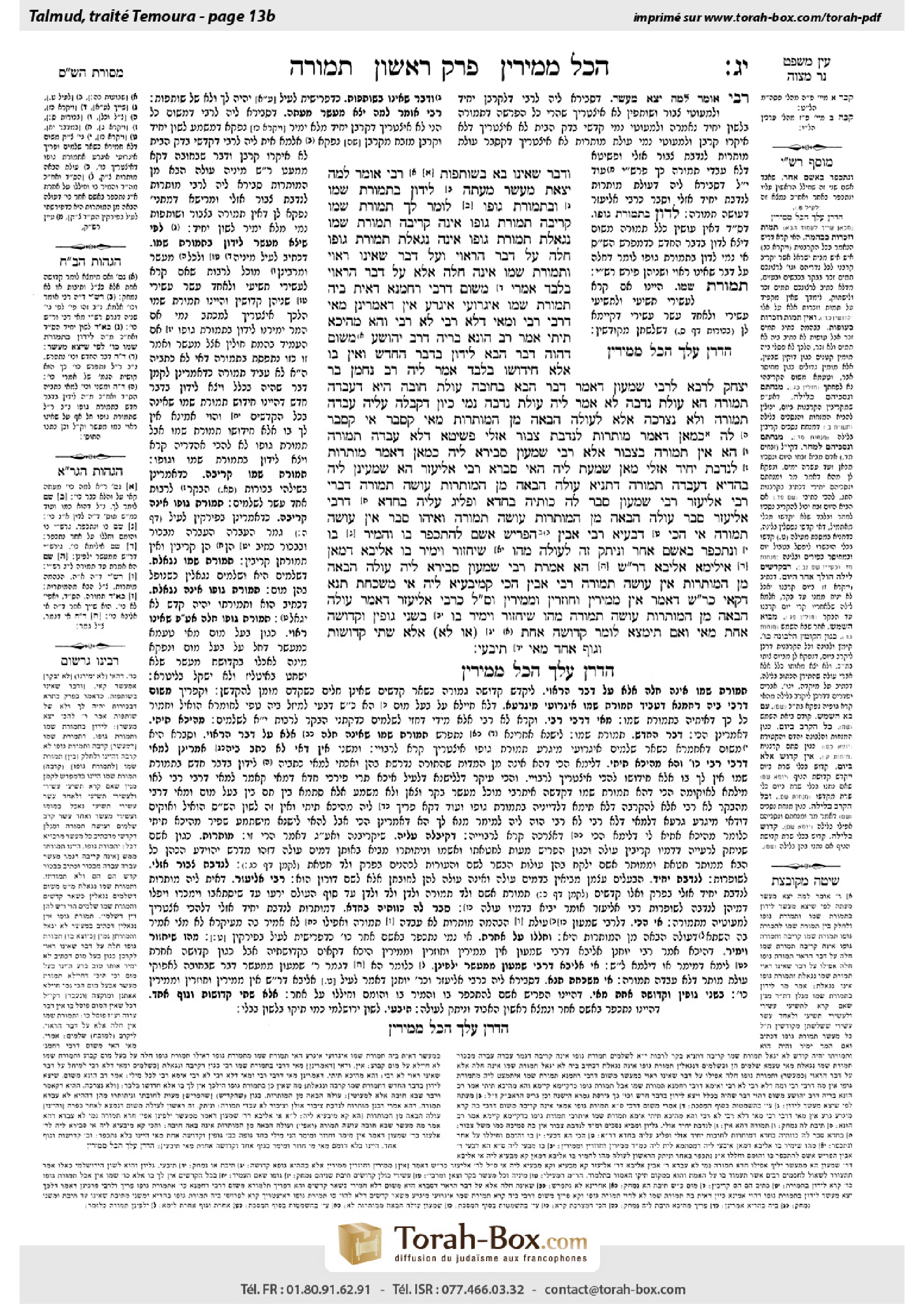
Temurah 13b: Talmud study for Daf Yomi
Daf Yomi is the daily study of one Talmud folio. Explore 37 tractates with scans, Hebrew text, Sefaria English and AI-generated French translations where annotated.
Passage selection and English or AI-generated French translation are available where the scan has annotations. Daf Study is independent of Torah-Box and Sefaria.
Browse Temurah · תמורה · All tractatesTemurah 13b text and translations
This page of Temurah includes the Aramaic text, an English translation and an AI-generated French translation, alongside the scan above.
תמורה י״ג ב · Aramaic and Hebrew text
וְדָבָר שֶׁאֵינוֹ בָּא בְּשׁוּתָּפוּת.
רַבִּי אוֹמֵר: לָמָּה יָצָא מַעֲשֵׂר מֵעַתָּה? לִידּוֹן בִּ״תְמוּרַת שְׁמוֹ״ וּבִ״תְמוּרַת גּוּפוֹ״.
לוֹמַר לָךְ: תְּמוּרַת שְׁמוֹ — קְרֵיבָה, תְּמוּרַת גּוּפוֹ — אֵינָהּ קְרֵיבָה; תְּמוּרַת שְׁמוֹ — נִגְאֶלֶת, תְּמוּרַת גּוּפוֹ — אֵינָהּ נִגְאֶלֶת.
תְּמוּרַת גּוּפוֹ — חָלָה עַל דָּבָר הָרָאוּי וְעַל דָּבָר שֶׁאֵינוֹ רָאוּי, וּתְמוּרַת שְׁמוֹ — אֵינָהּ חָלָה אֶלָּא עַל דָּבָר הָרָאוּי בִּלְבַד.
אָמְרִי: מִשּׁוּם דְּרַבִּי רַחֲמָנָא דְּאִית בֵּיהּ תְּמוּרַת שְׁמוֹ, אִיגְּרוֹעֵי אִיגְּרַע? אִין, דְּאָמְרִינַן: מַאי דְּרַבִּי — רַבִּי, וּמַאי דְּלָא רַבִּי — לָא רַבִּי.
וְהָא מֵהֵיכָא תֵּיתֵי? אָמַר רַב הוּנָא בְּרֵיהּ דְּרַב יְהוֹשֻׁעַ: מִשּׁוּם דְּהָוֵה דָּבָר הַבָּא לִידּוֹן בְּדָבָר הֶחָדָשׁ, וְאֵין בּוֹ אֶלָּא חִידּוּשׁוֹ בִּלְבָד.
אֲמַר לֵיהּ רַב נַחְמָן בַּר יִצְחָק לְרָבָא: לְרַבִּי שִׁמְעוֹן דְּאָמַר דָּבָר הַבָּא בְּחוֹבָה — עוֹלַת חוֹבָה הִיא דְּעָבְדָה תְּמוּרָה, הָא עוֹלַת נְדָבָה — לָא? אֲמַר לֵיהּ: עוֹלַת נְדָבָה נָמֵי, כֵּיוָן דְּקַבְּלַהּ עֲלֵיהּ — עַבְדַּהּ תְּמוּרָה.
וְלֹא נִצְרְכָה, אֶלָּא לְעוֹלָה הַבָּאָה מִן הַמּוֹתָרוֹת.
מַאי קָסָבַר? אִי קָסָבַר לַהּ כְּמַאן דְּאָמַר מוֹתָרוֹת לְנִדְבַת צִבּוּר אָזְלִי — פְּשִׁיטָא דְּלָא עָבְדָה תְּמוּרָה, הָא אֵין תְּמוּרָה בְּצִבּוּר!
אֶלָּא, רַבִּי שִׁמְעוֹן סְבִירָא לֵיהּ כְּמַאן דְּאָמַר מוֹתָרוֹת לְנִדְבַת יָחִיד אָזְלִי. מַאן שָׁמְעַתְּ לֵיהּ הַאי סְבָרָא? רַבִּי אֱלִיעֶזֶר! הָא שָׁמְעִינַן לֵיהּ בְּהֶדְיָא דְּעָבְדָה תְּמוּרָה, דְּתַנְיָא: ״עוֹלָה הַבָּאָה מִן הַמּוֹתָרוֹת עוֹשָׂה תְּמוּרָה״, דִּבְרֵי רַבִּי אֱלִיעֶזֶר!
רַבִּי שִׁמְעוֹן סָבַר לַהּ כְּוָתֵיהּ בַּחֲדָא, וּפְלִיג עֲלֵיהּ בַּחֲדָא, דְּרַבִּי אֱלִיעֶזֶר סָבַר: עוֹלָה הַבָּאָה מִן הַמּוֹתָרוֹת עוֹשָׂה תְּמוּרָה, וְאִיהוּ סָבַר: אֵין עוֹשָׂה תְּמוּרָה.
אִי הָכִי, דְּבָעֵי רַבִּי אָבִין: הִפְרִישׁ אָשָׁם לְהִתְכַּפֵּר בּוֹ, וְהֵמִיר בּוֹ, וְנִתְכַּפֵּר בְּאָשָׁם אַחֵר, וְנִיתַּק זֶה לְעוֹלָה — מַהוּ שֶׁיַּחְזוֹר וְיָמִיר בּוֹ?
אַלִּיבָּא דְּמַאן? אִילֵימָא אַלִּיבָּא דְּרַבִּי שִׁמְעוֹן — הָא אָמְרַתְּ רַבִּי שִׁמְעוֹן סְבִירָא לֵיהּ: עוֹלָה הַבָּאָה מִן הַמּוֹתָרוֹת אֵין עוֹשָׂה תְּמוּרָה!
רַבִּי אָבִין הָכִי קָמִיבַּעְיָא לֵיהּ: אִי מַשְׁכַּחַתְּ תַּנָּא דְּקָאֵי כְּרַבִּי שִׁמְעוֹן, דְּאָמַר אֵין מְמִירִין וְחוֹזְרִין וּמְמִירִין, וּסְבִירָא לֵיהּ כְּרַבִּי אֱלִיעֶזֶר, דְּאָמַר עוֹלָה הַבָּאָה מִן הַמּוֹתָרוֹת עוֹשָׂה תְּמוּרָה, מַהוּ שֶׁיַּחְזוֹר וְיָמִיר בּוֹ?
בִּשְׁנֵי גוּפִין וּקְדוּשָּׁה אַחַת, מַאי?
וְאִם תִּימְצָא לוֹמַר: קְדוּשָּׁה אַחַת (אוֹ לָא), אֶלָּא שְׁתֵּי קְדוּשּׁוֹת וְגוּף אֶחָד, מַאי? תִּיבְּעֵי.
הֲדַרַן עֲלָךְ הַכֹּל מְמִירִין.
Temurah 13b · English translation
and it must be an item that is not brought in partnership.
Rabbi Yehuda HaNasi says: Why was the animal tithe singled out of all offerings as subject to substitution now, after the halakha of substitution was stated in general? It serves to discuss a special halakha with regard to the animal tithe, that of substitution of its name. If, when the animals emerge from the pen to be tithed, the one counting them errs and calls the tenth animal the ninth and the eleventh the tenth, they are both sanctified. The animal that actually emerges tenth is the animal tithe, while the eleventh animal is consecrated as a peace offering. And since this halakha of a substitution of its name applies only to the animal tithe, it is necessary to teach that the general halakha of the substitution of its body, i.e., regular substitution, applies to it as well.
Furthermore, the verse tells you other halakhot unique to the animal tithe: An animal that is the substitute of the name of an animal tithe is sacrificed upon the altar as a peace offering, whereas the substitute of its body is not sacrificed at all. But for all other offerings, substitutes hold the same status as the animal for which they were substituted. Another difference is that the substitute of the name of an animal tithe is redeemed when it develops a blemish, like a peace offering, and the proceeds of the sale belong to the Temple treasury, whereas the substitute of its body is not redeemed, as it is stated with regard to the animal tithe: “Then both it and that for which it is substituted shall be sacred; it shall not be redeemed” (Leviticus 27:33).
Finally, the sanctity of the substitution of the body of an animal tithe takes effect upon both an item that is fit for sacrifice upon the altar and upon an item that is unfit for sacrifice, e.g., a blemished animal, as the sanctity of the animal tithe can apply even to a blemished animal, but the substitution of its name takes effect only upon an item that is fit for sacrifice. If the animal that was mistakenly called the tenth is blemished, it is not consecrated.
The Sages say in response to the statement of Rabbi Yehuda HaNasi: Simply because the Merciful One includes a unique halakha with regard to the animal tithe, that it has the substitution of its name, would one assume that it is diminished, and the halakha of regular substitution does not apply to it? The Gemara answers: Yes, one can make such a claim, as we say: That which the verse included with regard to a particular halakha, it included, and that which it did not include, it did not include. Since the passage initially addresses substitution of name solely with regard to the animal tithe, one could assume that this is the only substitution that applies to it.
The Gemara asks: And from where would this be derived, that in this case we should assume only that which is specifically mentioned? Rav Huna, son of Rav Yehoshua, said: This is derived since this is a case of a matter, i.e., the animal tithe, where the Torah comes to discuss a novel matter, i.e., substitution of name, and as a rule, in such cases the object of discussion has only its novelty, and one cannot infer the applicability of additional principles. It was therefore necessary for a verse to teach that substitution of body, which applies to all other offerings, applies to the animal tithe as well.
§ Rav Naḥman bar Yitzḥak said to Rava: According to the opinion of Rabbi Shimon, who said earlier that the halakha of substitution applies only to offerings that come as an obligation, should one conclude that it is only an obligatory burnt offering that renders an animal exchanged for it a substitute, but a voluntary burnt offering does not? Rava said to him: A voluntary burnt offering also falls under the category of obligatory offerings. Since he accepted upon himself to bring a voluntary burnt offering, it is considered an obligation for him, and therefore it renders an animal exchanged for it a substitute.
Rava adds: And this qualification mentioned by Rabbi Shimon is necessary only to exclude a burnt offering that came from surplus funds. For example, if one set aside a certain sum of money for a sin offering or a guilt offering, and after purchasing his animal some of the money remained, he must purchase a burnt offering with that money. The halakha of substitution does not apply to such an animal.
The Gemara raises a difficulty: The Sages disputed the use of surplus money. Some say that it must go toward the purchase of communal burnt offerings, whereas Rabbi Eliezer maintains that the owner himself must purchase a voluntary burnt offering. What does Rabbi Shimon hold in this regard? If he holds in accordance with the one who said that these surplus funds go toward communal gift offerings, then it is obvious that this offering does not render a substitute, as it is explicitly taught that there is no substitution with regard to a communal offering. Rabbi Shimon’s statement would then be redundant.
Rather, say that Rabbi Shimon holds in accordance with the one who said that these surplus funds go toward the voluntary burnt offering of an individual. But this too is problematic, as whom did you hear who holds this reasoning? It is Rabbi Eliezer, but we heard that Rabbi Eliezer explicitly stated that such an animal renders an animal exchanged for it a substitute. As it is taught in a baraita: A burnt offering that came from surplus funds renders a non-sacred animal that is exchanged for it consecrated as a substitute. This is the statement of Rabbi Eliezer.
The Gemara answers: Rabbi Shimon holds in accordance with the opinion of Rabbi Eliezer with regard to one matter, that surplus funds go toward an individual voluntary burnt offering, and disagrees with him with regard to another matter, as Rabbi Eliezer maintains that a burnt offering that came from surplus funds renders a non-sacred animal exchanged for it a substitute, and he, Rabbi Shimon, maintains that it does not render it a substitute.
The Gemara objects: If so, consider that dilemma raised by Rabbi Avin: If one separated an animal as a guilt offering by which to achieve atonement, and he effected substitution for it, and then that original guilt offering developed a blemish and he redeemed it with another animal, which he subsequently lost, and the owner achieved atonement by bringing yet another animal as a guilt offering; and then this lost animal was found and consigned to be sacrificed as a burnt offering, what is the halakha as to whether he can again effect substitution for it? In this case, the animal in question is a burnt offering that came from surplus funds.
In accordance with whose opinion was this dilemma raised? If we say it is in accordance with the opinion of Rabbi Shimon, you said that Rabbi Shimon maintains that a burnt offering that came from surplus funds does not render a non-sacred animal exchanged for it a substitute. There would therefore be no dilemma at all. This is problematic, because the dilemma assumes that one cannot effect substitution twice for the same animal, which is the opinion of Rabbi Shimon.
The Gemara explains that this is the dilemma that Rabbi Avin was raising: If a tanna is found who holds in accordance with the opinion of Rabbi Shimon, who said that one cannot effect substitution once and again effect substitution for the same consecrated animal, and he also holds in accordance with the opinion of Rabbi Eliezer, who said that a burnt offering that came from surplus funds renders a non-sacred animal exchanged for it a substitute, what is his opinion as to whether one can again effect substitution with the animal in question?
As explained earlier (9b), Rabbi Avin’s dilemma was first posed with regard to two bodies, i.e., two different animals, and one type of sanctity, e.g., in a case where one separated an animal as a guilt offering, and he effected substitution for it, and the animal he separated as a guilt offering developed a blemish and he redeemed it with another animal, which assumed the same status of a guilt offering. What is the halakha as to whether one can substitute for this replacement? Do we say that since it is a different animal from the one for which he initially effected substitution, the second substitution is effective? Or perhaps, since it possesses the same sanctity as the original animal, one cannot effect substitution for it.
And then Rabbi Avin further asked: If you say that in the above case one cannot effect substitution for the animal, perhaps this is only because the two animals possess one sanctity. But in a case of two sanctities and one body, what is the halakha? For example, if one consecrated a guilt offering and effected substitution for it, and he subsequently lost it and atoned using another animal, and he then found it again, such that the original animal must now be consigned to be sacrificed as a burnt offering, does one say that since the animal now possesses a different sanctity he can effect further substitution for it? The Gemara concludes: According to that tanna, the dilemma remains unresolved [tiba’ei].
Temurah 13b · Traduction française (IA)
et il doit s’agir d’un animal qui n’est pas apporté en partenariat.
Rabbi Yehuda HaNasi dit : Pourquoi le verset a-t-il distingué la dîme animale de toutes les autres offrandes en la soumettant à la substitution, alors que la halakha de la substitution a déjà été énoncée de manière générale ? C’est pour enseigner une halakha particulière concernant la dîme animale : la substitution de son nom. Lorsque les animaux sortent de l’enclos pour être dénombrés en vue de la dîme, si celui qui les compte se trompe et appelle le dixième animal « neuvième » et le onzième « dixième », les deux sont sanctifiés. L’animal qui sort effectivement en dixième position est la dîme animale, tandis que le onzième est consacré comme offrande de paix. Et puisque cette halakha de la substitution de son nom ne s’applique qu’à la dîme animale, il faut enseigner que la halakha générale de la substitution de son corps, c’est-à-dire la substitution ordinaire, s’applique également à elle.
En outre, le verset t’enseigne d’autres halakhot propres à la dîme animale : un animal substitué par erreur à la dîme animale en raison d’une erreur de dénomination est offert sur l’autel comme offrande de paix, tandis qu’un animal substitué à son corps n’est pas du tout offert. En revanche, pour toutes les autres offrandes, les animaux de substitution ont le même statut que l’animal auquel ils se substituent. Autre différence : l’animal substitué par erreur à la dîme animale en raison d’une erreur de dénomination est racheté lorsqu’il présente un défaut, comme une offrande de paix, et le produit de sa vente revient au Trésor du Temple, tandis que l’animal substitué à son corps n’est pas racheté, comme il est dit au sujet de la dîme animale : « Tous deux seront consacrés, lui et celui qui lui a été substitué ; il ne sera pas racheté » (Lévitique 27:33).
Enfin, la sainteté résultant de la substitution du corps de la dîme animale prend effet aussi bien sur un animal apte à être offert sur l’autel que sur un animal inapte à l’être, par exemple un animal présentant un défaut, puisque la sainteté de la dîme animale peut s’appliquer même à un animal présentant un défaut. En revanche, la substitution de son nom ne prend effet que sur un animal apte à être offert. Si l’animal appelé par erreur « dixième » présente un défaut, il n’est pas consacré.
Les Sages répondent à la déclaration de Rabbi Yehuda HaNasi : Le fait que le Miséricordieux ait inclus une halakha particulière concernant la dîme animale — à savoir qu’elle est soumise à la substitution de son nom — signifierait-il qu’elle est limitée et que la halakha de la substitution ordinaire ne s’applique pas à elle ? La Guemara répond : Oui, on peut soutenir cela, car nous disons : ce que le verset a inclus concernant une halakha particulière, il l’a inclus ; et ce qu’il n’a pas inclus, il ne l’a pas inclus. Puisque le passage traite d’abord de la substitution du nom uniquement à propos de la dîme animale, on pourrait supposer que c’est la seule substitution qui s’applique à elle.
La Guemara demande : Et d’où déduirait-on qu’en l’occurrence, il faut supposer que seule la règle expressément mentionnée s’applique ? Rav Huna, fils de Rav Yehoshua, dit : Cela se déduit du fait qu’il s’agit d’un cas où la Torah vient traiter d’une nouveauté, à savoir la substitution du nom concernant la dîme animale. Or, en règle générale, dans de tels cas, le sujet traité ne relève que de cette nouveauté, et l’on ne peut en déduire l’applicabilité de principes supplémentaires. Il fallait donc un verset pour enseigner que la substitution du corps, qui s’applique à toutes les autres offrandes, s’applique également à la dîme animale.
§ Rav Naḥman bar Yitzḥak dit à Rava : Selon l’opinion de Rabbi Shimon, qui a dit précédemment que la halakha de la substitution ne s’applique qu’aux offrandes apportées à titre obligatoire, faut-il conclure que seul un holocauste obligatoire rend l’animal échangé contre lui substitut, tandis qu’un holocauste volontaire ne le fait pas ? Rava lui dit : Un holocauste volontaire relève lui aussi de la catégorie des offrandes obligatoires. Puisqu’une personne s’est engagée à apporter un holocauste volontaire, celui-ci constitue pour elle une obligation et rend donc l’animal échangé contre lui substitut.
Rava ajoute : Cette restriction mentionnée par Rabbi Shimon ne sert qu’à exclure un holocauste acheté avec un surplus de fonds. Par exemple, si quelqu’un a mis de côté une certaine somme d’argent pour un sacrifice expiatoire ou un sacrifice de culpabilité et qu’après avoir acheté son animal il lui reste une partie de cette somme, il doit acheter un holocauste avec cet argent. La halakha de la substitution ne s’applique pas à un tel animal.
La Guemara soulève une difficulté : Les Sages sont en désaccord sur l’emploi de l’argent restant. Selon certains, il doit servir à acheter des holocaustes communautaires, tandis que Rabbi Eliezer soutient que le propriétaire lui-même doit acheter un holocauste volontaire. Quelle est, à cet égard, l’opinion de Rabbi Shimon ? S’il partage l’avis de celui qui dit que ces fonds excédentaires servent à des offrandes volontaires communautaires, il est évident que cet animal ne rend pas l’animal échangé contre lui substitut, puisqu’il est explicitement enseigné qu’il n’y a pas de substitution pour une offrande communautaire. La déclaration de Rabbi Shimon serait alors superflue.
Il faut plutôt dire que Rabbi Shimon partage l’avis de celui qui dit que ces fonds excédentaires servent à acheter l’holocauste volontaire d’un particulier. Mais cela pose également problème : qui as-tu entendu soutenir cette opinion ? Rabbi Eliezer. Or, nous avons appris que Rabbi Eliezer a explicitement déclaré qu’un tel animal rend substitut l’animal échangé contre lui. Comme il est enseigné dans une baraïta : « Un holocauste acheté avec un surplus de fonds rend l’animal non consacré échangé contre lui consacré comme substitut. » Telle est la déclaration de Rabbi Eliezer.
La Guemara répond : Rabbi Shimon partage l’opinion de Rabbi Eliezer sur un point — les fonds excédentaires servent à acheter un holocauste volontaire individuel — mais il est en désaccord avec lui sur un autre point. En effet, Rabbi Eliezer soutient qu’un holocauste acheté avec un surplus de fonds rend substitut l’animal non consacré échangé contre lui, tandis que Rabbi Shimon soutient qu’il ne le rend pas substitut.
La Guemara objecte : Dans ce cas, examinons le dilemme soulevé par Rabbi Avin : si quelqu’un a désigné un animal comme sacrifice de culpabilité afin d’obtenir l’expiation, a effectué une substitution à son égard, puis que ce sacrifice de culpabilité initial a présenté un défaut et qu’il l’a racheté en échange d’un autre animal, qu’il a ensuite perdu, et que le propriétaire a obtenu l’expiation en apportant un autre animal comme sacrifice de culpabilité ; puis que l’animal perdu a été retrouvé et destiné à être offert comme holocauste, quelle est la halakha quant à la possibilité d’effectuer à nouveau une substitution à son égard ? Dans ce cas, l’animal en question est un holocauste acheté avec un surplus de fonds.
Selon l’opinion de qui ce dilemme a-t-il été soulevé ? Si l’on dit qu’il s’agit de l’opinion de Rabbi Shimon, tu as dit que Rabbi Shimon soutient qu’un holocauste acheté avec un surplus de fonds ne rend pas l’animal non consacré échangé contre lui substitut. Il n’y aurait donc aucun dilemme. Cela pose problème, car le dilemme suppose que l’on ne peut pas effectuer deux substitutions successives pour un même animal, ce qui est l’opinion de Rabbi Shimon.
La Guemara explique le dilemme que Rabbi Avin soulevait : s’il existe un tanna qui partage l’opinion de Rabbi Shimon, selon laquelle on ne peut pas effectuer une substitution puis en effectuer une nouvelle pour le même animal consacré, et qui partage également l’opinion de Rabbi Eliezer, selon laquelle un holocauste acheté avec un surplus de fonds rend substitut l’animal non consacré échangé contre lui, quelle est son opinion quant à la possibilité d’effectuer à nouveau une substitution à l’égard de l’animal en question ?
Comme il a été expliqué précédemment (9b), le dilemme de Rabbi Avin a d’abord été formulé à propos de deux corps, c’est-à-dire deux animaux différents, et d’un seul type de sainteté. Par exemple, dans le cas où quelqu’un a désigné un animal comme sacrifice de culpabilité, a effectué une substitution à son égard, puis où l’animal désigné comme sacrifice de culpabilité a présenté un défaut et a été racheté en échange d’un autre animal, qui a pris le même statut de sacrifice de culpabilité. Quelle est la halakha quant à la possibilité de substituer cet animal de remplacement ? Disons-nous que, puisqu’il s’agit d’un animal différent de celui auquel il avait initialement substitué un autre animal, la seconde substitution prend effet ? Ou peut-être que, puisqu’il possède la même sainteté que l’animal initial, on ne peut pas effectuer de substitution à son égard.
Puis Rabbi Avin a posé une autre question : si tu dis que, dans le cas ci-dessus, on ne peut pas effectuer de substitution à l’égard de l’animal, est-ce peut-être uniquement parce que les deux animaux relèvent d’un seul type de sainteté ? Mais dans le cas de deux types de sainteté et d’un seul corps, quelle est la halakha ? Par exemple, si quelqu’un a consacré un animal comme sacrifice de culpabilité et a effectué une substitution à son égard, puis l’a perdu et a obtenu l’expiation au moyen d’un autre animal, et l’a ensuite retrouvé, de sorte que l’animal initial doit désormais être destiné à être offert comme holocauste, dira-t-on que, puisque l’animal relève maintenant d’un type de sainteté différent, il peut effectuer une nouvelle substitution à son égard ? La Guemara conclut : selon ce tanna, le dilemme demeure sans réponse [tiba’ei].
Traduction française générée par IA à partir de l’édition anglaise de Sefaria. Vérifie toujours un passage avec le texte source.
Text from Sefaria: William Davidson Edition - Vocalized Aramaic (CC BY NC); William Davidson Edition - English (CC BY NC).