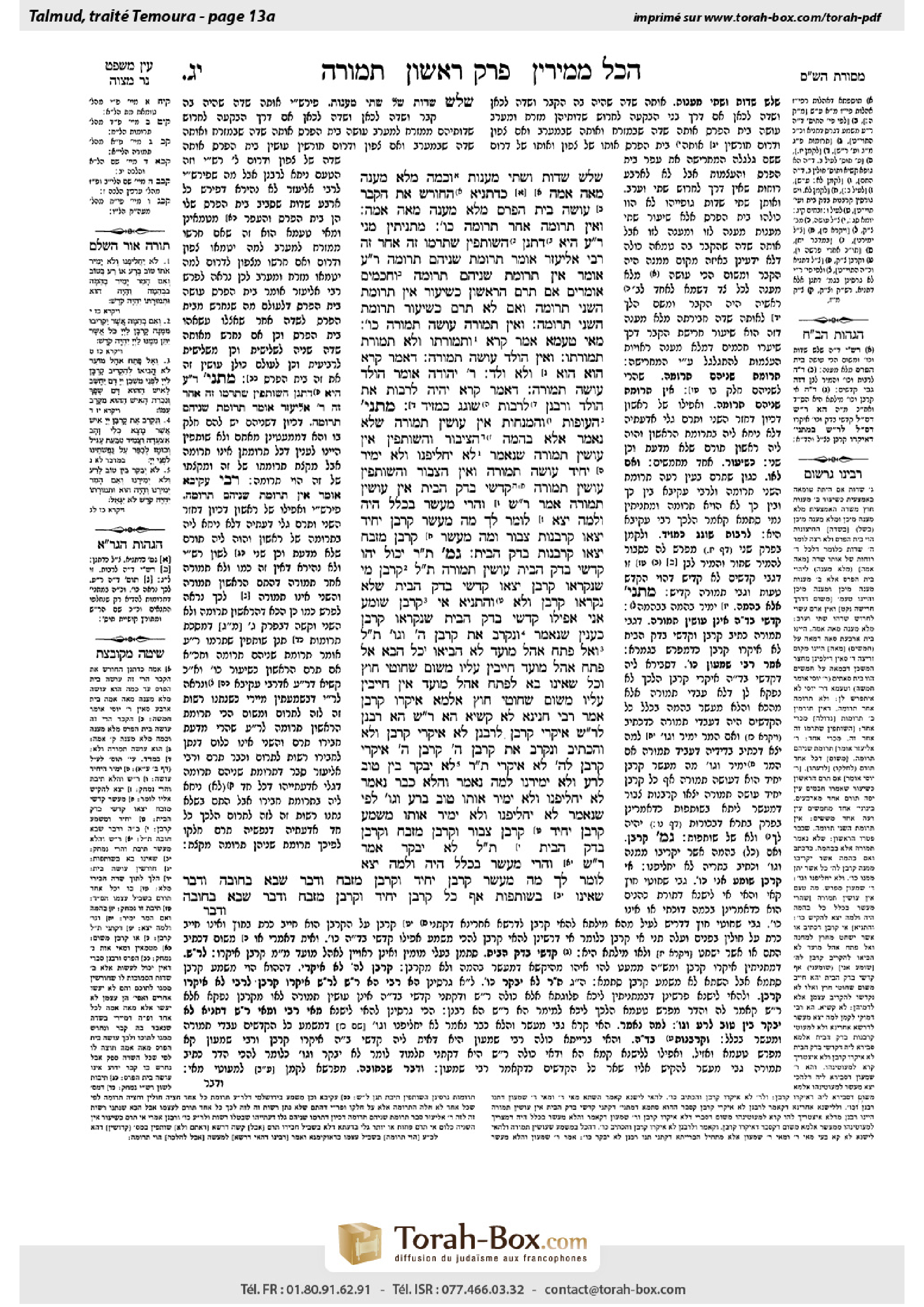
Temurah 13a: Talmud study for Daf Yomi
Daf Yomi is the daily study of one Talmud folio. Explore 37 tractates with scans, Hebrew text, Sefaria English and AI-generated French translations where annotated.
Passage selection and English or AI-generated French translation are available where the scan has annotations. Daf Study is independent of Torah-Box and Sefaria.
Browse Temurah · תמורה · All tractatesTemurah 13a text and translations
This page of Temurah includes the Aramaic text, an English translation and an AI-generated French translation, alongside the scan above.
תמורה י״ג א · Aramaic and Hebrew text
שָׁלֹשׁ שָׂדוֹת וּשְׁתֵּי מַעֲנוֹת. וְכַמָּה מְלֹא מַעֲנֶה? מֵאָה אַמָּה, כִּדְתַנְיָא: הַחוֹרֵשׁ אֶת הַקֶּבֶר — עוֹשֶׂה בֵּית הַפְּרָס מְלֹא מַעֲנֶה מֵאָה אַמָּה.
וְאֵין תְּרוּמָה אַחַר תְּרוּמָה כּוּ׳. מַתְנִיתִין מַנִּי? רַבִּי עֲקִיבָא הִיא, דִּתְנַן: הַשּׁוּתָּפִין שֶׁתָּרְמוּ זֶה אַחַר זֶה, רַבִּי אֱלִיעֶזֶר אוֹמֵר: תְּרוּמַת שְׁנֵיהֶם תְּרוּמָה.
רַבִּי עֲקִיבָא אוֹמֵר: אֵין תְּרוּמַת שְׁנֵיהֶם תְּרוּמָה, וַחֲכָמִים אוֹמְרִים: אִם תָּרַם הָרִאשׁוֹן כַּשִּׁיעוּר — אֵין תְּרוּמַת הַשֵּׁנִי תְּרוּמָה, וְאִם לֹא תָּרַם כַּשִּׁיעוּר — תְּרוּמַת הַשֵּׁנִי תְּרוּמָה.
וְאֵין תְּמוּרָה עוֹשָׂה תְּמוּרָה כּוּ׳. מַאי טַעְמָא? אָמַר קְרָא: ״וּתְמוּרָתוֹ״, וְלֹא תְּמוּרַת תְּמוּרָתוֹ.
וְאֵין הַוָּלָד עוֹשֶׂה תְּמוּרָה. דְּאָמַר קְרָא: ״הוּא״ — הוּא וְלֹא וָלָד.
רַבִּי יְהוּדָה אוֹמֵר: הַוָּלָד עוֹשֶׂה תְּמוּרָה. דְּאָמַר קְרָא ״יִהְיֶה״ לְרַבּוֹת אֶת הַוָּלָד. וְרַבָּנַן: לְרַבּוֹת שׁוֹגֵג כְּמֵזִיד.
מַתְנִי׳ הָעוֹפוֹת וְהַמְּנָחוֹת אֵין עוֹשִׂין תְּמוּרָה, שֶׁלֹּא נֶאֱמַר אֶלָּא בְּהֵמָה. הַצִּיבּוּר וְהַשּׁוּתָּפִין אֵין עוֹשִׂין תְּמוּרָה, שֶׁנֶּאֱמַר ״לֹא יַחֲלִיפֶנּוּ וְלֹא יָמִיר״. יָחִיד עוֹשֶׂה תְּמוּרָה, וְאֵין הַצִּבּוּר וְהַשּׁוּתָּפִין עוֹשִׂין תְּמוּרָה. קׇדְשֵׁי בֶּדֶק הַבַּיִת אֵין עוֹשִׂין תְּמוּרָה.
אָמַר רַבִּי שִׁמְעוֹן: וַהֲרֵי מַעֲשֵׂר בַּכְּלָל הָיָה, וְלָמָּה יָצָא?
לוֹמַר לָךְ: מָה מַעֲשֵׂר — קׇרְבַּן יָחִיד, יָצְאוּ קׇרְבְּנוֹת צִבּוּר; וּמָה מַעֲשֵׂר — קׇרְבַּן מִזְבֵּחַ, יָצְאוּ קׇרְבָּנוֹת בֶּדֶק הַבַּיִת.
גְּמָ׳ תָּנוּ רַבָּנַן: יָכוֹל יְהוּ קׇדְשֵׁי בֶּדֶק הַבַּיִת עוֹשִׂין תְּמוּרָה? תַּלְמוּד לוֹמַר ״קׇרְבָּן״ — מִי שֶׁנִּקְרְאוּ ״קׇרְבָּן״, יָצְאוּ קׇדְשֵׁי בֶּדֶק הַבַּיִת שֶׁלֹּא נִקְרְאוּ ״קׇרְבָּן״.
וְלָא? וְהָתַנְיָא: אִי ״קׇרְבָּן״ — שׁוֹמֵעַ אֲנִי אֲפִילּוּ קׇדְשֵׁי בֶּדֶק הַבַּיִת, שֶׁנִּקְרְאוּ ״קׇרְבָּן״, כָּעִנְיָן שֶׁנֶּאֱמַר: ״וַנַּקְרֵב אֶת קׇרְבַּן ה׳ וְגוֹ׳״.
תַּלְמוּד לוֹמַר ״וְאֶל פֶּתַח אֹהֶל מוֹעֵד לֹא הֱבִיאוֹ״ — כׇּל הַבָּא אֶל פֶּתַח אֹהֶל מוֹעֵד חַיָּיבִין עָלָיו מִשּׁוּם שְׁחוּטֵי חוּץ, וְכֹל שֶׁאֵינוֹ בָּא לְפֶתַח אֹהֶל מוֹעֵד אֵין חַיָּיבִין עָלָיו מִשּׁוּם שְׁחוּטֵי חוּץ. אַלְמָא אִיקְּרוּ ״קׇרְבָּן״.
אָמַר רַבִּי חֲנִינָא: לָא קַשְׁיָא, הָא רַבִּי שִׁמְעוֹן, הָא רַבָּנַן. לְרַבִּי שִׁמְעוֹן אִיקְּרִי ״קׇרְבָּן״, לְרַבָּנַן לָא אִיקְּרִי ״קׇרְבָּן״.
וְלָא? וְהָכְתִיב: ״וַנַּקְרֵב אֶת קׇרְבַּן ה׳״! ״קׇרְבַּן ה׳״ אִיקְּרִי, ״קׇרְבָּן לַה׳״ לָא אִיקְּרִי.
תָּנוּ רַבָּנַן: ״לֹא יְבַקֵּר בֵּין טוֹב לָרַע וְלֹא יְמִירֶנּוּ״, לָמָּה נֶאֱמַר? וַהֲלֹא כְּבָר נֶאֱמַר ״לֹא יַחֲלִיפֶנּוּ וְלֹא יָמִיר אוֹתוֹ טוֹב בְּרָעוְגוֹ׳״.
לְפִי שֶׁנֶּאֱמַר ״לֹא יַחֲלִיפֶנּוּ וְלֹא יָמִיר אוֹתוֹ״, מַשְׁמַע קׇרְבַּן יָחִיד, קׇרְבַּן צִבּוּר, וְקׇרְבַּן מִזְבֵּחַ וְקׇרְבַּן בֶּדֶק הַבַּיִת, תַּלְמוּד לוֹמַר ״לֹא יְבַקֵּר״.
אָמַר רַבִּי שִׁמְעוֹן: וַהֲרֵי מַעֲשֵׂר בַּכְּלָל הָיָה, וְלָמָּה יָצָא? לוֹמַר לָךְ: מָה מַעֲשֵׂר קׇרְבַּן יָחִיד, וְקׇרְבַּן מִזְבֵּחַ, וְדָבָר שֶׁבָּא בְּחוֹבָה, וְדָבָר שֶׁאֵינוֹ בְּשׁוּתָּפוּת — אַף כֹּל קׇרְבַּן יָחִיד, וְקׇרְבַּן מִזְבֵּחַ, וְדָבָר שֶׁבָּא בְּחוֹבָה,
Temurah 13a · English translation
A beit haperas extends over three fields, the field that was plowed and the two adjacent fields in the direction it was plowed. For example, if one plowed the field from north to south, each of the fields adjacent to it on the north and south is also considered a beit haperas. But whereas the plowed field is a beit haperas in its entirety, the two adjacent fields are a beit haperas only to the extent of two furrows, one furrow on each side. And how much is the full length of a furrow [ma’ana]? It is one hundred cubits, as it is taught in a mishna (Oholot 17:1): One who plows a field containing a grave, and who may have strewn the bones throughout the field, renders the field a beit haperas up to the full length of a furrow, which is one hundred cubits.
§ The mishna teaches: And there is no teruma after teruma. Once one designates produce from his crop as teruma, if he then designates additional produce from that crop as teruma, it is not teruma. The Gemara explains: Whose opinion is expressed in the mishna? It is the opinion of Rabbi Akiva, as we learned in a mishna (Terumot 3:3): In the case of joint owners of produce who separated teruma one after the other, Rabbi Eliezer says: The teruma of both of them is teruma, as each is considered to have separated from his share of the produce.
Rabbi Akiva says: The teruma of neither of them is teruma. Since each separated teruma independently, it is clear that neither accepts the separation of the other, and therefore neither is valid. And the Rabbis say: If the first one separated teruma of the correct measure, i.e., one-fiftieth of the produce, the produce is thereby tithed, and therefore the teruma of the second is not teruma; but if the first did not separate teruma of the correct measure, and he separated too little, the teruma of the second is teruma.
§ The mishna teaches: And a substitute animal that was consecrated when it was substituted for a consecrated animal does not render a non-sacred animal exchanged for it a substitute; rather, it remains non-sacred. The Gemara explains: What is the reason, i.e., the source for this halakha in the Torah? The verse states: “And if he substitutes an animal for an animal, then both it and that for which it is substituted shall be sacred” (Leviticus 27:10). The verse teaches that the halakha of substitution applies only to a consecrated animal and its substitute, but not the substitute of its substitute.
§ The mishna teaches: And the offspring born of a consecrated animal that was not consecrated itself does not render a non-sacred animal exchanged for it a substitute. The Gemara explains: The reason for this is that the verse states: “Then both it and that for which it is substituted shall be sacred” (Leviticus 27:10), which teaches that only it, a consecrated animal, but not its offspring, renders a non-sacred animal exchanged for it a substitute.
§ The mishna teaches that Rabbi Yehuda says: The offspring renders a non-sacred animal exchanged for it a substitute. The Gemara explains that Rabbi Yehuda reasons that when the verse states: “Shall be sacred,” this serves to include the offspring. The Gemara adds: And as for the Rabbis, who hold that one cannot substitute for the offspring of a consecrated animal, they maintain that this phrase serves to include one who substitutes unwittingly, so that the substitution is valid as if he had done so intentionally.
MISHNA: The birds sacrificed as offerings, i.e., doves and pigeons, and the meal offerings do not render non-sacred items exchanged for them substitutes, as only the term “an animal” is stated with regard to substitution, in the verse: “And if he substitutes an animal for an animal” (Leviticus 27:10). A consecrated animal belonging to the community or to partners does not render a non-sacred animal exchanged for it a substitute, as it is stated in the same verse: “He shall neither exchange it nor substitute it.” One derives from the singular pronoun in the verse that an individual renders a non-sacred animal a substitute, but the community and partners do not render a non-sacred animal a substitute. Items consecrated for Temple maintenance do not render non-sacred items exchanged for them substitutes.
Rabbi Shimon said: The fact that animals belonging to the community or partners do not render animals exchanged for them substitutes is derived as follows: The animal tithe was included in the category of all offerings, and why was it singled out in the verse: “And all the tithe of the herd or the flock, whatever passes under the rod, the tenth shall be sacred unto the Lord. He shall not inquire whether it is good or bad, neither shall he substitute for it; and if he substitutes it, then both it and that for which it is substituted shall be sacred” (Leviticus 27:32–33)?
Rabbi Shimon explains: It was singled out to juxtapose substitution to the animal tithe, to tell you: Just as the animal tithe is brought exclusively as an individual offering, so too, all offerings that render their substitutes sacred are individual offerings, excluding communal offerings and the offerings of partners from the halakha of substitution. And just as the animal tithe is an offering sacrificed on the altar, so too, all offerings that render their substitutes sacred are offerings sacrificed on the altar, excluding items consecrated for Temple maintenance from the halakha of substitution.
GEMARA: According to the mishna, items consecrated for Temple maintenance do not render non-sacred items exchanged for them substitutes. The Sages taught in a baraita: One might have thought that items consecrated for Temple maintenance render non-sacred items exchanged for them substitutes. Therefore, the verse states: “And if it is an animal of which men bring an offering to the Lord…he shall not alter it, nor substitute it, good for bad” (Leviticus 27:9–10). This teaches that the halakha of substitution applies to that which is called an offering, excluding items consecrated for Temple maintenance, which are not called an offering.
The Gemara asks: And are items consecrated for Temple maintenance not called offerings? But isn’t it taught in a baraita: The verse states with regard to sacrificial animals: “Or who slaughters it outside the camp, and has not brought it to the entrance to the Tent of Meeting to present it as an offering to the Lord before the Tabernacle of the Lord” (Leviticus 17:3–4). If the verse had mentioned just the word “offering,” I would derive that the prohibition against slaughtering outside the Temple applies even to items consecrated for Temple maintenance, as they too are called offerings, as is stated in the matter of the spoils of the war against Midian: “And we have brought the Lord’s offering, what every man has gotten, of jewels of gold, armlets, and bracelets, signet rings, earrings, and girdles, to make atonement for our souls before the Lord” (Numbers 31:50). These were certainly not items consecrated for the altar.
The baraita continues: Therefore the verse states: “And to the entrance of the Tent of Meeting he did not bring it” (Leviticus 17:4), to teach that for any item that is fit to come to the entrance of the Tent of Meeting, i.e., that is fit to be sacrificed, one is liable for it due to the prohibition against slaughtering offerings outside of the Temple courtyard. And by contrast, for any animal that is not fit to come to the entrance of the Tent of Meeting, one is not liable for it due to the prohibition against slaughtering offerings outside of the Temple courtyard. Evidently, as a verse is necessary to exclude items consecrated for Temple maintenance, such items are generally called an offering, contrary to the first baraita cited.
Rabbi Ḥanina said: This is not difficult. This second baraita is in accordance with the opinion of Rabbi Shimon, whereas that first baraita is in accordance with the opinion of the Rabbis. According to the opinion of Rabbi Shimon, items consecrated for Temple maintenance are in fact called an offering, and therefore in the mishna he derives that items consecrated for Temple maintenance are excluded from the halakhot of substitution from the juxtaposition with the animal tithe, not from word “offering.” According to the opinion of the Rabbis, items consecrated for Temple maintenance are not called an offering, and they therefore derive the halakha from the word “offering.”
The Gemara asks: And according to the opinion of the Rabbis, are items consecrated for Temple maintenance not called an offering? But isn’t it written: “And we have brought the Lord’s offering” (Numbers 31:50)? The Gemara answers: These items are called: “The Lord’s offering,” but they are not called: “An offering to the Lord,” which is used only with regard to offerings sacrificed upon the altar.
§ The mishna teaches that consecrated animals belonging to the community or to partners are not included in the halakha of substitution. The Sages taught in a baraita: The verse states with regard to the animal tithe: “He shall not inquire whether it is good or bad, neither shall he substitute it; and if he substitute it at all, then both it and that for which it is substituted shall be sacred; it shall not be redeemed” (Leviticus 27:33). Why is the issue of substitution stated here in connection to the animal tithe? Isn’t it already stated earlier: “He shall not alter it, nor substitute it, good for bad, or bad for good, and if he substitutes an animal for an animal, then both it and that for which it is substituted shall be sacred” (Leviticus 27:10)?
Since it is stated: “He shall not alter it, nor substitute it,” the verse apparently indicates that all types of offering are included, whether an individual offering or a communal offering, and whether it is an offering sacrificed on the altar or an offering consecrated for Temple maintenance. Therefore, the verse states with regard to the animal tithe: “He shall not inquire.”
Rabbi Shimon said in explanation: The animal tithe was included in the category of all offerings, and why was it singled out? It is to tell you: Just as the animal tithe is an individual offering, and an offering sacrificed on the altar, and it is an item that comes only as an obligation, not as a gift offering, and it is an item that is not brought in partnership, but only by an individual, so too, all offerings that render their substitutes sacred must be an individual offering, and an offering sacrificed on the altar, and it must be an item that comes only as an obligation,
Temurah 13a · Traduction française (IA)
Un beit haperas s’étend sur trois champs : le champ qui a été labouré et les deux champs adjacents dans le sens du labour. Par exemple, si l’on a labouré le champ du nord au sud, chacun des champs qui lui sont adjacents au nord et au sud est également considéré comme un beit haperas. Toutefois, tandis que le champ labouré est un beit haperas dans son intégralité, les deux champs adjacents ne le sont que sur deux sillons, à raison d’un sillon de chaque côté. Quelle est la longueur totale d’un sillon [ma’ana] ? Elle est de cent coudées, comme il est enseigné dans une Michna (Oholot 17:1) : Celui qui laboure un champ contenant une tombe, et qui a pu disperser les ossements dans tout le champ, rend le champ beit haperas sur la longueur totale d’un sillon, soit cent coudées.
§ La Michna enseigne : Et il n’y a pas de terouma après la terouma. Une fois qu’un homme a désigné une partie de sa récolte comme terouma, s’il en désigne ensuite une autre partie comme terouma, cette seconde désignation n’est pas valable. La Guemara explique : De qui la Michna exprime-t-elle l’opinion ? De Rabbi Akiva, comme nous l’avons appris dans une Michna (Terumot 3:3) : lorsque des copropriétaires de produits ont séparé la terouma l’un après l’autre, Rabbi Eliezer dit : La terouma de chacun des deux est valable, car chacun est considéré comme l’ayant séparée de sa propre part des produits.
Rabbi Akiva dit : La terouma d’aucun des deux n’est valable. Puisque chacun a séparé la terouma indépendamment, il est clair qu’aucun n’accepte la séparation de l’autre ; par conséquent, la terouma d’aucun des deux n’est valable. Et les Sages disent : Si le premier a séparé la terouma dans la mesure requise, c’est-à-dire un cinquantième des produits, ceux-ci sont ainsi soumis à la dîme, et la terouma du second n’est donc pas valable. Mais si le premier n’a pas séparé la terouma dans la mesure requise et en a séparé trop peu, la terouma du second est valable.
§ La Michna enseigne : Un animal substitué, consacré au moment où il a été substitué à un animal consacré, ne rend pas substituable un animal non consacré échangé contre lui ; celui-ci demeure non consacré. La Guemara explique : Quelle en est la raison, c’est-à-dire la source de cette halakha dans la Torah ? Le verset dit : « Et s’il substitue un animal à un animal, les deux, lui et celui auquel il a été substitué, seront sacrés » (Lévitique 27:10). Le verset enseigne que la halakha de la substitution ne s’applique qu’à un animal consacré et à son substitut, mais pas au substitut de son substitut.
§ La Michna enseigne : Le petit d’un animal consacré, qui n’a pas été consacré lui-même, ne rend pas substituable un animal non consacré échangé contre lui. La Guemara explique que la raison en est que le verset dit : « Les deux, lui et celui auquel il a été substitué, seront sacrés » (Lévitique 27:10), ce qui enseigne que seul l’animal consacré, mais pas son petit, rend substituable un animal non consacré échangé contre lui.
§ La Michna enseigne que Rabbi Yehouda dit : Le petit rend substituable un animal non consacré échangé contre lui. La Guemara explique que Rabbi Yehouda raisonne ainsi : lorsque le verset dit « seront sacrés », cela sert à inclure le petit. La Guemara ajoute : Quant aux Sages, qui soutiennent qu’on ne peut pas substituer un animal au petit d’un animal consacré, ils considèrent que cette expression sert à inclure celui qui procède à une substitution par inadvertance, de sorte que la substitution est valable comme s’il l’avait faite intentionnellement.
MICHNA : Les oiseaux offerts en sacrifice, c’est-à-dire les tourterelles et les pigeons, ainsi que les offrandes de farine, ne rendent pas substituables les éléments non consacrés échangés contre eux, car seul le terme « animal » est employé à propos de la substitution, dans le verset : « Et s’il substitue un animal à un animal » (Lévitique 27:10). Un animal consacré appartenant à la collectivité ou à des associés ne rend pas substituable un animal non consacré échangé contre lui, car le même verset dit : « Il ne l’échangera ni ne le substituera. » On déduit du pronom au singulier dans le verset qu’un particulier rend un animal non consacré substituable, mais pas la collectivité ni des associés. Les biens consacrés à l’entretien du Temple ne rendent pas substituables les éléments non consacrés échangés contre eux.
Rabbi Shimon dit : Le fait que les animaux appartenant à la collectivité ou à des associés ne rendent pas substituables les animaux échangés contre eux se déduit ainsi : la dîme animale a été incluse dans la catégorie de toutes les offrandes ; pourquoi a-t-elle alors été mentionnée à part dans le verset : « Toute dîme du gros ou du petit bétail, tout ce qui passe sous la houlette, le dixième sera consacré à l’Éternel. On ne s’enquerra pas s’il est bon ou mauvais, et on ne le substituera pas ; et si on le substitue, les deux, lui et celui auquel il a été substitué, seront sacrés » (Lévitique 27:32–33) ?
Rabbi Shimon explique : Elle a été mentionnée à part afin de rapprocher la substitution de la dîme animale, pour t’enseigner ceci : de même que la dîme animale est offerte exclusivement comme sacrifice individuel, de même toutes les offrandes dont les substituts deviennent sacrés sont des offrandes individuelles, ce qui exclut les offrandes collectives et celles des associés de la halakha de la substitution. Et de même que la dîme animale est une offrande sacrifiée sur l’autel, de même toutes les offrandes dont les substituts deviennent sacrés sont des offrandes sacrifiées sur l’autel, ce qui exclut les biens consacrés à l’entretien du Temple de la halakha de la substitution.
GUEMARA : Selon la Michna, les biens consacrés à l’entretien du Temple ne rendent pas substituables les éléments non consacrés échangés contre eux. Les Sages ont enseigné dans une baraïta : On aurait pu penser que les biens consacrés à l’entretien du Temple rendent substituables les éléments non consacrés échangés contre eux. C’est pourquoi le verset dit : « Et s’il s’agit d’un animal dont on apporte une offrande à l’Éternel […] il ne le remplacera ni ne le substituera, le bon par le mauvais » (Lévitique 27:9–10). Cela enseigne que la halakha de la substitution s’applique à ce qui est appelé « offrande », à l’exclusion des biens consacrés à l’entretien du Temple, qui ne sont pas appelés « offrande ».
La Guemara demande : Les biens consacrés à l’entretien du Temple ne sont-ils pas appelés des offrandes ? Pourtant, il est enseigné dans une baraïta : Le verset dit à propos des animaux sacrificiels : « Ou s’il l’égorge hors du camp, sans l’avoir amené à l’entrée de la Tente de la Rencontre pour le présenter comme offrande à l’Éternel devant le Tabernacle de l’Éternel » (Lévitique 17:3–4). Si le verset avait seulement mentionné le mot « offrande », j’aurais déduit que l’interdiction d’égorger hors du Temple s’applique même aux biens consacrés à l’entretien du Temple, car eux aussi sont appelés des offrandes, comme il est dit à propos du butin de la guerre contre Madian : « Et nous avons apporté l’offrande de l’Éternel, ce que chaque homme a obtenu : des objets en or, des bracelets, des joncs, des bagues, des boucles d’oreilles et des ceintures, afin de faire expiation pour nos âmes devant l’Éternel » (Nombres 31:50). Il ne s’agissait certainement pas de biens consacrés à l’autel.
La baraïta poursuit : C’est pourquoi le verset dit : « Il ne l’a pas amené à l’entrée de la Tente de la Rencontre » (Lévitique 17:4), pour enseigner que, pour tout élément qui peut être amené à l’entrée de la Tente de la Rencontre, c’est-à-dire qui peut être offert en sacrifice, on est passible au titre de l’interdiction d’égorger des offrandes hors de la cour du Temple. En revanche, pour tout animal qui ne peut pas être amené à l’entrée de la Tente de la Rencontre, on n’est pas passible au titre de l’interdiction d’égorger des offrandes hors de la cour du Temple. Il apparaît donc qu’un verset est nécessaire pour exclure les biens consacrés à l’entretien du Temple ; ces biens sont donc généralement appelés « offrande », contrairement à ce qu’affirmait la première baraïta citée.
Rabbi Ḥanina dit : Il n’y a pas de difficulté. Cette seconde baraïta est conforme à l’opinion de Rabbi Shimon, tandis que la première baraïta est conforme à l’opinion des Sages. Selon Rabbi Shimon, les biens consacrés à l’entretien du Temple sont effectivement appelés « offrande » ; dans la Michna, il déduit donc que ces biens sont exclus des halakhot de la substitution en raison de leur rapprochement avec la dîme animale, et non du mot « offrande ». Selon les Sages, les biens consacrés à l’entretien du Temple ne sont pas appelés « offrande » ; ils déduisent donc la halakha du mot « offrande ».
La Guemara demande : Et selon l’opinion des Sages, les biens consacrés à l’entretien du Temple ne sont-ils pas appelés « offrande » ? Pourtant, il est écrit : « Et nous avons apporté l’offrande de l’Éternel » (Nombres 31:50). La Guemara répond : Ces biens sont appelés « l’offrande de l’Éternel », mais ils ne sont pas appelés « offrande à l’Éternel », expression qui ne s’emploie qu’à propos des offrandes sacrifiées sur l’autel.
§ La Michna enseigne que les animaux consacrés appartenant à la collectivité ou à des associés ne sont pas soumis à la halakha de la substitution. Les Sages ont enseigné dans une baraïta : Le verset dit à propos de la dîme animale : « On ne s’enquerra pas s’il est bon ou mauvais, on ne le substituera pas ; et si on le substitue effectivement, les deux, lui et celui auquel il a été substitué, seront sacrés ; il ne sera pas racheté » (Lévitique 27:33). Pourquoi la question de la substitution est-elle énoncée ici à propos de la dîme animale ? N’est-elle pas déjà énoncée plus tôt : « Il ne le remplacera ni ne le substituera, le bon par le mauvais ou le mauvais par le bon ; et s’il substitue un animal à un animal, les deux, lui et celui auquel il a été substitué, seront sacrés » (Lévitique 27:10) ?
Puisqu’il est dit : « Il ne le remplacera ni ne le substituera », le verset semble indiquer que tous les types d’offrandes sont inclus, qu’il s’agisse d’une offrande individuelle ou collective, et qu’il s’agisse d’une offrande sacrifiée sur l’autel ou d’une offrande consacrée à l’entretien du Temple. C’est pourquoi le verset dit à propos de la dîme animale : « On ne s’enquerra pas. »
Rabbi Shimon expliqua ainsi : la dîme animale a été incluse dans la catégorie de toutes les offrandes ; pourquoi a-t-elle été mentionnée à part ? Pour t’enseigner ceci : de même que la dîme animale est une offrande individuelle et une offrande sacrifiée sur l’autel, qu’elle ne peut être apportée qu’à titre d’obligation, et non comme offrande volontaire, et qu’elle n’est pas apportée en partenariat, mais seulement par un particulier, de même toutes les offrandes dont les substituts deviennent sacrés doivent être des offrandes individuelles, sacrifiées sur l’autel et apportées uniquement à titre d’obligation,
Traduction française générée par IA à partir de l’édition anglaise de Sefaria. Vérifie toujours un passage avec le texte source.
Text from Sefaria: William Davidson Edition - Vocalized Aramaic (CC BY NC); William Davidson Edition - English (CC BY NC).