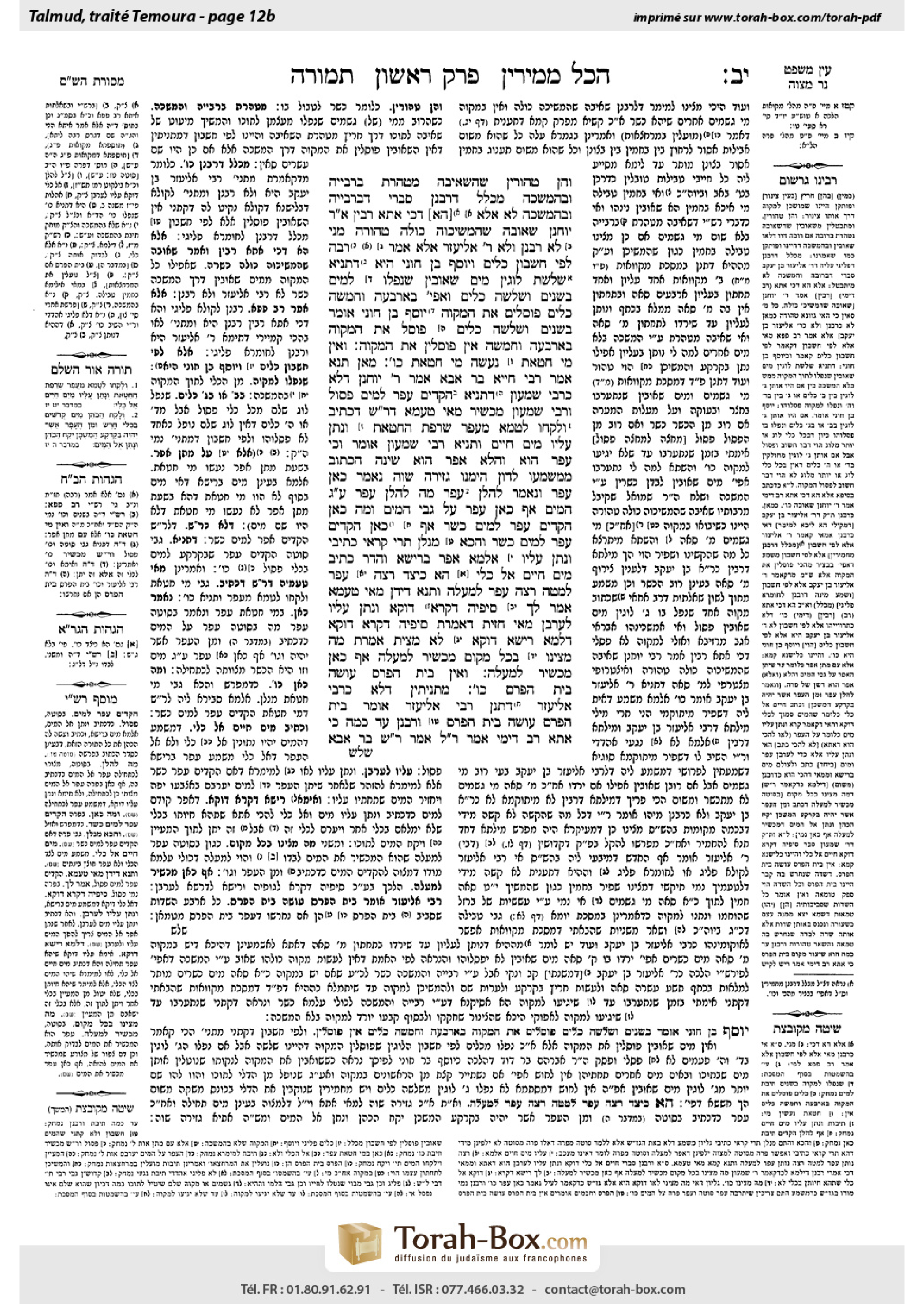
Temurah 12b: Talmud study for Daf Yomi
Daf Yomi is the daily study of one Talmud folio. Explore 37 tractates with scans, Hebrew text, Sefaria English and AI-generated French translations where annotated.
Passage selection and English or AI-generated French translation are available where the scan has annotations. Daf Study is independent of Torah-Box and Sefaria.
Browse Temurah · תמורה · All tractatesTemurah 12b text and translations
This page of Temurah includes the Aramaic text, an English translation and an AI-generated French translation, alongside the scan above.
תמורה י״ב ב · Aramaic and Hebrew text
וְהֵן טְהוֹרִין, שֶׁהַשְּׁאִיבָה מְטַהֶרֶת בִּרְבִיָּיה וּבְהַמְשָׁכָה.
מִכְּלָל דְּרַבָּנַן סָבְרִי דְּבִרְבִיָּיה וּבְהַמְשָׁכָה לָא? אֶלָּא דְּכִי אֲתָא רָבִין אָמַר רַבִּי יוֹחָנָן: שְׁאוּבָה שֶׁהִמְשִׁיכוּהָ כּוּלָּהּ — טְהוֹרָה. מַנִּי? לָא רַבָּנַן וְלָא רַבִּי אֱלִיעֶזֶר!
אֶלָּא אָמַר רַבָּה: לְפִי חֶשְׁבּוֹן כֵּלִים, וְיוֹסֵף בֶּן חוֹנִי הִיא.
דְּתַנְיָא: שְׁלֹשֶׁת לוּגִּין מַיִם שְׁאוּבִין שֶׁנָּפְלוּ לַמַּיִם, בִּשְׁנַיִם וּשְׁלֹשָׁה כֵּלִים, וַאֲפִילּוּ בְּאַרְבָּעָה וַחֲמִשָּׁה כֵּלִים — פּוֹסְלִים אֶת הַמִּקְוֶה. יוֹסֵף בֶּן חוֹנִי אוֹמֵר: בִּשְׁנַיִם וּשְׁלֹשָׁה כֵּלִים (פוסל) [פּוֹסְלִין] אֶת הַמִּקְוֶה, בְּאַרְבָּעָה וַחֲמִשָּׁה — אֵין פּוֹסְלִין אֶת הַמִּקְוֶה.
וְאֵין מֵי חַטָּאת (נַעֲשֶׂה) [נַעֲשִׂין] מֵי חַטָּאת כּוּ׳. מַאן תַּנָּא? אָמַר רַבִּי חִיָּיא בַּר אַבָּא אָמַר רַבִּי יוֹחָנָן: דְּלָא כְּרַבִּי שִׁמְעוֹן.
דְּתַנְיָא: הִקְדִּים עָפָר לַמַּיִם — פָּסוּל, וְרַבִּי שִׁמְעוֹן מַכְשִׁיר.
מַאי טַעְמָא דְּרַבִּי שִׁמְעוֹן? דִּכְתִיב ״וְלָקְחוּ לַטָּמֵא מֵעֲפַר שְׂרֵפַת הַחַטָּאת וְנָתַן עָלָיו מַיִם חַיִּים״, וְתַנְיָא: רַבִּי שִׁמְעוֹן אוֹמֵר: וְכִי עָפָר הוּא? וַהֲלֹא אֵפֶר הוּא!
שִׁינָּה הַכָּתוּב מִמַּשְׁמָעוֹ, לָדוּן הֵימֶנּוּ גְּזֵירָה שָׁוָה: נֶאֱמַר כָּאן ״עָפָר״, וְנֶאֱמַר לְהַלָּן ״עָפָר״. מָה לְהַלָּן — עָפָר עַל גַּבֵּי הַמַּיִם, אַף כָּאן — עָפָר עַל גַּבֵּי הַמַּיִם. וּמָה כָּאן הִקְדִּים עָפָר לַמַּיִם — כָּשֵׁר, אַף כָּאן הִקְדִּים עָפָר לַמַּיִם — כָּשֵׁר.
וְהָכָא מְנָלַן? תְּרֵי קְרָאֵי כְּתִיבִי: ״וְנָתַן עָלָיו״, אַלְמָא אֵפֶר בְּרֵישָׁא, וַהֲדַר כְּתִיב ״מַיִם חַיִּים אֶל כֶּלִי״. הָא כֵּיצַד? רָצָה עָפָר לְמַטָּה, רָצָה עָפָר לְמַעְלָה.
וְתַנָּא דִּידַן, מַאי טַעְמָא? אָמַר לָךְ: סֵיפֵיהּ דִּקְרָא דַּוְקָא, ״וְנָתַן עָלָיו״ — לְעָרְבָן.
מַאי חָזֵית דְּאָמְרַתְּ סֵיפֵיהּ דִּקְרָא דַּוְקָא, דִּלְמָא רֵישָׁא דַּוְקָא? לָא מָצֵית אָמְרַתְּ, מָה מָצִינוּ בְּכׇל מָקוֹם מַכְשִׁיר לְמַעְלָה, אַף כָּאן מַכְשִׁיר לְמַעְלָה.
וְאֵין בֵּית הַפְּרָס עוֹשֶׂה בֵּית הַפְּרָס כּוּ׳. מַתְנִיתִין דְּלָא כְּרַבִּי אֱלִיעֶזֶר, דִּתְנַן: רַבִּי אֱלִיעֶזֶר אוֹמֵר: בֵּית הַפְּרָס עוֹשֶׂה בֵּית הַפְּרָס.
וְרַבָּנַן, עַד כַּמָּה? כִּי אֲתָא רַב דִּימִי אָמַר רֵישׁ לָקִישׁ אָמַר רַבִּי שִׁמְעוֹן בַּר אַבָּא:
Temurah 12b · English translation
and in this manner all forty se’a are ritually pure. The reason is that drawn water is purified by a majority of fit water that was already present in the ritual bath and by the drawn water flowing into the ritual bath. This is the meaning of the mishna’s statement that drawn water invalidates the ritual bath only according to calculation: One calculates the amount of drawn water that flowed into the ritual bath, as the ritual bath is invalid only if most of the forty se’a is of that drawn water.
The Gemara asks: If this is the opinion of Rabbi Eliezer ben Ya’akov alone, one must conclude by inference that the Rabbis hold that the ritual bath is not fit even by a majority of fit water and by the flowing of the drawn water. But if so, consider that which Ravin said when he came from Eretz Yisrael to Babylonia, namely, that Rabbi Yoḥanan said: A ritual bath that consists in its entirety of drawn water that one made flow into it is pure. In accordance with whose opinion is this? It is not in accordance with the opinion of the Rabbis, who maintain that drawn water invalidates the ritual bath even if it flowed into it, and it is not in accordance with the opinion of Rabbi Eliezer ben Ya’akov, who holds that drawn water invalidates the ritual bath if it constitutes a majority of the forty se’a.
Rather, Rabba says: The mishna’s ruling, that drawn water invalidates the ritual bath only according to calculation, is not referring to drawn water that flowed. Instead, it means according to the calculation of the number of vessels from which the drawn water was directly poured into the ritual bath, and this is in accordance with the opinion of Yosef ben Ḥoni.
As it is taught in a baraita: If three log of drawn water fell into the water of a ritual bath that lacked the requisite measure, from two or three vessels, with each containing at least one log of drawn water, or even from four or five vessels, where no whole log fell in at once, it invalidates the ritual bath. Yosef ben Ḥoni says: It is only if the drawn water was in two or three vessels that the water invalidates the ritual bath. But if the drawn water was in four or five vessels, the water does not invalidate the ritual bath. This is what the mishna means.
§ The mishna teaches: And the water of purification of the red heifer becomes water of purification only with the placement of the ashes into the water, but not by the placement of water onto the ashes. The Gemara asks: Who is the tanna whose opinion is reflected in this ruling? Rabbi Ḥiyya bar Abba said that Rabbi Yoḥanan said that it is not in accordance with the opinion of Rabbi Shimon.
As it is taught in a baraita: A sota, a woman suspected of unfaithfulness by her husband, must drink bitter waters prepared in the Temple. The verse states: “And the priest shall take holy water in an earthen vessel; and of the dust that is on the floor of the Tabernacle the priest shall take and put it into the water” (Numbers 5:17). This verse teaches that the water must be placed in the vessel first, and the dust is placed on top of it. If one places the dust in the vessel before the water, the mixture is unfit, but Rabbi Shimon deems it fit.
The Gemara explains: What is the reasoning of Rabbi Shimon? As it is written with regard to the red heifer: “And for the impure they shall take of the dust of the burning of the purification from sin, and place on it flowing water in a vessel” (Numbers 19:17). And it is taught in a baraita that Rabbi Shimon said: But is it dust [afar] that is taken? Isn’t it really ashes [efer]?
Evidently the verse altered its standard usage and referred to ashes as dust in order to derive a verbal analogy from it: “Dust” is stated in the verse here, and “dust” is stated there, with regard to the sota. Just as there, in the case of the sota, the verse teaches that the dust must be placed on top of the water, so too here, with regard to the red heifer, the dust, i.e., ashes, must be placed on top of the water. And likewise, just as here, with regard to the red heifer, if one places the dust in the vessel before the water, it is fit after the fact, so too there, in the case of the sota, if one places the dust in the vessel before the water, it is fit after the fact.
The Gemara asks: And here, with regard to the red heifer, from where do we derive that the mixture is fit even if the dust is placed first? Two phrases are written. First it is written: “They shall take of the dust of the burning of the purification from sin and place on it.” Apparently, the ashes should be placed in the vessel first and the water afterward. And then it is written: “Running water in a vessel,” indicating that the water should be placed in the vessel first, while it is still empty. How can these texts be reconciled? They can be reconciled by concluding that if he desires to place the dust, i.e., the ashes of the red heifer, below, and put water on top, he may do so; and if he desires he may place the water first and then place the dust above the water.
And the tanna of our mishna, who deems the mixture unfit if the ashes are placed first, what is his reasoning? He could say to you that the last clause of the verse: “Running water in a vessel,” is meant specifically, i.e., the water must be placed first. And when the verse states beforehand: “They shall take of the dust of the burning of the purification from sin and place on it,” this teaches only that after placing the ashes upon the water one is required to mix the ashes with the water, so that the water covers the ashes.
The Gemara objects: But one could just as easily say the opposite. What did you see that led you to say that the last clause of the verse is meant specifically? Perhaps the first clause of the verse is meant specifically. The Gemara answers: You cannot say so, as just as we find in every instance that the facilitating item goes above, e.g., in the case of a sota the dust, which enables the water to be used, goes on top of the water, so too here, in the case of the red heifer, the facilitating item must go above. The water must be placed first, and only then the ashes.
§ The mishna further teaches: And one beit haperas does not create another beit haperas. The Gemara comments: The mishna is not in accordance with the opinion of Rabbi Eliezer, as we learned in a mishna (Oholot 17:2) that Rabbi Eliezer says: One beit haperas creates another beit haperas. If one plowed from a beit haperas into another field, that field is also ritually impure.
The Gemara asks: And according to the Rabbis, who disagree with Rabbi Eliezer, how far does a beit haperas extend? When Rav Dimi came from Eretz Yisrael to Babylonia, he said that Reish Lakish said that Rabbi Shimon bar Abba said:
Temurah 12b · Traduction française (IA)
Et ainsi, les quarante séa sont tous rituellement purs. La raison en est que l’eau puisée est rendue apte par une majorité d’eau apte déjà présente dans le mikvé et par l’eau puisée qui s’y écoule. Tel est le sens de l’enseignement de la Michna selon lequel l’eau puisée n’invalide le mikvé que selon le calcul : on calcule la quantité d’eau puisée qui s’y est écoulée, car le mikvé n’est invalidé que si cette eau puisée constitue la majorité des quarante séa.
La Guemara demande : Si telle est l’opinion de Rabbi Eliezer ben Ya’akov seul, il faut en déduire que les Sages estiment que le mikvé n’est pas apte, même grâce à une majorité d’eau apte et à l’écoulement de l’eau puisée. Mais, dans ce cas, considérons ce que Ravin a dit en arrivant de la terre d’Israël en Babylonie, à savoir que Rabbi Yoḥanan a dit : Un mikvé entièrement constitué d’eau puisée qu’on y a fait couler est pur. Selon l’opinion de qui est-ce ? Ce n’est ni celle des Sages, qui soutiennent que l’eau puisée invalide le mikvé même si elle s’y est écoulée, ni celle de Rabbi Eliezer ben Ya’akov, qui estime que l’eau puisée invalide le mikvé si elle constitue la majorité des quarante séa.
Rabba dit plutôt : La décision de la Michna selon laquelle l’eau puisée n’invalide le mikvé que selon le calcul ne concerne pas l’eau puisée qui s’y est écoulée. Elle signifie plutôt qu’il faut compter le nombre de récipients depuis lesquels l’eau puisée a été directement versée dans le mikvé, et elle est conforme à l’opinion de Yosef ben Ḥoni.
Comme il est enseigné dans une baraïta : Si trois log d’eau puisée tombent dans l’eau d’un mikvé auquel il manque la quantité requise, depuis deux ou trois récipients contenant chacun au moins un log d’eau puisée, ou même depuis quatre ou cinq récipients, sans qu’un log entier ne tombe d’un seul coup, cela invalide le mikvé. Yosef ben Ḥoni dit : L’eau n’invalide le mikvé que si elle se trouvait dans deux ou trois récipients. Mais si elle se trouvait dans quatre ou cinq récipients, elle ne l’invalide pas. Tel est le sens de la Michna.
§ La Michna enseigne : Et l’eau de purification de la vache rousse ne devient eau de purification que lorsque les cendres sont déposées dans l’eau, mais pas lorsque l’eau est versée sur les cendres. La Guemara demande : De quel tanna cette décision reflète-t-elle l’opinion ? Rabbi Ḥiyya bar Abba dit au nom de Rabbi Yoḥanan qu’elle n’est pas conforme à l’opinion de Rabbi Shimon.
Comme il est enseigné dans une baraïta : Une sota, femme que son mari soupçonne d’infidélité, doit boire les eaux amères préparées dans le Temple. Le verset dit : « Le prêtre prendra de l’eau sainte dans un récipient de terre ; puis, de la poussière qui se trouve sur le sol du Tabernacle, le prêtre en prendra et la mettra dans l’eau » (Nombres 5,17). Ce verset enseigne que l’eau doit d’abord être mise dans le récipient, puis que la poussière doit être déposée dessus. Si l’on met la poussière dans le récipient avant l’eau, le mélange est impropre, mais Rabbi Shimon le juge apte.
La Guemara explique : Quel est le raisonnement de Rabbi Shimon ? Car il est écrit à propos de la vache rousse : « Pour l’impur, ils prendront de la poussière provenant de la combustion du sacrifice expiatoire, et ils mettront dessus de l’eau vive dans un récipient » (Nombres 19,17). Et il est enseigné dans une baraïta que Rabbi Shimon a dit : Mais est-ce de la poussière [afar] qu’on prend ? N’est-ce pas en réalité des cendres [efer] ?
De toute évidence, le verset s’écarte de l’usage habituel et appelle les cendres « poussière », afin d’en tirer une analogie verbale : le terme « poussière » figure ici dans le verset, et le terme « poussière » figure là, à propos de la sota. De même que là, dans le cas de la sota, le verset enseigne que la poussière doit être déposée sur l’eau, de même ici, à propos de la vache rousse, la poussière, c’est-à-dire les cendres, doit être déposée sur l’eau. Et de même que là, à propos de la vache rousse, si l’on met la poussière dans le récipient avant l’eau, le mélange reste apte a posteriori, de même là, dans le cas de la sota, si l’on met la poussière dans le récipient avant l’eau, le mélange reste apte a posteriori.
La Guemara demande : Et ici, à propos de la vache rousse, d’où déduit-on que le mélange est apte même si la poussière est déposée en premier ? Deux expressions figurent dans le texte. Il est d’abord écrit : « Ils prendront de la poussière provenant de la combustion du sacrifice expiatoire et la mettront dessus. » Apparemment, les cendres doivent être placées d’abord dans le récipient, et l’eau ensuite. Puis il est écrit : « De l’eau vive dans un récipient », ce qui indique que l’eau doit être mise d’abord dans le récipient, alors qu’il est encore vide. Comment concilier ces textes ? Il faut en conclure que si l’on souhaite déposer la poussière, c’est-à-dire les cendres de la vache rousse, au fond, puis verser l’eau dessus, on peut le faire ; et que, si on le souhaite, on peut mettre d’abord l’eau, puis déposer la poussière au-dessus.
Et le tanna de notre Michna, qui juge le mélange impropre si les cendres sont déposées en premier, quel est son raisonnement ? Il pourrait te répondre que la dernière partie du verset, « de l’eau vive dans un récipient », doit être comprise au sens strict, c’est-à-dire que l’eau doit être mise en premier. Et lorsque le verset dit auparavant : « Ils prendront de la poussière provenant de la combustion du sacrifice expiatoire et la mettront dessus », cela enseigne seulement qu’après avoir déposé les cendres sur l’eau, il faut les mélanger à l’eau, afin que celle-ci recouvre les cendres.
La Guemara objecte : Mais on pourrait tout aussi bien dire le contraire. Qu’as-tu vu qui t’amène à dire que la dernière partie du verset doit être comprise au sens strict ? Peut-être la première partie du verset doit-elle l’être. La Guemara répond : On ne peut pas dire cela, car, comme nous le constatons dans tous les cas, l’élément qui permet l’usage est placé au-dessus — par exemple, dans le cas de la sota, la poussière, qui permet d’utiliser l’eau, est déposée sur celle-ci —, de même ici, dans le cas de la vache rousse, l’élément qui permet l’usage doit être placé au-dessus. L’eau doit être mise en premier, et les cendres seulement ensuite.
§ La Michna enseigne encore : Et un beit haperas ne crée pas un autre beit haperas. La Guemara fait remarquer : La Michna n’est pas conforme à l’opinion de Rabbi Eliezer, car nous avons appris dans une Michna (Oholot 17,2) que Rabbi Eliezer dit : Un beit haperas crée un autre beit haperas. Si l’on a labouré depuis un beit haperas jusqu’à un autre champ, ce champ est lui aussi rituellement impur.
La Guemara demande : Et selon les Sages, qui ne sont pas d’accord avec Rabbi Eliezer, jusqu’où s’étend un beit haperas ? Lorsque Rav Dimi arriva de la terre d’Israël en Babylonie, il dit que Reish Lakish avait dit au nom de Rabbi Shimon bar Abba :
Traduction française générée par IA à partir de l’édition anglaise de Sefaria. Vérifie toujours un passage avec le texte source.
Text from Sefaria: William Davidson Edition - Vocalized Aramaic (CC BY NC); William Davidson Edition - English (CC BY NC).