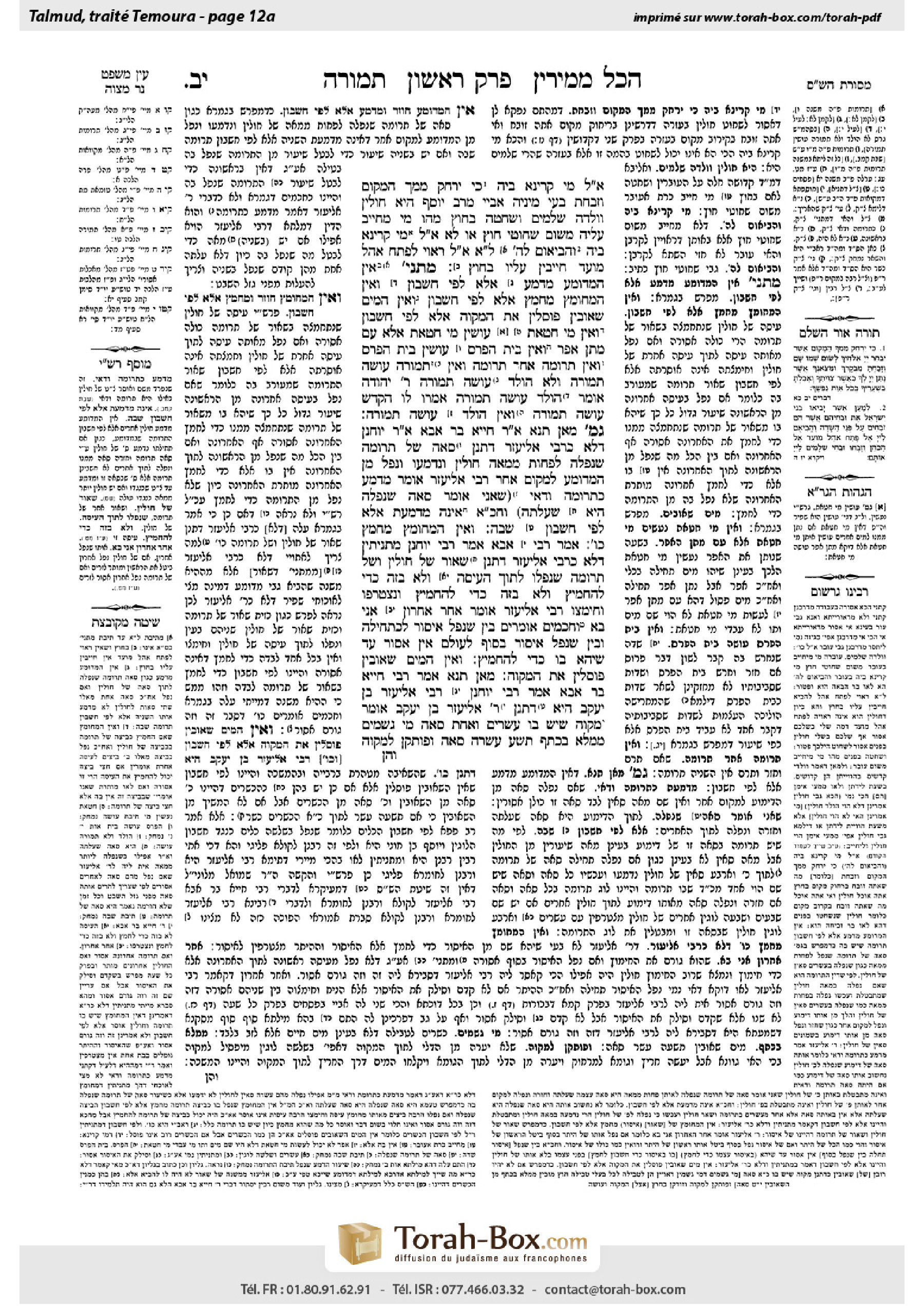
Temurah 12a: Talmud study for Daf Yomi
Daf Yomi is the daily study of one Talmud folio. Explore 37 tractates with scans, Hebrew text, Sefaria English and AI-generated French translations where annotated.
Passage selection and English or AI-generated French translation are available where the scan has annotations. Daf Study is independent of Torah-Box and Sefaria.
Browse Temurah · תמורה · All tractatesTemurah 12a text and translations
This page of Temurah includes the Aramaic text, an English translation and an AI-generated French translation, alongside the scan above.
תמורה י״ב א · Aramaic and Hebrew text
אֲמַר לֵיהּ: מִי קָרֵינָא בֵּיהּ ״כִּי יִרְחַק מִמְּךָ הַמָּקוֹם... וְזָבַחְתָּ״?
בָּעֵי מִינֵּיהּ אַבָּיֵי מֵרַב יוֹסֵף: הִיא חוּלִּין וּוְלָדָהּ שְׁלָמִים, וּשְׁחָטָהּ בְּחוּץ — מַהוּ? מִי מִחַיַּיב עֲלֵיהּ מִשּׁוּם שְׁחוּטֵי חוּץ, אוֹ לָא?
אֲמַר לֵיהּ: מִי קָרֵינָא בֵּיהּ ״וֶהֱבִיאָם לַה׳״?
לִישָּׁנָא אַחֲרִינָא, אֲמַר לֵיהּ: רָאוּי לְפֶתַח אֹהֶל מוֹעֵד חַיָּיבִין עָלָיו בַּחוּץ.
מַתְנִי׳ אֵין הַמְדוּמָּע מְדַמֵּעַ, אֶלָּא לְפִי חֶשְׁבּוֹן.
וְאֵין הַמְחוּמָּץ מְחַמֵּץ אֶלָּא לְפִי חֶשְׁבּוֹן, וְאֵין הַמַּיִם שְׁאוּבִין פּוֹסְלִין אֶת הַמִּקְוֶה אֶלָּא לְפִי חֶשְׁבּוֹן.
וְאֵין מֵי חַטָּאת, עוֹשִׂין מֵי חַטָּאת אֶלָּא עִם מַתַּן אֵפֶר, וְאֵין בֵּית הַפְּרָס עוֹשִׂין בֵּית הַפְּרָס, וְאֵין תְּרוּמָה אַחַר תְּרוּמָה.
וְאֵין תְּמוּרָה עוֹשָׂה תְּמוּרָה, וְלֹא הַוָּלָד עוֹשֶׂה תְּמוּרָה. רַבִּי יְהוּדָה אוֹמֵר: הַוָּלָד עוֹשֶׂה תְּמוּרָה. אָמְרוּ לוֹ: הֶקְדֵּשׁ עוֹשֶׂה תְּמוּרָה, וְאֵין הַוָּלָד עוֹשֶׂה תְּמוּרָה.
גְּמָ׳ מַאן תַּנָּא? אָמַר רַבִּי חִיָּיא בַּר אַבָּא אָמַר רַבִּי יוֹחָנָן: דְּלָא כְּרַבִּי אֱלִיעֶזֶר.
דִּתְנַן: סְאָה שֶׁל תְּרוּמָה שֶׁנָּפְלָה לְפָחוֹת מִמֵּאָה חוּלִּין, וְנִדְמְעוּ, וְנָפַל מִן הַמְדוּמָּע לְמָקוֹם אַחֵר, רַבִּי אֱלִיעֶזֶר אוֹמֵר: מְדַמֵּעַ כִּתְרוּמָה וַדַּאי (שֶׁאֲנִי אוֹמֵר: סְאָה שֶׁנָּפְלָה הִיא שֶׁעָלְתָה).
וַחֲכָמִים אוֹמְרִים: אֵינָהּ מְדַמַּעַת אֶלָּא לְפִי חֶשְׁבּוֹן שֶׁבָּהּ.
וְאֵין הַמְחוּמָּץ מְחַמֵּץ כּוּ׳. אָמַר רַבִּי אַבָּא אָמַר רַבִּי יוֹחָנָן: מַתְנִיתִין דְּלָא כְּרַבִּי אֱלִיעֶזֶר.
דִּתְנַן: שְׂאוֹר שֶׁל חוּלִּין וְשֶׁל תְּרוּמָה שֶׁנָּפְלוּ לְתוֹךְ הָעִיסָּה, וְלֹא בָּזֶה כְּדֵי לְהַחְמִיץ, וְלֹא בָּזֶה כְּדֵי לְהַחְמִיץ, וְנִצְטָרְפוּ וְחִימְּצוּ. רַבִּי אֱלִיעֶזֶר אוֹמֵר: אַחַר אַחֲרוֹן אֲנִי בָּא, וַחֲכָמִים אוֹמְרִים: בֵּין שֶׁנָּפַל אִיסּוּר לְכַתְּחִילָּה וּבֵין שֶׁנָּפַל אִיסּוּר בַּסּוֹף, לְעוֹלָם אֵין אָסוּר עַד שֶׁיְּהֵא בּוֹ כְּדֵי לְהַחְמִיץ.
וְאֵין הַמַּיִם שְׁאוּבִין פּוֹסְלִין אֶת הַמִּקְוֶה. מַאן תָּנָא? אָמַר רַבִּי חִיָּיא בַּר אַבָּא אָמַר רַבִּי יוֹחָנָן: רַבִּי אֱלִיעֶזֶר בֶּן יַעֲקֹב הִיא, דִּתְנַן: רַבִּי אֱלִיעֶזֶר בֶּן יַעֲקֹב אוֹמֵר: מִקְוֶה שֶׁיֵּשׁ בּוֹ עֶשְׂרִים וְאַחַת סְאָה מֵי גְשָׁמִים, מְמַלֵּא בַּכָּתֵף תְּשַׁע עֶשְׂרֵה סְאָה, וּפוֹתְקָן לַמִּקְוֶה,
Temurah 12a · English translation
Rav Yosef said to Abaye: Slaughtering a pregnant peace offering containing a non-sacred fetus is not subject to the prohibition against slaughtering non-sacred animals in the Temple courtyard. Do we read the verse: “If the place which the Lord your God shall choose to put His name there be too far from you, then you shall slaughter of your herd and of your flock” (Deuteronomy 12:21), as applying to such a case? This verse prohibits the slaughter of non-sacred animals in the Temple, but only those that could be slaughtered elsewhere. But here, he had no choice but to slaughter the pregnant mother in the Temple, since it was a peace offering.
Abaye posed the opposite dilemma to Rav Yosef: According to the opinion of Rabbi Yoḥanan that fetuses can be consecrated, if one consecrated the fetus, but not its mother, as a peace offering, such that it, the mother, is non-sacred, and its offspring is a peace offering, and he slaughtered it outside the Temple courtyard as a non-sacred animal, what is the halakha? Is one liable for it due to the prohibition against slaughtering offerings outside the Temple courtyard, or not?
Rav Yosef said to Abaye: Do we read the verse: “That they may bring them to the Lord” (Leviticus 17:5), as applying to this case? The full passage reads: “Any man of the house of Israel who shall slaughter a bull, or a lamb, or a goat…and has not brought it to the entrance to the Tent of Meeting…that man shall be cut off from among his people. To the end that the children of Israel may bring their sacrifices, which they sacrifice in the open field, even that they may bring them to the Lord, to the door of the Tent of Meeting” (Leviticus 17:3–5). The passage indicates that the prohibition against slaughtering offerings outside the Temple applies only to those offerings that are fit to be slaughtered inside. But this fetus is not fit to be slaughtered at all until it is born.
The Gemara cites another version of this answer. Rav Yosef said to Abaye: The verse states: “And has not brought it to the entrance to the Tent of Meeting.” This teaches that one is liable for slaughtering an offering outside the Temple only if it is fit to come through the entrance to the Tent of Meeting, i.e., to be sacrificed in the Temple. This fetus is not yet fit.
MISHNA: If teruma, the portion of the produce designated for the priest, was intermingled with non-sacred produce, and it is impossible to distinguish between them, if the ratio of non-sacred produce to teruma was less than one hundred to one, the teruma is not nullified and all the produce is forbidden to those for whom teruma is forbidden. If the mixture was then intermingled with other non-sacred produce, that mixture renders it a mixture of teruma only according to the calculation of the percentage of the original teruma produce in the entire mixture.
And dough that was leavened with a teruma leavening agent is forbidden to those for whom teruma is forbidden even if the ratio between the non-sacred and the teruma is greater than one hundred to one. If a portion of that dough was intermingled with non-sacred dough, it leavens only according to the calculation of the percentage of the original leavening agent in the entire dough, and the second dough is forbidden only if the quantity of the original teruma leavening agent inside it is sufficient to leaven it. And if three log of drawn water were poured into a ritual bath with less than forty se’a to complete the requisite forty se’a, the ritual bath is invalidated. But drawn water invalidates the ritual bath only according to calculation, as explained in the Gemara.
And the water of purification of the red heifer becomes water of purification only with the placement of the ashes into the water, but not by placement of water onto the ashes. And one beit haperas does not create another beit haperas. The Sages decreed ritual impurity on a field in which a grave was plowed, scattering the bones throughout the field. This field is called a beit haperas. That impurity extends to the area of one hundred cubits surrounding the grave. Nevertheless, they did not decree impurity on the second field if one plowed from that field into another field. And there is no teruma after teruma. Once one designates produce from his crop as teruma, if he then designates additional produce from that crop as teruma, it is not teruma.
And a substitute animal that was consecrated when it was substituted for a consecrated animal does not render a non-sacred animal exchanged for it a substitute; rather, it remains non-sacred. And the offspring born of a consecrated animal that was not consecrated itself does not render a non-sacred animal exchanged for it a substitute. Rabbi Yehuda says: The offspring renders a non-sacred animal exchanged for it a substitute. The Sages said to him: A consecrated animal renders a non-sacred animal exchanged for it a substitute, but the offspring does not render a non-sacred animal exchanged for it a substitute.
GEMARA: The mishna teaches that if a mixture of teruma produce and non-sacred produce was intermingled with other non-sacred produce, that mixture is prohibited only according to the calculation of the percentage of the original teruma produce in the entire mixture. The Gemara asks: Who is the tanna whose opinion is reflected in this ruling? Rabbi Ḥiyya bar Abba said that Rabbi Yoḥanan said: This ruling is not in accordance with the opinion of Rabbi Eliezer.
As we learned in a mishna (Terumot 5:6): If a se’a of teruma fell into less than one hundred se’a of non-sacred produce and thereby caused it to become a prohibited mixture, since the amount of teruma is too great to be nullified by the non-sacred produce, and a se’a from the mixture subsequently fell into a different place with non-sacred produce, Rabbi Eliezer says: The se’a from the original mixture renders it a prohibited mixture as definite teruma would, in the same ratio, since I say: It is possible that the same se’a of teruma that fell into the first mixture was not mixed evenly throughout, and it all came out of it intact and fell into the second mixture. Therefore, it requires nullification as if it were unadulterated teruma.
And the Rabbis say: The se’a from the original prohibited mixture renders the derivative mixture prohibited only according to the calculation of actual teruma in the entire mixture, calculated as if the teruma were evenly distributed throughout the first mixture. The mishna evidently follows the opinion of the Rabbis.
§ The mishna teaches: And if a portion of dough that was leavened with a teruma leavening agent was intermingled with non-sacred dough, it leavens only according to the calculation. Rabbi Abba said that Rabbi Yoḥanan said: The mishna is not in accordance with the opinion of Rabbi Eliezer.
As we learned in a mishna (Orla 2:11): In a case of non-sacred leaven and leaven of teruma that fell together into a non-sacred batch of dough, and this one alone was not potent enough to cause the dough to become leavened, and that one alone was not potent enough to cause the dough to become leavened, and they combined and caused the dough to become leavened, Rabbi Eliezer says: I follow the final element to fall into the dough. If the teruma fell in last, the dough is prohibited to non-priests. And the Rabbis say: Whether the forbidden item, i.e., the teruma, fell in first or the forbidden item fell in last, it is prohibited only if there is enough of the prohibited leaven itself to cause the dough to leaven.
§ The mishna further teaches: And drawn water invalidates the ritual bath only according to calculation. The Gemara asks: Who is the tanna whose opinion is reflected in this ruling? Rabbi Ḥiyya bar Abba says that Rabbi Yoḥanan says: It is Rabbi Eliezer ben Ya’akov, as we learned in a baraita (Tosefta, Mikvaot 4:3) that Rabbi Eliezer ben Ya’akov says: If a ritual bath contains twenty-one se’a of rainwater, the majority of a valid ritual bath of forty se’a, what can one do to render it valid? One fills drawn water in a bucket carried on the shoulder in the amount of nineteen se’a, and with it fills a pit adjacent to the ritual bath, and one lets the water flow [ufotekan] through a passage from the pit into the ritual bath,
Temurah 12a · Traduction française (IA)
Rav Yosef dit à Abaye : L’égorgement d’une offrande de paix gravide contenant un fœtus non consacré n’est pas soumis à l’interdiction d’égorger des animaux non consacrés dans la cour du Temple. Applique-t-on à ce cas le verset : « Si le lieu que l’Éternel, ton Dieu, choisira pour y faire résider son nom est trop éloigné de toi, tu égorgeras de ton gros et de ton petit bétail » (Deutéronome 12:21) ? Ce verset interdit l’égorgement d’animaux non consacrés dans le Temple, mais seulement de ceux qui pourraient être égorgés ailleurs. Or, ici, il n’avait pas d’autre choix que d’égorger la mère gravide dans le Temple, puisqu’il s’agissait d’une offrande de paix.
Abaye posa à Rav Yosef le dilemme inverse : selon l’opinion de Rabbi Yoḥanan, d’après laquelle les fœtus peuvent être consacrés, si quelqu’un consacrait le fœtus comme offrande de paix, mais pas sa mère, de sorte que celle-ci, la mère, ne soit pas consacrée et que son petit soit une offrande de paix, et qu’il égorgeait la mère hors de la cour du Temple comme un animal non consacré, quelle est la halakha ? Est-il passible de sanction en vertu de l’interdiction d’égorger des offrandes hors de la cour du Temple, ou non ?
Rav Yosef dit à Abaye : Applique-t-on à ce cas le verset : « Afin qu’ils les apportent à l’Éternel » (Lévitique 17:5) ? Le passage entier dit : « Tout homme de la maison d’Israël qui égorgera un taureau, un agneau ou une chèvre… et ne l’aura pas amené à l’entrée de la Tente d’assignation… cet homme sera retranché du sein de son peuple. Afin que les enfants d’Israël apportent à l’Éternel leurs sacrifices, qu’ils offrent en plein champ, afin qu’ils les apportent à l’Éternel, à l’entrée de la Tente d’assignation » (Lévitique 17:3–5). Le passage indique que l’interdiction d’égorger des offrandes hors du Temple ne s’applique qu’aux offrandes qui peuvent être égorgées à l’intérieur. Or, ce fœtus ne peut pas être égorgé avant sa naissance.
La Guemara cite une autre version de cette réponse. Rav Yosef dit à Abaye : Le verset dit : « Et ne l’aura pas amené à l’entrée de la Tente d’assignation. » Cela enseigne que l’on n’est passible d’avoir égorgé une offrande hors du Temple que si celle-ci peut être amenée à l’entrée de la Tente d’assignation, c’est-à-dire être offerte dans le Temple. Ce fœtus n’est pas encore apte à l’être.
Michna : Si de la terouma, la part de la récolte réservée au prêtre, s’est mélangée à des produits non consacrés et qu’il est impossible de les distinguer, si la proportion de produits non consacrés par rapport à la terouma est inférieure à cent pour un, la terouma n’est pas annulée et tous les produits sont interdits à ceux qui ne peuvent pas consommer de terouma. Si le mélange est ensuite mêlé à d’autres produits non consacrés, le nouveau mélange n’est considéré comme contenant de la terouma qu’en fonction de la proportion de la terouma initiale dans l’ensemble du mélange.
Et une pâte qui a levé grâce à un agent levant de terouma est interdite à ceux qui ne peuvent pas consommer de terouma, même si la proportion de produits non consacrés par rapport à la terouma dépasse cent pour un. Si une partie de cette pâte est mêlée à une pâte non consacrée, elle ne la fait lever qu’en fonction de la proportion de l’agent levant de terouma initial dans l’ensemble de la pâte ; la seconde pâte n’est interdite que si la quantité d’agent levant de terouma initial qu’elle contient suffit à la faire lever. Et si trois log d’eau puisée sont versés dans un bain rituel contenant moins de quarante séa, afin d’atteindre les quarante séa requis, le bain rituel est invalidé. Mais l’eau puisée n’invalide le bain rituel qu’en fonction du calcul, comme l’explique la Guemara.
Et l’eau de purification de la vache rousse ne devient de l’eau de purification que si l’on met les cendres dans l’eau, et non si l’on verse l’eau sur les cendres. Et un beit haperas n’en crée pas un autre. Les Sages ont décrété l’impureté rituelle d’un champ dans lequel une tombe a été labourée, dispersant les os dans tout le champ. Ce champ est appelé beit haperas. Cette impureté s’étend sur une distance de cent coudées autour de la tombe. Néanmoins, ils n’ont pas décrété l’impureté du second champ si l’on a labouré depuis le premier champ jusque dans un autre champ. Et il n’y a pas de terouma après la terouma. Dès lors qu’on désigne des produits de sa récolte comme terouma, si l’on en désigne ensuite d’autres de cette même récolte comme terouma, ceux-ci ne sont pas de la terouma.
Et un animal substitut consacré, consacré en remplacement d’un animal consacré, ne rend pas substitut l’animal non consacré échangé contre lui ; celui-ci reste non consacré. Et la progéniture née d’un animal consacré, qui n’a pas été consacrée elle-même, ne rend pas substitut l’animal non consacré échangé contre elle. Rabbi Yehouda dit : La progéniture rend substitut l’animal non consacré échangé contre elle. Les Sages lui dirent : Un animal consacré rend substitut l’animal non consacré échangé contre lui, mais la progéniture ne rend pas substitut l’animal non consacré échangé contre elle.
Guemara : La Michna enseigne que si un mélange de produits de terouma et de produits non consacrés a été mêlé à d’autres produits non consacrés, le nouveau mélange n’est interdit qu’en fonction de la proportion de la terouma initiale dans l’ensemble du mélange. La Guemara demande : De quel tanna cette décision reflète-t-elle l’opinion ? Rabbi Ḥiyya bar Abba dit au nom de Rabbi Yoḥanan : Cette décision n’est pas conforme à l’opinion de Rabbi Eliezer.
Comme nous l’avons appris dans une Michna (Teroumot 5:6) : Si un séa de terouma tombe dans moins de cent séa de produits non consacrés et rend ainsi le mélange interdit, puisque la quantité de terouma est trop importante pour être annulée par les produits non consacrés, et qu’un séa de ce mélange tombe ensuite en un autre endroit où se trouvent des produits non consacrés, Rabbi Eliezer dit : Le séa issu du mélange initial rend le nouveau mélange interdit comme le ferait de la terouma certaine, dans la même proportion, car je dis qu’il est possible que le séa de terouma tombé dans le premier mélange ne s’y soit pas réparti uniformément, mais en soit ressorti intact et soit tombé dans le second mélange. Il faut donc l’annuler comme s’il s’agissait de terouma pure.
Et les Sages disent : Le séa provenant du mélange initial interdit ne rend le mélange dérivé interdit qu’en fonction de la quantité réelle de terouma dans l’ensemble du mélange, calculée comme si la terouma était répartie uniformément dans le premier mélange. La Michna suit manifestement l’opinion des Sages.
§ La Michna enseigne : Et si une partie d’une pâte qui a levé grâce à un agent levant de terouma est mêlée à une pâte non consacrée, elle ne la fait lever qu’en fonction du calcul. Rabbi Abba dit au nom de Rabbi Yoḥanan : La Michna n’est pas conforme à l’opinion de Rabbi Eliezer.
Comme nous l’avons appris dans une Michna (Orla 2:11) : Dans le cas où du levain non consacré et du levain de terouma tombent ensemble dans une pâte non consacrée, que ni l’un ni l’autre, pris isolément, ne soit assez puissant pour faire lever la pâte, mais qu’ensemble ils la fassent lever, Rabbi Eliezer dit : Je m’en tiens au dernier élément tombé dans la pâte. Si la terouma tombe en dernier, la pâte est interdite aux non-prêtres. Et les Sages disent : Que l’élément interdit, c’est-à-dire la terouma, tombe en premier ou en dernier, la pâte n’est interdite que si la quantité de levain interdit à elle seule suffit à la faire lever.
§ La Michna enseigne encore : Et l’eau puisée n’invalide le bain rituel qu’en fonction du calcul. La Guemara demande : De quel tanna cette décision reflète-t-elle l’opinion ? Rabbi Ḥiyya bar Abba dit au nom de Rabbi Yoḥanan : Il s’agit de Rabbi Eliezer ben Yaakov, comme nous l’avons appris dans une baraïta (Tossefta, Mikvaot 4:3). Rabbi Eliezer ben Yaakov dit : Si un bain rituel contient vingt et un séa d’eau de pluie, soit plus de la moitié des quarante séa nécessaires à un bain rituel valide, que peut-on faire pour le rendre valide ? On remplit d’eau puisée, portée dans un seau sur l’épaule, une quantité de dix-neuf séa, puis on remplit avec cette eau une fosse adjacente au bain rituel et on laisse l’eau s’écouler [ufotekan] par un passage de la fosse vers le bain rituel,
Traduction française générée par IA à partir de l’édition anglaise de Sefaria. Vérifie toujours un passage avec le texte source.
Text from Sefaria: William Davidson Edition - Vocalized Aramaic (CC BY NC); William Davidson Edition - English (CC BY NC).