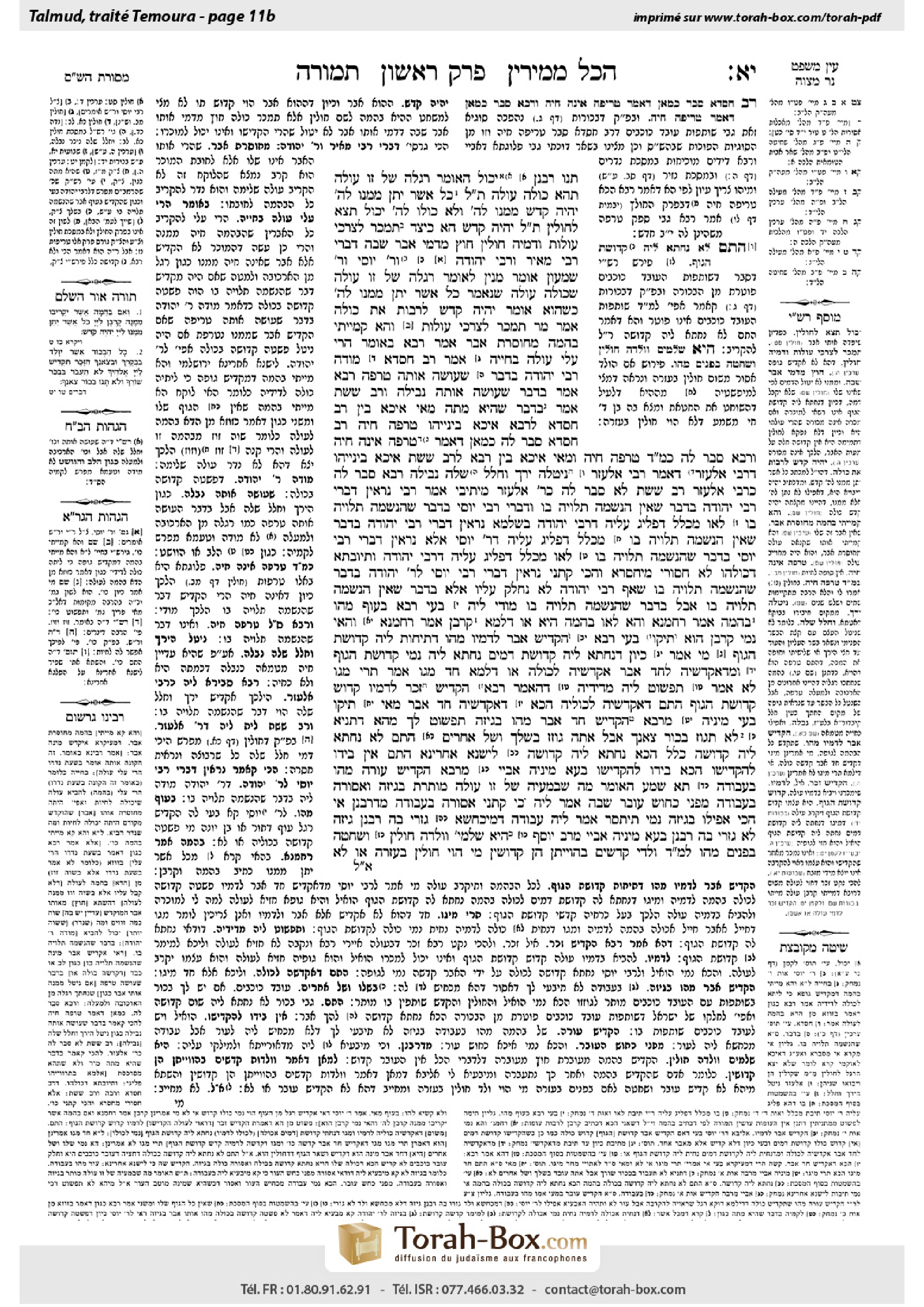
Temurah 11b: Talmud study for Daf Yomi
Daf Yomi is the daily study of one Talmud folio. Explore 37 tractates with scans, Hebrew text, Sefaria English and AI-generated French translations where annotated.
Passage selection and English or AI-generated French translation are available where the scan has annotations. Daf Study is independent of Torah-Box and Sefaria.
Browse Temurah · תמורה · All tractatesTemurah 11b text and translations
This page of Temurah includes the Aramaic text, an English translation and an AI-generated French translation, alongside the scan above.
תמורה י״א ב · Aramaic and Hebrew text
תָּנוּ רַבָּנַן: יָכוֹל הָאוֹמֵר ״רַגְלָהּ שֶׁל זוֹ עוֹלָה״ תְּהֵא כּוּלָּהּ עוֹלָה? תַּלְמוּד לוֹמַר: ״כֹּל אֲשֶׁר יִתֵּן מִמֶּנּוּ לַה׳ יִהְיֶה קֹּדֶשׁ״ — מִמֶּנּוּ לַה׳, וְלֹא כּוּלּוֹ לַה׳.
יָכוֹל תֵּצֵא לְחוּלִּין? תַּלְמוּד לוֹמַר ״יִהְיֶה קֹּדֶשׁ״. הָא כֵּיצַד? תִּמָּכֵר לְצׇרְכֵי עוֹלוֹת, וְדָמֶיהָ חוּלִּין, חוּץ מִדְּמֵי אֵבֶר שֶׁבָּהּ — דִּבְרֵי רַבִּי מֵאִיר וְרַבִּי יְהוּדָה.
וְרַבִּי יוֹסֵי וְרַבִּי שִׁמְעוֹן אוֹמֵר: מִנַּיִן לָאוֹמֵר ״רַגְלָהּ שֶׁל זוֹ עוֹלָה״, שֶׁכּוּלָּהּ עוֹלָה? שֶׁנֶּאֱמַר: ״כֹּל אֲשֶׁר יִתֵּן מִמֶּנּוּ לַה׳״, כְּשֶׁהוּא אוֹמֵר ״יִהְיֶה קֹדֶשׁ״ — לְרַבּוֹת אֶת כּוּלָּהּ.
אָמַר מָר: תִּמָּכֵר לְצׇרְכֵי עוֹלוֹת, וְהָא קָמַיְיתֵי בְּהֵמָה מְחוּסֶּרֶת אֵבֶר? אָמַר רָבָא: בְּאוֹמֵר ״הֲרֵי עָלַי עוֹלָה בְּחַיֶּיהָ״.
אָמַר רַב חִסְדָּא: מוֹדֶה רַבִּי יְהוּדָה בְּדָבָר שֶׁעוֹשֶׂה אוֹתָהּ טְרֵפָה. רָבָא אָמַר: בְּדָבָר שֶׁעוֹשֶׂה אוֹתָהּ נְבֵילָה. וְרַב שֵׁשֶׁת אָמַר: בְּדָבָר שֶׁהִיא מֵתָה.
מַאי אִיכָּא בֵּין רַב חִסְדָּא לְרָבָא? אִיכָּא בֵּינַיְיהוּ טְרֵפָה חַיָּה. רַב חִסְדָּא סָבַר לַהּ כְּמַאן דְּאָמַר טְרֵפָה אֵינָהּ חַיָּה, וְרָבָא סָבַר לַהּ כְּמַאן דְּאָמַר טְרֵפָה חַיָּה.
וּמַאי אִיכָּא בֵּין רָבָא לְרַב שֵׁשֶׁת? אִיכָּא בֵּינַיְיהוּ דְּרַבִּי אֶלְעָזָר, דְּאָמַר רַבִּי אֶלְעָזָר: נִיטְּלָה יָרֵךְ וְחָלָל שֶׁלָּהּ — נְבֵילָה. רָבָא סָבַר לַהּ כְּרַבִּי אֶלְעָזָר, רַב שֵׁשֶׁת לָא סָבַר לַהּ כְּרַבִּי אֶלְעָזָר.
מֵיתִיבִי: אָמַר רַבִּי: נִרְאִין דִּבְרֵי רַבִּי יְהוּדָה בְּדָבָר שֶׁאֵין הַנְּשָׁמָה תְּלוּיָה בּוֹ, וְדִבְרֵי רַבִּי יוֹסֵי בְּדָבָר שֶׁהַנְּשָׁמָה תְּלוּיָה בּוֹ. לָאו מִכְּלָל דִּפְלִיג עֲלֵיהּ דְּרַבִּי יְהוּדָה?
בִּשְׁלָמָא נִרְאִין דִּבְרֵי רַבִּי יְהוּדָה בְּדָבָר שֶׁאֵין הַנְּשָׁמָה תְּלוּיָה בּוֹ, מִכְּלָל דִּפְלִיג עֲלֵיהּ דְּרַבִּי יוֹסֵי. אֶלָּא נִרְאִין דִּבְרֵי רַבִּי יוֹסֵי בְּדָבָר שֶׁהַנְּשָׁמָה תְּלוּיָה בּוֹ — לָאו מִכְּלָל דִּפְלִיג עֲלֵיהּ דְּרַבִּי יְהוּדָה? וּתְיוּבְתָּא דְּכוּלְּהוּ!
לָא, חַסּוֹרֵי מִיחַסְּרָא וְהָכִי קָתָנֵי: נִרְאִין דִּבְרֵי רַבִּי יוֹסֵי לְרַבִּי יְהוּדָה בְּדָבָר שֶׁהַנְּשָׁמָה תְּלוּיָה בּוֹ, שֶׁאַף רַבִּי יְהוּדָה לֹא נֶחְלַק עָלָיו אֶלָּא בְּדָבָר שֶׁאֵין הַנְּשָׁמָה תְּלוּיָה בּוֹ, אֲבָל בְּדָבָר שֶׁהַנְּשָׁמָה תְּלוּיָה בּוֹ מוֹדֵי לֵיהּ.
בָּעֵי רָבָא: בָּעוֹף מַהוּ? ״בְּהֵמָה״ אָמַר רַחֲמָנָא, וְהָא לָאו ״בְּהֵמָה״ הִיא, אוֹ דִלְמָא ״קׇרְבָּן״ אָמַר רַחֲמָנָא, וְהַאי נָמֵי ״קׇרְבָּן״ הוּא? תֵּיקוּ.
בָּעֵי רָבָא: הִקְדִּישׁ אֵבֶר לְדָמָיו, מַהוּ דְּתֵיחוֹת לֵיהּ קְדוּשַּׁת הַגּוּף? מִי אָמַר: כֵּיוָן דְּנָחֲתָא לֵיהּ קְדוּשַּׁת דָּמִים — נָחֲתָא לֵיהּ נָמֵי קְדוּשַּׁת הַגּוּף, וּמִדְּאַקְדְּשֵׁיהּ לְחַד אֵבֶר — אַקְדְּשַׁיהּ לְכוּלַּהּ, אוֹ דִלְמָא חַד מִגּוֹ אָמַר, תְּרֵי מִגּוֹ לָא אָמַר?
תִּפְשׁוֹט לֵיהּ מִדִּידֵיהּ, דְּהָאָמַר רָבָא: הִקְדִּישׁ זָכָר לְדָמָיו — קָדוֹשׁ קְדוּשַּׁת הַגּוּף!
הָתָם — דְּאַקְדְּשֵׁיהּ לְכוּלֵּיהּ, הָכָא — דְּאַקְדְּשֵׁיהּ חַד אֵבֶר, מַאי? תֵּיקוּ.
בָּעֵי מִינֵּיהּ [אַבָּיֵי] מֵרָבָא: הִקְדִּישׁ חַד אֵבֶר, מַהוּ בְּגִיזָּה? תִּפְשׁוֹט לָךְ מֵהָא דְּתַנְיָא: ״לֹא תָגוֹז בְּכוֹר צֹאנְךָ״, אֲבָל אַתָּה גּוֹזֵז בְּשֶׁלְּךָ וְשֶׁל אֲחֵרִים.
הָתָם, לָא נָחֲתָא לֵיהּ קְדוּשָּׁה כְּלָל; הָכָא, נָחֲתָא לֵיהּ קְדוּשָּׁה. לִישָּׁנָא אַחֲרִינָא: הָתָם, אֵין בְּיָדוֹ לְהַקְדִּישׁוֹ; הָכָא, בְּיָדוֹ לְהַקְדִּישׁוֹ.
בְּעָא מִינֵּיהּ אַבָּיֵי מֵרָבָא: הִקְדִּישׁ עוֹרָהּ, מַהוּ בַּעֲבוֹדָה? תָּא שְׁמַע: הָאוֹמֵר ״מָה שֶׁבְּמֵעֶיהָ שֶׁל זוֹ עוֹלָה״ — מוּתֶּרֶת בְּגִיזָּה, וַאֲסוּרָה בַּעֲבוֹדָה, מִפְּנֵי כִּחוּשׁ עוּבָּר שֶׁבָּהּ.
אֲמַר לֵיהּ: כִּי קָתָנֵי אֲסוּרָה בַּעֲבוֹדָה — מִדְּרַבָּנַן. אִי הָכִי, אֲפִילּוּ בְּגִיזָּה נָמֵי תִּיתְּסַר! אֲמַר לֵיהּ: עֲבוֹדָה דְּמַיכְחֲשָׁא — גָּזְרִי בַּהּ רַבָּנַן, גִּיזָּה — לָא גָּזְרִי בַּהּ רַבָּנַן.
בְּעָא מִינֵּיהּ אַבָּיֵי מֵרַב יוֹסֵף: הִיא שְׁלָמִים וּוְלָדָהּ חוּלִּין, וּשְׁחָטָהּ בִּפְנִים, מַהוּ? לְמַאן דְּאָמַר וַלְדֵי קָדָשִׁים בַּהֲוָיָיתָן הֵן קְדוֹשִׁין, מִי הָוֵי חוּלִּין בַּעֲזָרָה אוֹ לָא?
Temurah 11b · English translation
The Sages taught: One might have thought that if one says: The leg of this animal is a burnt offering, the sanctity should extend to the whole animal and all of the animal will be a burnt offering. Therefore, the verse states: “And if it is an animal of those that they bring as an offering to the Lord, anything of it that one gives to the Lord, it shall be sacred” (Leviticus 27:9). The verse indicates that the part of it that one gives will be sacred unto the Lord, and not all of the animal will be sacred unto the Lord.
If so, one might have thought that the consecrated limb may be redeemed and thereby transferred to non-sacred status. Therefore the verse states: “Shall be sacred,” teaching that the limb remains consecrated. How is this possible, i.e., what should one do with the animal? The animal should be sold for the needs of burnt offerings to an individual who will sacrifice the entire animal as a burnt offering, and the payment received for the animal will be non-sacred, except for the payment received in exchange for the limb of the animal that was consecrated. This is the statement of Rabbi Meir and Rabbi Yehuda.
But Rabbi Yosei and Rabbi Shimon say: From where is it derived in the case of one who says: The leg of this animal is a burnt offering, that all of it becomes a burnt offering? Since it is stated: “All that any man give of such to the Lord shall be sacred” (Leviticus 27:9), one might have thought that individual limbs can be consecrated. When it says: “Shall be sacred,” this phrase serves to include all of the animal, indicating that it all becomes sacred.
The Gemara objects: The Master said: The animal should be sold for the needs of burnt offerings. But it is as though the purchaser is bringing an animal that lacks that limb that was consecrated by the previous owner, as his share in the offering consists only of the balance of the animal. Rava says: The baraita does not mean that the animal should be sold to anyone obligated to bring a burnt offering, but specifically to one who says: It is incumbent upon me to bring a burnt offering with all the limbs upon which its life depends. Since the consecrated limb is not one of these, it does not detract from the purchaser’s vow.
The Gemara cites a dispute between amora’im: Rav Ḥisda says that Rabbi Yehuda and Rabbi Meir concede with regard to a limb whose removal renders the animal a tereifa. If one consecrated such a limb, the sanctity extends throughout the entire animal. Rava says: Even in such a case, Rabbi Meir and Rabbi Yehuda maintain that the sanctity does not extend throughout the entire animal. Yet, they concede with regard to a limb whose removal renders it an animal carcass, i.e., without which the animal would die so soon that it assumes the status of a carcass. And Rav Sheshet says: They conceded only with regard to a limb whose removal would cause it to die immediately.
The Gemara explains: What difference is there between the opinion of Rav Ḥisda and that of Rava? The difference between them is with regard to the issue of whether a tereifa can survive. Rav Ḥisda holds in accordance with the opinion of the one who said that a tereifa cannot survive but will shortly die. Therefore, Rabbi Meir and Rabbi Yehuda concede that if one consecrates a limb whose removal would render an animal a tereifa, the sanctity applies to the whole animal, since it is a vital organ. And Rava holds in accordance with the opinion of the one who says that a tereifa can survive, and consequently the consecration of such a limb does not extend to the entire animal.
The Gemara further explains: And what difference is there between the opinion of Rava and the opinion of Rav Sheshet? The difference between them is with regard to the opinion of Rabbi Elazar, as Rabbi Elazar said: If the thigh, i.e., the hind leg of the animal, and its recess were removed, the animal is considered a carcass and imparts ritual impurity even while still alive. Rava holds in accordance with the opinion of Rabbi Elazar, and therefore he maintains that according to Rabbi Meir and Rabbi Yehuda, if one consecrates its thigh and its recess the sanctity extends throughout the animal, as it is a vital limb. But Rav Sheshet does not hold in accordance with the opinion of Rabbi Elazar, and therefore the sanctity in such a case does not extend to the entire animal.
The Gemara raises an objection: Rabbi Yehuda HaNasi said: With regard to the dispute between Rabbi Yehuda and Rabbi Yosei, the statement of Rabbi Yehuda, that the sanctity does not extend to the whole animal, appears correct with regard to a limb upon which the animal’s life does not depend, and the statement of Rabbi Yosei appears correct with regard to a limb upon which the animal’s life depends. May one not conclude by inference from the statement of Rabbi Yehuda HaNasi that Rabbi Yosei disagrees with Rabbi Yehuda even with regard to a limb upon which the animal’s life depends, contrary to the statements of the amora’im above?
Granted, Rabbi Yehuda HaNasi’s comment: The statement of Rabbi Yehuda appears correct with regard to a limb upon which the animal’s life does not depend, is not difficult, as one learns by inference only that Rabbi Yehuda disagrees with Rabbi Yosei with regard to such a case. But when he says that the statement of Rabbi Yosei appears correct with regard to a limb upon which the animal’s life depends, must one not conclude by inference that Rabbi Yosei disagrees with Rabbi Yehuda with regard to this case as well? And this is apparently a conclusive refutation of all the opinions of the amora’im cited above, who maintain that Rabbi Yehuda concedes with regard to vital organs.
The Gemara answers: No, the baraita citing Rabbi Yehuda HaNasi’s statement is incomplete, and this is what it is teaching: The statement of Rabbi Yosei appears correct to Rabbi Yehuda in the case of a limb upon which the animal’s life depends, as even Rabbi Yehuda disagreed with Rabbi Yosei only with regard to a limb upon which the animal’s life does not depend. But with regard to a limb upon which the animal’s life depends, Rabbi Yehuda concedes to him that the sanctity extends to the entire animal.
§ According to Rabbi Yosei, if one consecrates one limb of an animal the sanctity extends to the entire animal. Rava raises a dilemma: With regard to a bird that is fit for sacrifice, what is the halakha according to this opinion? Since this halakha is derived, as stated above, from the verse: “And if it is an animal of those that they bring as an offering to the Lord, anything of it that one gives to the Lord, it shall be sacred” (Leviticus 27:9), one can contend that the Merciful One states “animal,” and this bird is not considered an animal. Or perhaps one should stress that the Merciful One states “offering,” and this bird is also considered an offering. The Gemara concludes: The dilemma shall stand unresolved.
Rava raises another dilemma: According to Rabbi Yosei, if one consecrated a limb with the intention of selling it and purchasing an offering with its payment, what is the halakha as to whether the entire animal is imbued with inherent sanctity? Does one say that since it is imbued with sanctity that inheres in its value, it is likewise imbued with inherent sanctity, and then furthermore, from the fact that he consecrated one limb he has consecrated the entire animal? Or perhaps one says a claim using the logic that begins with: Since, only once, but one does not say two claims together using the logic that begins with: Since, i.e., one cannot make both of the suggested expansions simultaneously.
The Gemara suggests: Resolve the dilemma by citing Rava’s own statement. As, didn’t Rava say: If one consecrated a male ram for its value, since the ram is fit for sacrifice, it is automatically consecrated with inherent sanctity? The same reasoning should apply here: Although the limb was consecrated for its value, since the animal is fit for sacrifice, once the entire animal is consecrated for its value it should automatically assume inherent sanctity.
The Gemara responds that this is not a proof: There, where he initially consecrated all of it, the whole animal assumes inherent sanctity. Here, Rava is referring to a case where he consecrated only one limb at the outset, and one must invoke two separate expansions to apply inherent sanctity to the whole animal. The question stands: What is the halakha? The Gemara concludes: The dilemma shall stand unresolved.
§ According to Rabbi Yehuda, if one consecrates a limb, the sanctity does not extend to the entire animal. A Sage posed a dilemma to Rava: If one consecrated one limb, what is the halakha with regard to shearing the wool of that limb? Rava replied: You can resolve the dilemma from that which is taught in a baraita: The verse states: “Nor shear the firstborn of your flock” (Deuteronomy 15:19). This verse indicates that the prohibition against shearing applies only to an animal belonging entirely to you, but you may shear the wool of a firstborn that belongs both to you and to others, i.e., gentiles. Here too, since the animal is jointly owned by the Temple and by the one who consecrated it, the prohibition against shearing should not apply at all.
The Sage responded that this is not a proof: There, a firstborn animal owned partly by a gentile was not imbued with sanctity at all, whereas here it was at least partly imbued with sanctity, and therefore it is possible that the limb is prohibited with respect to shearing. The Gemara cites another version of this answer: There, in the case of a firstborn animal owned partly by a gentile, it is not in the Jew’s power to consecrate his share. Therefore, the prohibition against shearing does not apply. But here it is in his power to consecrate one limb, and sanctity applies to it. Therefore, one can claim that the limb should be prohibited with respect to shearing.
Abaye posed a dilemma to Rava: If one consecrated only the skin of an animal, what is the halakha as to whether it may be used for labor? Rava responded: Come and hear a baraita: In the case of one who says: That which is in the womb of this animal is a burnt offering, it is permitted for the mother to be shorn but it is prohibited to use the animal for labor, due to the inevitable weakening of the fetus inside it. The same should apply to an animal whose skin alone was consecrated, as performing labor with the animal would reduce the value of its skin.
Abaye said to Rava: When that baraita teaches that it is prohibited to use the mother for labor, this applies by rabbinic law. I was asking whether it is prohibited by Torah law. Rava responded: If so, that the baraita is referring to rabbinic law, then even shearing it should be prohibited. Abaye said to him: With regard to labor, which weakens the animal, the Sages issued a decree rendering it prohibited; with regard to shearing, which does not weaken the animal, the Sages did not issue a decree rendering it prohibited.
Abaye posed a dilemma to Rav Yosef: If one consecrates a pregnant animal as a peace offering but excludes its fetus, and as a result it is sanctified as a peace offering and its offspring is non-sacred, and he slaughtered the pregnant animal inside the Temple courtyard as appropriate for a peace offering, what is the halakha? Or, if one consecrates an animal and it subsequently becomes pregnant, then according to the one who said that the offspring of sacrificial animals are sanctified only when they come into being, i.e., at the time of their birth, are offspring such as this subject to the prohibition against slaughtering non-sacred animals in the Temple courtyard, since they are not yet born? Or are they not subject to the prohibition, since they themselves were not slaughtered?
Temurah 11b · Traduction française (IA)
Les Sages ont enseigné : On aurait pu penser que si quelqu’un dit : « La patte de cet animal est un holocauste », la sainteté s’étend à l’animal tout entier et que celui-ci devient entièrement un holocauste. C’est pourquoi le verset dit : « Et si c’est un animal parmi ceux qu’on apporte en offrande à l’Éternel, tout ce qu’on en donne à l’Éternel sera consacré » (Lévitique 27,9). Le verset indique que la partie qu’on donne sera consacrée à l’Éternel, mais non l’animal tout entier.
Si tel était le cas, on aurait pu penser que le membre consacré peut être racheté et ainsi passer au statut profane. C’est pourquoi le verset dit : « Sera consacré », pour enseigner que le membre reste consacré. Comment cela est-il possible, c’est-à-dire que faut-il faire de l’animal ? On vendra l’animal pour les besoins des holocaustes à une personne qui offrira l’animal entier en holocauste, et le prix reçu pour l’animal sera profane, à l’exception de la somme reçue en échange du membre de l’animal qui avait été consacré. Telle est la position de Rabbi Meïr et de Rabbi Yehouda.
Mais Rabbi Yossei et Rabbi Shimon disent : D’où déduit-on que, dans le cas de celui qui dit : « La patte de cet animal est un holocauste », l’animal tout entier devient un holocauste ? Puisqu’il est dit : « Tout ce qu’un homme donnera de ces animaux à l’Éternel sera consacré » (Lévitique 27,9), on aurait pu penser que des membres isolés peuvent être consacrés. L’expression « sera consacré » vient inclure l’animal tout entier, indiquant qu’il est entièrement consacré.
La Guemara objecte : Le Maître a dit : On vendra l’animal pour les besoins des holocaustes. Mais c’est comme si l’acheteur apportait un animal auquel manque le membre consacré par le propriétaire précédent, puisque sa part dans l’offrande ne consiste que dans le reste de l’animal. Rava dit : La baraïta ne veut pas dire que l’animal doit être vendu à n’importe qui ayant l’obligation d’apporter un holocauste, mais précisément à celui qui dit : « Je suis tenu d’apporter un holocauste avec tous les membres dont dépend la vie de l’animal. » Puisque le membre consacré n’est pas l’un de ces membres, il ne diminue pas la portée du vœu de l’acheteur.
La Guemara rapporte une controverse entre amoraïm : Rav Ḥisda dit que Rabbi Yehouda et Rabbi Meïr reconnaissent que, si l’on consacre un membre dont l’ablation rend l’animal tereifa, la sainteté s’étend à l’animal tout entier. Rava dit : Même dans ce cas, Rabbi Meïr et Rabbi Yehouda maintiennent que la sainteté ne s’étend pas à l’animal tout entier. Toutefois, ils reconnaissent le cas d’un membre dont l’ablation rend l’animal carcasse, c’est-à-dire qu’en son absence, l’animal mourrait si rapidement qu’il prendrait le statut de carcasse. Rav Sheshet dit : Ils ne reconnaissent ce cas que pour un membre dont l’ablation entraînerait la mort immédiate de l’animal.
La Guemara explique : Quelle différence y a-t-il entre l’opinion de Rav Ḥisda et celle de Rava ? Leur divergence porte sur la question de savoir si une tereifa peut survivre. Rav Ḥisda suit l’opinion de celui qui dit qu’une tereifa ne peut pas survivre, mais mourra bientôt. Par conséquent, Rabbi Meïr et Rabbi Yehouda reconnaissent que si quelqu’un consacre un membre dont l’ablation rendrait l’animal tereifa, la sainteté s’applique à l’animal tout entier, puisqu’il s’agit d’un organe vital. Rava suit, quant à lui, l’opinion de celui qui dit qu’une tereifa peut survivre ; par conséquent, la consécration d’un tel membre ne s’étend pas à l’animal tout entier.
La Guemara explique encore : Quelle différence y a-t-il entre l’opinion de Rava et celle de Rav Sheshet ? Leur divergence porte sur l’opinion de Rabbi Elazar, car Rabbi Elazar a dit : Si la cuisse, c’est-à-dire la patte arrière de l’animal, et son creux étaient retirés, l’animal serait considéré comme une carcasse et transmettrait l’impureté rituelle même s’il était encore vivant. Rava suit l’opinion de Rabbi Elazar et soutient donc que, selon Rabbi Meïr et Rabbi Yehouda, si quelqu’un consacre la cuisse et le creux de l’animal, la sainteté s’étend à l’animal tout entier, puisqu’il s’agit d’un membre vital. Mais Rav Sheshet ne suit pas l’opinion de Rabbi Elazar et, par conséquent, dans un tel cas, la sainteté ne s’étend pas à l’animal tout entier.
La Guemara soulève une objection : Rabbi Yehouda HaNassi a dit : Dans la controverse entre Rabbi Yehouda et Rabbi Yossei, la position de Rabbi Yehouda semble juste concernant un membre dont ne dépend pas la vie de l’animal, et celle de Rabbi Yossei semble juste concernant un membre dont dépend la vie de l’animal. Ne peut-on pas déduire de la déclaration de Rabbi Yehouda HaNassi que Rabbi Yossei est en désaccord avec Rabbi Yehouda même au sujet d’un membre dont dépend la vie de l’animal, contrairement aux propos des amoraïm rapportés plus haut ?
Certes, le commentaire de Rabbi Yehouda HaNassi selon lequel la position de Rabbi Yehouda semble juste concernant un membre dont ne dépend pas la vie de l’animal ne pose pas de difficulté, car on en déduit seulement que Rabbi Yehouda est en désaccord avec Rabbi Yossei dans un tel cas. Mais lorsqu’il dit que la position de Rabbi Yossei semble juste concernant un membre dont dépend la vie de l’animal, ne doit-on pas en déduire que Rabbi Yossei est également en désaccord avec Rabbi Yehouda dans ce cas ? Cela constituerait apparemment une réfutation décisive de toutes les opinions des amoraïm citées plus haut, qui soutiennent que Rabbi Yehouda reconnaît le cas des organes vitaux.
La Guemara répond : Non, la baraïta qui rapporte la déclaration de Rabbi Yehouda HaNassi est incomplète, et voici ce qu’elle enseigne : La position de Rabbi Yossei semble juste à Rabbi Yehouda dans le cas d’un membre dont dépend la vie de l’animal, car Rabbi Yehouda n’était en désaccord avec Rabbi Yossei que concernant un membre dont ne dépend pas la vie de l’animal. Mais pour un membre dont dépend la vie de l’animal, Rabbi Yehouda reconnaît que la sainteté s’étend à l’animal tout entier.
§ Selon Rabbi Yossei, si quelqu’un consacre un membre d’un animal, la sainteté s’étend à l’animal tout entier. Rava soulève une question : Selon cette opinion, quel est le statut d’un oiseau apte au sacrifice ? Puisque cette halakha est déduite, comme indiqué plus haut, du verset : « Et si c’est un animal parmi ceux qu’on apporte en offrande à l’Éternel, tout ce qu’on en donne à l’Éternel sera consacré » (Lévitique 27,9), on peut soutenir que le Miséricordieux parle d’un « animal », et que cet oiseau n’est pas considéré comme un animal. Ou peut-être faut-il souligner que le Miséricordieux parle d’une « offrande », et que cet oiseau est lui aussi considéré comme une offrande. La Guemara conclut : La question reste sans réponse.
Rava soulève une autre question : Selon Rabbi Yossei, si quelqu’un consacre un membre dans l’intention de le vendre et d’acheter une offrande avec le prix obtenu, l’animal tout entier est-il investi d’une sainteté inhérente ? Dit-on que, puisqu’il est investi d’une sainteté attachée à sa valeur, il est également investi d’une sainteté inhérente, et que, de plus, en consacrant un membre, il a consacré l’animal tout entier ? Ou bien dit-on qu’on peut invoquer une seule fois un raisonnement fondé sur « puisque », mais qu’on ne peut pas en invoquer deux à la fois, c’est-à-dire qu’on ne peut pas procéder simultanément aux deux extensions envisagées ?
La Guemara suggère : Résolvons la question en citant une déclaration de Rava lui-même. Rava n’a-t-il pas dit : Si quelqu’un consacre un bélier mâle pour sa valeur, puisque ce bélier est apte au sacrifice, il est automatiquement investi d’une sainteté inhérente ? Le même raisonnement devrait s’appliquer ici : bien que le membre ait été consacré pour sa valeur, puisque l’animal est apte au sacrifice, dès lors que l’animal tout entier est consacré pour sa valeur, il devrait automatiquement acquérir une sainteté inhérente.
La Guemara répond que ce n’est pas une preuve : dans le cas où il a consacré l’animal tout entier dès le départ, celui-ci acquiert une sainteté inhérente. Ici, Rava parle d’un cas où il n’a consacré au départ qu’un seul membre, et il faut invoquer deux extensions distinctes pour appliquer une sainteté inhérente à l’animal tout entier. La question demeure : quel est le statut ? La Guemara conclut : La question reste sans réponse.
§ Selon Rabbi Yehouda, si quelqu’un consacre un membre, la sainteté ne s’étend pas à l’animal tout entier. Un Sage posa une question à Rava : Si quelqu’un a consacré un membre, quel est le statut de la tonte de la laine de ce membre ? Rava répondit : On peut résoudre la question à partir de ce qui est enseigné dans une baraïta : Le verset dit : « Tu ne tondras pas le premier-né de ton troupeau » (Deutéronome 15,19). Ce verset indique que l’interdiction de tondre ne s’applique qu’à un animal qui t’appartient entièrement, mais que tu peux tondre la laine d’un premier-né qui t’appartient conjointement avec d’autres, c’est-à-dire des non-Juifs. Ici aussi, puisque l’animal appartient conjointement au Temple et à celui qui l’a consacré, l’interdiction de tondre ne devrait pas s’appliquer du tout.
Le Sage répondit que ce n’est pas une preuve : dans le cas cité, un premier-né appartenant en partie à un non-Juif n’était investi d’aucune sainteté, tandis qu’ici l’animal est au moins partiellement investi de sainteté, et il est donc possible que la tonte du membre soit interdite. La Guemara rapporte une autre version de cette réponse : dans le cas d’un premier-né appartenant en partie à un non-Juif, le Juif n’a pas le pouvoir de consacrer sa part. C’est pourquoi l’interdiction de tondre ne s’applique pas. Mais ici, il a le pouvoir de consacrer un membre, auquel la sainteté s’applique. On peut donc soutenir que la tonte de ce membre devrait être interdite.
Abayé posa une question à Rava : Si quelqu’un a consacré uniquement la peau d’un animal, peut-on utiliser celui-ci pour le travail ? Rava répondit : Viens et entends une baraïta : Dans le cas de celui qui dit : « Ce qui se trouve dans le ventre de cet animal est un holocauste », il est permis de tondre la mère, mais il est interdit de la faire travailler, en raison de l’affaiblissement inévitable du fœtus qu’elle porte. Il devrait en être de même pour un animal dont seule la peau a été consacrée, car le travail effectué avec lui diminuerait la valeur de sa peau.
Abayé dit à Rava : Lorsque cette baraïta enseigne qu’il est interdit de faire travailler la mère, elle parle d’une interdiction rabbinique. Je demandais si cela est interdit par la Torah. Rava répondit : Si tel est le cas, si la baraïta parle d’une interdiction rabbinique, alors même la tonte devrait être interdite. Abayé lui dit : Pour le travail, qui affaiblit l’animal, les Sages ont décrété une interdiction ; pour la tonte, qui n’affaiblit pas l’animal, les Sages n’ont pas décrété d’interdiction.
Abayé posa une question à Rav Yossef : Si quelqu’un consacre un animal gravide comme sacrifice de paix, mais en exclut le fœtus, de sorte que l’animal est consacré comme sacrifice de paix tandis que sa progéniture reste profane, et qu’il abat l’animal gravide dans la cour du Temple, comme il convient pour un sacrifice de paix, quel est le statut ? Ou bien, si quelqu’un consacre un animal qui devient ensuite gravide, alors, selon celui qui dit que la progéniture des animaux consacrés n’est consacrée qu’au moment où elle vient au monde, c’est-à-dire à sa naissance, de tels petits sont-ils soumis à l’interdiction d’abattre des animaux profanes dans la cour du Temple, puisqu’ils ne sont pas encore nés ? Ou bien n’y sont-ils pas soumis, puisqu’ils n’ont pas été abattus eux-mêmes ?
Traduction française générée par IA à partir de l’édition anglaise de Sefaria. Vérifie toujours un passage avec le texte source.
Text from Sefaria: William Davidson Edition - Vocalized Aramaic (CC BY NC); William Davidson Edition - English (CC BY NC).