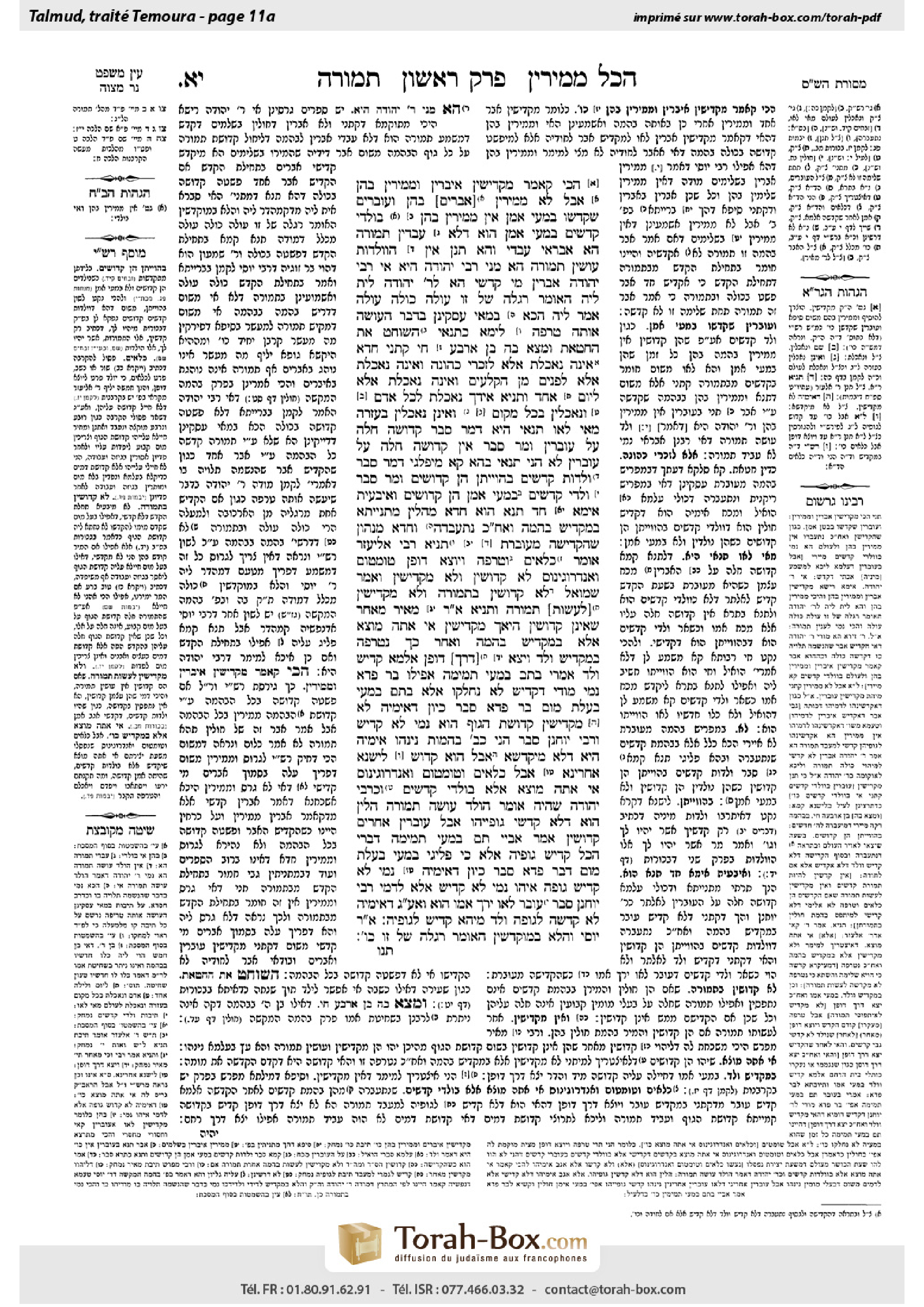
Temurah 11a: Talmud study for Daf Yomi
Daf Yomi is the daily study of one Talmud folio. Explore 37 tractates with scans, Hebrew text, Sefaria English and AI-generated French translations where annotated.
Passage selection and English or AI-generated French translation are available where the scan has annotations. Daf Study is independent of Torah-Box and Sefaria.
Browse Temurah · תמורה · All tractatesTemurah 11a text and translations
This page of Temurah includes the Aramaic text, an English translation and an AI-generated French translation, alongside the scan above.
תמורה י״א א · Aramaic and Hebrew text
הָכִי קָאָמַר: מַקְדִּישִׁין אֵיבָרִין וּמְמִירִין בָּהֶן, אֲבָל לֹא מְמִירִין בָּהֶן, וְעוּבָּרִים שֶׁקָּדְשׁוּ בִּמְעֵי אִמָּן אֵין מְמִירִין בָּהֶן.
בְּוַלְדֵי קָדָשִׁים, בִּמְעֵי אִמָּן — הוּא דְּלָא עָבְדִין תְּמוּרָה, הָא אַבָּרַאי — עָבְדִי. וְהָא תְּנַן: אֵין הַוְּולָדוֹת עוֹשִׂין תְּמוּרָה! הָא מַנִּי? רַבִּי יְהוּדָה הִיא.
אִי רַבִּי יְהוּדָה, אֵבָרִין מִי קָדְשִׁי? הָא לְרַבִּי יְהוּדָה לֵית לֵיהּ הָאוֹמֵר ״רַגְלָהּ שֶׁל זוֹ עוֹלָה״ — כּוּלָּהּ עוֹלָה!
אֲמַר לֵיהּ: הָכָא בְּמַאי עָסְקִינַן — בְּדָבָר הָעוֹשֶׂה אוֹתָהּ טְרֵפָה.
לֵימָא כְּתַנָּאֵי: הַשּׁוֹחֵט אֶת הַחַטָּאת, וּמָצָא בָּהּ בֶּן אַרְבַּע חַי, קָתָנֵי חֲדָא: אֵינָהּ נֶאֱכֶלֶת אֶלָּא לְזִכְרֵי כְהוּנָּה, וְאֵינָהּ נֶאֱכֶלֶת אֶלָּא לִפְנִים מִן הַקְּלָעִים, וְאֵינָהּ נֶאֱכֶלֶת אֶלָּא לְיוֹם אֶחָד.
וְתַנְיָא אִידַּךְ: נֶאֱכֶלֶת לְכׇל אָדָם, וְנֶאֱכָלִין בְּכׇל מָקוֹם, וְאֵינָן נֶאֱכָלִין בַּעֲזָרָה. מַאי לָאו תַּנָּאֵי הִיא? דְּמָר סָבַר: קְדוּשָּׁה חָלָה עַל עוּבָּרִין, וּמַר סָבַר: אֵין קְדוּשָּׁה חָלָה עַל עוּבָּרִין.
לָא, הָנֵי תַּנָּאֵי בְּהָא קָא מִיפַּלְגִי, דְּמָר סָבַר: וַלְדוֹת קָדָשִׁים בַּהֲוָיָיתָן הֵן קְדוֹשִׁים, וּמָר סָבַר: וַלְדֵי קָדָשִׁים בִּמְעֵי אִמָּן הֵן קְדוֹשִׁים.
וְאִיבָּעֵית אֵימָא, חַד תַּנָּא הוּא, חֲדָא מֵהָלֵין מַתְנְיָיתָא — בְּמַקְדִּישׁ בְּהֵמָה וְאַחַר כָּךְ נִתְעַבְּרָה, וַחֲדָא מִנְּהוֹן — שֶׁהִקְדִּישָׁהּ מְעוּבֶּרֶת.
תַּנְיָא, רַבִּי אֱלִיעֶזֶר אוֹמֵר: כִּלְאַיִם, וּטְרֵפָה, וְיוֹצֵא דּוֹפֶן, טוּמְטוּם, וְאַנְדְּרוֹגִינוֹס — לֹא קְדוֹשִׁין וְלֹא מַקְדִּישִׁין. וְאָמַר שְׁמוּאֵל: לֹא קְדוֹשִׁין בִּתְמוּרָה, וְלֹא מַקְדִּישִׁין לַעֲשׂוֹת תְּמוּרָה.
וְתַנְיָא, אָמַר רַבִּי מֵאִיר: מֵאַחַר שֶׁאֵינָן קְדוֹשִׁין, הֵיאַךְ מַקְדִּישִׁין? אִי אַתָּה מוֹצֵא אֶלָּא בְּמַקְדִּישׁ בְּהֵמָה וְאַחַר כָּךְ נִטְרְפָה, בְּמַקְדִּישׁ וָלָד וְיָצָא [דֶּרֶךְ] דּוֹפֶן. אַלְמָא קָדֵישׁ וָלָד!
אָמְרִי: בְּתָם בִּמְעֵי תְמִימָה, אֲפִילּוּ בַּר פְּדָא נָמֵי מוֹדֵי דְּקָדֵישׁ. לֹא נֶחְלְקוּ אֶלָּא בְּתָם בִּמְעֵי בַּעֲלַת מוּם. בַּר פְּדָא סָבַר: כֵּיוָן דְּאִימֵּיהּ לָא מִקַּדְּשָׁא קְדוּשַּׁת הַגּוּף, הוּא נָמֵי לָא קָדֵישׁ. וְרַבִּי יוֹחָנָן סָבַר: הָנֵי כִּשְׁתֵּי בְהֵמוֹת נִינְהוּ, אִימֵּיהּ הִיא דְּלָא מִיקַּדְּשָׁא, אֲבָל הוּא קָדוֹשׁ.
לִישָּׁנָא אַחֲרִינָא, אֲבָל כִּלְאַיִם וְטוּמְטוּם וְאַנְדְּרוֹגִינוֹס, אִי אַתָּה מוֹצֵא אֶלָּא בְּוַלְדֵי קֳדָשִׁים.
וּכְרַבִּי יְהוּדָה, שֶׁהָיָה אוֹמֵר: הַוָּלָד עוֹשֶׂה תְּמוּרָה. הָלֵין הוּא דְּלָא קָדְשִׁי גּוּפַיְיהוּ, אֲבָל עוּבָּרִין אֲחֵרִים קְדוֹשִׁין!
אָמַר אַבָּיֵי: תָּם בִּמְעֵי תְּמִימָה — דִּבְרֵי הַכֹּל קָדֵישׁ גּוּפֵיהּ, אֶלָּא כִּי פְּלִיגִי בִּמְעֵי בַּעֲלַת מוּם, דְּבַר פְּדָא סָבַר: כֵּיוָן דְּאִימֵּיהּ נָמֵי לָא קָדֵישׁ גּוּפַהּ — אִיהוּ נָמֵי לָא קָדֵישׁ אֶלָּא לִדְמֵי, רַבִּי יוֹחָנָן סָבַר: עוּבָּר לָאו יֶרֶךְ אִמּוֹ הוּא, וְאַף עַל גַּב דְּאִימֵּיהּ לָא קָדְשָׁה לְגוּפַהּ — וָלָד מִיהָא קָדֵישׁ לְגוּפֵיהּ.
אָמַר רַבִּי יוֹסֵי: וַהֲלֹא בְּמוּקְדָּשִׁין, הָאוֹמֵר ״רַגְלָהּ שֶׁל זוֹ״ כּוּ׳.
Temurah 11a · English translation
Rabbi Zeira answered that this is what the mishna is saying: One consecrates certain animal’s limbs, and the sanctity extends to the entire animal. And therefore, one substitutes these animals despite the fact that he initially consecrated only the limbs. But one does not substitute the limbs alone of non-sacred animals for consecrated animals or their limbs, since sanctity cannot be transferred to a limb through substitution. And as for fetuses that were consecrated in their mother’s womb through consecration of the mother, one does not substitute for them as long as they are in their mother’s womb. In other words, the clause of this mishna that refers to consecration is not referring to fetuses at all.
Rabbi Yirmeya objected: If the mishna is referring to the offspring of sacrificial animals, and it is teaching that it is only when they are in their mother’s womb that one may not render a substitute for them, one can infer that once they are outside their mother’s womb, one can render a substitute for them. But didn’t we learn in the next mishna that the offspring born of a consecrated animal do not render a non-sacred animal exchanged for them a substitute? Rabbi Zeira answered: In accordance with whose opinion is this mishna? It is in accordance with the opinion of Rabbi Yehuda, who disagrees and maintains that one can substitute for the offspring.
Rabbi Yirmeya objected: If the mishna is in accordance with the opinion of Rabbi Yehuda, one encounters a difficulty. According to Rabbi Yehuda, are limbs consecrated in this manner, in that the sanctity extends to the whole animal? But Rabbi Yehuda does not accept that if one says: The hind leg of this animal is a burnt offering, the entire animal is a burnt offering.
Rabbi Zeira said to him: What are we dealing with here? We are dealing with an item whose removal renders it a tereifa, i.e., will cause it to die within twelve months. Rabbi Yehuda’s ruling that the consecration of a limb does not extend to the entire animal applies only to limbs whose removal would not render the animal a tereifa. He concedes that the consecration of limbs which would render an animal tereifa were they removed does extend to the whole animal. In sum, bar Padda’s opinion that fetuses cannot be consecrated has not been refuted.
§ The Gemara suggests. Let us say that the dispute between bar Padda and Rabbi Yoḥanan is parallel to a dispute between tanna’im, as we learned: If one slaughtered a pregnant animal that was consecrated as a sin offering, and he found inside it a female fetus four months old, which is alive, despite the fact that the mother usually carries its young for five months, one baraita teaches: This animal is treated as a sin offering, and therefore it is eaten only by the males of the priesthood, and it is eaten only within the hangings, i.e., within the Temple courtyard, and it is eaten only for one day and night.
And it is taught in another baraita that it is treated as a non-sacred animal, which means it is eaten by any person, not only priests, and such animals may be eaten anywhere outside the Temple courtyard, but they may not be eaten in the Temple courtyard. What, is it not correct that the dispute between bar Padda and Rabbi Yoḥanan is a dispute between tanna’im, as one Sage, the tanna of the first baraita, holds in accordance with the opinion of Rabbi Yoḥanan, that fetuses are imbued with sanctity, and one Sage, the tanna of the second baraita, holds that fetuses are not imbued with sanctity, as maintained by bar Padda?
The Gemara responds: No, the tanna’im of both baraitot agree that sanctity can apply to fetuses if the animal was consecrated while pregnant. Rather, the baraitot are dealing with an animal that was consecrated and then became pregnant, and these tanna’im disagree about this, as one Sage, in the second baraita, holds that with regard to the offspring of sacrificial animals, only when they come into being, at the time of their birth, are they sanctified. Since this fetus was never born, it is not sacred. And one Sage, in the first baraita, holds that the offspring of sacrificial animals are sanctified already in their mother’s womb, and therefore all the halakhot of a sin offering apply to the fetus immediately.
And if you wish, say instead that there is no contradiction between these two baraitot at all, and it is one tanna who taught both of them, in accordance with the opinion of Rabbi Yoḥanan that fetuses are imbued with sanctity. And the second one of these baraitot is referring to a case where one consecrates an animal as a sin offering and it became pregnant only afterward. Since the fetus did not exist at the moment of consecration, it is not sacred. And the first one of the baraitot is referring to a case where he consecrated the animal when it was already pregnant, and therefore its fetus is imbued with its sanctity.
§ It is taught in a baraita that Rabbi Eliezer says: An animal crossbred from diverse kinds, and a tereifa, and an animal born by caesarean section, and an animal whose sexual organs are indeterminate [tumtum], and an animal that is a hermaphrodite [ve’androginos] are neither sacred nor do they sanctify another animal. And Shmuel says, in explanation of the baraita: These animals are not sacred as a substitute, i.e., if one of these was non-sacred it cannot be consecrated as a substitute for a sacred animal. And they do not sanctify another animal to render it a substitute; that is, if one of these animals was sacred, no non-sacred animal can be consecrated as a substitute for them.
And it is taught in another baraita that Rabbi Meir said: Why is it necessary for Rabbi Eliezer to state that one cannot substitute for these animals? After all, since he has already said that they are not sanctified, how could they sanctify another animal exchanged for them? Rabbi Meir himself responded: You find that these animals can be sacred, but only in specific situations, for example, where one consecrated an animal and subsequently it became a tereifa, or where one consecrated an animal’s offspring and it was then born by caesarean section. One can infer from Rabbi Meir’s statement that evidently an offspring can be sanctified while in the womb, contrary to the opinion of bar Padda.
The Sages say in response: In the case of an unblemished animal in the womb of an unblemished mother, even bar Padda concedes that it can be consecrated. Bar Padda and Rabbi Yoḥanan disagree only with regard to an unblemished animal in the womb of a blemished mother. Bar Padda maintains that since its mother cannot be consecrated with inherent sanctity, its offspring is not consecrated either. And Rabbi Yoḥanan maintains: These are considered as two separate animals; it is its mother alone that is not consecrated, but the fetus itself is consecrated.
The Gemara cites another version of the above discussion, which cites the continuation of Rabbi Meir’s statement: But with regard to an animal born of diverse kinds, and a tumtum, and a hermaphrodite, you find that they can be consecrated only when they are offspring of sacrificial animals, i.e., a consecrated animal impregnated by an animal of a different species, or whose fetus was a tumtum or a hermaphrodite.
Rabbi Meir adds: And Rabbi Eliezer holds in accordance with the opinion of Rabbi Yehuda, who would say that the offspring of a consecrated animal renders a non-sacred animal exchanged for it a substitute. These offspring are exceptions, as they are disqualified for the altar. The Gemara infers: It is only for these disqualified offspring that one cannot substitute, as they cannot have inherent sanctity, but other offspring that are fit for the altar, and likewise other fetuses, can be consecrated, contrary to the opinion of bar Padda.
Abaye said: In the case of an unblemished animal in the womb of an unblemished mother, everyone agrees that the fetus can have inherent sanctity. Rather, when bar Padda and Rabbi Yoḥanan disagree, it is with regard to an unblemished animal in the womb of a blemished mother. As bar Padda maintains: Since even its mother cannot have inherent sanctity, the offspring too can be consecrated only for its value. And Rabbi Yoḥanan maintains: A fetus is considered not the thigh of its mother but a separate entity, and therefore even though its mother’s sanctity is not inherent, the sanctity of its offspring can still be inherent.
§ The mishna teaches that according to the Rabbis, one cannot substitute non-sacred limbs for whole consecrated animals, but Rabbi Yosei said that one can substitute in this manner. He claims: But isn’t it so with regard to sacrificial animals, that if one says: The hind leg of this animal is a burnt offering, the entire animal is a burnt offering? The same should apply to substitution.
Temurah 11a · Traduction française (IA)
Rabbi Zeira répondit que voici ce que dit la Michna : on consacre certains membres d’un animal, et la sainteté s’étend à l’animal entier. C’est pourquoi on procède à une substitution pour ces animaux, bien qu’on n’ait consacré au départ que leurs membres. En revanche, on ne substitue pas les seuls membres d’animaux non consacrés à des animaux consacrés ou à leurs membres, car la sainteté ne peut pas être transférée à un membre par substitution. Quant aux fœtus consacrés dans le ventre de leur mère par la consécration de celle-ci, on ne procède pas à une substitution pour eux tant qu’ils se trouvent dans son ventre. Autrement dit, la clause de cette Michna qui traite de la consécration ne fait pas du tout référence aux fœtus.
Rabbi Yirmeya objecta : si la Michna parle des petits d’animaux sacrificiels et enseigne que c’est seulement tant qu’ils sont dans le ventre de leur mère qu’on ne peut pas procéder à une substitution pour eux, on peut en déduire qu’une fois sortis du ventre de leur mère, on peut le faire. Or, n’avons-nous pas appris dans la Michna suivante que les petits nés d’un animal consacré ne rendent pas substituable un animal non consacré échangé contre eux ? Rabbi Zeira répondit : De l’avis de qui est cette Michna ? De celui de Rabbi Yehuda, qui est en désaccord et soutient qu’on peut procéder à une substitution pour les petits.
Rabbi Yirmeya objecta : si la Michna est conforme à l’avis de Rabbi Yehuda, une difficulté se présente. Selon Rabbi Yehuda, des membres peuvent-ils être consacrés de cette façon, de sorte que la sainteté s’étende à l’animal entier ? Rabbi Yehuda n’admet pas que, si quelqu’un dit : « La patte arrière de cet animal est un holocauste », l’animal entier devienne un holocauste.
Rabbi Zeira lui dit : De quoi s’agit-il ici ? D’un membre dont le retrait rendrait l’animal tereifa, c’est-à-dire entraînerait sa mort dans les douze mois. La décision de Rabbi Yehuda selon laquelle la consécration d’un membre ne s’étend pas à l’animal entier ne s’applique qu’aux membres dont le retrait ne rendrait pas l’animal tereifa. Il reconnaît que la consécration des membres dont le retrait rendrait l’animal tereifa s’étend à l’animal entier. En somme, l’avis de bar Padda selon lequel les fœtus ne peuvent pas être consacrés n’a pas été réfuté.
§ La Guemara propose : disons que la controverse entre bar Padda et Rabbi Yoḥanan correspond à une controverse entre tannaïm, comme nous l’avons appris : si quelqu’un égorge un animal gravide consacré comme sacrifice expiatoire et trouve en lui un fœtus femelle vivant, âgé de quatre mois, bien que la mère porte normalement son petit pendant cinq mois, une baraïta enseigne : cet animal est traité comme un sacrifice expiatoire ; il n’est donc consommé que par les hommes du sacerdoce, uniquement à l’intérieur des tentures, c’est-à-dire dans la cour du Temple, et seulement pendant un jour et une nuit.
Une autre baraïta enseigne qu’il est traité comme un animal non consacré : il peut donc être consommé par toute personne, et de tels animaux peuvent être consommés partout à l’extérieur de la cour du Temple, mais pas dans la cour du Temple. N’est-il pas exact de dire que la controverse entre bar Padda et Rabbi Yoḥanan est une controverse entre tannaïm ? Un Sage, le tanna de la première baraïta, suit l’avis de Rabbi Yoḥanan, selon lequel les fœtus sont investis de sainteté, tandis qu’un autre Sage, le tanna de la seconde baraïta, soutient que les fœtus ne sont pas investis de sainteté, comme l’affirme bar Padda.
La Guemara répond : non, les tannaïm des deux baraïtot conviennent que la sainteté peut s’appliquer aux fœtus si l’animal a été consacré alors qu’il était gravide. Les baraïtot traitent plutôt d’un animal qui a été consacré puis est devenu gravide, et les tannaïm sont en désaccord à ce sujet. Un Sage, celui de la seconde baraïta, soutient que les petits d’animaux sacrificiels ne sont sanctifiés qu’au moment où ils viennent au monde, c’est-à-dire à leur naissance. Puisque ce fœtus n’est jamais né, il n’est pas consacré. L’autre Sage, celui de la première baraïta, soutient que les petits d’animaux sacrificiels sont sanctifiés dès qu’ils se trouvent dans le ventre de leur mère ; toutes les halakhot du sacrifice expiatoire s’appliquent donc immédiatement au fœtus.
Et si tu le souhaites, dis plutôt qu’il n’y a aucune contradiction entre ces deux baraïtot : un seul tanna les a enseignées toutes deux, conformément à l’avis de Rabbi Yoḥanan selon lequel les fœtus sont investis de sainteté. La seconde baraïta traite d’un cas où quelqu’un consacre un animal comme sacrifice expiatoire, lequel ne devient gravide que par la suite. Puisque le fœtus n’existait pas au moment de la consécration, il n’est pas consacré. La première baraïta, elle, traite d’un cas où l’animal a été consacré alors qu’il était déjà gravide ; son fœtus est donc investi de sa sainteté.
§ Une baraïta enseigne que Rabbi Eliezer dit : un animal issu du croisement d’espèces différentes, un animal tereifa, un animal né par césarienne, un animal dont les organes sexuels sont indéterminés [tumtum] et un animal hermaphrodite [ve’androginos] ne sont ni consacrés ni aptes à consacrer un autre animal. Shmuel explique la baraïta ainsi : ces animaux ne peuvent pas être consacrés comme substituts, c’est-à-dire que si l’un d’eux n’était pas consacré, il ne peut pas être consacré comme substitut d’un animal consacré. Et ils ne rendent pas un autre animal substituable : autrement dit, si l’un de ces animaux était consacré, aucun animal non consacré ne peut être consacré comme substitut de celui-ci.
Une autre baraïta enseigne que Rabbi Meir a dit : pourquoi est-il nécessaire que Rabbi Eliezer précise qu’on ne peut pas procéder à une substitution pour ces animaux ? Puisqu’il a déjà dit qu’ils ne sont pas consacrés, comment pourraient-ils rendre substituable un autre animal échangé contre eux ? Rabbi Meir répondit lui-même : on trouve des cas où ces animaux peuvent être consacrés, mais seulement dans des circonstances particulières, par exemple lorsqu’on a consacré un animal qui est ensuite devenu tereifa, ou lorsqu’on a consacré le petit d’un animal et que celui-ci est né par césarienne. On peut déduire de la déclaration de Rabbi Meir qu’un petit peut manifestement être consacré alors qu’il se trouve dans le ventre de sa mère, contrairement à l’avis de bar Padda.
Les Sages répondent : dans le cas d’un animal sans défaut dans le ventre d’une mère sans défaut, même bar Padda reconnaît que le fœtus peut être consacré. bar Padda et Rabbi Yoḥanan ne sont en désaccord qu’au sujet d’un animal sans défaut dans le ventre d’une mère présentant un défaut. bar Padda soutient que, puisque sa mère ne peut pas recevoir une sainteté inhérente, son petit ne peut pas non plus en recevoir. Rabbi Yoḥanan soutient, lui, qu’il faut les considérer comme deux animaux distincts : seule la mère n’est pas consacrée, tandis que le fœtus lui-même l’est.
La Guemara cite une autre version de la discussion précédente, qui rapporte la suite de la déclaration de Rabbi Meir : quant à un animal issu du croisement d’espèces différentes, à un tumtum et à un hermaphrodite, ils ne peuvent être consacrés que lorsqu’ils sont les petits d’animaux sacrificiels, c’est-à-dire lorsqu’un animal consacré a été fécondé par un animal d’une autre espèce, ou que son fœtus était un tumtum ou un hermaphrodite.
Rabbi Meir ajoute : Rabbi Eliezer suit l’avis de Rabbi Yehuda, qui disait que le petit d’un animal consacré rend substituable un animal non consacré échangé contre lui. Ces petits font exception, car ils sont inaptes à l’autel. La Guemara en déduit que c’est seulement pour ces petits inaptes qu’on ne peut pas procéder à une substitution, puisqu’ils ne peuvent pas avoir de sainteté inhérente ; en revanche, les autres petits, qui sont aptes à l’autel, ainsi que les autres fœtus, peuvent être consacrés, contrairement à l’avis de bar Padda.
Abaye dit : dans le cas d’un animal sans défaut dans le ventre d’une mère sans défaut, tous conviennent que le fœtus peut recevoir une sainteté inhérente. Le désaccord entre bar Padda et Rabbi Yoḥanan porte plutôt sur un animal sans défaut dans le ventre d’une mère présentant un défaut. bar Padda soutient que, puisque même sa mère ne peut pas recevoir une sainteté inhérente, le petit ne peut être consacré qu’à hauteur de sa valeur. Rabbi Yoḥanan soutient qu’un fœtus n’est pas considéré comme la cuisse de sa mère, mais comme une entité distincte ; par conséquent, bien que sa mère ne puisse recevoir une sainteté inhérente, son petit peut néanmoins en recevoir une.
§ La Michna enseigne que, selon les Rabbins, on ne peut pas substituer des membres non consacrés à des animaux entiers consacrés, mais Rabbi Yosei a dit qu’on peut procéder à une substitution de cette manière. Il soutient : n’en va-t-il pas ainsi pour les animaux sacrificiels ? Si quelqu’un dit : « La patte arrière de cet animal est un holocauste », l’animal entier devient un holocauste. Il devrait en être de même pour la substitution.
Traduction française générée par IA à partir de l’édition anglaise de Sefaria. Vérifie toujours un passage avec le texte source.
Text from Sefaria: William Davidson Edition - Vocalized Aramaic (CC BY NC); William Davidson Edition - English (CC BY NC).