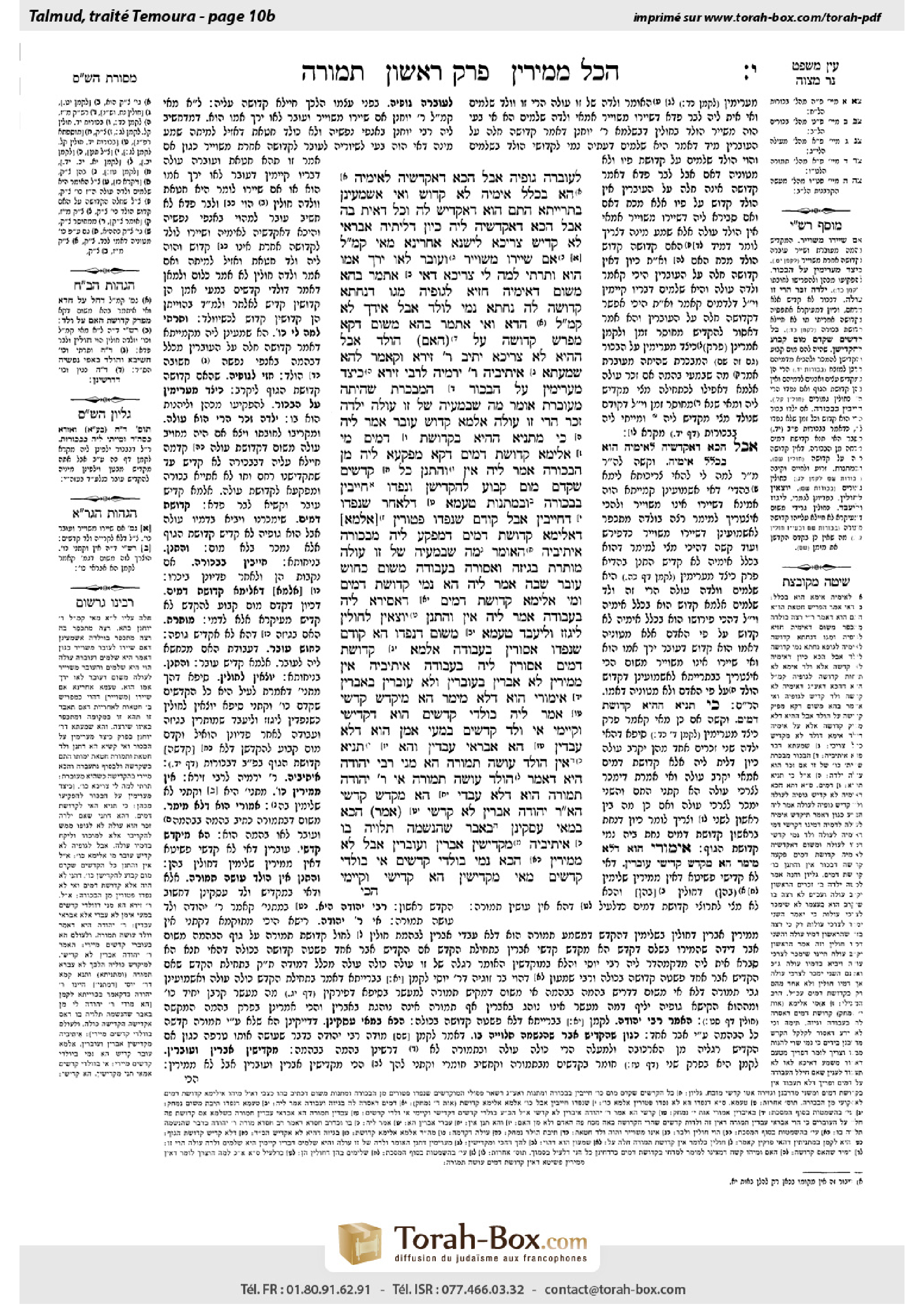
Temurah 10b: Talmud study for Daf Yomi
Daf Yomi is the daily study of one Talmud folio. Explore 37 tractates with scans, Hebrew text, Sefaria English and AI-generated French translations where annotated.
Passage selection and English or AI-generated French translation are available where the scan has annotations. Daf Study is independent of Torah-Box and Sefaria.
Browse Temurah · תמורה · All tractatesTemurah 10b text and translations
This page of Temurah includes the Aramaic text, an English translation and an AI-generated French translation, alongside the scan above.
תמורה י׳ ב · Aramaic and Hebrew text
לְעוּבָּרָה גּוּפֵיהּ, אֲבָל הָכָא דְּאַקְדְּשַׁיהּ לְאִימֵּיהּ — הָא בִּכְלַל אִימֵּיהּ לָא קָדוֹשׁ.
וְאִי אַשְׁמְעִינַן בָּתְרָיְיתָא — הָתָם הוּא דְּאַקְדֵּישׁ לַהּ, וְכֹל דְּאִית בַּהּ, אֲבָל הָכָא דְּאַקְדְּשֵׁיהּ לֵיהּ — כֵּיוָן דְּלֵיתֵיהּ אַבָּרַאי, לָא קָדֵישׁ. צְרִיכָא.
לִישָּׁנָא אַחֲרִינָא, מַאי קָא מַשְׁמַע לַן? אִם שִׁיְּירוֹ — מְשׁוּיָּיר, וְעוּבָּר לָאו יֶרֶךְ אִמּוֹ הוּא, וְתַרְתֵּי לְמָה לִי?
צְרִיכָא, דְּאִי אִתְּמַר בְּהָא — מִשּׁוּם דְּאִימֵּיהּ חַזְיָא לְגוּפֵיהּ, מִגּוֹ דְּנָחֲתָא קְדוּשָּׁה לַהּ נָחֲתָא נָמֵי לְוָלָד, אֲבָל אִידַּךְ — לָא. קָא מַשְׁמַע לַן הָדָא.
וְאִי אִתְּמַר בְּהָא, מִשּׁוּם דְּקָא מְפָרֵשׁ קְדוּשָּׁה עַל (הָאֵם) הַוָּלָד, אֲבָל הָהִיא לָא צְרִיכָא.
יָתֵיב רַבִּי זֵירָא וְקָאָמַר לְהָא שְׁמַעְתָּא, אֵיתִיבֵיהּ רַבִּי יִרְמְיָה לְרַבִּי זֵירָא: כֵּיצַד מַעֲרִימִין עַל הַבְּכוֹר? הַמְבַכֶּרֶת שֶׁהָיְתָה מְעוּבֶּרֶת, אוֹמֵר: ״מָה שֶׁבְּמֵעֶיהָ שֶׁל זוֹ עוֹלָה״, יָלְדָה זָכָר — הֲרֵי זוֹ עוֹלָה, אַלְמָא קָדוֹשׁ עוּבָּר!
אֲמַר לֵיהּ: כִּי מִתַּנְיָא הָהִיא בִּקְדוּשַּׁת דָּמִים, מִי אַלִּימָא קְדוּשַּׁת דָּמִים דְּקָא מַפְקְעָא לֵיהּ מִן הַבְּכוֹרָה?
אֲמַר לֵיהּ: אִין, וְהָתְנַן: כֹּל קָדָשִׁים שֶׁקָּדַם מוּם קָבוּעַ לְהֶקְדֵּישָׁן וְנִפְדּוּ — חַיָּיבִין בַּבְּכוֹרָה וּבַמַּתָּנוֹת. טַעְמָא דִּלְאַחַר שֶׁנִּפְדּוּ דְּחַיָּיבִין, אֲבָל קוֹדֶם שֶׁנִּפְדּוּ — פְּטוּרִין, [אַלְמָא] דְּאַלִּימָא קְדוּשַּׁת דָּמִים דְּמַפְקַע לֵיהּ מִבְּכוֹרָה.
אֵיתִיבֵיהּ: הָאוֹמֵר ״מָה שֶׁבְּמֵעֶיהָ שֶׁל זוֹ עוֹלָה״ — מוּתֶּרֶת בְּגִיזָּה וַאֲסוּרָה בַּעֲבוֹדָה, מִשּׁוּם כִּחוּשׁ עוּבָּר שֶׁבָּהּ! אֲמַר לֵיהּ: הָא נָמֵי קְדוּשַּׁת דָּמִים.
וּמִי אַלִּימָא קְדוּשַּׁת דָּמִים, דְּאָסְירָא לֵיהּ בַּעֲבוֹדָה? אֲמַר לֵיהּ: אִין, וְהָתְנַן: יוֹצְאִין לְחוּלִּין, לִיגָּזֵז וְלֵיעָבֵד. טַעְמָא מִשּׁוּם דְּנִפְדּוּ, הָא קוֹדֶם שֶׁנִּפְדּוּ אֲסוּרִין בָּעֲבוֹדָה, אַלְמָא קְדוּשַּׁת דָּמִים אָסְורִין לֵיהּ בַּעֲבוֹדָה.
אֵיתִיבֵיהּ: אֵין מְמִירִין לֹא אֵבָרִין בְּעוּבָּרִין, וְלֹא עוּבָּרִין בְּאֵבָרִין. אֵימוּרֵי הוּא דְּלָא מֵימַר, הָא מִיקְדָּשׁ — קָדְשִׁי!
אֲמַר לֵיהּ: בְּוַלְדֵי קָדָשִׁים הוּא דְּקַדִּישִׁי וְקָיְימִי.
אִי וְלַד קָדָשִׁים, בִּמְעֵי אִמָּן הוּא דְּלָא עָבְדִין, הָא אַבָּרַאי — עָבְדִין, וְהָא תַּנְיָא: אֵין הַוָּלָד עוֹשֶׂה תְּמוּרָה!
הָא מַנִּי? רַבִּי יְהוּדָה הִיא, דְּאָמַר: הַוָּלָד עוֹשֶׂה תְּמוּרָה.
אִי רַבִּי יְהוּדָה, תְּמוּרָה הוּא דְּלָא עָבְדִי, הָא מִקְדָּשׁ — קָדְשִׁי, הָאָמַר רַבִּי יְהוּדָה: אֵבָרִין לָא קָדְשִׁי! אֲמַר [לֵיהּ]: הָכָא בְּמַאי עָסְקִינַן — בְּאֵיבָר שֶׁהַנְּשָׁמָה תְּלוּיָה בּוֹ.
אֵיתִיבֵיהּ: מַקְדִּישִׁין אֵבָרִין וְעוּבָּרִין, אֲבָל לֹא מְמִירִין! הָכָא נָמֵי בְּוַלְדֵי קָדָשִׁים.
אִי בְּוַלְדֵי קָדָשִׁים, מַאי ״מַקְדִּישִׁין״? הָא קַדִּישִׁי וְקָיְימִי!
Temurah 10b · English translation
the fetus itself. But here, where he consecrated its pregnant mother, not the fetus itself, one might think that this fetus is not consecrated along with its mother.
And if Rabbi Yoḥanan had taught us only this last case, of one who consecrates a pregnant animal, I might have said that it is only there that its fetus is sacred, as he consecrated the animal and all that is inside it, including the fetus. But here, where he consecrated the fetus itself, since the object of the consecration is not outside its mother, as it has yet to be born, one might say that it is not consecrated. Therefore, it was necessary for Rabbi Yoḥanan to state both halakhot.
§ The Gemara cites another version of the discussion: What is Rabbi Yoḥanan teaching us when he says above that one may atone with either the mother or the offspring? He is evidently saying that if he explicitly excluded the fetus from his consecration, it is excluded, and only the mother is consecrated. And the reason is that a fetus is not considered the thigh of its mother but a separate entity that can possess a different status. But if so, why do I need two halakhot to teach me this, both with regard to one who consecrates a pregnant animal and with regard to one who consecrates the fetus alone?
The Gemara answers: Both halakhot are necessary, as, if it was stated only with regard to that case of one who consecrates a pregnant animal, I would say that the fetus is consecrated because its mother is fit to be consecrated itself, and since sanctity applies to her, it likewise applies to the offspring. But in the other case of one who consecrates a fetus alone, perhaps it is not consecrated. Therefore, Rabbi Yoḥanan teaches us this case as well.
And if it was stated only with regard to this case of one who consecrates a fetus, one might say that the fetus is sanctified because he expressly states that sanctity should apply to the offspring. But with regard to that case of one who consecrates a pregnant animal, where he does not explicitly mention the fetus, perhaps is it not consecrated. Therefore, both statements are necessary.
§ Rabbi Zeira sat and stated this halakha of the dispute between bar Padda and Rabbi Yoḥanan with regard to the consecration of fetuses. Rabbi Yirmeya raised an objection to Rabbi Zeira from a mishna (24b): How may one employ artifice to circumvent the obligation to give the firstborn to the priest and use the animal instead to fulfill a different obligation? He may approach an animal that is going to give birth to its firstborn but which is still pregnant, and say: That which is in the womb of this animal, if it is male, is designated as a burnt offering. If he did so, and the animal gave birth to a male, it will be sacrificed as a burnt offering, and it is not consecrated as a firstborn. Evidently, a fetus can be consecrated, contrary to the opinion of bar Padda.
Rabbi Zeira said to Rabbi Yirmeya: Bar Padda can answer that when that mishna is taught, it is referring to one who consecrates the fetus for sanctity that inheres in its value, i.e., that the offspring should be sold and a burnt offering brought with the proceeds. This form of sanctity does apply to a fetus, but inherent sanctity rendering it obligated to be sacrificed itself does not. Rabbi Yirmeya again asked Rabbi Zeira: Is sanctity that inheres in the animal’s value so strong that it removes the firstborn status from an animal?
Rabbi Zeira said to him: Yes, and so we learned in a mishna in tractate Bekhorot (14a): All sacrificial animals in which a permanent blemish preceded their consecration assume not inherent sanctity but sanctity of value, and once they are redeemed they are obligated, i.e., subject to, accounting their offspring a firstborn, and one is obligated to give the gifts of the foreleg, the jaw, and the maw to a priest as for any non-sacred slaughtered animal. One can infer from the mishna that the reason that these animals are obligated is that they have already been redeemed. But before they are redeemed, they are exempt from the obligation of the firstborn and the gifts, despite the fact that only their value is sacred. Evidently, sanctity that inheres in the animal’s value is strong enough to remove firstborn status from an animal.
Rabbi Yirmeya raised another objection to bar Padda’s opinion from a baraita: If one says: That which is in the womb of this animal is a burnt offering, it is permitted for the mother to be shorn but it is prohibited to use it for labor, due to the inevitable weakening and consequent reduction in value of the fetus that is inside it. This indicates that fetuses are imbued with sanctity, contrary to the opinion of bar Padda. Rabbi Zeira said to Rabbi Yirmeya: This baraita is also referring to one who consecrates the fetus for sanctity that inheres in its value, and bar Padda concedes that this sanctity applies to the fetus.
Rabbi Yirmeya objected: But is sanctity that inheres in the animal’s value so strong that it renders the mother prohibited for labor? Rabbi Zeira said to Rabbi Yirmeya: Yes, and so we learned in the mishna cited previously, that blemished animals that were consecrated for their value and redeemed emerge from their sacred status and assume complete non-sacred status and may be shorn and used for labor. Apparently, the reason they may be used for labor is that they were redeemed. One may infer that before they are redeemed, they are prohibited for labor. Evidently, sanctity that inheres in the animal’s value renders the mother of the fetus prohibited for labor.
Rabbi Yirmeya raised another objection to bar Padda’s opinion from the mishna: One does not substitute non-sacred limbs for consecrated fetuses, and likewise one does not substitute non-sacred fetuses for consecrated limbs, or non-sacred limbs or fetuses for whole consecrated animals, or non-sacred whole animals for consecrated limbs or fetuses. One may infer from the mishna that it is a substitution of fetuses that one cannot effect, as the Torah states with regard to substitution: “And if he substitutes an animal for an animal” (Leviticus 27:10), and a fetus is not classified as an animal. But if one consecrates fetuses directly, not in the manner of substitution, they are consecrated, contrary to the opinion of bar Padda.
Rabbi Zeira said to him: The mishna is referring to the offspring of sacrificial animals that became pregnant after they were consecrated. That case is different, as they are already consecrated through their mothers. It does not indicate that one can consecrate a fetus directly.
Rabbi Yirmeya objected: If the mishna is referring to the offspring of sacrificial animals, and it is teaching that one does not substitute them because fetuses are not considered animals, one can infer that it is only when they are in their mother’s womb that one cannot effect substitution with them. But once they are outside their mother’s womb, i.e., once they are born, one can effect substitution with them. But this is not the case, as isn’t it taught in the next mishna (12a) that the offspring born of a consecrated animal that was not itself consecrated does not render a non-sacred animal exchanged for it a substitute?
Rabbi Zeira answered: In accordance with whose opinion is this first mishna? It is in accordance with the opinion of Rabbi Yehuda, who disagreed with that ruling in the next mishna and said that the offspring renders a non-sacred animal exchanged for it a substitute.
Rabbi Yirmeya objected: If this mishna is in accordance with the opinion of Rabbi Yehuda, one encounters another difficulty. The mishna indicates that it is substitution that one cannot perform with consecrated limbs, as the sanctity of substitution does not extend to the entire animal. Consequently, if one consecrates limbs directly, they are consecrated and the sanctity extends to the whole animal. But doesn’t Rabbi Yehuda say that limbs are not consecrated in this manner, that the sanctity extends to the whole animal? Rabbi Zeira said him: What are we dealing with here? With a limb upon which the animal’s life depends. Rabbi Yehuda’s ruling that limbs cannot be consecrated applies only to non-vital organs, e.g., legs. He concedes that vital organs are consecrated and the consecration extends to the entire animal.
Rabbi Yirmeya raised another objection to bar Padda’s opinion: A later mishna (16b) lists stringencies that apply to sacrificial animals but not to substitutes: One consecrates an animal’s limbs and fetuses in utero, but one does not substitute non-sacred animals for them. This contradicts bar Padda’s opinion that one cannot consecrate fetuses. Rabbi Zeira answered: Here too, the mishna is referring to the offspring of sacrificial animals that became pregnant after they were consecrated.
Rabbi Yirmeya objected: If the mishna is referring to the offspring of sacrificial animals, what is the meaning of the term: One consecrates? After all, these offspring are already consecrated through their mothers.
Temurah 10b · Traduction française (IA)
le fœtus lui-même. Mais ici, puisqu’il a consacré sa mère alors qu’elle était enceinte, et non le fœtus lui-même, on aurait pu penser que ce fœtus n’est pas consacré avec sa mère.
Et si Rabbi Yoḥanan ne nous avait enseigné que ce dernier cas, celui de quelqu’un qui consacre un animal en gestation, j’aurais pu dire que le fœtus n’est consacré que dans ce cas, puisqu’il a consacré l’animal et tout ce qu’il contient, y compris le fœtus. Mais ici, où il a consacré le fœtus lui-même, puisque l’objet de la consécration ne se trouve pas à l’extérieur de sa mère, car il n’est pas encore né, on aurait pu dire qu’il n’est pas consacré. C’est pourquoi Rabbi Yoḥanan devait énoncer les deux halakhot.
§ La Guemara rapporte une autre version de la discussion : Que nous enseigne Rabbi Yoḥanan lorsqu’il dit plus haut qu’on peut obtenir l’expiation soit par la mère, soit par le petit ? Il enseigne manifestement que si quelqu’un a expressément exclu le fœtus de sa consécration, celui-ci en est exclu et seule la mère est consacrée. La raison en est qu’un fœtus n’est pas considéré comme la cuisse de sa mère, mais comme une entité distincte, susceptible d’avoir un statut différent. Mais dans ce cas, pourquoi faut-il deux halakhot pour nous l’enseigner : l’une concernant quelqu’un qui consacre un animal en gestation, l’autre quelqu’un qui consacre le fœtus seul ?
La Guemara répond : Les deux halakhot sont nécessaires. En effet, si cela avait été enseigné uniquement à propos de ce cas, celui de quelqu’un qui consacre un animal en gestation, j’aurais dit que le fœtus est consacré parce que sa mère peut elle-même être consacrée et que, puisque la sainteté s’applique à elle, elle s’applique également à son petit. Mais dans l’autre cas, celui de quelqu’un qui consacre le fœtus seul, peut-être celui-ci n’est-il pas consacré. Rabbi Yoḥanan nous enseigne donc également ce cas.
Et si cela avait été enseigné uniquement à propos de ce cas, celui de quelqu’un qui consacre un fœtus, on aurait pu dire que le fœtus est consacré parce qu’il précise expressément que la sainteté doit s’appliquer au petit. Mais dans l’autre cas, celui de quelqu’un qui consacre un animal en gestation et ne mentionne pas expressément le fœtus, peut-être celui-ci n’est-il pas consacré. Les deux enseignements sont donc nécessaires.
§ Rabbi Zeira s’assit et énonça cette halakha au sujet de la controverse entre bar Padda et Rabbi Yoḥanan concernant la consécration des fœtus. Rabbi Yirmeya souleva une objection contre Rabbi Zeira à partir d’une Michna (24b) : Comment peut-on user d’un stratagème pour se soustraire à l’obligation de remettre le premier-né au prêtre et utiliser plutôt l’animal pour s’acquitter d’une autre obligation ? On peut s’approcher d’un animal qui va mettre bas son premier-né, mais qui est encore en gestation, et dire : « Ce qui se trouve dans le ventre de cet animal, s’il est mâle, est désigné comme holocauste. » S’il a agi ainsi et que l’animal a donné naissance à un mâle, celui-ci sera offert en holocauste et ne sera pas consacré comme premier-né. Il ressort manifestement de là qu’un fœtus peut être consacré, contrairement à l’opinion de bar Padda.
Rabbi Zeira dit à Rabbi Yirmeya : bar Padda peut répondre que, lorsque cette Michna est enseignée, elle concerne quelqu’un qui consacre le fœtus d’une sainteté portant sur sa valeur, c’est-à-dire que le petit doit être vendu et qu’un holocauste doit être offert avec le produit de la vente. Cette forme de sainteté s’applique bien à un fœtus, mais la sainteté intrinsèque, qui l’oblige à être offert lui-même, ne s’y applique pas. Rabbi Yirmeya demanda de nouveau à Rabbi Zeira : La sainteté portant sur la valeur de l’animal est-elle si forte qu’elle lui retire son statut de premier-né ?
Rabbi Zeira lui dit : Oui, et nous avons appris la même chose dans une Michna du traité Bekhorot (14a) : Tous les animaux destinés au sacrifice qui avaient une infirmité permanente avant leur consécration acquièrent non pas une sainteté intrinsèque, mais une sainteté portant sur leur valeur ; une fois rachetés, ils sont assujettis à ce que leurs petits soient considérés comme des premiers-nés, et l’on est tenu de donner au prêtre l’épaule, la mâchoire et la caillette, comme pour tout animal non consacré abattu. On peut déduire de la Michna que ces animaux sont assujettis à ces obligations parce qu’ils ont déjà été rachetés. Mais avant leur rachat, ils en sont exemptés, bien que seule leur valeur soit sacrée. Il ressort manifestement de là que la sainteté portant sur la valeur de l’animal est assez forte pour lui retirer son statut de premier-né.
Rabbi Yirmeya souleva une autre objection contre l’opinion de bar Padda à partir d’une baraïta : Si quelqu’un dit : « Ce qui se trouve dans le ventre de cet animal est un holocauste », il est permis de tondre la mère, mais il est interdit de l’utiliser pour le travail, en raison de l’affaiblissement inévitable du fœtus qu’elle porte et de la diminution de sa valeur qui en résulterait. Cela indique que les fœtus sont investis de sainteté, contrairement à l’opinion de bar Padda. Rabbi Zeira dit à Rabbi Yirmeya : Cette baraïta aussi concerne quelqu’un qui consacre le fœtus d’une sainteté portant sur sa valeur, et bar Padda reconnaît que cette sainteté s’applique au fœtus.
Rabbi Yirmeya objecta : Mais la sainteté portant sur la valeur de l’animal est-elle si forte qu’elle rende la mère impropre au travail ? Rabbi Zeira dit à Rabbi Yirmeya : Oui, et nous avons appris la même chose dans la Michna citée précédemment : les animaux présentant une infirmité, consacrés pour leur valeur puis rachetés, sortent de leur statut sacré, deviennent entièrement non consacrés et peuvent être tondus et utilisés pour le travail. Apparemment, si leur utilisation pour le travail est permise, c’est parce qu’ils ont été rachetés. On peut en déduire qu’avant leur rachat, il est interdit de les utiliser pour le travail. Il ressort manifestement de là que la sainteté portant sur la valeur de l’animal rend la mère du fœtus impropre au travail.
Rabbi Yirmeya souleva une autre objection contre l’opinion de bar Padda à partir de la Michna : On ne peut pas substituer des membres non consacrés à des fœtus consacrés, ni des fœtus non consacrés à des membres consacrés, ni des membres ou des fœtus non consacrés à des animaux entiers consacrés, ni des animaux entiers non consacrés à des membres ou à des fœtus consacrés. On peut déduire de la Michna que ce qu’on ne peut pas faire, c’est substituer des fœtus, car la Torah dit au sujet de la substitution : « Et s’il substitue un animal à un animal » (Lévitique 27:10), et un fœtus n’est pas considéré comme un animal. Mais si l’on consacre directement des fœtus, sans procéder par substitution, ils sont consacrés, contrairement à l’opinion de bar Padda.
Rabbi Zeira lui dit : La Michna parle des petits d’animaux destinés au sacrifice qui sont devenus gestants après avoir été consacrés. Ce cas est différent, car ces petits sont déjà consacrés par l’intermédiaire de leur mère. Cela n’indique pas qu’on puisse consacrer directement un fœtus.
Rabbi Yirmeya objecta : Si la Michna parle des petits d’animaux destinés au sacrifice et enseigne qu’on ne peut pas les substituer parce que les fœtus ne sont pas considérés comme des animaux, on peut en déduire que la substitution est impossible uniquement tant qu’ils se trouvent dans le ventre de leur mère. Mais une fois qu’ils en sont sortis, c’est-à-dire une fois nés, on pourrait les substituer. Or, ce n’est pas le cas, car n’est-il pas enseigné dans la Michna suivante (12a) que le petit né d’un animal consacré, qui n’a pas lui-même été consacré, ne confère pas le statut d’animal de substitution à un animal non consacré substitué contre lui ?
Rabbi Zeira répondit : De l’avis de qui est cette première Michna ? De l’avis de Rabbi Yehuda, qui s’est opposé à cette décision dans la Michna suivante et a dit que le petit confère le statut d’animal de substitution à un animal non consacré substitué contre lui.
Rabbi Yirmeya objecta : Si cette Michna est conforme à l’opinion de Rabbi Yehuda, une autre difficulté se présente. La Michna indique qu’on ne peut pas substituer des membres consacrés, car la sainteté de la substitution ne s’étend pas à l’animal entier. Par conséquent, si l’on consacre directement des membres, ils sont consacrés et la sainteté s’étend à l’animal entier. Mais Rabbi Yehuda ne dit-il pas que des membres ne sont pas consacrés de cette manière, c’est-à-dire que leur sainteté ne s’étend pas à l’animal entier ? Rabbi Zeira lui dit : De quoi s’agit-il ici ? D’un membre dont dépend la vie de l’animal. La décision de Rabbi Yehuda selon laquelle des membres ne peuvent pas être consacrés ne s’applique qu’aux organes non vitaux, par exemple les pattes. Il reconnaît que les organes vitaux sont consacrés et que la consécration s’étend à l’animal entier.
Rabbi Yirmeya souleva une autre objection contre l’opinion de bar Padda : une Michna ultérieure (16b) énumère des règles plus strictes qui s’appliquent aux animaux destinés au sacrifice, mais non aux animaux substitués : on consacre les membres d’un animal ainsi que les fœtus in utero, mais on ne peut pas leur substituer des animaux non consacrés. Cela contredit l’opinion de bar Padda, selon laquelle on ne peut pas consacrer de fœtus. Rabbi Zeira répondit : Ici aussi, la Michna parle des petits d’animaux destinés au sacrifice qui sont devenus gestants après leur consécration.
Rabbi Yirmeya objecta : Si la Michna parle des petits d’animaux destinés au sacrifice, que signifie le terme « on consacre » ? Après tout, ces petits sont déjà consacrés par l’intermédiaire de leur mère.
Traduction française générée par IA à partir de l’édition anglaise de Sefaria. Vérifie toujours un passage avec le texte source.
Text from Sefaria: William Davidson Edition - Vocalized Aramaic (CC BY NC); William Davidson Edition - English (CC BY NC).