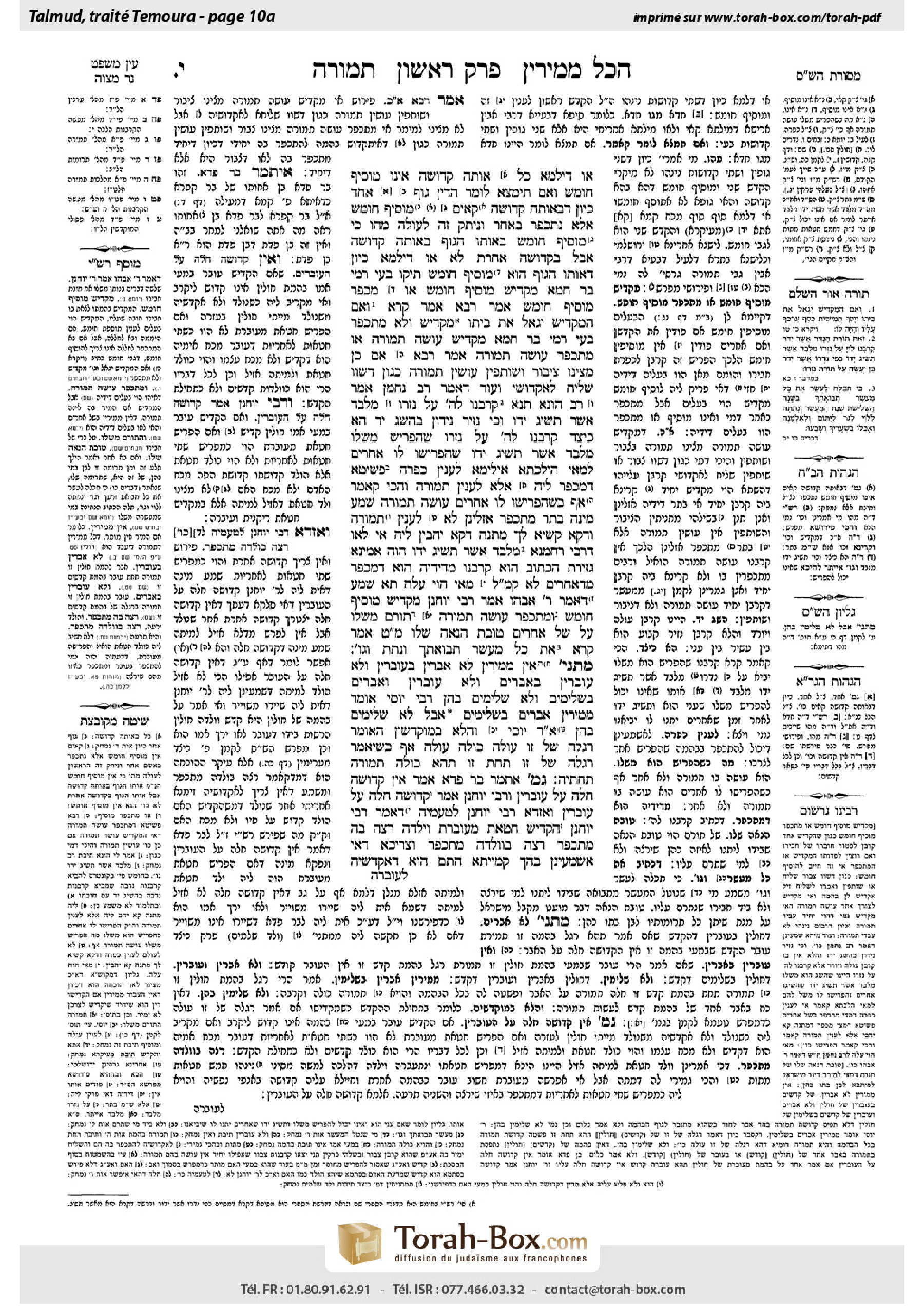
Temurah 10a: Talmud study for Daf Yomi
Daf Yomi is the daily study of one Talmud folio. Explore 37 tractates with scans, Hebrew text, Sefaria English and AI-generated French translations where annotated.
Passage selection and English or AI-generated French translation are available where the scan has annotations. Daf Study is independent of Torah-Box and Sefaria.
Browse Temurah · תמורה · All tractatesTemurah 10a text and translations
This page of Temurah includes the Aramaic text, an English translation and an AI-generated French translation, alongside the scan above.
תמורה י׳ א · Aramaic and Hebrew text
אוֹ דִילְמָא: כׇּל אוֹתָהּ קְדוּשָּׁה אֵינוֹ מוֹסִיף חוֹמֶשׁ?
וְאִם תִּימָּצֵא לוֹמַר הָדֵין גּוּף (אֶחָד) [אַחֵר], כֵּיוָן דִּבְאוֹתָהּ קְדוּשָּׁה קָאֵים [אֵינוֹ] מוֹסִיף חוֹמֶשׁ, אֶלָּא נִתְכַּפֵּר בְּאַחֵר, וְנִיתַּק זֶה לְעוֹלָה — מַהוּ? כִּי [אֵינוֹ] מוֹסִיף חוֹמֶשׁ בְּאוֹתוֹ הַגּוּף בְּאוֹתָהּ קְדוּשָּׁה, אֲבָל בִּקְדוּשָּׁה אַחֶרֶת — לָא? אוֹ דִילְמָא, כֵּיוָן דְּאוֹתוֹ הַגּוּף הוּא — [אֵינוֹ] מוֹסִיף חוֹמֶשׁ? תֵּיקוּ.
בָּעֵי רָמֵי בַּר חָמָא: מַקְדִּישׁ מוֹסִיף חוֹמֶשׁ, אוֹ (מכפר) [מִתְכַּפֵּר] מוֹסִיף חוֹמֶשׁ? אָמַר רָבָא: אָמַר קְרָא ״וְאִם הַמַּקְדִּישׁ יִגְאַל אֶת בֵּיתוֹ״ — מַקְדִּישׁ, וְלֹא מִתְכַּפֵּר.
בָּעֵי רָמֵי בַּר חָמָא: מַקְדִּישׁ עוֹשֶׂה תְּמוּרָה, אוֹ מִתְכַּפֵּר עוֹשֶׂה תְּמוּרָה? אָמַר רָבָא: אִם כֵּן, מָצִינוּ צִיבּוּר וְשׁוּתָּפִין עוֹשִׂין תְּמוּרָה, כְּגוֹן דְּשַׁוּוֹ שָׁלִיחַ לְאַקְדּוֹשֵׁי.
וְעוֹד, דְּאָמַר רַב נַחְמָן אָמַר רַב הוּנָא: תָּנָא ״קׇרְבָּנוֹ לַה׳ עַל נִזְרוֹ מִלְּבַד אֲשֶׁר תַּשִּׂיג יָדוֹ״, וְכִי נָזִיר נִידּוֹן בְּהֶשֵּׂג יָד? הָא כֵּיצַד? ״קׇרְבָּנוֹ לַה׳ עַל נִזְרוֹ״ — שֶׁהִפְרִישׁ מִשֶּׁלּוֹ, ״מִלְּבַד אֲשֶׁר תַּשִּׂיג יָדוֹ״ — שֶׁהִפְרִישׁוּ לוֹ אֲחֵרִים.
לְמַאי הִילְכְתָא? אִילֵּימָא לְעִנְיַן כַּפָּרָה — פְּשִׁיטָא דְּמִכַּפַּר לֵיהּ! אֶלָּא לְעִנְיַן תְּמוּרָה, וְהָכִי קָאָמַר: אַף כְּשֶׁהִפְרִישׁוּ לוֹ אֲחֵרִים — עוֹשֶׂה תְּמוּרָה. שְׁמַע מִינַּהּ: בָּתַר מִתְכַּפֵּר אָזְלִינַן!
לָא לְעִנְיַן תְּמוּרָה, וּדְקָא קַשְׁיָא לָךְ מַתָּנָה דְּקָא יָהֲבִין לֵיהּ — אִי לָאו דְּרַבִּי רַחֲמָנָא ״מִלְּבַד אֲשֶׁר תַּשִּׂיג יָדוֹ״, הֲוָה אָמֵינָא גְּזֵירַת הַכָּתוּב הוּא ״קׇרְבָּנוֹ״ מִדִּידֵיהּ הוּא דְּמִכַּפַּר, מִדַּאֲחֵרִים לָא, קָא מַשְׁמַע לַן.
מַאי הָוֵי עֲלַהּ? תָּא שְׁמַע, דְּאָמַר רַבִּי אֲבָהוּ אָמַר רַבִּי יוֹחָנָן: מַקְדִּישׁ מוֹסִיף חוֹמֶשׁ, וּמִתְכַּפֵּר עוֹשֶׂה תְּמוּרָה.
תּוֹרֵם מִשֶּׁלּוֹ עַל שֶׁל אֲחֵרִים — טוֹבַת הֲנָאָה שֶׁלּוֹ. מַאי טַעְמָא? אָמַר קְרָא: ״אֶת כׇּל מַעְשַׂר תְּבוּאָתְךָ... וְנָתַתָּ וְגוֹ׳״.
מַתְנִי׳ אֵין מְמִירִין, לֹא אֵבָרִין בְּעוּבָּרִין, וְלֹא עוּבָּרִין בְּאֵבָרִים, וְלֹא עוּבָּרִין וְאֵבָרִים בִּשְׁלֵימִים, וְלֹא שְׁלֵימִים בָּהֶן.
רַבִּי יוֹסֵי אוֹמֵר: מְמִירִין אֵבָרִים בִּשְׁלֵימִים, אֲבָל לֹא שְׁלֵימִים בָּהֶן. אָמַר רַבִּי יוֹסֵי: וַהֲלֹא בְּמוּקְדָּשִׁין, הָאוֹמֵר ״רַגְלָהּ שֶׁל זוֹ עוֹלָה״ — כּוּלָּהּ עוֹלָה, אַף כְּשֶׁיֹּאמַר ״רַגְלָהּ שֶׁל זוֹ תַּחַת זוֹ״ תְּהֵא כּוּלָּהּ תְּמוּרָה תַּחְתֶּיהָ.
גְּמָ׳ אִתְּמַר, בַּר פְּדָא אָמַר: אֵין קְדוּשָּׁה חָלָה עַל עוּבָּרִין, רַבִּי יוֹחָנָן אָמַר: קְדוּשָּׁה חָלָה עַל עוּבָּרִין. וְאַזְדָּא רַבִּי יוֹחָנָן לְטַעְמֵיהּ, דְּאָמַר רַבִּי יוֹחָנָן: הִקְדִּישׁ חַטָּאת מְעוּבֶּרֶת וְיָלְדָה — רָצָה בָּהּ מִתְכַּפֵּר, רָצָה בִּוְולָדָהּ מִתְכַּפֵּר.
וּצְרִיכָא, דְּאִי אַשְׁמְעִינַן בְּהָךְ קַמַּיְיתָא — הָתָם הוּא דְּאַקְדְּשֵׁיהּ
Temurah 10a · English translation
Or perhaps we say that if one redeems any animal that possesses the same sanctity as the original he does not add an additional one-fifth.
And if you say that with regard to this other body, since it maintains the same type of sanctity as the initial animal, one does not add one-fifth when redeeming it, but what of a case where the first animal was lost and the owner achieved atonement by bringing another, and this first animal was found and was consigned to be sacrificed as a burnt offering? What is the halakha? Do we say that when one does not add an additional one-fifth, that is only with regard to the same body with the same type of sanctity, but in the case of another type of sanctity the exemption does not apply? Or perhaps we say that since it is the same body, one does not add one-fifth. The Gemara concludes: The dilemma shall stand unresolved.
Rami bar Ḥama raises a dilemma: If one person consecrates his animal to be used as an offering by another, does the one who consecrates it add one-fifth when he redeems it, or does the one atoning by means of the offering add one-fifth? Who is considered the owner of the offering? Rava said that the verse states: “And if he that consecrated it will redeem his house, then he shall add the fifth part of the money” (Leviticus 27:15). It may be inferred from here that only the one who consecrates the item adds one-fifth, but not the one for whom the offering atones.
Rami bar Ḥama raises a dilemma: If one person consecrates an animal to be used as an offering by another, can the one who consecrates it render another animal a substitute for it, or can the one achieving atonement through it render a substitute for it? Rava said: If it were so, that the one who consecrates it can render a substitute for it, we would find a case where the community or partners can render a substitute for their consecrated animal, for example where they appointed an agent to consecrate an animal for them. The mishna (13a) states that one cannot substitute for consecrated animals belonging to the community or to partners. By contrast, in this case, since only one person consecrated it, he would be able to substitute for it, contrary to the mishna.
And furthermore, Rav Naḥman says that Rav Huna says: The Sages taught in a baraita: The verse states: “This is the law of the nazirite who vows, and of his offering unto the Lord for his naziriteship, besides that for which his means suffice; according to his vow which he vows” (Numbers 6:21). But is the offering of a nazirite judged according to his means? The offerings of a nazirite are fixed by the Torah. How is it possible to understand this clause: “Besides that for which his means suffice”? Rather, the clause “his offering unto the Lord for his naziriteship” is referring to a case where he separated an offering from his own animals, whereas the clause “besides that for which his means suffice” is referring to a case where others separated the offering for him. This teaches that designation by others is effective.
With regard to what halakha is this baraita stated? If we say that it is with regard to the matter of atonement, and it is teaching that a nazirite can atone even by means of an offering designated for him by others, isn’t it obvious that such an offering can atone for him? Once it is his offering, he can certainly use it. Rather, the ruling of this baraita must be stated with regard to substitution, and this is what it is saying: Even in a case where others separated the offering for him, he alone can render a substitute for it. Conclude from this verse that we follow the one for whom the offering atones, and only he can effect substitution for the offering.
The Gemara responds: The baraita is not referring to substitution, but to the matter of atonement. And that which is difficult for you, that it is obvious that the nazirite can atone by bringing an offering consecrated by another, as they have given it to him as a gift, this is in fact not obvious. Had the Merciful One not included an offering received from another by writing the clause “besides that for which his means suffice,” I would say that it is a Torah edict expressed in the term “his offering,” that a nazirite can atone only with an offering consecrated from his own animals, but not through one received from the animals of others. Therefore, the verse teaches us that he can atone even with an offering received from others.
Having failed to resolve Rami bar Ḥama’s dilemma, the Gemara asks: What halakhic conclusion was reached about this matter? The Gemara answers: Come and hear a proof from that which Rabbi Abbahu said that Rabbi Yoḥanan said: If one consecrates his animal as an offering for someone else’s atonement, and he subsequently redeems the animal, he adds one-fifth to its value as the owner. But only the one for whom the offering atones can render a substitute for it. This resolves the dilemma of Rami bar Ḥama.
Rabbi Yoḥanan’s statement continues: And if one separates teruma from his produce to exempt the produce of others, so that the other’s produce will be permitted in consumption, the benefit of discretion is his. He is entitled to determine which priest receives the teruma. The Gemara explains: What is the reason for this? The verse states: “When you have made an end of tithing all the tithe of your produce in the third year, which is the year of tithing, and have given it to the Levite, to the stranger, to the fatherless, and to the widow” (Deuteronomy 26:12). This indicates that the one actually giving the produce chooses to whom to give it.
MISHNA: One does not substitute non-sacred limbs for consecrated fetuses, i.e., if one says that a certain limb of a non-sacred animal is substituted for a fetus in the womb of a consecrated animal, it is not consecrated. And likewise, one does not substitute non-sacred fetuses for consecrated limbs. And one substitutes neither non-sacred limbs nor fetuses for whole consecrated animals nor non-sacred whole animals for consecrated limbs or fetuses.
Rabbi Yosei says: One substitutes non-sacred limbs for whole consecrated animals, but not whole animals for consecrated limbs. Rabbi Yosei said: But isn’t it so with regard to sacrificial animals, that if one says: The hind leg of this animal is a burnt offering, the entire animal is a burnt offering? So too, when he says: The non-sacred hind leg of this animal is in exchange for that animal, the entire animal is a substitute in exchange for it.
GEMARA: It was stated that Bar Padda says: Fetuses are not imbued with sanctity if one attempts to consecrate them for sacrifice, and Rabbi Yoḥanan said: Fetuses are imbued with sanctity. The Gemara notes: And Rabbi Yoḥanan follows his line of reasoning in this regard, as Rabbi Yoḥanan said: In the case of one who consecrated a pregnant animal as a sin offering, and it later gave birth, if he wishes he may achieve atonement by sacrificing the mother, and the offspring will be left to graze until it develops a blemish that renders it unfit, whereupon it will be sold and the money is used to purchase a gift burnt offering; and if he wishes he may achieve atonement through the animal’s offspring, and the mother will be left to graze until it develops a blemish.
The Gemara adds: And both statements of Rabbi Yoḥanan are necessary, despite the fact that both affirm that fetuses may be consecrated. As, if Rabbi Yoḥanan had taught us only this first case, of one who consecrates a fetus by itself, I might say that only there is the fetus imbued with sanctity, as he consecrated
Temurah 10a · Traduction française (IA)
Ou peut-être dirons-nous que si quelqu’un rachète un animal qui possède le même degré de sainteté que l’animal initial, il n’ajoute pas de cinquième supplémentaire.
Et si tu dis que, dans le cas de cet autre corps, puisqu’il conserve le même type de sainteté que l’animal initial, on n’ajoute pas un cinquième lors de son rachat, qu’en est-il du cas où le premier animal a été perdu et où son propriétaire a obtenu l’expiation en apportant un autre animal, puis où le premier animal a été retrouvé et destiné à être sacrifié comme holocauste ? Quelle est la halakha ? Dirons-nous que l’absence d’ajout d’un cinquième ne concerne que le même corps doté du même type de sainteté, mais que l’exemption ne s’applique pas dans le cas d’un autre type de sainteté ? Ou peut-être dirons-nous que, puisqu’il s’agit du même corps, on n’ajoute pas un cinquième. La Guemara conclut : le dilemme demeure sans solution.
Rami bar Ḥama soulève un dilemme : si quelqu’un consacre son animal pour qu’il serve d’offrande à une autre personne, celui qui le consacre ajoute-t-il un cinquième lorsqu’il le rachète, ou est-ce celui qui obtient l’expiation au moyen de l’offrande qui ajoute un cinquième ? Qui est considéré comme le propriétaire de l’offrande ? Rava dit que le verset énonce : « Et si celui qui l’a consacré rachète sa maison, il ajoutera un cinquième à la somme d’argent » (Lévitique 27,15). On peut en déduire que seul celui qui consacre l’objet ajoute un cinquième, et non celui pour qui l’offrande procure l’expiation.
Rami bar Ḥama soulève un dilemme : si quelqu’un consacre un animal pour qu’il serve d’offrande à une autre personne, celui qui le consacre peut-il lui substituer un autre animal, ou bien est-ce celui qui obtient l’expiation grâce à lui qui peut lui substituer un autre animal ? Rava dit : si celui qui le consacre pouvait lui substituer un autre animal, nous trouverions un cas où la communauté ou des associés peuvent substituer un autre animal à leur animal consacré, par exemple lorsqu’ils ont désigné un mandataire pour consacrer un animal en leur nom. Or la Michna (13a) enseigne qu’on ne peut pas substituer un autre animal à des animaux consacrés appartenant à la communauté ou à des associés. En revanche, dans le cas présent, puisqu’une seule personne l’a consacré, elle pourrait lui substituer un autre animal, contrairement à la Michna.
Et en outre, Rav Naḥman dit au nom de Rav Houna : les Sages ont enseigné dans une baraïta : le verset énonce : « Telle est la règle concernant le nazir qui fait un vœu, et son offrande à l’Éternel pour son naziréat, outre ce que ses moyens lui permettent ; selon le vœu qu’il fait » (Nombres 6,21). Mais l’offrande d’un nazir est-elle déterminée en fonction de ses moyens ? Les offrandes d’un nazir sont fixées par la Torah. Comment comprendre alors cette expression : « outre ce que ses moyens lui permettent » ? Il faut plutôt comprendre que l’expression « son offrande à l’Éternel pour son naziréat » désigne le cas où il a prélevé une offrande parmi ses propres animaux, tandis que l’expression « outre ce que ses moyens lui permettent » désigne le cas où d’autres ont prélevé l’offrande pour lui. Cela enseigne qu’une désignation effectuée par d’autres est valable.
À propos de quelle halakha cette baraïta est-elle énoncée ? Si nous disons qu’elle concerne l’expiation et qu’elle enseigne qu’un nazir peut obtenir l’expiation même au moyen d’une offrande désignée pour lui par d’autres, n’est-il pas évident qu’une telle offrande peut lui procurer l’expiation ? Puisqu’il s’agit de son offrande, il peut certainement l’utiliser. La décision de cette baraïta doit donc concerner la substitution, et voici ce qu’elle enseigne : même dans le cas où d’autres ont prélevé l’offrande pour lui, lui seul peut lui substituer un autre animal. Conclus de ce verset que c’est la personne pour qui l’offrande procure l’expiation qui est déterminante, et que seule elle peut effectuer une substitution à l’offrande.
La Guemara répond : la baraïta ne concerne pas la substitution, mais l’expiation. Et ce qui te pose difficulté — à savoir qu’il est évident que le nazir peut obtenir l’expiation en apportant une offrande consacrée par quelqu’un d’autre, puisque celui-ci la lui a donnée en cadeau — n’est en réalité pas évident. Si le Miséricordieux n’avait pas inclus une offrande reçue d’autrui en écrivant l’expression « outre ce que ses moyens lui permettent », j’aurais dit que c’est un décret de la Torah, exprimé par les mots « son offrande », selon lequel un nazir ne peut obtenir l’expiation qu’au moyen d’une offrande consacrée à partir de ses propres animaux, et non au moyen d’une offrande reçue des animaux d’autrui. Le verset nous enseigne donc qu’il peut obtenir l’expiation même au moyen d’une offrande reçue d’autrui.
N’ayant pas résolu le dilemme de Rami bar Ḥama, la Guemara demande : quelle conclusion halakhique a-t-on tirée à ce sujet ? La Guemara répond : viens et entends une preuve de ce que Rabbi Abbahou a dit au nom de Rabbi Yoḥanan : si quelqu’un consacre son animal comme offrande pour l’expiation d’une autre personne, puis rachète l’animal, il ajoute un cinquième à sa valeur en tant que propriétaire. Mais seul celui pour qui l’offrande procure l’expiation peut lui substituer un autre animal. Cela résout le dilemme de Rami bar Ḥama.
La déclaration de Rabbi Yoḥanan se poursuit : et si quelqu’un prélève la terouma de ses récoltes afin d’exempter les récoltes d’autrui, de sorte que celles-ci deviennent permises à la consommation, le droit de choisir le bénéficiaire lui revient. Il a le droit de décider quel prêtre recevra la terouma. La Guemara explique : quelle en est la raison ? Le verset énonce : « Lorsque tu auras achevé de prélever toute la dîme de tes récoltes, la troisième année, année de la dîme, et que tu l’auras donnée au Lévite, à l’étranger, à l’orphelin et à la veuve » (Deutéronome 26,12). Cela indique que celui qui donne effectivement les récoltes choisit à qui les donner.
MICHNA : On ne peut pas substituer des membres non consacrés à des fœtus consacrés, c’est-à-dire que si quelqu’un déclare qu’un certain membre d’un animal non consacré est substitué à un fœtus dans le ventre d’un animal consacré, ce membre n’est pas consacré. De même, on ne peut pas substituer des fœtus non consacrés à des membres consacrés. Et l’on ne peut substituer ni des membres ni des fœtus non consacrés à des animaux entiers consacrés, ni des animaux entiers non consacrés à des membres ou à des fœtus consacrés.
Rabbi Yosei dit : on peut substituer des membres non consacrés à des animaux entiers consacrés, mais non des animaux entiers à des membres consacrés. Rabbi Yosei dit : mais n’en va-t-il pas ainsi pour les animaux destinés aux sacrifices ? Si quelqu’un dit : « La patte arrière de cet animal est un holocauste », l’animal tout entier est un holocauste. De même, lorsqu’il dit : « La patte arrière non consacrée de cet animal est échangée contre cet animal », l’animal tout entier devient un substitut en échange de celui-ci.
GUEMARA : Il a été rapporté que Bar Padda dit : les fœtus ne sont pas investis de sainteté lorsqu’on tente de les consacrer pour un sacrifice, tandis que Rabbi Yoḥanan dit : les fœtus sont investis de sainteté. La Guemara note que Rabbi Yoḥanan suit ici son raisonnement, car Rabbi Yoḥanan a dit : dans le cas de quelqu’un qui a consacré comme sacrifice expiatoire une femelle enceinte, laquelle met ensuite bas, s’il le souhaite, il peut obtenir l’expiation en sacrifiant la mère, et le petit sera laissé au pâturage jusqu’à ce qu’il développe un défaut qui le rende impropre ; il sera alors vendu et l’argent servira à acheter un holocauste volontaire. Et s’il le souhaite, il peut obtenir l’expiation au moyen du petit de l’animal, tandis que la mère sera laissée au pâturage jusqu’à ce qu’elle développe un défaut.
La Guemara ajoute : les deux déclarations de Rabbi Yoḥanan sont nécessaires, bien que toutes deux affirment que les fœtus peuvent être consacrés. En effet, si Rabbi Yoḥanan nous avait enseigné seulement ce premier cas, celui de quelqu’un qui consacre un fœtus à part, j’aurais pu dire que le fœtus n’est investi de sainteté que dans ce cas, puisqu’il l’a consacré
Traduction française générée par IA à partir de l’édition anglaise de Sefaria. Vérifie toujours un passage avec le texte source.
Text from Sefaria: William Davidson Edition - Vocalized Aramaic (CC BY NC); William Davidson Edition - English (CC BY NC).