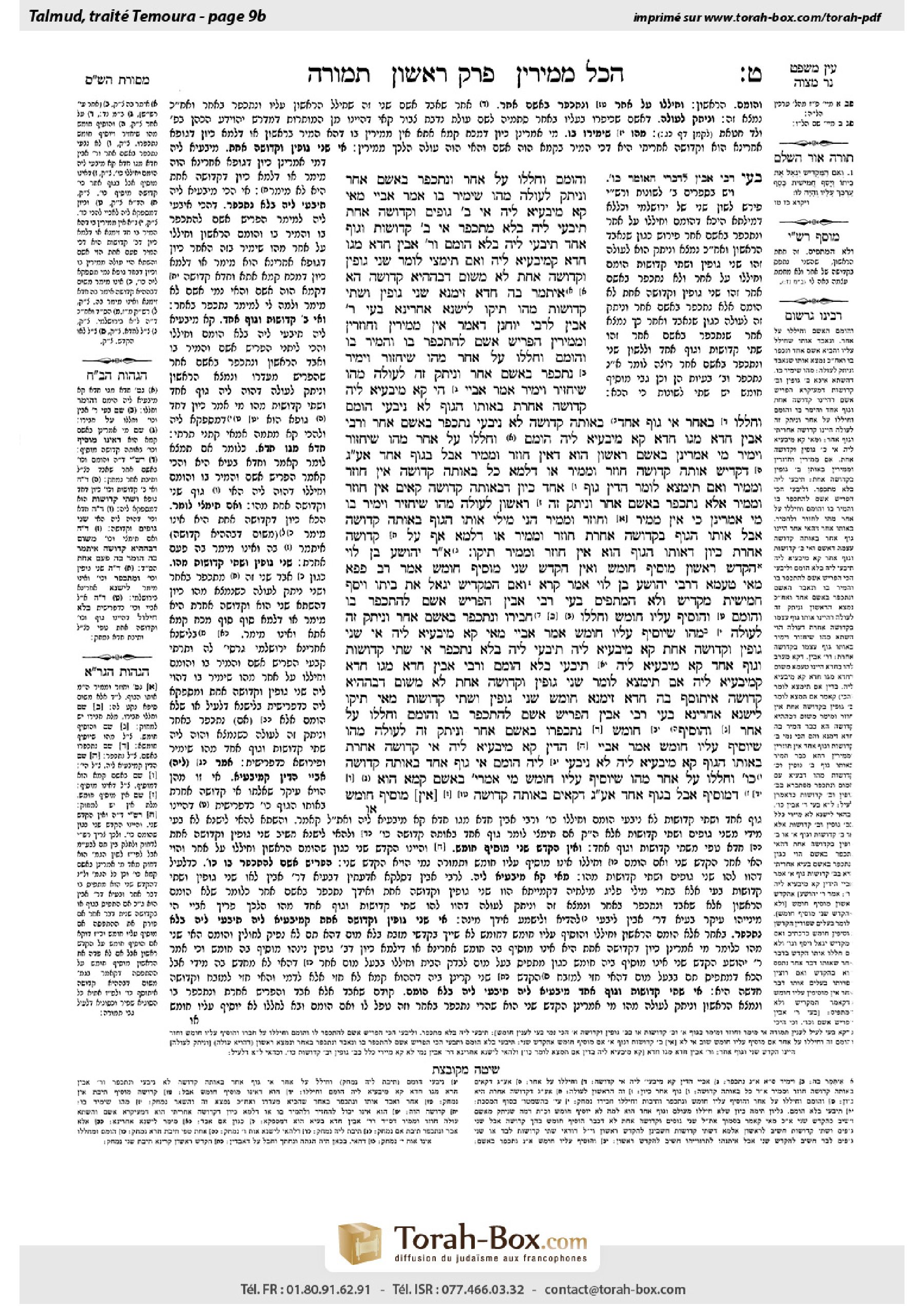
Temurah 9b: Talmud study for Daf Yomi
Daf Yomi is the daily study of one Talmud folio. Explore 37 tractates with scans, Hebrew text, Sefaria English and AI-generated French translations where annotated.
Passage selection and English or AI-generated French translation are available where the scan has annotations. Daf Study is independent of Torah-Box and Sefaria.
Browse Temurah · תמורה · All tractatesTemurah 9b text and translations
This page of Temurah includes the Aramaic text, an English translation and an AI-generated French translation, alongside the scan above.
תמורה ט׳ ב · Aramaic and Hebrew text
וְהוּמַם וְחִלְּלוֹ עַל אַחֵר, וְנִתְכַּפֵּר בְּאָשָׁם אַחֵר, וְנִיתַּק לְעוֹלָה — מַהוּ שֶׁיָּמִיר בּוֹ?
אָמַר אַבָּיֵי: מַאי קָא מִיבַּעְיָא לֵיהּ? אִי שְׁנֵי גוּפִים וּקְדוּשָּׁה אַחַת — תִּיבְּעֵי לֵיהּ בְּלֹא מִתְכַּפֵּר.
אִי שְׁתֵּי קְדוּשּׁוֹת, וְגוּף אֶחָד — תִּיבְּעֵי לֵיהּ בְּלֹא הוּמַם!
וְרַבִּי אָבִין, חֲדָא מִגּוֹ חֲדָא קָמִיבַּעְיָא לֵיהּ, וְאִם תִּימְצֵי לוֹמַר: שְׁנֵי גוּפִין וּקְדוּשָּׁה אַחַת — לָא, מִשּׁוּם דִּבְהָהִיא קְדוּשָּׁה הָא אִיתְּמַר בַּהּ חֲדָא זִימְנָא. שְׁנֵי גוּפִין וּשְׁתֵּי קְדוּשּׁוֹת מַהוּ? תֵּיקוּ.
לִישָּׁנָא אַחֲרִינָא, בָּעֵי רַבִּי אָבִין לְרַבִּי יוֹחָנָן: דְּאָמַר אֵין מְמִירִין וְחוֹזְרִין וּמְמִירִין — הִפְרִישׁ אָשָׁם לְהִתְכַּפֵּר בּוֹ, וְהֵמִיר בּוֹ, וְהוּמַם וְחִלְּלוֹ עַל אַחֵר, מַהוּ שֶׁיַּחְזוֹר וְיָמִיר?
נִתְכַּפֵּר בְּאָשָׁם אַחֵר, וְנִיתַּק זֶה לְעוֹלָה, מַהוּ שֶׁיַּחֲזִיר וְיָמִיר?
אָמַר אַבָּיֵי: הֵי קָא מִיבַּעְיָא לֵיהּ? קְדוּשָּׁה אַחֶרֶת בְּאוֹתוֹ הַגּוּף — לָא נִיבְעֵי הוּמַם וְחִלְּלוֹ בְּאַחֵר! אִי גּוּף (אֶחָד) [אַחֵר] בְּאוֹתָהּ קְדוּשָּׁה — לָא נִיבְעֵי נִתְכַּפֵּר בְּאָשָׁם אַחֵר!
וְרַבִּי אָבִין, חֲדָא מִגּוֹ חֲדָא קָא מִיבַּעְיָא לֵיהּ: הוּמַם וְחִלְּלוֹ עַל אַחֵר, מַהוּ שֶׁיַּחֲזוֹר וְיָמִיר? מִי אָמְרִינַן: בְּאָשָׁם רִאשׁוֹן הוּא דְּאֵין חוֹזֵר וּמֵמִיר, אֲבָל בְּגוּף (אֶחָד) [אַחֵר], אַף עַל גַּב דְּקַדִּישׁ אוֹתָהּ קְדוּשָּׁה — חוֹזֵר וּמֵמִיר, אוֹ דִלְמָא: כֹּל בְּאוֹתָהּ קְדוּשָּׁה אֵין חוֹזֵר וּמֵמִיר?
וְאִם תִּימְצָא לוֹמַר הַדִּין גּוּף (אֶחָד) [אַחֵר], כֵּיוָן דִּבְאוֹתָהּ קְדוּשָּׁה קָאֵים — אֵין חוֹזֵר וּמֵמִיר, אֶלָּא נִתְכַּפֵּר בְּאָשָׁם אַחֵר, וְנִיתַּק זֶה רִאשׁוֹן לְעוֹלָה, מַהוּ שֶׁיַּחֲזִיר וְיָמִיר בּוֹ?
מִי אָמְרִינַן: כִּי אֵין מֵמִיר וְחוֹזֵר וּמֵמִיר — הָנֵי מִילֵּי אוֹתוֹ הַגּוּף בְּאוֹתָהּ קְדוּשָּׁה, אֲבָל אוֹתוֹ הַגּוּף בִּקְדוּשָּׁה אַחֶרֶת — חוֹזֵר וּמֵמִיר, אוֹ דִלְמָא: אַף עַל קְדוּשָּׁה אַחֶרֶת, כֵּיוָן דְּאוֹתוֹ הַגּוּף הוּא — אֵין חוֹזֵר וּמֵמִיר? תֵּיקוּ.
אָמַר רַבִּי יְהוֹשֻׁעַ בֶּן לֵוִי: הֶקְדֵּשׁ רִאשׁוֹן מוֹסִיף חוֹמֶשׁ, וְאֵין הֶקְדֵּשׁ שֵׁנִי מוֹסִיף חוֹמֶשׁ.
אָמַר רַב פָּפָּא: מַאי טַעְמָא דְּרַבִּי יְהוֹשֻׁעַ בֶּן לֵוִי? אָמַר קְרָא: ״וְאִם הַמַּקְדִּישׁ יִגְאַל אֶת בֵּיתוֹ וְיָסַף חֲמִישִׁית״ — מַקְדִּישׁ, וְלֹא הַמַּתְפִּיס.
בָּעֵי רַבִּי אָבִין: הִפְרִישׁ אָשָׁם לְהִתְכַּפֵּר בּוֹ, וְהוּמַם, וְהוֹסִיף עָלָיו חוֹמֶשׁ, וְחִלְּלוֹ חֲבֵירוֹ, וְנִתְכַּפֵּר בְּאָשָׁם אַחֵר, וְנִיתַּק זֶה לְעוֹלָה — מַהוּ שֶׁיּוֹסִיף עָלָיו חוֹמֶשׁ?
אָמַר אַבָּיֵי: מַאי קָא מִיבַּעְיָא לֵיהּ? אִי שְׁנֵי גוּפִין וּקְדוּשָּׁה אַחַת קָא מִיבַּעְיָא לֵיהּ — תִּיבְּעֵי לֵיהּ בְּלֹא נִתְכַּפֵּר!
אִי שְׁתֵּי קְדוּשּׁוֹת, וְגוּף אֶחָד קָא מִיבַּעְיָא לֵיהּ — תִּיבְּעֵי בְּלֹא הוּמַם!
וְרַבִּי אָבִין, חֲדָא מִגּוֹ חֲדָא קָמִיבַּעְיָא לֵיהּ: אִם תִּימְצָא לוֹמַר שְׁנֵי גוּפִין וּקְדוּשָּׁה אַחַת לָא — מִשּׁוּם דִּבְהָהִיא קְדוּשָּׁה אִיתּוֹסַף בַּהּ חֲדָא זִימְנָא חוֹמֶשׁ, שְׁנֵי גוּפִין וּשְׁתֵּי קְדוּשּׁוֹת מַאי? תֵּיקוּ.
לִישָּׁנָא אַחֲרִינָא, בָּעֵי רַבִּי אָבִין: הִפְרִישׁ אָשָׁם לְהִתְכַּפֵּר בּוֹ, וְהוּמַם וְחִלְּלוֹ עַל אַחֵר וְהוֹסִיף חוֹמֶשׁ, נִתְכַּפְּרוּ בְּאָשָׁם אַחֵר, וְנִיתַּק זֶה לְעוֹלָה — מַהוּ שֶׁיּוֹסִיף עָלָיו חוֹמֶשׁ?
אָמַר אַבָּיֵי: הָדֵין קָא מִיבַּעְיָא לֵיהּ, אִי קְדוּשָּׁה אַחֶרֶת בְּאוֹתוֹ הַגּוּף קָא מִיבַּעְיָא לֵיהּ — לָא נִיבְּעֵי לֵיהּ הוּמַם, אִי גּוּף (אֶחָד) [אַחֵר] בְּאוֹתָהּ קְדוּשָּׁה כּוּ׳.
וְחִלְּלוֹ עַל אַחֵר, מַהוּ שֶׁיּוֹסִיף עָלָיו חוֹמֶשׁ? מִי אָמְרִינַן: בְּאָשָׁם קַמָּא הוּא דְּמוֹסֵיף, אֲבָל בְּגוּף (אֶחָד) [אַחֵר], אַף עַל גַּב דְּקָאֵים בְּאוֹתָהּ קְדוּשָּׁה, [אֵין] מוֹסִיף חוֹמֶשׁ,
Temurah 9b · English translation
and the original guilt offering became blemished, and he desacralized it by transferring its sanctity onto another animal, which was then lost, and the owner achieved atonement by bringing another, third, animal as a guilt offering, and then the second animal was found and was consigned to be sacrificed as a burnt offering, as is the case for any guilt offering whose owner has achieved atonement by means of another offering, what is the halakha as to whether he can effect substitution for the second animal? Since this animal’s sanctity stems from that of the original blemished animal, and he had already effected a substitute for that original animal, perhaps he cannot now substitute for the second animal, as this would constitute repeat substitution.
Abaye said: What is the dilemma he is raising? If his essential dilemma concerns the fact that there are two bodies, i.e., two different animals, then the dilemma would stand even if the original animal and the replacement were of one type of sanctity. If so, let the dilemma be raised even in a case where he did not achieve atonement by another guilt offering, and the second animal remained a guilt offering, rather than being consigned to be sacrificed as a burnt offering.
And if the dilemma is due to the fact that there are two types of sanctity, it would stand even if it was only one body. If so, let the dilemma be raised even where the animal did not become blemished but was simply lost and found after the owner atoned by means of another animal, and it was thereby consigned to be sacrificed as a burnt offering. Why did Rabbi Avin present such a complex case?
The Gemara explains: Rabbi Avin raises one dilemma as a result of the anticipated solution to another dilemma: If you say that in the case of two bodies and one type of sanctity it is not possible to effect substitution on the second animal, perhaps that is because this sanctity already had been substituted one time. If so, what is the halakha in the case of two bodies and two types of sanctity? Is the offering changed enough to enable another substitution for it? The Gemara concludes: The dilemma shall stand unresolved.
The Gemara presents an alternative version of the previous dilemma. Rabbi Avin raises a dilemma: According to the opinion of Rabbi Yoḥanan, who said that Rabbi Shimon holds that one cannot effect substitution and then effect substitution again for the same animal, if one designated an animal as a guilt offering with which to achieve atonement and substituted for it, and the initial guilt offering became blemished and he desacralized it by transferring its sanctity onto another animal, what is the halakha as to whether he can then effect substitution for this last animal? On the one hand, it is a different animal; on the other hand, it possesses the same sanctity.
Rabbi Avin raises another dilemma: If the first animal was lost and the owner achieved atonement by bringing another as a guilt offering, and the first animal was found and was consigned to be sacrificed as a burnt offering, what is the halakha as to whether he can then effect substitution for it? On the one hand, it is the same animal; on the other hand, it possesses a different type of sanctity.
Abaye said: Which of these two is the essential dilemma he is raising? If his dilemma concerns a case of another type of sanctity in the same body, he should not raise the dilemma in the case where the initial guilt offering became blemished and he desacralized it by transferring its sanctity onto another animal. And if his dilemma concerns a case of another body with the same sanctity, he should not raise the dilemma in the case where the owner achieved atonement by bringing another animal as a guilt offering.
The Gemara explains: Rabbi Avin raises one dilemma as a result of the anticipated solution to another dilemma, as follows: If the initial guilt offering became blemished and he desacralized it by transferring its sanctity onto another animal, what is the halakha as to whether he can then effect substitution for the second animal? Do we say that it is with the first guilt offering that he cannot effect substitution again, but with another body, even though it is sanctified with the same type of sanctity, he can effect substitution again? Or perhaps we say that with regard to any animal with the same type of sanctity, he cannot effect substitution again?
And if you say that with regard to this other body, since it maintains the same type of sanctity as the original animal one cannot effect substitution again, but what then of a case where the first animal was lost and the owner achieved atonement by bringing another animal as a guilt offering, and this first animal was then found and was consigned to be sacrificed as a burnt offering? What is the halakha as to whether he can effect substitution again for the same animal, since now its sanctity has changed?
The Gemara elaborates: Do we say that when Rabbi Yoḥanan states that the owner cannot effect substitution and then effect substitution again, this statement applies to the same body with the same type of sanctity, but as for the same body with another type of sanctity, he can effect substitution again? Or perhaps we say that even concerning another type of sanctity, since it is the same body, he cannot effect substitution again with it. The Gemara concludes: The dilemma shall stand unresolved.
§ The Gemara cites a similar discussion. Rabbi Yehoshua ben Levi says: One who redeems an animal that was originally consecrated as an offering and developed a blemish must pay an amount equivalent to its value and add an additional one-fifth of its value. But one who redeems an animal that was consecrated second, i.e., in place of a desacralized blemished offering, and then developed a blemish itself, must pay an amount equivalent to its value but does not add an additional one-fifth of its value.
Rav Pappa said: What is the reasoning of Rabbi Yehoshua ben Levi? The verse states: “And if he that consecrated it will redeem his house, then he shall add the fifth part of the money of your valuation unto it, and it shall be his” (Leviticus 27:15), from which Rabbi Yehoshua ben Levi infers that the requirement to pay an additional one-fifth applies to one who consecrates an item directly, but not to the one who applies the sanctity of another item to it.
Rabbi Avin raises a dilemma concerning a similar matter: If one designated an animal as a guilt offering by which to achieve atonement and it became blemished, and he added one-fifth to its value and desacralized it, and he then used the consecrated money to purchase another guilt offering, which was then lost, and the owner achieved atonement by bringing another, third, animal as a guilt offering, and the second animal was found and consigned to be sacrificed as a burnt offering, and then it developed a blemish, what is the halakha as to whether the owner must add one-fifth to its value when he redeems it?
Abaye said: What is the dilemma he is raising? If he is raising a dilemma with regard to two bodies, i.e., two different animals, the problem should stand even if both are of one type of sanctity. If so, let the dilemma be raised even in a case where he did not achieve atonement through another guilt offering, and the second animal was never consigned to be sacrificed as a burnt offering.
And if he is raising a dilemma with regard to two types of sanctity, it should apply even in the case of one body. If so, let the dilemma be raised even in a case where the original animal did not become blemished but was simply lost and found after the owner atoned by means of another offering and thereby consigned the original animal to be sacrificed as a burnt offering.
The Gemara explains that Rabbi Avin raises one dilemma as a result of the anticipated solution to another dilemma, as follows: If you say that in a case of two bodies and one type of sanctity the owner does not add one-fifth, perhaps that is because one-fifth was already added once to redeem an animal with that type of sanctity. If so, what is the halakha in the case of two bodies and two types of sanctity? Perhaps, since the second animal possesses a different sanctity, it is considered to possess its own original sanctity, rather than derivative sanctity, and therefore one who redeems it adds one-fifth. The Gemara concludes: The dilemma shall stand unresolved.
The Gemara presents an alternative version of the previous dilemma. Rabbi Avin raises a dilemma: If one designated an animal as a guilt offering with which to achieve atonement, and it became blemished and he desacralized it by transferring its sanctity onto another animal, and he added one-fifth of its value, and the second animal was lost and the owner achieved atonement by bringing another, third, animal as a guilt offering, and the second animal was found and was consigned to be sacrificed as a burnt offering, and then it developed a blemish, what is the halakha as to whether the owner must add one-fifth to its value when he redeems it?
Abaye said: Which of these two is the essential dilemma he is raising? If he raises a dilemma with regard to the case of another type of sanctity in the same body, he should not raise the dilemma about a case where the initial guilt offering became blemished and he transferred its sanctity to another animal. And if his essential dilemma concerns the case of another body with the same type of sanctity, he could pose his dilemma with regard to a case where the second animal was not lost and found and consigned to be a burnt offering.
The Gemara explains that Rabbi Avin raises one dilemma as a result of the anticipated solution to another dilemma. If the initial guilt offering became blemished and he desacralized it by transferring its sanctity onto another, second, animal, what is the halakha as to whether the owner must add one-fifth to its value when he redeems it? Do we say that with regard to a second redemption of the first guilt offering he does not add one-fifth, since it is the same body and the same sanctity, but here, when it is another body, even though it maintains the same type of sanctity as the initial animal, he adds one-fifth, as it is considered to be directly consecrated?
Temurah 9b · Traduction française (IA)
Et le sacrifice de culpabilité initial devint atteint d’un défaut, puis il le désacralisa en transférant sa sainteté à un autre animal, qui fut ensuite perdu. Le propriétaire obtint l’expiation en apportant un troisième animal comme sacrifice de culpabilité. Puis le deuxième animal fut retrouvé et destiné à être sacrifié comme holocauste, comme tout sacrifice de culpabilité dont le propriétaire a obtenu l’expiation au moyen d’un autre sacrifice. Quelle est la halakha quant à la possibilité d’effectuer une substitution pour le deuxième animal ? Puisque la sainteté de cet animal découle de celle du sacrifice initial atteint d’un défaut, et qu’il avait déjà effectué une substitution pour cet animal initial, peut-être ne peut-il pas maintenant substituer le deuxième animal, car cela constituerait une substitution répétée.
Abaye dit : Quel est le dilemme qu’il soulève ? Si son dilemme porte essentiellement sur le fait qu’il y a deux corps, c’est-à-dire deux animaux différents, il se poserait même si l’animal initial et son remplaçant relevaient du même type de sainteté. Dans ce cas, qu’il soulève le dilemme même dans une situation où il n’a pas obtenu l’expiation au moyen d’un autre sacrifice de culpabilité et où le deuxième animal est resté un sacrifice de culpabilité, au lieu d’être destiné à être sacrifié comme holocauste.
Et si le dilemme tient au fait qu’il y a deux types de sainteté, il se poserait même s’il n’y avait qu’un seul corps. Dans ce cas, qu’il soulève le dilemme même lorsque l’animal n’a pas été atteint d’un défaut, mais a simplement été perdu puis retrouvé après que le propriétaire a obtenu l’expiation au moyen d’un autre animal, et qu’il a ainsi été destiné à être sacrifié comme holocauste. Pourquoi Rabbi Avin a-t-il présenté un cas aussi complexe ?
La Guemara explique : Rabbi Avin soulève un dilemme à partir de la réponse anticipée à un autre dilemme : si tu dis que, dans le cas de deux corps et d’un seul type de sainteté, il est impossible d’effectuer une substitution pour le deuxième animal, peut-être est-ce parce que cette sainteté a déjà fait l’objet d’une substitution. Dans ce cas, quelle est la halakha dans le cas de deux corps et de deux types de sainteté ? Le sacrifice a-t-il suffisamment changé pour permettre une nouvelle substitution ? La Guemara conclut : le dilemme demeure sans réponse.
La Guemara présente une autre version du dilemme précédent. Rabbi Avin soulève un dilemme : selon l’opinion de Rabbi Yoḥanan, qui a dit que, selon Rabbi Shimon, on ne peut pas effectuer une substitution puis en effectuer une autre pour le même animal, si quelqu’un a désigné un animal comme sacrifice de culpabilité pour obtenir l’expiation et lui a substitué un autre animal, puis que le sacrifice de culpabilité initial a été atteint d’un défaut et qu’il l’a désacralisé en transférant sa sainteté à un autre animal, quelle est la halakha quant à la possibilité d’effectuer ensuite une substitution pour ce dernier animal ? D’un côté, il s’agit d’un animal différent ; de l’autre, il possède la même sainteté.
Rabbi Avin soulève un autre dilemme : si le premier animal a été perdu et que le propriétaire a obtenu l’expiation en apportant un autre animal comme sacrifice de culpabilité, puis que le premier animal a été retrouvé et destiné à être sacrifié comme holocauste, quelle est la halakha quant à la possibilité d’effectuer ensuite une substitution pour lui ? D’un côté, il s’agit du même animal ; de l’autre, il possède un type de sainteté différent.
Abaye dit : Lequel de ces deux cas constitue le dilemme essentiel qu’il soulève ? Si son dilemme porte sur le cas d’un même corps doté d’un autre type de sainteté, il ne devrait pas le soulever dans le cas où le sacrifice de culpabilité initial a été atteint d’un défaut et où il l’a désacralisé en transférant sa sainteté à un autre animal. Et si son dilemme porte sur le cas d’un autre corps doté de la même sainteté, il ne devrait pas le soulever dans le cas où le propriétaire a obtenu l’expiation en apportant un autre animal comme sacrifice de culpabilité.
La Guemara explique : Rabbi Avin soulève un dilemme à partir de la réponse anticipée à un autre dilemme, comme suit : si le sacrifice de culpabilité initial a été atteint d’un défaut et qu’il l’a désacralisé en transférant sa sainteté à un autre animal, quelle est la halakha quant à la possibilité d’effectuer ensuite une substitution pour le deuxième animal ? Disons-nous que c’est pour le premier sacrifice de culpabilité qu’on ne peut pas effectuer une nouvelle substitution, mais que, pour un autre corps, même sanctifié du même type de sainteté, on peut en effectuer une nouvelle ? Ou peut-être disons-nous que, pour tout animal relevant du même type de sainteté, on ne peut pas effectuer de nouvelle substitution ?
Et si tu dis que, pour cet autre corps, on ne peut pas effectuer une nouvelle substitution puisqu’il conserve le même type de sainteté que l’animal initial, qu’en est-il alors d’un cas où le premier animal a été perdu, où le propriétaire a obtenu l’expiation en apportant un autre animal comme sacrifice de culpabilité, puis où ce premier animal a été retrouvé et destiné à être sacrifié comme holocauste ? Quelle est la halakha quant à la possibilité d’effectuer à nouveau une substitution pour le même animal, puisque sa sainteté a maintenant changé ?
La Guemara développe : disons-nous que, lorsque Rabbi Yoḥanan affirme que le propriétaire ne peut pas effectuer une substitution puis en effectuer une autre, cela s’applique au même corps doté du même type de sainteté, mais que, pour le même corps doté d’un autre type de sainteté, il peut effectuer une nouvelle substitution ? Ou peut-être disons-nous que, même lorsqu’il s’agit d’un autre type de sainteté, puisqu’il s’agit du même corps, il ne peut pas effectuer une nouvelle substitution pour celui-ci ? La Guemara conclut : le dilemme demeure sans réponse.
§ La Guemara cite une discussion analogue. Rabbi Yehoshua ben Levi dit : Celui qui rachète un animal initialement consacré comme sacrifice et qui est devenu atteint d’un défaut doit payer une somme équivalente à sa valeur et y ajouter un cinquième de cette valeur. Mais celui qui rachète un animal consacré en second, c’est-à-dire à la place d’un sacrifice atteint d’un défaut et désacralisé, et qui est lui-même devenu atteint d’un défaut, doit payer une somme équivalente à sa valeur, sans y ajouter un cinquième.
Rav Pappa dit : Quel est le raisonnement de Rabbi Yehoshua ben Levi ? Le verset dit : « Et si celui qui l’a consacré veut racheter sa maison, il ajoutera un cinquième à l’argent de ton estimation, et elle lui appartiendra » (Lévitique 27:15). Rabbi Yehoshua ben Levi en déduit que l’obligation d’ajouter un cinquième s’applique à celui qui consacre directement un bien, mais non à celui qui lui confère la sainteté d’un autre bien.
Rabbi Avin soulève un dilemme sur une question analogue : si quelqu’un a désigné un animal comme sacrifice de culpabilité pour obtenir l’expiation, que celui-ci a été atteint d’un défaut, qu’il a ajouté un cinquième à sa valeur et l’a désacralisé, puis qu’il a utilisé l’argent consacré pour acheter un autre sacrifice de culpabilité, lequel a ensuite été perdu, que le propriétaire a obtenu l’expiation en apportant un troisième animal comme sacrifice de culpabilité, que le deuxième animal a été retrouvé et destiné à être sacrifié comme holocauste, et que celui-ci a ensuite été atteint d’un défaut, quelle est la halakha quant à l’obligation du propriétaire d’ajouter un cinquième à sa valeur lorsqu’il le rachète ?
Abaye dit : Quel est le dilemme qu’il soulève ? S’il soulève un dilemme portant sur deux corps, c’est-à-dire deux animaux différents, le problème se poserait même s’ils relevaient tous deux d’un seul type de sainteté. Dans ce cas, qu’il soulève le dilemme même dans une situation où il n’a pas obtenu l’expiation au moyen d’un autre sacrifice de culpabilité et où le deuxième animal n’a jamais été destiné à être sacrifié comme holocauste.
Et s’il soulève un dilemme portant sur deux types de sainteté, celui-ci devrait également se poser dans le cas d’un seul corps. Dans ce cas, qu’il soulève le dilemme même lorsque l’animal initial n’a pas été atteint d’un défaut, mais a simplement été perdu puis retrouvé après que le propriétaire a obtenu l’expiation au moyen d’un autre sacrifice, et que l’animal initial a ainsi été destiné à être sacrifié comme holocauste.
La Guemara explique que Rabbi Avin soulève un dilemme à partir de la réponse anticipée à un autre dilemme, comme suit : si tu dis que, dans le cas de deux corps et d’un seul type de sainteté, le propriétaire n’ajoute pas un cinquième, peut-être est-ce parce qu’un cinquième a déjà été ajouté une fois pour racheter un animal relevant de ce type de sainteté. Dans ce cas, quelle est la halakha pour deux corps et deux types de sainteté ? Peut-être que, puisque le deuxième animal possède une sainteté différente, il est considéré comme ayant sa propre sainteté originelle plutôt qu’une sainteté dérivée ; par conséquent, celui qui le rachète ajoute un cinquième. La Guemara conclut : le dilemme demeure sans réponse.
La Guemara présente une autre version du dilemme précédent. Rabbi Avin soulève un dilemme : si quelqu’un a désigné un animal comme sacrifice de culpabilité pour obtenir l’expiation, que celui-ci a été atteint d’un défaut et qu’il l’a désacralisé en transférant sa sainteté à un autre animal, et qu’il a ajouté un cinquième de sa valeur, puis que le deuxième animal a été perdu, que le propriétaire a obtenu l’expiation en apportant un troisième animal comme sacrifice de culpabilité, que le deuxième animal a été retrouvé et destiné à être sacrifié comme holocauste, et que celui-ci a ensuite été atteint d’un défaut, quelle est la halakha quant à l’obligation du propriétaire d’ajouter un cinquième à sa valeur lorsqu’il le rachète ?
Abaye dit : Lequel de ces deux cas constitue le dilemme essentiel qu’il soulève ? S’il soulève un dilemme sur le cas d’un même corps doté d’un autre type de sainteté, il ne devrait pas soulever celui d’un cas où le sacrifice de culpabilité initial a été atteint d’un défaut et où il a transféré sa sainteté à un autre animal. Et si son dilemme essentiel porte sur le cas d’un autre corps doté du même type de sainteté, il pourrait soulever son dilemme à propos d’un cas où le deuxième animal n’a pas été perdu, puis retrouvé et destiné à être sacrifié comme holocauste.
La Guemara explique que Rabbi Avin soulève un dilemme à partir de la réponse anticipée à un autre dilemme. Si le sacrifice de culpabilité initial a été atteint d’un défaut et qu’il l’a désacralisé en transférant sa sainteté à un deuxième animal, quelle est la halakha quant à l’obligation du propriétaire d’ajouter un cinquième à sa valeur lorsqu’il le rachète ? Disons-nous que, lors d’un deuxième rachat du premier sacrifice de culpabilité, il n’ajoute pas un cinquième, puisqu’il s’agit du même corps et de la même sainteté, mais qu’ici, puisqu’il s’agit d’un autre corps, même s’il conserve le même type de sainteté que l’animal initial, il ajoute un cinquième, car on le considère comme ayant été consacré directement ?
Traduction française générée par IA à partir de l’édition anglaise de Sefaria. Vérifie toujours un passage avec le texte source.
Text from Sefaria: William Davidson Edition - Vocalized Aramaic (CC BY NC); William Davidson Edition - English (CC BY NC).