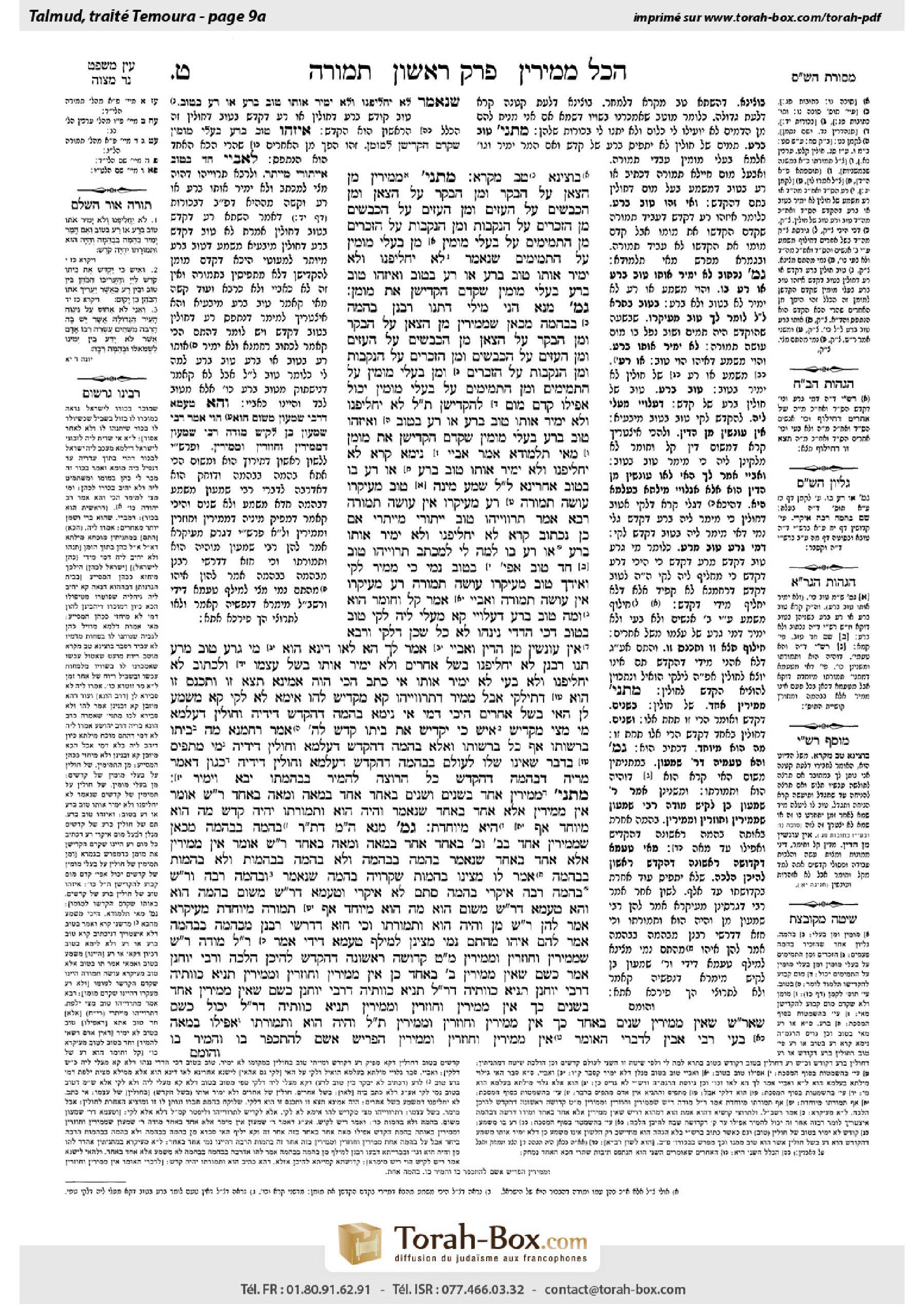
Temurah 9a: Talmud study for Daf Yomi
Daf Yomi is the daily study of one Talmud folio. Explore 37 tractates with scans, Hebrew text, Sefaria English and AI-generated French translations where annotated.
Passage selection and English or AI-generated French translation are available where the scan has annotations. Daf Study is independent of Torah-Box and Sefaria.
Browse Temurah · תמורה · All tractatesTemurah 9a text and translations
This page of Temurah includes the Aramaic text, an English translation and an AI-generated French translation, alongside the scan above.
תמורה ט׳ א · Aramaic and Hebrew text
בּוּצִינָא טָב מִקָּרָא.
מַתְנִי׳ מְמִירִין מִן הַצֹּאן עַל הַבָּקָר, וּמִן הַבָּקָר עַל הַצֹּאן, וּמִן הַכְּבָשִׂים עַל הָעִזִּים, וּמִן הָעִזִּים עַל הַכְּבָשִׂים, מִן הַזְּכָרִים עַל הַנְּקֵבוֹת, וּמִן הַנְּקֵבוֹת עַל הַזְּכָרִים, מִן הַתְּמִימִים עַל בַּעֲלֵי מוּמִין, מִן בַּעֲלֵי מוּמִין עַל הַתְּמִימִים.
שֶׁנֶּאֱמַר: ״לֹא יַחֲלִיפֶנּוּ וְלֹא יָמִיר אוֹתוֹ טוֹב בְּרָע אוֹ רַע בְּטוֹב״, וְאֵיזֶהוּ ״טוֹב בְּרָע״? בַּעֲלֵי מוּמִין שֶׁקָּדַם הֶקְדֵּישָׁן אֶת מוּמָן.
גְּמָ׳ מְנָא הָנֵי מִילֵּי? דְּתָנוּ רַבָּנַן: ״בְּהֵמָה בִּבְהֵמָה״ — מִכָּאן שֶׁמְּמִירִין מִן הַצֹּאן עַל הַבָּקָר, וּמִן הַבָּקָר עַל הַצֹּאן, מִן הַכְּבָשִׂים עַל הָעִזִּים, וּמִן הָעִזִּים עַל הַכְּבָשִׂים, וּמִן הַזְּכָרִים עַל הַנְּקֵבוֹת, וּמִן הַנְּקֵבוֹת עַל הַזְּכָרִים, וּמִן בַּעֲלֵי מוּמִין עַל הַתְּמִימִים, וּמִן הַתְּמִימִים עַל בַּעֲלֵי מוּמִין.
יָכוֹל אֲפִילּוּ קָדַם מוּם לְהֶקְדֵּישָׁן? תַּלְמוּד לוֹמַר: ״לֹא יַחֲלִיפֶנּוּ וְלֹא יָמִיר אֹתוֹ טוֹב בְּרָע אוֹ רַע בְּטוֹב״, וְאֵיזֶהוּ ״טוֹב בְּרָע״? בַּעֲלֵי מוּמִין שֶׁקָּדַם הֶקְדֵּישָׁן אֶת מוּמָן.
מַאי תַּלְמוּדָא? אָמַר אַבָּיֵי: נֵימָא קְרָא ״לֹא יַחֲלִיפֶנּוּ וְלֹא יָמִיר אֹתוֹ טוֹב בְּרָע אוֹ רַע בּוֹ״, ״בְּטוֹב״ אַחְרִינָא לְמָה לִי? שְׁמַע מִינַּהּ: טוֹב מֵעִיקָּרוֹ עוֹשֶׂה תְּמוּרָה, רַע מֵעִיקָּרוֹ אֵין עוֹשֶׂה תְּמוּרָה.
רָבָא אָמַר: תַּרְוַויְיהוּ ״טוֹב״ יַיתּוֹרֵי מְיַיתְּרִי. אִם כֵּן, נִכְתּוֹב קְרָא ״לֹא יַחֲלִיפֶנּוּ וְלֹא יָמִיר אוֹתוֹ בְּרָע אוֹ רַע בּוֹ״, לְמָה לִי לְמִכְתַּב תַּרְוַיְיהוּ ״טוֹב״? חַד ״טוֹב״ — אֲפִילּוּ בְּטוֹב נָמֵי, כִּי מֵמִיר לָקֵי. וְאִידַּךְ ״טוֹב״ — מֵעִיקָּרוֹ עוֹשֶׂה תְּמוּרָה, רַע מֵעִיקָּרוֹ אֵין עוֹשֶׂה תְּמוּרָה.
וְאַבָּיֵי אָמַר: קַל וָחוֹמֶר הוּא, וּמָה טוֹב בְּרָע, דְּעַלּוֹיֵי קָא מְעַלֵּי לֵיהּ — לָקֵי, טוֹב בְּטוֹב, דְּכִי הֲדָדֵי נִינְהוּ — לֹא כׇּל שֶׁכֵּן דְּלָקֵי!
וְרָבָא — אֵין עוֹנְשִׁין מִן הַדִּין, וְאַבַּיֵּי אָמַר לָךְ: הָא לָאו דִּינָא הוּא, מִי גָּרַע טוֹב מֵרַע?
תָּנוּ רַבָּנַן: ״לֹא יַחֲלִיפֶנּוּ״ בְּשֶׁל אֲחֵרִים, ״וְלֹא יָמִיר אוֹתוֹ״ בְּשֶׁל עַצְמוֹ. וְלִכְתּוֹב ״לֹא יַחֲלִיפֶנּוּ״, וְלָא בָּעֵי ״לֹא יָמִיר אוֹתוֹ״!
אִי כְּתַב הָכִי — הֲוָה אָמֵינָא: תֵּצֵא זוֹ וְתִכָּנֵס זוֹ הוּא דְּתִילְקֵי, אֲבָל מֵמִיר דְּתַרְוַויְיהוּ קָא מַקְדֵּישׁ לְהוּ — אֵימָא לָא לָקֵי. קָא מַשְׁמַע לַן.
הַאי בְּשֶׁל אֲחֵרִים, הֵיכִי דָּמֵי? אִי נֵימָא בְּהֵמָה דְּהֶקְדֵּשׁ דִּידֵיהּ, וְחוּלִּין דְּעָלְמָא — מִי מָצֵי מַקְדֵּישׁ? ״אִישׁ כִּי יַקְדִּישׁ אֶת בֵּיתוֹ קֹדֶשׁ לַה׳״ אָמַר רַחֲמָנָא, מָה בֵּיתוֹ בִּרְשׁוּתוֹ, אַף כֹּל בִּרְשׁוּתוֹ. וְאֶלָּא בְּהֵמָה דְּהֶקְדֵּשׁ דְּעָלְמָא, וְחוּלִּין דִּידֵיהּ — מִי מַתְפֵּיס בְּדָבָר שֶׁאֵינוֹ שֶׁלּוֹ?
לְעוֹלָם בִּבְהֵמָה דְּהֶקְדֵּשׁ דְּעָלְמָא, וְחוּלִּין דִּידֵיהּ, כְּגוֹן דְּאָמַר מָרֵיהּ דִּבְהֵמָה דְּהֶקְדֵּשׁ: ״כׇּל הָרוֹצֶה לְהָמִיר בִּבְהֶמְתּוֹ יָבֹא וְיָמִיר״.
מַתְנִי׳ מְמִירִין אֶחָד בִּשְׁנַיִם, וּשְׁנַיִם בְּאֶחָד, אֶחָד בְּמֵאָה, וּמֵאָה בְּאֶחָד. רַבִּי שִׁמְעוֹן אוֹמֵר: אֵין מְמִירִין אֶלָּא אֶחָד בְּאֶחָד, שֶׁנֶּאֱמַר: ״וְהָיָה הוּא וּתְמוּרָתוֹ יִהְיֶה קֹּדֶשׁ״, מָה ״הוּא״ מְיוּחָד, אַף הִיא מְיוּחֶדֶת.
גְּמָ׳ מְנָא הָנֵי מִילֵּי? דְּתָנוּ רַבָּנַן: ״בְּהֵמָה בִּבְהֵמָה״ — מִכָּאן שֶׁמְּמִירִין אֶחָד בִּשְׁנַיִם, וּשְׁנַיִם בְּאֶחָד, אֶחָד בְּמֵאָה, וּמֵאָה בְּאֶחָד. רַבִּי שִׁמְעוֹן אוֹמֵר: אֵין מְמִירִין אֶלָּא אֶחָד בְּאֶחָד, שֶׁנֶּאֱמַר ״בְּהֵמָה בִּבְהֵמָה״, וְלֹא בְּהֵמָה בִּבְהֵמוֹת, וְלֹא בְּהֵמוֹת בִּבְהֵמָה.
אָמַר לוֹ: מָצִינוּ בְּהֵמוֹת שֶׁקְּרוּיָה ״בְּהֵמָה״, שֶׁנֶּאֱמַר: ״וּבְהֵמָה רַבָּה״. וְרַבִּי שִׁמְעוֹן — ״בְּהֵמָה רַבָּה״ אִיקְּרִי, ״בְּהֵמָה״ סְתָם לָא אִיקְּרִי.
וְטַעְמָא דְּרַבִּי שִׁמְעוֹן מִשּׁוּם ״בְּהֵמָה״ הוּא? וְהָא טַעְמָא דְּרַבִּי שִׁמְעוֹן מִשּׁוּם ״הוּא״, מָה ״הוּא״ מְיוּחָד — אַף תְּמוּרָה מְיוּחֶדֶת!
מֵעִיקָּרָא אָמַר לָהֶן רַבִּי שִׁמְעוֹן מִן ״וְהָיָה הוּא וּתְמוּרָתוֹ״, וְכִי חֲזָא דְּדָרְשִׁי רַבָּנַן מִ״בְּהֵמָה בִּבְהֵמָה״, אָמַר לָהֶם אִיהוּ: מֵהָתָם נָמֵי מָצֵינַן לְמֵילַף טַעְמָא דִּידִי.
אָמַר רֵישׁ לָקִישׁ: מוֹדֶה רַבִּי שִׁמְעוֹן שֶׁמְּמִירִין וְחוֹזְרִין וּמְמִירִין, מַאי טַעְמָא? קְדוּשָּׁה רִאשׁוֹנָה דְּהֶקְדֵּשׁ לְהֵיכָן הָלְכָה?! וְרַבִּי יוֹחָנָן אָמַר: כְּשֵׁם שֶׁאֵין מְמִירִין שְׁנַיִם בְּאֶחָד, כֵּן אֵין מְמִירִין וְחוֹזְרִין וּמְמִירִין.
תַּנְיָא כְּוָותֵיהּ דְּרַבִּי יוֹחָנָן, תַּנְיָא כְּוָותֵיהּ דְּרֵישׁ לָקִישׁ. תַּנְיָא כְּוָותֵיהּ דְּרַבִּי יוֹחָנָן: כְּשֵׁם שֶׁאֵין מְמִירִין אֶחָד בִּשְׁנַיִם, כָּךְ אֵין מְמִירִין וְחוֹזְרִין וּמְמִירִין. תַּנְיָא כְּוָותֵיהּ דְּרֵישׁ לָקִישׁ: יָכוֹל כְּשֵׁם שֶׁאָמַר רַבִּי שִׁמְעוֹן שֶׁאֵין מְמִירִין שְׁנַיִם בְּאֶחָד, כָּךְ אֵין מְמִירִין וְחוֹזְרִין וּמְמִירִין — תַּלְמוּד לוֹמַר: ״וְהָיָה הוּא וּתְמוּרָתוֹ״, אֲפִילּוּ בְּמֵאָה.
בָּעֵי רַבִּי אָבִין: לְדִבְרֵי הָאוֹמֵר ״אֵין מְמִירִין וְחוֹזְרִין וּמְמִירִין״, הִפְרִישׁ אָשָׁם לְהִתְכַּפֵּר בּוֹ, וְהֵמִיר בּוֹ,
Temurah 9a · English translation
A zucchini now is better than the possibility of a gourd later. There is no reason to give up an animal now for the hope of receiving another later.
MISHNA: It is written: “He shall neither exchange it, nor substitute it, good for bad, or bad for good; and if he substitutes an animal for an animal, then both it and its substitute shall be sacred” (Leviticus 27:10). The mishna enumerates the consecrated and non-sacred animals this verse applies to. One substitutes for consecrated animals from the flock of sheep or goats, and the sanctity takes effect upon animals from the herd of cattle, and one substitutes from the herd and the sanctity takes effect upon animals from the flock. And one substitutes from the sheep and the sanctity takes effect upon the goats, and from the goats upon the sheep; and from the males upon the females, and from the females upon the males; and from the unblemished animals upon the blemished animals, and from the blemished animals upon the unblemished animals.
The source for this is as it is stated: “He shall neither exchange it, nor substitute it, good for bad, or bad for good” (Leviticus 27:10). And which is the case of good for bad where the substitution takes effect? It is a case where one substitutes for blemished animals whose consecration preceded their blemish. But if an animal was consecrated after it was blemished, substitution for it does not take effect.
GEMARA: From where are these matters derived? They are derived from a verse, as the Sages taught in a baraita: The verse states: “And if he substitutes an animal for an animal, then both it and its substitute shall be sacred” (Leviticus 27:10). When the verse states: “An animal for an animal,” from here it is derived that one substitutes for consecrated animals from the flock and the sanctity takes effect upon animals from the herd, and one likewise substitutes from the herd upon animals from the flock; and one substitutes from the sheep and the sanctity takes effect upon the goats, and from the goats upon the sheep; and from the males upon the females and from the females upon the males; and from the blemished animals upon the unblemished animals and from the unblemished animals upon the blemished animals.
One might have thought that this is the halakha even for animals whose blemish preceded their consecration. Therefore, the verse states: “He shall neither exchange it, nor substitute it, good for bad, or bad for good” (Leviticus 27:10), and which is the case of good for bad where the substitution takes effect? It is a case of blemished animals whose consecration preceded their blemish. If an animal was consecrated after it was blemished, substitution for it does not take effect.
The Gemara discusses the second half of the baraita: What is the biblical derivation that leads to this conclusion? Abaye said that the verse should have stated: He shall neither exchange it, nor substitute it, good for bad, or bad for it. Why do I need another instance of the term “for good”? Learn from this repetition that if the animal is good, i.e., unblemished, from its beginning, before it was consecrated, one can render a substitute for it, but if it is bad from its beginning, one cannot render a substitute for it.
Rava said: Both instances of the word “good” in the verse are superfluous. If so, let the verse write: He shall neither exchange it, nor substitute it for bad, or bad for it. Why do I need the verse to write both instances of the word “good”? One instance of the word “good” teaches that even if one substitutes a good animal for a good animal, when he effects substitution he is flogged. And the other instance teaches that if the animal is good from its beginning one can render a substitute for it, but if it is bad from its beginning one cannot render a substitute for it.
And Abaye said: The first derivation of Rava is unnecessary, as that halakha is already derived by an a fortiori inference, as follows: Just as one who substitutes a good animal for a bad blemished one, where he seeks to improve the standing of the consecrated animal by making it fit for sacrifice, is nevertheless flogged, is it not all the more so the case that one who substitutes a good animal for a good animal, which are equivalent to each other, should be flogged?
And Rava would respond that an a fortiori inference is not sufficient, as one does not administer punishment based on an a fortiori inference. Punishment with lashes can be based only on the explicit wording of a verse. And Abaye could say to you that this is not a mere logical derivation, but it is included in the language of the verse, as, is substituting a good, unblemished, animal less of an act of substitution than substituting a bad one? The prohibition stated in the verse clearly applies in either case.
§ The Sages taught in a baraita that when the verse states: “He shall neither exchange it,” this is referring to substituting one’s animal for that of others. The phrase “nor substitute it” is referring to substituting one’s non-sacred animal for his own sacred one. The Gemara objects: But let the verse write simply: “He shall not exchange it,” and there will be no need to write: “Nor substitute it,” as the prohibition against substituting for one’s own animal can be inferred a fortiori from the prohibition against substituting for another’s animal.
The Gemara explains: If the verse had written the prohibition in that manner, I would say that one is flogged only if he stated: This consecrated animal should leave its consecrated status and this non-sacred animal should enter in its stead. But if one effects substitution by simply stating: This is a substitute for that, as he has consecrated both of the animals, I would say that he is not flogged. The additional phrase in the verse teaches us that he is flogged in this case as well.
The Gemara explains: What are the circumstances of substituting his animal for that of others? If we say that the consecrated animal is his and the non-sacred animal belongs to others, is he able to consecrate an animal in this manner? The Merciful One states in the Torah: “When a man shall consecrate his house to be sacred unto the Lord” (Leviticus 27:14), which teaches that just as his house is in his possession, so too, any item one desires to consecrate must be in his possession. One cannot consecrate another’s animal. But rather, if we say that the consecrated animal belongs to others, and the non-sacred animal is his, can one effect substitution for an item that is not his?
The Gemara explains: Actually, the baraita is referring to a consecrated animal of others and his non-sacred animal, and it is a case where the owner of the consecrated animal said that whoever wants to effect substitution for his animal can come and effect substitution. In this case, one can effect substitution even for a consecrated item that is not his.
MISHNA: One substitutes one non-sacred animal for two consecrated animals and two non-sacred animals for one consecrated animal, and one substitutes one non-sacred animal for one hundred consecrated animals and one hundred non-sacred animals for one consecrated animal. Rabbi Shimon says: One substitutes only one non-sacred animal for one consecrated animal, as it is stated: “Then both it and its substitute shall be sacred” (Leviticus 27:10). Just as “it” indicates one specific animal, so too, its substitute can be only one specific animal.
GEMARA: With regard to the dispute between the first tanna and Rabbi Shimon, the Gemara explains: From where are these matters derived? As the Sages taught in a baraita: The verse states: “An animal for an animal” (Leviticus 27:10). From here it is derived that one substitutes one non-sacred animal for two consecrated animals and two non-sacred animals for one consecrated animal, and one non-sacred animal for one hundred consecrated animals and one hundred non-sacred animals for one consecrated animal. Rabbi Shimon says: One substitutes only one non-sacred animal for one consecrated animal, as it is stated: “An animal [behema] for an animal,” and it is not stated: An animal for animals [bivehemot], nor: Animals for an animal.
The first tanna said to Rabbi Shimon: We have found that a group of animals is called by the singular term behema, as it is stated: “And many animals [uvhema rabba]” (Jonah 4:11). The Gemara notes: And Rabbi Shimon could respond that many animals are indeed called “behema rabba,” but they are not called “behema” without further specification.
The Gemara asks: And is the reason of Rabbi Shimon really due to the verse’s phrase “an animal for an animal”? But isn’t the reason of Rabbi Shimon, as explained in the mishna, due to the word “it” in the verse? Just as “it” indicates one specific animal, so too, its substitute can be only one specific animal.
The Gemara answers: Initially, Rabbi Shimon stated his opinion to the Sages by drawing support from the phrase: “Then both it and its substitute.” But when he saw that the Rabbis taught their opinion drawing support from the phrase “an animal for an animal,” he said to them: You can learn the reason for my opinion from there too.
Reish Lakish says: Although he holds that one cannot substitute two animals for one, Rabbi Shimon concedes that one can effect substitution once and then effect substitution again for the same consecrated animal. What is the reason for this? The reason is that one can ask: Where has the initial consecration of the consecrated animal gone? Even after one effects substitution, it remains consecrated as it was before. And Rabbi Yoḥanan says: Rabbi Shimon maintains that just as one cannot substitute two animals for one, so too, one cannot effect substitution and then effect substitution again using the same consecrated animal.
The Gemara comments: It is taught in a baraita in accordance with the opinion of Rabbi Yoḥanan, and it is taught in a baraita in accordance with the opinion of Reish Lakish. It is taught in a baraita in accordance with the opinion of Rabbi Yoḥanan: Just as one cannot substitute one animal for two, so too, one cannot effect substitution and then effect substitution again. It is taught in a baraita in accordance with the opinion of Reish Lakish: One might have thought that just as Rabbi Shimon said that one cannot substitute two animals for one, so too, one cannot effect substitution and then effect substitution again. Therefore, the verse states: “Then both it and its substitute” (Leviticus 27:10), which teaches that one can effect substitution with even one hundred non-sacred animals.
Rabbi Avin raises a dilemma: According to the statement of the one who says that one cannot effect substitution once and then effect substitution again, if one designated an animal as a guilt offering with which to atone and effected substitution for it,
Temurah 9a · Traduction française (IA)
Une courgette maintenant vaut mieux qu’une gourde éventuelle plus tard. Il n’y a aucune raison de renoncer à un animal maintenant dans l’espoir d’en recevoir un autre plus tard.
MICHNA : Il est écrit : « Il ne l’échangera pas et ne le substituera pas, un bon contre un mauvais, ni un mauvais contre un bon ; et s’il substitue un animal à un animal, ils seront tous deux consacrés, l’animal et son substitut » (Lévitique 27,10). La Michna énumère les animaux consacrés et non consacrés auxquels s’applique ce verset. On peut substituer à un animal consacré un animal du troupeau des moutons ou des chèvres, et la sainteté prend effet sur un animal du cheptel bovin ; on peut aussi substituer un animal du cheptel bovin, et la sainteté prend effet sur un animal du troupeau. On peut substituer un mouton, et la sainteté prend effet sur une chèvre, et inversement ; un mâle à une femelle, et une femelle à un mâle ; un animal sans défaut à un animal atteint d’un défaut, et un animal atteint d’un défaut à un animal sans défaut.
La source de cette règle est le verset suivant : « Il ne l’échangera pas et ne le substituera pas, un bon contre un mauvais, ni un mauvais contre un bon » (Lévitique 27,10). Quel est le cas où l’on substitue un bon animal à un mauvais et où la substitution prend effet ? C’est celui d’animaux atteints d’un défaut, qui ont été consacrés avant l’apparition de leur défaut. Mais si un animal a été consacré après avoir été atteint d’un défaut, la substitution à cet animal ne prend pas effet.
GUEMARA : D’où déduit-on ces règles ? Elles sont déduites d’un verset, comme les Sages l’enseignent dans une baraïta : le verset dit : « Et s’il substitue un animal à un animal, ils seront tous deux consacrés, l’animal et son substitut » (Lévitique 27,10). Les mots « un animal à un animal » enseignent qu’on peut substituer à un animal consacré du troupeau un animal du cheptel bovin, et inversement ; on peut substituer un mouton, et la sainteté prend effet sur une chèvre, et inversement ; un mâle à une femelle, et une femelle à un mâle ; un animal atteint d’un défaut à un animal sans défaut, et un animal sans défaut à un animal atteint d’un défaut.
On aurait pu penser que cette halakha s’applique aussi aux animaux dont le défaut est apparu avant leur consécration. Le verset dit donc : « Il ne l’échangera pas et ne le substituera pas, un bon contre un mauvais, ni un mauvais contre un bon » (Lévitique 27,10). Quel est le cas où l’on substitue un bon animal à un mauvais et où la substitution prend effet ? C’est celui d’animaux atteints d’un défaut, qui ont été consacrés avant l’apparition de leur défaut. Si un animal a été consacré après avoir été atteint d’un défaut, la substitution à cet animal ne prend pas effet.
La Guemara examine la seconde moitié de la baraïta : quelle déduction biblique conduit à cette conclusion ? Abayé dit que le verset aurait dû dire : « Il ne l’échangera pas et ne le substituera pas, un bon contre un mauvais, ni un mauvais contre lui. » Pourquoi le terme « bon » apparaît-il une seconde fois ? Déduis de cette répétition que si l’animal était bon, c’est-à-dire sans défaut, dès le début, avant d’être consacré, on peut lui substituer un autre animal ; mais s’il était mauvais dès le début, on ne peut pas lui substituer un autre animal.
Rava dit : les deux occurrences du mot « bon » dans le verset sont superflues. Le verset aurait donc pu dire : « Il ne l’échangera pas et ne le substituera pas contre un mauvais, ni un mauvais contre lui. » Pourquoi le verset fait-il figurer les deux occurrences du mot « bon » ? L’une enseigne que même si l’on substitue un bon animal à un bon animal, celui qui effectue la substitution est passible de flagellation. L’autre enseigne que si l’animal était bon dès le début, on peut lui substituer un autre animal, mais que s’il était mauvais dès le début, on ne peut pas lui substituer un autre animal.
Abayé dit aussi : la première déduction de Rava est inutile, car cette halakha se déduit déjà d’un raisonnement a fortiori, comme suit : si celui qui substitue un bon animal à un mauvais animal atteint d’un défaut — alors qu’il cherche à améliorer le statut de l’animal consacré en le rendant apte au sacrifice — est néanmoins passible de flagellation, à plus forte raison celui qui substitue un bon animal à un bon animal, deux animaux équivalents, doit-il être passible de flagellation.
Rava répondrait qu’un raisonnement a fortiori ne suffit pas, car on ne prononce pas de peine sur la base d’un raisonnement a fortiori. La flagellation ne peut être infligée que sur la base du libellé explicite d’un verset. Abayé pourrait te répondre que ce n’est pas une simple déduction logique, mais que cela est inclus dans le libellé du verset : substituer un animal bon, sans défaut, est-il moins un acte de substitution que substituer un animal mauvais ? L’interdiction énoncée dans le verset s’applique clairement dans les deux cas.
§ Les Sages enseignent dans une baraïta que, lorsque le verset dit : « Il ne l’échangera pas », il s’agit de substituer son animal à celui d’autrui. L’expression « et ne le substituera pas » désigne le fait de substituer son animal non consacré à son propre animal consacré. La Guemara objecte : le verset aurait-il simplement pu dire « Il ne l’échangera pas », sans qu’il soit nécessaire d’ajouter « et ne le substituera pas » ? En effet, l’interdiction de substituer un animal à celui qui lui appartient peut se déduire a fortiori de l’interdiction de le substituer à l’animal d’autrui.
La Guemara explique : si le verset avait formulé l’interdiction de cette manière, j’aurais dit qu’on n’est passible de flagellation que si l’on déclare : « Que cet animal consacré sorte de son statut d’animal consacré, et que cet animal non consacré entre à sa place. » Mais si l’on effectue la substitution en disant simplement : « Celui-ci est le substitut de celui-là », consacrant ainsi les deux animaux, j’aurais dit qu’on n’est pas passible de flagellation. L’expression supplémentaire du verset nous enseigne qu’on est également passible de flagellation dans ce cas.
La Guemara explique : dans quelles circonstances substitue-t-on son animal à celui d’autrui ? Si l’animal consacré lui appartient et que l’animal non consacré appartient à autrui, peut-il consacrer un animal de cette manière ? Le Miséricordieux dit dans la Torah : « Lorsqu’un homme consacrera sa maison au Seigneur comme chose sainte » (Lévitique 27,14), ce qui enseigne que, de même que sa maison est en sa possession, tout objet qu’il souhaite consacrer doit également être en sa possession. On ne peut pas consacrer l’animal d’autrui. Mais supposons plutôt que l’animal consacré appartienne à autrui et que l’animal non consacré lui appartienne : peut-on effectuer une substitution portant sur un objet qui ne lui appartient pas ?
La Guemara explique : en réalité, la baraïta parle de l’animal consacré d’autrui et de son propre animal non consacré. Il s’agit d’un cas où le propriétaire de l’animal consacré a dit que quiconque souhaite effectuer une substitution avec son animal peut venir le faire. Dans ce cas, on peut effectuer une substitution même avec un objet consacré qui ne nous appartient pas.
MICHNA : On substitue un seul animal non consacré à deux animaux consacrés, et deux animaux non consacrés à un seul animal consacré ; on substitue un seul animal non consacré à cent animaux consacrés, et cent animaux non consacrés à un seul animal consacré. Rabbi Chimon dit : on ne substitue qu’un seul animal non consacré à un seul animal consacré, ainsi qu’il est dit : « Ils seront tous deux consacrés, l’animal et son substitut » (Lévitique 27,10). De même que le mot « l’animal » désigne un animal précis, son substitut ne peut lui aussi être qu’un seul animal précis.
GUEMARA : Au sujet du désaccord entre le premier tanna et Rabbi Chimon, la Guemara explique : d’où déduit-on ces règles ? Les Sages l’enseignent dans une baraïta : le verset dit : « Un animal à un animal » (Lévitique 27,10). On en déduit qu’on substitue un seul animal non consacré à deux animaux consacrés, et deux animaux non consacrés à un seul animal consacré ; un seul animal non consacré à cent animaux consacrés, et cent animaux non consacrés à un seul animal consacré. Rabbi Chimon dit : on ne substitue qu’un seul animal non consacré à un seul animal consacré, ainsi qu’il est dit : « Un animal [behema] à un animal », et non : « Un animal à des animaux [bivehemot] », ni : « Des animaux à un animal ».
Le premier tanna dit à Rabbi Chimon : nous avons établi qu’un groupe d’animaux peut être désigné par le terme singulier behema, ainsi qu’il est dit : « Et de nombreux animaux [uvhema rabba] » (Jonas 4,11). La Guemara note que Rabbi Chimon pourrait répondre que de nombreux animaux sont effectivement appelés « behema rabba », mais qu’ils ne sont pas appelés « behema » sans autre précision.
La Guemara demande : la raison de Rabbi Chimon tient-elle vraiment à l’expression « un animal à un animal » du verset ? Mais la raison de Rabbi Chimon, telle qu’elle est expliquée dans la Michna, ne tient-elle pas au mot « l’animal » dans le verset ? De même que « l’animal » désigne un animal précis, son substitut ne peut lui aussi être qu’un seul animal précis.
La Guemara répond : initialement, Rabbi Chimon a exposé son opinion aux Sages en s’appuyant sur l’expression « ils seront tous deux consacrés, l’animal et son substitut ». Mais lorsqu’il a vu que les Rabbins fondaient leur opinion sur l’expression « un animal à un animal », il leur a dit : vous pouvez également en déduire la raison de mon opinion.
Reich Lakich dit : bien qu’il soutienne qu’on ne peut pas substituer deux animaux à un seul, Rabbi Chimon reconnaît qu’on peut effectuer une substitution, puis en effectuer une nouvelle pour le même animal consacré. Pour quelle raison ? On peut demander : qu’est devenue la consécration initiale de l’animal consacré ? Même après la substitution, il reste consacré comme auparavant. Rabbi Yoḥanan dit : Rabbi Chimon soutient que, de même qu’on ne peut pas substituer deux animaux à un seul, on ne peut pas non plus effectuer une substitution puis en effectuer une nouvelle en utilisant le même animal consacré.
La Guemara remarque : une baraïta est enseignée conformément à l’opinion de Rabbi Yoḥanan, et une autre conformément à celle de Reich Lakich. La baraïta conforme à l’opinion de Rabbi Yoḥanan dit : de même qu’on ne peut pas substituer un animal à deux, on ne peut pas non plus effectuer une substitution puis en effectuer une nouvelle. La baraïta conforme à l’opinion de Reich Lakich dit : on aurait pu penser que, de même que Rabbi Chimon a dit qu’on ne peut pas substituer deux animaux à un seul, on ne peut pas non plus effectuer une substitution puis en effectuer une nouvelle. Le verset dit donc : « L’animal et son substitut » (Lévitique 27,10), ce qui enseigne qu’on peut effectuer une substitution même avec cent animaux non consacrés.
Rabbi Avin soulève un dilemme : selon celui qui dit qu’on ne peut pas effectuer une substitution, puis en effectuer une nouvelle, si quelqu’un a désigné un animal comme sacrifice de culpabilité en vue d’obtenir l’expiation et a effectué une substitution pour celui-ci,
Traduction française générée par IA à partir de l’édition anglaise de Sefaria. Vérifie toujours un passage avec le texte source.
Text from Sefaria: William Davidson Edition - Vocalized Aramaic (CC BY NC); William Davidson Edition - English (CC BY NC).