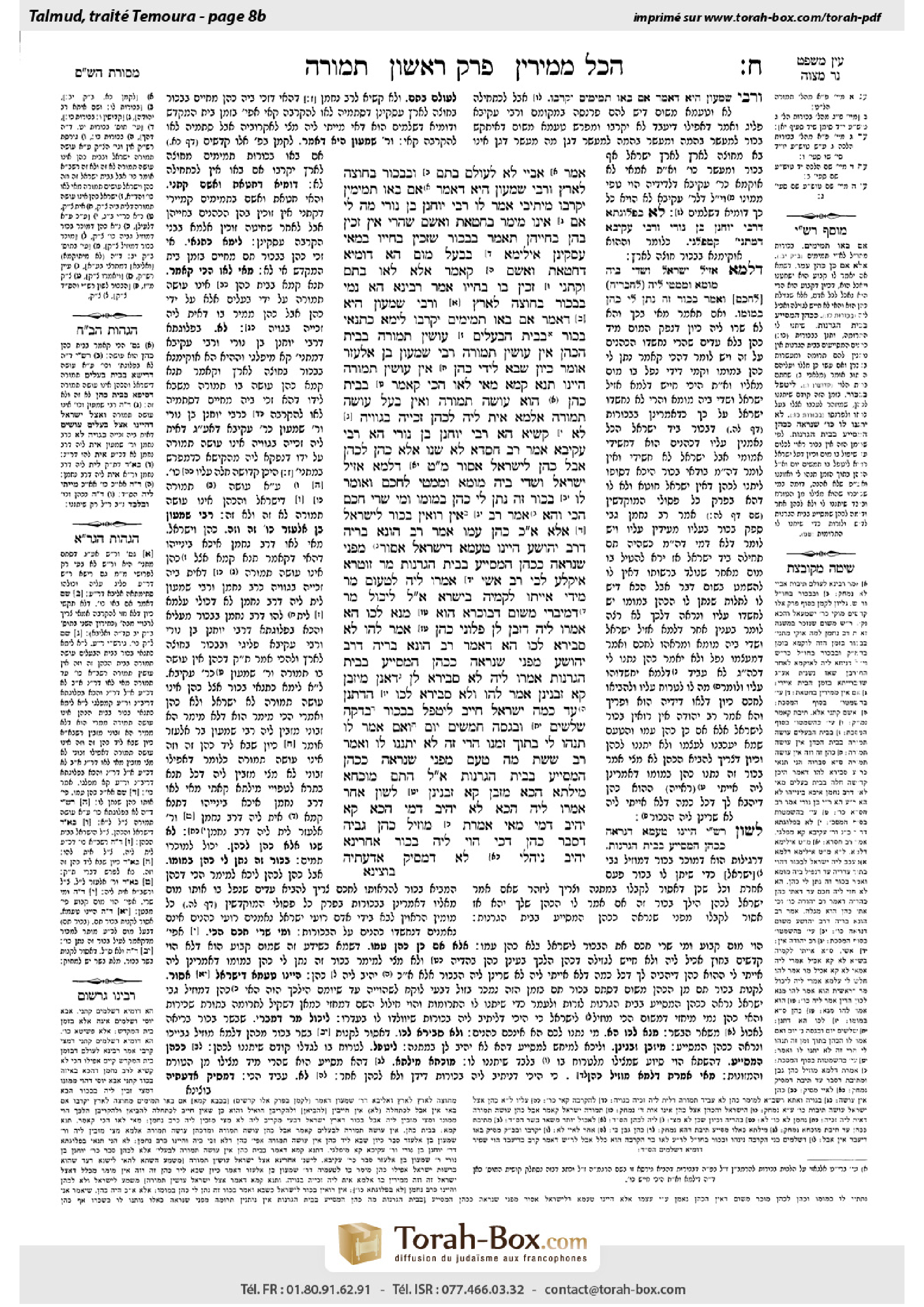
Temurah 8b: Talmud study for Daf Yomi
Daf Yomi is the daily study of one Talmud folio. Explore 37 tractates with scans, Hebrew text, Sefaria English and AI-generated French translations where annotated.
Passage selection and English or AI-generated French translation are available where the scan has annotations. Daf Study is independent of Torah-Box and Sefaria.
Browse Temurah · תמורה · All tractatesTemurah 8b text and translations
This page of Temurah includes the Aramaic text, an English translation and an AI-generated French translation, alongside the scan above.
תמורה ח׳ ב · Aramaic and Hebrew text
אָמַר אַבָּיֵי: לָא, לְעוֹלָם בְּתָם, וּבִבְכוֹר בְּחוּצָה לָאָרֶץ, וְרַבִּי שִׁמְעוֹן הִיא דְּאָמַר: אִם בָּאוּ תְּמִימִין יִקְרְבוּ.
מֵיתִיבִי: אָמַר לוֹ רַבִּי יוֹחָנָן בֶּן נוּרִי: מָה לִי אִם אֵינוֹ מֵימֵר בְּחַטָּאת וְאָשָׁם, שֶׁהֲרֵי אֵין זָכִין בָּהֶן בְּחַיֵּיהֶן, תֹּאמַר בִּבְכוֹר שֶׁזָּכִין בְּחַיָּיו. בְּמַאי עָסְקִינַן? אִילֵימָא בְּבַעַל מוּם — הָא דּוּמְיָא דְּחַטָּאת וְאָשָׁם קָאָמַר, אֶלָּא לָאו בְּתָם, וְקָתָנֵי זָכִין בּוֹ בְּחַיָּיו!
אָמַר רָבִינָא: הָא נָמֵי בִּבְכוֹר בְּחוּצָה לָאָרֶץ, וְרַבִּי שִׁמְעוֹן הִיא, דְּאָמַר: אִם בָּאוּ תְּמִימִים — יִקְרְבוּ.
לֵימָא כְּתַנָּאֵי: בְּכוֹר, בְּבֵית הַבְּעָלִים — עוֹשִׂין תְּמוּרָה, בְּבֵית הַכֹּהֵן — אֵין עוֹשִׂין תְּמוּרָה. רַבִּי שִׁמְעוֹן בֶּן אֶלְעָזָר אוֹמֵר: כֵּיוָן שֶׁבָּא לִידֵי כֹהֵן — אֵין עוֹשִׂין תְּמוּרָה.
הַיְינוּ תַּנָּא קַמָּא! מַאי לָאו הָכִי קָאָמַר: בְּבֵית כֹּהֵן — הוּא עוֹשֶׂה תְּמוּרָה, וְאֵין בַּעַל עוֹשֶׂה תְּמוּרָה, אַלְמָא אִית לֵיהּ לְכֹהֵן זְכִיָּיה בְּגַוֵּויהּ.
לָא קַשְׁיָא, הָא רַבִּי יוֹחָנָן בֶּן נוּרִי, הָא רַבִּי עֲקִיבָא.
אָמַר רַב חִסְדָּא: לֹא שָׁנוּ אֶלָּא כֹּהֵן לְכֹהֵן, אֲבָל כֹּהֵן לְיִשְׂרָאֵל — אָסוּר. מַאי טַעְמָא? דִּלְמָא אָזֵיל יִשְׂרָאֵל וְשָׁדֵי בֵּיהּ מוּמָא, וּמַמְטֵי לְחָכָם, וְאוֹמֵר לוֹ: ״בְּכוֹר זֶה נָתַן לִי כֹּהֵן בְּמוּמוֹ״.
וּמִי שָׁרֵי חָכָם הָכִי? וְהָא אָמַר רַב: אֵין רוֹאִין בְּכוֹר לְיִשְׂרָאֵל אֶלָּא אִם כֵּן כֹּהֵן עִמּוֹ!
אָמַר רַב הוּנָא בְּרֵיהּ דְּרַב יְהוֹשֻׁעַ: הַיְינוּ טַעְמָא דְּיִשְׂרָאֵל אָסוּר, מִפְּנֵי שֶׁנִּרְאֶה כְּכֹהֵן הַמְסַיֵּיעַ בְּבֵית הַגֳּרָנוֹת.
מָר זוּטְרָא אִיקְּלַע לְבֵי רַב אָשֵׁי. אֲמַרוּ לֵיהּ: לִטְעוֹם מָר מִידֵּי. אַיְיתוֹ לְקַמֵּיהּ בִּישְׂרָא. אֲמַר לֵיהּ: לֵיכוֹל מָר, דְּמַיבְרֵי מִשּׁוּם דְּבוּכְרָא הוּא. מְנָא לְכוּ הָא? אֲמַרוּ לֵיהּ: דְּזַבֵּן לַן פְּלוֹנִי כֹּהֵן.
אֲמַר לְהוּ: לָא סְבִירָא לְכוּ הָא דְּאָמַר רַב הוּנָא בְּרֵיהּ דְּרַב יְהוֹשֻׁעַ, מִפְּנֵי שֶׁנִּרְאֶה כְּכֹהֵן הַמְסַיֵּיעַ בְּבֵית הַגֳּרָנוֹת? אֲמַרוּ לֵיהּ: לָא סְבִירָא לַן, דַּאֲנַן מִיזְבָּן קָא זָבְנִינַן.
אֲמַר לְהוּ: וְלָא סְבִירָא לְכוּ הָדִתְנַן: עַד כַּמָּה יִשְׂרָאֵל חַיָּיב לִיטַּפֵּל בַּבְּכוֹר? בַּדַּקָּה — שְׁלֹשִׁים יוֹם, ובגסה — חמשים יום. וְאִם אָמַר לוֹ: ״תְּנֵהוּ לִי בְּתוֹךְ זְמַנּוֹ״ — הֲרֵי זֶה לֹא יִתְּנֶנּוּ לוֹ. וְאָמַר רַב שֵׁשֶׁת: מָה טַעַם? מִפְּנֵי שֶׁנִּרְאֶה כְּכֹהֵן הַמְסַיֵּיעַ בְּבֵית הַגֳּרָנוֹת!
אֲמַרוּ לֵיהּ: הָתָם מוֹכְחָא מִילְּתָא, הָכָא מִזְבָּן קָא זָבְנִינַן.
לָשׁוֹן אַחֵר, אֲמַרוּ לֵיהּ: הָכָא לָא יָהֵיב דְּמֵי, הָכָא קָא יָהֵיב דְּמֵי. מַאי אָמְרַתְּ? מוֹזֵיל כֹּהֵן גַּבֵּיהּ, דְּסָבַר כֹּהֵן דְּכִי הָוֵי לֵיהּ בְּכוֹר אַחֲרִינָא יָהֵיב נִיהֲלֵיהּ? לָא, דְּמַסֵּיק אַדַּעְתֵּיהּ:
Temurah 8b · English translation
Abaye says: No, actually, the baraita is referring to an unblemished animal when the Temple is standing, but it is speaking of a firstborn offering outside of Eretz Yisrael, and it is in accordance with the opinion of Rabbi Shimon, who said: If unblemished firstborn offerings came from outside of Eretz Yisrael, they may be sacrificed on the altar. This language indicates that there is no obligation to sacrifice such an animal, as people did not generally bring their firstborn offerings from outside Eretz Yisrael. Therefore, a priest is able to acquire it even when it is unblemished. Firstborn offerings from Eretz Yisrael, by contrast, cannot be acquired by the priests.
§ The Gemara raises an objection from the mishna: Rabbi Yoḥanan ben Nuri said to him: What is this comparison for me? If a priest does not substitute for a sin offering and a guilt offering, which priests do not acquire during the animals’ lifetimes, will you say the same with regard to a firstborn, which priests acquire during the animal’s lifetime? What are we dealing with in the mishna? If we say that it is referring to a blemished animal, isn’t the mishna saying that the firstborn offering is similar to a sin offering and a guilt offering, which the priests acquire only unblemished? Rather, is it not referring to unblemished animals? And it nevertheless teaches: Which priests acquire during the animal’s lifetime.
Ravina said: This mishna too is referring to a firstborn offering outside of Eretz Yisrael, and it is in accordance with the opinion of Rabbi Shimon, who said: If unblemished firstborn offerings came from outside of Eretz Yisrael, they may be sacrificed on the altar. The priests do not acquire firstborn offerings from Eretz Yisrael.
The Gemara suggests: Let us say that acquisition of the firstborn offerings by the priests is the subject of a dispute between tanna’im. The baraita states: In the case of a firstborn offering, when it is in the house of its owner, who did not yet give it to a priest, its owner can render another animal a substitute for it. Once it is in the house of the priest, its owner cannot render a substitute for it. Rabbi Shimon ben Elazar says: Once it has entered the possession of the priest, its owner cannot render a substitute for it.
Apparently, the opinion of Rabbi Shimon ben Elazar is identical to that of the first tanna. What is their dispute? What, is it not correct that this is what the first tanna is saying: Once it is in the house, i.e., possession, of the priest, the priest can render a substitute for it, but the owner cannot render a substitute for it, as the priest has acquired it; while Rabbi Shimon ben Elazar holds that once it enters the possession of the priest, neither of them can render a substitute with it. Apparently, the first tanna holds that the priest has the right of acquisition to an unblemished firstborn offering when the Temple is standing.
The Gemara explains: The opinion of the first tanna is not difficult; one can say that the dispute in the baraita concerns a firstborn offering outside of Eretz Yisrael, while those from Eretz Yisrael are not acquired by the priests. And this opinion of the first tanna accords with the opinion of Rabbi Yoḥanan ben Nuri in the mishna above, and that opinion of Rabbi Shimon ben Elazar accords with the opinion of Rabbi Akiva in that mishna.
§ The Gemara earlier (7b) cited a mishna (Ma’aser Sheni 1:2) which states that a firstborn offering may be sold unblemished only while it is alive. Rav Ḥisda says: The Sages taught this halakha only with regard to a priest selling to a priest, but with regard to a priest selling it to an Israelite, it is prohibited even when the animal is alive. What is the reason? Since an Israelite can consume a firstborn animal only if it is blemished, there is a concern that perhaps the Israelite will go and inflict a blemish on the firstborn offering and bring it to a halakhic authority to attain permission to eat it, and he will say to him: A priest gave me this firstborn offering when it was already blemished.
The Gemara asks: And may a halakhic authority permit the animal in a case such as this? But didn’t Rav say: A halakhic authority may not look at a firstborn offering brought by an Israelite to determine if it has the type of permanent blemish allowing it to be slaughtered unless a priest is with him, out of concern that the Israelite will keep the blemished animal for himself without performing the mitzva of giving it to a priest? If so, one can demand that the priest who sold him the animal must be present, and this should prevent the Israelite from lying about the blemish.
Rav Huna, son of Rabbi Yehoshua, said: This is the reason why it is prohibited for a priest to sell an unblemished firstborn offering to an Israelite: Because this looks like a priest who assists at the threshing floor in order to receive teruma from an Israelite. Unblemished firstborn offerings have a low purchase price, as the owner must wait for it to become blemished before eating it. It might appear that the priest sold the animal to an Israelite at a discount in order to receive future firstborns from him.
The Gemara relates: Mar Zutra arrived at the home of Rav Ashi. Those present said to him: Let the Master taste some food. They brought meat before him. The one who placed the meat before him said: Let the Master eat, as this meat is particularly healthful, because it is a firstborn. Mar Zutra asked: From where did you receive this firstborn animal? They said to him: It is an animal that so-and-so the priest sold to us.
Mar Zutra said to them: Do you not hold like that which Rav Huna, son of Rabbi Yehoshua, said, that Israelites may not receive an unblemished firstborn offering from a priest because it looks like a priest who assists at the threshing floor? They said to Mar Zutra: We hold that this is not a concern, as we purchased it for its fair market value, and did not receive it at a discount. Therefore, there is no appearance of impropriety.
Mar Zutra said to them: But do you not hold like that which we learned in a mishna (Bekhorot 26b): Until when is an Israelite obligated to tend to a firstborn animal before giving it to the priest? In the case of a small animal, a sheep or goat, thirty days, and in the case of a large animal, one of a herd of cattle, fifty days. And if the priest said to the owner: Give it to me within its period, the owner may not give it to him. And Rav Sheshet says: What is the reason for this? Because it looks like a priest who assists at the threshing floor, as the priest is assisting the Israelite by assuming the responsibility of tending to the firstborn.
They said to Mar Zutra: There the circumstances of the matter prove that the priest accepted responsibility to care for the animal in return for some benefit, and it has the appearance of impropriety. Here, we purchased it for its fair market value, and there is no appearance of impropriety.
The Gemara presents an alternative version of this final response. They said to Mar Zutra: There the Israelite does not give payment to the priest for accepting responsibility to care for the animal. Here, the Israelite gives payment to the priest, as we purchased the animal. And what would you say to this claim? Would you say that perhaps the priest lowered the price of the animal for us, as the priest thinks that when we have another firstborn offering we will give it to him, and therefore it has the appearance of impropriety? This is not a concern, as he thinks:
Temurah 8b · Traduction française (IA)
Abayé dit : Non, en réalité, la baraïta parle d’un animal sans défaut à l’époque où le Temple est debout ; mais il s’agit d’un premier-né provenant de l’extérieur d’Eretz Israël, et elle suit l’opinion de Rabbi Chimon, qui a dit : « Si des premiers-nés sans défaut proviennent de l’extérieur d’Eretz Israël, ils peuvent être offerts sur l’autel. » Cette formulation indique qu’il n’y a pas d’obligation d’offrir un tel animal, car, en général, les gens n’apportaient pas leurs premiers-nés de l’extérieur d’Eretz Israël. Par conséquent, un prêtre peut l’acquérir même s’il est sans défaut. En revanche, les prêtres ne peuvent pas acquérir les premiers-nés provenant d’Eretz Israël.
§ La Guemara soulève une objection tirée de la Michna. Rabbi Yoḥanan ben Nouri lui dit : « En quoi cette comparaison me convient-elle ? Si un prêtre ne peut pas substituer un animal à un sacrifice expiatoire ou à un sacrifice de culpabilité, que les prêtres n’acquièrent pas du vivant de l’animal, diras-tu la même chose au sujet d’un premier-né, que les prêtres acquièrent du vivant de l’animal ? » De quoi parle la Michna ? Si nous disons qu’elle concerne un animal atteint d’un défaut, ne dit-elle pas que le premier-né est comparable à un sacrifice expiatoire et à un sacrifice de culpabilité, que les prêtres n’acquièrent que lorsqu’ils sont sans défaut ? Ne parle-t-elle donc pas d’animaux sans défaut ? Et pourtant, elle enseigne : « que les prêtres acquièrent du vivant de l’animal ».
Ravina dit : Cette Michna aussi concerne un premier-né provenant de l’extérieur d’Eretz Israël, et elle suit l’opinion de Rabbi Chimon, qui a dit : « Si des premiers-nés sans défaut proviennent de l’extérieur d’Eretz Israël, ils peuvent être offerts sur l’autel. » Les prêtres n’acquièrent pas les premiers-nés provenant d’Eretz Israël.
La Guemara suggère : Disons que la question de l’acquisition des premiers-nés par les prêtres fait l’objet d’une controverse entre tannaïm. La baraïta enseigne : Dans le cas d’un premier-né, tant qu’il se trouve dans la maison de son propriétaire, qui ne l’a pas encore donné à un prêtre, son propriétaire peut lui substituer un autre animal. Une fois qu’il se trouve dans la maison du prêtre, son propriétaire ne peut plus lui substituer un autre animal. Rabbi Chimon ben Elazar dit : Dès qu’il est entré en possession du prêtre, son propriétaire ne peut plus lui substituer un autre animal.
Apparemment, l’opinion de Rabbi Chimon ben Elazar est identique à celle du premier tanna. Quel est leur désaccord ? N’est-il pas juste de comprendre que le premier tanna dit ceci : Dès que le premier-né se trouve dans la maison du prêtre, c’est-à-dire en sa possession, le prêtre peut lui substituer un autre animal, mais le propriétaire ne le peut pas, puisque le prêtre l’a acquis ; tandis que Rabbi Chimon ben Elazar soutient que, dès qu’il est entré en possession du prêtre, ni l’un ni l’autre ne peut lui substituer un autre animal ? Apparemment, le premier tanna soutient que le prêtre a un droit d’acquisition sur un premier-né sans défaut lorsque le Temple est debout.
La Guemara explique : L’opinion du premier tanna ne pose pas de difficulté ; on peut dire que la controverse de la baraïta concerne un premier-né provenant de l’extérieur d’Eretz Israël, tandis que les prêtres n’acquièrent pas les premiers-nés provenant d’Eretz Israël. L’opinion du premier tanna correspond à celle de Rabbi Yoḥanan ben Nouri dans la Michna précédente, et celle de Rabbi Chimon ben Elazar correspond à celle de Rabbi Akiva dans cette Michna.
§ Plus haut, la Guemara (7b) a cité une Michna (Ma’asser Chéni 1:2) qui enseigne qu’un premier-né ne peut être vendu sans défaut que lorsqu’il est vivant. Rav Ḥisda dit : Les Sages n’ont enseigné cette halakha que dans le cas où un prêtre vend à un prêtre ; mais lorsqu’un prêtre vend le premier-né à un Israélite, cela est interdit même si l’animal est vivant. Pour quelle raison ? Puisqu’un Israélite ne peut consommer un premier-né que s’il est atteint d’un défaut, on craint que l’Israélite n’aille infliger un défaut au premier-né, puis ne l’apporte à une autorité halakhique afin d’obtenir la permission de le manger, en lui disant : « Un prêtre m’a donné ce premier-né alors qu’il était déjà atteint d’un défaut. »
La Guemara demande : Une autorité halakhique peut-elle autoriser l’animal dans un cas comme celui-ci ? Rav n’a-t-il pas dit : « Une autorité halakhique ne peut pas examiner un premier-né qu’un Israélite lui présente pour déterminer s’il présente le type de défaut permanent qui permet de l’abattre, à moins qu’un prêtre ne l’accompagne, de crainte que l’Israélite ne garde pour lui l’animal atteint d’un défaut sans accomplir la mitsva de le donner à un prêtre » ? Si tel est le cas, on peut exiger que le prêtre qui lui a vendu l’animal soit présent, ce qui devrait empêcher l’Israélite de mentir au sujet du défaut.
Rav Houna, fils de Rabbi Yehochoua, dit : Voici pourquoi il est interdit à un prêtre de vendre à un Israélite un premier-né sans défaut : cela ressemble au cas d’un prêtre qui aide à l’aire de battage afin de recevoir de la terouma d’un Israélite. Le prix d’achat des premiers-nés sans défaut est bas, car leur propriétaire doit attendre qu’ils soient atteints d’un défaut avant de pouvoir les manger. On pourrait croire que le prêtre a vendu l’animal à un Israélite à prix réduit afin de recevoir de lui de futurs premiers-nés.
La Guemara rapporte : Mar Zoutra arriva chez Rav Achi. Les personnes présentes lui dirent : « Que le Maître goûte à quelques mets. » On lui apporta de la viande. Celui qui la lui servit dit : « Que le Maître en mange, car cette viande est particulièrement bonne pour la santé : c’est un premier-né. » Mar Zoutra demanda : « D’où avez-vous reçu cet animal premier-né ? » Ils lui répondirent : « C’est un animal que tel prêtre nous a vendu. »
Mar Zoutra leur dit : « Ne tenez-vous pas compte de ce qu’a dit Rav Houna, fils de Rabbi Yehochoua, à savoir que les Israélites ne peuvent pas recevoir d’un prêtre un premier-né sans défaut, car cela ressemble au cas d’un prêtre qui aide à l’aire de battage ? » Ils répondirent à Mar Zoutra : « Nous estimons qu’il n’y a pas lieu de s’inquiéter, car nous l’avons acheté à sa juste valeur marchande et ne l’avons pas reçu à prix réduit. Il n’y a donc pas d’apparence de conduite répréhensible. »
Mar Zoutra leur dit : « Mais ne tenez-vous pas compte de ce que nous avons appris dans une Michna (Bekhorot 26b) : Jusqu’à quand un Israélite est-il tenu de prendre soin d’un animal premier-né avant de le donner au prêtre ? Dans le cas d’un petit animal, mouton ou chèvre, trente jours ; et dans le cas d’un grand animal, une bête du troupeau bovin, cinquante jours. Et si le prêtre dit au propriétaire : “Donne-le-moi avant l’expiration de ce délai”, le propriétaire ne peut pas le lui donner. Rav Chéchet dit : Quelle en est la raison ? Cela ressemble au cas d’un prêtre qui aide à l’aire de battage, puisque le prêtre aide l’Israélite en prenant à sa charge les soins du premier-né. »
Ils dirent à Mar Zoutra : « Là, les circonstances montrent que le prêtre a accepté de prendre soin de l’animal en échange d’un avantage, ce qui donne une apparence de conduite répréhensible. Ici, nous l’avons acheté à sa juste valeur marchande, et il n’y a pas d’apparence de conduite répréhensible. »
La Guemara présente une autre version de cette dernière réponse. Ils dirent à Mar Zoutra : « Là, l’Israélite ne verse pas d’argent au prêtre pour qu’il accepte de prendre soin de l’animal. Ici, l’Israélite paie le prêtre, puisque nous avons acheté l’animal. Et que répondrais-tu à cet argument ? Dirais-tu peut-être que le prêtre nous a fait un prix inférieur parce qu’il pense que, lorsque nous aurons un autre premier-né, nous le lui donnerons, ce qui donne une apparence de conduite répréhensible ? Il n’y a pas lieu de s’inquiéter, car il pense : »
Traduction française générée par IA à partir de l’édition anglaise de Sefaria. Vérifie toujours un passage avec le texte source.
Text from Sefaria: William Davidson Edition - Vocalized Aramaic (CC BY NC); William Davidson Edition - English (CC BY NC).