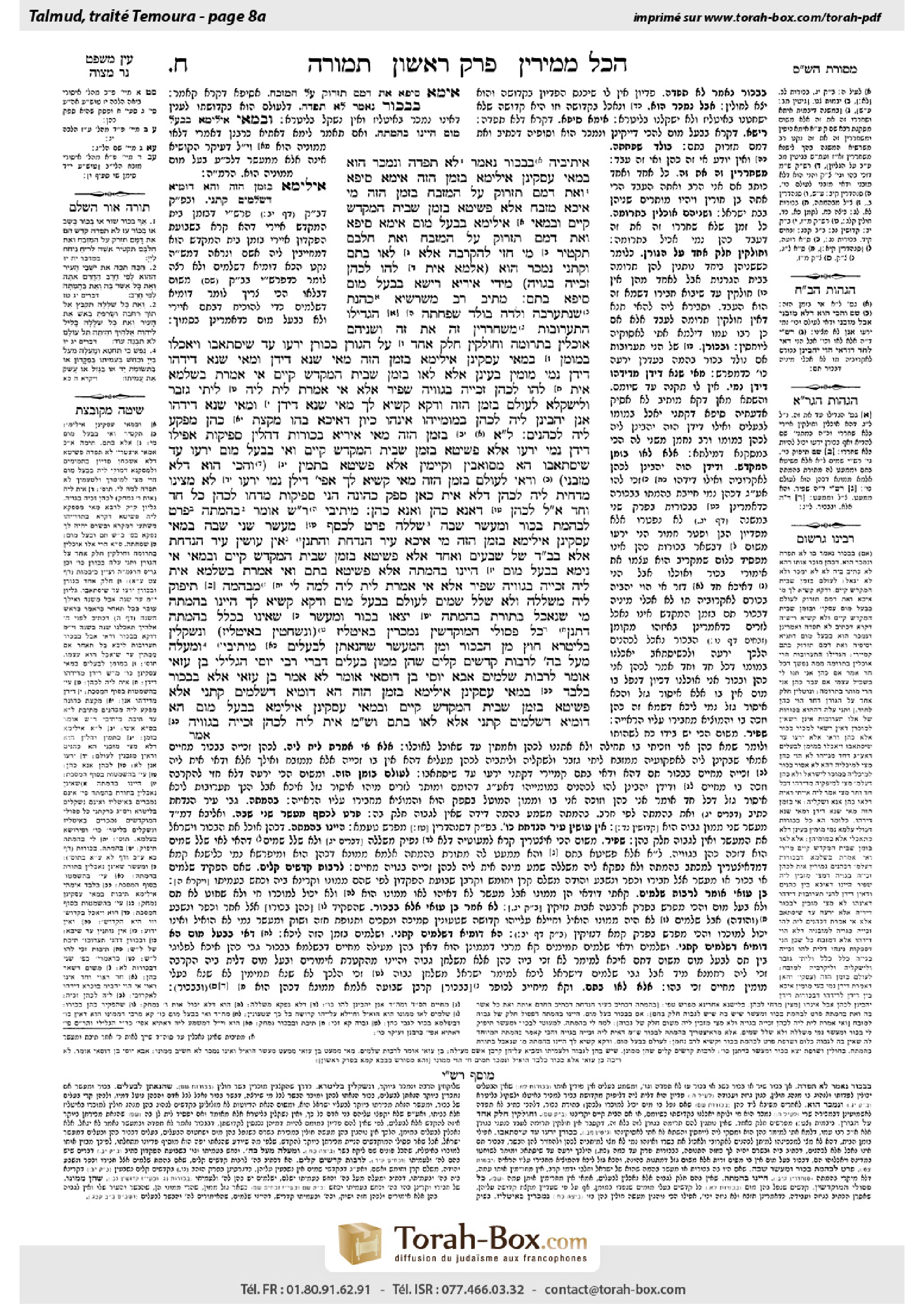
Temurah 8a: Talmud study for Daf Yomi
Daf Yomi is the daily study of one Talmud folio. Explore 37 tractates with scans, Hebrew text, Sefaria English and AI-generated French translations where annotated.
Passage selection and English or AI-generated French translation are available where the scan has annotations. Daf Study is independent of Torah-Box and Sefaria.
Browse Temurah · תמורה · All tractatesTemurah 8a text and translations
This page of Temurah includes the Aramaic text, an English translation and an AI-generated French translation, alongside the scan above.
תמורה ח׳ א · Aramaic and Hebrew text
אֵיתִיבֵיהּ: בִּבְכוֹר נֶאֱמַר ״לֹא תִפְדֶּה״ וְנִמְכָּר הוּא, בְּמַאי עָסְקִינַן? אִילֵימָא בִּזְמַן הַזֶּה — אֵימָא סֵיפָא: ״וְאֶת דָּמָם תִּזְרוֹק עַל הַמִּזְבֵּחַ״, בִּזְמַן הַזֶּה מִי אִיכָּא מִזְבֵּחַ? אֶלָּא פְּשִׁיטָא בִּזְמַן שֶׁבֵּית הַמִּקְדָּשׁ קַיָּים.
וּבְמַאי? אִילֵימָא בְּבַעַל מוּם — אֵימָא סֵיפָא: ״וְאֶת דָּמָם תִּזְרוֹק עַל הַמִּזְבֵּחַ וְאֶת חֶלְבָּם תַּקְטִיר״ — מִי חֲזֵי לְהַקְרָבָה?! אֶלָּא לָאו בְּתָם, וְקָתָנֵי נִמְכָּר הוּא, אַלְמָא אִית לְהוּ לְכֹהֵן זְכִיָּיה בְּגַוֵּיהּ!
מִידֵּי אִירְיָא? רֵישָׁא — בְּבַעַל מוּם, סֵיפָא — בְּתָם.
מֵתִיב רַב מְשַׁרְשְׁיָא: כֹּהֶנֶת שֶׁנִּתְעָרֵבה וְלָדָהּ בִּוְלַד שִׁפְחָתָהּ, הִגְדִּילוּ הַתַּעֲרוֹבוֹת — מְשַׁחְרְרִין זֶה אֶת זֶה, וּשְׁנֵיהֶם אוֹכְלִין בִּתְרוּמָה, וְחוֹלְקִין חֵלֶק אֶחָד עַל הַגּוֹרֶן. בְּכוֹרָן יִרְעוּ עַד שֶׁיִּסְתָּאֲבוּ, וְיֵאָכְלוּ בְּמוּמָן.
בְּמַאי עָסְקִינַן? אִילֵימָא בִּזְמַן הַזֶּה — מַאי שְׁנָא דִּידַן וּמַאי שְׁנָא דִּידְהוּ? דִּידַן נָמֵי מוּמִין בָּעֵינַן! אֶלָּא לָאו בִּזְמַן שֶׁבֵּית הַמִּקְדָּשׁ קַיָּים? אִי אָמְרַתְּ בִּשְׁלָמָא אִית לְהוּ לְכֹהֵן זְכִיָּיה בְּגַוֵּויהּ — שַׁפִּיר, אֶלָּא אִי אָמְרַתְּ לֵית לֵיהּ — לֵיתֵי גִּזְבָּר וְלִישְׁקְלֵהּ!
לְעוֹלָם בִּזְמַן הַזֶּה, וּדְקָא קַשְׁיָא לָךְ: מַאי שְׁנָא דִּידַן וּמַאי שְׁנָא דִּידְהוּ? אֲנַן יָהֲבִינַן לֵיהּ לְכֹהֵן בְּמוּמַיְיהוּ, אִינְהוּ — כֵּיוָן דְּאִיכָּא בְּהוּ מִקְצָת כֹּהֵן, מַפְקַע לֵיהּ לְכֹהֲנִים.
לִישָּׁנָא אַחֲרִינָא: בִּזְמַן הַזֶּה, מַאי אִירְיָא בְּכוֹרוֹת דְּהָלֵין סְפֵיקוֹת? אֲפִילּוּ דִּידַן נָמֵי יִרְעוּ! אֶלָּא פְּשִׁיטָא בִּזְמַן שֶׁבֵּית הַמִּקְדָּשׁ קַיָּים, וְאִי בְּבַעַל מוּם — יִרְעוּ עַד שֶׁיִּסְתָּאֲבוּ? הָא מְסוֹאָבִין וְקָיְימִין! אֶלָּא פְּשִׁיטָא בְּתַמִּין, וְהָכִי הוּא דְּלָא מְזַבְּנִי וַדַּאי.
לְעוֹלָם בִּזְמַן הַזֶּה, מַאי קַשְׁיָא לָךְ, אֲפִילּוּ דִּילַן נָמֵי יִרְעוּ? לָא (מָצִינוּ) [מָצֵינַן] מְדַחֵינַן לֵיהּ לְכֹהֵן, דְּלָא אִית כָּאן סְפֵק כְּהוּנָּה. הָנֵי סְפֵיקוֹת מְדַחוּ לְכֹהֵן, כֹּל חַד וְחַד אָמַר לֵיהּ לְכֹהֵן: דַּאֲנָא כֹּהֵן וַאֲנָא כֹּהֵן.
מֵיתִיבִי: רַבִּי שִׁמְעוֹן אוֹמֵר: ״בְּהֶמְתָּהּ״ — פְּרָט לְבֶהֱמַת בְּכוֹר וּמַעֲשֵׂר שֶׁבָּהּ, ״שְׁלָלָהּ״ — פְּרָט לְכֶסֶף מַעֲשֵׂר שֵׁנִי שֶׁבָּהּ.
בְּמַאי עָסְקִינַן? אִילֵימָא בִּזְמַן הַזֶּה — מִי אִיכָּא עִיר הַנִּדַּחַת? וְהָתְנַן: אֵין עוֹשִׂין עִיר הַנִּדַּחַת אֶלָּא בְּבֵית דִּין שֶׁל שִׁבְעִים וְאֶחָד! אֶלָּא פְּשִׁיטָא בִּזְמַן שֶׁבֵּית הַמִּקְדָּשׁ קַיָּים.
וּבְמַאי? אִי נֵימָא בְּבַעַל מוּם — הַיְינוּ ״בְּהֶמְתָּהּ״! אֶלָּא פְּשִׁיטָא בְּתָם. וְאִי אָמְרַתְּ בִּשְׁלָמָא אִית לֵיהּ זְכִיָּיה בְּגַוֵּיהּ — שַׁפִּיר, אֶלָּא אִי אָמְרַתְּ לֵית לֵיהּ — לְמָה לִי מִבְּהֵמָה? תִּיפּוֹק לֵיהּ מִ״שְּׁלָלָהּ״, וְלֹא שְׁלַל שָׁמַיִם!
לְעוֹלָם בְּבַעַל מוּם, וּדְקָא קַשְׁיָא לָךְ הַיְינוּ ״בְּהֶמְתָּהּ״ — מִי שֶׁנֶּאֱכָל בְּתוֹרַת ״בְּהֶמְתָּהּ״, יָצְאוּ בְּכוֹר וּמַעֲשֵׂר (שֶׁאֵינוֹ בִּכְלַל) [שֶׁאֵין נֶאֱכָלִין בְּתוֹרַת] ״בְּהֶמְתָּהּ״.
דִּתְנַן: כׇּל פְּסוּלֵי הַמּוּקְדָּשִׁין נִמְכָּרִין בָּאִיטְלִיז, וְנִשְׁחָטִין בָּאִיטְלִיז, וְנִשְׁקָלִין בְּלִיטְרָא, חוּץ מִן הַבְּכוֹר וּמִן הַמַּעֲשֵׂר, שֶׁהֲנָאָתָן לַבְּעָלִים.
מֵיתִיבִי: ״וּמָעֲלָה מַעַל בַּה׳״ — לְרַבּוֹת קֳדָשִׁים קַלִּים, שֶׁהֵן מָמוֹן בְּעָלִים, דִּבְרֵי רַבִּי יוֹסֵי הַגְּלִילִי.
בֶּן עַזַּאי אוֹמֵר: לְרַבּוֹת שְׁלָמִים. אַבָּא יוֹסֵי בֶּן דּוֹסַאי אוֹמֵר: לֹא אָמַר בֶּן עַזַּאי אֶלָּא בִּבְכוֹר בִּלְבָד.
בְּמַאי עָסְקִינַן? אִילֵימָא בִּזְמַן הַזֶּה — הָא דּוּמְיָא דִּשְׁלָמִים קָתָנֵי! אֶלָּא פְּשִׁיטָא בִּזְמַן שֶׁבֵּית הַמִּקְדָּשׁ קַיָּים.
וּבְמַאי עָסְקִינַן? אִילֵימָא בְּבַעַל מוּם — הָא דּוּמְיָא דִּשְׁלָמִים קָתָנֵי! אֶלָּא לָאו בְּתָם, וּשְׁמַע מִינַּהּ אִית לֵיהּ לְכֹהֵן זְכִיָּיה בְּגַוֵּויהּ.
Temurah 8a · English translation
§ Rava raised an objection to the statement of Rav Naḥman from a baraita: With regard to a firstborn offering, it is stated: “But the firstling of an ox, or the firstling of a sheep, or the firstling of a goat, you shall not redeem; they are holy: And you shall sprinkle their blood against the altar” (Numbers 18:17). But it may be sold to another priest for consumption after its sacrifice. What era are we dealing with in this baraita? If we say it is in the present, say the latter clause of the verse: “And you shall sprinkle their blood against the altar.” Is there an altar in the present? Rather, it is obvious that it is referring to the time when the Temple is standing.
And what sort of animal are we dealing with here? If we say that it is referring to a blemished animal, say the latter clause of the verse: “And you shall sprinkle their blood against the altar, and burn their fat.” Is a blemished animal fit for sacrifice? Rather, is it not referring to an unblemished animal? And the baraita teaches that it may be sold. Evidently, the priest has the right of acquisition to an unblemished firstborn offering even when the Temple is standing and the animal must be sacrificed.
Rav Naḥman responds: Are the two clauses of the verse comparable? The first clause is stated with regard to a blemished animal, and it is teaching that it may be sold, and the latter clause is stated with regard to an unblemished animal, and it teaches that it is sacrificed as an offering. Unblemished animals may not be sold when the Temple is standing.
§ Rav Mesharshiyya raises an objection from a mishna (Yevamot 99a): In the case of a priestess’s offspring who was comingled with her maidservant’s offspring, when the comingled children have grown up, they free each other, and therefore whichever one was a slave will be emancipated. And even beforehand, they both may partake of teruma, as both a priest and the slave of a priest may partake of teruma. And they receive one share of teruma in the granary, because the slave of a priest receives no share. And their firstborn animals must graze until they become unfit for sacrifice by virtue of a blemish, and then they may be eaten with their blemish.
What era are we dealing with in this mishna? If we say it is in the present, what is different about our firstborn offerings, i.e., those of Israelites, and what is different about their firstborn offerings, those of priests? Ours also require that they have blemishes before they may be eaten. Why is the halakha stated specifically with regard to priests? Rather, is it not speaking of the time when the Temple is standing? Granted, if you say that the priest has the right of acquisition to an unblemished firstborn offering when the Temple is standing, it is well. But if you say that a priest does not have the right of acquisition, let the Temple treasurer [gizbar] come and take the firstborn offerings for sacrifice. Why are they left in the offspring’s possession until they develop blemishes?
The Gemara answers: Actually, the mishna is speaking of the present. And as for that which is difficult for you: What is different about our firstborn offerings and what is different about their firstborn offerings, there is in fact a difference, as we must give ours to a priest once they are blemished. Although it is permitted for Israelites to eat blemished firstborn offerings, they are still required to give them to priests. By contrast, they, the offspring mentioned in the mishna, are different, since there is part of a priest in each of them due to the uncertainty of their parentage. And this is sufficient to dislodge the claims of all other priests to the animal.
The Gemara presents an alternative version of the previous discussion: If the mishna is referring to the present, why specifically discuss the firstborn offerings of these cases of uncertain parentage? Even our firstborn offerings should be left to graze until they are blemished. Rather, it is obvious that the mishna is referring to the time when the Temple is standing. And if the mishna is speaking of a blemished animal, does it make sense to say: They should graze until they become unfit for sacrifice? They are already unfit. Rather, it is obvious that the mishna is referring to unblemished animals, and it is only in a case such as this, when the owners might not be priests, that they definitely may not sell the animal. One can infer that a priest may sell an unblemished firstborn offering when the Temple is standing.
The Gemara explains: Actually, the mishna is referring to the present. What is difficult for you, the fact that even our firstborn offerings should graze until they are blemished? We Israelites are unable to deny the priest who claims the firstborn offering, as there is no member of the priesthood, however uncertain, here among the owners of the animal. By contrast, in these cases of uncertain parentage described in the mishna, they can deny the priest, as both of them can say to the priest: I am a priest, and I am a priest. Since the burden of proof rests upon the claimant, both may keep their animals until they are blemished.
§ The Gemara raises an objection from a baraita (Tosefta, Sanhedrin 4:5): A verse discussing an idolatrous city states: “You shall smite the inhabitants of that city with the edge of the sword, destroying it utterly, and all that is therein and its animals, with the edge of the sword. And you shall gather all its spoil into the midst of the broad place thereof, and shall burn with fire the city, and all the spoil thereof” (Deuteronomy 13:16–17). Rabbi Shimon says: The term “its animals” serves to exclude firstborn kosher animals and the animal tithe that are in the city, as they are sacred. The term “its spoil” serves to exclude money used to redeem the second tithe that is found in the city, as it too is sacred.
What era are we dealing with in this baraita? If we say it is in the present, can there be an idolatrous city in the present day? But didn’t we learn in a mishna (Sanhedrin 2a): A city may be designated as an idolatrous city only in accordance with the ruling of a court of seventy-one judges, i.e., the Great Sanhedrin? Rather, it is obvious that the mishna is referring to the period when the Temple is standing.
And to what type of animal is the baraita referring? If you say that it is referring to a blemished firstborn animal, which belongs to its owners, this is included in the term “its animals,” which one is commanded to destroy. Rather, it is obvious that the baraita is referring to an unblemished firstborn offering. And granted, if you say that the priest has the right of acquisition to an unblemished firstborn offering when the Temple is standing, it is well, as although it belongs to an individual, the Torah nevertheless exempts it from destruction. But if you say that a priest does not have the right of acquisition, why do I need to derive its exemption from the term “its animals”? One should derive its exemption from the term “its spoil,” from which one can infer: But not the spoils of Heaven.
The Gemara answers: Actually, the baraita is speaking of a blemished animal. And as for that which is difficult for you, that this is considered “its animals,” one can answer that this term includes only that which is eaten in the manner of its animals, without additional restrictions. This excludes even a blemished firstborn offering and animal tithe offering, which is not included in the category of “its animals.”
And which restrictions apply to the consumption of blemished firstborn animals? The restrictions are as we learned in a mishna (Bekhorot 31a): All disqualified consecrated animals are redeemed and then sold in the butchers’ market [ba’itliz], where they fetch a higher price, in order to benefit the Temple treasury. And they are slaughtered in the butchers’ market, and their meat is weighed and sold by the litra, as is done with non-sacred meat, with the exception of a firstborn offering and animal tithe offering, as their benefit is accrued to their owners. The money will benefit their owners rather than the Temple treasury, and private individuals may not disgrace disqualified offerings by treating them as one would non-sacred meat.
§ The Gemara raises an objection from a baraita: If one takes an oath falsely denying possession of another’s property, he must pay the value of that property and an additional one-fifth to the owner. The passage stating this halakha begins: “If anyone sin, and commit a trespass against the Lord, and deal falsely with his neighbor in a matter of deposit, or of pledge, or of robbery” (Leviticus 5:21). By stating: “And commit a trespass against the Lord,” the verse serves to include one who denies possession of offerings of lesser sanctity belonging to another, as they are the property of their owner, who has the right to consume their meat after the sacrifice. This is the statement of Rabbi Yosei HaGelili.
Ben Azzai says: The verse serves to include only one who denies possession of a peace offering of another, not other offerings of lesser sanctity. Abba Yosei ben Dosai says: Ben Azzai stated his halakha only with regard to a firstborn offering, that it is considered the property of the owner, i.e., the priest, but not with regard to other offerings of lesser sanctity.
What era are we dealing with in this baraita? If we say it is in the present, doesn’t the baraita teach the halakha of a firstborn offering as similar to the halakha of a peace offering? Peace offerings are not a relevant category in the present day. Rather, it is obvious that the baraita is referring to the period when the Temple is standing.
And what type of animal are we dealing with? If we say that the baraita is referring specifically to a blemished animal, doesn’t it teach the halakha of a firstborn offering as similar to the halakha of a peace offering? Peace offerings are the property of their owners even when they are unblemished. Rather, is it not referring even to an unblemished firstborn animal? And the baraita teaches that this animal is the property of its owner. Learn from it that the priest has the right of acquisition to an unblemished firstborn offering when the Temple is standing.
Temurah 8a · Traduction française (IA)
§ Rava soulève une objection à l’affirmation de Rav Naḥman à partir d’une baraïta : À propos d’un sacrifice de premier-né, il est dit : « Mais le premier-né d’un bœuf, le premier-né d’un mouton ou le premier-né d’une chèvre, tu ne le rachèteras pas ; ils sont saints. Tu répandras leur sang contre l’autel » (Nombres 18:17). Toutefois, il peut être vendu à un autre prêtre pour être consommé après le sacrifice. De quelle époque parle cette baraïta ? Si nous disons qu’elle parle de l’époque actuelle, examinons la suite du verset : « Tu répandras leur sang contre l’autel. » Y a-t-il un autel à l’époque actuelle ? Il est donc évident qu’elle parle de l’époque où le Temple est debout.
Et de quel type d’animal s’agit-il ici ? Si nous disons qu’il s’agit d’un animal atteint d’un défaut, examinons la suite du verset : « Tu répandras leur sang contre l’autel et tu brûleras leur graisse. » Un animal atteint d’un défaut peut-il être offert en sacrifice ? Il s’agit donc nécessairement d’un animal sans défaut. Or, la baraïta enseigne qu’il peut être vendu. Il en ressort que le prêtre a un droit d’acquisition sur un sacrifice de premier-né sans défaut, même lorsque le Temple est debout et que l’animal doit être sacrifié.
Rav Naḥman répond : Les deux parties du verset sont-elles comparables ? La première partie concerne un animal atteint d’un défaut et enseigne qu’il peut être vendu ; la dernière partie concerne un animal sans défaut et enseigne qu’il est offert en sacrifice. Les animaux sans défaut ne peuvent pas être vendus lorsque le Temple est debout.
§ Rav Mesharshiyya soulève une objection à partir d’une Michna (Yevamot 99a) : Dans le cas où l’enfant d’une femme de famille sacerdotale a été mêlé à l’enfant de sa servante, lorsque les enfants ont grandi, ils s’affranchissent mutuellement ; ainsi, celui qui est esclave est libéré. Même auparavant, tous deux peuvent consommer de la terouma, car un prêtre comme l’esclave d’un prêtre peuvent en consommer. Ils reçoivent une seule part de terouma à l’aire de battage, car l’esclave d’un prêtre ne reçoit aucune part. Leurs premiers-nés doivent paître jusqu’à ce qu’un défaut les rende inaptes au sacrifice ; ils peuvent alors être consommés malgré leur défaut.
De quelle époque parle cette Michna ? Si nous disons qu’elle parle de l’époque actuelle, en quoi nos sacrifices de premier-né, c’est-à-dire ceux des Israélites, diffèrent-ils des leurs, ceux des prêtres ? Les nôtres aussi doivent avoir un défaut avant de pouvoir être consommés. Pourquoi cette halakha est-elle énoncée spécifiquement à propos des prêtres ? La Michna ne parle-t-elle donc pas de l’époque où le Temple est debout ? Certes, si tu dis que le prêtre a un droit d’acquisition sur un sacrifice de premier-né sans défaut lorsque le Temple est debout, cela s’explique. Mais si tu dis que le prêtre n’a pas de droit d’acquisition, que le trésorier du Temple [gizbar] vienne donc prendre les sacrifices de premier-né pour les offrir. Pourquoi les laisse-t-on en possession des enfants jusqu’à ce qu’ils aient un défaut ?
La Guemara répond : En réalité, la Michna parle de l’époque actuelle. Quant à la difficulté que tu soulèves — en quoi nos sacrifices de premier-né diffèrent-ils des leurs ? —, il y a effectivement une différence : nous devons remettre les nôtres à un prêtre une fois qu’ils ont un défaut. Même si les Israélites ont le droit de consommer les sacrifices de premier-né atteints d’un défaut, ils sont néanmoins tenus de les remettre aux prêtres. En revanche, les enfants mentionnés dans la Michna sont différents, car chacun d’eux comporte une part sacerdotale, du fait de l’incertitude concernant leur filiation. Cela suffit à écarter les prétentions de tous les autres prêtres sur l’animal.
La Guemara présente une autre version de la discussion précédente : Si la Michna parle de l’époque actuelle, pourquoi mentionner spécifiquement les sacrifices de premier-né de ces cas où la filiation est incertaine ? Même nos sacrifices de premier-né devraient paître jusqu’à ce qu’ils aient un défaut. Il est donc évident que la Michna parle de l’époque où le Temple est debout. Et si la Michna parle d’un animal atteint d’un défaut, est-il logique de dire qu’ils doivent paître jusqu’à devenir inaptes au sacrifice ? Ils le sont déjà. Il est donc évident que la Michna parle d’animaux sans défaut ; et c’est uniquement dans un cas comme celui-ci, où les propriétaires ne sont peut-être pas des prêtres, qu’ils ne peuvent assurément pas vendre l’animal. On peut en déduire qu’un prêtre peut vendre un sacrifice de premier-né sans défaut lorsque le Temple est debout.
La Guemara explique : En réalité, la Michna parle de l’époque actuelle. Qu’est-ce qui te pose problème, à savoir que même nos sacrifices de premier-né devraient paître jusqu’à ce qu’ils aient un défaut ? Nous, les Israélites, ne pouvons pas repousser le prêtre qui revendique le sacrifice de premier-né, car parmi les propriétaires de l’animal, il n’y a aucun membre du sacerdoce, même de statut incertain. En revanche, dans les cas de filiation incertaine décrits dans la Michna, ils peuvent repousser le prêtre, car tous deux peuvent lui dire : « Je suis prêtre, et je suis prêtre. » Puisque la charge de la preuve incombe au revendiquant, tous deux peuvent garder leurs animaux jusqu’à ce qu’ils aient un défaut.
§ La Guemara soulève une objection à partir d’une baraïta (Tosefta, Sanhédrin 4:5) : Un verset au sujet d’une ville idolâtre dit : « Tu frapperas au tranchant de l’épée les habitants de cette ville ; tu la voueras à la destruction, elle et tout ce qu’elle contient ainsi que ses animaux, au tranchant de l’épée. Tu rassembleras tout son butin au milieu de sa place publique et tu brûleras par le feu la ville et tout son butin » (Deutéronome 13:16–17). Rabbi Shimon dit : L’expression « ses animaux » sert à exclure les animaux purs premiers-nés et la dîme animale qui se trouvent dans la ville, puisqu’ils sont consacrés. L’expression « son butin » sert à exclure l’argent utilisé pour racheter la seconde dîme qui se trouve dans la ville, puisqu’il est lui aussi consacré.
De quelle époque parle cette baraïta ? Si nous disons qu’elle parle de l’époque actuelle, peut-il exister une ville idolâtre de nos jours ? N’avons-nous pas appris dans une Michna (Sanhédrin 2a) qu’une ville ne peut être déclarée ville idolâtre que conformément à la décision d’un tribunal de soixante et onze juges, c’est-à-dire du Grand Sanhédrin ? Il est donc évident que la baraïta parle de la période où le Temple est debout.
Et à quel type d’animal la baraïta fait-elle référence ? Si tu dis qu’elle parle d’un animal premier-né atteint d’un défaut, qui appartient à ses propriétaires, cela est inclus dans l’expression « ses animaux », qu’il faut détruire. Il est donc évident que la baraïta parle d’un sacrifice de premier-né sans défaut. Certes, si tu dis que le prêtre a un droit d’acquisition sur un sacrifice de premier-né sans défaut lorsque le Temple est debout, cela s’explique : bien qu’il appartienne à un particulier, la Torah l’exempte néanmoins de la destruction. Mais si tu dis que le prêtre n’a pas de droit d’acquisition, pourquoi faut-il déduire son exemption de l’expression « ses animaux » ? Il faudrait déduire son exemption de l’expression « son butin », d’où l’on peut inférer : mais non le butin du Ciel.
La Guemara répond : En réalité, la baraïta parle d’un animal atteint d’un défaut. Quant à la difficulté que tu soulèves — à savoir que celui-ci est considéré comme « ses animaux » —, on peut répondre que cette expression n’inclut que ce qui se consomme comme ses animaux, sans restriction supplémentaire. Elle exclut ainsi même un sacrifice de premier-né atteint d’un défaut et un sacrifice de la dîme animale, qui ne sont pas inclus dans la catégorie de « ses animaux ».
Et quelles restrictions s’appliquent à la consommation des animaux premiers-nés atteints d’un défaut ? Ce sont celles que nous avons apprises dans une Michna (Bekhorot 31a) : Tous les animaux consacrés devenus inaptes sont rachetés, puis vendus au marché des bouchers [ba’itliz], où ils atteignent un prix plus élevé, afin de procurer un bénéfice au trésor du Temple. Ils sont abattus au marché des bouchers, et leur viande est pesée et vendue à la litra, comme la viande non consacrée, à l’exception du sacrifice de premier-né et du sacrifice de la dîme animale, puisque le bénéfice qu’ils procurent revient à leurs propriétaires. L’argent bénéficiera à leurs propriétaires plutôt qu’au trésor du Temple, et les particuliers ne peuvent pas déshonorer les sacrifices devenus inaptes en les traitant comme de la viande non consacrée.
§ La Guemara soulève une objection à partir d’une baraïta : Si quelqu’un prête un faux serment en niant détenir le bien d’autrui, il doit en payer la valeur au propriétaire, ainsi qu’un cinquième supplémentaire. Le passage énonçant cette halakha commence ainsi : « Si quelqu’un commet une faute et une infidélité envers le Seigneur en trompant son prochain au sujet d’un dépôt, d’un gage ou d’un vol » (Lévitique 5:21). Par les mots « et une infidélité envers le Seigneur », le verset inclut celui qui nie détenir des sacrifices de moindre sainteté appartenant à autrui, car ils sont la propriété de leur propriétaire, qui a le droit d’en consommer la viande après le sacrifice. Telle est la déclaration de Rabbi Yosei HaGelili.
Ben Azzai dit : Le verset sert à inclure uniquement celui qui nie détenir le sacrifice de paix d’autrui, et non d’autres sacrifices de moindre sainteté. Abba Yosei ben Dosai dit : Ben Azzai n’a énoncé sa halakha qu’au sujet d’un sacrifice de premier-né, considéré comme la propriété de son propriétaire, c’est-à-dire du prêtre, mais pas au sujet d’autres sacrifices de moindre sainteté.
De quelle époque parle cette baraïta ? Si nous disons qu’elle parle de l’époque actuelle, la baraïta n’enseigne-t-elle pas la halakha d’un sacrifice de premier-né par comparaison avec celle d’un sacrifice de paix ? Les sacrifices de paix ne sont pas une catégorie pertinente à l’époque actuelle. Il est donc évident que la baraïta parle de la période où le Temple est debout.
Et de quel type d’animal s’agit-il ? Si nous disons que la baraïta parle spécifiquement d’un animal atteint d’un défaut, n’enseigne-t-elle pas la halakha d’un sacrifice de premier-né par comparaison avec celle d’un sacrifice de paix ? Les sacrifices de paix appartiennent à leurs propriétaires même lorsqu’ils sont sans défaut. La baraïta ne parle-t-elle donc pas également d’un animal premier-né sans défaut ? Or, elle enseigne que cet animal appartient à son propriétaire. Déduis-en que le prêtre a un droit d’acquisition sur un sacrifice de premier-né sans défaut lorsque le Temple est debout.
Traduction française générée par IA à partir de l’édition anglaise de Sefaria. Vérifie toujours un passage avec le texte source.
Text from Sefaria: William Davidson Edition - Vocalized Aramaic (CC BY NC); William Davidson Edition - English (CC BY NC).