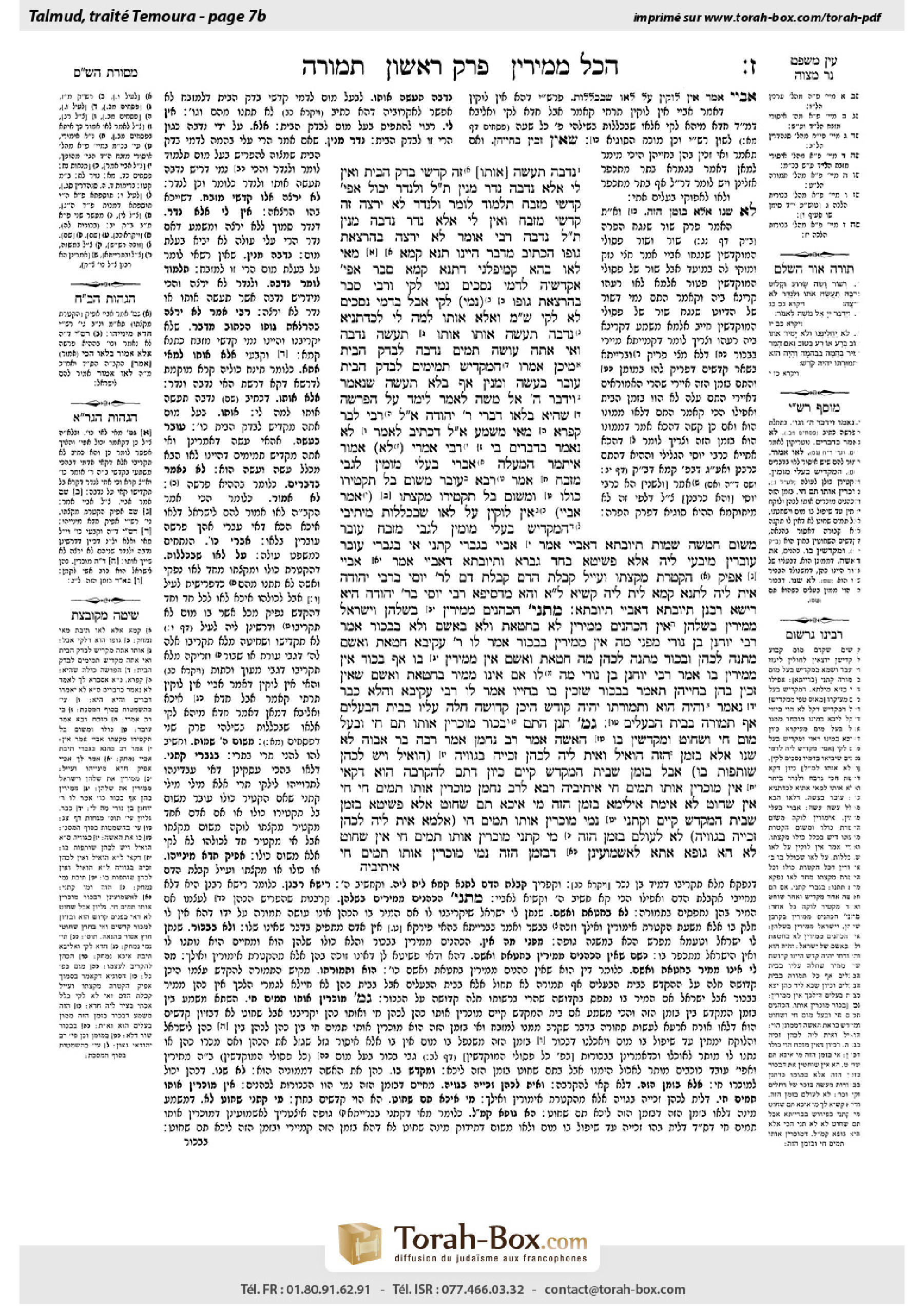
Temurah 7b: Talmud study for Daf Yomi
Daf Yomi is the daily study of one Talmud folio. Explore 37 tractates with scans, Hebrew text, Sefaria English and AI-generated French translations where annotated.
Passage selection and English or AI-generated French translation are available where the scan has annotations. Daf Study is independent of Torah-Box and Sefaria.
Browse Temurah · תמורה · All tractatesTemurah 7b text and translations
This page of Temurah includes the Aramaic text, an English translation and an AI-generated French translation, alongside the scan above.
תמורה ז׳ ב · Aramaic and Hebrew text
״נְדָבָה תַּעֲשֶׂה אֹתוֹ״ — זֶה קׇדְשֵׁי בֶּדֶק הַבַּיִת, וְאֵין לִי אֶלָּא נְדָבָה, נֶדֶר מִנַּיִן? תַּלְמוּד לוֹמַר: ״וּלְנֵדֶר״.
יָכוֹל אֲפִילּוּ קׇדְשֵׁי מִזְבֵּחַ? תַּלְמוּד לוֹמַר ״וּלְנֵדֶר לֹא יֵרָצֶה״, זֶה קׇדְשֵׁי מִזְבֵּחַ. וְאֵין לִי אֶלָּא נֶדֶר, נְדָבָה מִנַּיִן? תַּלְמוּד לוֹמַר ״נְדָבָה״. רַבִּי אוֹמֵר: ״לֹא יֵרָצֶה״ — בְּהַרְצָאַת גּוּפוֹ הַכָּתוּב מְדַבֵּר.
הַיְינוּ תַּנָּא קַמָּא! מַאי לָאו בְּהָא קָמִיפַּלְגִי, דְּתַנָּא קַמָּא סָבַר: אֲפִילּוּ אַקְדְּשֵׁיהּ לִדְמֵי נְסָכִים — נָמֵי לָקֵי, וְרַבִּי סָבַר: בְּהַרְצָאַת גּוּפוֹ — נָמֵי לָקֵי, אֲבָל בִּדְמֵי נְסָכִים — לָא לָקֵי. שְׁמַע מִינַּהּ.
וְאֶלָּא ״אוֹתוֹ״ לְמָה לִי? לְכִדְתַנְיָא: ״נְדָבָה תַּעֲשֶׂה אוֹתוֹ״ — ״אוֹתוֹ״ תַּעֲשֶׂה נְדָבָה, וְאִי אַתָּה עוֹשֶׂה תָּמִים נְדָבָה לְבֶדֶק הַבַּיִת. מִיכָּן אָמְרוּ: הַמַּקְדִּישׁ תְּמִימִים לְבֶדֶק הַבַּיִת — עוֹבֵר בַּעֲשֵׂה.
וּמִנַּיִן אַף בְּלֹא תַעֲשֶׂה — שֶׁנֶּאֱמַר ״וַיְדַבֵּר ה׳ אֶל מֹשֶׁה לֵּאמֹר״ — לִימֵּד עַל הַפָּרָשָׁה שֶׁהִיא בְּלָאו, דִּבְרֵי רַבִּי יְהוּדָה.
אֲמַר לֵיהּ רַבִּי לְבַר קַפָּרָא: מַאי מַשְׁמַע? אֲמַר לֵיהּ דִּכְתִיב ״לֵאמֹר״ — ״לֹא״ נֶאֱמַר בַּדְּבָרִים. בֵּי רַבִּי אָמְרִי: ״לֹא אֱמוֹר״.
אִיתְּמַר: הַמַּעֲלֶה אֵבְרֵי בַּעֲלֵי מוּמִין לְגַבֵּי מִזְבֵּחַ, אָמַר רָבָא: עוֹבֵר מִשּׁוּם ״בַּל תַּקְטִירוּ כּוּלּוֹ״ וּמִשּׁוּם ״בַּל תַּקְטִירוּ מִקְצָתוֹ״. אָמַר אַבָּיֵי: אֵין לוֹקִין עַל לָאו שֶׁבִּכְלָלוֹת.
מֵיתִיבִי: הַמַּקְדִּישׁ בַּעֲלֵי מוּמִין לְגַבֵּי מִזְבֵּחַ — עוֹבֵר מִשּׁוּם חֲמִשָּׁה שֵׁמוֹת, תְּיוּבְתָּא דְּאַבָּיֵי.
אָמַר אַבָּיֵי: בְּגַבְרֵי קָתָנֵי! אִי בְּגַבְרֵי — ״עוֹבֵר״?! ״עוֹבְרִין״ מִיבְּעֵי לֵיהּ! אֶלָּא פְּשִׁיטָא בְּחַד גַּבְרָא, וּתְיוּבְתָּא דְאַבָּיֵי.
אָמַר אַבָּיֵי: אַפֵּיק ״הַקְטָרַת מִקְצָתוֹ״, וְעַיֵּיל ״קַבָּלַת הַדָּם״. קַבָּלַת דָּם — לְרַבִּי יוֹסֵי בְּרַבִּי יְהוּדָה אִית לֵיהּ, לְתַנָּא קַמָּא לֵית לֵיהּ? קַשְׁיָא!
לִישָּׁנָא אַחֲרִינָא: וְהָא מִדְּסֵיפָא רַבִּי יוֹסֵי בְּרַבִּי יְהוּדָה הִיא, רֵישָׁא רַבָּנַן. תְּיוּבְתָּא דְאַבָּיֵי, תְּיוּבְתָּא.
מַתְנִי׳ הַכֹּהֲנִים מְמִירִין בְּשֶׁלָּהֶן, וְיִשְׂרָאֵל מְמִירִין בְּשֶׁלָּהֶן. אֵין הַכֹּהֲנִים מְמִירִין לֹא בְּחַטָּאת וְלֹא בְּאָשָׁם וְלֹא בִּבְכוֹר. אָמַר רַבִּי יוֹחָנָן בֶּן נוּרִי: מִפְּנֵי מָה אֵין מְמִירִין בִּבְכוֹר? אָמַר לוֹ רַבִּי עֲקִיבָא: חַטָּאת וְאָשָׁם מַתָּנָה לַכֹּהֵן, וּבְכוֹר מַתָּנָה לַכֹּהֵן. מָה חַטָּאת וְאָשָׁם אֵין מְמִירִין בּוֹ, אַף בְּכוֹר אֵין מְמִירִין בּוֹ.
אָמַר רַבִּי יוֹחָנָן בֶּן נוּרִי: מָה לוֹ אִם אֵינוֹ מֵמִיר בְּחַטָּאת וְאָשָׁם, שֶׁאֵין זָכִין בָּהֶן בְּחַיֵּיהֶן, תֹּאמַר בִּבְכוֹר שֶׁזָּכִין בּוֹ בְּחַיָּיו! אָמַר לוֹ רַבִּי עֲקִיבָא: וַהֲלֹא כְּבָר נֶאֱמַר ״וְהָיָה הוּא וּתְמוּרָתוֹ יִהְיֶה קּוֹדֶשׁ״, הֵיכָן קְדוּשָּׁה חָלָה עָלָיו? בְּבֵית הַבְּעָלִים, אַף תְּמוּרָה בְּבֵית הַבְּעָלִים.
גְּמָ׳ תְּנַן הָתָם: בְּכוֹר מוֹכְרִין אוֹתוֹ תָּם חַי, וּבַעַל מוּם חַי וְשָׁחוּט, וּמְקַדְּשִׁין בּוֹ הָאִשָּׁה. אָמַר רַב נַחְמָן אָמַר רַבָּה בַּר אֲבוּהּ: לֹא שָׁנוּ אֶלָּא בִּזְמַן הַזֶּה, הוֹאִיל וְאִית לֵיהּ לְכֹהֵן זְכִיָּיה בְּגַוֵּויהּ (הוֹאִיל וְיֵשׁ לַכֹּהֵן שׁוּתָּפוּת בּוֹ), אֲבָל בִּזְמַן שֶׁבֵּית הַמִּקְדָּשׁ קַיָּים, כֵּיוָן דְּתָם לְהַקְרָבָה הוּא דְּקָאֵי — אֵין מוֹכְרִין אוֹתוֹ תָּמִים חַי.
אֵיתִיבֵיהּ רָבָא לְרַב נַחְמָן: מוֹכְרִין אוֹתוֹ תָּמִים חַי — חַי אִין, שָׁחוּט לָא. אֵימַת? אִילֵּימָא בִּזְמַן הַזֶּה — מִי אִיכָּא תָּם שָׁחוּט? אֶלָּא פְּשִׁיטָא בִּזְמַן שֶׁבֵּית הַמִּקְדָּשׁ קַיָּים, וְקָתָנֵי נָמֵי: מוֹכְרִין אוֹתוֹ תָּמִים חַי, (אַלְמָא אִית לֵיהּ לְכֹהֵן זְכִיָּיה בְּגַוֵּויהּ)!
לָא, לְעוֹלָם בִּזְמַן הַזֶּה, מִי קָתָנֵי: מוֹכְרִין אוֹתוֹ תָּמִים חַי — אִין, שָׁחוּט — לָא? הִא גּוּפַאּ אֲתָא לְאַשְׁמוֹעִינַן, דְּבִזְמַן הַזֶּה נָמֵי מוֹכְרִין אוֹתוֹ תָּמִים חַי.
Temurah 7b · English translation
A vow offering differs from a gift offering in that if it dies prematurely, one is liable to replace the former but not the latter. The verse states: “Either a bull or a lamb that has anything too long or too short, you may offer it for a gift, and for a vow it shall not be accepted” (Leviticus 22:23). The phrase “You may offer it for a gift” is referring to a blemished animal consecrated for Temple maintenance. And I have derived only that one may consecrate it in the manner of a gift; from where is it derived that one may consecrate it in the manner of a vow as well? The verse states: “You may offer it for a gift and for a vow.”
One might have thought that one can consecrate blemished animals even as offerings to be sacrificed on the altar. Therefore, the verse states: “And for a vow it shall not be accepted.” This is referring to offerings sacrificed on the altar, for which acceptance is a relevant term. And I have derived only that one may not consecrate such an animal as a vow offering. From where is it derived that one may not do so as a gift offering? The verse states: “A gift…and for a vow it shall not be accepted.” Rabbi Yehuda HaNasi says: In employing the phrase “It shall not be accepted,” the verse is speaking of consecration that depends upon the acceptance of the animal’s body, i.e., consecration as an offering. Nevertheless, they may be consecrated for Temple maintenance.
The Gemara asks: The opinion of Rabbi Yehuda HaNasi is identical to the opinion of the first tanna. What is their dispute? The Gemara suggests: What, is it not that they disagree with regard to this, that the first tanna holds that even if one consecrates it to be sold and its money is used for purchasing libations, he is flogged as well; and Rabbi Yehuda HaNasi holds that in a case where there is acceptance of the animal’s body, the one who consecrated it is indeed flogged, but if one consecrates it to be sold and its money is used for purchasing libations, he is not flogged. Learn from the baraita that the first tanna holds that consecration toward libations is equivalent to consecration as an offering, as Rava suggested above.
§ The Gemara analyzes the wording of Leviticus 22:23: But why do I need the word “it,” in the phrase: “You may offer it”? What does this serve to exclude? It is required for that which is taught in a baraita: When the verse states: “You may offer it for a gift,” this teaches that you may offer this blemished animal as a gift for Temple maintenance, but you may not offer an unblemished animal as a gift for Temple maintenance. From here the Sages said: One who consecrates unblemished animals for Temple maintenance transgresses a positive mitzva.
And from where is it derived that he has transgressed a prohibition as well? As it is stated at the beginning of that passage: “And the Lord spoke to Moses, saying [lemor]” (Leviticus 22:1). This teaches that every mitzva stated in the passage is considered a prohibition. This is the statement of Rabbi Yehuda.
The Gemara relates that Rabbi Yehuda HaNasi said to bar Kappara: From where may it be inferred that every mitzva stated in the passage is considered a prohibition? Bar Kappara said to him that this is as it is written: As the verse states: “Lemor,” the term can be read as though it states: No [lo], an expression of prohibition, is stated [ne’emar] with regard to the subsequent matters. In the school of Rabbi Yehuda HaNasi they say: The term should be understood to mean that God said to Moses: No [lo] shall you say [emor] to them these matters.
§ A baraita above (6b) stated that one who sacrifices a blemished animal on the altar transgresses the prohibition “You may not burn all of it,” and if he sacrificed part of it, he transgresses the prohibition “You may not burn part of it.” With regard to this it was stated: In the case of one who brings up the limbs of blemished animals onto the altar, Rava says that he violates both the prohibition of “You may not burn all of it;” and the prohibition of “You may not burn part of it,” and he receives two sets of lashes. Abaye says: One is not flogged twice for violating a general prohibition. Since one verse serves as the source for both prohibitions, one is not flogged twice for its violation.
The Gemara raises an objection from the Tosefta (1:10): One who consecrates blemished animals for sacrifice on the altar violates five separate categories of prohibition. The aforementioned baraita enumerated these and included both the prohibition “You may not burn all of it” and the prohibition “You may not burn part of it,” indicating that one is flogged for transgressing each of these prohibitions. This is apparently a conclusive refutation of the opinion of Abaye.
Abaye said: The baraita is teaching the halakha with regard to different men, one of whom burned an entire animal on the altar, and one of whom burned only part of it. One person cannot be liable for both prohibitions. The Gemara challenges: If it is teaching the halakha of different men, why does it say: Violates, in the third person singular? It should have stated: Violate, in the plural. Rather, it is obvious that the baraita is referring to one man, and this is apparently a conclusive refutation of the opinion of Abaye.
Abaye said: From the list of five prohibitions, remove that of burning part of the offering, and insert the collection of the blood, which means that there is only one prohibition for burning the offering, and the number of prohibitions still remains at five. The Gemara raises a difficulty: With regard to the collection of the blood, Rabbi Yosei, son of Rabbi Yehuda, is of the opinion that one transgresses that prohibition, but the first tanna is not of that opinion. How, then, can Abaye contradict the first tanna? The Gemara concludes: It is difficult.
The Gemara presents an alternative version of the previous point: But from the fact that the latter clause of the baraita is in accordance with the opinion of Rabbi Yosei, son of Rabbi Yehuda, it may be inferred that the first clause is in accordance with the opinion of the Rabbis. The Gemara concludes: The refutation of the opinion of Abaye is indeed a conclusive refutation.
MISHNA: The priests substitute for their own offerings and Israelites substitute for their own offerings. The priests substitute neither for a sin offering, nor for a guilt offering, nor for a firstborn offering that they received from an Israelite, as those animals are not their property, and one does not substitute an animal that is not his. Rabbi Yoḥanan ben Nuri said: For what reason can priests not substitute for a firstborn offering that they received from an Israelite? Does it not belong to them? Rabbi Akiva said to him: A sin offering and a guilt offering are a gift to the priest, and the firstborn offering is likewise a gift to the priest. Just as in the cases of a sin offering and a guilt offering, priests that receive one of them from an Israelite cannot substitute for it, so too with regard to a firstborn offering, priests that receive it from an Israelite cannot substitute for it.
Rabbi Yoḥanan ben Nuri said: What is this comparison for him? If a priest does not substitute for a sin offering and a guilt offering, which priests do not acquire during the animals’ lifetimes, will you say the same with regard to a firstborn, which priests do acquire during the animal’s lifetime? Rabbi Akiva said to him: But isn’t it already stated: “Then both it and its substitute shall be sacred” (Leviticus 27:10), which juxtaposes the consecration of the consecrated animal with that of its non-sacred substitute? Where is the consecrated animal imbued with sanctity? It is in the house of the owner. So too, the substitute animal is consecrated in the house of the owner. Therefore, the priest cannot substitute for the firstborn that he received because he is not the owner that initially consecrated it.
GEMARA: We learned in a mishna elsewhere (Ma’aser Sheni 1:2): With regard to a firstborn offering, one may sell it if it is unblemished only while it is still alive, as after it is slaughtered outside the Temple one may not derive benefit from it, and if it was offered in the Temple, one may not sell sacrificial meat. And if it is blemished, one may sell it while it is alive or after it has been slaughtered. And a priest can betroth a woman with it, as it is his property. Rav Naḥman says that Rabba bar Avuh says: They taught this halakha only with regard to the present, when there is no Temple, since the priest has the ability to acquire the firstborn offering. But when the Temple is standing, since the unblemished firstborn animal stands for sacrifice, one may not sell it unblemished while it is alive.
Rava raised an objection to Rav Naḥman: The mishna teaches that one may sell an unblemished firstborn offering while it is alive. One can infer that while it is alive, yes, one may sell it, but once it has been slaughtered, one may not sell it. When is this the halakha? If we say that this mishna is speaking in the present, is there an unblemished, slaughtered, firstborn offering? Offerings are not slaughtered in the present day. Rather, it is obvious that the mishna is speaking of the time when the Temple is standing. And yet, the mishna still teaches that one may sell an unblemished firstborn offering while it is alive, which contradicts the statement of Rav Naḥman.
Rav Naḥman responds: No; actually the mishna is referring to the halakha in the present. I disagree with the above inference. Does the mishna explicitly teach: One may sell an unblemished firstborn offering while it is alive, yes, but once it has been slaughtered, no? The mishna does not mean to rule out selling a slaughtered animal; rather, it is coming to teach us the matter itself, that even in the present, one may sell it unblemished while it is alive.
Temurah 7b · Traduction française (IA)
Une offrande votive diffère d’une offrande volontaire en ce que, si elle meurt prématurément, on est tenu de la remplacer dans le premier cas, mais pas dans le second. Le verset dit : « Un taureau ou un agneau qui a un membre trop long ou trop court, tu peux l’offrir en offrande volontaire, mais il ne sera pas accepté comme offrande votive » (Lévitique 22:23). L’expression « Tu peux l’offrir en offrande volontaire » fait référence à un animal atteint d’un défaut, consacré à l’entretien du Temple. Or, je n’ai déduit de là que l’on peut le consacrer à la manière d’une offrande volontaire ; d’où déduit-on que l’on peut aussi le consacrer à la manière d’une offrande votive ? Le verset dit : « Tu peux l’offrir en offrande volontaire et en offrande votive. »
On aurait pu penser que l’on peut consacrer des animaux atteints d’un défaut même comme offrandes destinées à être sacrifiées sur l’autel. C’est pourquoi le verset dit : « Il ne sera pas accepté comme offrande votive. » Cela concerne les offrandes sacrifiées sur l’autel, pour lesquelles la notion d’acceptation est pertinente. Or, je n’ai déduit de là que l’on ne peut pas consacrer un tel animal comme offrande votive. D’où déduit-on que l’on ne peut pas non plus le faire comme offrande volontaire ? Le verset dit : « Une offrande volontaire… et il ne sera pas accepté comme offrande votive. » Rabbi Yehuda HaNasi dit : En employant l’expression « Il ne sera pas accepté », le verset parle d’une consécration qui dépend de l’acceptation du corps de l’animal, c’est-à-dire de sa consécration comme offrande. Néanmoins, on peut consacrer ces animaux à l’entretien du Temple.
La Guemara demande : L’opinion de Rabbi Yehuda HaNasi est identique à celle du premier tanna. Sur quoi porte leur désaccord ? La Guemara propose : Ne divergent-ils pas sur ce point : selon le premier tanna, même si quelqu’un consacre l’animal pour qu’il soit vendu et que son prix serve à acheter des libations, il est également passible de flagellation ; tandis que, selon Rabbi Yehuda HaNasi, celui qui le consacre est passible de flagellation lorsque la consécration porte sur le corps de l’animal, mais ne l’est pas s’il le consacre pour qu’il soit vendu et que son prix serve à acheter des libations ? Déduis de la baraïta que, selon le premier tanna, la consécration destinée aux libations équivaut à une consécration comme offrande, comme Rava l’a proposé plus haut.
§ La Guemara analyse la formulation de Lévitique 22:23 : Mais pourquoi le mot « le », dans l’expression « Tu peux l’offrir », est-il nécessaire ? Qu’est-ce qu’il vient exclure ? Il est nécessaire pour ce qui est enseigné dans une baraïta : lorsque le verset dit « Tu peux l’offrir en offrande volontaire », cela enseigne que tu peux offrir cet animal atteint d’un défaut comme offrande volontaire pour l’entretien du Temple, mais que tu ne peux pas offrir un animal sans défaut comme offrande volontaire pour l’entretien du Temple. C’est de là que les Sages ont déduit que celui qui consacre des animaux sans défaut à l’entretien du Temple transgresse une mitsva positive.
Et d’où déduit-on qu’il a également transgressé une interdiction ? Car il est dit au début de ce passage : « Et l’Éternel parla à Moïse, en disant [lemor] » (Lévitique 22:1). Cela enseigne que chaque mitsva énoncée dans ce passage est considérée comme une interdiction. Telle est l’opinion de Rabbi Yehuda.
La Guemara rapporte que Rabbi Yehuda HaNasi dit à bar Kappara : « D’où peut-on déduire que chaque mitsva énoncée dans ce passage est considérée comme une interdiction ? » bar Kappara lui répondit que cela découle de ce qui est écrit : le verset dit « Lemor » ; ce terme peut se lire comme s’il disait : « Non [lo] est dit [ne’emar] » au sujet des dispositions qui suivent, « non » étant une expression d’interdiction. À l’école de Rabbi Yehuda HaNasi, on dit que le terme doit être compris ainsi : Dieu dit à Moïse : « Tu ne [lo] leur diras [emor] pas ces choses. »
§ Une baraïta citée plus haut (6b) a enseigné que celui qui sacrifie sur l’autel un animal atteint d’un défaut transgresse l’interdiction « Tu ne brûleras pas la totalité », et que, s’il en sacrifie une partie, il transgresse l’interdiction « Tu n’en brûleras pas une partie ». À ce sujet, il a été dit : dans le cas de celui qui fait monter sur l’autel les membres d’animaux atteints d’un défaut, Rava dit qu’il transgresse à la fois l’interdiction « Tu ne brûleras pas la totalité » et l’interdiction « Tu n’en brûleras pas une partie », et qu’il reçoit deux séries de coups. Abaye dit : On ne reçoit pas deux fois la flagellation pour avoir transgressé une interdiction générale. Puisqu’un même verset sert de source aux deux interdictions, on ne reçoit pas deux fois la flagellation pour leur transgression.
La Guemara soulève une objection à partir de la Tosefta (1:10) : celui qui consacre des animaux atteints d’un défaut en vue de les sacrifier sur l’autel transgresse cinq catégories distinctes d’interdictions. La baraïta précitée les a énumérées et a inclus à la fois l’interdiction « Tu ne brûleras pas la totalité » et l’interdiction « Tu n’en brûleras pas une partie », ce qui indique que l’on reçoit la flagellation pour chacune de ces interdictions. C’est apparemment une réfutation décisive de l’opinion d’Abaye.
Abaye dit : La baraïta enseigne la halakha à propos de personnes différentes : l’une a brûlé un animal entier sur l’autel, et une autre n’en a brûlé qu’une partie. Une même personne ne peut pas être passible des deux interdictions. La Guemara objecte : si la baraïta enseigne la halakha à propos de personnes différentes, pourquoi dit-elle « transgresse », au singulier et à la troisième personne ? Elle aurait dû dire « transgressent », au pluriel. Il est donc évident que la baraïta parle d’une seule personne, ce qui constitue apparemment une réfutation décisive de l’opinion d’Abaye.
Abaye dit : Dans la liste des cinq interdictions, retranche celle qui concerne le fait de brûler une partie de l’offrande et ajoute le prélèvement du sang ; ainsi, il n’y a qu’une seule interdiction concernant le fait de brûler l’offrande, et le nombre d’interdictions reste de cinq. La Guemara soulève une difficulté : en ce qui concerne le prélèvement du sang, Rabbi Yosei, fils de Rabbi Yehuda, estime que l’on transgresse cette interdiction, mais le premier tanna ne partage pas cet avis. Comment Abaye peut-il donc contredire le premier tanna ? La Guemara conclut : C’est difficile.
La Guemara présente une autre version du point précédent : mais puisque la dernière partie de la baraïta est conforme à l’opinion de Rabbi Yosei, fils de Rabbi Yehuda, on peut déduire que la première partie est conforme à l’opinion des Rabbins. La Guemara conclut : La réfutation de l’opinion d’Abaye est effectivement décisive.
MICHNA : Les prêtres font des substitutions pour leurs propres offrandes, et les Israélites font des substitutions pour leurs propres offrandes. Les prêtres ne font de substitution ni pour un sacrifice expiatoire, ni pour un sacrifice de culpabilité, ni pour une offrande de premier-né qu’ils ont reçus d’un Israélite, car ces animaux ne leur appartiennent pas et on ne substitue pas un animal qui ne nous appartient pas. Rabbi Yoḥanan ben Nuri dit : « Pourquoi les prêtres ne peuvent-ils pas faire de substitution pour une offrande de premier-né qu’ils ont reçue d’un Israélite ? Ne leur appartient-elle pas ? » Rabbi Akiva lui dit : « Un sacrifice expiatoire et un sacrifice de culpabilité sont des dons faits au prêtre, et l’offrande de premier-né est également un don fait au prêtre. De même que, dans le cas d’un sacrifice expiatoire ou d’un sacrifice de culpabilité, les prêtres qui en reçoivent un d’un Israélite ne peuvent pas lui substituer un autre animal, de même, dans le cas d’une offrande de premier-né, les prêtres qui la reçoivent d’un Israélite ne peuvent pas lui substituer un autre animal. »
Rabbi Yoḥanan ben Nuri dit : « En quoi cette comparaison est-elle pertinente ? Si un prêtre ne fait pas de substitution pour un sacrifice expiatoire ou un sacrifice de culpabilité, que les prêtres n’acquièrent pas du vivant de ces animaux, diras-tu la même chose d’un premier-né, que les prêtres acquièrent du vivant de l’animal ? » Rabbi Akiva lui dit : « Mais n’est-il pas déjà écrit : “Alors lui et son substitut seront saints” (Lévitique 27:10), ce qui met en parallèle la consécration de l’animal consacré avec celle de son substitut profane ? Où l’animal consacré est-il investi de sainteté ? Dans la maison de son propriétaire. De même, le substitut est consacré dans la maison de son propriétaire. » Par conséquent, le prêtre ne peut pas faire de substitution pour le premier-né qu’il a reçu, car il n’est pas le propriétaire qui l’a consacré initialement.
GUEMARA : Nous avons appris dans une Michna ailleurs (Ma’aser Sheni 1:2) : En ce qui concerne une offrande de premier-né, si elle est sans défaut, on peut la vendre seulement tant qu’elle est encore vivante ; car, après qu’elle a été abattue hors du Temple, on ne peut pas en tirer profit, et si elle a été offerte dans le Temple, on ne peut pas vendre la viande sacrificielle. Si elle est atteinte d’un défaut, on peut la vendre vivante ou après l’avoir abattue. Un prêtre peut se servir d’elle pour fiancer une femme, car elle lui appartient. Rav Naḥman dit au nom de Rabba bar Avuh : Cette halakha n’a été enseignée qu’à propos de l’époque actuelle, où il n’y a pas de Temple, puisque le prêtre peut acquérir l’offrande de premier-né. Mais lorsque le Temple est debout, puisque l’animal premier-né sans défaut est destiné au sacrifice, on ne peut pas le vendre sans défaut tant qu’il est vivant.
Rava souleva une objection à Rav Naḥman : La Michna enseigne qu’on peut vendre une offrande de premier-né sans défaut tant qu’elle est vivante. On peut en déduire que, tant qu’elle est vivante, on peut la vendre, mais qu’une fois abattue, on ne peut pas la vendre. Quand cette halakha s’applique-t-elle ? Si l’on dit que cette Michna parle de l’époque actuelle, existe-t-il une offrande de premier-né sans défaut qui ait été abattue ? On n’abat pas d’animaux destinés à être offerts de nos jours. Il est donc évident que la Michna parle de l’époque où le Temple est debout. Et pourtant, elle enseigne toujours qu’on peut vendre une offrande de premier-né sans défaut tant qu’elle est vivante, ce qui contredit la déclaration de Rav Naḥman.
Rav Naḥman répond : « Non ; en réalité, la Michna se réfère à la halakha en vigueur à l’époque actuelle. Je conteste la déduction ci-dessus. La Michna enseigne-t-elle explicitement : “On peut vendre une offrande de premier-né sans défaut tant qu’elle est vivante, oui, mais une fois qu’elle a été abattue, non” ? La Michna n’entend pas exclure la vente d’un animal abattu ; elle vient plutôt nous enseigner la règle elle-même : même à l’époque actuelle, on peut vendre une offrande de premier-né sans défaut tant qu’elle est vivante. »
Traduction française générée par IA à partir de l’édition anglaise de Sefaria. Vérifie toujours un passage avec le texte source.
Text from Sefaria: William Davidson Edition - Vocalized Aramaic (CC BY NC); William Davidson Edition - English (CC BY NC).