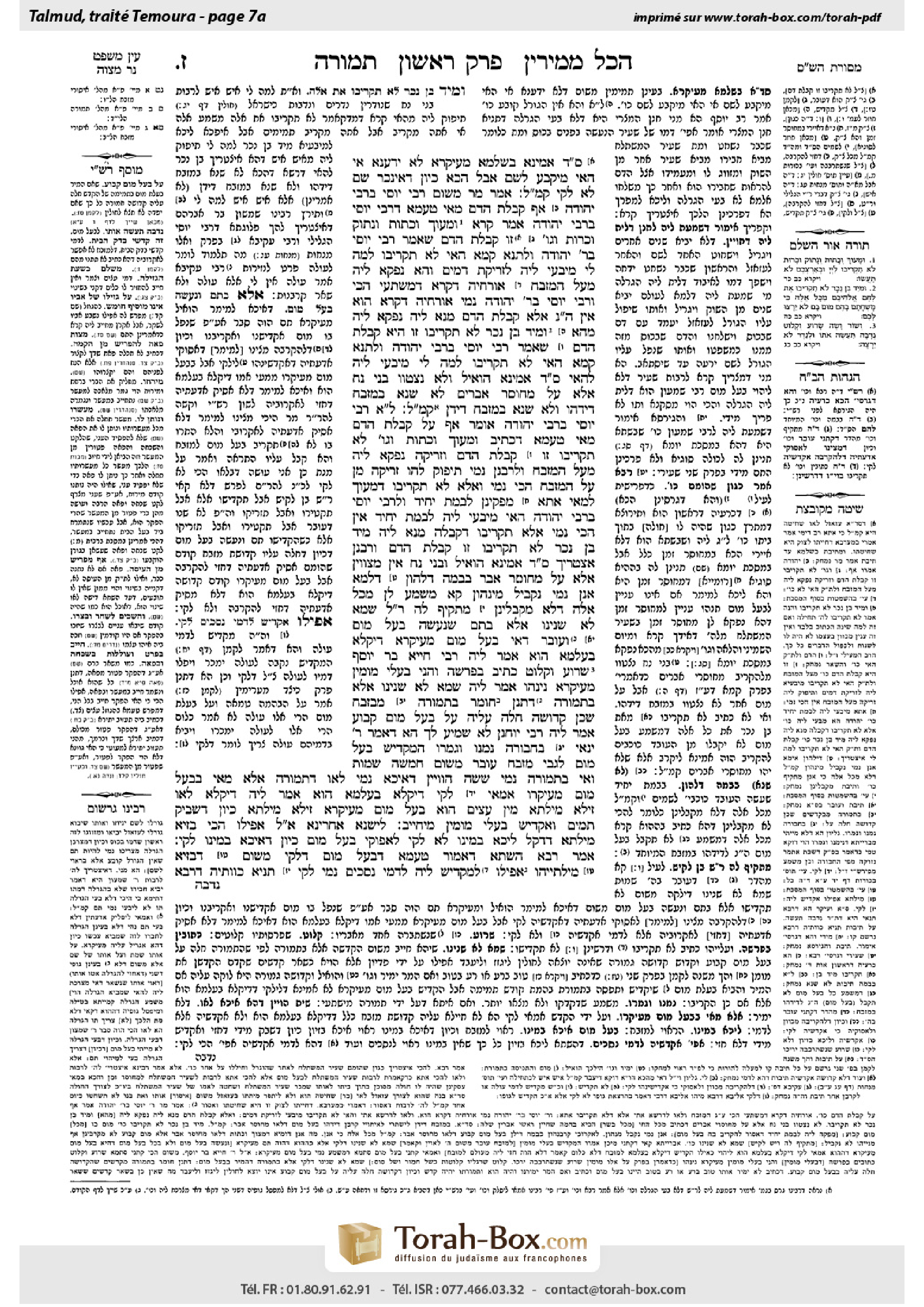
Temurah 7a: Talmud study for Daf Yomi
Daf Yomi is the daily study of one Talmud folio. Explore 37 tractates with scans, Hebrew text, Sefaria English and AI-generated French translations where annotated.
Passage selection and English or AI-generated French translation are available where the scan has annotations. Daf Study is independent of Torah-Box and Sefaria.
Browse Temurah · תמורה · All tractatesTemurah 7a text and translations
This page of Temurah includes the Aramaic text, an English translation and an AI-generated French translation, alongside the scan above.
תמורה ז׳ א · Aramaic and Hebrew text
סָלְקָא דַּעְתָּךְ אָמֵינָא: בִּשְׁלָמָא מֵעִיקָּרָא לָא יָדַעְנָא אִי הַאי מִיקְּבַע לַשֵּׁם, אֲבָל הָכָא, כֵּיוָן דְּאִינְּכַר שֵׁם — לָא לָקֵי, קָא מַשְׁמַע לַן.
אָמַר מָר: מִשּׁוּם רַבִּי יוֹסֵי בְּרַבִּי יְהוּדָה אַף קַבָּלַת הַדָּם. מַאי טַעְמָא דְּרַבִּי יוֹסֵי בְּרַבִּי יְהוּדָה? אָמַר קְרָא: ״וּמָעוּךְ וְכָתוּת וְנָתוּק וְכָרוּת וְגוֹ׳״ — זוֹ קַבָּלַת הַדָּם, שֶׁאָמַר רַבִּי יוֹסֵי בְּרַבִּי יְהוּדָה.
וּלְתַנָּא קַמָּא, הַאי ״לֹא תַקְרִיבוּ״ לְמָה לִי? מִיבְּעֵי לֵיהּ לִזְרִיקַת דָּמִים. וְהָא נָפְקָא לֵיהּ מֵ״עַל הַמִּזְבֵּחַ״? אוֹרְחֵיהּ דִּקְרָא דְּמִשְׁתַּעֵי הָכִי.
וְרַבִּי יוֹסֵי בְּרַבִּי יְהוּדָה נָמֵי, אוֹרְחֵיהּ דִּקְרָא הוּא? אִין הָכִי נָמֵי. אֶלָּא קַבָּלַת הַדָּם מְנָא לֵיהּ? נָפְקָא לֵיהּ מֵהָא: ״וּמִיַּד בֶּן נֵכָר לֹא תַקְרִיבוּ״ — זוֹ הִיא קַבָּלַת הַדָּם שֶׁאָמַר רַבִּי יוֹסֵי בְּרַבִּי יְהוּדָה.
וּלְתַנָּא קַמָּא, הַאי ״לֹא תַקְרִיבוּ״ לְמָה לִי? מִיבְּעֵי לֵיהּ לְהַאי: סָלְקָא דַּעְתָּךְ אָמֵינָא, הוֹאִיל וְלֹא נִצְטַוּוּ בְּנֵי נֹחַ אֶלָּא עַל מְחוּסַּר אֵבָרִים, לָא שְׁנָא בְּמִזְבֵּחַ דִּידְהוּ וְלָא שְׁנָא בְּמִזְבֵּחַ דִּידַן, קָא מַשְׁמַע לַן.
לִישָּׁנָא אַחֲרִינָא: רַבִּי יוֹסֵי בְּרַבִּי יְהוּדָה אוֹמֵר: אַף עַל קַבָּלַת הַדָּם. מַאי טַעְמָא? דִּכְתִיב: ״וּמָעוּךְ וְכָתוּת... לֹא תַקְרִיבוּ״ — זוֹ קַבָּלַת הַדָּם, וּזְרִיקָה נָפְקָא לֵיהּ מֵ״עַל הַמִּזְבֵּחַ״.
וּלְרַבָּנַן נָמֵי תִּיפּוֹק לְהוּ זְרִיקָה מִן ״עַל הַמִּזְבֵּחַ״! הָכִי נָמֵי, וְאֶלָּא ״לֹא תַקְרִיבוּ״ דְּמָעוּךְ לְמַאי אֲתָא? מַפְּקִינַן [לֵיהּ] לְבָמַת יָחִיד.
וּלְרַבִּי יוֹסֵי בְּרַבִּי יְהוּדָה, הַאי מִיבְּעֵי לֵיהּ לְבָמַת יָחִיד? אִין הָכִי נָמֵי, אֶלָּא ״תַּקְרִיבוּ״ דְּקַבָּלָה מְנָא לֵיהּ? ״מִיָּד בֶּן נֵכָר לֹא תַקְרִיבוּ״ — זוֹ קַבָּלַת הַדָּם.
וְרַבָּנַן אִצְטְרִיךְ, סָלְקָא דַּעְתָּךְ אָמֵינָא: הוֹאִיל וּבְנֵי נֹחַ אֵין מְצוִּּוין אֶלָּא עַל מְחוּסַּר אֵבֶר בְּבָמָה דִּלְהוֹן, דִּלְמָא אֲנַן נָמֵי נְקַבֵּיל מִינְּהוֹן? קָא מַשְׁמַע לַן ״מִכׇּל אֵלֶּה״ דְּלָא מְקַבְּלִינַן.
מַתְקֵיף לַהּ רֵישׁ לָקִישׁ: שֶׁמָּא לֹא שָׁנִינוּ אֶלָּא בְּתָם שֶׁנַּעֲשָׂה בַּעַל מוּם, וְעוֹבֵר, דְּאִי בַּעַל מוּם מֵעִיקָּרָא — דִּיקְלָא בְּעָלְמָא הוּא!
אֲמַר לֵיהּ רַבִּי חִיָּיא בַּר יוֹסֵף: ״שָׂרוּעַ וְקָלוּט״ כְּתִיב בַּפָּרָשָׁה, וְהָנֵי בַּעֲלֵי מוּמִין מֵעִיקָּרָא נִינְהוּ.
אֲמַר לֵיהּ: שֶׁמָּא לֹא שָׁנִינוּ אֶלָּא בִּתְמוּרָה, דִּתְנַן: חוֹמֶר בַּתְּמוּרָה מִבַּזֶּבַח, שֶׁכֵּן קְדוּשָּׁה חָלָה עָלֶיהָ עַל בַּעַל מוּם קָבוּעַ.
אֲמַר לֵיהּ רַבִּי יוֹחָנָן: לָא שְׁמִיעַ לָךְ הָא דְּאָמַר רַבִּי יַנַּאי, בַּחֲבוּרָה נִמְנוּ וְגָמְרוּ: הַמַּקְדִּישׁ בַּעַל מוּם לְגַבֵּי מִזְבֵּחַ עוֹבֵר מִשּׁוּם חֲמִשָּׁה שֵׁמוֹת, וְאִי בִּתְמוּרָה נָמֵי — שִׁשָּׁה הָוְויָין, דְּאִיכָּא נָמֵי לָאו דִּתְמוּרָה! אֶלָּא מַאי — בְּבַעַל מוּם מֵעִיקָּרוֹ? אַמַּאי לָקֵי? דִּיקְלָא בְּעָלְמָא הוּא!
אֲמַר לֵיהּ: דִּיקְלָא — לָאו זִילָא מִילְּתָא, מִין עֵצִים הוּא; בַּעַל מוּם מֵעִיקָּרָא — זִילָא מִילְּתָא, כֵּיוָן דִּשְׁבֵיק תְּמִימִים וְאַקְדֵּישׁ בַּעֲלֵי מוּמִין — מִיחַיַּיב.
לִישָּׁנָא אַחֲרִינָא, אֲמַר לֵיהּ: אֲפִילּוּ הָכִי בַּזְיָא מִילְּתָא, דְּדֶקֶל לֵיכָּא בְּמִינוֹ — לָא לָקֵי, לְאַפּוֹקֵי בַּעַל מוּם, כֵּיוָן דְּאִיכָּא בְּמִינוֹ — לָקֵי.
אָמַר רָבָא: הַשְׁתָּא דַּאֲמוּר טַעְמָא דְּבַעַל מוּם דְּלָקֵי — מִשּׁוּם דְּבַזְיָא מִילְּתַיְיהוּ, אֲפִילּוּ (למקדיש) [מַקְדֵּישׁ] לֵיהּ לִדְמֵי נְסָכִים — נָמֵי לָקֵי.
תַּנְיָא כְּוָותֵיהּ דְּרָבָא:
Temurah 7a · English translation
Since it might enter your mind to say that granted, if one does this initially, before the lottery, we do not know if this blemished animal will be designated as the one sacrificed to the Lord or sent to the wilderness. Therefore, the one who consecrated the blemished animal is flogged. But here, since it is already clear that the other animal is to be sacrificed to the Lord, and the one he consecrates will be sent to the wilderness, perhaps he is not flogged for consecrating it. The verse therefore teaches us that this is also a violation of the prohibition and he is flogged.
§ The Master said above: The Sages said in the name of Rabbi Yosei, son of Rabbi Yehuda: One who sacrifices a blemished animal violates a prohibition against the collection of the blood as well. The Gemara asks: What is the reasoning of Rabbi Yosei, son of Rabbi Yehuda? The Gemara answers: The verse states: “That which has its testicles bruised, or crushed, or torn, or cut, you shall not offer unto the Lord” (Leviticus 22:24). The phrase “You shall not offer unto the Lord” is apparently superfluous, as the Torah already stated earlier: “But whatever has a blemish, you shall not offer” (Leviticus 22:20). Rather, this extra phrase is referring to the collection of the blood, for which Rabbi Yosei, son of Rabbi Yehuda, said that one is liable.
The Gemara asks: And according to the first tanna, who holds that one is not liable for collection of the blood per se, why do I need this phrase: “You shall not offer,” stated with regard to damaged testicles? The Gemara answers: He requires it to teach that one is liable for sprinkling the blood. The Gemara challenges: But he derives this from the phrase: “Upon the altar” (Leviticus 22:22), which indicates that one may not sacrifice any part of such an animal on the altar, even its blood. The Gemara answers: With regard to that phrase, the first tanna holds that it is simply the normal manner of the verse that it speaks like this. It does not teach any additional halakha.
The Gemara challenges: But also according to Rabbi Yosei, son of Rabbi Yehuda, one may claim that this is the normal manner of the verse. Why does he derive a halakha from this phrase? The Gemara answers: Yes, it is indeed so. He does not derive liability for sprinkling of the blood from the phrase “upon the altar.” Rather, from where does he derive the prohibition against collection of the blood? He derives it from this verse: “Neither from the hand of a foreigner shall you offer the bread of your God of any of these, because their corruption is in them; there is a blemish in them; they shall not be accepted for you” (Leviticus 22:25). This verse is referring to the collection of the blood when sacrificing a blemished animal, for which Rabbi Yosei, son of Rabbi Yehuda, said that one is liable.
The Gemara asks: And according to the first tanna, who holds that one is not liable for collection of the blood, why do I need this phrase: Neither from the hand of a foreigner shall you offer? The Gemara answers: He requires it to teach this halakha: It may enter your mind to say that since the descendants of Noah are commanded only with regard to the sacrifice of an animal lacking limbs but they are permitted to sacrifice animals with minor blemishes, perhaps there is no difference if this is performed on their altar outside the Temple or if it is done on our altar in the Temple. Accordingly, one might claim that a gentile may sacrifice a blemished animal in the Temple in Jerusalem. The verse therefore teaches us that they may not sacrifice a blemished animal in such a manner.
The Gemara presents an alternative version of the discussion. Rabbi Yosei, son of Rabbi Yehuda, says: One violates a prohibition for the collection of the blood as well. The Gemara asks: What is the reasoning of Rabbi Yosei, son of Rabbi Yehuda? The Gemara answers: As it is written: “That which has its testicles bruised, or crushed, or torn, or cut, you shall not offer unto the Lord” (Leviticus 22:24). This verse is referring to the collection of the blood. And he derives the prohibition against sprinkling the blood from the phrase: “Upon the altar” (Leviticus 22:22).
The Gemara objects: And according to the Rabbis as well, who hold that one is not liable for collection of the blood, let them derive liability for sprinkling the blood from the phrase “upon the altar.” The Gemara explains that it is indeed so, that they derive it from that phrase. But for what purpose comes the phrase “You shall not offer” with regard to bruised testicles? We learn from this phrase the prohibition of the sacrifice of a blemished animal even on a private altar, where offerings were sacrificed before the construction of the Temple.
The Gemara asks: But according to Rabbi Yosei, son of Rabbi Yehuda, how can he then derive the prohibition against collection of the blood of a blemished animal from the phrase “You shall not offer”? After all, he requires this phrase to render prohibited sacrifice on a private altar. The Gemara answers: Yes, it is indeed so. Rather, where does he find another instance of the term “shall offer” for prohibiting collection of the blood? From the following verse: “Neither from the hand of a foreigner shall you offer the bread of your God of any of these, because their corruption is in them; there is a blemish in them; they shall not be accepted for you” (Leviticus 22:25). This verse is referring to the collection of the blood.
And the Rabbis maintain that this verse is necessary for a different halakha, as it may enter your mind to say that since the descendants of Noah are commanded only with regard to sacrificing an animal lacking a limb on their private altar but are permitted to sacrifice animals with minor blemishes, perhaps we should accept blemished offerings from them in the Temple as well. Therefore, the verse teaches us by the use of the phrase “of any of these” that we do not accept them.
§ The baraita cited earlier stated that one who consecrates a blemished animal violates several prohibitions, but it did not differentiate between animals born with blemishes and those that acquired them during their lives. Reish Lakish objects to this: Perhaps we learned the prohibition only with regard to an unblemished animal that became blemished, and only one who consecrates such an animal transgresses the prohibition. As, if he consecrated an animal that was blemished from the outset, it is akin to consecrating a mere date palm, and his presumed intention is to consecrate its value, with the proceeds from its sale being used to purchase an offering. This would be permitted.
Rav Ḥiyya bar Yosef said to Reish Lakish: The blemishes mentioned in the phrase in the verse that states: “Either a bull or a lamb that has anything too long or too short” (Leviticus 22:23), are written in the passage that prohibits the sacrifice of blemished animals, and animals such as these are blemished from the outset.
Reish Lakish said to Rav Ḥiyya bar Yosef: Perhaps in the case of animals born with blemishes, we learned the prohibition only with regard to substitution, as we learned in a mishna (16b): There is greater stringency with regard to a substitute than there is with regard to the initial consecration of an offering, as, if one substituted a non-sacred animal with a permanent blemish for a consecrated unblemished animal, the blemished animal is imbued with sanctity. But initial consecration of an animal with such a blemish is effective only with regard to its value, so perhaps one who does so is exempt from punishment.
Rabbi Yoḥanan said to Reish Lakish: Didn’t you hear that which Rabbi Yannai says, that when the Sages sat in a group, their opinions were counted and they concluded: One who consecrates blemished animals for sacrifice on the altar violates five separate categories of prohibition. But if the baraita is also referring to a case of substitution, there are six categories, as there is also the prohibition of performing substitution. Reish Lakish responded: Rather, what can you say? Is the baraita speaking of one who consecrated an animal that is blemished from the outset? Why then is he flogged? It is akin to one who consecrates a mere date palm.
Rabbi Yoḥanan said to Reish Lakish: There is a difference between the cases. When one consecrates a date palm, the matter is not disgraceful, as it is a type of wood that one may burn on the altar. Therefore, he is not flogged. By contrast, when one consecrates an animal that is blemished from the outset, the matter is disgraceful. Since he forsook unblemished animals and consecrated blemished animals, he is liable to be flogged.
The Gemara presents an alternative version of the previous point. Rabbi Yoḥanan said to Reish Lakish: Nevertheless, the matter of consecrating an animal blemished from the outset is disgraceful. For in the case of a date palm, as there is no item of its type that can be sacrificed as an offering, he is not flogged for consecrating it. This is to the exclusion of a blemished animal; since there are items of its type that can be sacrificed as offerings, i.e., unblemished animals, he is flogged for consecrating it.
Rava said: Now that it has been said that the reason that one who consecrates a blemished animal is flogged is due to the fact that the matter is disgraceful, then even one who consecrates it to be sold and its money used for purchasing libations should be flogged as well, as consecrating a blemished animal is in and of itself a disgraceful act.
The Gemara notes: It is taught in a baraita in accordance with the opinion of Rava:
Temurah 7a · Traduction française (IA)
Car on pourrait penser que, certes, si quelqu’un fait cela d’emblée, avant le tirage au sort, on ignore si cet animal atteint d’un défaut sera désigné comme celui qui sera offert au Seigneur ou comme celui qui sera envoyé au désert. Par conséquent, celui qui a consacré l’animal atteint d’un défaut est passible de flagellation. Mais ici, puisqu’il est déjà clair que l’autre animal sera offert au Seigneur et que celui qu’il consacre sera envoyé au désert, peut-être n’est-il pas passible de flagellation pour l’avoir consacré. Le verset nous enseigne donc que cela constitue également une transgression de l’interdit et qu’il est passible de flagellation.
§ Le Maître a dit plus haut : Les Sages ont dit au nom de Rabbi Yosei, fils de Rabbi Yehuda : Celui qui sacrifie un animal atteint d’un défaut transgresse également un interdit lors du prélèvement du sang. La Guemara demande : Quel est le raisonnement de Rabbi Yosei, fils de Rabbi Yehuda ? La Guemara répond : Le verset dit : « Celui qui a les testicules meurtris, écrasés, arrachés ou coupés, vous ne l’offrirez pas au Seigneur » (Lévitique 22,24). L’expression « vous ne l’offrirez pas au Seigneur » semble superflue, puisque la Torah a déjà dit auparavant : « Mais tout animal qui a un défaut, vous ne l’offrirez pas » (Lévitique 22,20). Cette expression supplémentaire se rapporte donc au prélèvement du sang, pour lequel, selon Rabbi Yosei, fils de Rabbi Yehuda, on est passible de flagellation.
La Guemara demande : Et selon le premier tanna, qui considère qu’on n’est pas passible de flagellation pour le seul prélèvement du sang, pourquoi faut-il l’expression « vous ne l’offrirez pas », énoncée à propos des testicules endommagés ? La Guemara répond : Il en a besoin pour enseigner qu’on est passible de flagellation pour l’aspersion du sang. La Guemara objecte : Mais il déduit cela de l’expression « sur l’autel » (Lévitique 22,22), qui indique qu’on ne peut sacrifier aucune partie d’un tel animal sur l’autel, pas même son sang. La Guemara répond : Pour cette expression, le premier tanna considère que le verset s’exprime simplement selon sa tournure habituelle. Elle n’enseigne aucune halakha supplémentaire.
La Guemara objecte : Mais on peut également soutenir, selon Rabbi Yosei, fils de Rabbi Yehuda, qu’il s’agit là de la tournure habituelle du verset. Pourquoi déduit-il une halakha de cette expression ? La Guemara répond : Oui, c’est bien ainsi. Il ne déduit pas l’interdiction de l’aspersion du sang de l’expression « sur l’autel ». D’où déduit-il alors l’interdiction du prélèvement du sang ? Il la déduit de ce verset : « Tu n’offriras pas non plus, de la main d’un étranger, le pain de ton Dieu sous aucune de ces formes, car leur corruption est en eux ; ils ont un défaut ; ils ne seront pas agréés pour toi » (Lévitique 22,25). Ce verset se rapporte au prélèvement du sang lors du sacrifice d’un animal atteint d’un défaut, pour lequel, selon Rabbi Yosei, fils de Rabbi Yehuda, on est passible de flagellation.
La Guemara demande : Et selon le premier tanna, qui considère qu’on n’est pas passible de flagellation pour le prélèvement du sang, pourquoi faut-il l’expression « Tu n’offriras pas non plus, de la main d’un étranger » ? La Guemara répond : Il en a besoin pour enseigner cette halakha : on pourrait penser que, puisque les descendants de Noé ne sont astreints qu’à l’interdiction de sacrifier un animal auquel il manque un membre, mais qu’ils sont autorisés à sacrifier des animaux présentant des défauts mineurs, il n’y a peut-être pas de différence entre le fait de le faire sur leur autel, hors du Temple, et le fait de le faire sur notre autel, dans le Temple. On pourrait donc soutenir qu’un non-Juif peut sacrifier un animal atteint d’un défaut dans le Temple de Jérusalem. Le verset nous enseigne donc qu’ils ne peuvent pas sacrifier un animal atteint d’un défaut de cette manière.
La Guemara présente une autre version de la discussion. Rabbi Yosei, fils de Rabbi Yehuda, dit : On transgresse également un interdit lors du prélèvement du sang. La Guemara demande : Quel est le raisonnement de Rabbi Yosei, fils de Rabbi Yehuda ? La Guemara répond : Car il est écrit : « Celui qui a les testicules meurtris, écrasés, arrachés ou coupés, vous ne l’offrirez pas au Seigneur » (Lévitique 22,24). Ce verset se rapporte au prélèvement du sang. Et il déduit l’interdiction de l’aspersion du sang de l’expression « sur l’autel » (Lévitique 22,22).
La Guemara objecte : Et les Rabbins aussi, qui considèrent qu’on n’est pas passible de flagellation pour le prélèvement du sang, qu’ils déduisent donc l’obligation de flagellation pour l’aspersion du sang de l’expression « sur l’autel ». La Guemara explique que c’est bien le cas : ils la déduisent de cette expression. Mais à quoi sert l’expression « vous ne l’offrirez pas », à propos des testicules meurtris ? Nous apprenons de cette expression l’interdiction de sacrifier un animal atteint d’un défaut même sur un autel privé, où l’on offrait des sacrifices avant la construction du Temple.
La Guemara demande : Mais selon Rabbi Yosei, fils de Rabbi Yehuda, comment peut-il alors déduire de l’expression « vous ne l’offrirez pas » l’interdiction du prélèvement du sang d’un animal atteint d’un défaut ? Après tout, il a besoin de cette expression pour interdire le sacrifice sur un autel privé. La Guemara répond : Oui, c’est bien ainsi. D’où tire-t-il alors une autre occurrence du terme « offrir » qui interdit le prélèvement du sang ? Du verset suivant : « Tu n’offriras pas non plus, de la main d’un étranger, le pain de ton Dieu sous aucune de ces formes, car leur corruption est en eux ; ils ont un défaut ; ils ne seront pas agréés pour toi » (Lévitique 22,25). Ce verset se rapporte au prélèvement du sang.
Et les Rabbins considèrent que ce verset est nécessaire pour une autre halakha, car on pourrait penser que, puisque les descendants de Noé ne sont astreints qu’à ne pas sacrifier sur leur autel privé un animal auquel il manque un membre, mais qu’ils sont autorisés à sacrifier des animaux présentant des défauts mineurs, nous devrions peut-être également accepter leurs offrandes atteintes d’un défaut dans le Temple. Le verset nous enseigne donc, par l’expression « de toutes ces choses », que nous ne les acceptons pas.
§ La baraïta citée précédemment disait que celui qui consacre un animal atteint d’un défaut transgresse plusieurs interdits, mais elle ne distinguait pas les animaux nés avec des défauts de ceux qui les ont acquis au cours de leur vie. Reish Lakish objecte : Peut-être n’avons-nous appris l’interdiction que pour un animal sans défaut qui en a acquis un, et seul celui qui consacre un tel animal transgresse l’interdit. Car s’il a consacré un animal qui avait un défaut dès le départ, cela revient à consacrer un simple palmier-dattier, et son intention présumée est de consacrer sa valeur, le produit de sa vente devant servir à acheter une offrande. Cela serait permis.
Rav Ḥiyya bar Yosef dit à Reish Lakish : Les défauts mentionnés dans l’expression du verset qui dit : « Qu’il s’agisse d’un taureau ou d’un agneau ayant un membre trop long ou trop court » (Lévitique 22,23) figurent dans le passage qui interdit le sacrifice d’animaux atteints d’un défaut, et de tels animaux ont un défaut dès le départ.
Reish Lakish dit à Rav Ḥiyya bar Yosef : Peut-être n’avons-nous appris l’interdiction, dans le cas des animaux nés avec des défauts, qu’à propos de la substitution, comme nous l’avons appris dans une Michna (16b) : La substitution est soumise à une rigueur plus grande que la consécration initiale d’une offrande, car si quelqu’un substitue un animal profane atteint d’un défaut permanent à un animal sans défaut consacré, l’animal atteint d’un défaut acquiert la sainteté. Mais la consécration initiale d’un animal présentant un tel défaut n’a d’effet qu’en ce qui concerne sa valeur ; peut-être celui qui agit ainsi est-il donc exempt de peine.
Rabbi Yoḥanan dit à Reish Lakish : N’as-tu pas entendu ce que dit Rabbi Yannai, à savoir que lorsque les Sages se réunirent en groupe, ils comptèrent les interdits et conclurent : Celui qui consacre des animaux atteints d’un défaut en vue de les offrir sur l’autel transgresse cinq catégories distinctes d’interdits. Mais si la baraïta se rapporte également à un cas de substitution, il y a six catégories, puisqu’il y a aussi l’interdiction d’effectuer une substitution. Reish Lakish répondit : Alors, que peux-tu dire ? La baraïta parle-t-elle de quelqu’un qui a consacré un animal ayant un défaut dès le départ ? Pourquoi serait-il alors passible de flagellation ? Cela revient à consacrer un simple palmier-dattier.
Rabbi Yoḥanan dit à Reish Lakish : Les cas diffèrent. Quand quelqu’un consacre un palmier-dattier, l’acte n’est pas déshonorant, car c’est un type de bois que l’on peut brûler sur l’autel. Il n’est donc pas passible de flagellation. En revanche, quand quelqu’un consacre un animal qui avait un défaut dès le départ, l’acte est déshonorant. Puisqu’il a délaissé les animaux sans défaut et consacré des animaux atteints d’un défaut, il est passible de flagellation.
La Guemara présente une autre version du point précédent. Rabbi Yoḥanan dit à Reish Lakish : Néanmoins, consacrer un animal qui avait un défaut dès le départ est un acte déshonorant. En effet, dans le cas d’un palmier-dattier, puisqu’il n’existe aucun objet de son espèce qui puisse être offert en sacrifice, on n’est pas passible de flagellation pour l’avoir consacré. Cela exclut un animal atteint d’un défaut : puisqu’il existe des objets de son espèce qui peuvent être offerts en sacrifice, c’est-à-dire des animaux sans défaut, on est passible de flagellation pour l’avoir consacré.
Rava dit : À présent qu’il a été dit que celui qui consacre un animal atteint d’un défaut est passible de flagellation parce que cet acte est déshonorant, même celui qui le consacre pour le vendre et utiliser l’argent obtenu afin d’acheter des libations devrait également être passible de flagellation, car consacrer un animal atteint d’un défaut est en soi un acte déshonorant.
La Guemara relève : Une baraïta enseigne conformément à l’opinion de Rava :
Traduction française générée par IA à partir de l’édition anglaise de Sefaria. Vérifie toujours un passage avec le texte source.
Text from Sefaria: William Davidson Edition - Vocalized Aramaic (CC BY NC); William Davidson Edition - English (CC BY NC).