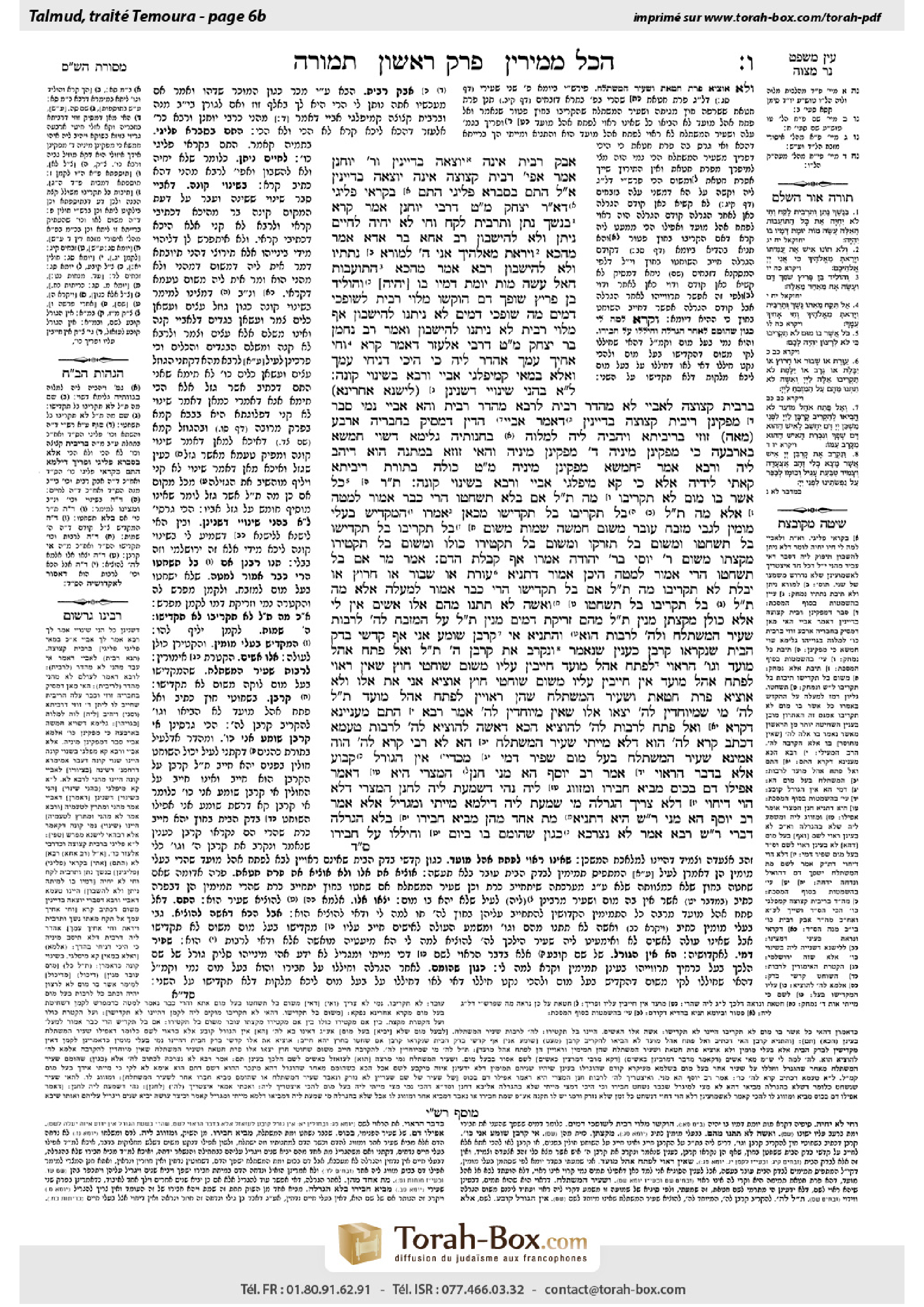
Temurah 6b: Talmud study for Daf Yomi
Daf Yomi is the daily study of one Talmud folio. Explore 37 tractates with scans, Hebrew text, Sefaria English and AI-generated French translations where annotated.
Passage selection and English or AI-generated French translation are available where the scan has annotations. Daf Study is independent of Torah-Box and Sefaria.
Browse Temurah · תמורה · All tractatesTemurah 6b text and translations
This page of Temurah includes the Aramaic text, an English translation and an AI-generated French translation, alongside the scan above.
תמורה ו׳ ב · Aramaic and Hebrew text
אֲבַק רִבִּית אֵינָהּ יוֹצְאָה בְּדַיָּינִין, וְרַבִּי יוֹחָנָן אָמַר: אֲפִילּוּ רִבִּית קְצוּצָה אֵינָהּ יוֹצְאָה בְּדַיָּינִין.
אֲמַר לֵיהּ: הָתָם בִּסְבָרָא פְּלִיגִי? הָתָם בִּקְרָאֵי פְּלִיגִי! דְּאָמַר רַבִּי יִצְחָק: מַאי טַעְמָא דְּרַבִּי יוֹחָנָן? אָמַר קְרָא: ״בַּנֶּשֶׁךְ נָתַן וְתַרְבִּית לָקַח וָחָי לֹא יִחְיֶה״, לְחַיִּים נִיתַּן וְלֹא לְהִישָּׁבוֹן.
רַב אַחָא בַּר אַדָּא אָמַר מֵהָכָא: ״וְיָרֵאתָ מֵּאֱלֹהֶיךָ... אֲנִי ה׳״ — לְמוֹרָא נְתַתִּיו, וְלֹא לְהִישָּׁבוֹן.
רָבָא אָמַר מֵהָכָא: ״הַתּוֹעֵבוֹת הָאֵל עָשָׂה מוֹת יוּמָת דָּמָיו בּוֹ יִהְיֶה״, ״וְהוֹלִיד בֵּן פָּרִיץ שׁוֹפֵךְ דָּם״ — הוּקְּשׁוּ מַלְוֵי רִבִּית לְשׁוֹפְכֵי דָמִים: מָה שׁוֹפְכֵי דָּמִים לֹא נִיתְּנוּ לְהִישָּׁבוֹן, אַף מַלְוֵי רִבִּית לֹא נִיתְּנוּ לְהִישָּׁבוֹן.
וְאָמַר רַב נַחְמָן בַּר יִצְחָק: מַאי טַעְמָא דְּרַבִּי אֶלְעָזָר? דְּאָמַר קְרָא: ״וְחֵי אָחִיךָ עִמָּךְ״ — אַהְדַּר לֵיהּ, כִּי הֵיכִי דְּנֵיחֵי עִמָּךְ.
וְאֶלָּא בְּמַאי קָמִיפַּלְגִי אַבָּיֵי וְרָבָא? בְּשִׁינּוּי קוֹנֶה.
לִישָּׁנָא אַחֲרִינָא, בְּהָנֵי שִׁינּוּיֵי דְּשַׁנִּינַן, בְּרִבִּית קְצוּצָה — לְאַבָּיֵי לָא מַהְדַּר רִבִּית, לְרָבָא מַהְדַּר רִבִּית.
וְהָא אַבָּיֵי נָמֵי סָבַר מַפְּקִינַן רִיבִּית קְצוּצָה בְּדַיָּינִין! דְּאָמַר אַבָּיֵי: הָדֵין דְּמַסֵּיק בְּחַבְרֵיהּ אַרְבַּע זוּזֵי בְּרִיבִּיתָא, וִיהַביה לֵיהּ לְמַלְוֶה (בְּחָנוּתֵיהּ) [בְּגַוַּיְיהוּ] גְּלִימָא דְּשָׁוֵי חַמְשָׁא בְּאַרְבְּעָה — כִּי מַפְּקִינַן מִינֵּיהּ, אַרְבְּעָה מַפְּקִינַן מִינֵּיהּ, וְהַאי זוּזָא בְּמַתָּנָה הוּא דִּיהַב לֵיהּ. וְרָבָא אָמַר: חַמְשָׁא מַפְּקִינַן מִינֵּיהּ. מַאי טַעְמָא? כּוּלַּהּ בְּתוֹרַת רִיבִּיתָא קָאָתֵי לִידֵיהּ!
אֶלָּא, כִּי קָא מִיפַּלְגִי אַבָּיֵי וְרָבָא בְּשִׁינּוּי קוֹנֶה.
תָּנוּ רַבָּנַן: ״כׇּל אֲשֶׁר בּוֹ מוּם לֹא תַקְרִיבוּ״, מָה תַּלְמוּד לוֹמַר? אִם בְּ״לֹא תִשְׁחֲטוּ״ — הֲרֵי כְּבָר אָמוּר לְמַטָּה! אֶלָּא מָה תַּלְמוּד לוֹמַר ״בַּל תַּקְרִיבוּ״? — ״בַּל תַּקְדִּישׁוּ״. מִכָּאן אָמְרוּ: הַמַּקְדִּישׁ בַּעֲלֵי מוּמִין לְגַבֵּי מִזְבֵּחַ עוֹבֵר מִשּׁוּם חֲמִשָּׁה שֵׁמוֹת.
מִשּׁוּם ״בַּל תַּקְרִיבוּ״, ״בַּל תַּקְדִּישׁוּ״, ״בַּל תִּשְׁחֲטוּ״, וּמִשּׁוּם ״בַּל תִּזְרְקוּ״, וּמִשּׁוּם ״בַּל תַּקְטִירוּ כּוּלּוֹ״, וּמִשּׁוּם ״בַּל תַּקְטִירוּ מִקְצָתוֹ״. מִשּׁוּם רַבִּי יוֹסֵי בְּרַבִּי יְהוּדָה אָמְרוּ: אַף קַבָּלַת הַדָּם.
אָמַר מָר: אִם ״בַּל תִּשְׁחֲטוּ״ — הֲרֵי אָמוּר לְמַטָּה. הֵיכָן אָמוּר? דְּתַנְיָא: ״עַוֶּרֶת אוֹ שָׁבוּר אוֹ חָרוּץ אוֹ יַבֶּלֶת לֹא תַקְרִיבוּ״ — מָה תַּלְמוּד לוֹמַר? אִם ״בַּל תַּקְדִּישׁוּ״ — הֲרֵי כְּבָר אָמוּר לְמַעְלָה, אֶלָּא מָה תַּלְמוּד לוֹמַר ״בַּל תַּקְרִיבוּ״? — ״בַּל תִּשְׁחֲטוּ״.
״וְאִשֶּׁה לֹא תִתְּנוּ מֵהֶם״ — אֵלּוּ אִשִּׁים, אֵין לִי אֶלָּא כּוּלָּן, מִקְצָתָן מִנַּיִן? תַּלְמוּד לוֹמַר: ״מֵהֶם״.
זְרִיקַת דָּמִים מִנַּיִן? תַּלְמוּד לוֹמַר: ״עַל הַמִּזְבֵּחַ״, ״לַה׳״ — לְרַבּוֹת שָׂעִיר הַמִּשְׁתַּלֵּחַ.
וְ״לַה׳״ — לְרַבּוֹת הוּא? וְהָתַנְיָא: אִי ״קׇרְבָּן״ — שׁוֹמֵעַ אֲנִי אַף קׇדְשֵׁי בֶּדֶק הַבַּיִת, שֶׁנִּקְרְאוּ ״קׇרְבָּן״, כְּעִנְיָן שֶׁנֶּאֱמַר: ״וַנַּקְרֵב אֶת קׇרְבַּן ה׳״!
תַּלְמוּד לוֹמַר ״וְאֶל פֶּתַח אֹהֶל מוֹעֵד וְגוֹ׳״ — הָרָאוּי לְפֶתַח אֹהֶל מוֹעֵד חַיָּיבִין עָלָיו מִשּׁוּם שׁוֹחֲטֵי חוּץ, שֶׁאֵין רָאוּי לְפֶתַח אֹהֶל מוֹעֵד אֵין חַיָּיבִין עָלָיו מִשּׁוּם שׁוֹחֲטֵי חוּץ.
אוֹצִיא אֲנִי אֶת אֵלּוּ, וְלֹא אוֹצִיא פָּרַת חַטָּאת וְשָׂעִיר הַמִּשְׁתַּלֵּחַ, שֶׁהֵן רְאוּיִין לְפֶתַח אֹהֶל מוֹעֵד — תַּלְמוּד לוֹמַר ״לַה׳״, מִי שֶׁמְּיוּחָדִין לַה׳, יָצְאוּ אֵלּוּ שֶׁאֵין מְיוּחָדִין לַה׳.
אָמַר רָבָא: הָתָם, מֵעִנְיָינָא דִּקְרָא, ״וְאֶל פֶּתַח״ — לְרַבּוֹת, ״לַה׳״ — לְהוֹצִיא; הָכָא, דְּ״אִשֶּׁה״ — לְהוֹצִיא, ״לַה׳״ — לְרַבּוֹת.
טַעְמָא דִּכְתַב קְרָא ״לַה׳״ הוּא דְּלָא מַיְיתֵי שָׂעִיר הַמִּשְׁתַּלֵּחַ, הָא לָא רַבִּי קְרָא ״לַה׳״ הֲוָה אָמֵינָא שָׂעִיר הַמִּשְׁתַּלֵּחַ בַּעַל מוּם שַׁפִּיר דָּמֵי. מִכְּדִי, אֵין הַגּוֹרָל קוֹבֵעַ אֶלָּא בְּדָבָר הָרָאוּי!
אָמַר רַב יוֹסֵף: הָא מַנִּי? חָנָן הַמִּצְרִי הִיא, דְּאָמַר: אֲפִילּוּ דָּם בְּכוֹס — מֵבִיא חֲבֵירוֹ וּמְזַוֵּוג לוֹ.
נְהִי דְּשָׁמְעַתְּ לֵיהּ לְחָנָן הַמִּצְרִי, דְּלָא הָוֵי דִּיחוּי, דְּלָא צְרִיךְ הַגְרָלָה — מִי שָׁמְעַתְּ לֵיהּ? דִּילְמָא מַיְיתֵי וּמַגְרִיל!
אֶלָּא אָמַר רַב יוֹסֵף: הָא מַנִּי? רַבִּי שִׁמְעוֹן הִיא, דְּתַנְיָא: מֵת אֶחָד מֵהֶן — מֵבִיא חֲבֵירוֹ בְּלֹא הַגְרָלָה, דִּבְרֵי רַבִּי שִׁמְעוֹן.
רָבָא אָמַר: לֹא נִצְרְכָא, כְּגוֹן שֶׁהוּמַם בּוֹ בַּיּוֹם וְחִילְּלוֹ עַל חֲבֵירוֹ.
Temurah 6b · English translation
If a debtor paid a hint of interest and petitions the court to have it returned to him, it is not repossessed from the creditor by the judges of the court. And Rabbi Yoḥanan says: Even fixed interest is not repossessed by the judges. Abaye holds that transgressions are effective, and the interest now belongs to the creditor and cannot be repossessed, in accordance with the opinion of Rabbi Yoḥanan. Therefore, the judges do not appropriate it. Rava holds that transgressions are not effective, and the creditor is in unlawful possession of the interest. Therefore, the judges repossess it, in accordance with the opinion of Rabbi Elazar.
Rav Aḥa said to Rav Ashi: There, in the dispute concerning fixed interest, do Rabbi Elazar and Rabbi Yoḥanan disagree with regard to logical reasoning, i.e., the principle of whether transgressions are effective? Not so; rather, they disagree there with regard to the interpretation of the verses, as Rabbi Yitzḥak said: What is the reasoning of Rabbi Yoḥanan? The verse states: “[He] has given forth upon interest, and has taken increase; shall he then live? He shall not live; he has done all these abominations; he shall be put to death; his blood shall be upon him” (Ezekiel 18:13). Apparently, a usurer is subject to divine punishment for his life, but the interest is not subject to returning. This is the source for the opinion of Rabbi Yoḥanan.
Rav Aḥa bar Adda said that the source for the opinion of Rabbi Yoḥanan is from here: “Take no interest of him or increase, but fear your God, that your brother may live with you. You shall not give him your money upon interest, nor give him your provisions for increase; I am the Lord” (Leviticus 25:36–38). In effect, God is saying: I have made a usurer subject to punishment for insufficient fear of Me, but the interest is not subject to returning.
Rava said that the source for the opinion of Rabbi Yoḥanan is from here: “Has lent at advance interest, or exacted accrued interest; shall he live? He shall not live! He has done all these abominations; he shall be put to death; his blood shall be upon him” (Ezekiel 18:13). And an earlier verse states: “If he fathers a son that is a robber, a shedder of blood” (Ezekiel 18:10). Usurers are thereby juxtaposed to shedders of blood, i.e., murderers: Just as the sins of shedders of blood cannot be undone, so too, the sins of usurers cannot be undone.
And Rav Naḥman bar Yitzḥak said: What is the reasoning of Rabbi Elazar? As the verse states: “Take no interest of him or increase; but fear your God, that your brother may live with you” (Leviticus 25:36). The verse teaches that one must return the interest to the debtor so that he will be able to live together with you.
The Gemara asks: But if this matter is not a consequence of the dispute of Abaye and Rava, with regard to what case do Abaye and Rava disagree? The Gemara answers: There is perhaps no practical dispute between them, and they disagree only with regard to the theoretical question of whether deviation from what is stated in the Torah is effective. According to the opinion of Abaye, if there is no verse teaching otherwise, a transgression is presumed to be effective. According to the opinion of Rava, it is presumed to be not effective. They, therefore, disagree as to which halakhot reflect the rule and which are exceptions.
§ The Gemara presents an alternative version of the answer to this question: In accordance with the answers we answered above, Abaye and Rava disagree with regard to fixed interest. According to the opinion of Abaye that transgressions are effective, the creditor does not need to return the interest, as he has acquired it. But according to the opinion of Rava that transgressions are not effective, the creditor must return the interest, as it still belongs to the debtor.
The Gemara objects: But Abaye also holds that we repossess fixed interest by the authority of the judges, as Abaye said: In the event that this one, who was collecting a debt from another, demanded that he pay four dinars as interest, and the debtor gave to the creditor, in his store, a cloak that was worth five dinars in place of the four dinars of interest, the halakha is that when we repossess the interest from the creditor, we repossess only four dinars from him. And as for that additional one dinar, one presumes the debtor gave it to him as a gift. And Rava said: We repossess all five dinars from him. What is the reason? All of it came into his possession by virtue of a payment of interest. In any event, it is clear that Abaye holds that fixed interest is repossessed by the court.
The Gemara concludes as earlier: Rather, there may be no practical dispute between them, as when Abaye and Rava disagree, it is only with regard to the theoretical question of whether deviation from what is stated in the Torah is effective.
§ The Gemara returns to the topic of blemished animals. The Sages taught in a baraita: Why must the verse state: “But whatever has a blemish, you shall not offer; for it shall not be acceptable for you” (Leviticus 22:20)? If it serves to teach that you may not slaughter a blemished animal as a sacrifice even if it has been consecrated, that is already stated below, later on in the passage, as the Gemara will soon explain. Rather, why must the verse state that you may not offer a blemished animal? This serves to teach that you may not consecrate it. From here, the Sages stated (Tosefta 1:10): One who consecrates blemished animals for sacrifice on the altar violates five separate categories of prohibition.
He is liable for violating the prohibitions: You may not offer a blemished animal as an offering, i.e., you may not consecrate it; you may not slaughter it; and for the prohibition: You may not sprinkle its blood; and for the prohibition: You may not burn all of it on the altar; and for the prohibition: You may not burn part of it. The Sages said in the name of Rabbi Yosei, son of Rabbi Yehuda: One also violates a prohibition against the collection of the blood.
The Gemara interjects: The Master said above: If one suggests that the prohibition in Leviticus 22:20 teaches that you may not slaughter a blemished animal as an offering, that is already stated below, later on in the passage. The Gemara asks: Where is it stated? The Gemara answers: As it is taught in a baraita: Why must the verse state: “Blind, or broken, or maimed, or having a cyst, or scabbed, or scurvy, you shall not offer” (Leviticus 22:22)? If this serves to teach that you may not consecrate them, that is already stated above, in verse 20. Rather, why must the verse state that you may not offer these animals? This serves to teach that you may not slaughter them if they have been consecrated.
The baraita continues: The verse states: “Nor make an offering by fire of them upon the altar unto the Lord” (Leviticus 22:22). These words teach that one may not burn a blemished animal in the fires of the altar. I have derived only that it is prohibited to burn all of the animal. From where is it derived that it is prohibited to burn some portions of the animal? The verse states: “Of them,” which prohibits the burning of even part of them.
From where is it derived that sprinkling the blood of a blemished animal is prohibited? The verse states: “Upon the altar,” thereby indicating that one may not sacrifice any part of it, even its blood, on the altar. The verse continues: “Unto the Lord,” which serves to include the scapegoat of Yom Kippur in this prohibition, that it may not be blemished even though it is not sacrificed on the altar.
The Gemara interjects: And does the term: “Unto the Lord,” serve to include the scapegoat? But isn’t it taught in a baraita: The Torah condemns one who slaughters an offering outside the Temple “and has not brought it unto the door of the Tent of Meeting, to present it as an offering unto the Lord” (Leviticus 17:4)? If the verse had stated only “offering,” I would derive that one is liable even for slaughtering animals consecrated for Temple maintenance outside the Temple, for they are also called an offering, as it is stated: “And we have brought the Lord’s offering, what every man has found: Articles of gold” (Numbers 31:50).
Therefore, the verse states: “And has not brought it to the entrance of the Tent of Meeting” (Leviticus 17:4). This teaches that one is liable only for sacrificing an animal fit to be sacrificed within the entrance of the Tent of Meeting or the Temple due to the prohibition of slaughtering offerings outside the Temple. But one is not liable for sacrificing an animal not fit to be sacrificed within the entrance of the Tent of Meeting due to the prohibition of slaughtering offerings outside the Temple.
I might exclude these animals consecrated for Temple maintenance, but not exclude the red heifer of purification, whose ashes are used to purge the impurity imparted by a corpse, and the scapegoat, despite the fact that neither are sacrificed on the altar, as they are unblemished and therefore fit to come to the entrance of the Tent of Meeting. Therefore, the verse states: “Unto the Lord,” to teach that one is liable only for those animals that are exclusively the Lord’s as offerings. These, the red heifer of purification and the scapegoat, are excluded, as they are not exclusively the Lord’s as offerings, but rather they serve unique ritual functions. In any event, the term “unto the Lord” is interpreted as excluding, rather than including, the scapegoat.
Rava said: There, in the baraita discussing offerings slaughtered outside the Temple, the halakha is derived from the context of the verse. The verse states: “And has not brought it to the entrance of the Tent of Meeting” (Leviticus 17:4), which serves to include any unblemished animal. Therefore, the following term: “Unto the Lord,” serves to exclude certain exceptions to the rule. Here, where the verse states “fire” (Leviticus 22:22), which serves to exclude animals not burned on the altar from the prohibition, the term: “Unto the Lord,” serves to include exceptions to that principle.
The Gemara objects: The baraita indicates that the reason why a blemished animal may not be brought as the scapegoat is that the verse writes: “Unto the Lord.” One may infer that had the verse not included the scapegoat by employing the term: “Unto the Lord,” I would say that it is permitted to sacrifice a blemished scapegoat. Now, of the two goats of the Yom Kippur service, one is selected as the scapegoat and one as an offering by lottery. As a rule, the lottery can establish the animals in their respective roles only if each is fit for either role. Given that a blemished animal cannot be sacrificed as an offering, it cannot be designated as the scapegoat either. The term “unto the Lord” therefore seems unnecessary.
Rav Yosef said: In accordance with whose opinion is this baraita? It is in accordance with the opinion of Ḥanan the Egyptian, who said that if the scapegoat dies before being sent to the wilderness, even if the other goat has already been slaughtered and its blood collected in the cup, the slaughtered goat is nevertheless a fit offering, and the priest brings another goat and pairs it with the slaughtered goat to serve as the scapegoat. This new scapegoat is thereby designated without a lottery, and one might therefore suppose it can be blemished. The term “unto the Lord” is therefore needed to teach that it must be unblemished.
The Gemara challenges: Granted that you learn from the statement of Ḥanan the Egyptian that he holds that there is no deferral of the second goat once it has already been slaughtered. But do you learn from him that the new scapegoat need not be designated by a lottery? Perhaps the priest brings two potential scapegoats and performs a lottery to decide between them. Therefore, the question again arises: What need is there for the term “unto the Lord”?
Rather, Rav Yosef said: In accordance with whose opinion is this baraita? It is in accordance with the opinion of Rabbi Shimon, as it is taught in a baraita: If one of the two goats dies, the priest brings another goat without another lottery; this is the statement of Rabbi Shimon. It is this scapegoat that, absent the term “unto the Lord,” could have been blemished.
Rava said: No, the term in the verse is necessary for a case where the scapegoat became blemished on that day of Yom Kippur, after it had been designated, and then the priest desacralized it by transferring its sanctity onto another blemished goat.
Temurah 6b · Traduction française (IA)
Si un débiteur a payé un intérêt léger et demande au tribunal qu’on le lui restitue, les juges ne le reprennent pas au créancier. Rabbi Yoḥanan dit : « Même l’intérêt fixe n’est pas repris par les juges. » Abaye considère que les transgressions produisent leurs effets et que l’intérêt appartient désormais au créancier, sans pouvoir lui être repris, conformément à l’opinion de Rabbi Yoḥanan. Les juges ne se l’approprient donc pas. Rava considère que les transgressions ne produisent pas leurs effets et que le créancier détient illégalement l’intérêt. Les juges le lui reprennent donc, conformément à l’opinion de Rabbi Elazar.
Rav Aḥa dit à Rav Ashi : Dans le différend au sujet de l’intérêt fixe, Rabbi Elazar et Rabbi Yoḥanan sont-ils en désaccord sur un raisonnement logique, c’est-à-dire sur le principe selon lequel les transgressions produisent leurs effets ? Ce n’est pas le cas ; ils sont plutôt en désaccord sur l’interprétation des versets, comme l’a dit Rabbi Yitzḥak : Quel est le raisonnement de Rabbi Yoḥanan ? Le verset dit : « [Il] a prêté à intérêt et en a tiré un profit ; vivrait-il donc ? Il ne vivra pas ; il a commis toutes ces abominations ; il sera mis à mort ; son sang retombera sur lui » (Ézéchiel 18:13). Il apparaît ainsi qu’un usurier est passible d’un châtiment divin qui lui ôte la vie, mais que l’intérêt, lui, n’est pas à restituer. Telle est la source de l’opinion de Rabbi Yoḥanan.
Rav Aḥa bar Adda dit que la source de l’opinion de Rabbi Yoḥanan se trouve ici : « Ne prends de lui ni intérêt ni accroissement, mais crains ton Dieu, afin que ton frère vive avec toi. Tu ne lui donneras pas ton argent à intérêt, et tu ne lui fourniras pas tes provisions en échange d’un accroissement ; Je suis le Seigneur » (Lévitique 25:36–38). En substance, Dieu dit : J’ai rendu l’usurier passible d’un châtiment pour n’avoir pas suffisamment craint Ma personne, mais l’intérêt n’est pas à restituer.
Rava dit que la source de l’opinion de Rabbi Yoḥanan se trouve ici : « A prêté à intérêt ou exigé un intérêt accumulé ; vivrait-il ? Il ne vivra pas ! Il a commis toutes ces abominations ; il sera mis à mort ; son sang retombera sur lui » (Ézéchiel 18:13). Un verset antérieur dit : « S’il engendre un fils qui est un voleur, un meurtrier » (Ézéchiel 18:10). Les usuriers sont ainsi rapprochés des meurtriers : de même que les péchés des meurtriers ne peuvent être annulés, de même les péchés des usuriers ne peuvent être annulés.
Rav Naḥman bar Yitzḥak dit : Quel est le raisonnement de Rabbi Elazar ? Le verset dit : « Ne prends de lui ni intérêt ni accroissement, mais crains ton Dieu, afin que ton frère vive avec toi » (Lévitique 25:36). Le verset enseigne qu’il faut restituer l’intérêt au débiteur, afin qu’il puisse vivre avec toi.
La Guemara demande : Mais si cette question ne découle pas du différend entre Abaye et Rava, au sujet de quel cas Abaye et Rava sont-ils en désaccord ? La Guemara répond : Il se peut qu’il n’y ait entre eux aucun différend pratique et qu’ils ne soient en désaccord que sur la question théorique de savoir si une transgression à ce qui est énoncé dans la Torah produit ses effets. Selon Abaye, en l’absence d’un verset enseignant le contraire, une transgression est présumée produire ses effets. Selon Rava, elle est présumée ne pas produire ses effets. Ils sont donc en désaccord sur les halakhot qui relèvent de la règle et celles qui en constituent des exceptions.
§ La Guemara présente une autre version de la réponse à cette question : conformément aux réponses données plus haut, Abaye et Rava sont en désaccord au sujet de l’intérêt fixe. Selon Abaye, qui considère que les transgressions produisent leurs effets, le créancier n’a pas à restituer l’intérêt, puisqu’il l’a acquis. Mais selon Rava, qui considère que les transgressions ne produisent pas leurs effets, le créancier doit restituer l’intérêt, puisqu’il appartient toujours au débiteur.
La Guemara objecte : Mais Abaye aussi considère que l’intérêt fixe est repris par les juges, car Abaye a dit : Si un homme qui recouvrait une dette auprès d’un autre lui a réclamé quatre dinars d’intérêt et que le débiteur a remis au créancier, dans son magasin, un manteau d’une valeur de cinq dinars à la place des quatre dinars d’intérêt, la halakha est que, lorsque l’on reprend l’intérêt au créancier, on ne lui reprend que quatre dinars. Quant au dinar supplémentaire, on présume que le débiteur le lui a donné en cadeau. Rava dit : On lui reprend les cinq dinars. Pour quelle raison ? La totalité est entrée en sa possession en paiement d’intérêts. Quoi qu’il en soit, il est clair qu’Abaye considère que le tribunal reprend l’intérêt fixe.
La Guemara conclut comme précédemment : Il se peut plutôt qu’il n’y ait entre eux aucun différend pratique ; lorsqu’Abaye et Rava sont en désaccord, cela concerne uniquement la question théorique de savoir si une transgression à ce qui est énoncé dans la Torah produit ses effets.
§ La Guemara revient au sujet des animaux présentant un défaut. Les Sages ont enseigné dans une baraïta : Pourquoi le verset doit-il dire : « Mais tout animal qui a un défaut, vous ne l’offrirez pas, car il ne sera pas agréé pour vous » (Lévitique 22:20) ? S’il s’agit d’enseigner qu’il est interdit d’abattre comme sacrifice un animal présentant un défaut, même s’il a été consacré, cela est déjà énoncé plus loin dans le passage, comme la Guemara va bientôt l’expliquer. Pourquoi donc le verset doit-il dire qu’il est interdit d’offrir un animal présentant un défaut ? Cela enseigne qu’il est interdit de le consacrer. De là, les Sages ont conclu (Tosefta 1:10) : Celui qui consacre des animaux présentant un défaut pour les offrir sur l’autel enfreint cinq catégories distinctes d’interdiction.
Il est passible pour avoir enfreint les interdictions suivantes : offrir un animal présentant un défaut, c’est-à-dire le consacrer ; l’abattre ; en faire l’aspersion du sang ; le brûler entièrement sur l’autel ; et en brûler une partie. Les Sages ont dit au nom de Rabbi Yosei, fils de Rabbi Yehuda : On enfreint également une interdiction en recueillant le sang.
La Guemara intervient : Le Maître a dit plus haut que si l’on propose que l’interdiction de Lévitique 22:20 enseigne qu’il est interdit d’abattre comme sacrifice un animal présentant un défaut, cela est déjà énoncé plus loin dans le passage. La Guemara demande : Où cela est-il énoncé ? La Guemara répond : Comme il est enseigné dans une baraïta : Pourquoi le verset doit-il dire : « Aveugle, ou brisé, ou mutilé, ou atteint d’une tumeur, ou de gale, ou de dartres, vous ne l’offrirez pas » (Lévitique 22:22) ? S’il s’agit d’enseigner qu’il est interdit de consacrer ces animaux, cela est déjà énoncé plus haut, au verset 20. Pourquoi donc le verset doit-il dire qu’il est interdit d’offrir ces animaux ? Cela enseigne qu’il est interdit de les abattre s’ils ont été consacrés.
La baraïta poursuit : Le verset dit : « Vous n’en ferez pas non plus une offrande consumée par le feu sur l’autel pour le Seigneur » (Lévitique 22:22). Ces mots enseignent qu’il est interdit de brûler un animal présentant un défaut dans les feux de l’autel. J’ai seulement déduit qu’il est interdit de brûler l’animal tout entier. D’où déduit-on qu’il est interdit d’en brûler certaines parties ? Le verset dit : « d’eux », ce qui interdit d’en brûler même une partie.
D’où déduit-on qu’il est interdit de faire l’aspersion du sang d’un animal présentant un défaut ? Le verset dit : « sur l’autel », indiquant ainsi qu’il est interdit de sacrifier sur l’autel quelque partie que ce soit de l’animal, même son sang. Le verset poursuit : « pour le Seigneur », expression qui sert à inclure le bouc émissaire de Yom Kippour dans cette interdiction : il ne doit pas non plus présenter de défaut, même s’il n’est pas sacrifié sur l’autel.
La Guemara intervient : L’expression « pour le Seigneur » sert-elle à inclure le bouc émissaire ? Pourtant, n’est-il pas enseigné dans une baraïta que la Torah condamne celui qui abat une offrande hors du Temple « et ne l’a pas amenée à l’entrée de la Tente d’assignation pour la présenter en offrande au Seigneur » (Lévitique 17:4) ? Si le verset avait seulement dit « offrande », j’en aurais déduit qu’on est passible même pour avoir abattu hors du Temple des animaux consacrés à l’entretien du Temple, puisqu’on les appelle eux aussi des offrandes, comme il est dit : « Nous avons apporté l’offrande du Seigneur, ce que chacun a trouvé : des objets d’or » (Nombres 31:50).
Le verset dit donc : « Et ne l’a pas amenée à l’entrée de la Tente d’assignation » (Lévitique 17:4). Cela enseigne qu’on n’est passible, au titre de l’interdiction d’abattre des offrandes hors du Temple, que si l’on sacrifie un animal qui peut être sacrifié à l’intérieur de l’entrée de la Tente d’assignation ou du Temple. Mais on n’est pas passible, au titre de cette interdiction, si l’on sacrifie un animal qui ne peut pas être sacrifié à l’intérieur de l’entrée de la Tente d’assignation.
Je pourrais exclure ces animaux consacrés à l’entretien du Temple, mais non la vache rousse de purification, dont les cendres servent à éliminer l’impureté transmise par un cadavre, ni le bouc émissaire, bien qu’aucun des deux ne soit sacrifié sur l’autel, puisqu’ils sont sans défaut et donc aptes à être amenés à l’entrée de la Tente d’assignation. Le verset dit donc : « pour le Seigneur », afin d’enseigner qu’on n’est passible que pour les animaux qui appartiennent exclusivement au Seigneur en tant qu’offrandes. La vache rousse de purification et le bouc émissaire sont exclus, car ils n’appartiennent pas exclusivement au Seigneur en tant qu’offrandes, mais remplissent des fonctions rituelles particulières. Quoi qu’il en soit, l’expression « pour le Seigneur » est interprétée comme excluant le bouc émissaire, et non comme l’incluant.
Rava dit : Là, dans la baraïta qui traite des offrandes abattues hors du Temple, la halakha est déduite du contexte du verset. Le verset dit : « Et ne l’a pas amenée à l’entrée de la Tente d’assignation » (Lévitique 17:4), ce qui sert à inclure tout animal sans défaut. L’expression qui suit, « pour le Seigneur », sert donc à exclure certaines exceptions à la règle. Ici, où le verset dit « feu » (Lévitique 22:22), ce qui sert à exclure de l’interdiction les animaux qui ne sont pas brûlés sur l’autel, l’expression « pour le Seigneur » sert à inclure des exceptions à ce principe.
La Guemara objecte : La baraïta indique que si un animal présentant un défaut ne peut pas être amené comme bouc émissaire, c’est parce que le verset emploie l’expression « pour le Seigneur ». On peut en déduire que si le verset n’avait pas inclus le bouc émissaire au moyen de cette expression, j’aurais dit qu’il est permis de sacrifier comme bouc émissaire un animal présentant un défaut. Or, parmi les deux boucs du service de Yom Kippour, l’un est désigné comme bouc émissaire et l’autre comme offrande par tirage au sort. En règle générale, le tirage au sort ne peut attribuer à chacun des animaux son rôle que si chacun peut convenir à l’un ou l’autre rôle. Puisqu’un animal présentant un défaut ne peut pas être sacrifié comme offrande, il ne peut pas non plus être désigné comme bouc émissaire. L’expression « pour le Seigneur » semble donc superflue.
Rav Yosef dit : Selon l’opinion de qui cette baraïta est-elle ? Selon celle de Ḥanan l’Égyptien, qui dit que si le bouc émissaire meurt avant d’être envoyé dans le désert, même si l’autre bouc a déjà été abattu et que son sang a été recueilli dans une coupe, le bouc abattu reste néanmoins une offrande valable ; le prêtre apporte alors un autre bouc et l’associe au bouc abattu pour qu’il serve de bouc émissaire. Ce nouveau bouc émissaire est ainsi désigné sans tirage au sort, et l’on pourrait donc supposer qu’il peut présenter un défaut. L’expression « pour le Seigneur » est donc nécessaire pour enseigner qu’il doit être sans défaut.
La Guemara objecte : On peut admettre que l’on déduit de la déclaration de Ḥanan l’Égyptien qu’il considère que le second bouc ne peut plus être écarté une fois l’autre bouc abattu. Mais déduit-on de lui que le nouveau bouc émissaire n’a pas besoin d’être désigné par tirage au sort ? Peut-être le prêtre apporte-t-il deux boucs susceptibles d’être désignés et procède-t-il à un tirage au sort pour choisir entre eux. La question se pose donc à nouveau : à quoi sert l’expression « pour le Seigneur » ?
Rav Yosef dit plutôt : Selon l’opinion de qui cette baraïta est-elle ? Selon celle de Rabbi Shimon, comme il est enseigné dans une baraïta : Si l’un des deux boucs meurt, le prêtre en apporte un autre sans procéder à un nouveau tirage au sort ; telle est l’opinion de Rabbi Shimon. C’est ce bouc émissaire qui, sans l’expression « pour le Seigneur », aurait pu présenter un défaut.
Rava dit : Non, l’expression du verset est nécessaire dans le cas où le bouc émissaire a présenté un défaut le jour de Yom Kippour, après avoir été désigné, puis où le prêtre l’a désacralisé en transférant sa sainteté sur un autre bouc présentant un défaut.
Traduction française générée par IA à partir de l’édition anglaise de Sefaria. Vérifie toujours un passage avec le texte source.
Text from Sefaria: William Davidson Edition - Vocalized Aramaic (CC BY NC); William Davidson Edition - English (CC BY NC).