Temurah 6a: Talmud study for Daf Yomi
Daf Yomi is the daily study of one Talmud folio. Explore 37 tractates with scans, Hebrew text, Sefaria English and AI-generated French translations where annotated.
Passage selection and English or AI-generated French translation are available where the scan has annotations. Daf Study is independent of Torah-Box and Sefaria.
Browse Temurah · תמורה · All tractatesTemurah 6a text and translations
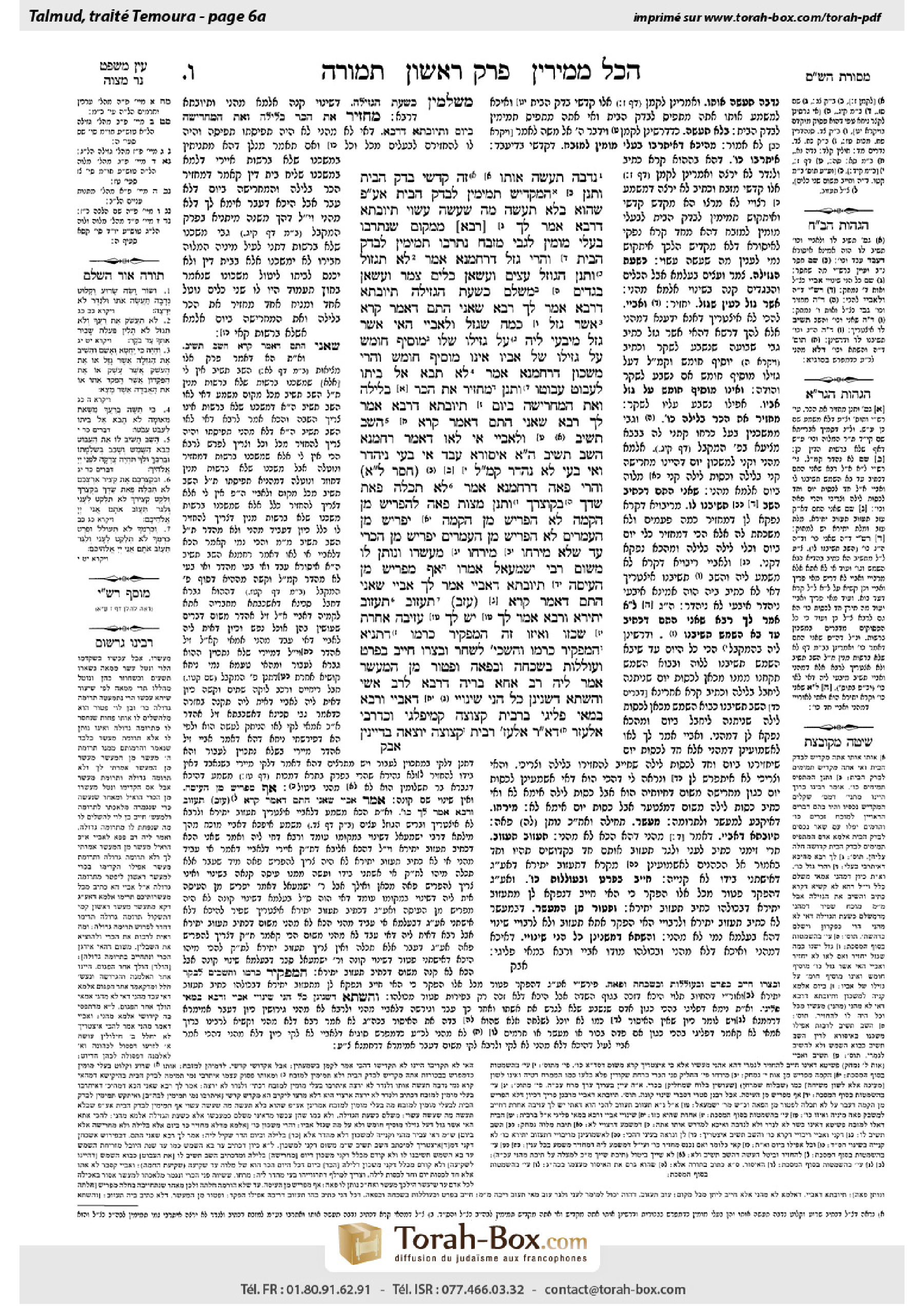
This page of Temurah includes the Aramaic text, an English translation and an AI-generated French translation, alongside the scan above.
תמורה ו׳ א · Aramaic and Hebrew text
״נְדָבָה תַּעֲשֶׂה אֹתוֹ״ — זֶה קׇדְשֵׁי בֶּדֶק הַבַּיִת, וּתְנַן: הַמַּקְדִּישׁ תְּמִימִין לְבֶדֶק הַבַּיִת, אַף עַל פִּי שֶׁהוּא בְּלֹא תַעֲשֶׂה — מַה שֶּׁעָשָׂה עָשׂוּי. תְּיוּבְתָּא דְרָבָא!
אָמַר לָךְ [רָבָא]: מִמָּקוֹם שֶׁנִּתְרַבּוּ בַּעֲלֵי מוּמִין לְגַבֵּי מִזְבֵּחַ, נִתְרַבּוּ תְּמִימִין לְבֶדֶק הַבַּיִת.
וַהֲרֵי גָּזֵל, דְּרַחֲמָנָא אָמַר ״לֹא תִגְזוֹל״, וּתְנַן: הַגּוֹזֵל עֵצִים וַעֲשָׂאָן כֵּלִים, צֶמֶר וַעֲשָׂאָן בְּגָדִים — מְשַׁלֵּם כִּשְׁעַת הַגְּזֵילָה, תְּיוּבְתָּא דְרָבָא!
אָמַר לָךְ רָבָא: שָׁאנֵי הָתָם, דְּאָמַר קְרָא ״אֲשֶׁר גָּזָל״ — כְּמָה שֶׁגָּזַל.
וּלְאַבָּיֵי, הַאי ״אֲשֶׁר גָּזָל״ מִיבְּעֵי לֵיהּ: עַל גְּזֵילוֹ שֶׁלּוֹ מוֹסִיף חוֹמֶשׁ, עַל גְּזֵילוֹ שֶׁל אָבִיו אֵינוֹ מוֹסִיף חוֹמֶשׁ.
וַהֲרֵי מַשְׁכּוֹן, דְּרַחֲמָנָא אָמַר: ״לֹא תָבֹא אֶל בֵּיתוֹ לַעֲבוֹט עֲבוֹטוֹ״, וּתְנַן: מַחֲזִיר אֶת הַכַּר בַּלַּיְלָה וְאֶת הַמַּחֲרֵישָׁה בַּיּוֹם — תְּיוּבְתָּא דְרָבָא!
אָמַר לָךְ רָבָא: שָׁאנֵי הָתָם, דְּאָמַר קְרָא ״הָשֵׁב תָּשִׁיב״.
וּלְאַבָּיֵי, אִי לָאו דְּאָמַר רַחֲמָנָא ״הָשֵׁב תָּשִׁיב״, הֲוָה אָמֵינָא אִיסּוּרָא עֲבַד, אִי בָּעֵי נַיהְדַּר וְאִי בָּעֵי לָא נַהְדַּר, קָא מַשְׁמַע לַן. (חסר לישנא אחרינא)
וַהֲרֵי פֵּאָה, דְּרַחֲמָנָא אָמַר: ״לֹא תְכַלֶּה פְּאַת שָׂדְךָ בְּקוּצְרֶךָ״, וּתְנַן: מִצְוַת פֵּאָה לְהַפְרִישׁ מִן הַקָּמָה, לֹא הִפְרִישׁ מִן הַקָּמָה — יַפְרִישׁ מִן הָעֳמָרִים, לֹא הִפְרִישׁ מִן הָעֳמָרִים — יַפְרִישׁ מִן הַכְּרִי עַד שֶׁלֹּא מֵירְחוֹ.
מֵירְחוֹ — מְעַשְּׂרוֹ וְנוֹתֵן לוֹ; מִשּׁוּם רַבִּי יִשְׁמָעֵאל אָמְרוּ: אַף מַפְרִישׁ מִן הָעִיסָּה, תְּיוּבְתָּא דְאַבָּיֵי!
אָמַר לָךְ אַבַּיֵּי: שָׁאנֵי הָתָם, דְּאָמַר קְרָא ״תַּעֲזוֹב״, ״תַּעֲזוֹב״ יַתִּירָא.
וְרָבָא אָמַר לָךְ: יֵשׁ לְךָ עֲזִיבָה אַחֶרֶת שֶׁכָּזוֹ, וְאֵיזוֹ? זֶה הַמַּפְקִיר כַּרְמוֹ.
דְּתַנְיָא: הַמַּפְקִיר כַּרְמוֹ, וְהִשְׁכִּים לַשַּׁחַר וּבְצָרוֹ — חַיָּיב בְּפֶרֶט וְעוֹלֵלוֹת, בְּשִׁכְחָה וּבְפֵאָה, וּפָטוּר מִן הַמַּעֲשֵׂר.
אֲמַר לֵיהּ רַב אַחָא בְּרֵיהּ דְּרָבָא לְרַב אָשֵׁי: וְהַשְׁתָּא דְּשַׁנִּינַן כֹּל הָנֵי שִׁינּוּיֵי, דְּאַבָּיֵי וְרָבָא בְּמַאי פְּלִיגִי?
בְּרִבִּית קְצוּצָה קָמִיפַּלְגִי, וְכִדְרַבִּי אֶלְעָזָר, דְּאָמַר רַבִּי אֶלְעָזָר: רִבִּית קְצוּצָה יוֹצְאָה בְּדַיָּינִין,
Temurah 6a · English translation
“Either a bull or a lamb that has anything too long or too short, that may you offer for a gift; but for a vow it shall not be accepted” (Leviticus 22:23). This verse teaches that only blemished animals may be consecrated for Temple maintenance. And we learned in a baraita: With regard to one who consecrates unblemished animals for Temple maintenance, even though he has transgressed a prohibition, what he did is done. This is apparently a conclusive refutation of the opinion of Rava.
The Gemara explains that Rava could say to you: From the same place that it was derived earlier that blemished animals are included, i.e., that their consecration for sacrifice on the altar is effective after the fact, it is likewise derived that unblemished animals are included, that their consecration for Temple maintenance is effective. But in general, transgressions are not effective.
The Gemara objects: But there is the case of robbery, with regard to which the Merciful One states: “You shall not oppress you neighbor, and you shall not rob him” (Leviticus 19:13), and we learned in a mishna (Bava Kamma 93b): One who robs another of wood and fashions it into vessels, or one who robs another of wool and fashions it into garments, pays the victim according to the value of the goods at the time of the robbery, but he need not return the vessels or garments, since by changing the stolen items he acquired them. If he can acquire the stolen item, this is apparently a conclusive refutation of the opinion of Rava.
The Gemara explains that Rava could say to you: It is different there, as the verse states: “He shall restore the stolen item that he took by robbery” (Leviticus 5:23). This teaches that he must return the original item only if it is still like that which he took by robbery and has not been altered. But in general, transgressions are not effective.
And according to the opinion of Abaye, this phrase: “That he took by robbery,” is necessary to teach that one who takes a false oath denying he robbed another, who must then pay an additional fifth of the value of the stolen item when he returns it, need add a fifth only for denying his own act of robbery, but for denying his deceased father’s act of robbery when sued by the victim as the robber’s heir, he need not add an additional fifth.
The Gemara objects: But there is the case of collateral, with regard to which the Merciful One states: “When you lend your neighbor any manner of loan, you shall not go into his house to fetch his pledge” (Deuteronomy 24:10), teaching that a creditor may not seize collateral if the debtor delays payment. And we learned in a mishna (Bava Metzia 113a): If the creditor nevertheless seized two items as collateral, he returns a mattress by night, as the debtor requires it for sleeping, and a plow, which is needed for his daytime work, by day. The creditor may keep possession of seized collateral when it is not being used, which is apparently a conclusive refutation of the opinion of Rava.
The Gemara explains that Rava could say to you: It is different there, as the verse states: “And if he be a poor man, you shall not sleep with his pledge; you shall restore [hashev tashiv] to him the pledge” (Deuteronomy 24:12–13). The repetition of the verb teaches that the creditor must return the collateral many times, e.g., he must return a plow each morning and take it back each night, and return a mattress each night and take it back each morning, but he does not have to return the collateral permanently. But in general, transgressions are not effective.
The Gemara notes: And according to the opinion of Abaye, that transgressions are generally effective, the repetition of the verb may be explained as follows: If the Merciful One had not stated: “Hashev tashiv,” I would say that a creditor who seizes collateral from the home of the debtor has performed a prohibition, but having done so, if he desires, he may return the collateral, and if he desires, he may not return it. The verse therefore teaches us that he must return the items the debtor needs.
The Gemara objects: But there is the case of produce in the corner of the field, which is given to the poor [pe’a], with regard to which the Merciful One stated: And when you reap the harvest of your land, you shall not wholly reap the corner of your field” (Leviticus 23:22), but one must leave a corner of the field for the poor. And we learned in a baraita (Tosefta, Pe’a 1:5): The optimal way to fulfill the mitzva of pe’a is for the owner to separate it from the standing grain, i.e., grain that has not been harvested. If he did not separate it from the standing grain, he separates it from the sheaves of grain that have already been harvested. If he did not separate it from the sheaves, he separates it from the pile of grain, as long as he has not yet smoothed the pile.
The baraita continues: Once he smooths the pile of grain, it becomes obligated in tithes. Therefore, he must first tithe the grain and then give a portion of the produce to the poor as pe’a, so that the poor need not tithe what they receive. Additionally, the Sages said in the name of Rabbi Yishmael: If he did not separate pe’a during any of these stages, and he milled the grain and kneaded it into dough, he separates pe’a even from the dough and gives it to the poor. Even if the owner harvested the grain, the pe’a is still not considered his, which is apparently a conclusive refutation of the opinion of Abaye.
The Gemara explains that Abaye could say to you: It is different there, as the verse states: “You shall leave them for the poor and for the stranger” (Leviticus 19:10), and subsequently, it again states: “You shall leave them for the poor and for the stranger” (Leviticus 23:22). The superfluous phrase teaches that the owner must give pe’a in any event, even if he harvests the grain and kneads it into dough. But in general, transgressions are effective.
And Rava, who maintains that in general transgressions are not effective, could say to you that the extra verse teaches that there is another type of leaving over one’s grain that is like this. And what is that? It is the case of one who renounces ownership of his vineyard.
As it is taught in a baraita: If one renounced ownership of his vineyard, thereby exempting it from tithes and gifts to the poor, and he rose early in the morning, retook possession of it, and harvested it, he is still obligated in the mitzva of individual fallen grapes left for the poor [peret], and in the mitzva of incompletely formed clusters of grapes left for the poor [olelot], and in the mitzva of forgotten clusters of grapes left for the poor, and in the mitzva of pe’a, but he remains exempt from the mitzva to tithe his produce. His obligation to give the gifts to the poor even though the vineyard was at some point ownerless is derived from the repeated phrase: “You shall leave them for the poor.”
§ Rav Aḥa, son of Rava, said to Rav Ashi: And now that we have given all of these answers, explaining that Abaye and Rava concede to one another in all the above cases, with regard to what cases do Abaye and Rava disagree?
Rav Ashi answered: They disagree with regard to fixed [ketzutza] interest, and their dispute is like that of Rabbi Elazar and Rabbi Yoḥanan. As Rabbi Elazar said: If a debtor paid fixed interest and petitions the court to have it returned to him, since the Torah prohibits the charging of interest, it is repossessed from the creditor by the judges of the court.
Temurah 6a · Traduction française (IA)
« Soit un taureau, soit un agneau qui a un membre trop long ou trop court, tu peux l’offrir en don ; mais il ne sera pas accepté pour un vœu » (Lévitique 22,23). Ce verset enseigne que seuls des animaux atteints d’un défaut peuvent être consacrés à l’entretien du Temple. Or, nous avons appris dans une baraïta : Celui qui consacre des animaux sans défaut à l’entretien du Temple a certes transgressé une interdiction, mais son acte produit effet. Cela constitue apparemment une réfutation décisive de l’opinion de Rava.
La Guemara explique que Rava pourrait te répondre : De même que l’on a déduit précédemment que les animaux atteints d’un défaut sont inclus, c’est-à-dire que leur consécration en vue d’un sacrifice sur l’autel produit effet a posteriori, on en déduit également que les animaux sans défaut sont inclus, c’est-à-dire que leur consécration à l’entretien du Temple produit effet. Mais, de manière générale, les transgressions ne produisent pas effet.
La Guemara objecte : Mais il y a le cas du vol, à propos duquel le Miséricordieux dit : « Tu n’opprimeras pas ton prochain et tu ne le voleras pas » (Lévitique 19,13), et nous avons appris dans une Michna (Bava Kamma 93b) : Celui qui vole du bois à autrui et en fait des ustensiles, ou qui vole de la laine à autrui et en fait des vêtements, indemnise la victime à hauteur de la valeur des biens au moment du vol ; mais il n’a pas à rendre les ustensiles ou les vêtements, car, en modifiant les objets volés, il en a acquis la propriété. S’il peut acquérir l’objet volé, cela constitue apparemment une réfutation décisive de l’opinion de Rava.
La Guemara explique que Rava pourrait te répondre : Ce cas est différent, car le verset dit : « Il rendra l’objet volé qu’il a pris par vol » (Lévitique 5,23). Cela enseigne qu’il ne doit rendre l’objet d’origine que s’il est toujours tel qu’il l’a pris par vol et qu’il n’a pas été modifié. Mais, de manière générale, les transgressions ne produisent pas effet.
Et selon l’opinion d’Abayé, l’expression « qu’il a pris par vol » est nécessaire pour enseigner que celui qui prête un faux serment en niant avoir volé autrui, et qui doit alors ajouter un cinquième de la valeur de l’objet volé lorsqu’il le restitue, ne doit ajouter un cinquième que s’il a nié son propre vol ; mais s’il a nié le vol de son père défunt, lorsque la victime le poursuit en tant qu’héritier du voleur, il n’a pas à ajouter un cinquième.
La Guemara objecte : Mais il y a le cas du gage, à propos duquel le Miséricordieux dit : « Lorsque tu prêteras quelque chose à ton prochain, tu n’entreras pas chez lui pour prendre son gage » (Deutéronome 24,10), ce qui enseigne qu’un créancier ne peut pas saisir un gage si le débiteur tarde à payer. Or, nous avons appris dans une Michna (Bava Metsia 113a) : Si le créancier a néanmoins saisi deux objets comme gages, il rend le matelas la nuit, car le débiteur en a besoin pour dormir, et la charrue, dont il a besoin pour son travail diurne, le jour. Le créancier peut garder en sa possession les gages saisis lorsqu’ils ne sont pas utilisés ; cela constitue apparemment une réfutation décisive de l’opinion de Rava.
La Guemara explique que Rava pourrait te répondre : Ce cas est différent, car le verset dit : « Et s’il est pauvre, tu ne dormiras pas en gardant son gage ; tu lui rendras [hashev tashiv] son gage » (Deutéronome 24,12-13). La répétition du verbe enseigne que le créancier doit rendre le gage à plusieurs reprises : par exemple, il doit rendre la charrue chaque matin et la reprendre chaque soir, et rendre le matelas chaque soir et le reprendre chaque matin ; mais il n’a pas à rendre le gage définitivement. Mais, de manière générale, les transgressions ne produisent pas effet.
La Guemara relève : Et selon l’opinion d’Abayé, d’après laquelle les transgressions produisent généralement effet, la répétition du verbe peut s’expliquer ainsi : Si le Miséricordieux n’avait pas dit « hashev tashiv », j’aurais dit qu’un créancier qui saisit un gage dans la maison du débiteur a transgressé une interdiction, mais qu’ensuite, s’il le souhaite, il peut rendre le gage et, s’il le souhaite, ne pas le rendre. Le verset nous enseigne donc qu’il doit rendre les objets dont le débiteur a besoin.
La Guemara objecte : Mais il y a le cas des produits laissés dans le coin du champ pour les pauvres [pe’a], à propos desquels le Miséricordieux dit : « Lorsque tu moissonneras la récolte de ton pays, tu ne moissonneras pas entièrement le coin de ton champ » (Lévitique 23,22) ; tu dois laisser un coin du champ aux pauvres. Or, nous avons appris dans une baraïta (Tossefta, Pe’a 1,5) : La manière idéale d’accomplir la mitsva de pe’a consiste, pour le propriétaire, à la prélever sur le grain encore sur pied, c’est-à-dire le grain qui n’a pas été moissonné. S’il ne l’a pas prélevée sur le grain encore sur pied, il la prélève sur les gerbes déjà moissonnées. S’il ne l’a pas prélevée sur les gerbes, il la prélève sur le tas de grain, tant qu’il n’en a pas encore aplani la surface.
La baraïta poursuit : Une fois que le propriétaire a aplani la surface du tas de grain, celui-ci est assujetti aux dîmes. Il doit donc d’abord prélever les dîmes sur le grain, puis en donner une part aux pauvres au titre de la pe’a, afin que les pauvres n’aient pas à prélever la dîme sur ce qu’ils reçoivent. En outre, les Sages ont enseigné au nom de Rabbi Yishmaël : S’il n’a pas prélevé la pe’a à l’une de ces étapes et qu’il a moulu le grain et l’a pétri en pâte, il prélève la pe’a même sur la pâte et la donne aux pauvres. Même si le propriétaire a moissonné le grain, la pe’a n’est toujours pas considérée comme lui appartenant ; cela constitue apparemment une réfutation décisive de l’opinion d’Abayé.
La Guemara explique qu’Abayé pourrait te répondre : Ce cas est différent, car le verset dit : « Tu les laisseras pour le pauvre et pour l’étranger » (Lévitique 19,10), puis dit de nouveau : « Tu les laisseras pour le pauvre et pour l’étranger » (Lévitique 23,22). Cette expression superflue enseigne que le propriétaire doit donner la pe’a dans tous les cas, même s’il moissonne le grain et le pétrit en pâte. Mais, de manière générale, les transgressions produisent effet.
Et Rava, qui soutient que, de manière générale, les transgressions ne produisent pas effet, pourrait te répondre que le verset supplémentaire enseigne qu’il existe une autre manière de laisser une partie de sa récolte, comparable à ce cas. Laquelle ? Le cas de celui qui renonce à la propriété de sa vigne.
Comme il est enseigné dans une baraïta : Si quelqu’un renonce à la propriété de sa vigne, l’exemptant ainsi des dîmes et des dons aux pauvres, puis se lève tôt le matin, en reprend possession et la vendange, il reste néanmoins tenu d’accomplir la mitsva de laisser aux pauvres les grains de raisin tombés individuellement [peret], la mitsva de leur laisser les grappes incomplètement formées [olelot], celle de leur laisser les grappes oubliées et celle de la pe’a ; mais il reste exempt de la mitsva de prélever la dîme sur sa récolte. Son obligation de donner les dons aux pauvres, bien que la vigne ait été à un moment donné sans propriétaire, est déduite de la répétition de l’expression : « Tu les laisseras pour le pauvre. »
§ Rav Aḥa, fils de Rava, dit à Rav Ashi : Maintenant que nous avons donné toutes ces réponses, expliquant qu’Abayé et Rava s’accordent dans tous les cas précédents, sur quels cas Abayé et Rava sont-ils en désaccord ?
Rav Ashi répondit : Ils sont en désaccord au sujet des intérêts fixes [ketzutza], et leur controverse est semblable à celle de Rabbi Elazar et de Rabbi Yoḥanan. Car Rabbi Elazar a dit : Si un débiteur a payé des intérêts fixes et demande au tribunal qu’ils lui soient restitués, puisque la Torah interdit de percevoir des intérêts, les juges du tribunal les reprennent au créancier.
Traduction française générée par IA à partir de l’édition anglaise de Sefaria. Vérifie toujours un passage avec le texte source.
Text from Sefaria: William Davidson Edition - Vocalized Aramaic (CC BY NC); William Davidson Edition - English (CC BY NC).