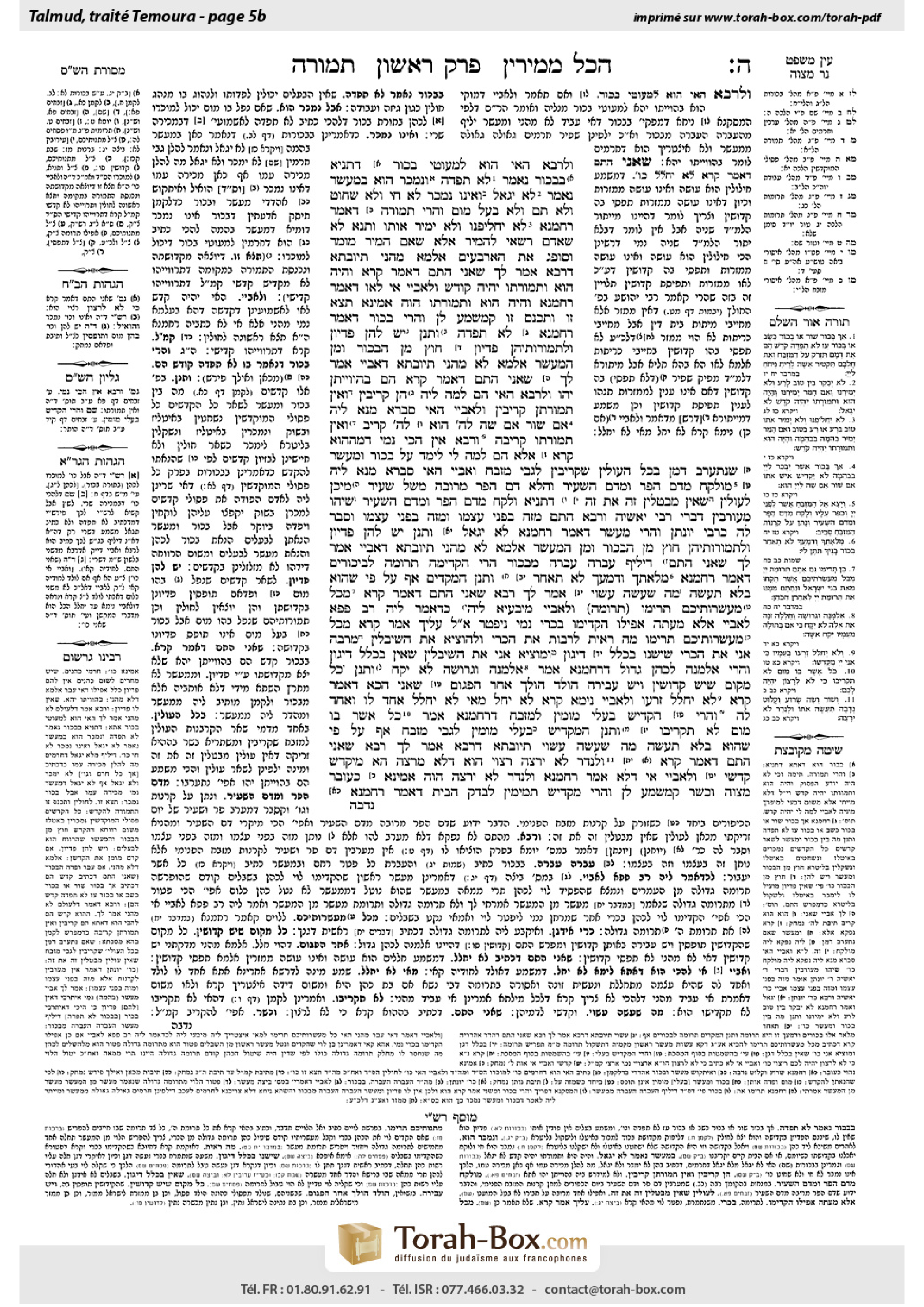
Temurah 5b: Talmud study for Daf Yomi
Daf Yomi is the daily study of one Talmud folio. Explore 37 tractates with scans, Hebrew text, Sefaria English and AI-generated French translations where annotated.
Passage selection and English or AI-generated French translation are available where the scan has annotations. Daf Study is independent of Torah-Box and Sefaria.
Browse Temurah · תמורה · All tractatesTemurah 5b text and translations
This page of Temurah includes the Aramaic text, an English translation and an AI-generated French translation, alongside the scan above.
תמורה ה׳ ב · Aramaic and Hebrew text
וּלְרָבָא, הַאי ״הוּא״ לְמַעוֹטֵי בְּכוֹר, דְּתַנְיָא: בִּבְכוֹר נֶאֱמַר ״לֹא תִפְדֶּה״ וְנִמְכָּר הוּא, בְּמַעֲשֵׂר נֶאֱמַר ״לֹא יִגָּאֵל״ וְאֵינוֹ נִמְכָּר, לֹא חַי וְלֹא שָׁחוּט, לא תָּם וְלֹא בַּעַל מוּם.
וַהֲרֵי תְּמוּרָה, דְּאָמַר רַחֲמָנָא: ״לֹא יַחֲלִיפֶנּוּ וְלֹא יָמִיר אוֹתוֹ״, וְתָנָא: לֹא שֶׁאָדָם רַשַּׁאי לְהָמִיר, אֶלָּא שֶׁאִם הֵמִיר — מוּמָר, וְסוֹפֵג אֶת הָאַרְבָּעִים. אַלְמָא מַהֲנֵי, תְּיוּבְתָּא דְרָבָא!
אָמַר לָךְ: שָׁאנֵי הָתָם, דְּאָמַר קְרָא ״וְהָיָה הוּא וּתְמוּרָתוֹ יִהְיֶה קֹּדֶשׁ״.
וּלְאַבָּיֵי, אִי לָאו דְּאָמַר רַחֲמָנָא ״וְהָיָה הוּא וּתְמוּרָתוֹ״, הֲוָה אָמֵינָא תֵּצֵא זוֹ וְתִכָּנֵס זוֹ, קָמַשְׁמַע לַן.
וַהֲרֵי בְּכוֹר, דְּאָמַר רַחֲמָנָא ״לֹא תִפְדֶּה״, וּתְנַן: יֵשׁ לָהֶן פִּדְיוֹן, וְלִתְמוּרוֹתֵיהֶן פִּדְיוֹן, חוּץ מִן הַבְּכוֹר וּמִן הַמַּעֲשֵׂר, אַלְמָא לָא מַהֲנֵי, תְּיוּבְתָּא דְאַבָּיֵי.
אָמַר לָךְ: שָׁאנֵי הָתָם, דְּאָמַר קְרָא ״הֵם״, בַּהֲוָויָיתָן יְהוּ.
וּלְרָבָא, הַאי ״הֵם״ לְמָה לֵיהּ? הֵן קְרֵיבִין, וְאֵין תְּמוּרָתָן קְרֵיבִין.
וּלְאַבָּיֵי — הַאי סְבָרָא מְנָא לֵיהּ? ״אִם שׁוֹר אִם שֶׂה לַה׳ הוּא״ — לַה׳ קָרֵיב, וְאֵין תְּמוּרָתוֹ קְרֵיבָה.
וְרָבָא, אִין הָכִי נָמֵי דְּמֵהָהוּא קְרָא, אֶלָּא ״הֵם״ לְמָה לִי? לִימֵּד עַל בְּכוֹר וּמַעֲשֵׂר שֶׁנִּתְעָרֵב דָּמָן בְּכׇל הָעוֹלִין שֶׁקְּרֵיבִין לְגַבֵּי מִזְבֵּחַ.
וְאַבָּיֵי, הַאי סְבָרָא מְנָא לֵיהּ? מִ״וְּלָקַח מִדַּם הַפָּר וּמִדַּם הַשָּׂעִיר״, וַהֲלֹא דַּם הַפָּר מְרוּבֶּה מִשֶּׁל שָׂעִיר! מִיכָּן לָעוֹלִין שֶׁאֵין מְבַטְּלִין זֶה אֶת זֶה, דְּתַנְיָא: ״וְלָקַח מִדַּם הַפָּר וּמִדַּם הַשָּׂעִיר״ — שֶׁיְּהוּ מְעוֹרָבִין, דִּבְרֵי רַבִּי יֹאשִׁיָּה.
וְרָבָא, הָתָם — מִזֶּה בִּפְנֵי עַצְמוֹ וּמִזֶּה בִּפְנֵי עַצְמוֹ, וְסָבַר לַהּ כְּרַבִּי יוֹנָתָן.
וַהֲרֵי מַעֲשֵׂר, דְּאָמַר רַחֲמָנָא ״לֹא יִגָּאֵל״, וּתְנַן: יֵשׁ לָהֶן פִּדְיוֹן וְלִתְמוּרוֹתֵיהֶן, חוּץ מִן הַבְּכוֹר וּמִן הַמַּעֲשֵׂר, אַלְמָא לָא מַהֲנֵי, תְּיוּבְתָּא דְאַבָּיֵי.
אָמַר לָךְ: שָׁאנֵי הָתָם, דְּיָלֵיף ״עֲבָרָה״ ״עֲבָרָה״ מִבְּכוֹר.
הֲרֵי הִקְדִּימָהּ תְּרוּמָה לַבִּיכּוּרִים, דְּאָמַר רַחֲמָנָא ״מְלֵאָתְךָ וְדִמְעֲךָ לֹא תְאַחֵר״, וּתְנַן: הַמַּקְדִּים, אַף עַל פִּי שֶׁהוּא בְּלֹא תַעֲשֶׂה — מַה שֶּׁעָשָׂה עָשׂוּי!
אָמַר לָךְ רָבָא: שָׁאנֵי הָתָם, דְּאָמַר קְרָא ״מִכֹּל מַעְשְׂרוֹתֵיכֶם תָּרִימוּ תְּרוּמָה״.
וּלְאַבָּיֵי מִיבַּעְיָא לֵיהּ, כִּדְאָמַר רַב פָּפָּא לְאַבָּיֵי: אֶלָּא מֵעַתָּה, אֲפִילּוּ הִקְדִּימוֹ בִּכְרִי נָמֵי נִיפְּטַר!
אֲמַר לֵיהּ: עָלֶיךָ אָמַר קְרָא ״מִכֹּל מַעְשְׂרוֹתֵיכֶם תָּרִימוּ״.
מָה רָאִיתָ לְרַבּוֹת אֶת הַכְּרִי וּלְהוֹצִיא אֶת הַשִּׁיבֳּלִין? מְרַבֶּה אֲנִי אֶת הַכְּרִי, שֶׁיֶּשְׁנוֹ בִּכְלַל דִּיגּוּן, וּמוֹצִיא אֲנִי אֶת הַשִּׁיבֳּלִין, שֶׁאֵינָן בִּכְלַל דִּיגּוּן.
וַהֲרֵי אַלְמָנָה לְכֹהֵן גָּדוֹל, דְּרַחֲמָנָא אָמַר ״אַלְמָנָה וּגְרוּשָׁה... לֹא יִקָּח״, וּתְנַן: כׇּל מָקוֹם שֶׁיֵּשׁ קִדּוּשִׁין וְיֵשׁ עֲבֵירָה — הַוָּלָד הוֹלֵךְ אַחַר הַפָּגוּם.
שָׁאנֵי הָכָא, דְּאָמַר קְרָא: ״לֹא יְחַלֵּל זַרְעוֹ״.
וּלְאַבָּיֵי, נֵימָא קְרָא ״לֹא יַחֵל״, מַאי ״לֹא יְחַלֵּל״? אֶחָד לוֹ, וְאֶחָד לָהּ.
וַהֲרֵי הִקְדִּישׁ בַּעֲלֵי מוּמִין לַמִּזְבֵּחַ, דְּרַחֲמָנָא אָמַר: ״כֹּל אֲשֶׁר בּוֹ מוּם לֹא תַקְרִיבוּ״, וּתְנַן: הַמַּקְדִּישׁ בַּעֲלֵי מוּמִין לְגַבֵּי מִזְבֵּחַ, אַף עַל פִּי שֶׁהוּא בְּלֹא תַעֲשֶׂה — מַה שֶּׁעָשָׂה עָשׂוּי, תְּיוּבְתָּא דְרָבָא!
אָמַר לָךְ רָבָא: שָׁאנֵי הָתָם, דְּאָמַר קְרָא ״וּלְנֶדֶר לֹא יֵרָצֶה״ — רִצּוּי הוּא דְּלָא מְרַצֵּה, הָא מִיקְדָּשׁ קָדְשִׁי.
וּלְאַבָּיֵי, אִי דְּלָא אָמַר רַחֲמָנָא ״וּלְנֶדֶר לֹא יֵרָצֶה״, הֲוָה אָמֵינָא: כְּעוֹבֵר מִצְוָה וְכָשֵׁר, קָמַשְׁמַע לַן.
וַהֲרֵי מַקְדִּישׁ תְּמִימִין לְבֶדֶק הַבַּיִת, דְּאָמַר רַחֲמָנָא:
Temurah 5b · English translation
And according to the opinion of Rava, this term: “Is most holy,” serves to exclude the case of a firstborn offering from the prohibition of sale. As it is taught in a baraita: It is stated with regard to a firstborn offering: “But the firstling of an ox, or the firstling of a sheep, or the firstling of a goat, you shall not redeem; they are holy” (Numbers 18:17). But if it develops a blemish it may still be sold. By contrast, it is stated with regard to the animal tithe offering: “It shall not be redeemed” (Leviticus 27:33), and the animal tithe may not be sold, not when alive and not when slaughtered, not when unblemished and not when blemished.
The Gemara objects: But isn’t there the case of substitution, with regard to which the Merciful One states: “He shall not exchange it, nor substitute it” (Leviticus 27:10), and it is taught in the mishna (2a): That is not to say that it is permitted for a person to effect substitution; rather, it means that if one substituted a non-sacred animal for a consecrated animal, the substitution takes effect, and the one who substituted the non-sacred animal incurs the forty lashes. Apparently, his action is effective, and this seems to be a conclusive refutation of the opinion of Rava.
The Gemara explains that Rava could say to you: It is different there, as that same verse states: “And if he shall at all substitute animal for animal, then both it and that for which it is substituted shall be holy,” which teaches that his action is effective in this context specifically.
And according to the opinion of Abaye, that transgressions are effective in general, that clause is still necessary, because if the Merciful One had not stated: “Both it and that for which it is substituted shall be holy,” I would say that this initially consecrated animal will leave its consecrated state, and that non-sacred animal will enter into sanctity instead. Therefore, the verse teaches us that the first animal retains its sanctity as well.
The Gemara objects: But isn’t there the case of a firstborn offering, with regard to which the Merciful One states: “But the firstling of an ox, or the firstling of a sheep, or the firstling of a goat, you shall not redeem; they are holy” (Numbers 18:17)? And we learned in a mishna (21a): All sacrificial animals that became blemished are subject to redemption through sale, and their substitutes are also subject to redemption through sale, except for the firstborn and the animal tithe offerings. Apparently, if one attempts to redeem a firstborn offering, his action is not effective, and this seems to be a conclusive refutation of the opinion of Abaye.
The Gemara explains that Abaye could say to you: It is different there, as that same verse states: “They are holy,” thereby teaching that they shall always be as they are, even if one attempts to redeem them.
The Gemara asks: And according to Rava, who maintains that transgressions are not effective, why does he need the term “They are holy”? The Gemara answers: This term teaches that if one substituted another animal for a firstborn offering or for an animal tithe offering, they, the originally consecrated animals, are sacrificed, but their substitutes, although they have sanctity, are not sacrificed.
The Gemara asks: And according to Abaye, from where does he derive this conclusion that the substitutes are not sacrificed? The Gemara answers: The verse states concerning firstborn offerings: “Whether it be ox or sheep, it is the Lord’s” (Leviticus 27:26). One can infer from this wording that it is sacrificed to the Lord but its substitute is not sacrificed.
The Gemara asks: And what does Rava derive from that verse? The Gemara responds: Yes, it is indeed so that he, like Abaye, derives from that verse, not from Numbers 18:17 as originally suggested, the halakha that the substitute of a firstborn is not sacrificed. Rather, why do I need the term “They are holy” which appears in that verse? It teaches with regard to a firstborn offering or an animal tithe offering whose blood was mixed with the blood of any other offering brought upon the altar that the blood is nevertheless sacrificed on the altar as it would have been individually.
The Gemara asks: And Abaye, from where does he derive this conclusion, that such blood is sacrificed? The Gemara answers: He derives it from the verse concerning the High Priest’s service on Yom Kippur: “And he shall take of the blood of the bull, and of the blood of the goat, and put it upon the corners of the altar” (Leviticus 16:18). One might ask: But isn’t there more blood of the bull than of the goat? Why is the blood of the goat not nullified? From here it is derived that offerings brought upon the altar do not nullify one another, as it is taught in a baraita that the phrase in the verse “And he shall take of the blood of the bull, and of the blood of the goat” serves to teach that they must be mixed. This is the statement of Rabbi Yoshiya. Accordingly, Abaye derives that mixtures of blood may be sacrificed.
And as for Rava, he holds that there, the High Priest would take from this blood of the bull by itself and from that blood of the goat by itself, rather than mixing them together. And in this matter, he holds in accordance with the opinion of Rabbi Yonatan, who disagrees with Rabbi Yoshiya.
The Gemara continues its analysis of the dispute between Abaye and Rava. But isn’t there the case of an animal tithe offering, with regard to which the Merciful One states: “It shall not be redeemed” (Leviticus 27:33)? And we learned in a mishna (21a): All sacrificial animals that became blemished are subject to redemption through sale, and their substitutes are also subject to redemption through sale, except for the firstborn and the animal tithe offering. Apparently, if one attempts to redeem an animal tithe offering, his act is not effective, and this seems to be a conclusive refutation of the opinion of Abaye.
The Gemara explains that Abaye could say to you: It is different there, as one derives that halakha from the halakha of a firstborn offering, by verbal analogy between the term “avara” that is stated with regard to an animal tithe offering: “Whatsoever passes [ya’avor] under the rod” (Leviticus 27:32), and the term “avara” that is stated with regard to a firstborn offering: “You shall set apart [veha’avarta] to the Lord all that opens the womb” (Exodus 13:12). It was already derived above that a firstborn offering cannot be redeemed. But in general, transgressions are effective.
The Gemara objects: But isn’t there the case of one who separated teruma prior to the separation of the first fruits, with regard to which the Merciful One states: “You shall not delay to offer of the fullness of your harvest and the outflow of your presses” (Exodus 22:28)? The verse was expounded earlier (4b) as teaching that one must separate first fruits before separating teruma. And we learned in a mishna (Terumot 3:6): If one separates teruma prior to the separation of the first fruits, although he has transgressed a prohibition, what he did is done, and produce has the status of teruma. This appears to refute the opinion of Rava.
The Gemara explains that Rava could say to you: It is different there, as the verse states: “From all that is given you, you shall set apart that which is the Lord’s teruma” (Numbers 18:29), thereby teaching that the separation of teruma is effective in any case. But in general, transgressions are not effective.
And according to the opinion of Abaye that transgressions are generally effective, that verse is required to teach another halakha, as Rav Pappa said to Abaye (Beitza 13b): Rabbi Shimon ben Lakish stated that if the first tithe was separated while the grain was still on the stalks, that amount is exempt from teruma, even though the amount of teruma the priest receives is thereby reduced. If that is so, then even if the Levite preceded the priest by taking the first tithe after the grain had been threshed and arranged in a pile, we should exempt that grain from the obligation of teruma as well.
Abaye said to Rav Pappa: With regard to your claim, the verse states: “From all that is given you, you shall set apart.” This verse teaches that the Levites must designate a portion of all the gifts they receive and give it to the priests, even if they received them before teruma had been separated.
Rav Pappa asked: What did you see that leads you to include the first tithe taken from the pile in the category: “All that is given,” and to exclude that which is taken from the stalks? Abaye answered: I include a tithe taken from the pile, as it has been processed to the point where it is included in the category of grain, since it is written: “The first fruits of your grain…you shall give him” (Deuteronomy 18:4); and I exclude a tithe taken from the stalks, as it is not included in the category of grain and is not yet obligated in teruma.
The Gemara objects: But isn’t there the case of a widow betrothed to a High Priest, with regard to which the Merciful One stated: “A widow, or one divorced, or a profaned woman, or a harlot, these shall he not take; but a virgin of his own people shall he take to wife. And he shall not profane his seed among his people” (Leviticus 21:14–15)? And we learned in a mishna (Kiddushin 66b): Any case where there is a valid betrothal and yet there is a transgression, the offspring follows the flawed lineage. For example, if a widow, who may not marry a High Priest, nevertheless did so, the offspring may not marry a priest. Still, the marriage is in force, contrary to the opinion of Rava.
The Gemara explains that Rava could say: It is different there, as the verse states: “And he shall not profane [lo yeḥallel] his seed.” The verse states only that the offspring is profaned, not that he has the status of a mamzer, which would hold for one born of a union between two people with regard to whom marriage cannot take effect. Rava infers from the verse that the betrothal of a High Priest and a widow specifically does take effect. But in general, transgressions are not effective.
And according to the opinion of Abaye, that transgressions are generally effective, what is derived from that phrase? Abaye can say: If it merely means to teach that the betrothal takes effect, let the verse state simply: Lo yaḥel, which would have the same meaning. What is indicated by the use of the longer form: Lo yeḥallel? This teaches that there are two profanations: One for him, i.e., that the offspring is profaned, and one for her, i.e., that the mother is disqualified from marrying even a common priest.
The Gemara objects: But isn’t there the case of one who consecrated blemished animals for sacrifice on the altar, with regard to which the Merciful One states: “But whatsoever has a blemish, that you shall not bring; for it shall not be acceptable for you” (Leviticus 22:20)? And we learned in a baraita: If one consecrates blemished animals for sacrifice on the altar, even though he has transgressed a prohibition, what he did is done, and the consecration takes effect. This is apparently a conclusive refutation of the opinion of Rava.
The Gemara explains that Rava could say to you: It is different there, as the verse states with regard to blemished animals: “But for a vow it shall not be accepted” (Leviticus 22:23). Since the verse specifies only that it is its sacrifice which does not effect acceptance, one may consequently infer that if one consecrates them, they are still consecrated. But in general, transgressions are not effective.
And according to the opinion of Abaye, that transgressions are generally effective, what does this phrase teach? Abaye can say that if the Merciful One had not stated: “But for a vow it shall not be accepted,” I would say that one who consecrated it is considered like one who transgressed a mitzva but the offering is still fit to be sacrificed. The verse therefore teaches us that it may not be sacrificed as an offering.
The Gemara objects: But there is the case of one who consecrates unblemished animals for Temple maintenance, with regard to which the Merciful One states:
Temurah 5b · Traduction française (IA)
Et selon l’opinion de Rava, l’expression « ils sont saints » sert à exclure le premier-né de l’interdiction de vente. En effet, il est enseigné dans une baraïta : au sujet du premier-né, il est dit : « Mais le premier-né d’un bœuf, le premier-né d’un mouton ou le premier-né d’une chèvre, tu ne le rachèteras pas ; ils sont saints » (Nombres 18:17). Toutefois, s’il développe un défaut, il peut néanmoins être vendu. En revanche, au sujet de la dîme du bétail, il est dit : « Il ne sera pas racheté » (Lévitique 27:33), et la dîme du bétail ne peut être vendue ni vivante ni après l’abattage, ni sans défaut ni avec un défaut.
La Guemara objecte : Mais n’y a-t-il pas le cas de la substitution, au sujet de laquelle le Miséricordieux dit : « Il ne l’échangera pas et ne lui substituera rien » (Lévitique 27:10) ? Et il est enseigné dans la Michna (2a) que cela ne signifie pas qu’il est permis à quelqu’un d’effectuer une substitution ; cela signifie plutôt que si quelqu’un substitue un animal profane à un animal consacré, la substitution prend effet et celui qui a substitué l’animal profane encourt quarante coups de fouet. Apparemment, son acte produit bien un effet, ce qui semble constituer une réfutation décisive de l’opinion de Rava.
La Guemara explique que Rava pourrait te répondre : ce cas est différent, car le même verset dit : « Et s’il substitue effectivement une bête à une autre bête, les deux seront saintes », ce qui enseigne que son acte produit un effet précisément dans ce contexte.
Et selon l’opinion d’Abayé, selon laquelle les transgressions produisent généralement un effet, cette clause est néanmoins nécessaire : si le Miséricordieux n’avait pas dit : « Les deux seront saintes », j’aurais dit que l’animal initialement consacré sortirait de son état de consécration et que l’animal profane entrerait à sa place dans la sainteté. Le verset nous enseigne donc que le premier animal conserve lui aussi sa sainteté.
La Guemara objecte : Mais n’y a-t-il pas le cas d’un premier-né, au sujet duquel le Miséricordieux dit : « Mais le premier-né d’un bœuf, le premier-né d’un mouton ou le premier-né d’une chèvre, tu ne le rachèteras pas ; ils sont saints » (Nombres 18:17) ? Et nous avons appris dans une Michna (21a) : tous les animaux destinés aux sacrifices qui ont développé un défaut peuvent être rachetés par la vente, et leurs substituts peuvent eux aussi être rachetés par la vente, à l’exception des premiers-nés et des offrandes de dîme du bétail. Apparemment, si quelqu’un tente de racheter un premier-né, son acte ne produit pas d’effet, ce qui semble constituer une réfutation décisive de l’opinion d’Abayé.
La Guemara explique qu’Abayé pourrait te répondre : ce cas est différent, car le même verset dit : « Ils sont saints », enseignant ainsi qu’ils resteront toujours tels qu’ils sont, même si quelqu’un tente de les racheter.
La Guemara demande : Et selon Rava, qui soutient que les transgressions ne produisent pas d’effet, pourquoi a-t-il besoin de l’expression « ils sont saints » ? La Guemara répond : cette expression enseigne que si quelqu’un substitue un autre animal à un premier-né ou à une offrande de dîme du bétail, ce sont les animaux initialement consacrés qui sont sacrifiés, tandis que leurs substituts, bien qu’ils soient sanctifiés, ne sont pas sacrifiés.
La Guemara demande : Et d’où Abayé déduit-il que les substituts ne sont pas sacrifiés ? La Guemara répond : le verset dit au sujet des premiers-nés : « Qu’il s’agisse d’un bœuf ou d’un mouton, il appartient au Seigneur » (Lévitique 27:26). On peut déduire de cette formulation que l’animal est sacrifié au Seigneur, mais que son substitut ne l’est pas.
La Guemara demande : Et que déduit Rava de ce verset ? La Guemara répond : En effet, comme Abayé, il déduit de ce verset — et non de Nombres 18:17, comme cela avait été suggéré au départ — la halakha selon laquelle le substitut d’un premier-né n’est pas sacrifié. Mais alors, pourquoi ai-je besoin de l’expression « ils sont saints » qui figure dans ce verset ? Elle enseigne que, lorsque le sang d’un premier-né ou d’une offrande de dîme du bétail a été mélangé au sang de tout autre sacrifice offert sur l’autel, le sang est néanmoins offert sur l’autel comme il l’aurait été s’il était resté séparé.
La Guemara demande : Et d’où Abayé déduit-il que ce sang est sacrifié ? La Guemara répond : il le déduit du verset relatif au service du Grand Prêtre à Yom Kippour : « Il prendra du sang du taureau et du sang du bouc, et en mettra sur les cornes de l’autel » (Lévitique 16:18). On pourrait demander : Mais le sang du taureau n’est-il pas plus abondant que celui du bouc ? Pourquoi le sang du bouc n’est-il pas annulé ? On en déduit que les sacrifices offerts sur l’autel ne s’annulent pas les uns les autres, car il est enseigné dans une baraïta que les mots du verset « Il prendra du sang du taureau et du sang du bouc » servent à enseigner que les sangs doivent être mélangés. Telle est l’opinion de Rabbi Yoshiya. Ainsi, Abayé déduit que les mélanges de sang peuvent être sacrifiés.
Quant à Rava, il soutient que, dans ce cas, le Grand Prêtre prenait séparément de ce sang du taureau et de ce sang du bouc, au lieu de les mélanger. Sur ce point, il suit l’opinion de Rabbi Yonatan, qui est en désaccord avec Rabbi Yoshiya.
La Guemara poursuit son analyse du désaccord entre Abayé et Rava. Mais n’y a-t-il pas le cas d’une offrande de dîme du bétail, au sujet de laquelle le Miséricordieux dit : « Elle ne sera pas rachetée » (Lévitique 27:33) ? Et nous avons appris dans une Michna (21a) : tous les animaux destinés aux sacrifices qui ont développé un défaut peuvent être rachetés par la vente, et leurs substituts peuvent eux aussi être rachetés par la vente, à l’exception des premiers-nés et des offrandes de dîme du bétail. Apparemment, si quelqu’un tente de racheter une offrande de dîme du bétail, son acte ne produit pas d’effet, ce qui semble constituer une réfutation décisive de l’opinion d’Abayé.
La Guemara explique qu’Abayé pourrait te répondre : ce cas est différent, car on déduit cette halakha de celle du premier-né par une analogie verbale entre le terme « avara », employé au sujet de la dîme du bétail : « Tout ce qui passe [ya’avor] sous le bâton » (Lévitique 27:32), et le terme « avara », employé au sujet du premier-né : « Tu consacreras [veha’avarta] au Seigneur tout premier-né du sein maternel » (Exode 13:12). Il a déjà été déduit plus haut qu’un premier-né ne peut pas être racheté. Mais, en général, les transgressions produisent un effet.
La Guemara objecte : Mais n’y a-t-il pas le cas de celui qui a prélevé la terouma avant les prémices, au sujet duquel le Miséricordieux dit : « Tu ne tarderas pas à offrir le produit de ta récolte et celui de tes pressoirs » (Exode 22:28) ? Le verset a été interprété plus haut (4b) comme enseignant qu’il faut prélever les prémices avant la terouma. Et nous avons appris dans une Michna (Teroumot 3:6) : si quelqu’un prélève la terouma avant les prémices, bien qu’il ait transgressé une interdiction, son acte est valide et le produit a le statut de terouma. Cela semble réfuter l’opinion de Rava.
La Guemara explique que Rava pourrait te répondre : ce cas est différent, car le verset dit : « De tout ce qui vous est donné, vous prélèverez la terouma du Seigneur » (Nombres 18:29), enseignant ainsi que le prélèvement de la terouma produit un effet dans tous les cas. Mais, en général, les transgressions ne produisent pas d’effet.
Et selon l’opinion d’Abayé, selon laquelle les transgressions produisent généralement un effet, ce verset est nécessaire pour enseigner une autre halakha, comme Rav Pappa l’a dit à Abayé (Beitsa 13b) : Rabbi Shimon ben Lakish a déclaré que si la première dîme était prélevée alors que le grain était encore sur les tiges, cette quantité est exemptée de terouma, même si cela réduit la quantité de terouma que reçoit le prêtre. Dans ce cas, même si le Lévite a devancé le prêtre en prélevant la première dîme après que le grain eut été battu et rassemblé en tas, nous devrions aussi exempter ce grain de l’obligation de terouma.
Abayé dit à Rav Pappa : Pour répondre à ton argument, le verset dit : « De tout ce qui vous est donné, vous prélèverez. » Ce verset enseigne que les Lévites doivent prélever une part de tous les dons qu’ils reçoivent et la donner aux prêtres, même s’ils les ont reçus avant que la terouma ait été prélevée.
Rav Pappa demanda : Qu’est-ce qui t’a amené à inclure la première dîme prélevée sur le tas dans la catégorie « tout ce qui est donné », et à exclure ce qui est prélevé sur les tiges ? Abayé répondit : J’inclus la première dîme prélevée sur le tas, car le produit a été traité au point d’entrer dans la catégorie du grain, puisqu’il est écrit : « Les prémices de ton grain… tu les lui donneras » (Deutéronome 18:4) ; et j’exclus la première dîme prélevée sur les tiges, car elle n’entre pas dans la catégorie du grain et n’est pas encore assujettie à la terouma.
La Guemara objecte : Mais n’y a-t-il pas le cas d’une veuve fiancée à un Grand Prêtre, au sujet de laquelle le Miséricordieux dit : « Une veuve, une femme répudiée, une femme profanée ou une prostituée, il ne les prendra pas ; mais il prendra pour femme une vierge de son peuple. Et il ne profanera pas sa descendance au sein de son peuple » (Lévitique 21:14–15) ? Et nous avons appris dans une Michna (Kiddouchin 66b) : dans tout cas où les fiançailles sont valides, mais s’accompagnent néanmoins d’une transgression, la descendance hérite de la lignée entachée. Par exemple, si une veuve, qui ne peut pas épouser un Grand Prêtre, l’a néanmoins épousé, leur descendance ne peut pas épouser un prêtre. Pourtant, le mariage est valide, contrairement à l’opinion de Rava.
La Guemara explique que Rava pourrait répondre : ce cas est différent, car le verset dit : « Et il ne profanera pas [lo yeḥallel] sa descendance. » Le verset dit seulement que la descendance est profanée, et non qu’elle a le statut de mamzer, statut qui s’appliquerait à celui qui naît d’une union entre deux personnes dont le mariage ne peut prendre effet. Rava déduit du verset que les fiançailles entre un Grand Prêtre et une veuve prennent précisément effet. Mais, en général, les transgressions ne produisent pas d’effet.
Et selon l’opinion d’Abayé, selon laquelle les transgressions produisent généralement un effet, que déduit-on de cette expression ? Abayé peut répondre : si elle signifie seulement que les fiançailles prennent effet, que le verset dise simplement lo yaḥel, ce qui aurait le même sens. Que signifie donc l’emploi de la forme plus longue lo yeḥallel ? Cela enseigne qu’il y a deux profanations : l’une pour lui, c’est-à-dire que la descendance est profanée, et l’autre pour elle, c’est-à-dire que la mère est disqualifiée et ne peut même pas épouser un prêtre ordinaire.
La Guemara objecte : Mais n’y a-t-il pas le cas de celui qui consacre des animaux présentant un défaut pour être sacrifiés sur l’autel, au sujet duquel le Miséricordieux dit : « Mais tout ce qui a un défaut, vous ne l’apporterez pas, car cela ne sera pas agréé en votre faveur » (Lévitique 22:20) ? Et il est enseigné dans une baraïta : si quelqu’un consacre des animaux présentant un défaut pour qu’ils soient sacrifiés sur l’autel, bien qu’il ait transgressé une interdiction, son acte est valide et la consécration prend effet. Cela semble constituer une réfutation décisive de l’opinion de Rava.
La Guemara explique que Rava pourrait te répondre : ce cas est différent, car le verset dit au sujet des animaux présentant un défaut : « Mais pour un vœu, cela ne sera pas agréé » (Lévitique 22:23). Puisque le verset précise seulement que leur sacrifice n’est pas agréé, on peut en déduire que, si quelqu’un les consacre, ils demeurent néanmoins consacrés. Mais, en général, les transgressions ne produisent pas d’effet.
Et selon l’opinion d’Abayé, selon laquelle les transgressions produisent généralement un effet, que nous enseigne cette expression ? Abayé peut répondre que, si le Miséricordieux n’avait pas dit : « Mais pour un vœu, cela ne sera pas agréé », j’aurais dit que celui qui l’a consacré est considéré comme ayant transgressé une mitsva, mais que l’offrande reste néanmoins apte à être sacrifiée. Le verset nous enseigne donc qu’elle ne peut pas être sacrifiée comme offrande.
La Guemara objecte : Mais il y a le cas de celui qui consacre des animaux sans défaut à l’entretien du Temple, au sujet duquel le Miséricordieux dit :
Traduction française générée par IA à partir de l’édition anglaise de Sefaria. Vérifie toujours un passage avec le texte source.
Text from Sefaria: William Davidson Edition - Vocalized Aramaic (CC BY NC); William Davidson Edition - English (CC BY NC).