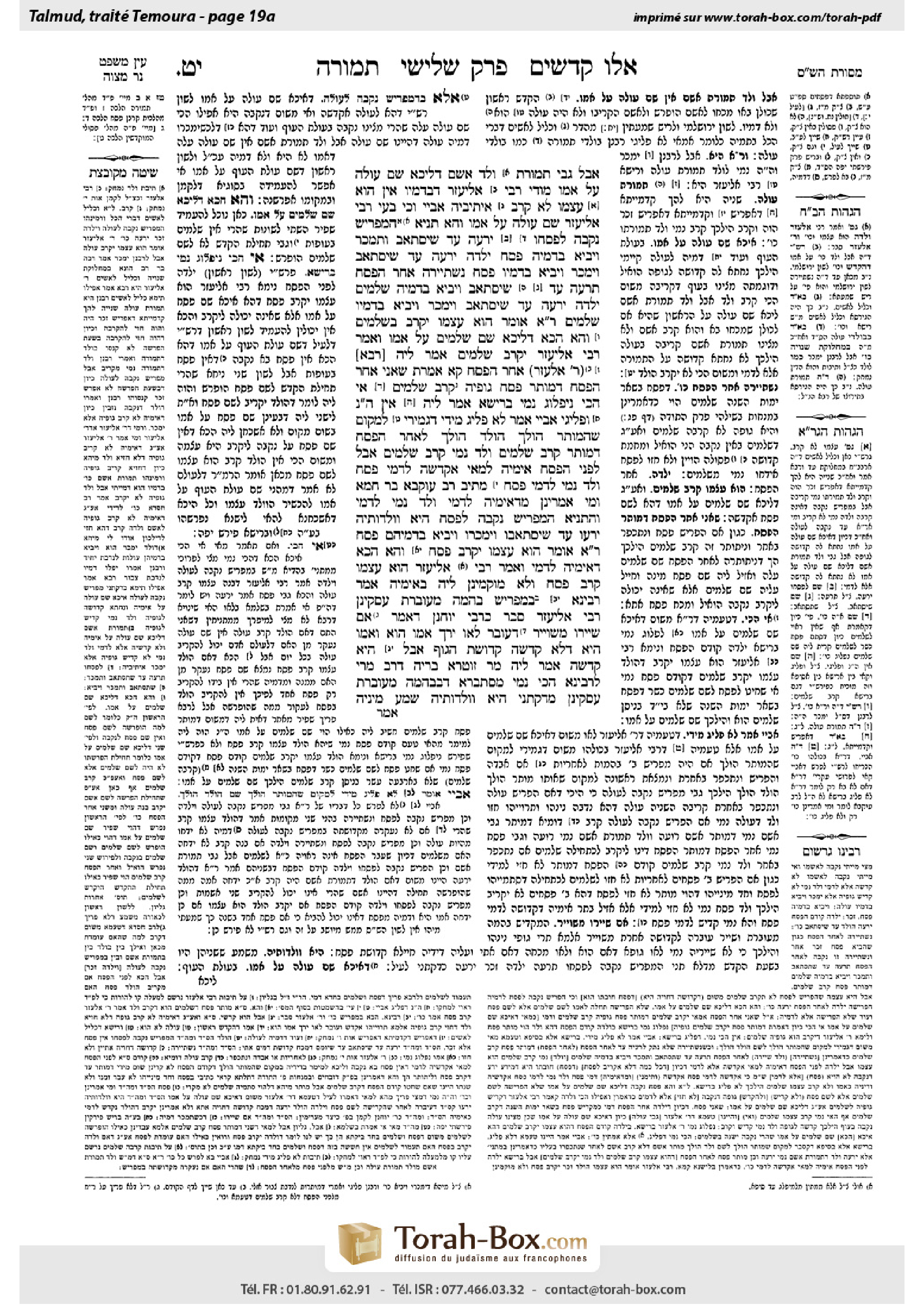
Temurah 19a: Talmud study for Daf Yomi
Daf Yomi is the daily study of one Talmud folio. Explore 37 tractates with scans, Hebrew text, Sefaria English and AI-generated French translations where annotated.
Passage selection and English or AI-generated French translation are available where the scan has annotations. Daf Study is independent of Torah-Box and Sefaria.
Browse Temurah · תמורה · All tractatesTemurah 19a text and translations
This page of Temurah includes the Aramaic text, an English translation and an AI-generated French translation, alongside the scan above.
תמורה י״ט א · Aramaic and Hebrew text
אֲבָל גַּבֵּי תְּמוּרַת וְלַד אָשָׁם, דְּלֵיכָּא שֵׁם עוֹלָה עַל אִמּוֹ, מוֹדֵי רַבִּי אֶלְעָזָר דִּבְדָמָיו אִין הוּא עַצְמוֹ לָא קָרֵב.
אֵיתִיבֵיהּ אַבָּיֵי: וְכִי בָּעֵי רַבִּי אֶלְעָזָר שֵׁם עוֹלָה עַל אִמּוֹ? וְהָא תַּנְיָא: הַמַּפְרִישׁ נְקֵבָה לְפִסְחוֹ — תִּרְעֶה עַד (שֶׁיִּסְתָּאֵב) [שֶׁתִּסְתָּאֵב], וְתִמָּכֵר, וְיָבִיא בְּדָמֶיהָ פֶּסַח. יָלְדָה — יִרְעֶה עַד שֶׁיִּסְתָּאֵב, וְיִמָּכֵר, וְיָבִיא בְּדָמָיו פֶּסַח.
נִשְׁתַּיְּירָה אַחַר הַפֶּסַח, תִּרְעֶה עַד (שֶׁיִּסְתָּאֵב) [שֶׁתִּסְתָּאֵב], וְיָבִיא בְּדָמֶיהָ שְׁלָמִים. יָלְדָה, יִרְעֶה עַד שֶׁיִּסְתָּאֵב, וְיִמָּכֵר וְיָבִיא בְּדָמָיו שְׁלָמִים. רַבִּי אֶלְעָזָר אוֹמֵר: הוּא עַצְמוֹ יִקְרַב שְׁלָמִים.
וְהָא הָכָא, דְּלֵיכָּא שֵׁם שְׁלָמִים עַל אִמּוֹ, וְאָמַר רַבִּי אֶלְעָזָר יִקְרַב שְׁלָמִים. אֲמַר לֵיהּ (רַבִּי אֶלְעָזָר) [רָבָא]: ״אַחַר הַפֶּסַח״ קָא אָמְרַתְּ? שָׁאנֵי אַחַר הַפֶּסַח, דְּמוֹתַר פֶּסַח גּוּפֵיהּ קָרֵב שְׁלָמִים.
אִי הָכִי, נִיפְלוֹג נָמֵי בְּרֵישָׁא! אֲמַר לֵיהּ: אִין הָכִי נָמֵי, וּפְלִיגִי.
אַבָּיֵי אָמַר: לָא פְּלִיג מִידֵּי, דִּגְמִירִי לִמְקוֹם שֶׁהַמּוֹתָר הוֹלֵךְ — הַוָּלָד הוֹלֵךְ; לְאַחַר הַפֶּסַח, דְּמוֹתָר קָרֵב שְׁלָמִים — וָלָד נָמֵי קָרֵב שְׁלָמִים.
אֲבָל לִפְנֵי הַפֶּסַח, אִימֵּיהּ לְמַאי אַקְדְּשַׁהּ? לִדְמֵי פֶסַח, וָלָד נָמֵי לִדְמֵי פֶסַח.
מֵתִיב רַב עוּקְבָא בַּר חָמָא: וּמִי אָמְרִינַן מִדְּאִימֵּיהּ לִדְמֵי, וָלָד נָמֵי לִדְמֵי? וְהָתַנְיָא: הַמַּפְרִישׁ נְקֵבָה לַפֶּסַח — הִיא וּוַלְדוֹתֶיהָ יִרְעוּ עַד שֶׁיִּסְתָּאֲבוּ, וְיִמָּכְרוּ, וְיָבִיא בִּדְמֵיהֶם פֶּסַח. רַבִּי אֶלְעָזָר אוֹמֵר: הוּא עַצְמוֹ יִקְרַב פֶּסַח.
וְהָא הָכָא, דְּאִימֵּיהּ לִדְמֵי, וְאָמַר רַבִּי אֶלְעָזָר: הוּא עַצְמוֹ קָרֵב פֶּסַח, וְלָא מוֹקְמִינַן לֵיהּ בְּאִימֵּיהּ!
אָמַר רָבִינָא: בְּמַפְרִישׁ בְּהֵמָה מְעוּבֶּרֶת עָסְקִינַן, רַבִּי אֶלְעָזָר סָבַר כְּרַבִּי יוֹחָנָן, דְּאָמַר: אִם שִׁיְּירוֹ מְשׁוּיָּיר, דְּעוּבָּר לָאו יֶרֶךְ אִמּוֹ הוּא, וְאִמּוֹ הִיא דְּלָא קָדְשָׁה קְדוּשַּׁת הַגּוּף, אֲבָל הִיא קָדְשָׁה.
אֲמַר לֵיהּ מָר זוּטְרָא בְּרֵיהּ דְּרַב מָרִי לְרָבִינָא: הָכִי נָמֵי מִסְתַּבְּרָא דְּבִבְהֵמָה מְעוּבֶּרֶת עָסְקִינַן, מִדְּקָתָנֵי ״הִיא וּוַלְדוֹתֶיהָ״, שְׁמַע מִינַּהּ.
Temurah 19a · English translation
But with regard to the offspring of the substitute of a guilt offering, where there is no burnt offering status for its mother, as the animal for which it was substituted was a guilt offering, Rabbi Elazar concedes that an animal purchased with its money, received from selling the offspring, yes, it is sacrificed as a burnt offering, but the offspring itself is not sacrificed as a burnt offering.
Abaye raised an objection to Rava: And does Rabbi Elazar require that there be burnt offering status for its mother, in order for the offspring to be sacrificed as a burnt offering? But isn’t it taught in a baraita: In the case of one who designates a female animal for his Paschal offering, which must be a male, the animal is left to graze until it becomes unfit, and it is then sold and he brings a Paschal offering with the money received for its sale. If the female animal gave birth to a male,the offspring may not be sacrificed as a Paschal offering despite the fact that it is a male. Rather, it is left to graze until it becomes unfit, and then it is sold and he brings a Paschal offering with the money received from its sale.
If the animal remained without a blemish until after Passover, it is left to graze until it becomes unfit, and he brings a peace offering with the money received for its sale. If it gave birth to a male after Passover, the offspring too is left to graze until it becomes unfit, and then it is sold, and he brings a peace offering with the money received for its sale. Rabbi Elazar disagrees in the latter case and says: The offspring itself is sacrificed as a peace offering.
Abaye explains his objection: But here, it is a case where there is no peace offering status for its mother, as the mother was consecrated as a Paschal offering, and yet Rabbi Elazar says that the offspring is sacrificed as a peace offering. Rava said to Abaye in response: Do you say that this statement of Rabbi Elazar with regard to a Paschal offering after Passover contradicts my explanation? Not so; the status of a Paschal offering after Passover is different, as a leftover Paschal offering itself is sacrificed as a peace offering. Therefore, a female animal designated as a Paschal offering has the status of a peace offering after Passover.
Abaye asked Rava: If so, that the reason Rabbi Elazar permits the offspring to be sacrificed is that the mother also has the status of a peace offering, let Rabbi Elazar also disagree with the Rabbis in the first clause of the baraita, where the female animal designated as a Paschal offering gave birth before Passover. Rabbi Elazar should state that this offspring itself may be brought as a peace offering, as here too the mother has the status of a peace offering, since a Paschal offering slaughtered before Passover as a peace offering is valid. Rava said to Abaye: Yes, it is indeed so, and they disagree in this case as well.
Abaye suggested another explanation of the opinion of Rabbi Elazar and said: In a case where the female animal designated as a Paschal offering gave birth before Passover, there is nobody who disagrees; rather, they all agree that the offspring may not be sacrificed. As it is learned as a tradition that to the place that the leftover offering goes, the offspring goes as well. Therefore, after Passover, when the leftover Paschal offering is sacrificed as a peace offering, the offspring is also sacrificed as a peace offering.
But before Passover, when the Paschal offering is not yet considered leftover, the offspring is endowed with the same sanctity as the mother. In what way is the mother consecrated? It is consecrated for the value of a Paschal offering, that is, so that it should be sold and a Paschal offering should be purchased with the proceeds, as the female animal itself may not be sacrificed as a Paschal offering. If so, the offspring as well is consecrated only for the value of a Paschal offering.
Rav Ukva bar Ḥama raises an objection to this explanation of Abaye: And do we say that Rabbi Elazar maintains that as its mother is consecrated only for the value of a Paschal offering, the offspring as well is consecrated only for the value of a Paschal offering? But isn’t it taught in a baraita: One who designates a female animal as a Paschal offering, it and its offspring are left to graze until they become unfit, and then they are sold, and he brings a Paschal offering with the money received for their sale. Rabbi Elazar says: The offspring itself is sacrificed as a Paschal offering.
But here it is a case where its mother was consecrated for the value of a Paschal offering, and nevertheless Rabbi Elazar said that the offspring itself is sacrificed as a Paschal offering, and we do not establish the status of the offspring based upon the sanctity of the mother.
Ravina says: One can answer that here we are dealing with a case of one who designates a pregnant animal, and Rabbi Elazar holds in accordance with the opinion of Rabbi Yoḥanan, who said with regard to one who consecrates a pregnant animal for a specific purpose, that if he left it out, i.e., designated the fetus as having a different sanctity, it is left out from the sanctity of the mother and consecrated in accordance with the designated sanctity. The reason is that a fetus is not considered the thigh of its mother, but rather the mother and its offspring are considered two separate animals. Here too, it is only its mother that is not sanctified with the inherent sanctity of a Paschal offering, but only for the value of a Paschal offering, as it is female. But the offspring is consecrated as a Paschal offering.
Mar Zutra, son of Rav Mari, said to Ravina: This, too, stands to reason, that we are dealing with a case where he designated a pregnant animal, from the fact that the baraita teaches: It and its offspring. This indicates that both the mother and its offspring were in existence at the time of the consecration. The Gemara comments: Conclude from here that this explanation is correct.
Temurah 19a · Traduction française (IA)
Mais, en ce qui concerne le petit issu de la descendante d’un sacrifice de culpabilité, dont la mère n’a pas le statut d’holocauste, puisque l’animal auquel elle a été substituée était un sacrifice de culpabilité, Rabbi Elazar reconnaît qu’un animal acheté avec l’argent obtenu de la vente du petit, oui, est offert en holocauste, mais que le petit lui-même ne l’est pas.
Abayé objecta à Rava : Rabbi Elazar exige-t-il donc que la mère ait le statut d’holocauste pour que le petit soit offert en holocauste ? Pourtant, n’est-il pas enseigné dans une baraïta : Celui qui désigne une femelle pour son sacrifice pascal, lequel doit être un mâle, la laisse paître jusqu’à ce qu’elle devienne impropre, puis la vend et apporte un sacrifice pascal avec l’argent obtenu de sa vente. Si la femelle met bas un mâle, le petit ne peut pas être offert en sacrifice pascal, bien qu’il soit mâle. On le laisse plutôt paître jusqu’à ce qu’il devienne impropre, puis on le vend et il apporte un sacrifice pascal avec l’argent obtenu de sa vente.
Si l’animal est resté sans défaut jusqu’après Pessa’h, on le laisse paître jusqu’à ce qu’il devienne impropre, et il apporte un sacrifice de paix avec l’argent obtenu de sa vente. S’il met bas un mâle après Pessa’h, le petit aussi est laissé à paître jusqu’à ce qu’il devienne impropre, puis il est vendu et il apporte un sacrifice de paix avec l’argent obtenu de sa vente. Rabbi Elazar est en désaccord dans ce dernier cas et dit : le petit lui-même est offert en sacrifice de paix.
Abayé explique son objection : Mais ici, la mère n’a pas le statut de sacrifice de paix, puisqu’elle a été consacrée comme sacrifice pascal, et pourtant Rabbi Elazar dit que le petit est offert en sacrifice de paix. Rava répondit à Abayé : Penses-tu que cette déclaration de Rabbi Elazar au sujet d’un sacrifice pascal après Pessa’h contredit mon explication ? Ce n’est pas le cas : le statut du sacrifice pascal après Pessa’h est différent, car un sacrifice pascal restant est lui-même offert en sacrifice de paix. Par conséquent, après Pessa’h, une femelle désignée comme sacrifice pascal a le statut d’un sacrifice de paix.
Abayé demanda à Rava : Si Rabbi Elazar permet que le petit soit offert parce que sa mère a elle aussi le statut de sacrifice de paix, pourquoi Rabbi Elazar ne serait-il pas également en désaccord avec les rabbins dans la première partie de la baraïta, où la femelle désignée comme sacrifice pascal met bas avant Pessa’h ? Rabbi Elazar devrait déclarer que ce petit lui-même peut être offert en sacrifice de paix, car ici aussi la mère a le statut d’un sacrifice de paix, puisque le sacrifice pascal abattu avant Pessa’h en tant que sacrifice de paix est valide. Rava dit à Abayé : Oui, c’est effectivement le cas, et ils sont également en désaccord dans cette situation.
Abayé proposa une autre explication de l’opinion de Rabbi Elazar et dit : Dans le cas où la femelle désignée comme sacrifice pascal met bas avant Pessa’h, personne n’est en désaccord ; tous conviennent plutôt que le petit ne peut pas être offert. En effet, on a reçu par tradition que le petit suit le sort du sacrifice restant. Par conséquent, après Pessa’h, lorsque le sacrifice pascal restant est offert en sacrifice de paix, le petit est lui aussi offert en sacrifice de paix.
Mais avant Pessa’h, lorsque le sacrifice pascal n’est pas encore considéré comme un sacrifice restant, le petit reçoit la même sainteté que sa mère. De quelle manière la mère est-elle consacrée ? Elle est consacrée à la valeur d’un sacrifice pascal, c’est-à-dire qu’elle doit être vendue afin qu’un sacrifice pascal soit acheté avec le produit de la vente, puisque la femelle elle-même ne peut pas être offerte en sacrifice pascal. Dans ce cas, le petit aussi n’est consacré qu’à la valeur d’un sacrifice pascal.
Rav Ukva bar Ḥama objecte à cette explication d’Abayé : Dit-on donc que, selon Rabbi Elazar, puisque sa mère est consacrée seulement à la valeur d’un sacrifice pascal, le petit aussi n’est consacré qu’à la valeur d’un sacrifice pascal ? Pourtant, n’est-il pas enseigné dans une baraïta : Celui qui désigne une femelle comme sacrifice pascal laisse celle-ci et son petit paître jusqu’à ce qu’ils deviennent impropres, puis les vend et apporte un sacrifice pascal avec l’argent obtenu de leur vente. Rabbi Elazar dit : le petit lui-même est offert en sacrifice pascal.
Mais ici, il s’agit d’un cas où sa mère a été consacrée à la valeur d’un sacrifice pascal, et pourtant Rabbi Elazar a dit que le petit lui-même est offert en sacrifice pascal ; nous ne déterminons donc pas le statut du petit en fonction de la sainteté de sa mère.
Ravina dit : On peut répondre qu’ici, il s’agit du cas de celui qui désigne un animal gravide, et que Rabbi Elazar suit l’opinion de Rabbi Yoḥanan, qui a dit au sujet de celui qui consacre un animal gravide à une fin précise que, s’il l’en distingue, c’est-à-dire s’il attribue au fœtus une autre sainteté, celui-ci est soustrait à la sainteté de sa mère et consacré conformément à la sainteté qui lui a été attribuée. La raison en est qu’un fœtus n’est pas considéré comme la cuisse de sa mère ; la mère et son petit sont plutôt considérés comme deux animaux distincts. Ici aussi, seule la mère n’est pas consacrée avec la sainteté intrinsèque d’un sacrifice pascal, mais seulement à la valeur d’un sacrifice pascal, puisqu’elle est femelle. Le petit, lui, est consacré comme sacrifice pascal.
Mar Zutra, fils de Rav Mari, dit à Ravina : Il est également raisonnable de dire qu’il s’agit d’un cas où il a désigné un animal gravide, puisque la baraïta enseigne : « Elle et son petit ». Cela indique que la mère et son petit existaient tous deux au moment de la consécration. La Guemara commente : Conclus-en que cette explication est correcte.
Traduction française générée par IA à partir de l’édition anglaise de Sefaria. Vérifie toujours un passage avec le texte source.
Text from Sefaria: William Davidson Edition - Vocalized Aramaic (CC BY NC); William Davidson Edition - English (CC BY NC).