Temurah 19b: Talmud study for Daf Yomi
Daf Yomi is the daily study of one Talmud folio. Explore 37 tractates with scans, Hebrew text, Sefaria English and AI-generated French translations where annotated.
Passage selection and English or AI-generated French translation are available where the scan has annotations. Daf Study is independent of Torah-Box and Sefaria.
Browse Temurah · תמורה · All tractatesTemurah 19b text and translations
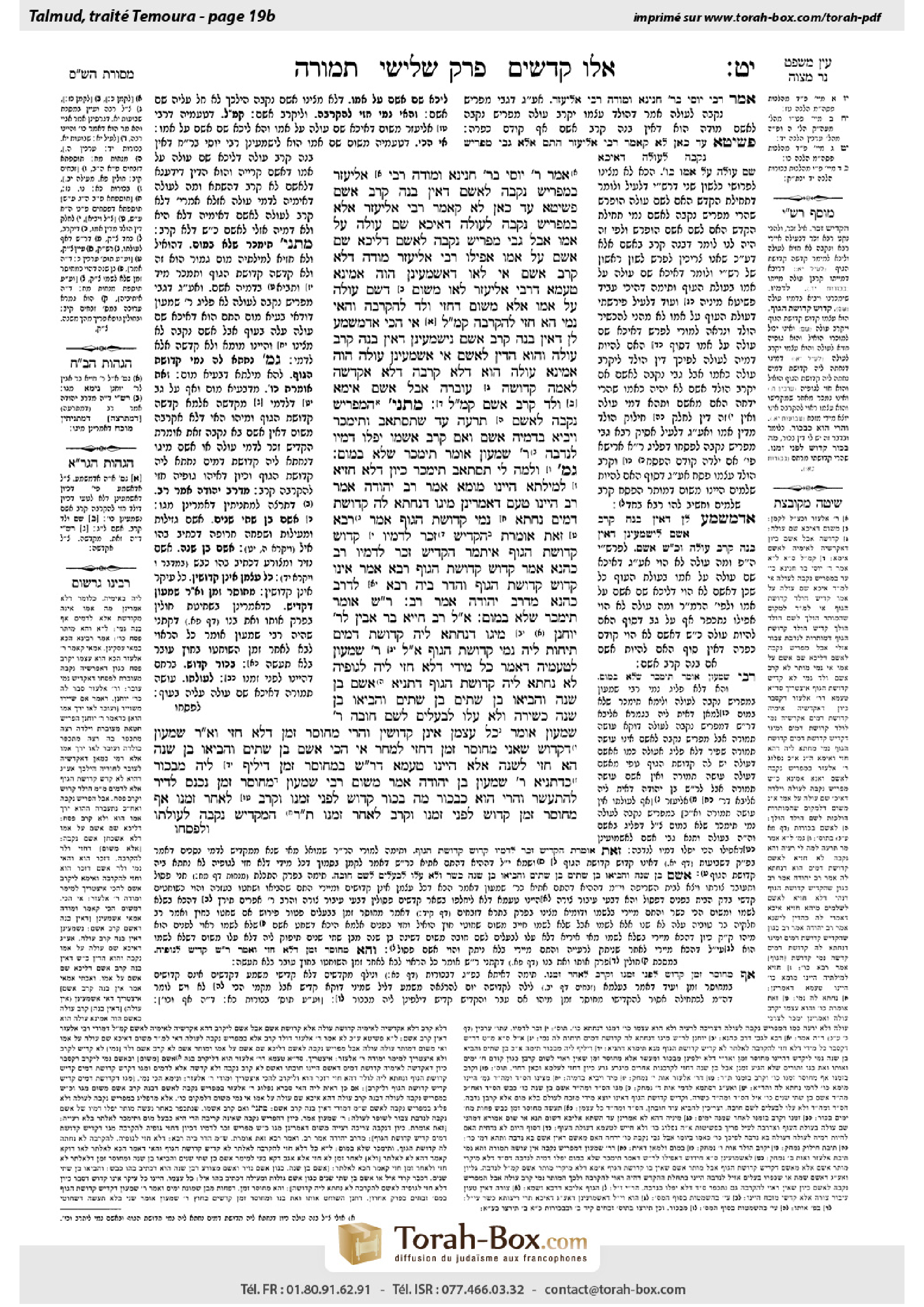
This page of Temurah includes the Aramaic text, an English translation and an AI-generated French translation, alongside the scan above.
תמורה י״ט ב · Aramaic and Hebrew text
אָמַר רַבִּי יוֹסֵי בְּרַבִּי חֲנִינָא: וּמוֹדֶה רַבִּי אֶלְעָזָר בְּמַפְרִישׁ נְקֵבָה לְאָשָׁם דְּאֵין בְּנָהּ קָרֵב אָשָׁם. פְּשִׁיטָא! עַד כַּאן לָא קָאָמַר רַבִּי אֶלְעָזָר אֶלָּא בְּמַפְרִישׁ נְקֵבָה לְעוֹלָה, דְּאִיכָּא שֵׁם עוֹלָה עַל אִמּוֹ, אֲבָל גַּבֵּי מַפְרִישׁ נְקֵבָה לְאָשָׁם דְּלֵיכָּא שֵׁם אָשָׁם עַל אִמּוֹ — אֲפִילּוּ רַבִּי אֶלְעָזָר מוֹדֶה דְּלֹא קָרֵב אָשָׁם!
אִי לָאו דְּאַשְׁמְעִינַן, הֲוָה אָמֵינָא טַעְמָא דְּרַבִּי אֶלְעָזָר לָאו מִשּׁוּם דְּשֵׁם עוֹלָה עַל אִמּוֹ, אֶלָּא מִשּׁוּם דַּחֲזֵי וָלָד לְהַקְרָבָה, וְהַאי נָמֵי הָא חֲזֵי לְהַקְרָבָה, קָא מַשְׁמַע לַן.
אִי הָכִי, אַדְּמַשְׁמַע לַן דְּאֵין בְּנָהּ קָרֵב אָשָׁם, נַישְׁמְעִינַן דְּאֵין בְּנָהּ קָרֵב עוֹלָה, וְהוּא הַדִּין לְאָשָׁם!
אִי אַשְׁמְעִינַן עוֹלָה, הֲוָה אָמֵינָא: עוֹלָה הוּא דְּלָא קָרְבָה, דְּלָא אַקְדְּשַׁהּ לְאִמַּהּ (קְדוּשָּׁה עוּבָּרָהּ) [קְדוּשַּׁת עוֹלָה], אֲבָל אָשָׁם — [כֵּיוָן דְּאַקְדְּשַׁהּ לְאִימֵּיהּ לְאָשָׁם] — אֵימָא: וָלָד קָרֵב אָשָׁם, קָא מַשְׁמַע לַן.
מַתְנִי׳ הַמַּפְרִישׁ נְקֵבָה לְאָשָׁם, תִּרְעֶה עַד שֶׁתִּסְתָּאֵב, וְתִימָּכֵר, וְיָבִיא בְּדָמֶיהָ אָשָׁם. וְאִם קָרַב אֲשָׁמוֹ, יִפְּלוּ דָּמָיו לִנְדָבָה.
רַבִּי שִׁמְעוֹן אוֹמֵר: תִּימָּכֵר שֶׁלֹּא בְּמוּם.
גְּמָ׳ וּלְמָה לִי תִּסְתָּאֵב? תִּימָּכֵר! כֵּיוָן דְּלָא חַזְיָא לְמִילְּתָא — הַיְינוּ מוּמָא!
אָמַר רַב יְהוּדָה, אָמַר רַב: הַיְינוּ טַעַם דְּאָמְרִינַן, מִיגּוֹ דְּנָחֲתָא לַהּ קְדוּשַּׁת דָּמִים — נָחֲתָא נָמֵי קְדוּשַּׁת הַגּוּף. אָמַר רָבָא: זֹאת אוֹמֶרֶת, הִקְדִּישׁ זָכָר לְדָמָיו — קָדוֹשׁ קְדוּשַּׁת הַגּוּף.
אִיתְּמַר: הִקְדִּישׁ זָכָר לְדָמָיו, רַב כָּהֲנָא אָמַר: קָדוֹשׁ קְדוּשַּׁת הַגּוּף, רָבָא אָמַר: אֵינוֹ קָדוֹשׁ קְדוּשַּׁת הַגּוּף. וַהֲדַר בֵּיהּ רָבָא לִדְרַב כָּהֲנָא, מִדְּרַב יְהוּדָה אָמַר רַב.
רַבִּי שִׁמְעוֹן אוֹמֵר: תִּימָּכֵר שֶׁלֹּא בְּמוּם. אֲמַר לֵיהּ רַב חִיָּיא בַּר אָבִין לְרַבִּי יוֹחָנָן: מִיגּוֹ דְּנָחֲתָא לֵיהּ קְדוּשַּׁת דָּמִים, תֵּיחוֹת לֵיהּ נָמֵי קְדוּשַּׁת הַגּוּף!
אֲמַר לֵיהּ רַבִּי שִׁמְעוֹן לְטַעְמֵיהּ, דְּאָמַר: כֹּל מִידֵּי דְּלָא חֲזֵי לֵיהּ לְגוּפֵיהּ — לָא נָחֲתָא לֵיהּ קְדוּשַּׁת הַגּוּף, דְּתַנְיָא: אָשָׁם בֶּן שָׁנָה וֶהֱבִיאוֹ בֶּן שְׁתַּיִם, בֶּן שְׁתַּיִם וֶהֱבִיאוֹ בֶּן שָׁנָה — כְּשֵׁירָה, וְלֹא עָלוּ לַבְּעָלִים לְשֵׁם חוֹבָה.
רַבִּי שִׁמְעוֹן אוֹמֵר: כׇּל עַצְמָן אֵינָן קְדוֹשִׁין.
וַהֲרֵי מְחוּסַּר זְמַן, דְּלָא חֲזֵי, וְאָמַר רַבִּי שִׁמְעוֹן דְּקָדוֹשׁ, שָׁאנֵי מְחוּסַּר זְמַן, דַּחֲזֵי לִמְחַר.
אִי הָכִי, אָשָׁם בֶּן שְׁתַּיִם וֶהֱבִיאוֹ בֶּן שָׁנָה, הָא חֲזֵי לְשָׁנָה, אֶלָּא הַיְינוּ טַעְמָא דְּרַבִּי שִׁמְעוֹן בִּמְחוּסַּר זְמַן, דְּיָלֵיף לֵיהּ מִבְּכוֹר.
כִּדְתַנְיָא, רַבִּי שִׁמְעוֹן בֶּן יְהוּדָה אָמַר מִשּׁוּם רַבִּי שִׁמְעוֹן: מְחוּסַּר זְמַן נִכְנָס לַדִּיר לְהִתְעַשֵּׂר, וַהֲרֵי הוּא כִּבְכוֹר, מָה בְּכוֹר קָדוֹשׁ לִפְנֵי זְמַנּוֹ וְקָרֵב לְאַחַר זְמַנּוֹ, אַף מְחוּסַּר זְמַן קָדוֹשׁ לִפְנֵי זְמַנּוֹ וְקָרֵב לְאַחַר זְמַנּוֹ.
תָּנוּ רַבָּנַן: הַמַּקְדִּישׁ נְקֵבָה לְעוֹלָתוֹ
Temurah 19b · English translation
Rabbi Yosei, son of Rabbi Ḥanina, said: And Rabbi Elazar concedes to the opinion of the Rabbis with regard to a case where one designates a female animal for a guilt offering, which is only brought from a male animal, that its offspring is not sacrificed as a guilt offering. The Gemara asks: Isn’t that obvious? As Rabbi Elazar states that the offspring may be sacrificed only if one designates a female animal for a burnt offering and it gives birth, due to the fact that there is burnt offering status for a bird that is the same sex as its mother. But with regard to one who designates a female animal as a guilt offering, where there is no guilt offering status for its mother, even Rabbi Elazar concedes that its offspring is not sacrificed as a guilt offering.
The Gemara answers that this statement is nevertheless necessary, for if Rabbi Yosei, son of Rabbi Ḥanina, had not informed us of this halakha, I would say that the reason for the ruling of Rabbi Elazar, that one who designates a female animal for a burnt offering may sacrifice the offspring as a burnt offering, is not due to the fact that there is burnt offering status for a bird with the same sex as its mother; rather it is because the offspring is fit as an offering, as it is a male, and this too, the offspring of the female that was designated as a guilt offering, is likewise fit as an offering, as it is a male. Therefore, he teaches us that this offspring is not sacrificed even according to the opinion of Rabbi Elazar.
The Gemara objects: If so, that Rabbi Yosei, son of Rabbi Ḥanina’s ruling is necessary to exclude the possibility that Rabbi Elazar’s reason is that the offspring is suitable as an offering, then say the following: Rather than teach us that the offspring of a female designated as a guilt offering is not sacrificed as a guilt offering, let him teach us a more expansive ruling, that its offspring is not sacrificed as a burnt offering, despite the fact that the mother is left to graze until it becomes unfit, at which point it is sold, and the proceeds are used for the purchase of a burnt offering. And from that ruling one would know that the same is true that the offspring is not sacrificed as a guilt offering.
The Gemara explains: If he would teach us that according to Rabbi Elazar the offspring is not sacrificed as a burnt offering, I would say that it is only as a burnt offering that the offspring is not sacrificed, because he did not consecrate the mother with the same type of sanctity for the sake of which the fetus would be sacrificed. This is because the mother was consecrated as a guilt offering whereas the offspring would have been sacrificed as a burnt offering. But with regard to the option of sacrificing the offspring as a guilt offering, when the offspring has the same type of sanctity as that with which the mother was consecrated, I might say that the offspring is sacrificed as a guilt offering. Therefore, he teaches us that it is not sacrificed as a guilt offering, even according to the opinion of Rabbi Elazar.
MISHNA: In the case of one who designates a female animal for a guilt offering, which may be brought only from males, it is left to graze until it becomes blemished and then it is sold, and he brings a guilt offering with the money received for its sale. And if in the interim, he designated a male animal and his guilt offering was already sacrificed, so that a guilt offering is no longer needed, the money received for the sale of the blemished female is allocated for communal gift offerings.
Rabbi Shimon says: Since a female is unfit to be sacrificed as a guilt offering, its halakhic status is like that of a blemished animal in the sense that it does not become inherently sacred; rather, its value alone becomes sacred. Therefore, it may be sold without a blemish, and a guilt offering is purchased with the money received for its sale.
GEMARA: The Gemara asks: And why do I need to wait until the female animal that was designated as a guilt offering becomes blemished before it can be sold? Let it be sold immediately even without a blemish: Since it is a female and therefore unfit for the matter for which it was designated, this is the same thing as a blemish.
Rav Yehuda said that Rav said: This is the reason that the female animal may not be sold before it becomes blemished, for we say that as sanctity that inheres in its value has descended on it, therefore inherent sanctity has descended on it as well. Although it may not be sacrificed in any event, its inherent sanctity still mandates that it may not be sold until it becomes blemished. Rava says: That is to say that even if one consecrated a male animal with the intention of selling it and bringing a burnt offering or guilt offering with the money received for its sale, as it becomes sanctified with sanctity that inheres in its value, it also becomes sanctified with inherent sanctity. And as the animal is fit to be brought as a burnt offering or as a guilt offering, it is sacrificed.
It was stated that this issue is subject to a dispute of amora’im: If one consecrated a male animal with the intention of selling it and bringing a burnt offering or guilt offering with the money received for its sale, Rav Kahana says that it is sanctified with inherent sanctity, whereas Rava says that it is not sanctified with inherent sanctity. But Rava later retracted his statement and agreed with the opinion of Rav Kahana, due to the aforementioned statement of Rav Yehuda citing that which Rav said, that as the animal becomes sanctified with sanctity that inheres in its value, inherent sanctity also takes effect.
§ The mishna teaches that Rabbi Shimon disagrees with the opinion of the Rabbis and says that a female animal that was designated as a guilt offering may be sold without a blemish, as it is unfit to be sacrificed as the offering for which it was designated, and this itself is considered a blemish. Rav Ḥiyya bar Avin said to Rabbi Yoḥanan: Why doesn’t Rabbi Shimon say that as sanctity that inheres in its value has descended on it, inherent sanctity should descend on it as well, and therefore it may not be sold until it becomes blemished?
Rabbi Yoḥanan said to Rav Ḥiyya bar Avin: Rabbi Shimon conforms to his standard line of reasoning, as he says with regard to anything that is not fit itself to be sacrificed upon the altar, that inherent sanctity does not descend upon it. As it is taught in a baraita: In the case of a guilt offering that should be sacrificed when it is in its first year, such as a guilt offering of a nazirite or of a leper, but the owner brought it when it was in its second year, or a guilt offering that should be sacrificed when it is in its second year, such as a guilt offering for robbery, for misuse of consecrated property, or for a designated maidservant, and the owner brought it when it was in its first year, the offering is fit, but it does not satisfy the obligation of the owner to bring a guilt offering, and he must bring another one.
Rabbi Shimon says that the offering is disqualified, as these offerings themselves are not consecrated, due to the fact that the proper time of their offering has either not yet arrived or has already passed. This indicates that Rabbi Shimon maintains that in such a case there is no inherent sanctity.
The Gemara objects: But consider the case of one who consecrates an animal whose time has not yet arrived, e.g., an animal that is less than eight days old, which is unfit to be sacrificed, and yet Rabbi Shimon said that it is sanctified with regard to the prohibition against the slaughter of sacrificial animals outside the Temple courtyard. This proves that according to Rabbi Shimon, even an offering that is not fit to be sacrificed has inherent sanctity. The Gemara explains that an animal whose time has not yet arrived is different, as it is fit to be offered tomorrow, i.e., automatically at a later stage, and is therefore considered to be fit for an offering.
The Gemara objects: If so, that any animal which will be fit to be sacrificed when its time arrives is sanctified with inherent sanctity, the same should also apply to a guilt offering that should be offered when it is in its second year but the owner brought it to be sacrificed when it was in its first year, as it will be fit for sacrifice in another year. Why, then, doesn’t it have inherent sanctity according to Rabbi Shimon? Rather, this is the reason of Rabbi Shimon in the case of an animal whose time has not yet arrived, as he derives it from the halakha of a firstborn.
As it is taught in a baraita that Rabbi Shimon ben Yehuda says in the name of Rabbi Shimon: An animal whose time has not yet arrived enters the pen to be tithed together with the other animals. And it is considered in this regard to be like a firstborn: Just as a firstborn is sanctified before the time when it is fit to be sacrificed has arrived, i.e., immediately after birth, and it is sacrificed after its time, following the eighth day, so too, an animal whose time has not yet arrived is sanctified before its time has arrived and is sacrificed after its time.
§ The Gemara continues to discuss this dispute between Rabbi Shimon and the Rabbis: The Sages taught that one who consecrates a female animal for his burnt offering
Temurah 19b · Traduction française (IA)
Rabbi Yosei, fils de Rabbi Ḥanina, dit : Rabbi Elazar admet aussi l’opinion des Rabbins dans le cas où quelqu’un désigne une femelle pour un sacrifice de culpabilité, qui ne peut être apporté qu’avec un mâle : son petit n’est pas offert comme sacrifice de culpabilité. La Guemara demande : N’est-ce pas évident ? Rabbi Elazar affirme que le petit ne peut être offert que si quelqu’un désigne une femelle pour un holocauste et qu’elle met bas, car un oiseau du même sexe que sa mère peut avoir le statut d’holocauste. Mais lorsqu’une femelle est désignée pour un sacrifice de culpabilité, alors que sa mère ne peut avoir le statut de sacrifice de culpabilité, même Rabbi Elazar admet que son petit n’est pas offert comme sacrifice de culpabilité.
La Guemara répond que cette déclaration est néanmoins nécessaire, car si Rabbi Yosei, fils de Rabbi Ḥanina, ne nous avait pas enseigné cette halakha, j’aurais dit que, selon Rabbi Elazar, si celui qui désigne une femelle pour un holocauste peut offrir son petit comme holocauste, ce n’est pas parce qu’un oiseau du même sexe que sa mère peut avoir le statut d’holocauste, mais parce que le petit peut être offert puisqu’il est mâle. Or le petit de la femelle désignée pour un sacrifice de culpabilité peut lui aussi être offert puisqu’il est mâle. Rabbi Yosei nous enseigne donc que ce petit n’est pas offert, même selon l’opinion de Rabbi Elazar.
La Guemara objecte : Si tel est le cas, si la décision de Rabbi Yosei, fils de Rabbi Ḥanina, est nécessaire pour écarter la possibilité que, selon Rabbi Elazar, la raison soit que le petit peut être offert, qu’il nous enseigne plutôt ceci : au lieu de nous enseigner que le petit d’une femelle désignée pour un sacrifice de culpabilité n’est pas offert comme sacrifice de culpabilité, qu’il nous enseigne une règle plus générale, à savoir que son petit n’est pas offert comme holocauste, bien que la mère soit laissée à paître jusqu’à ce qu’elle devienne impropre, puis vendue, et que le produit de la vente serve à acheter un holocauste. On saurait alors que le petit n’est pas davantage offert comme sacrifice de culpabilité.
La Guemara explique : S’il nous avait enseigné que, selon Rabbi Elazar, le petit n’est pas offert comme holocauste, j’aurais dit qu’il n’est pas offert en tant qu’holocauste uniquement parce que sa mère n’a pas été consacrée avec le même type de sainteté que celui en vertu duquel le fœtus aurait été offert. En effet, la mère a été consacrée comme sacrifice de culpabilité, tandis que le petit aurait été offert comme holocauste. Mais quant à la possibilité d’offrir le petit comme sacrifice de culpabilité, puisqu’il aurait le même type de sainteté que celui avec lequel sa mère a été consacrée, j’aurais pu dire qu’il est offert comme sacrifice de culpabilité. Rabbi Yosei nous enseigne donc qu’il n’est pas offert comme sacrifice de culpabilité, même selon l’opinion de Rabbi Elazar.
MICHNA : Celui qui désigne une femelle pour un sacrifice de culpabilité, qui ne peut être apporté qu’avec un mâle, la laisse paître jusqu’à ce qu’elle présente un défaut, puis la vend et apporte un sacrifice de culpabilité avec le produit de la vente. Si, entre-temps, il a désigné un mâle et que son sacrifice de culpabilité a déjà été offert, de sorte qu’il n’a plus besoin d’un sacrifice de culpabilité, le produit de la vente de la femelle présentant un défaut est affecté aux offrandes volontaires de la communauté.
Rabbi Shimon dit : Puisqu’une femelle ne peut être offerte comme sacrifice de culpabilité, son statut selon la halakha est celui d’un animal présentant un défaut, en ce sens qu’elle ne devient pas intrinsèquement sainte ; seule sa valeur devient sainte. Elle peut donc être vendue sans présenter de défaut, et un sacrifice de culpabilité est acheté avec le produit de la vente.
GUEMARA : La Guemara demande : Pourquoi faut-il attendre que la femelle désignée pour un sacrifice de culpabilité présente un défaut avant de pouvoir la vendre ? Qu’on la vende immédiatement, même sans défaut : puisqu’elle est femelle et donc impropre à l’usage pour lequel elle a été désignée, cela équivaut à un défaut.
Rav Yehuda dit au nom de Rav : Voici pourquoi la femelle ne peut être vendue avant de présenter un défaut : puisque la sainteté de sa valeur s’est posée sur elle, nous disons que la sainteté intrinsèque s’est également posée sur elle. Bien qu’elle ne puisse en aucun cas être offerte, sa sainteté intrinsèque impose tout de même qu’elle ne soit pas vendue avant de présenter un défaut. Rava dit : On en déduit que même si quelqu’un consacre un mâle avec l’intention de le vendre et d’apporter un holocauste ou un sacrifice de culpabilité avec le produit de la vente, l’animal, dès lors qu’il acquiert la sainteté de sa valeur, acquiert également une sainteté intrinsèque. Et puisque l’animal peut être offert comme holocauste ou comme sacrifice de culpabilité, il est offert.
Il a été rapporté que cette question fait l’objet d’un désaccord entre les amoraïm : si quelqu’un consacre un mâle avec l’intention de le vendre et d’apporter un holocauste ou un sacrifice de culpabilité avec le produit de la vente, Rav Kahana dit qu’il acquiert une sainteté intrinsèque, tandis que Rava dit qu’il n’acquiert pas de sainteté intrinsèque. Mais Rava est ensuite revenu sur sa déclaration et s’est rangé à l’avis de Rav Kahana, en raison de la déclaration susmentionnée de Rav Yehuda rapportant les paroles de Rav : puisque l’animal acquiert la sainteté de sa valeur, la sainteté intrinsèque prend également effet.
§ La Michna enseigne que Rabbi Shimon est en désaccord avec les Rabbins et dit qu’une femelle désignée pour un sacrifice de culpabilité peut être vendue sans présenter de défaut, car elle ne peut être offerte comme le sacrifice pour lequel elle a été désignée, et cela même est considéré comme un défaut. Rav Ḥiyya bar Avin dit à Rabbi Yoḥanan : Pourquoi Rabbi Shimon ne dit-il pas que, puisque la sainteté de sa valeur s’est posée sur elle, la sainteté intrinsèque devrait également s’y poser, de sorte qu’elle ne puisse être vendue avant de présenter un défaut ?
Rabbi Yoḥanan dit à Rav Ḥiyya bar Avin : Rabbi Shimon est fidèle à sa position habituelle, car il affirme que la sainteté intrinsèque ne s’applique pas à ce qui ne peut pas être offert sur l’autel. Comme il est enseigné dans une baraïta : dans le cas d’un sacrifice de culpabilité qui doit être offert au cours de sa première année, tel le sacrifice de culpabilité d’un nazir ou d’un lépreux, mais que son propriétaire apporte au cours de sa deuxième année ; ou d’un sacrifice de culpabilité qui doit être offert au cours de sa deuxième année, tel un sacrifice de culpabilité pour vol, pour détournement d’un bien consacré ou pour une servante désignée, mais que son propriétaire apporte au cours de sa première année, l’offrande est valide, mais elle ne s’acquitte pas de l’obligation du propriétaire d’apporter un sacrifice de culpabilité, et il doit en apporter un autre.
Rabbi Shimon dit que l’offrande est disqualifiée, car ces offrandes elles-mêmes ne sont pas consacrées, étant donné que le moment où elles doivent être offertes n’est pas encore arrivé ou est déjà passé. Cela indique que, selon Rabbi Shimon, dans un tel cas, il n’y a pas de sainteté intrinsèque.
La Guemara objecte : Mais considérons le cas de celui qui consacre un animal dont le moment n’est pas encore venu, par exemple un animal âgé de moins de huit jours, qui ne peut pas être offert. Pourtant, Rabbi Shimon dit qu’il est consacré en ce qui concerne l’interdiction d’abattre des animaux consacrés hors de la cour du Temple. Cela prouve que, selon Rabbi Shimon, même une offrande qui ne peut pas être offerte possède une sainteté intrinsèque. La Guemara explique qu’un animal dont le moment n’est pas encore venu constitue un cas différent, car il pourra être offert le lendemain, c’est-à-dire automatiquement à une étape ultérieure, et est donc considéré comme apte à être offert.
La Guemara objecte : Si tel est le cas, si tout animal qui pourra être offert lorsque son heure sera venue acquiert une sainteté intrinsèque, cela devrait également s’appliquer à un sacrifice de culpabilité qui doit être offert au cours de sa deuxième année, mais que son propriétaire apporte pour être offert au cours de sa première année, puisqu’il pourra être offert l’année suivante. Pourquoi, alors, n’acquiert-il pas de sainteté intrinsèque selon Rabbi Shimon ? La raison pour laquelle Rabbi Shimon reconnaît la sainteté d’un animal dont le moment n’est pas encore venu est plutôt qu’il la déduit de la halakha du premier-né.
Comme il est enseigné dans une baraïta, Rabbi Shimon ben Yehuda dit au nom de Rabbi Shimon : Un animal dont le moment n’est pas encore venu entre dans l’enclos avec les autres animaux pour être soumis à la première dîme. À cet égard, il est considéré comme un premier-né : de même qu’un premier-né est consacré avant que n’arrive le moment où il peut être offert, c’est-à-dire immédiatement après sa naissance, et qu’il est offert une fois ce moment arrivé, après le huitième jour, de même un animal dont le moment n’est pas encore venu est consacré avant que ce moment n’arrive et est offert une fois celui-ci arrivé.
§ La Guemara poursuit l’examen du désaccord entre Rabbi Shimon et les Rabbins : les Sages ont enseigné que celui qui consacre une femelle pour son holocauste
Traduction française générée par IA à partir de l’édition anglaise de Sefaria. Vérifie toujours un passage avec le texte source.
Text from Sefaria: William Davidson Edition - Vocalized Aramaic (CC BY NC); William Davidson Edition - English (CC BY NC).