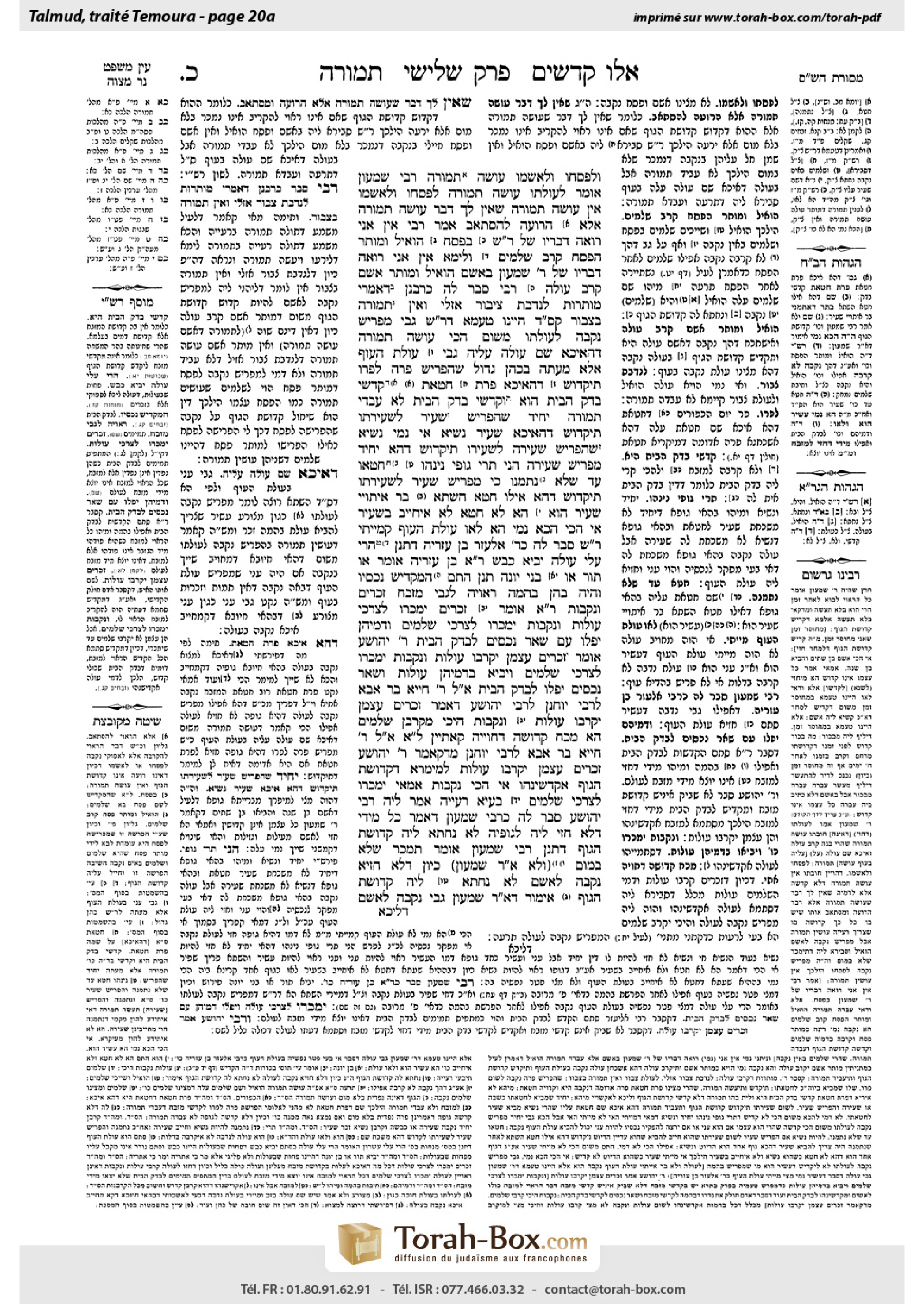
Temurah 20a: Talmud study for Daf Yomi
Daf Yomi is the daily study of one Talmud folio. Explore 37 tractates with scans, Hebrew text, Sefaria English and AI-generated French translations where annotated.
Passage selection and English or AI-generated French translation are available where the scan has annotations. Daf Study is independent of Torah-Box and Sefaria.
Browse Temurah · תמורה · All tractatesTemurah 20a text and translations
This page of Temurah includes the Aramaic text, an English translation and an AI-generated French translation, alongside the scan above.
תמורה כ׳ א · Aramaic and Hebrew text
וּלְפִסְחוֹ וְלַאֲשָׁמוֹ — עוֹשָׂה תְּמוּרָה.
רַבִּי שִׁמְעוֹן אוֹמֵר: לְעוֹלָתוֹ — עוֹשָׂה תְּמוּרָה, לְפִסְחוֹ וְלַאֲשָׁמוֹ — אֵין עוֹשָׂה תְּמוּרָה.
שֶׁאֵין לְךָ דָּבָר עוֹשֶׂה תְּמוּרָה, אֶלָּא הָרוֹעֶה לְהִסְתָּאֵב.
אָמַר רַבִּי: אֵין אֲנִי רוֹאֶה דְּבָרָיו שֶׁל רַבִּי שִׁמְעוֹן בַּפֶּסַח, הוֹאִיל וּמוֹתַר הַפֶּסַח קָרֵב שְׁלָמִים.
וְלֵימָא: אֵין אֲנִי רוֹאֶה דְּבָרָיו שֶׁל רַבִּי שִׁמְעוֹן בְּאָשָׁם, הוֹאִיל וּמוֹתַר אָשָׁם קָרֵב עוֹלָה! רַבִּי סָבַר לַהּ כְּרַבָּנַן, דְּאָמְרִי: מוֹתָרוֹת לְנִדְבַת צִיבּוּר אָזְלִי, וְאֵין תְּמוּרָה בְּצִבּוּר.
קָא סָלְקָא דַעְתָּךְ, הַיְינוּ טַעְמָא דְּרַבִּי שִׁמְעוֹן גַּבֵּי מַפְרִישׁ נְקֵבָה לְעוֹלָתוֹ, מִשּׁוּם הָכִי עוֹשָׂה תְּמוּרָה, דְּהָאִיכָּא שֵׁם עוֹלֶה עָלֶיהָ גַּבֵּי עוֹלַת הָעוֹף.
אֶלָּא מֵעַתָּה, בְּכֹהֵן גָּדוֹל שֶׁהִפְרִישׁ פָּרָה לְפָרוֹ — תִּיקְדּוֹשׁ, דְּהָאִיכָּא פָּרַת חַטָּאת! קׇדְשֵׁי בֶּדֶק הַבַּיִת הוּא, וְקׇדְשֵׁי בֶּדֶק הַבַּיִת לָא עָבְדִי תְּמוּרָה.
יָחִיד שֶׁהִפְרִישׁ שָׂעִיר לִשְׂעִירָתוֹ — תִּיקְדּוֹשׁ, דְּהָאִיכָּא שְׂעִיר נָשִׂיא! אִי נָמֵי, נָשִׂיא שֶׁהִפְרִישׁ שְׂעִירָה לִשְׂעִירוֹ — תִּיקְדּוֹשׁ, דְּהָא יָחִיד מַפְרִישׁ שְׂעִירָה!
הָנֵי תְּרֵי גּוּפֵי נִינְהוּ.
חָטְאוּ עַד שֶׁלֹּא נִתְמַנּוּ, כִּי מַפְרֵישׁ שָׂעִיר לִשְׂעִירָתוֹ — תִּיקְדּוֹשׁ, דְּהָא אִילּוּ חָטָא הַשְׁתָּא — בַּר אֵיתוֹיֵי שָׂעִיר הוּא! הָא לָא חָטָא — לָא אִיחַיַּיב בְּשָׂעִיר.
אִי הָכִי, הָכָא נָמֵי, הָא לָאו עוֹלַת הָעוֹף קָמַיְיתֵי!
רַבִּי שִׁמְעוֹן סָבַר לַהּ כְּרַבִּי אֶלְעָזָר בֶּן עֲזַרְיָה, דִּתְנַן: ״הֲרֵי עָלַי עוֹלָה״ — יָבִיא כֶּבֶשׂ. רַבִּי אֶלְעָזָר בֶּן עֲזַרְיָה אוֹמֵר: אוֹ תּוֹר אוֹ בְּנֵי יוֹנָה.
תְּנַן הָתָם: הַמַּקְדִּישׁ נְכָסָיו, וְהָיָה בָּהֶן בְּהֵמָה רְאוּיָה לְגַבֵּי מִזְבֵּחַ, זְכָרִים וּנְקֵבוֹת.
רַבִּי אֱלִיעֶזֶר אוֹמֵר: זְכָרִים יִמָּכְרוּ לְצׇרְכֵי עוֹלוֹת, וּנְקֵבוֹת יִמָּכְרוּ לְצׇרְכֵי שְׁלָמִים, וּדְמֵיהֶן יִפְּלוּ עִם שְׁאָר נְכָסִים לְבֶדֶק הַבַּיִת.
רַבִּי יְהוֹשֻׁעַ אוֹמֵר: זְכָרִים עַצְמָן יִקְרְבוּ עוֹלוֹת, וּנְקֵבוֹת יִמָּכְרוּ לְצׇרְכֵי שְׁלָמִים, וְיָבִיא בִּדְמֵיהֶן עוֹלוֹת, וּשְׁאָר נְכָסִים יִפְּלוּ לְבֶדֶק הַבַּיִת.
אֲמַר לֵיהּ רַבִּי חִיָּיא בַּר אַבָּא לְרַבִּי יוֹחָנָן: לְרַבִּי יְהוֹשֻׁעַ דְּאָמַר זְכָרִים עַצְמָן יִקְרְבוּ עוֹלוֹת, וּנְקֵבוֹת הֵיכִי (מקרבן) [קָרְבָן] שְׁלָמִים? הָא מִכֹּחַ קְדוּשָּׁה דְּחוּיָּיה קָאָתְיָין!
לִישָּׁנָא אַחְרִינָא, אֲמַר לֵיהּ רַבִּי חִיָּיא בַּר אַבָּא לְרַבִּי יוֹחָנָן: מִדְּקָאָמַר רַבִּי יְהוֹשֻׁעַ זְכָרִים עַצְמָן יִקְרְבוּ עוֹלוֹת, לְמֵימְרָא דִּקְדוּשַּׁת הַגּוּף אַקְדְּשִׁינְהוּ? אִי הָכִי, נְקֵבוֹת אַמַּאי יִמָּכְרוּ לְצׇרְכֵי שְׁלָמִים? בָּעֲיָא רְעִיָּיה!
אֲמַר לֵיהּ רַבִּי יְהוֹשֻׁעַ סָבַר לַהּ כְּרַבִּי שִׁמְעוֹן, דְּאָמַר: כֹּל מִידֵּי דְּלָא חֲזֵי לֵיהּ לְגוּפֵיהּ — לָא נָחֲתָא לֵיהּ קְדוּשַּׁת הַגּוּף. דִּתְנַן, רַבִּי שִׁמְעוֹן אוֹמֵר: תִּמָּכֵר שֶׁלֹּא בְּמוּם, וְאָמְרִינַן דְּטַעְמָא דְּרַבִּי שִׁמְעוֹן — כֵּיוָן דְּלָא חַזְיָא נְקֵבָה לְאָשָׁם, לָא נָחֲתָא לֵיהּ קְדוּשַּׁת הַגּוּף.
אֵימוֹר דְּאָמַר רַבִּי שִׁמְעוֹן גַּבֵּי נְקֵבָה לְאָשָׁם,
Temurah 20a · English translation
or for his Paschal offering or for his guilt offering, although these offerings are brought only from male animals, it is still consecrated with inherent sanctity. Therefore, if one exchanges for it a non-sacred animal, he renders that animal a substitute, which is consecrated with the same sanctity as the original animal.
Rabbi Shimon disagrees with the Sages and says: The halakha is not the same in all these cases. Granted, if he consecrates a female animal for his burnt offering, it renders the non-sacred animal that is exchanged for it a substitute, as there is burnt offering status for female birds. For this reason it is consecrated with inherent sanctity and can be sold only after it has become blemished. But if he consecrates a female animal for his Paschal offering or for his guilt offering it is not consecrated with inherent sanctity, and it may be sold even without a blemish. Therefore, it does not render the non-sacred animal that is exchanged for it a substitute.
This ruling is based upon the principle that no animal renders the non-sacred animal that is exchanged for it a substitute except for an animal that has inherent sanctity, which means that even if it may not be sacrificed, it must still be left to graze in order to become blemished, after which it is sold, and the proceeds from the sale are used to purchase a fit offering.
Rabbi Yehuda HaNasi says, with regard to this dispute between Rabbi Shimon and the first tanna: I do not agree with the statement of Rabbi Shimon with regard to the Paschal offering, that a non-sacred animal exchanged for a female which was designated for a Paschal offering does not become consecrated as a substitute. I disagree, since a leftover Paschal offering is sacrificed after Passover as a peace offering, and a peace offering is brought even from female animals. Therefore, a female animal that was designated for a Paschal offering should be consecrated with inherent sanctity, as there is peace offering status for female animals. It should not be sold unless it has a blemish, and it should render a non-sacred animal that is exchanged for it a substitute.
The Gemara clarifies the opinion of Rabbi Yehuda HaNasi: And let him also say: I do not agree with the statement of Rabbi Shimon with regard to a guilt offering, for the same reason that Rabbi Yehuda HaNasi disagrees with regard to the Paschal offering, since a leftover guilt offering is sacrificed as a burnt offering, and a bird burnt offering is brought even from female animals. Therefore, a female animal designated as a guilt offering should be consecrated with inherent sanctity, and it should render a non-sacred animal that is exchanged for it a substitute. The Gemara explains: Rabbi Yehuda HaNasi holds in accordance with the opinion of the Rabbis, who say: Leftover guilt offerings are used for communal gift offerings, i.e., they are sold and the money is used to purchase communal gift offerings, and a substitute cannot be designated for a communal offering.
§ The Gemara analyzes the opinion of Rabbi Shimon in the baraita: It might enter your mind to say that this is the reason for the ruling of Rabbi Shimon with regard to one who designates a female animal for his burnt offering: One renders a non-sacred animal that is exchanged for it a substitute due to that reason, that it has burnt offering status because of the case of a bird burnt offering, which may be brought as a female.
But if that is so, in the case of a High Priest who designated a female cow instead of his male bull that he is obligated to bring as a sin offering on Yom Kippur, it should be sanctified with regard to rendering a non-sacred animal that is exchanged for it a substitute. Here too, the status of a sin offering is upon it, as the red heifer of purification is similar to a sin offering and is female. The Gemara answers: The red heifer is not consecrated with inherent sanctity, as it is not sacrificed upon the altar; rather, it is consecrated for Temple maintenance, and items consecrated for Temple maintenance do not render a non-sacred animal that is exchanged for them a substitute.
The Gemara objects: According to Rabbi Shimon, if an individual, who is obligated to bring a female animal as a sin offering, designated a male goat instead of his female goat, it should be sanctified with inherent sanctity with regard to rendering a substitute, as it has sin offering status, due to the case of the male goat brought as a sin offering by the king. Alternatively, if a king, who is obligated to bring a male animal as a sin offering, designated a female goat instead of his male goat, it should be sanctified with inherent sanctity with regard to rendering a substitute, since here too it has sin offering status, as an individual designates a female goat as a sin offering. Therefore, Rabbi Shimon should have stated that these animals render non-sacred animals exchanged for them consecrated as substitutes.
The Gemara explains: Neither a female goat brought as a sin offering by a king nor a male goat brought as a sin offering by an individual are considered to have sin offering status. The reason is that these, the king and an individual, are two distinct bodies, and the status of an offering can be conferred only when such an offering is brought by people of the same status.
The Gemara objects: If so, then in a case where an individual sinned and is obligated to bring a female goat as a sin offering prior to being appointed as king, and he did not designate an animal as his offering before his appointment, if he designates a male goat instead of his female goat following his appointment, it should be sanctified with inherent sanctity with regard to substitution. In this situation, it should have sin offering status, as, if he sinned now, he is obligated to bring a male goat. The Gemara explains: This is not correct, as he did not sin when he was a king, and therefore was not actually obligated to bring a male goat, but a female goat.
The Gemara asks: If so, that the individual’s appointment as king does not give sin offering status to the male goat designated as a sin offering for a sin committed prior to his appointment, here too, one should say that a female animal designated for a burnt offering does not have burnt offering status, as the person is not a poor leper, and therefore he does not bring a bird burnt offering. Why, then, does Rabbi Shimon maintain that such an animal renders a non-sacred animal that is exchanged for it a substitute?
The Gemara explains: The baraita is not referring to an obligatory burnt offering but rather to a voluntary burnt offering, and Rabbi Shimon holds in accordance with the opinion of Rabbi Elazar ben Azarya, who says that anyone, even a wealthy man, can bring a bird if he vows to bring a burnt offering. As we learned in a mishna (Menaḥot 107a) that one who says: It is incumbent upon me to bring a burnt offering, without specifying which animal, brings a lamb, which is the smallest animal that a wealthy man can bring as a burnt offering. Rabbi Elazar ben Azarya says: He may even bring a dove or pigeons as a bird burnt offering.
§ The Gemara continues to discuss Rabbi Shimon’s opinion in the baraita: We learned in a mishna elsewhere (Shekalim 4:7): In the case of one who consecrates all his possessions without specifying for what purpose, and among them there is an animal that is suitable to be sacrificed on the altar, or multiple such animals that are males and females, what should be done with them?
Rabbi Eliezer says: Since he did not specify otherwise, everything is consecrated for Temple maintenance. Therefore, any males should be sold for the needs of burnt offerings, i.e., to individuals who will sacrifice them as burnt offerings. And any females, as they cannot be brought as burnt offerings, should be sold for the needs of peace offerings, i.e., to individuals who will sacrifice them as such. And their monetary value that is received from their sale is allocated with the rest of his property for Temple maintenance.
Rabbi Yehoshua says: Although he did not specify for what purpose he consecrated his possessions, it may be assumed that he intended the animals to be consecrated as burnt offerings. Therefore, any males should themselves be sacrificed as burnt offerings, and any females, since they cannot be brought as burnt offerings, should be sold for the needs of peace offerings, i.e., to individuals who will sacrifice them as such, and their monetary value that is received from their sale should be used to purchase and bring burnt offerings. And according to both opinions, the rest of the property, which is not suitable for sacrificial use, is allocated for Temple maintenance.
Rabbi Ḥiyya bar Abba said to Rabbi Yoḥanan: According to the opinion of Rabbi Yehoshua, who said that any males should themselves be sacrificed as burnt offerings, as that was the intention of the one who consecrated them, how can the buyers sacrifice the females as peace offerings? He explains the difficulty: Their status stems from deferred sanctity, as they were consecrated to be burnt offerings, and a female that was designated as a burnt offering is not sacrificed upon the altar, but instead is left to graze until it becomes blemished and is then sold.
The Gemara cites another version of this statement: Rabbi Ḥiyya bar Abba said to Rabbi Yoḥanan: From the fact that Rabbi Yehoshua said that any males should themselves be sacrificed as burnt offerings, is this to say that he consecrated them with inherent sanctity? If so, why are the females sold for the needs of peace offerings? Since they were consecrated as burnt offerings, it is required that they be left to graze until they become blemished.
Rabbi Yoḥanan said to Rabbi Ḥiyya bar Abba: Rabbi Yehoshua holds in accordance with the opinion of Rabbi Shimon, who said with regard to anything that is not fit to be sacrificed itself upon the altar that inherent sanctity does not descend upon it. As we learned in the mishna that Rabbi Shimon says: If one designated a female for a guilt offering, for which one must bring a male, it may be sold without a blemish, and a guilt offering is purchased with the money received for its sale. And we say that the reason of Rabbi Shimon is that as a female animal is not fit to be sacrificed as a guilt offering, inherent sanctity does not descend upon it.
Rabbi Ḥiyya bar Abba objected to Rabbi Yoḥanan: You can say that Rabbi Shimon expressed his opinion specifically with regard to one who consecrates a female for a guilt offering,
Temurah 20a · Traduction française (IA)
ou pour son sacrifice pascal ou son sacrifice de culpabilité : bien que ces sacrifices ne soient offerts qu’à partir d’animaux mâles, l’animal est néanmoins consacré d’une sainteté intrinsèque. Par conséquent, si l’on échange contre lui un animal non consacré, celui-ci devient un substitut, consacré de la même sainteté que l’animal initial.
Rabbi Shimon est en désaccord avec les Sages et dit : La halakha n’est pas la même dans tous ces cas. Certes, s’il consacre une femelle pour son holocauste, celle-ci fait de l’animal non consacré échangé contre elle un substitut, car il existe des holocaustes d’oiseaux femelles. C’est pourquoi elle est consacrée d’une sainteté intrinsèque et ne peut être vendue qu’après avoir été atteinte d’un défaut. Mais s’il consacre une femelle pour son sacrifice pascal ou son sacrifice de culpabilité, elle n’est pas consacrée d’une sainteté intrinsèque et peut être vendue même sans défaut. Elle ne fait donc pas de l’animal non consacré échangé contre elle un substitut.
Cette décision repose sur le principe qu’aucun animal ne fait de l’animal non consacré échangé contre lui un substitut, si ce n’est un animal doté d’une sainteté intrinsèque. Cela signifie que, même s’il ne peut pas être sacrifié, il doit néanmoins être laissé au pâturage jusqu’à ce qu’il soit atteint d’un défaut. Il est alors vendu, et le produit de la vente sert à acheter un sacrifice apte à être offert.
Rabbi Yehuda HaNasi dit, au sujet de ce désaccord entre Rabbi Shimon et le premier tanna : Je ne suis pas d’accord avec Rabbi Shimon au sujet du sacrifice pascal, lorsqu’il affirme qu’un animal non consacré échangé contre une femelle désignée pour un sacrifice pascal n’est pas consacré comme substitut. Je ne suis pas d’accord, car un sacrifice pascal restant est offert après Pessa’h comme sacrifice de paix, et un sacrifice de paix peut également être offert à partir d’animaux femelles. Par conséquent, une femelle désignée pour un sacrifice pascal devrait être consacrée d’une sainteté intrinsèque, puisqu’il existe des sacrifices de paix provenant d’animaux femelles. Elle ne devrait être vendue qu’après avoir été atteinte d’un défaut et devrait faire de l’animal non consacré échangé contre elle un substitut.
La Guemara précise l’opinion de Rabbi Yehuda HaNasi : Qu’il dise aussi : Je ne suis pas d’accord avec Rabbi Shimon au sujet d’un sacrifice de culpabilité, pour la même raison que Rabbi Yehuda HaNasi est en désaccord au sujet du sacrifice pascal, puisque le sacrifice de culpabilité restant est offert comme holocauste, et qu’un holocauste d’oiseau peut également être offert à partir d’animaux femelles. Par conséquent, une femelle désignée comme sacrifice de culpabilité devrait être consacrée d’une sainteté intrinsèque et faire de l’animal non consacré échangé contre elle un substitut. La Guemara explique : Rabbi Yehuda HaNasi suit l’opinion des Rabbins, qui disent que les sacrifices de culpabilité restants sont affectés à des offrandes volontaires collectives, c’est-à-dire qu’ils sont vendus et que l’argent sert à acheter des offrandes volontaires collectives ; or, on ne peut pas désigner de substitut pour une offrande collective.
§ La Guemara examine l’opinion de Rabbi Shimon dans la baraïta : On pourrait penser que voici la raison de la décision de Rabbi Shimon au sujet de celui qui désigne une femelle pour son holocauste : l’animal non consacré échangé contre elle devient un substitut parce qu’elle a le statut d’holocauste en raison du cas de l’holocauste d’oiseau, qui peut être offert sous la forme d’une femelle.
Mais, si tel est le cas, lorsqu’un grand prêtre désigne une vache femelle à la place du taureau mâle qu’il est tenu d’apporter comme sacrifice expiatoire à Yom Kippour, celle-ci devrait être consacrée de façon à faire de l’animal non consacré échangé contre elle un substitut. Ici aussi, elle a le statut de sacrifice expiatoire, puisque la vache rousse de purification est semblable à un sacrifice expiatoire et qu’elle est femelle. La Guemara répond : La vache rousse n’est pas consacrée d’une sainteté intrinsèque, car elle n’est pas sacrifiée sur l’autel ; elle est plutôt consacrée à l’entretien du Temple, et les objets consacrés à l’entretien du Temple ne font pas de l’animal non consacré échangé contre eux un substitut.
La Guemara objecte : Selon Rabbi Shimon, si un particulier, tenu d’apporter une femelle comme sacrifice expiatoire, désigne un bouc mâle à la place de sa chèvre femelle, celui-ci devrait être consacré d’une sainteté intrinsèque et rendre un animal substitué sacré, puisqu’il a le statut de sacrifice expiatoire en raison du cas du bouc mâle apporté comme sacrifice expiatoire par le roi. Ou bien, si un roi, tenu d’apporter un animal mâle comme sacrifice expiatoire, désigne une chèvre femelle à la place de son bouc mâle, celle-ci devrait être consacrée d’une sainteté intrinsèque et rendre un animal substitué sacré, puisqu’ici aussi elle a le statut de sacrifice expiatoire, car un particulier désigne une chèvre femelle comme sacrifice expiatoire. Rabbi Shimon aurait donc dû dire que ces animaux rendent sacrés les animaux non consacrés échangés contre eux.
La Guemara explique : Ni la chèvre femelle apportée comme sacrifice expiatoire par un roi ni le bouc mâle apporté comme sacrifice expiatoire par un particulier ne sont considérés comme ayant le statut de sacrifice expiatoire. La raison en est que le roi et le particulier sont deux entités distinctes, et le statut d’un sacrifice ne peut être conféré que lorsqu’un tel sacrifice est apporté par des personnes de même statut.
La Guemara objecte : Si tel est le cas, lorsqu’un particulier a commis une faute et est tenu d’apporter une chèvre femelle comme sacrifice expiatoire avant d’être nommé roi, et qu’il n’a désigné aucun animal comme sacrifice avant sa nomination, s’il désigne un bouc mâle à la place de sa chèvre femelle après sa nomination, celui-ci devrait être consacré d’une sainteté intrinsèque en vue de la substitution. Dans cette situation, il devrait avoir le statut de sacrifice expiatoire, car, s’il commettait maintenant une faute, il serait tenu d’apporter un bouc mâle. La Guemara explique : Ce raisonnement est erroné, car il n’a pas commis de faute alors qu’il était roi et n’était donc pas effectivement tenu d’apporter un bouc mâle, mais une chèvre femelle.
La Guemara demande : Si tel est le cas, puisque la nomination du particulier comme roi ne confère pas le statut de sacrifice expiatoire au bouc mâle désigné comme sacrifice expiatoire pour une faute commise avant sa nomination, il faudrait aussi dire qu’une femelle désignée pour un holocauste n’a pas le statut d’holocauste, puisque la personne n’est pas un lépreux pauvre et n’apporte donc pas d’holocauste d’oiseau. Pourquoi Rabbi Shimon soutient-il alors qu’un tel animal fait de l’animal non consacré échangé contre lui un substitut ?
La Guemara explique : La baraïta ne parle pas d’un holocauste obligatoire, mais d’un holocauste volontaire, et Rabbi Shimon suit l’opinion de Rabbi Elazar ben Azarya, qui dit que chacun, même un homme riche, peut apporter un oiseau s’il fait vœu d’apporter un holocauste. Car nous avons appris dans une Michna (Menaḥot 107a) que celui qui dit : « Je m’engage à apporter un holocauste », sans préciser de quel animal il s’agit, apporte un agneau, le plus petit animal qu’un homme riche puisse apporter comme holocauste. Rabbi Elazar ben Azarya dit : Il peut même apporter une tourterelle ou des pigeons comme holocauste d’oiseaux.
§ La Guemara poursuit l’examen de l’opinion de Rabbi Shimon dans la baraïta : Nous avons appris dans une Michna ailleurs (Shekalim 4:7) : Dans le cas de celui qui consacre tous ses biens sans en préciser la destination, et parmi lesquels se trouve un animal apte à être sacrifié sur l’autel, ou plusieurs animaux de ce type, mâles et femelles, que faut-il en faire ?
Rabbi Eliezer dit : Puisqu’il n’a rien précisé d’autre, tout est consacré à l’entretien du Temple. Par conséquent, les mâles sont vendus pour les besoins des holocaustes, c’est-à-dire à des particuliers qui les offriront comme holocaustes. Quant aux femelles, puisqu’elles ne peuvent pas être offertes comme holocaustes, elles sont vendues pour les besoins des sacrifices de paix, c’est-à-dire à des particuliers qui les offriront ainsi. La valeur obtenue de leur vente est affectée, avec le reste de ses biens, à l’entretien du Temple.
Rabbi Yehoshua dit : Bien qu’il n’ait pas précisé à quelle fin il consacrait ses biens, on peut supposer qu’il avait l’intention de consacrer les animaux comme holocaustes. Par conséquent, les mâles doivent eux-mêmes être offerts comme holocaustes. Quant aux femelles, puisqu’elles ne peuvent pas être offertes comme holocaustes, elles sont vendues pour les besoins des sacrifices de paix, c’est-à-dire à des particuliers qui les offriront ainsi, et la valeur obtenue de leur vente sert à acheter et à offrir des holocaustes. Selon les deux opinions, le reste des biens, qui ne convient pas à un usage sacrificiel, est affecté à l’entretien du Temple.
Rabbi Ḥiyya bar Abba dit à Rabbi Yoḥanan : Selon l’opinion de Rabbi Yehoshua, qui dit que les mâles doivent eux-mêmes être offerts comme holocaustes, puisque telle était l’intention de celui qui les a consacrés, comment les acheteurs peuvent-ils offrir les femelles comme sacrifices de paix ? Il explique la difficulté : Leur statut découle d’une sainteté différée, puisqu’elles ont été consacrées comme holocaustes ; or une femelle désignée comme holocauste n’est pas sacrifiée sur l’autel, mais est laissée au pâturage jusqu’à ce qu’elle soit atteinte d’un défaut, puis vendue.
La Guemara rapporte une autre version de cette déclaration : Rabbi Ḥiyya bar Abba dit à Rabbi Yoḥanan : Du fait que Rabbi Yehoshua dit que les mâles doivent eux-mêmes être offerts comme holocaustes, faut-il en conclure qu’il les a consacrés d’une sainteté intrinsèque ? Dans ce cas, pourquoi les femelles sont-elles vendues pour les besoins des sacrifices de paix ? Puisqu’elles ont été consacrées comme holocaustes, elles doivent être laissées au pâturage jusqu’à ce qu’elles soient atteintes d’un défaut.
Rabbi Yoḥanan dit à Rabbi Ḥiyya bar Abba : Rabbi Yehoshua suit l’opinion de Rabbi Shimon, qui dit que tout ce qui ne peut pas être sacrifié sur l’autel n’acquiert pas de sainteté intrinsèque. Car nous avons appris dans la Michna que Rabbi Shimon dit : Si quelqu’un désigne une femelle pour un sacrifice de culpabilité, pour lequel il faut apporter un mâle, elle peut être vendue sans défaut, et un sacrifice de culpabilité est acheté avec le produit de sa vente. Nous disons que, selon Rabbi Shimon, la raison en est qu’une femelle n’étant pas apte à être sacrifiée comme sacrifice de culpabilité, elle n’acquiert pas de sainteté intrinsèque.
Rabbi Ḥiyya bar Abba objecta à Rabbi Yoḥanan : On peut dire que Rabbi Shimon a exprimé son opinion précisément au sujet de celui qui consacre une femelle pour un sacrifice de culpabilité,
Traduction française générée par IA à partir de l’édition anglaise de Sefaria. Vérifie toujours un passage avec le texte source.
Text from Sefaria: William Davidson Edition - Vocalized Aramaic (CC BY NC); William Davidson Edition - English (CC BY NC).