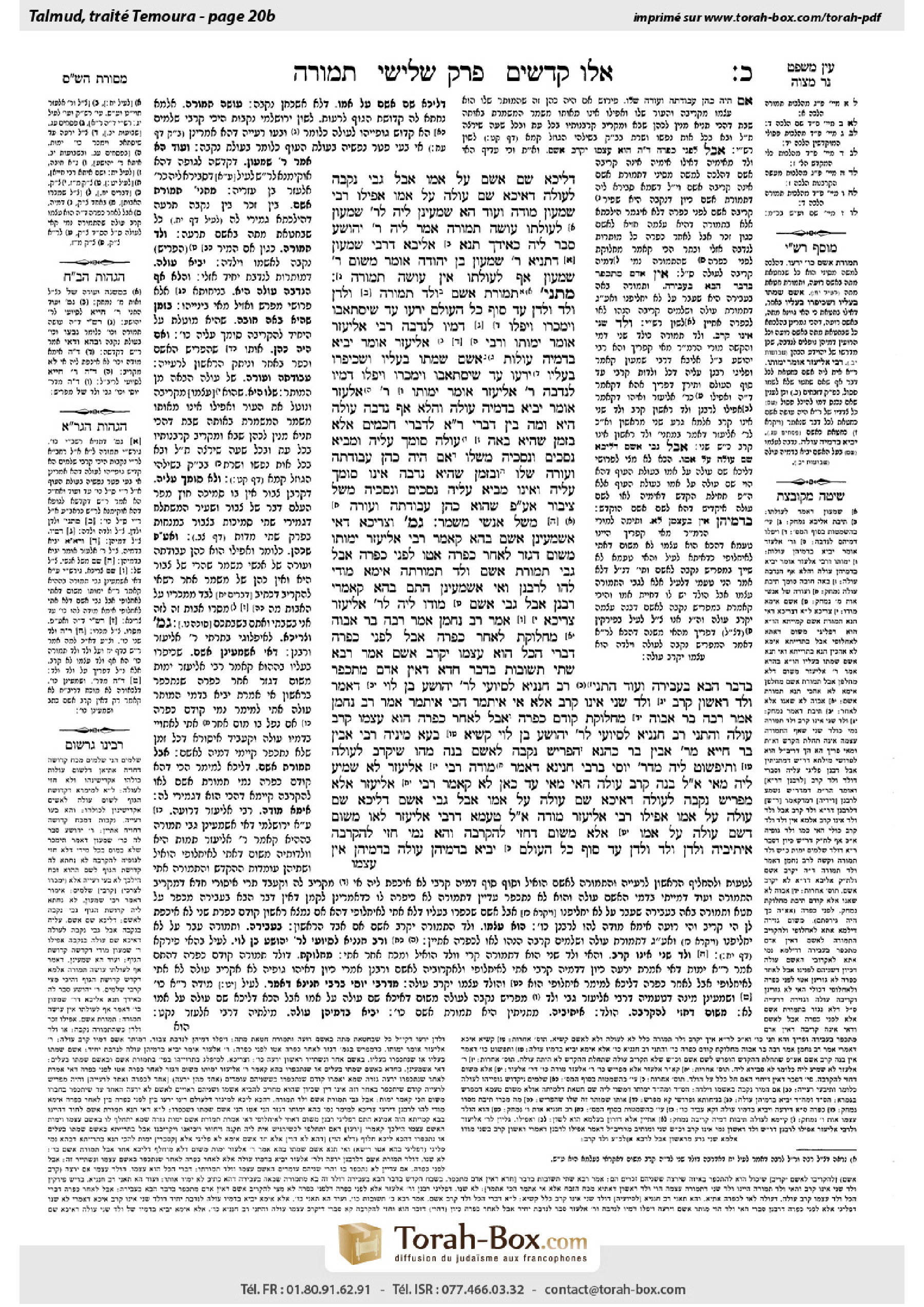
Temurah 20b: Talmud study for Daf Yomi
Daf Yomi is the daily study of one Talmud folio. Explore 37 tractates with scans, Hebrew text, Sefaria English and AI-generated French translations where annotated.
Passage selection and English or AI-generated French translation are available where the scan has annotations. Daf Study is independent of Torah-Box and Sefaria.
Browse Temurah · תמורה · All tractatesTemurah 20b text and translations
This page of Temurah includes the Aramaic text, an English translation and an AI-generated French translation, alongside the scan above.
תמורה כ׳ ב · Aramaic and Hebrew text
דְּלֵיכָּא שֵׁם אָשָׁם עַל אִמּוֹ, אֲבָל גַּבֵּי נְקֵבָה לְעוֹלָה דְּאִיכָּא שֵׁם עוֹלָה עַל אִמּוֹ — אֲפִילּוּ רַבִּי שִׁמְעוֹן מוֹדֶה!
וְעוֹד, הָא שָׁמְעִינַן לֵיהּ לְרַבִּי שִׁמְעוֹן: לְעוֹלָתוֹ עוֹשֶׂה תְּמוּרָה!
אֲמַר לֵיהּ רַבִּי יְהוֹשֻׁעַ סָבַר לֵיהּ כְּאִידַּךְ תַּנָּא אַלִּיבָּא דְּרַבִּי שִׁמְעוֹן, דְּתַנְיָא: רַבִּי שִׁמְעוֹן בֶּן יְהוּדָה אוֹמֵר מִשּׁוּם רַבִּי שִׁמְעוֹן: אַף לְעוֹלָתוֹ אֵין עוֹשֶׂה תְּמוּרָה.
מַתְנִי׳ תְּמוּרַת אָשָׁם, וְלַד תְּמוּרָה, וְלָדָן וְלַד וְלָדָן עַד סוֹף כׇּל הָעוֹלָם — יִרְעוּ עַד שֶׁיִּסְתָּאֲבוּ, וְיִמָּכְרוּ, וְיִפְּלוּ (דָּמָיו) [דְּמֵיהֶן] לִנְדָבָה. רַבִּי אֱלִיעֶזֶר אוֹמֵר: יָמוּתוּ. וְרַבִּי אֶלְעָזָר אוֹמֵר: יָבִיא בִּדְמֵיהּ עוֹלוֹת.
אָשָׁם שֶׁמֵּתוּ בְּעָלָיו, וְשֶׁכִּיפְּרוּ בְּעָלָיו — יִרְעוּ עַד שֶׁיִּסְתָּאֲבוּ, וְיִמָּכְרוּ, וְיִפְּלוּ דָּמָיו לִנְדָבָה. רַבִּי אֱלִיעֶזֶר אוֹמֵר: יָמוּתוּ. רַבִּי אֶלְעָזָר אוֹמֵר: יָבִיא בְּדָמֶיהָ עוֹלָה.
וַהֲלֹא אַף נְדָבָה עוֹלָה הִיא, וּמָה בֵּין דִּבְרֵי רַבִּי אֶלְעָזָר לְדִבְרֵי חֲכָמִים? אֶלָּא, בִּזְמַן שֶׁהִיא בָּאָה עוֹלָה — סוֹמֵךְ עָלֶיהָ, וּמֵבִיא נְסָכִים, וּנְסָכֶיהָ מִשֶּׁלּוֹ. אִם הָיָה כֹּהֵן — עֲבוֹדָתָהּ וְעוֹרָהּ שֶׁלּוֹ.
וּבִזְמַן שֶׁהִיא נְדָבָה — אֵינוֹ סוֹמֵךְ עָלֶיהָ, וְאֵינוֹ מֵבִיא עָלֶיהָ נְסָכִים, וּנְסָכֶיהָ מִשֶּׁל צִיבּוּר, אַף עַל פִּי שֶׁהוּא כֹּהֵן — עֲבוֹדָתָהּ וְעוֹרָהּ מִשֶּׁל אַנְשֵׁי מִשְׁמָר.
גְּמָ׳ וּצְרִיכָא:
דְּאִי אַשְׁמְעִינַן אָשָׁם, בְּהָא קָאָמַר רַבִּי אֱלִיעֶזֶר יָמוּתוּ, מִשּׁוּם דְּגָזַר לְאַחַר כַּפָּרָה אַטּוּ לִפְנֵי כַּפָּרָה.
אֲבָל גַּבֵּי תְּמוּרַת אָשָׁם, וְלַד תְּמוּרָתָהּ, אֵימָא מוֹדֵי לְהוּ לְרַבָּנַן.
וְאִי אַשְׁמְעִינַן הָתָם, בְּהָא קָאָמְרִי רַבָּנַן, אֲבָל גַּבֵּי אָשָׁם מוֹדוּ לֵיהּ לְרַבִּי אֱלִיעֶזֶר — צְרִיכָא.
אָמַר רַב נַחְמָן, אָמַר רַבָּה בַּר אֲבוּהּ: מַחְלוֹקֶת לְאַחַר כַּפָּרָה, אֲבָל לִפְנֵי כַּפָּרָה — דִּבְרֵי הַכֹּל הוּא עַצְמוֹ יִקְרַב אָשָׁם.
אָמַר רָבָא: שְׁתֵּי תְּשׁוּבוֹת בַּדָּבָר, חֲדָא דְּאֵין אָדָם מִתְכַּפֵּר בְּדָבָר הַבָּא בַּעֲבֵירָה, וְעוֹד, הָתָנֵי רַב חֲנַנְיָא לְסַיּוֹעֵי לְרַבִּי יְהוֹשֻׁעַ בֶּן לֵוִי דְּאָמַר וָלָד רִאשׁוֹן קָרֵב, וְלַד שֵׁנִי אֵינוֹ קָרֵב!
אֶלָּא, אִי אִיתְּמַר, הָכִי אִיתְּמַר: אָמַר רַב נַחְמָן, אָמַר רַבָּה בַּר אֲבוּהּ: מַחְלוֹקֶת קוֹדֶם כַּפָּרָה, אֲבָל לְאַחַר כַּפָּרָה — הוּא עַצְמוֹ קָרֵב עוֹלָה.
וְהָתָנֵי רַב חֲנַנְיָא לְסַיּוֹעֵי לְרַבִּי יְהוֹשֻׁעַ בֶּן לֵוִי! קַשְׁיָא.
בְּעָא מִינֵּיהּ רַבִּי אָבִין בַּר חִיָּיא מֵרַבִּי אָבִין בַּר כָּהֲנָא: הִפְרִישׁ נְקֵבָה לְאָשָׁם, בְּנָהּ מַהוּ שֶׁיִּקְרַב לְעוֹלָה? וְתִיפְשׁוֹט לֵיהּ מִדְּרַבִּי יוֹסֵי בְּרַבִּי חֲנִינָא, דְּאָמַר: מוֹדֶה רַבִּי אֶלְעָזָר. לָא שְׁמִיעַ לֵיהּ.
מַאי אֲמַר לֵיהּ: בְּנָהּ קָרֵב עוֹלָה. הַאי מַאי? עַד כַּאן לָא קָאָמַר רַבִּי אֶלְעָזָר אֶלָּא מַפְרִישׁ נְקֵבָה לְעוֹלָה, דְּאִיכָּא שֵׁם עוֹלָה עַל אִמּוֹ, אֲבָל גַּבֵּי אָשָׁם דְּלֵיכָּא שֵׁם עוֹלָה עַל אִמּוֹ — אֲפִילּוּ רַבִּי אֱלִיעֶזֶר מוֹדֶה!
אֲמַר לֵיהּ: טַעְמָא דְּרַבִּי אֶלְעָזָר, לָאו מִשּׁוּם דְּשֵׁם עוֹלֶה עַל אִמּוֹ, אֶלָּא מִשּׁוּם דַּחֲזֵי לְהַקְרָבָה, וְהָא נָמֵי חֲזֵי לְהַקְרָבָה.
אֵיתִיבֵיהּ: וְלָדָן וְלַד וְלָדָן עַד סוֹף כׇּל הָעוֹלָם יָבִיא בִּדְמֵיהֶן עוֹלָה — בִּדְמֵיהֶן — אִין,
Temurah 20b · English translation
where there is no guilt offering status for an animal that is the same sex as its mother, as a female guilt offering is never brought. But with regard to one who designates a female animal as a burnt offering, where there is burnt offering status for a bird that is the same sex as its mother, even Rabbi Shimon concedes that it has inherent sanctity, and therefore it should not be sold for the needs of a peace offering.
In addition, another objection can be raised against the explanation of Rabbi Yoḥanan, as we have heard that Rabbi Shimon maintains that one who designates a female animal as a burnt offering renders a non-sacred animal that is exchanged for it a substitute. This indicates that it does have inherent sanctity with regard to this issue. Therefore, the question remains: How can the buyers sacrifice the females as peace offerings, when their status stems from deferred sanctity?
Rabbi Yoḥanan said to Rabbi Ḥiyya bar Abba in response: I meant that Rabbi Yehoshua holds in accordance with the interpretation of the other tanna with regard to the opinion of Rabbi Shimon. As it is taught in a baraita that Rabbi Shimon ben Yehuda says in the name of Rabbi Shimon: Even one who consecrates a female as his burnt offering does not render a non-sacred animal that is exchanged for it a substitute. Even though there is burnt offering status for female birds, a female animal consecrated as a burnt offering does not have inherent sanctity. Therefore, it is sold and sacrificed as a peace offering, and its status is not considered to stem from deferred sanctity.
MISHNA: With regard to the substitute of a guilt offering, the offspring of that substitute, their offspring and the offspring of their offspring, until the end of all time, they are all left to graze until they become unfit, and then they are sold, and the money received for the sale is allocated for communal gift offerings. Rabbi Eliezer says: These animals are not left to graze; rather they are left to die. And Rabbi Elazar says: Communal gift offerings are not purchased with the money from the sale; rather, the owner should bring an individual burnt offering with the money received for its sale.
These tanna’im similarly disagree about the following case: A guilt offering whose owner died, and a guilt offering that was lost and its owner gained atonement with another animal, graze until they become unfit, and then they are sold, and the money received for the sale is allocated for communal gift offerings. Rabbi Eliezer says: These animals are left to die. Rabbi Elazar says: The owner must bring an individual burnt offering with the money received for its sale.
The mishna objects: But even according to the Rabbis, isn’t a gift offering also a burnt offering? And what then is the difference between the statement of Rabbi Elazar and the statement of the Rabbis? Rather, the Rabbis are referring to a communal burnt offering and Rabbi Elazar is referring to an individual burnt offering, and there are several differences between these two offerings: When the animal comes as an individual burnt offering, the owner places his hands upon it and brings the accompanying meal offering and libations, and its libations come from his own property. If the owner of the animal was a priest, the right to perform its Temple service and the right to its hide are his.
And when it is a communal gift offering, the owner of the animal that was sold does not place his hands upon it, as there is no placing of hands for communal offerings, and he does not bring its libations; rather, its libations are brought from the property of the community. Furthermore, although the owner of the animal that was sold is a priest, the right to perform its Temple service and the right to its hide are divided among the members of the priestly watch serving in the Temple that week.
GEMARA: The mishna teaches that Rabbi Eliezer and the Sages disagreed about two cases, the substitute of a guilt offering and the halakha of a guilt offering whose owner died. The Gemara explains that both disputes are necessary.
As, had the tanna taught us the dispute only in the case of the guilt offering where the owner achieved atonement through another animal, I might have said that perhaps it is in this case alone that Rabbi Eliezer says that the animals are left to die. This would be because he holds that there is a rabbinic decree concerning what to do with a guilt offering following the owner having achieved atonement, due to the case of a guilt offering before the owner achieved atonement. If burnt offerings were brought with the money from the sale in a case where the owner already achieved atonement by means of another offering, people might mistakenly say that if a guilt offering was lost and another was designated in its place, there too the other animal is sold and burnt offerings are brought from the proceeds. In fact, in that case, as atonement has not yet been achieved, that money must actually be used for a guilt offering.
But with regard to the substitute of a guilt offering and the offspring of its substitute, which in any case are sent to graze, even if the owner did not achieve atonement with another animal, one might say that Rabbi Eliezer concedes to the Rabbis, as there is no need for such a decree.
And had the tanna taught us the dispute only there, in the case of the substitute of a guilt offering and the offspring of the substitute, I might have said that perhaps it is only in this case that the Rabbis say the animals are sent to graze, as there is no reason for a decree. But with regard to the case of a guilt offering where the owners achieved atonement, one might say that they concede to Rabbi Eliezer that the animals are left to die, as a decree. Therefore, both cases are necessary.
§ Rav Naḥman says that Rabba bar Avuh says: This dispute between Rabbi Eliezer and the Rabbis with regard to the offspring of a substitute applies only after atonement has been achieved, i.e., after the guilt offering has been sacrificed. But before atonement is achieved, and the consecrated animal and the substitute are both present, everyone agrees that even the offspring itself is sacrificed as a guilt offering, if the owner wishes.
Rava said: There are two refutations of this statement: One is that a person cannot achieve atonement through an item that comes from a transgression, and this offspring comes from a transgression, as its mother offspring was rendered a substitute, which is prohibited. And in addition, didn’t Rav Ḥananya teach a baraita in support of the opinion of Rabbi Yehoshua ben Levi, who said that only the first offspring of a peace offering is sacrificed, but the second offspring, i.e., the offspring of the offspring, is not sacrificed? Here too, the offspring of a substitute is considered like the second offspring, as it is two stages removed from the original offering.
Rather, if it was stated, it was stated like this: Rav Naḥman says that Rabba bar Avuh says: The dispute between Rabbi Eliezer and the Rabbis with regard to the offspring of a substitute applies only before atonement has been achieved,as Rabbi Eliezer holds that it is left to die, due to a concern that it might be sacrificed as a guilt offering, whereas the Rabbis say that it is left to graze, as there is no concern that it will be brought as a guilt offering. But after the original guilt offering is sacrificed and atonement has been achieved, everyone agrees that even the offspring itself is sacrificed as a burnt offering, as there is no further concern that it might be sacrificed as a guilt offering.
The Gemara asks: But didn’t Rav Ḥananya teach a baraita in support of Rabbi Yehoshua ben Levi that the second offspring is not sacrificed? How, then, can the offspring of the substitute be sacrificed, as it too should be treated like the second offspring? The Gemara concedes: That is difficult.
§ Rabbi Avin bar Ḥiyya inquired of Rabbi Avin bar Kahana: If one designated a female animal as a guilt offering and it gave birth to a male, what is the halakha with regard to whether its offspring is sacrificed as a burnt offering? The Gemara questions the necessity of this inquiry: And let him resolve the inquiry from the statement of Rabbi Yosei, son of Rabbi Ḥanina, who said that Rabbi Elazar concedes that if one designates a female animal as a guilt offering, the offspring is not sacrificed as a guilt offering, as there is no guilt offering status for animals that are the same sex as the mother, and likewise it is not sacrificed as a burnt offering, as the mother was designated as a guilt offering. The Gemara answers: Rabbi Avin bar Ḥiyya never heard that statement of Rabbi Yosei bar Ḥanina.
The Gemara returns to the inquiry of Rabbi Avin bar Ḥiyya: What is the halakha? Rabbi Avin bar Kahana said to Rabbi Avin bar Ḥiyya: Its offspring is sacrificed as a burnt offering. Rabbi Avin bar Ḥiyya challenges his response: What is this? Rabbi Elazar says in the mishna (18b) that the offspring itself is offered as a burnt offering only when he designates a female animal as a burnt offering and then it gives birth to a male, due to the fact that there is burnt offering status for a bird that is the same sex as its mother. But with regard to a female animal that was designated as a guilt offering and subsequently gave birth to a male, where there is no guilt offering status for animals that are the same sex as its mother, even Rabbi Eliezer concedes that its offspring is not sacrificed at all.
Rabbi Avin bar Kahana said to him in response: The reason for the statement of Rabbi Elazar, that the offspring of a female animal designated as a burnt offering is sacrificed as a burnt offering, is not because there is burnt offering status for an animal that is the same sex as its mother, but rather because it is fit to be sacrificed upon the altar, and this offspring of the female animal designated as a guilt offering is also fit to be sacrificed.
Rabbi Avin bar Ḥiyya raised an objection to Rabbi Avin bar Kahana from the mishna: Rabbi Elazar says that in the case of the offspring of a female animal that was designated as a guilt offering or the offspring of the substitute of a guilt offering, and the offspring of their offspring until the end of all time, they graze until they become blemished, and then they are sold, and the owner brings an individual burnt offering with the money received for their sale. The Gemara infers: With the money received for their sale, yes, he brings a burnt offering,
Temurah 20b · Traduction française (IA)
là où un animal du même sexe que sa mère ne peut avoir le statut de sacrifice de culpabilité, puisqu’on n’offre jamais de sacrifice de culpabilité femelle. Mais lorsqu’une personne désigne une femelle comme holocauste, puisqu’un oiseau femelle peut avoir le statut d’holocauste, même Rabbi Shimon reconnaît qu’elle possède une sainteté intrinsèque et qu’elle ne doit donc pas être vendue pour financer un sacrifice de paix.
En outre, une autre objection peut être soulevée contre l’explication de Rabbi Yoḥanan : nous avons appris que, selon Rabbi Shimon, celui qui désigne une femelle comme holocauste rend substitut l’animal profane échangé contre elle. Cela indique qu’elle possède bien une sainteté intrinsèque à cet égard. La question demeure donc : comment les acheteurs peuvent-ils offrir les femelles comme sacrifices de paix, alors que leur statut découle d’une sainteté différée ?
Rabbi Yoḥanan répondit à Rabbi Ḥiyya bar Abba : Je voulais dire que Rabbi Yehoshua suit l’interprétation de l’autre tanna quant à l’opinion de Rabbi Shimon. En effet, une baraïta enseigne que Rabbi Shimon ben Yehuda dit au nom de Rabbi Shimon : Même celui qui consacre une femelle comme holocauste ne rend pas substitut l’animal profane échangé contre elle. Bien que les oiseaux femelles puissent avoir le statut d’holocauste, une femelle consacrée comme holocauste ne possède pas de sainteté intrinsèque. Elle est donc vendue et offerte comme sacrifice de paix, et son statut n’est pas considéré comme découlant d’une sainteté différée.
MICHNA : Le substitut d’un sacrifice de culpabilité, la progéniture de ce substitut, leur progéniture et la progéniture de celle-ci, jusqu’à la fin des temps, sont tous laissés au pâturage jusqu’à ce qu’ils deviennent impropres ; ils sont alors vendus, et le produit de la vente est affecté à des offrandes volontaires communautaires. Rabbi Eliezer dit : Ces animaux ne sont pas laissés au pâturage ; ils sont plutôt laissés à mourir. Rabbi Elazar dit : On n’achète pas d’offrandes volontaires communautaires avec le produit de la vente ; le propriétaire doit plutôt apporter un holocauste individuel avec l’argent obtenu de la vente.
Ces tannaïm sont également en désaccord dans le cas suivant : un sacrifice de culpabilité dont le propriétaire est mort, et un sacrifice de culpabilité qui a été perdu et pour lequel son propriétaire a obtenu l’expiation au moyen d’un autre animal, sont laissés au pâturage jusqu’à ce qu’ils deviennent impropres ; ils sont alors vendus, et le produit de la vente est affecté à des offrandes volontaires communautaires. Rabbi Eliezer dit : Ces animaux sont laissés à mourir. Rabbi Elazar dit : Le propriétaire doit apporter un holocauste individuel avec le produit de leur vente.
La Michna objecte : Mais même selon les Sages, une offrande volontaire n’est-elle pas aussi un holocauste ? Quelle est donc la différence entre l’avis de Rabbi Elazar et celui des Sages ? Il faut plutôt dire que les Sages parlent d’un holocauste communautaire, tandis que Rabbi Elazar parle d’un holocauste individuel ; or ces deux offrandes diffèrent à plusieurs égards. Lorsque l’animal est apporté comme holocauste individuel, le propriétaire pose les mains sur lui et apporte l’offrande de farine et les libations qui l’accompagnent ; les libations sont financées par ses biens personnels. Si le propriétaire de l’animal est un prêtre, le droit d’effectuer le service au Temple et celui de recevoir la peau lui reviennent.
En revanche, lorsqu’il s’agit d’une offrande volontaire communautaire, le propriétaire de l’animal vendu ne pose pas les mains sur l’animal, car on ne pose pas les mains sur les offrandes communautaires, et il n’apporte pas ses libations ; celles-ci sont plutôt financées par les biens de la communauté. De plus, même si le propriétaire de l’animal vendu est un prêtre, le droit d’effectuer le service au Temple et celui de recevoir la peau sont répartis entre les membres de la garde sacerdotale qui officie au Temple cette semaine-là.
GUEMARA : La Michna enseigne que Rabbi Eliezer et les Sages sont en désaccord dans deux cas : le substitut d’un sacrifice de culpabilité et la halakha d’un sacrifice de culpabilité dont le propriétaire est mort. La Guemara explique que ces deux controverses sont nécessaires.
En effet, si le tanna ne nous avait enseigné leur désaccord que dans le cas du sacrifice de culpabilité dont le propriétaire a obtenu l’expiation au moyen d’un autre animal, j’aurais pu dire que Rabbi Eliezer ne soutient peut-être que dans ce cas que les animaux sont laissés à mourir. Ce serait parce qu’il estime qu’un décret rabbinique s’applique au sort d’un sacrifice de culpabilité après que son propriétaire a obtenu l’expiation, en raison du cas d’un sacrifice de culpabilité avant que son propriétaire n’ait obtenu l’expiation. Si l’on apportait des holocaustes avec le produit de la vente lorsque le propriétaire a déjà obtenu l’expiation au moyen d’une autre offrande, les gens pourraient croire que, si un sacrifice de culpabilité a été perdu et qu’un autre a été désigné à sa place, ce second animal est lui aussi vendu et que des holocaustes sont apportés avec le produit de la vente. En réalité, dans ce cas, puisque l’expiation n’a pas encore été obtenue, cet argent doit effectivement servir à un sacrifice de culpabilité.
Mais, dans le cas du substitut d’un sacrifice de culpabilité et de la progéniture de son substitut, qui sont de toute façon laissés au pâturage, même si le propriétaire n’a pas obtenu l’expiation au moyen d’un autre animal, on pourrait dire que Rabbi Eliezer se rallie à l’avis des Sages, puisqu’un tel décret n’est pas nécessaire.
Et si le tanna ne nous avait enseigné leur désaccord que dans ce cas, celui du substitut d’un sacrifice de culpabilité et de la progéniture de ce substitut, j’aurais pu dire que les Sages ne prescrivent peut-être de laisser les animaux au pâturage que dans ce cas, puisqu’il n’y a aucune raison d’édicter un décret. Mais, dans le cas d’un sacrifice de culpabilité dont les propriétaires ont obtenu l’expiation, on pourrait dire qu’ils se rallient à l’avis de Rabbi Eliezer et que les animaux sont laissés à mourir en vertu d’un décret. Les deux cas sont donc nécessaires.
§ Rav Naḥman dit au nom de Rabba bar Avuh : La controverse entre Rabbi Eliezer et les Sages concernant la progéniture d’un substitut ne s’applique qu’après que l’expiation a été obtenue, c’est-à-dire après que le sacrifice de culpabilité a été offert. Mais avant que l’expiation soit obtenue, lorsque l’animal consacré et son substitut sont tous deux présents, tous conviennent que même la progéniture elle-même peut être offerte comme sacrifice de culpabilité, si le propriétaire le souhaite.
Rava dit : Cette déclaration peut être réfutée de deux façons. Premièrement, une personne ne peut pas obtenir l’expiation par un élément issu d’une transgression ; or cette progéniture est issue d’une transgression, puisque sa mère a été transformée en substitut, ce qui est interdit. En outre, Rav Ḥananya n’a-t-il pas enseigné une baraïta à l’appui de l’opinion de Rabbi Yehoshua ben Levi, selon laquelle seule la première progéniture d’un sacrifice de paix est offerte, tandis que la deuxième, c’est-à-dire la progéniture de la progéniture, ne l’est pas ? Ici aussi, la progéniture d’un substitut est considérée comme une deuxième progéniture, puisqu’elle se trouve à deux degrés de l’offrande initiale.
Il faut plutôt dire que, si cette déclaration a été rapportée, elle l’a été ainsi : Rav Naḥman dit au nom de Rabba bar Avuh : La controverse entre Rabbi Eliezer et les Sages concernant la progéniture d’un substitut ne s’applique qu’avant que l’expiation soit obtenue. Rabbi Eliezer estime qu’elle est laissée à mourir, par crainte qu’elle ne soit offerte comme sacrifice de culpabilité, tandis que les Sages disent qu’elle est laissée au pâturage, car ils ne craignent pas qu’elle soit offerte comme sacrifice de culpabilité. Mais après que le sacrifice de culpabilité initial a été offert et que l’expiation a été obtenue, tous conviennent que même la progéniture elle-même est offerte comme holocauste, puisqu’il n’y a plus lieu de craindre qu’elle soit offerte comme sacrifice de culpabilité.
La Guemara demande : Mais Rav Ḥananya n’a-t-il pas enseigné une baraïta à l’appui de Rabbi Yehoshua ben Levi, selon laquelle la deuxième progéniture n’est pas offerte ? Comment, dès lors, la progéniture du substitut peut-elle être offerte, puisqu’elle aussi devrait être traitée comme une deuxième progéniture ? La Guemara reconnaît que la difficulté demeure.
§ Rabbi Avin bar Ḥiyya demanda à Rabbi Avin bar Kahana : Si quelqu’un désigne une femelle comme sacrifice de culpabilité et qu’elle donne naissance à un mâle, quelle est la halakha quant à l’offrande de sa progéniture comme holocauste ? La Guemara s’interroge sur la nécessité de cette question : Ne peut-il pas la résoudre à partir de la déclaration de Rabbi Yosei, fils de Rabbi Ḥanina, qui dit que Rabbi Elazar reconnaît que, si quelqu’un désigne une femelle comme sacrifice de culpabilité, sa progéniture n’est pas offerte comme sacrifice de culpabilité, puisqu’un animal du même sexe que sa mère n’a pas le statut de sacrifice de culpabilité ; et qu’elle n’est pas non plus offerte comme holocauste, puisque sa mère a été désignée comme sacrifice de culpabilité ? La Guemara répond : Rabbi Avin bar Ḥiyya n’avait jamais entendu cette déclaration de Rabbi Yosei bar Ḥanina.
La Guemara revient à la question de Rabbi Avin bar Ḥiyya : Quelle est la halakha ? Rabbi Avin bar Kahana lui répondit : Sa progéniture est offerte comme holocauste. Rabbi Avin bar Ḥiyya conteste sa réponse : Qu’est-ce à dire ? Dans la Michna (18b), Rabbi Elazar dit que la progéniture elle-même n’est offerte comme holocauste que lorsqu’une personne désigne une femelle comme holocauste et qu’elle donne ensuite naissance à un mâle, parce qu’un oiseau femelle peut avoir le statut d’holocauste. Mais, dans le cas d’une femelle désignée comme sacrifice de culpabilité qui donne ensuite naissance à un mâle, puisqu’un animal du même sexe que sa mère n’a pas le statut de sacrifice de culpabilité, même Rabbi Eliezer reconnaît que sa progéniture n’est pas offerte du tout.
Rabbi Avin bar Kahana lui répondit : Si Rabbi Elazar dit que la progéniture d’une femelle désignée comme holocauste est offerte comme holocauste, ce n’est pas parce qu’un animal du même sexe que sa mère peut avoir le statut d’holocauste, mais parce qu’elle est apte à être offerte sur l’autel. Or la progéniture de cette femelle désignée comme sacrifice de culpabilité est, elle aussi, apte à être offerte.
Rabbi Avin bar Ḥiyya souleva contre Rabbi Avin bar Kahana une objection tirée de la Michna : Rabbi Elazar dit que, dans le cas de la progéniture d’une femelle désignée comme sacrifice de culpabilité, ou de la progéniture du substitut d’un sacrifice de culpabilité, ainsi que de leur progéniture jusqu’à la fin des temps, ces animaux sont laissés au pâturage jusqu’à ce qu’ils deviennent atteints d’un défaut ; ils sont alors vendus, et le propriétaire apporte un holocauste individuel avec le produit de leur vente. La Guemara en déduit : avec le produit de leur vente, oui, il apporte un holocauste.
Traduction française générée par IA à partir de l’édition anglaise de Sefaria. Vérifie toujours un passage avec le texte source.
Text from Sefaria: William Davidson Edition - Vocalized Aramaic (CC BY NC); William Davidson Edition - English (CC BY NC).