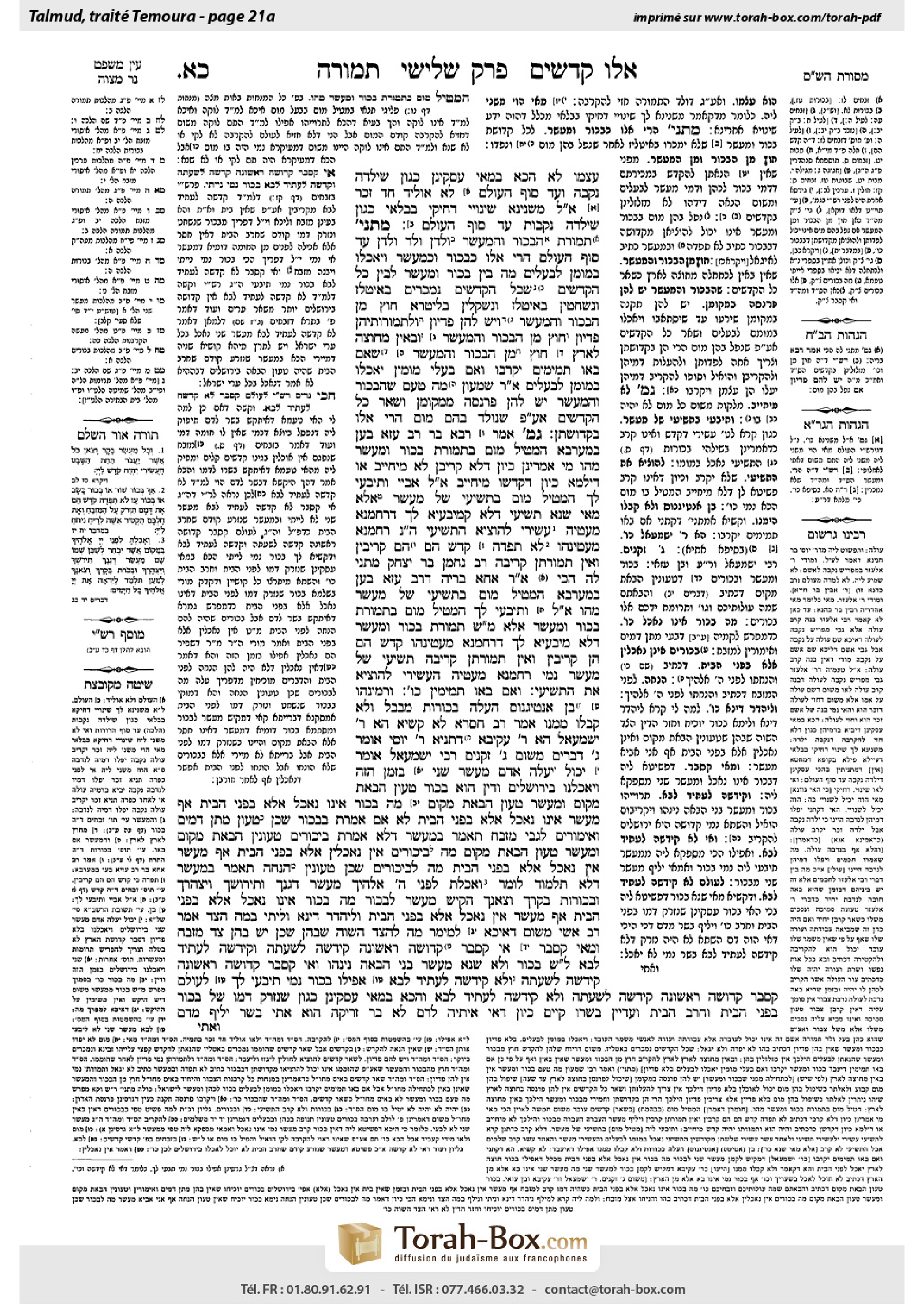
Temurah 21a: Talmud study for Daf Yomi
Daf Yomi is the daily study of one Talmud folio. Explore 37 tractates with scans, Hebrew text, Sefaria English and AI-generated French translations where annotated.
Passage selection and English or AI-generated French translation are available where the scan has annotations. Daf Study is independent of Torah-Box and Sefaria.
Browse Temurah · תמורה · All tractatesTemurah 21a text and translations
This page of Temurah includes the Aramaic text, an English translation and an AI-generated French translation, alongside the scan above.
תמורה כ״א א · Aramaic and Hebrew text
עַצְמוֹ — לֹא! הָכָא בְמַאי עָסְקִינַן? כְּגוֹן שֶׁיָּלְדָה נְקֵבָה, וְעַד סוֹף הָעוֹלָם לֹא אוֹלִיד חַד זָכָר?! אֲמַר לֵיהּ: מְשַׁנֵּינָא [לָךְ] שִׁינּוּיֵי דְּחִיקִי בַּבְלָאֵי, כְּגוֹן שֶׁיָּלְדָה נְקֵבוֹת עַד סוֹף הָעוֹלָם.
מַתְנִי׳ תְּמוּרַת הַבְּכוֹר וְהַמַּעֲשֵׂר, וְלָדָן וְלַד וְלָדָן עַד סוֹף הָעוֹלָם — הֲרֵי אֵלּוּ כִּבְכוֹר וּכְמַעֲשֵׂר, וְיֵאָכְלוּ בְּמוּמָן לַבְּעָלִים.
מָה בֵּין בְּכוֹר וּמַעֲשֵׂר לְבֵין כׇּל הַקֳּדָשִׁים? שֶׁכׇּל הַקֳּדָשִׁים נִמְכָּרִים בָּאִיטְלֵז, וְנִשְׁחָטִין בָּאִיטְלֵז, וְנִשְׁקָלִין בְּלִיטְרָא, חוּץ מִן הַבְּכוֹר וְהַמַּעֲשֵׂר.
וְיֵשׁ לָהֶן פִּדְיוֹן, וְלִתְמוּרוֹתֵיהֶן פִּדְיוֹן, חוּץ מִן הַבְּכוֹר וְהַמַּעֲשֵׂר. וּבָאִין מֵחוּצָה לָאָרֶץ, חוּץ מִן הַבְּכוֹר וְהַמַּעֲשֵׂר, שֶׁאִם בָּאוּ תְּמִימִים — יִקְרְבוּ, וְאִם בַּעֲלֵי מוּמִין — יֵאָכְלוּ בְּמוּמָן לַבְּעָלִים.
אָמַר רַבִּי שִׁמְעוֹן: מָה טַעַם שֶׁהַבְּכוֹר וְהַמַּעֲשֵׂר יֵשׁ לָהֶן פַּרְנָסָה מִמְּקוֹמָן, וּשְׁאָר כׇּל הַקֳּדָשִׁים, אַף עַל פִּי שֶׁנּוֹלַד בָּהֶם מוּם — הֲרֵי אֵלּוּ בִּקְדוּשָּׁתָן.
גְּמָ׳ אָמַר רָבָא בַּר רַב עַזָּא: בָּעַן בְּמַעְרְבָא — הַמֵּטִיל מוּם בִּתְמוּרַת בְּכוֹר וּמַעֲשֵׂר מַהוּ? מִי אָמְרִינַן: כֵּיוָן דְּלָא קְרִיבָן — לָא מִיחַיַּיב, אוֹ דִילְמָא: כֵּיוָן דְּקָדְשׁוּ — מִיחַיַּיב?
אֲמַר לֵיהּ אַבָּיֵי: וְתִיבְּעֵי לָךְ הַמֵּטִיל מוּם בִּתְשִׁיעִי שֶׁל מַעֲשֵׂר!
אֶלָּא מַאי שְׁנָא תְּשִׁיעִי, דְּלָא קָמִיבַּעְיָא לָךְ? דְּרַחֲמָנָא מַעֲטֵיהּ, ״עֲשִׂירִי״ — לְהוֹצִיא הַתְּשִׁיעִי.
הָכִי נָמֵי, רַחֲמָנָא מַעֲטִינְהוּ, ״לֹא תִפְדֶּה קֹדֶשׁ הֵם״ — הֵם קְרֵיבִין, וְאֵין תְּמוּרָתָן קְרֵיבָה.
רַב נַחְמָן בַּר יִצְחָק מַתְנֵי לַהּ הָכִי: אָמַר רַב אַחָא בְּרֵיהּ דְּרַב עַזָּא, בָּעַן בְּמַעְרְבָא: הַמֵּטִיל מוּם בִּתְשִׁיעִי שֶׁל מַעֲשֵׂר מַהוּ? אֲמַר לֵיהּ: וְתִיבְּעֵי לָךְ הַמֵּטִיל מוּם בִּתְמוּרַת בְּכוֹר וּמַעֲשֵׂר!
אֶלָּא מַאי שְׁנָא תְּמוּרַת בְּכוֹר וּמַעֲשֵׂר דְּלָא מִיבַּעְיָא לָךְ? דְּרַחֲמָנָא מַעֲטִינְהוּ, ״קֹדֶשׁ הֵם״ — הֵן קְרֵיבִין וְאֵין תְּמוּרָתָן קְרֵיבָה. תְּשִׁיעִי שֶׁל מַעֲשֵׂר נָמֵי רַחֲמָנָא מַעֲטֵיהּ, ״הָעֲשִׂירִי״ — לְהוֹצִיא אֶת הַתְּשִׁיעִי.
וְאִם בָּאוּ תְּמִימִין כּוּ׳. וּרְמִינְהוּ: בֶּן אַנְטִיגְנוֹס הֶעֱלָה בְּכוֹרוֹת מִבָּבֶל וְלֹא קִבְּלוּ מִמֶּנּוּ! אָמַר רַב חִסְדָּא: לָא קַשְׁיָא, הָא — רַבִּי יִשְׁמָעֵאל, הָא — רַבִּי עֲקִיבָא.
דְּתַנְיָא: רַבִּי יוֹסֵי אוֹמֵר שְׁלֹשָׁה דְּבָרִים מִשּׁוּם שְׁלֹשָׁה זְקֵנִים, רַבִּי יִשְׁמָעֵאל אוֹמֵר: יָכוֹל יַעֲלֶה אָדָם מַעֲשֵׂר שֵׁנִי בִּזְמַן הַזֶּה וְיֹאכְלֶנּוּ בִּירוּשָׁלַיִם?
וְדִין הוּא: בְּכוֹר טָעוּן הֲבָאַת מָקוֹם, וּמַעֲשֵׂר טָעוּן הֲבָאַת מָקוֹם. מָה בְּכוֹר אֵינוֹ נֶאֱכָל אֶלָּא בִּפְנֵי הַבַּיִת, אַף מַעֲשֵׂר אֵינוֹ נֶאֱכָל אֶלָּא בִּפְנֵי הַבַּיִת. לֹא, אִם אָמַרְתָּ בִּבְכוֹר — שֶׁכֵּן טָעוּן מַתַּן דָּמִים וְאֵימוּרִים לְגַבֵּי מִזְבֵּחַ, תֹּאמַר בְּמַעֲשֵׂר דְּלָא?!
אָמַרְתָּ: בִּיכּוּרִים טְעוּנִין הֲבָאַת מָקוֹם, וּמַעֲשֵׂר טָעוּן הֲבָאַת מָקוֹם. מָה בִּיכּוּרִים אֵין נֶאֱכָלִין אֶלָּא בִּפְנֵי הַבַּיִת, אַף מַעֲשֵׂר אֵין נֶאֱכָל אֶלָּא בִּפְנֵי הַבַּיִת.
מָה לְבִיכּוּרִים, שֶׁכֵּן טְעוּנִין הַנָּחָה, תֹּאמַר בְּמַעֲשֵׂר דְּלָא?!
תַּלְמוּד לוֹמַר: ״וְאָכַלְתָּ לִפְנֵי ה׳ אֱלֹהֶיךָ... מַעְשַׂר דְּגָנְךָ וְתִירוֹשְׁךָ וְיִצְהָרֶךָ וּבְכוֹרוֹת בְּקָרְךָ וְצֹאנֶךָ״, הִקִּישׁ מַעֲשֵׂר לִבְכוֹר: מָה בְּכוֹר אֵינוֹ נֶאֱכָל אֶלָּא בִּפְנֵי הַבַּיִת, אַף מַעֲשֵׂר אֵין נֶאֱכָל אֶלָּא בִּפְנֵי הַבַּיִת.
וְלֶיהְדַּר דִּינָא, וְלֵיתֵי בְּ״מָה הַצַּד״!
אָמַר רַב אָשֵׁי: מִשּׁוּם דְּאִיכָּא לְמֵימַר, מָה לְהַצַּד הַשָּׁוֶה שֶׁבָּהֶן, שֶׁכֵּן יֵשׁ בָּהֶן צַד מִזְבֵּחַ.
וּמַאי קָסָבַר? אִי קָסָבַר קְדוּשָּׁה רִאשׁוֹנָה קִידְּשָׁה לִשְׁעָתָהּ וְקִידְּשָׁה לֶעָתִיד לָבֹא, לָא שְׁנָא בְּכוֹר וְלָא שְׁנָא מַעֲשֵׂר בְּנֵי הֲבָאָה נִינְהוּ. וְאִי קָסָבַר קְדוּשָּׁה רִאשׁוֹנָה קִידְּשָׁה לִשְׁעָתָהּ וְלֹא קִידְּשָׁה לֶעָתִיד לָבֹא, אֲפִילּוּ בְּכוֹר נָמֵי תִּיבְּעֵי לָךְ!
לְעוֹלָם קָסָבַר, קְדוּשָּׁה רִאשׁוֹנָה קִידְּשָׁה לִשְׁעָתָהּ וְלֹא קִידְּשָׁה לֶעָתִיד לָבֹא, וְהָכָא בְּמַאי עָסְקִינַן — כְּגוֹן שֶׁנִּזְרַק דָּמוֹ שֶׁל בְּכוֹר בִּפְנֵי הַבַּיִת, וְחָרַב הַבַּיִת, וַעֲדַיִין בְּשָׂרוֹ קַיָּים.
כֵּיוָן דְּאִי אִיתֵיהּ לְדָם (לא) [לָאו] בַּר זְרִיקָה הוּא, אָתֵי בָּשָׂר יָלֵיף מִדָּם,
Temurah 21a · English translation
but the offspring itself is not sacrificed as a burnt offering. Rabbi Avin bar Kahana responds: What are we dealing with here? It is a case where the female designated as a guilt offering or as the substitute of a guilt offering gave birth to a female, which cannot itself be offered as a guilt offering. Rabbi Avin bar Ḥiyya asks: This is problematic, as the mishna states that the same is true with regard to the offspring of its offspring until the end of time. But could the mishna be referring to a case where until the end of time not even one male was born? Rabbi Avin bar Kahana said to him in response: I answer forced answers, in the manner of the Babylonians, and say that the mishna is referring to a case where it gave birth to females, and those females also gave birth to females, until the end of time.
MISHNA: With regard to the substitute of a firstborn offering and the substitute of an animal tithe offering, and the offspring of those substitutes and the offspring of their offspring until the end of time, the halakhic status of these animals is like that of a firstborn offering and like that of an animal tithe offering in that they must be treated with sanctity: They graze until they become blemished, and at that point they may be eaten in their blemished state, the substitute of the firstborn by the priests and the substitute of the animal tithe by their owners. They are not sacrificed upon the altar like the original firstborn and animal tithe offerings.
What is the practical difference between a firstborn offering and an animal tithe offering and all the other sacrificial animals? The difference is that all the other sacrificial animals that were blemished and redeemed are sold in the butchers’ market [ba’itliz], and slaughtered in the butchers’ market, and weighed and sold by the litra, in the manner that non-sacred meat is slaughtered and sold. This is the case with regard to all consecrated animals except for the firstborn and animal tithe offerings, which are sold only from the home and not by the litra.
And in addition, all sacrificial animals that became blemished are subject to redemption through sale, at which point the money becomes sacred and the animal becomes non-sacred, and their substitutes are also subject to redemption through sale.This is true for all consecrated animals, except for the firstborn and animal tithe offerings, which are not subject to redemption. And all sacrificial animals come to be sacrificed in the Temple even from outside of Eretz Yisrael, except for the firstborn and animal tithe offerings, which should not be brought from outside Eretz Yisrael ab initio. But if they came unblemished, they are sacrificed in the Temple like a regular firstborn or animal tithe offering coming from Eretz Yisrael; and if they are blemished animals, they may be eaten in their blemished state, the firstborns by the priests and the animal tithes by their owners.
Rabbi Shimon says: What is the reason for this last difference between them? It is that the firstborn and animal tithe offerings have a remedy in their place outside Eretz Yisrael, as they can graze until they become blemished and then can be eaten there. It is not necessary to bring them to Eretz Yisrael in order to eat them. But with regard to all other sacrificial animals, even if a blemish develops in them, these animals remain in their sanctity, and one must redeem them and bring another offering with the money of their redemption. Therefore, when they are unblemished it is proper to bring these animals themselves to Eretz Yisrael.
GEMARA: With regard to the status of the substitute of firstborn and animal tithe offerings that was discussed in the mishna, Rava bar Rav Azza said that they inquired in the West, Eretz Yisrael: What is the halakha with regard to one who inflicts a blemish on the substitute of a firstborn offering or on the substitute of an animal tithe offering? Do we say that since they are not sacrificed on the altar like the actual firstborn or animal tithe offering, one who does this is not liable, as the prohibition against inflicting a blemish on a sacrificial animal applies only when one thereby disqualifies the animal from the altar, and that is not the case here; or perhaps since they are sanctified, he is liable for inflicting a blemish?
Abaye said to Rava bar Rav Azza: And let the dilemma be raised in a case of one who inflicts a blemish on other sacrificial animals, such as the ninth animal counted while selecting the animal tithe offering, which was mistakenly declared to be the tenth. This animal is consecrated in that one is prohibited to work it or shear it until it becomes blemished, but it may not be sacrificed upon the altar.
Rather, what is different about the ninth animal, which one called the tenth, that you did not raise the dilemma about it? It is because the Merciful One excluded it, with the verse: “The tenth shall be holy to the Lord” (Leviticus 27:32), which serves to exclude from the altar the ninth that was mistakenly declared to be the tenth. One may derive from here that one who inflicts a blemish upon this ninth animal is not liable.
Here, too, with regard to the substitute of a firstborn, the Merciful One excluded it from the altar: “But the firstborn…you shall not redeem; they are holy” (Numbers 18:17). This indicates that they, the firstborns themselves, are sacrificed, but their substitute is not sacrificed, and it may be derived from here that one is also not liable for inflicting a blemish upon the substitute of a firstborn.
Rav Naḥman bar Yitzḥak teaches that statement in this way, in the opposite manner to the previous version: Rav Aḥa, son of Rav Azza, said that they inquired in the West, Eretz Yisrael: In the case of one who inflicts a blemish upon the ninth animal counted while selecting the animal tithe offering, what is the halakha? Abaye said to him: And let the dilemma be raised with regard to one who inflicts a blemish upon the substitute of a firstborn offering or the substitute of an animal tithe offering.
Rather, what is different about the substitute of a firstborn or the substitute of an animal tithe that you did not raise the dilemma about them? It is because the Merciful One excluded them, as it is stated: “They are holy,” which indicates that they themselves are sacrificed, but their substitutes are not sacrificed. With regard to the ninth animal counted while selecting the animal tithe as well, the Merciful One excluded it, as it is stated: “The tenth,” which serves to exclude from the altar the ninth that was mistakenly declared to be the tenth.
§ The mishna teaches that although the firstborn and animal tithe offerings should not be brought from outside Eretz Yisrael ab initio, if they came unblemished, they may be sacrificed. With regard to this issue, the Gemara raises a contradiction: There was an incident where ben Antigonus brought up firstborn animals from Babylonia in order to sacrifice them and they did not accept them in the Temple. Rav Ḥisda said: That is not difficult: This statement in the mishna is in accordance with the opinion of Rabbi Yishmael, while this case of ben Antigonus is in accordance with the opinion of Rabbi Akiva.
As it is taught in a baraita that Rabbi Akiva and Rabbi Yishmael disagreed over this matter: Rabbi Yosei says three matters in the name of three elders: Rabbi Yishmael, Rabbi Akiva, and Ben Azzai, each of whom issued a different statement with regard to a firstborn and second tithe. Rabbi Yishmael says that one might have thought that a person may bring up second tithe in the present day to Jerusalem and eat it in Jerusalem.
But the opposite conclusion should be derived through logical inference from the halakha of a firstborn: A firstborn requires that it be brought to a specific place, i.e., Jerusalem, and second tithe requires that it be brought to a specific place. Just as a firstborn is eaten only in the presence of the Temple, so too, second tithe is eaten only in the presence of the Temple. This comparison can be refuted: No, if you said that this is true with regard to a firstborn, that it may be eaten only in the presence of the Temple, as it requires placing the blood and sacrificial portions of the offering upon the altar, shall you also say that this is the case with regard to second tithe, for which this is not required?
Rather, perhaps you will say that the halakha of eating second tithe in Jerusalem in the present is derived from a comparison to first fruits: First fruits require that they be brought to a specific place, i.e., Jerusalem, and second tithe requires that they be brought to a specific place. Just as first fruits may be eaten only in the presence of the Temple, so too, second tithe may be eaten only in the presence of the Temple.
But this comparison is also flawed, as what is unique about first fruits? They are unique in that they require placement before the altar, as it is stated: “And the priest shall take the basket out of your hand, and set it down before the altar of the Lord your God” (Deuteronomy 26:4). Perhaps it is for this reason that they must be eaten in the presence of the Temple. Shall you say that this is also the case with regard to second tithe, which is not obligated in placement before the altar?
The verse states with regard to second tithe: “And you shall eat before the Lord your God in the place that He shall choose to cause His name to dwell there, the tithe of your grain, of your wine, and of your oil, and the firstborn of your cattle and sheep” (Deuteronomy 14:23). This verse compares second tithe to the firstborn: Just as a firstborn is eaten only in the presence of the Temple, so too, second tithe is eaten only in the presence of the Temple. This concludes the statement of Rabbi Yishmael.
The Gemara analyzes the opinion of Rabbi Yishmael: But let the inference return and compare second tithe to both the firstborn and first fruits together, and let the halakha of second tithe be derived by analogy from the common element [bema hatzad] of the two sources: Just as the firstborn and first fruits both require that they be brought to a specific place and are not eaten in the present time, so too, second tithe, which also requires that it must be brought to a specific place, should not be eaten in the present time.
Rav Ashi said: The halakha of second tithe cannot be derived in this manner, because it can be said: What is notable about the common element of these cases? They are notable in that they have an aspect of their halakha that involves the altar: A firstborn must have its blood and sacrificial portions placed upon the altar, and first fruits must be placed before the altar, whereas no obligation with regard to the altar applies to the second tithe at all.
According to Rabbi Yishmael, a firstborn is not eaten in the present day, but with regard to second tithe he is uncertain about the halakha. The Gemara asks: And what does he hold? If he holds that the initial consecration both sanctified Jerusalem for its time and sanctified Jerusalem forever, including the period after the destruction of the Temple, then a firstborn is no different and second tithe is no different, as both are capable of being brought to Jerusalem: In the case of the firstborn, an altar may be built upon which it may be offered, while second tithe may be eaten in Jerusalem, and the presence of the Temple is not required for either one. And if he holds that the initial consecration sanctified Jerusalem for its time but did not sanctify Jerusalem forever, and he is still uncertain about the status of second tithe, then raise the dilemma even with regard to the firstborn.
The Gemara answers: Actually, he holds that the initial consecration sanctified Jerusalem for its time but did not sanctify it forever, and here we are dealing with a case where the blood of a firstborn offering was sprinkled upon the altar before the Temple was destroyed, and then the Temple was destroyed, but its flesh was still in existence.
Since if the blood is still there and had not yet been sprinkled upon the altar, it is not subject to sprinkling, as the Temple has been destroyed, and consequently the meat of the firstborn offering may not be eaten. This halakha comes and is derived from the halakha of the blood, based upon the juxtaposition in the following verse: “You shall sprinkle their blood against the altar… and their flesh shall be yours” (Numbers 18:17–18). This teaches that the meat may be eaten only when the blood is fit to be sprinkled upon the altar. By contrast, there is no such juxtaposition with regard to second tithe, and therefore Rabbi Yishmael remains uncertain whether it may be eaten in the present time in Jerusalem.
Temurah 21a · Traduction française (IA)
mais le petit lui-même n’est pas offert en holocauste. Rabbi Avin bar Kahana répond : De quel cas s’agit-il ici ? D’un cas où la femelle désignée comme sacrifice de culpabilité, ou comme substitut d’un sacrifice de culpabilité, a donné naissance à une femelle, qui ne peut pas elle-même être offerte comme sacrifice de culpabilité. Rabbi Avin bar Ḥiyya objecte : Cela pose problème, car la Michna affirme qu’il en va de même pour le petit de son petit, jusqu’à la fin des temps. Mais la Michna pourrait-elle parler d’un cas où, jusqu’à la fin des temps, aucun mâle ne serait né ? Rabbi Avin bar Kahana lui répond : Je donne des réponses forcées, à la manière des Babyloniens, et je dis que la Michna parle d’un cas où elle a donné naissance à des femelles, et où ces femelles ont elles aussi donné naissance à des femelles, jusqu’à la fin des temps.
MICHNA : Le substitut d’une offrande de premier-né et le substitut d’une offrande de dîme animale, ainsi que les petits de ces substituts et les petits de leurs petits, jusqu’à la fin des temps, ont le statut halakhique d’une offrande de premier-né et d’une offrande de dîme animale, en ce qu’ils doivent être traités avec sainteté : ils paissent jusqu’à ce qu’ils soient atteints d’un défaut, puis peuvent être consommés avec leur défaut, le substitut du premier-né par les prêtres et le substitut de la dîme animale par leurs propriétaires. Ils ne sont pas offerts sur l’autel comme les offrandes originales de premier-né et de dîme animale.
Quelle est la différence pratique entre une offrande de premier-né ou de dîme animale et tous les autres animaux consacrés ? La différence est que tous les autres animaux consacrés qui ont été atteints d’un défaut puis rachetés sont vendus au marché des bouchers [ba’itliz], y sont abattus, puis pesés et vendus à la litra, comme on abat et vend la viande non consacrée. Cela vaut pour tous les animaux consacrés, à l’exception des offrandes de premier-né et de dîme animale, qui ne sont vendues qu’à domicile et non à la litra.
De plus, tous les animaux consacrés qui ont été atteints d’un défaut peuvent être rachetés par la vente ; l’argent devient alors sacré et l’animal cesse d’être consacré, et leurs substituts peuvent eux aussi être rachetés par la vente. Cela vaut pour tous les animaux consacrés, à l’exception des offrandes de premier-né et de dîme animale, qui ne peuvent pas être rachetées. Tous les animaux consacrés peuvent être offerts dans le Temple, même s’ils viennent de l’extérieur d’Eretz Yisrael, à l’exception des offrandes de premier-né et de dîme animale, qu’il ne faut pas apporter de l’extérieur d’Eretz Yisrael a priori. Toutefois, si elles arrivent sans défaut, elles sont offertes dans le Temple comme une offrande ordinaire de premier-né ou de dîme animale venant d’Eretz Yisrael ; et si ce sont des animaux atteints d’un défaut, ils peuvent être consommés avec leur défaut, les premiers-nés par les prêtres et les dîmes animales par leurs propriétaires.
Rabbi Shimon dit : Quelle est la raison de cette dernière différence entre eux ? C’est que les offrandes de premier-né et de dîme animale ont une solution sur place, à l’extérieur d’Eretz Yisrael : elles peuvent paître jusqu’à ce qu’elles soient atteintes d’un défaut, puis être consommées là-bas. Il n’est pas nécessaire de les apporter en Eretz Yisrael pour les consommer. En revanche, pour tous les autres animaux consacrés, même si un défaut apparaît, ils conservent leur sainteté ; il faut les racheter et apporter une autre offrande avec l’argent de leur rachat. Par conséquent, lorsqu’ils sont sans défaut, il convient d’apporter ces animaux eux-mêmes en Eretz Yisrael.
GUEMARA : Au sujet du statut du substitut des offrandes de premier-né et de dîme animale évoqué dans la Michna, Rava bar Rav Azza dit qu’on a demandé en Occident, c’est-à-dire en Eretz Yisrael : Quel est le statut de celui qui inflige un défaut au substitut d’une offrande de premier-né ou au substitut d’une offrande de dîme animale ? Doit-on dire que, puisqu’ils ne sont pas offerts sur l’autel comme les véritables offrandes de premier-né ou de dîme animale, celui qui agit ainsi n’est pas passible, car l’interdiction d’infliger un défaut à un animal consacré ne s’applique que si cela rend l’animal impropre à être offert sur l’autel, ce qui n’est pas le cas ici ? Ou peut-être est-il passible, puisqu’ils sont consacrés ?
Abaye dit à Rava bar Rav Azza : Pourquoi ne soulève-t-on pas le dilemme dans le cas de celui qui inflige un défaut à d’autres animaux consacrés, par exemple au neuvième animal compté lors de la sélection de l’offrande de dîme animale, qui a été déclaré par erreur être le dixième ? Cet animal est consacré, puisqu’il est interdit de le faire travailler ou de le tondre tant qu’il n’est pas atteint d’un défaut, mais il ne peut pas être offert sur l’autel.
Mais en quoi le neuvième animal, appelé dixième, est-il différent, pour que tu n’aies pas soulevé le dilemme à son sujet ? C’est que le Miséricordieux l’a exclu par le verset : « Le dixième sera consacré à l’Éternel » (Lévitique 27:32), qui exclut de l’autel le neuvième animal déclaré par erreur être le dixième. On peut en déduire que celui qui inflige un défaut à ce neuvième animal n’est pas passible.
Ici aussi, au sujet du substitut d’un premier-né, le Miséricordieux l’a exclu de l’autel : « Mais le premier-né… tu ne le rachèteras pas ; ils sont saints » (Nombres 18:17). Cela indique que ce sont les premiers-nés eux-mêmes qui sont offerts, mais pas leur substitut ; on peut donc en déduire que celui qui inflige un défaut au substitut d’un premier-né n’est pas non plus passible.
Rav Naḥman bar Yitzḥak enseigne cette déclaration de la manière suivante, à l’inverse de la version précédente : Rav Aḥa, fils de Rav Azza, dit qu’on a demandé en Occident, c’est-à-dire en Eretz Yisrael : Quel est le statut de celui qui inflige un défaut au neuvième animal compté lors de la sélection de l’offrande de dîme animale ? Abaye lui dit : Pourquoi ne soulève-t-on pas le dilemme au sujet de celui qui inflige un défaut au substitut d’une offrande de premier-né ou au substitut d’une offrande de dîme animale ?
Mais en quoi le substitut d’un premier-né ou le substitut d’une dîme animale est-il différent, pour que tu n’aies pas soulevé le dilemme à leur sujet ? C’est que le Miséricordieux les a exclus, comme il est dit : « Ils sont saints », ce qui indique que ce sont les premiers-nés eux-mêmes qui sont offerts, mais pas leurs substituts. En ce qui concerne également le neuvième animal compté lors de la sélection de la dîme animale, le Miséricordieux l’a exclu, comme il est dit : « Le dixième », ce qui exclut de l’autel le neuvième animal déclaré par erreur être le dixième.
§ La Michna enseigne que, bien qu’il ne faille pas apporter a priori les offrandes de premier-né et de dîme animale de l’extérieur d’Eretz Yisrael, si elles arrivent sans défaut, elles peuvent être offertes. À ce sujet, la Guemara soulève une contradiction : un jour, ben Antigonus apporta de Babylonie des animaux premiers-nés pour les offrir, mais ils ne furent pas acceptés dans le Temple. Rav Ḥisda dit : Il n’y a pas de difficulté : l’énoncé de la Michna est conforme à l’opinion de Rabbi Yishmael, tandis que le cas de ben Antigonus est conforme à celle de Rabbi Akiva.
Comme il est enseigné dans une baraïta que Rabbi Akiva et Rabbi Yishmael ont divergé sur cette question : Rabbi Yosei rapporte trois enseignements au nom de trois anciens : Rabbi Yishmael, Rabbi Akiva et Ben Azzai, qui ont chacun formulé une déclaration différente au sujet du premier-né et de la seconde dîme. Rabbi Yishmael dit qu’on aurait pu penser qu’à l’époque actuelle, une personne peut apporter la seconde dîme à Jérusalem et l’y consommer.
Mais on devrait déduire la conclusion inverse par inférence logique à partir de la halakha du premier-né : un premier-né doit être apporté en un lieu précis, c’est-à-dire Jérusalem, et la seconde dîme doit elle aussi être apportée en un lieu précis. De même qu’un premier-né ne peut être consommé qu’en présence du Temple, de même la seconde dîme ne peut être consommée qu’en présence du Temple. On peut réfuter cette comparaison : non. Si tu dis cela du premier-né, qui ne peut être consommé qu’en présence du Temple parce qu’il faut placer son sang et ses parties sacrificielles sur l’autel, diras-tu aussi la même chose de la seconde dîme, pour laquelle cela n’est pas requis ?
Peut-être diras-tu plutôt que la halakha permettant de consommer la seconde dîme à Jérusalem à l’époque actuelle se déduit par comparaison avec les prémices : les prémices doivent être apportées en un lieu précis, c’est-à-dire Jérusalem, et la seconde dîme doit elle aussi être apportée en un lieu précis. De même que les prémices ne peuvent être consommées qu’en présence du Temple, de même la seconde dîme ne peut être consommée qu’en présence du Temple.
Mais cette comparaison est elle aussi défectueuse : qu’est-ce qui distingue les prémices ? Elles se distinguent en ce qu’elles doivent être déposées devant l’autel, comme il est dit : « Le prêtre prendra la corbeille de ta main et la déposera devant l’autel de l’Éternel ton Dieu » (Deutéronome 26:4). C’est peut-être pour cette raison qu’elles doivent être consommées en présence du Temple. Dirais-tu la même chose de la seconde dîme, qui n’est pas tenue d’être déposée devant l’autel ?
Au sujet de la seconde dîme, le verset dit : « Tu mangeras devant l’Éternel ton Dieu, dans le lieu qu’Il choisira pour y faire demeurer Son nom, la dîme de ton blé, de ton vin et de ton huile, ainsi que les premiers-nés de ton gros et de ton petit bétail » (Deutéronome 14:23). Ce verset compare la seconde dîme au premier-né : de même qu’un premier-né ne peut être consommé qu’en présence du Temple, de même la seconde dîme ne peut être consommée qu’en présence du Temple. La déclaration de Rabbi Yishmael s’achève ici.
La Guemara analyse l’opinion de Rabbi Yishmael : Mais que l’inférence reprenne et compare la seconde dîme à la fois au premier-né et aux prémices, et que la halakha de la seconde dîme soit déduite par analogie à partir de l’élément commun [bema hatzad] aux deux sources : de même que le premier-né et les prémices doivent tous deux être apportés en un lieu précis et ne sont pas consommés à l’époque actuelle, de même la seconde dîme, qui doit elle aussi être apportée en un lieu précis, ne devrait pas être consommée à l’époque actuelle.
Rav Ashi dit : On ne peut pas déduire la halakha de la seconde dîme de cette manière, car on peut dire : Qu’est-ce qui caractérise l’élément commun à ces deux cas ? Ils se distinguent par un aspect de leur halakha qui concerne l’autel : le sang et les parties sacrificielles d’un premier-né doivent être placés sur l’autel, et les prémices doivent être déposées devant l’autel, tandis qu’aucune obligation relative à l’autel ne s’applique à la seconde dîme.
Selon Rabbi Yishmael, un premier-né n’est pas consommé à l’époque actuelle, mais il n’est pas certain du statut de la seconde dîme. La Guemara demande : Quelle est donc sa position ? S’il estime que la consécration initiale a sanctifié Jérusalem pour son temps et pour toujours, y compris après la destruction du Temple, alors le premier-né et la seconde dîme ne diffèrent pas, puisque tous deux peuvent être apportés à Jérusalem : dans le cas du premier-né, on peut construire un autel sur lequel l’offrir, tandis que la seconde dîme peut être consommée à Jérusalem ; la présence du Temple n’est nécessaire ni pour l’un ni pour l’autre. Et s’il estime que la consécration initiale a sanctifié Jérusalem pour son temps, mais ne l’a pas sanctifiée pour toujours, tout en demeurant dans le doute quant au statut de la seconde dîme, alors il faut aussi soulever le dilemme au sujet du premier-né.
La Guemara répond : En réalité, il estime que la consécration initiale a sanctifié Jérusalem pour son temps, mais ne l’a pas sanctifiée pour toujours ; ici, nous sommes en présence d’un cas où le sang d’une offrande de premier-né a été aspergé sur l’autel avant la destruction du Temple, puis le Temple a été détruit alors que sa chair était encore là.
En effet, si le sang se trouve encore là et n’a pas encore été aspergé sur l’autel, il ne peut pas l’être, puisque le Temple a été détruit ; par conséquent, la viande de l’offrande de premier-né ne peut pas être consommée. Cette halakha est déduite de celle du sang, sur la base de la juxtaposition des versets suivants : « Tu aspergeras leur sang sur l’autel… et leur chair sera à toi » (Nombres 18:17–18). Cela enseigne que la viande ne peut être consommée que lorsque le sang peut être aspergé sur l’autel. En revanche, il n’y a pas de juxtaposition de ce type pour la seconde dîme ; Rabbi Yishmael reste donc incertain quant à la possibilité de la consommer à Jérusalem à l’époque actuelle.
Traduction française générée par IA à partir de l’édition anglaise de Sefaria. Vérifie toujours un passage avec le texte source.
Text from Sefaria: William Davidson Edition - Vocalized Aramaic (CC BY NC); William Davidson Edition - English (CC BY NC).