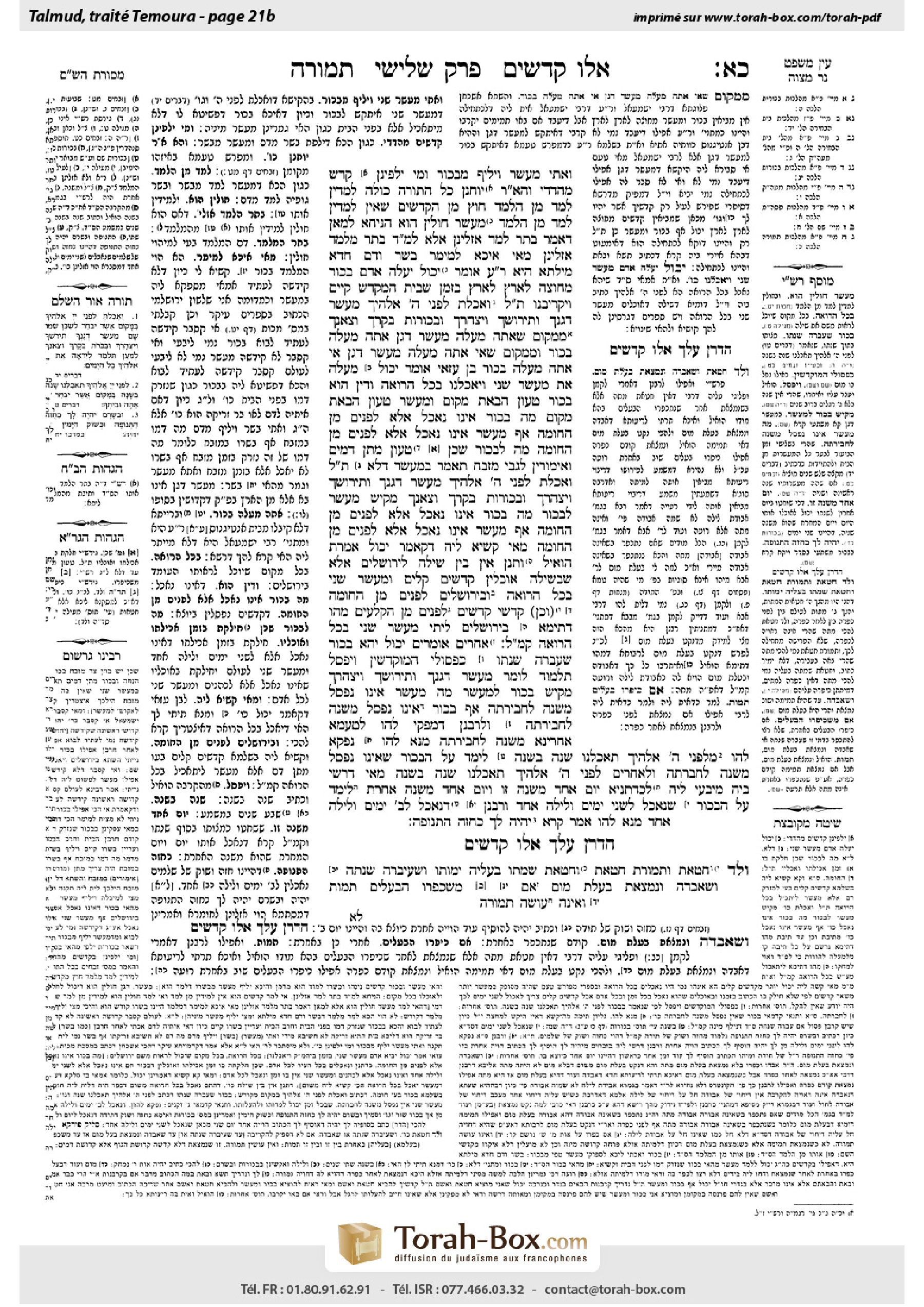
Temurah 21b: Talmud study for Daf Yomi
Daf Yomi is the daily study of one Talmud folio. Explore 37 tractates with scans, Hebrew text, Sefaria English and AI-generated French translations where annotated.
Passage selection and English or AI-generated French translation are available where the scan has annotations. Daf Study is independent of Torah-Box and Sefaria.
Browse Temurah · תמורה · All tractatesTemurah 21b text and translations
This page of Temurah includes the Aramaic text, an English translation and an AI-generated French translation, alongside the scan above.
תמורה כ״א ב · Aramaic and Hebrew text
וְאָתֵי מַעֲשֵׂר וְיָלֵיף מִבְּכוֹר. וּמִי יָלְפִינַן (קֹדֶשׁ) [בְּקָדָשִׁים] מֵהֲדָדֵי? וְהָאָמַר רַבִּי יוֹחָנָן: כׇּל הַתּוֹרָה כּוּלָּהּ לְמֵדִין לָמֵד מִן הַלָּמֵד, חוּץ מִן הַקֳּדָשִׁים שֶׁאֵין לְמֵדִין לָמֵד מִן הַלָּמֵד!
מַעֲשֵׂר חוּלִּין הוּא. הָנִיחָא לְמַאן דְּאָמַר בָּתַר לָמֵד אָזְלִינַן, אֶלָּא לְמַאן דְּאָמַר בָּתַר מְלַמֵּד אָזְלִינַן, מַאי אִיכָּא לְמֵימַר? בָּשָׂר וָדָם חֲדָא מִילְּתָא הִיא.
רַבִּי עֲקִיבָא אוֹמֵר: יָכוֹל יַעֲלֶה אָדָם בְּכוֹר מֵחוּצָה לָאָרֶץ לָאָרֶץ בִּזְמַן שֶׁבֵּית הַמִּקְדָּשׁ קַיָּים וְיַקְרִיבֶנּוּ? תַּלְמוּד לוֹמַר: ״וְאָכַלְתָּ לִפְנֵי ה׳ אֱלֹהֶיךָ מַעְשַׂר דְּגָנְךָ וְתִירוֹשְׁךָ וְיִצְהָרֶךָ וּבְכוֹרוֹת בְּקָרְךָ וְצֹאנֶךָ״ — מִמְּקוֹם שֶׁאַתָּה מַעֲלֶה מַעְשַׂר דָּגָן, אַתָּה מַעֲלֶה בְּכוֹר.
וּמִמְּקוֹם שֶׁאִי אַתָּה מַעֲלֶה מַעְשַׂר דָּגָן — אִי אַתָּה מַעֲלֶה בְּכוֹר.
בֶּן עַזַּאי אוֹמֵר: יָכוֹל (מַעֲלֶה אֶת) [יַעֲלֶה אָדָם] מַעֲשֵׂר שֵׁנִי, וְיֹאכְלֶנּוּ בְּכׇל הָרוֹאֶה? וְדִין הוּא: בְּכוֹר טָעוּן הֲבָאַת מָקוֹם, וּמַעֲשֵׂר טָעוּן הֲבָאַת מָקוֹם — מָה בְּכוֹר אֵינוֹ נֶאֱכָל אֶלָּא לִפְנִים מִן הַחוֹמָה, אַף מַעֲשֵׂר אֵינוֹ נֶאֱכָל אֶלָּא לִפְנִים מִן הַחוֹמָה.
מָה לִבְכוֹר — שֶׁכֵּן טָעוּן מַתַּן דָּמִים וְאֵימוּרִין לְגַבֵּי מִזְבֵּחַ, תֹּאמַר בְּמַעֲשֵׂר דְּלָא?! תַּלְמוּד לוֹמַר: ״וְאָכַלְתָּ לִפְנֵי ה׳ אֱלֹהֶיךָ... מַעְשַׂר דְּגָנְךָ וְתִירוֹשְׁךָ וְיִצְהָרֶךָ וּבְכוֹרוֹת בְּקָרְךָ וְצֹאנֶךָ״ — מַקִּישׁ מַעֲשֵׂר לִבְכוֹר: מָה בְּכוֹר אֵינוֹ נֶאֱכָל אֶלָּא לִפְנִים מִן הַחוֹמָה, אַף מַעֲשֵׂר אֵינוֹ נֶאֱכָל אֶלָּא לִפְנִים מִן הַחוֹמָה.
מַאי קַשְׁיָא לֵיהּ דְּקָאָמַר ״יָכוֹל״? אָמַרְתָּ הוֹאִיל וּתְנַן: אֵין בֵּין שִׁילֹה לִירוּשָׁלַיִם אֶלָּא שֶׁבְּשִׁילֹה אוֹכְלִין קָדָשִׁים קַלִּים וּמַעֲשֵׂר שֵׁנִי בְּכׇל הָרוֹאֶה, וּבִירוּשָׁלַיִם לִפְנִים מִן הַחוֹמָה,
וְכֵן קׇדְשֵׁי קָדָשִׁים לִפְנִים מִן הַקְּלָעִים, מַהוּ דְּתֵימָא בִּירוּשָׁלַיִם לַיְתֵי מַעֲשֵׂר שֵׁנִי בְּכׇל הָרוֹאֶה? קָא מַשְׁמַע לַן.
אֲחֵרִים אוֹמְרִים: יָכוֹל יְהֵא בְּכוֹר שֶׁעִבְּרָה שְׁנָתוֹ כִּפְסוּלֵי הַמּוּקְדָּשִׁין, וְיִפָּסֵל?
תַּלְמוּד לוֹמַר: ״מַעְשַׂר דְּגָנְךָ וְתִירוֹשְׁךָ וְיִצְהָרֶךָ״, מַקִּישׁ בְּכוֹר לְמַעֲשֵׂר, מָה מַעֲשֵׂר אֵינוֹ נִפְסָל מִשָּׁנָה לַחֲבֶירְתָּהּ, אַף בְּכוֹר אֵינוֹ נִפְסָל מִשָּׁנָה לַחֲבֶירְתָּהּ.
וּלְרַבָּנַן, דְּמַפְּקִי לְהוּ לְטַעְמָא אַחֲרִינָא, מִשָּׁנָה לַחֲבֶירְתָּהּ מְנָא לְהוּ? נָפְקָא לְהוּ מִ״לִּפְנֵי ה׳ אֱלֹהֶיךָ תֹאכְלֶנּוּ שָׁנָה בְשָׁנָה״, לִימֵּד עַל הַבְּכוֹר שֶׁאֵינוֹ נִפְסָל מִשָּׁנָה לַחֲבֶרְתָּהּ.
וְלַאֲחֵרִים, לִפְנֵי ״ה׳ אֱלֹהֶיךָ תֹאכְלֶנּוּ שָׁנָה בְשָׁנָה״, מַאי דָּרְשִׁי בֵּיהּ? מִיבְּעֵי לֵיהּ לְכִדְתַנְיָא: יוֹם אֶחָד מִשָּׁנָה זוֹ, וְיוֹם אֶחָד מִשָּׁנָה אַחֶרֶת, לִימֵּד עַל הַבְּכוֹר שֶׁנֶּאֱכָל לִשְׁנֵי יָמִים וָלָיְלָה אֶחָד.
וְרַבָּנַן, דְּנֶאֱכָל לִשְׁנֵי יָמִים וָלָיְלָה אֶחָד מְנָא לְהוּ? אָמַר קְרָא: ״יִהְיֶה לָּךְ כַּחֲזֵה הַתְּנוּפָה״.
הֲדַרַן עֲלָךְ אֵלּוּ קָדָשִׁים.
מַתְנִי׳ וְלַד חַטָּאת, וּתְמוּרַת חַטָּאת, וְחַטָּאת שֶׁמֵּתוּ בְּעָלֶיהָ — יָמוּתוּ, וְשֶׁעִיבְּרָה שְׁנָתָהּ, וְשֶׁאָבְדָה וְנִמְצֵאת בַּעֲלַת מוּם, אִם מִשֶּׁכִּפְּרוּ הַבְּעָלִים — תָּמוּת, וְאֵינָהּ עוֹשָׂה תְּמוּרָה.
Temurah 21b · English translation
And then, as Rabbi Yishmael holds that a firstborn definitely may not be eaten in the present, he says that second tithe comes and its status is derived from the juxtaposition to the firstborn. The Gemara asks: And can we derive the halakhot of sacrificial food from one another? But doesn’t Rabbi Yoḥanan say: In the entire Torah, we may derive that which is derived from a halakha that was itself derived from another source, except for the case of sacrificial animals, where we do not derive that which is derived from that which was already derived from another source.
The Gemara answers: Second tithe is considered non-sacred. Therefore, this derivation does not pertain to consecrated items. The Gemara asks: This works out well according to the one who said that we follow the halakha that is derived. If it is a consecrated item, it may not be derived from another halakha that was derived from another source, but if it is non-sacred, such as second tithe, it may be derived in this manner. But according to the one who said that we follow the halakha that teaches, what is there to say? In this case the halakha that teaches, i.e., the source of the derivation, is the meat of the firstborn, which is a consecrated item that is derived itself from the status of the blood of the firstborn. The Gemara answers: The status of the meat and the blood of a firstborn offering are one matter. Therefore, the meat is not considered as derived from another halakha.
§ The Gemara cites the second statement of Rabbi Yosei from the elders, in the continuation of the baraita above: Rabbi Akiva says: One might have thought that a person may bring up a firstborn from outside Eretz Yisrael to Eretz Yisrael when the Temple is standing and sacrifice it. Therefore, the verse states: “And you shall eat before the Lord your God, in the place which He shall choose to cause His name to dwell there, the tithe of your grain, of your wine, and of your oil, and the firstborn of your herd and of your flock” (Deuteronomy 14:23). Rabbi Akiva derives from here that only from the place that you bring up the tithe of grain to Jerusalem, i.e., from Eretz Yisrael, may you bring up a firstborn to the Temple as an offering.
But from a place that you may not bring up the tithe of grain, i.e., outside Eretz Yisrael, you may not bring up a firstborn from there. Therefore, the statement of the mishna that if one did bring up an unblemished firstborn from outside Eretz Yisrael it may be sacrificed, is in accordance with the opinion of Rabbi Yishmael. By contrast, the statement that ben Antigonus brought firstborn offerings from Babylonia and they were not accepted as offerings is in accordance with the opinion of Rabbi Akiva.
§ The Gemara relates the third statement in the baraita, which discusses second tithe: Ben Azzai says that one might have thought that he may bring up second tithe and eat it in any place that overlooks Jerusalem.But could this matter not be derived through logical inference: A firstborn offering requires that it be brought to the place, i.e., Jerusalem, and a second tithe requires that it be brought to the place. Just as a firstborn animal is eaten only within the walls of Jerusalem, so too, second tithe is eaten only within the walls of Jerusalem.
This inference may be refuted: What is unique about a firstborn? It is unique in that it requires the placement of the blood and sacrificial portions upon the altar. Shall you also say that this is the case with regard to second tithe, where that is not required? Therefore, the verse states: “And you shall eat before the Lord your God, in the place which He shall choose to cause His name to dwell there, the tithe of your grain, of your wine, and of your oil, and the firstborn of your herd and of your flock.” The verse juxtaposes second tithe and the firstborn, to teach that just as the firstborn is eaten only within the walls, so too, second tithe is eaten only within the walls.
The Gemara comments: What is difficult for ben Azzai that prompted him to say: One might have thought that it is permitted to eat second tithe in any place that overlooks Jerusalem? The Gemara explains: You can say that it is difficult for him since we learned in a mishna (Megilla 9b): The difference between the Tabernacle in Shiloh and the Temple in Jerusalem is only that in Shiloh one eats offerings of lesser sanctity, e.g., individual peace offerings, thanks offerings, and the Paschal lamb, and also the second tithe, in any place that overlooks Shiloh,but in Jerusalem one eats those consecrated items only within the walls.
And likewise, offerings of the most sacred order are eaten only in the area within the hangings, which surrounded the courtyard in the Tabernacle in Shiloh, which was equivalent to the area within the surrounding wall in the Temple courtyard in Jerusalem. Lest you say that even in Jerusalem, they may bring second tithe and eat it in any location that overlooks the walls, since, unlike the firstborn animal, second tithe does not possess any unique stringency, the verse teaches us that this is not so, as taught in the mishna.
§ Rabbi Yosei cites one more statement in the baraita with regard to a firstborn: The mishna (Bekhorot 26b) states that a firstborn animal is eaten from one year to the next, i.e., within its first year, as it is stated: “You shall eat it before the Lord your God year by year” (Deuteronomy 15:20). Rabbi Yosei adds that others say: One might have thought that a firstborn whose first year has passed should have the same status as disqualified consecrated animals and therefore be disqualified.
Therefore, the verse states: “And you shall eat before the Lord your God…the tithe of your grain, of your wine, and of your oil, and the firstborn of your herd and of your flock.” The verse thereby juxtaposes a firstborn animal to second tithe, which teaches that just as second tithe is not disqualified from one year to the next, so too, a firstborn animal is not disqualified from one year to the next.
The Gemara asks: And according to the Rabbis, i.e., Rabbi Yishmael, Rabbi Akiva, and ben Azzai, who expound this verse for another explanation, from where do they derive that a firstborn animal is not disqualified from one year to the next? The Gemara answers: They derive it from the verse “You shall eat it before the Lord your God year by year.” The formulation “year by year” indicates two years, thereby teaching with regard to a firstborn animal that it is not disqualified from one year to the next.
The Gemara asks: And according to the opinion of the others, who derive this halakha from the juxtaposition of the firstborn and second tithe, with regard to what do they interpret the verse: “You shall eat it before the Lord your God year by year”? The Gemara answers: It is necessary for that which is taught in a baraita with regard to the time for the consumption of a firstborn animal: The phrase “year by year” teaches that there is a manner in which it may be eaten over two years: During one day of this year, and during one day of the next year. The verse therefore teaches with regard to a firstborn offering that it may be eaten for two days and one night in between.
The Gemara asks: And the Rabbis, Rabbi Yishmael, Rabbi Akiva, and ben Azzai, from where do they derive the halakha that a firstborn offering may be eaten for two days and one night? The Gemara answers that the verse states with regard to the firstborn: “And their flesh shall be yours, like the breast of the waving and the right thigh, it shall be yours” (Numbers 18:18). The repetition of the expression “It shall be yours” teaches that one may eat the firstborn for one more day than a standard thanks offering, which may be eaten only for one day and one night.
MISHNA: The offspring of a sin offering and the substitute for a sin offering, and a sin offering whose owner has died shall be sequestered and left to die. And with regard to a sin offering that is unfit for sacrifice because its first year from birth has passed, and a sin offering that was lost and when it was found, it was blemished, if it was after the owner achieved atonement through sacrifice of another animal as a sin offering, the blemished animal shall die, and it does not render a non-sacred animal exchanged for it a substitute.
Temurah 21b · Traduction française (IA)
Et alors, puisque Rabbi Yishmael estime qu’un premier-né ne peut absolument pas être consommé à l’époque actuelle, il affirme que la seconde dîme vient et que son statut se déduit de sa juxtaposition au premier-né. La Guemara demande : Peut-on déduire les halakhot relatives aux sacrifices les unes des autres ? Rabbi Yoḥanan ne dit-il pas : Dans toute la Torah, nous pouvons déduire une règle à partir d’une halakha elle-même déduite d’une autre source, à l’exception des sacrifices, pour lesquels nous ne déduisons pas une règle de ce qui a déjà été déduit d’une autre source ?
La Guemara répond : La seconde dîme est considérée comme profane. Cette déduction ne concerne donc pas les choses consacrées. La Guemara demande : Cela convient selon celui qui dit que nous suivons la halakha qui est déduite. S’il s’agit d’une chose consacrée, on ne peut pas la déduire d’une autre halakha elle-même déduite d’une autre source ; mais s’il s’agit d’une chose profane, comme la seconde dîme, on peut la déduire de cette manière. Mais, selon celui qui dit que nous suivons la halakha qui sert de source à la déduction, que peut-on répondre ? Dans ce cas, la halakha qui sert de source, c’est-à-dire le fondement de la déduction, est la chair du premier-né, une chose consacrée dont le statut est lui-même déduit de celui du sang du premier-né. La Guemara répond : Le statut de la chair et celui du sang d’un sacrifice de premier-né relèvent d’un seul et même sujet. La chair n’est donc pas considérée comme déduite d’une autre halakha.
§ La Guemara cite la deuxième déclaration de Rabbi Yosei au nom des anciens, dans la suite de la baraïta précédente : Rabbi Akiva dit : On aurait pu penser qu’une personne peut faire monter un premier-né depuis l’extérieur d’Eretz Israël vers Eretz Israël, lorsque le Temple est debout, pour l’offrir en sacrifice. C’est pourquoi le verset dit : « Et tu mangeras devant l’Éternel ton Dieu, dans le lieu qu’Il choisira pour y faire résider Son nom, la dîme de ton blé, de ton vin et de ton huile, ainsi que les premiers-nés de ton gros et de ton petit bétail » (Deutéronome 14:23). Rabbi Akiva en déduit que l’on ne peut faire monter un premier-né au Temple pour l’offrir que depuis le lieu d’où l’on fait monter la dîme du blé à Jérusalem, c’est-à-dire depuis Eretz Israël.
Mais on ne peut pas faire monter un premier-né depuis un lieu d’où l’on ne peut faire monter la dîme du blé, c’est-à-dire depuis l’extérieur d’Eretz Israël. Par conséquent, l’énoncé de la Michna selon lequel, si l’on a fait monter au Temple un premier-né sans défaut depuis l’extérieur d’Eretz Israël, il peut y être offert en sacrifice, est conforme à l’opinion de Rabbi Yishmael. En revanche, l’énoncé selon lequel ben Antigonus a apporté de Babylonie des sacrifices de premier-né qui n’ont pas été acceptés est conforme à l’opinion de Rabbi Akiva.
§ La Guemara rapporte la troisième déclaration de la baraïta, qui traite de la seconde dîme : ben Azzai dit : On aurait pu penser qu’on peut faire monter la seconde dîme et la manger en tout lieu d’où l’on voit Jérusalem. Mais cette règle ne pourrait-elle pas se déduire par raisonnement logique ? Une offrande de premier-né doit être apportée au lieu en question, c’est-à-dire à Jérusalem, et la seconde dîme doit elle aussi y être apportée. De même qu’un animal premier-né ne se mange qu’à l’intérieur des remparts de Jérusalem, de même la seconde dîme ne se mange qu’à l’intérieur des remparts de Jérusalem.
On peut réfuter ce raisonnement : Qu’est-ce qui caractérise un premier-né ? Le sang et les parties sacrificielles doivent être placés sur l’autel. En diras-tu autant de la seconde dîme, alors que cela n’est pas requis ? C’est pourquoi le verset dit : « Et tu mangeras devant l’Éternel ton Dieu, dans le lieu qu’Il choisira pour y faire résider Son nom, la dîme de ton blé, de ton vin et de ton huile, ainsi que les premiers-nés de ton gros et de ton petit bétail. » Le verset juxtapose la seconde dîme au premier-né pour enseigner que, de même que le premier-né ne se mange qu’à l’intérieur des remparts, de même la seconde dîme ne se mange qu’à l’intérieur des remparts.
La Guemara fait remarquer : Qu’est-ce qui pose problème à ben Azzai et l’a poussé à dire : « On aurait pu penser qu’il est permis de manger la seconde dîme en tout lieu d’où l’on voit Jérusalem » ? La Guemara explique : On peut dire que cela lui pose problème parce que nous avons appris dans une Michna (Meguila 9b) : La seule différence entre le Tabernacle de Silo et le Temple de Jérusalem est qu’à Silo, on mange les sacrifices de moindre sainteté — par exemple, les offrandes de paix individuelles, les sacrifices de remerciement et l’agneau pascal — ainsi que la seconde dîme, en tout lieu d’où l’on voit Silo ; mais à Jérusalem, ces choses consacrées ne se mangent qu’à l’intérieur des remparts.
De même, les sacrifices de sainteté suprême ne se mangent que dans l’enceinte délimitée par les tentures qui entouraient la cour du Tabernacle de Silo et correspondaient à l’espace situé à l’intérieur du mur d’enceinte de la cour du Temple de Jérusalem. De peur que l’on dise qu’à Jérusalem aussi, on peut apporter la seconde dîme et la manger en tout lieu d’où l’on voit les remparts, puisque, contrairement au premier-né, la seconde dîme n’est soumise à aucune exigence particulière, le verset nous enseigne que ce n’est pas le cas, comme l’enseigne la Michna.
§ Rabbi Yosei cite une autre déclaration de la baraïta au sujet d’un premier-né : La Michna (Bekhorot 26b) enseigne qu’un animal premier-né se mange d’une année à l’autre, c’est-à-dire au cours de sa première année, ainsi qu’il est dit : « Tu le mangeras devant l’Éternel ton Dieu, année après année » (Deutéronome 15:20). Rabbi Yosei ajoute que d’autres disent : On aurait pu penser qu’un premier-né dont la première année est écoulée devrait avoir le même statut que des sacrifices consacrés disqualifiés et être donc lui-même disqualifié.
C’est pourquoi le verset dit : « Et tu mangeras devant l’Éternel ton Dieu… la dîme de ton blé, de ton vin et de ton huile, ainsi que les premiers-nés de ton gros et de ton petit bétail. » Le verset juxtapose ainsi un animal premier-né à la seconde dîme, ce qui enseigne que, de même que la seconde dîme n’est pas disqualifiée d’une année à l’autre, de même un animal premier-né n’est pas disqualifié d’une année à l’autre.
La Guemara demande : Et selon les Rabbins, c’est-à-dire Rabbi Yishmael, Rabbi Akiva et ben Azzai, qui interprètent ce verset pour en tirer une autre explication, d’où déduisent-ils qu’un animal premier-né n’est pas disqualifié d’une année à l’autre ? La Guemara répond : Ils le déduisent du verset « Tu le mangeras devant l’Éternel ton Dieu, année après année ». La formulation « année après année » indique deux années et enseigne ainsi, au sujet d’un animal premier-né, qu’il n’est pas disqualifié d’une année à l’autre.
La Guemara demande : Et selon l’opinion des autres, qui déduisent cette halakha de la juxtaposition du premier-né et de la seconde dîme, comment interprètent-ils le verset : « Tu le mangeras devant l’Éternel ton Dieu, année après année » ? La Guemara répond : Ce verset est nécessaire pour enseigner ce qui figure dans une baraïta au sujet de la période pendant laquelle un animal premier-né peut être consommé : l’expression « année après année » enseigne qu’il existe une manière de le manger sur deux années, un jour de cette année et un jour de l’année suivante. Le verset enseigne donc qu’un sacrifice de premier-né peut être mangé pendant deux jours, avec une nuit entre les deux.
La Guemara demande : Et les Rabbins, Rabbi Yishmael, Rabbi Akiva et ben Azzai, d’où déduisent-ils la halakha selon laquelle un sacrifice de premier-né peut être mangé pendant deux jours et une nuit ? La Guemara répond que le verset dit, au sujet du premier-né : « Leur chair sera à vous ; comme la poitrine de présentation et la cuisse droite, elle sera à vous » (Nombres 18:18). La répétition de l’expression « elle sera à vous » enseigne que l’on peut manger le premier-né un jour de plus qu’un sacrifice de remerciement ordinaire, qui ne peut être mangé que pendant un jour et une nuit.
MICHNA : Le petit d’un sacrifice expiatoire, le substitut d’un sacrifice expiatoire et un sacrifice expiatoire dont le propriétaire est mort doivent être mis à l’écart et laissés à mourir. Quant à un sacrifice expiatoire impropre au sacrifice parce que sa première année après sa naissance est écoulée, ainsi qu’à un sacrifice expiatoire qui a été perdu et qui, lorsqu’il a été retrouvé, était atteint d’un défaut, si cela s’est produit après que le propriétaire a obtenu l’expiation en offrant un autre animal en sacrifice expiatoire, l’animal atteint d’un défaut doit mourir ; et l’animal profane échangé contre lui ne devient pas son substitut.
Traduction française générée par IA à partir de l’édition anglaise de Sefaria. Vérifie toujours un passage avec le texte source.
Text from Sefaria: William Davidson Edition - Vocalized Aramaic (CC BY NC); William Davidson Edition - English (CC BY NC).