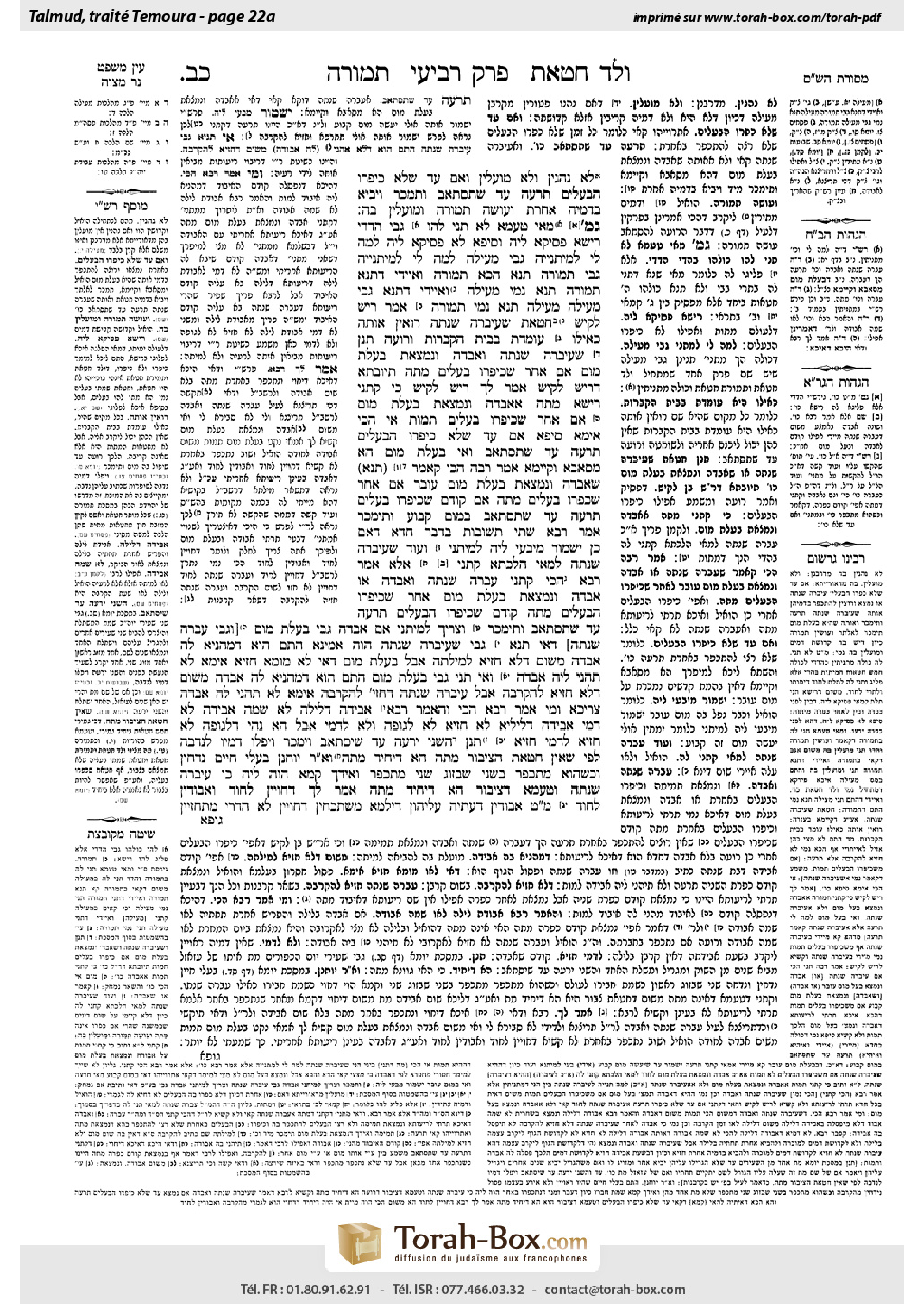
Temurah 22a: Talmud study for Daf Yomi
Daf Yomi is the daily study of one Talmud folio. Explore 37 tractates with scans, Hebrew text, Sefaria English and AI-generated French translations where annotated.
Passage selection and English or AI-generated French translation are available where the scan has annotations. Daf Study is independent of Torah-Box and Sefaria.
Browse Temurah · תמורה · All tractatesTemurah 22a text and translations
This page of Temurah includes the Aramaic text, an English translation and an AI-generated French translation, alongside the scan above.
תמורה כ״ב א · Aramaic and Hebrew text
לֹא נֶהֱנִין וְלֹא מוֹעֲלִין, וְאִם עַד שֶׁלֹּא כִּיפְּרוּ הַבְּעָלִים — תִּרְעֶה עַד שֶׁתִּסְתָּאֵב, וְתִמָּכֵר וְיָבִיא בְּדָמֶיהָ אַחֶרֶת, וְעוֹשָׂה תְּמוּרָה וּמוֹעֲלִין בָּהּ.
גְּמָ׳ מַאי טַעְמָא לָא תָּנֵי לְהוּ גַּבֵּי הֲדָדֵי? רֵישָׁא — פְּסִיקָא לֵיהּ, וְסֵיפָא — לָא פְּסִיקָא לֵיהּ.
לְמָה לִי לְמִיתְנְיַיהּ גַּבֵּי מְעִילָה, לְמָה לִי לְמִיתְנְיַיהּ גַּבֵּי תְּמוּרָה? תְּנָא הָכָא תְּמוּרָה, וְאַיְּידֵי דִּתְנָא תְּמוּרָה — תְּנָא נָמֵי מְעִילָה, וְאַיְּידֵי דִּתְנָא גַּבֵּי מְעִילָה מְעִילָה — תְּנָא נָמֵי תְּמוּרָה.
אָמַר רֵישׁ לָקִישׁ: חַטָּאת שֶׁעִיבְּרָה שְׁנָתָהּ, רוֹאִין אוֹתָהּ כְּאִילּוּ עוֹמֶדֶת בְּבֵית הַקְּבָרוֹת, וְרוֹעָה.
תְּנַן: שֶׁעִיבְּרָה שְׁנָתָהּ, וְאָבְדָה וְנִמְצֵאת בַּעֲלַת מוּם, אִם אַחַר שֶׁכִּיפְּרוּ בְּעָלִים — מֵתָה, תְּיוּבְתָּא דְּרֵישׁ לָקִישׁ!
אָמַר לָךְ רֵישׁ לָקִישׁ: כִּי קָתָנֵי רֵישָׁא ״מֵתָה״ — אַאָבְדָה וְנִמְצֵאת בַּעֲלַת מוּם, אִם אַחַר שֶׁכִּיפְּרוּ בְּעָלִים — תָּמוּת.
אִי הָכִי, אֵימָא סֵיפָא: ״אִם עַד שֶׁלֹּא כִּיפְּרוּ הַבְּעָלִים תִּרְעֶה עַד שֶׁתִּסְתָּאֵב״, וְאִי בַּעֲלַת מוּם — הָא מְסָאֲבָא וְקַיְימָא!
אָמַר רַבָּה: הָכִי קָאָמַר תַּנָּא: שֶׁאָבְדָה וְנִמְצֵאת בַּעֲלַת מוּם עוֹבֵר, אִם אַחַר שֶׁכִּפְּרוּ בְּעָלִים — מֵתָה, אִם קוֹדֶם שֶׁכִּיפְּרוּ בְּעָלִים — תִּרְעֶה עַד שֶׁתִּסְתָּאֵב בְּמוּם קָבוּעַ, וְתִימָּכֵר.
אָמַר רָבָא: שְׁתֵּי תְּשׁוּבוֹת בַּדָּבָר, חֲדָא — דְּאִם כֵּן, ״יִשְׁמוֹר״ מִיבְּעֵי לֵיהּ לְמִיתְנֵי, וְעוֹד — ״שֶׁעִיבְּרָה שְׁנָתָהּ״ לְמַאי הִלְכְתָא קָתָנֵי?
אֶלָּא אָמַר רָבָא: הָכִי קָתָנֵי, עִבְּרָה שְׁנָתָהּ וְאָבְדָה, אוֹ אָבְדָה וְנִמְצֵאת בַּעֲלַת מוּם — אַחַר שֶׁכִּיפְּרוּ הַבְּעָלִים מֵתָה, קוֹדֶם שֶׁכִּיפְּרוּ הַבְּעָלִים תִּרְעֶה עַד שֶׁתִּסְתָּאֵב וְתִימָּכֵר.
וְצָרִיךְ לְמִיתְנֵי ״אִם אָבְדָה״ גַּבֵּי בַּעֲלַת מוּם, וְגַבֵּי עִבְּרָה שְׁנָתָהּ, דְּאִי תְּנָא גַּבֵּי שֶׁעִיבְּרָה שְׁנָתָהּ — הֲוָה אָמֵינָא הָתָם הוּא דְּמַהְנְיָא לַהּ אֲבֵדָה, מִשּׁוּם דְּלָא חַזְיָא לְמִילְּתַהּ, אֲבָל בַּעֲלַת מוּם דְּאִי לָא מוּמָא חַזְיָא — אֵימָא לָא תַּהֲנֵי לֵיהּ אֲבֵדָה.
וְאִי תָּנֵי גַּבֵּי בַּעֲלַת מוּם, הָתָם הוּא דְּמַהְנְיָא לַהּ אֲבֵדָה, מִשּׁוּם דְּלָא חַזְיָא לְהַקְרָבָה, אֲבָל עִיבְּרָה שְׁנָתָהּ דְּחַזְיָא לְהַקְרָבָה, אֵימָא לָא תַּהֲנֵי לַהּ אֲבֵדָה, צְרִיכָא.
וּמִי אָמַר רָבָא הָכִי? וְהָאָמַר רָבָא: אֲבֵידָה דְּלַיְלָה לָא שְׁמַהּ אֲבֵידָה!
לָא דָּמֵי אֲבֵידָה דְּלֵילְיָא — לָא חַזְיָא לָא לְגוּפַהּ וְלָא לִדְמֵי, אֲבָל הָא — נְהִי דִּלְגוּפַהּ לָא חַזְיָא, לִדְמֵי חַזְיָא.
תְּנַן: הַשֵּׁנִי יִרְעֶה עַד שֶׁיִּסְתָּאֵב, וְיִמָּכֵר, וְיִפְּלוּ דָּמָיו לִנְדָבָה, לְפִי שֶׁאֵין חַטַּאת הַצִּיבּוּר מֵתָה. הָא דְּיָחִיד — מֵתָה!
וְאָמַר רַבִּי יוֹחָנָן: בַּעֲלֵי חַיִּים נִדְחִין, וּכְשֶׁהוּא מִתְכַּפֵּר — בְּשֵׁנִי שֶׁבְּזוּג שֵׁנִי מִתְכַּפֵּר.
וְאִידַּךְ, קַמָּא, הָוֵה לֵיהּ כִּי עִיבְּרָה שְׁנָתָהּ, וְטַעְמָא דְּצִיבּוּר, הָא דְּיָחִיד — מֵתָה!
אָמַר לָךְ: דְּחוּיִין לְחוּד, וַאֲבוּדִין לְחוּד. מַאי טַעְמָא? אֲבוּדִין — דַּעְתֵּיהּ עֲלֵיהוֹן, דִּילְמָא מִשְׁתַּכְחִין. דְּחוּיִין — לָא הָדָרִי מִתְחֲזַיִין.
Temurah 22a · English translation
Furthermore, one may not derive benefit from any of these sin offerings ab initio, but if one derived benefit from them, after the fact, he is not liable to bring a sin offering for misuse of consecrated items. And if the lost animal was found and discovered to be unfit before the owner achieved atonement for his sin with a different animal, it shall graze until it becomes blemished, and then it shall be sold. And he must bring another sin offering with the money received from the sale. And this animal renders a non-sacred animal exchanged for it a substitute, and one who derives benefit from this animal is liable for misusing it.
GEMARA: Although there are five types of sin offerings that are sequestered and left to die, the mishna initially states: The offspring of a sin offering, and the substitute for a sin offering, and a sin offering whose owner has died shall be sequestered and left to die, and only then mentions the remaining two types, a sin offering that is more than one year old and a sin offering that was lost and then found after the owner achieved atonement through the sacrifice of another animal. The Gemara asks: What is the reason the mishna does not teach them all together? The Gemara responds: With regard to those sin offerings taught in the first clause, there is an absolute rule that applies equally in all circumstances. But with regard to the remaining types taught in the latter clause, there is no absolute rule, as these sin offerings are left to die only if the owner has already achieved atonement with another animal.
The Gemara asks: This mishna also appears in tractate Me’ila (10b). Why do I need the tanna to teach this mishna in tractate Me’ila and why do I need him to teach it in tractate Temura? The Gemara responds: Here, in Temura, the mishna taught the halakhot pertaining to substitution, which is the central theme of tractate Temura. And since it taught the halakhot pertaining to substitution, it also taught the relevant halakhot pertaining to misuse of consecrated property. And similarly, since it taught in tractate Me’ila the halakhot pertaining to misuse of consecrated property, which is the subject of tractate Me’ila, it also taught the relevant halakhot pertaining to substitution.
§ Reish Lakish says: With regard to a sin offering whose first year from birth has passed, one considers it as though it is standing in a cemetery, where a priest cannot enter in order to retrieve it and sacrifice it, and it is left to graze until it develops a blemish, after which it is sold and the money received in its sale is used to purchase another animal for a sin offering. Since Reish Lakish makes no distinction between an owner who already achieved atonement with another animal and one who did not, it seems that according to Reish Lakish, this is the halakha in all cases of a sin offering whose first year from birth has passed.
The Gemara objects: We learned in the mishna: With regard to a sin offering whose first year from birth has passed and a sin offering that was lost and when it was found it was blemished, if it was after the owner achieved atonement through the sacrifice of another animal as a sin offering, the blemished animal is left to die. This is apparently a conclusive refutation of the opinion of Reish Lakish.
The Gemara explains that Reish Lakish could say to you: When the mishna teaches in the first clause that the animal is sequestered and left to die, it is referring only to the case where it was lost and when it was found it was blemished. In that situation, if it was after the owner achieved atonement through the sacrifice of another animal as a sin offering, the blemished animal shall be left to die. By contrast, a sin offering whose first year from birth has passed is indeed left to graze until it develops a blemish.
The Gemara objects: If so, say the latter clause: If the lost animal was found and discovered to be unfit before the owner achieved atonement for his sin with a different animal, it shall graze until it becomes blemished. Now, if the mishna is referring specifically to an animal that was lost and found when it was blemished, why is this statement necessary? Doesn’t it already stand blemished?
Rabba said in response that this is what the tanna is saying: In a case where it was lost and subsequently found when it had a temporary blemish, then if it was after the owner achieved atonement with another sin offering, the blemished animal shall be left to die. But if this was before the owner achieved atonement with another sin offering, it shall graze until it becomes blemished with a permanent blemish, and then it shall be sold.
Rava says: There are two refutations of Rabba’s statement: One refutation is that if it is so, that the mishna is referring to an animal that was lost and then found when it had a temporary blemish, then instead of stating: It shall graze until it becomes blemished, the mishna should have taught: One observes the animal to see whether the temporary blemish becomes permanent. And furthermore, according to this interpretation of the mishna, when it mentions the case of a sin offering whose first year from birth has passed, with regard to what halakha is that case taught?
Rather, Rava said a different explanation of the mishna so that it does not contradict the statement of Reish Lakish: This is what the mishna is teaching: With regard to a sin offering whose first year from birth has passed and was lost, or one that was lost and when it was found it was blemished, which means that in each case, there are two disqualifying factors, the halakha is as follows: If the first animal is found after the owner achieved atonement with another sin offering, the animal shall be left to die. If it is found before the owner achieved atonement with another sin offering, it shall graze until it becomes blemished and then it shall be sold. Reish Lakish, by contrast, is referring to a situation where the sin offering was not lost. In such a case there is only one disqualifying factor, and therefore the animal is left to graze regardless of whether or not the owner achieved atonement with another animal.
Rava continues: And it was necessary for the mishna to teach: If it was lost, with regard to a sin offering that was found to be blemished, and also to teach that clause with regard to a sin offering whose first year has passed. In other words, it was necessary for the mishna to teach that in each of these cases losing the animal means that it must be sequestered and left to die if the owner already achieved atonement with another animal. As if it had taught this halakha only with regard to a sin offering whose first year has passed, I would say: It is only there that the fact that it was lost is effective in requiring that the animal must be left to die, because it is not fit for its original purpose, as an animal more than one year old is inherently unfit for a sin offering. But with regard to a blemished animal, which would have been fit for sacrifice if not for its blemish, I might say that the fact that it was lost is not effective in causing the animal to be left to die.
And similarly, if the mishna had taught the halakha only with regard to a blemished animal, I would say: It is only there that the fact that it was lost is effective in requiring that the animal must be left to die, because a blemished animal is not fit for sacrifice at all. But with regard to a sin offering whose first year has passed, which is fit for sacrifice as a different offering, I might say that the fact that it was lost is not effective in causing the animal to be left to die. Consequently, it was necessary for the mishna to teach the halakha with regard to both cases.
The Gemara asks: And did Rava actually say this, that an animal whose first year has passed and was then lost is left to die? But didn’t Rava say: A sin offering lost at night is not called lost? In other words, if the offering is lost at a time that it is not fit for sacrifice, the animal is not considered lost. Consequently, provided that the owner finds the sin offering before morning, it is left to graze and not to die, even if the owner designated another animal in its stead. By the same logic, as a sin offering whose first year has passed is not fit for sacrifice as a sin offering, it should not be considered lost even if the owner cannot locate it. Therefore, it should not be left to die.
The Gemara responds: The case of a sin offering lost at night is not comparable to that of a sin offering lost after its first year has passed. When a sin offering is lost at night, it is not fit at all, neither for itself, i.e., to be sacrificed, nor for its value, to be sold and the proceeds used to purchase another offering. But with regard to this sin offering that was lost after its first year has passed, granted that it is not fit for itself, but it is fit for its value.
The Gemara presents another challenge to the opinion of Rava: We learned in a mishna (Yoma 62a): On Yom Kippur, a pair of goats are brought to the Temple, and lots are drawn to determine which goat is to be sent to Azazel as the scapegoat, and which goat is sacrificed as a sin offering. If after the lots were drawn for both goats, the scapegoat died, another pair of goats is brought and lots are drawn for the second pair. In such a case, there are two goats that were selected as the sin offering, i.e., the remaining goat from the first pair and the goat selected from the second. One of them is sacrificed and the second goat shall graze until it becomes blemished, at which point it will be sold, and the money received from its sale will be allocated for communal gift offerings. This is because a communal sin offering is not left to die. One may infer from the mishna that under similar circumstances, the sin offering of an individual is left to die.
The Gemara continues: And as the mishna does not specify which of the two goats is sacrificed as the sin offering, Rabbi Yoḥanan says: The goat from the second pair is sacrificed, since living animals are rejected. That is, animals that were consecrated for a specific purpose but were not fit to be used for that purpose at the proper time are permanently disqualified as a sacrifice. Accordingly, as the first goat was unfit for sacrifice when the first scapegoat died, it is permanently disqualified from the altar. And therefore, when the High Priest achieves atonement on behalf of the Jewish people, he achieves atonement with the second goat of the second pair [zug].
The Gemara concludes: And the other goat, i.e., the first goat selected as the sin offering, is like a sin offering whose first year has passed, in that both are disqualified due to an external factor. And the Gemara infers that the reason the first goat is not left to die is that it is a communal sin offering; but if it was the sin offering of an individual, it would be left to die. Evidently, a sin offering whose first year has passed is left to die even if it was not lost.
The Gemara responds: Rava could say to you: The case of sin offerings that were rejected is discrete and the case of sin offerings that were lost is discrete, i.e., the two cases cannot be compared. What is the reason for this? In the case of lost sin offerings, the owner’s mind is on them, as he thinks that perhaps they will be found and will be fit for sacrifice. Therefore, they are not left to die simply because they are lost. But in the case of sin offerings that have been rejected, they do not become fit ever again, and therefore the owner’s mind is not on them.
Temurah 22a · Traduction française (IA)
De plus, il est interdit a priori de tirer profit de l’un quelconque de ces sacrifices expiatoires ; toutefois, si quelqu’un en a tiré profit après coup, il n’est pas tenu d’apporter un sacrifice expiatoire pour détournement d’objets consacrés. Si l’animal perdu a été retrouvé et s’est révélé impropre avant que son propriétaire ait obtenu l’expiation de sa faute au moyen d’un autre animal, il paîtra jusqu’à ce qu’il devienne porteur d’un défaut, puis sera vendu. Le propriétaire devra apporter un autre sacrifice expiatoire avec le produit de la vente. Cet animal rend également substitut l’animal non consacré qui lui est substitué, et celui qui en tire profit est passible pour détournement.
GUEMARA : Bien qu’il existe cinq catégories de sacrifices expiatoires que l’on met à l’écart et que l’on laisse mourir, la Michna commence par enseigner : « La progéniture d’un sacrifice expiatoire, son substitut et un sacrifice expiatoire dont le propriétaire est mort sont mis à l’écart et laissés mourir », et ne mentionne qu’ensuite les deux catégories restantes : un sacrifice expiatoire âgé de plus d’un an et un sacrifice expiatoire qui a été perdu puis retrouvé après que son propriétaire a obtenu l’expiation en sacrifiant un autre animal. La Guemara demande : Pourquoi la Michna ne les enseigne-t-elle pas tous ensemble ? La Guemara répond : Pour les sacrifices expiatoires enseignés dans la première partie, une règle absolue s’applique dans tous les cas. En revanche, pour les catégories restantes enseignées dans la seconde partie, il n’existe pas de règle absolue, car ces sacrifices expiatoires ne sont laissés mourir que si leur propriétaire a déjà obtenu l’expiation au moyen d’un autre animal.
La Guemara demande : Cette Michna figure également dans le traité Meïla (10b). Pourquoi le tanna doit-il enseigner cette Michna dans le traité Meïla et aussi dans le traité Temoura ? La Guemara répond : Ici, dans Temoura, la Michna enseigne les halakhot relatives à la substitution, qui est le thème central du traité Temoura. Puisqu’elle enseigne les halakhot relatives à la substitution, elle enseigne aussi les halakhot pertinentes relatives au détournement d’objets consacrés. De même, puisqu’elle enseigne dans le traité Meïla les halakhot relatives au détournement d’objets consacrés, qui est le sujet du traité Meïla, elle enseigne aussi les halakhot pertinentes relatives à la substitution.
§ Reish Lakish dit : S’agissant d’un sacrifice expiatoire dont la première année depuis sa naissance est écoulée, on le considère comme s’il se trouvait dans un cimetière, où un prêtre ne peut entrer pour le récupérer et le sacrifier ; il paît donc jusqu’à ce qu’il devienne porteur d’un défaut, après quoi il est vendu et le produit de la vente sert à acheter un autre animal destiné à un sacrifice expiatoire. Puisque Reish Lakish ne distingue pas entre le cas où le propriétaire a déjà obtenu l’expiation au moyen d’un autre animal et celui où il ne l’a pas obtenue, il semble que, selon Reish Lakish, cette halakha s’applique dans tous les cas d’un sacrifice expiatoire dont la première année depuis la naissance est écoulée.
La Guemara objecte : Nous avons appris dans la Michna : « S’agissant d’un sacrifice expiatoire dont la première année depuis sa naissance est écoulée et d’un sacrifice expiatoire qui a été perdu et qui, lorsqu’il a été retrouvé, était porteur d’un défaut, si cela s’est produit après que le propriétaire a obtenu l’expiation en sacrifiant un autre animal comme sacrifice expiatoire, l’animal porteur d’un défaut est laissé mourir. » Cela réfute apparemment de façon décisive l’avis de Reish Lakish.
La Guemara explique que Reish Lakish pourrait te répondre ainsi : lorsque la Michna enseigne, dans sa première partie, que l’animal est mis à l’écart et laissé mourir, elle vise uniquement le cas où il a été perdu et où, lorsqu’il a été retrouvé, il était porteur d’un défaut. Dans cette situation, si cela s’est produit après que le propriétaire a obtenu l’expiation en sacrifiant un autre animal comme sacrifice expiatoire, l’animal porteur d’un défaut doit être laissé mourir. En revanche, un sacrifice expiatoire dont la première année depuis sa naissance est écoulée paît effectivement jusqu’à ce qu’il devienne porteur d’un défaut.
La Guemara objecte : Dans ce cas, explique la seconde partie : « Si l’animal perdu a été retrouvé et s’est révélé impropre avant que son propriétaire ait obtenu l’expiation de sa faute au moyen d’un autre animal, il paîtra jusqu’à ce qu’il devienne porteur d’un défaut. » Or, si la Michna parle précisément d’un animal qui a été perdu puis retrouvé alors qu’il était porteur d’un défaut, pourquoi cette précision est-elle nécessaire ? N’est-il pas déjà porteur d’un défaut ?
Rabba répondit que voici ce qu’enseigne le tanna : si l’animal a été perdu puis retrouvé alors qu’il portait un défaut temporaire, et qu’il a été retrouvé après que le propriétaire a obtenu l’expiation au moyen d’un autre sacrifice expiatoire, l’animal porteur d’un défaut doit être laissé mourir. Mais si cela s’est produit avant que le propriétaire ait obtenu l’expiation au moyen d’un autre sacrifice expiatoire, l’animal paîtra jusqu’à ce qu’il présente un défaut permanent, puis sera vendu.
Rava dit : Il y a deux réfutations de la réponse de Rabba. La première est la suivante : si tel était le cas, si la Michna parlait d’un animal perdu puis retrouvé alors qu’il portait un défaut temporaire, au lieu de dire : « Il paîtra jusqu’à ce qu’il devienne porteur d’un défaut », la Michna aurait dû enseigner : « On surveille l’animal pour voir si le défaut temporaire devient permanent. » De plus, selon cette interprétation de la Michna, pour quelle halakha enseigne-t-elle le cas d’un sacrifice expiatoire dont la première année depuis sa naissance est écoulée ?
Rava donne plutôt une autre explication de la Michna, afin qu’elle ne contredise pas l’enseignement de Reish Lakish : voici ce que la Michna enseigne. S’agissant d’un sacrifice expiatoire dont la première année depuis sa naissance est écoulée et qui a été perdu, ou d’un sacrifice expiatoire qui a été perdu et qui, lorsqu’il a été retrouvé, était porteur d’un défaut — autrement dit, dans chacun de ces cas, deux facteurs le rendent impropre —, la halakha est la suivante : si le premier animal est retrouvé après que le propriétaire a obtenu l’expiation au moyen d’un autre sacrifice expiatoire, l’animal doit être laissé mourir. S’il est retrouvé avant que le propriétaire ait obtenu l’expiation au moyen d’un autre sacrifice expiatoire, il paîtra jusqu’à ce qu’il devienne porteur d’un défaut, puis sera vendu. Reish Lakish, en revanche, parle d’un cas où le sacrifice expiatoire n’a pas été perdu. Dans ce cas, il n’y a qu’un seul facteur le rendant impropre ; l’animal paît donc, que son propriétaire ait ou non obtenu l’expiation au moyen d’un autre animal.
Rava poursuit : Il était nécessaire que la Michna enseigne le cas où l’animal a été perdu, à propos d’un sacrifice expiatoire qui a été retrouvé porteur d’un défaut ; il était également nécessaire qu’elle enseigne cette disposition à propos d’un sacrifice expiatoire dont la première année est écoulée. Autrement dit, il était nécessaire qu’elle enseigne que, dans chacun de ces cas, si l’animal a été perdu, il doit être mis à l’écart et laissé mourir lorsque son propriétaire a déjà obtenu l’expiation au moyen d’un autre animal. En effet, si elle avait enseigné cette halakha uniquement à propos d’un sacrifice expiatoire dont la première année est écoulée, j’aurais dit que c’est seulement dans ce cas que le fait qu’il ait été perdu entraîne qu’il doit être laissé mourir, car il ne convient pas à son usage initial : un animal âgé de plus d’un an est intrinsèquement impropre à servir de sacrifice expiatoire. Mais, à propos d’un animal porteur d’un défaut, qui aurait été apte au sacrifice sans son défaut, j’aurais pu dire que le fait qu’il ait été perdu n’entraîne pas qu’il soit laissé mourir.
De même, si la Michna avait enseigné cette halakha uniquement à propos d’un animal porteur d’un défaut, j’aurais dit que c’est seulement dans ce cas que le fait qu’il ait été perdu entraîne qu’il doit être laissé mourir, car un animal porteur d’un défaut est totalement inapte au sacrifice. Mais, à propos d’un sacrifice expiatoire dont la première année est écoulée, qui peut être sacrifié comme une autre sorte d’offrande, j’aurais pu dire que le fait qu’il ait été perdu n’entraîne pas qu’il soit laissé mourir. Par conséquent, il était nécessaire que la Michna enseigne cette halakha dans les deux cas.
La Guemara demande : Rava a-t-il réellement dit cela, à savoir qu’un animal dont la première année est écoulée et qui a ensuite été perdu est laissé mourir ? Rava n’a-t-il pas dit : « Un sacrifice expiatoire perdu pendant la nuit n’est pas considéré comme perdu » ? Autrement dit, si l’offrande est perdue à un moment où elle n’est pas apte au sacrifice, l’animal n’est pas considéré comme perdu. Par conséquent, à condition que le propriétaire retrouve le sacrifice expiatoire avant le matin, l’animal est laissé au pâturage et non laissé mourir, même si le propriétaire a désigné un autre animal à sa place. Selon le même raisonnement, puisque le sacrifice expiatoire dont la première année est écoulée n’est pas apte à être sacrifié comme sacrifice expiatoire, il ne devrait pas être considéré comme perdu, même si le propriétaire ne parvient pas à le retrouver. Il ne devrait donc pas être laissé mourir.
La Guemara répond : Le cas d’un sacrifice expiatoire perdu pendant la nuit n’est pas comparable à celui d’un sacrifice expiatoire perdu après que sa première année est écoulée. Lorsqu’un sacrifice expiatoire est perdu pendant la nuit, il n’est apte en aucun cas : ni à être sacrifié, ni à être vendu afin que le produit de la vente serve à acheter une autre offrande. Mais ce sacrifice expiatoire qui a été perdu après que sa première année est écoulée, même s’il n’est pas apte à être sacrifié, il peut être échangé contre sa valeur.
La Guemara présente une autre objection à l’avis de Rava. Nous avons appris dans une Michna (Yoma 62a) : à Yom Kippour, on amène au Temple une paire de boucs et l’on tire au sort pour déterminer lequel sera envoyé à Azazel comme bouc émissaire et lequel sera sacrifié comme sacrifice expiatoire. Si, après le tirage au sort pour les deux boucs, le bouc émissaire meurt, on amène une autre paire de boucs et l’on tire au sort pour cette seconde paire. Dans ce cas, deux boucs ont été désignés comme sacrifice expiatoire : le bouc restant de la première paire et celui qui a été désigné dans la seconde paire. L’un est sacrifié et le second paît jusqu’à ce qu’il devienne porteur d’un défaut ; il est alors vendu et le produit de la vente est affecté aux offrandes volontaires de la communauté. En effet, un sacrifice expiatoire communautaire n’est pas laissé mourir. On peut déduire de la Michna que, dans des circonstances similaires, le sacrifice expiatoire d’un particulier est laissé mourir.
La Guemara poursuit : Comme la Michna ne précise pas lequel des deux boucs est sacrifié comme sacrifice expiatoire, Rabbi Yoḥanan dit : c’est le bouc de la seconde paire qui est sacrifié, car les animaux vivants sont rejetés. Autrement dit, les animaux consacrés à un usage précis, mais qui n’étaient pas aptes à cet usage au moment voulu, sont définitivement disqualifiés comme sacrifices. Puisque le premier bouc était inapte au sacrifice lorsque le premier bouc émissaire est mort, il est donc définitivement disqualifié pour l’autel. Ainsi, lorsque le Grand Prêtre obtient l’expiation au nom du peuple juif, il l’obtient au moyen du second bouc de la seconde paire [zug].
La Guemara conclut : L’autre bouc, c’est-à-dire le premier bouc désigné comme sacrifice expiatoire, est comparable à un sacrifice expiatoire dont la première année est écoulée, car tous deux sont disqualifiés par un facteur extérieur. La Guemara en déduit que si le premier bouc n’est pas laissé mourir, c’est parce qu’il s’agit d’un sacrifice expiatoire communautaire ; mais s’il s’agissait du sacrifice expiatoire d’un particulier, il serait laissé mourir. Il est donc évident qu’un sacrifice expiatoire dont la première année est écoulée est laissé mourir même s’il n’a pas été perdu.
La Guemara répond : Rava pourrait te dire que le cas des sacrifices expiatoires qui ont été rejetés est distinct de celui des sacrifices expiatoires qui ont été perdus ; autrement dit, ces deux cas ne sont pas comparables. Pour quelle raison ? Dans le cas des sacrifices expiatoires perdus, le propriétaire les garde à l’esprit, car il pense qu’ils seront peut-être retrouvés et pourront servir au sacrifice. C’est pourquoi ils ne sont pas laissés mourir simplement parce qu’ils sont perdus. En revanche, les sacrifices expiatoires qui ont été rejetés ne redeviennent jamais aptes, et le propriétaire ne les garde donc pas à l’esprit.
Traduction française générée par IA à partir de l’édition anglaise de Sefaria. Vérifie toujours un passage avec le texte source.
Text from Sefaria: William Davidson Edition - Vocalized Aramaic (CC BY NC); William Davidson Edition - English (CC BY NC).