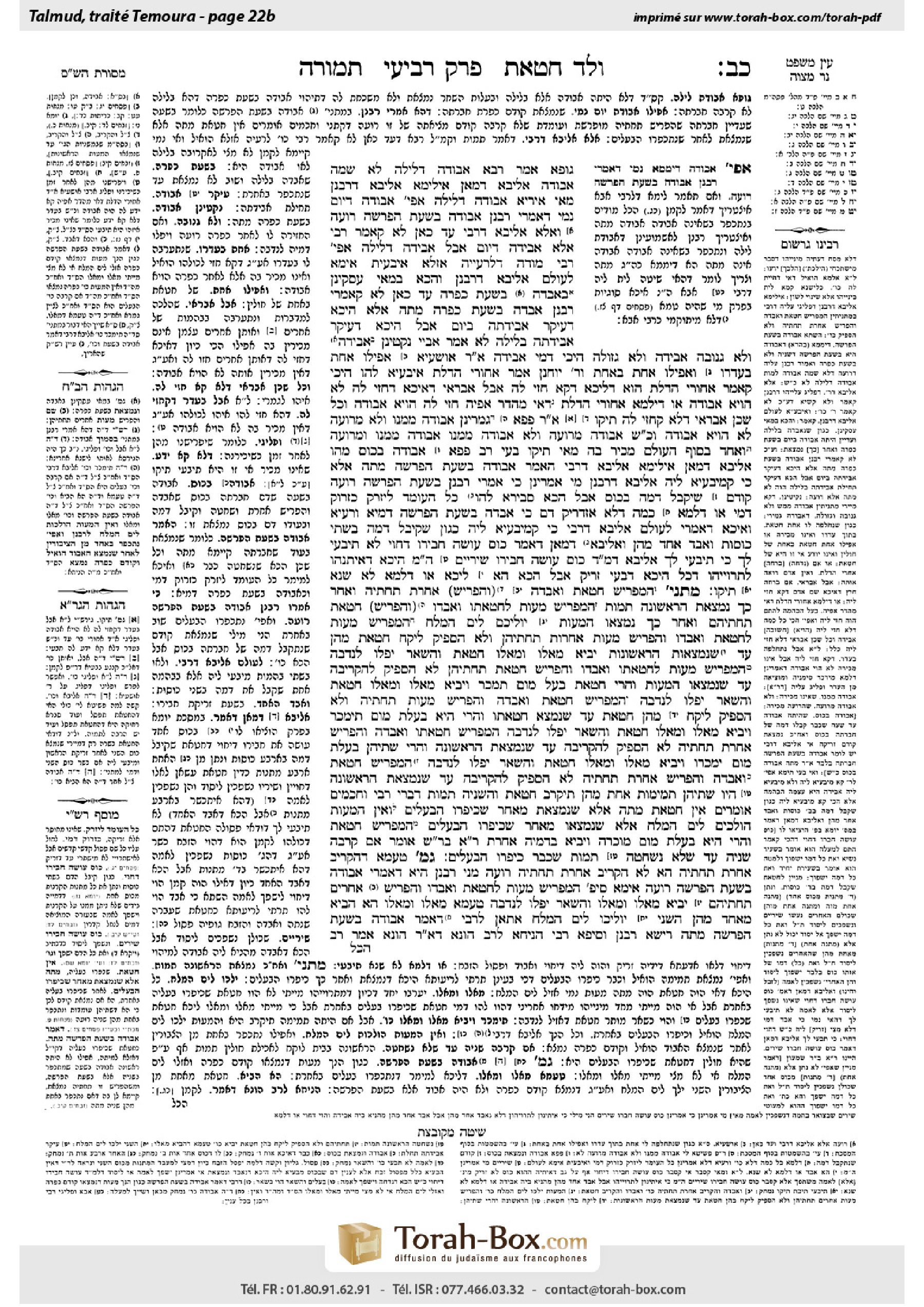
Temurah 22b: Talmud study for Daf Yomi
Daf Yomi is the daily study of one Talmud folio. Explore 37 tractates with scans, Hebrew text, Sefaria English and AI-generated French translations where annotated.
Passage selection and English or AI-generated French translation are available where the scan has annotations. Daf Study is independent of Torah-Box and Sefaria.
Browse Temurah · תמורה · All tractatesTemurah 22b text and translations
This page of Temurah includes the Aramaic text, an English translation and an AI-generated French translation, alongside the scan above.
תמורה כ״ב ב · Aramaic and Hebrew text
גּוּפָא: אָמַר רָבָא: אֲבוּדָה דְּלַיְלָה לָא שְׁמַהּ אֲבוּדָה. אַלִּיבָּא דְּמַאן? אִילֵימָא אַלִּיבָּא דְּרַבָּנַן — מַאי אִירְיָא אֲבוּדָה דְּלַיְלָה? אֲפִילּוּ אֲבוּדָה דְּיוֹם נָמֵי, דְּאָמְרִי רַבָּנַן: אֲבוּדָה בִּשְׁעַת הַפְרָשָׁה רוֹעָה.
וְאֶלָּא, אַלִּיבָּא דְּרַבִּי, עַד כָּאן לָא קָאָמַר רַבִּי אֶלָּא אֲבֵידָה דְּיוֹם, אֲבָל אֲבֵידָה דְּלַיְלָה — אֲפִילּוּ רַבִּי מוֹדֶה דְּלִרְעִיָּיה אָזְלָא.
אִיבָּעֵית אֵימָא: לְעוֹלָם אַלִּיבָּא דְּרַבָּנַן, וְהָכָא בְמַאי עָסְקִינַן — בְּאָבְדָה בִּשְׁעַת כַּפָּרָה. עַד כָּאן לָא קָאָמְרִי רַבָּנַן אָבְדָה בִּשְׁעַת כַּפָּרָה מֵתָה, אֶלָּא הֵיכָא דְּעִיקַּר אֲבֵידָתָהּ בַּיּוֹם, אֲבָל הֵיכָא דְּעִיקַּר אֲבֵידָתָהּ בַּלַּיְלָה — לָא.
אָמַר אַבָּיֵי: נָקְטִינַן, אֲבֵידָה וְלֹא גְּנוּבָה, אֲבֵידָה וְלֹא גְּזוּלָה.
הֵיכִי דָמֵי אֲבֵידָה? אָמַר רַבִּי אוֹשַׁעְיָא: אֲפִילּוּ אַחַת בְּעֶדְרוֹ, וַאֲפִילּוּ אַחַת בְּאַחַת. וְרַבִּי יוֹחָנָן אָמַר: אֲחוֹרֵי הַדֶּלֶת.
אִיבַּעְיָא לְהוּ: הֵיכִי קָאָמַר? אֲחוֹרֵי הַדֶּלֶת הוּא דְּלֵיכָּא דְּקָא חָזֵי לַהּ, אֲבָל אַבָּרַאי דְּאִיכָּא דַּחֲזֵי לַהּ — לָא הָוְיָא אֲבוּדָה, אוֹ דִילְמָא אֲחוֹרֵי הַדֶּלֶת דְּאִי מַהְדַּר אַפֵּיהּ חָזֵי לַהּ — הָוְיָא אֲבוּדָה, וְכׇל שֶׁכֵּן אַבָּרַאי דְּלָא קָחָזֵי לַהּ? תֵּיקוּ.
אָמַר רַב פָּפָּא: גָּמְרִינַן אֲבוּדָה מִמֶּנּוּ וְלֹא מֵרוֹעָהּ — לָא הָוְיָא אֲבוּדָה, וְכׇל שֶׁכֵּן אֲבוּדָה מֵרוֹעָהּ וְלֹא אֲבוּדָה מִמֶּנּוּ. אֲבוּדָה מִמֶּנּוּ וּמֵרוֹעָהּ, וְאֶחָד בְּסוֹף הָעוֹלָם מַכִּיר בָּהּ — מַאי? תֵּיקוּ.
בָּעֵי רַב פָּפָּא: אֲבוּדָה בַּכּוֹס מַהוּ? אַלִּיבָּא דְּמַאן? אִילֵימָא אַלִּיבָּא דְּרַבִּי — הָאָמַר אֲבוּדָה בִּשְׁעַת הַפְרָשָׁה מֵתָה!
אֶלָּא, כִּי קָמִיבַּעְיָא לֵיהּ אַלִּיבָּא דְּרַבָּנַן, מִי אָמְרִינַן: כִּי אָמְרִי רַבָּנַן בִּשְׁעַת הַפְרָשָׁה רוֹעָה, קוֹדֶם שֶׁיְּקַבֵּל דָּמָהּ בַּכּוֹס, אֲבָל הָכָא סְבִירָא לְהוּ: כָּל הָעוֹמֵד לִיזָּרֵק כְּזָרוּק דָּמֵי.
אוֹ דִלְמָא, כְּמָה דְּלָא אִזְדְּרִיק דָּם — כִּי אָבְדָה בִּשְׁעַת הַפְרָשָׁה דָּמְיָא, וְרָעֲיָא.
וְאִיכָּא דְאָמְרִי: לְעוֹלָם אַלִּיבָּא דְּרַבִּי, כִּי קָמִיבַּעְיָא לֵיהּ — כְּגוֹן שֶׁקִּיבֵּל דָּמָהּ בִּשְׁתֵּי כוֹסוֹת, וְאָבַד אֶחָד מֵהֶן.
וְאַלִּיבָּא דְּמַאן דְּאָמַר כּוֹס עוֹשֶׂה חֲבֵירוֹ דָּחוּי — לָא תִּיבְּעֵי לָךְ, כִּי תִּיבְּעֵי לָךְ אַלִּיבָּא דְּמַאן דְּאָמַר כּוֹס עוֹשֶׂה חֲבֵירוֹ שִׁירַיִים.
הָנֵי מִילֵּי — הֵיכָא דְּאִיתַנְהוּ לְתַרְוַיְיהוּ, דְּכֹל הֵיכָא דְּבָעֵי זָרֵיק; אֲבָל הָכָא — הָא לֵיכָּא, אוֹ דִלְמָא לָא שְׁנָא? תֵּיקוּ.
מַתְנִי׳ הַמַּפְרִישׁ חַטָּאת, וְאָבְדָה, וְהִפְרִישׁ אַחֶרֶת תַּחְתֶּיהָ, וְאַחַר כָּךְ נִמְצֵאת הָרִאשׁוֹנָה — תָּמוּת.
הַמַּפְרִישׁ מָעוֹת לְחַטָּאתוֹ, וְאָבְדוּ, וְהִפְרִישׁ חַטָּאת תַּחְתֵּיהֶם, וְאַחַר כָּךְ נִמְצְאוּ הַמָּעוֹת — יוֹלִיכֵם לְיָם הַמֶּלַח.
הַמַּפְרִישׁ מָעוֹת לְחַטָּאת, וְאָבְדוּ, וְהִפְרִישׁ מָעוֹת אֲחֵרוֹת תַּחְתֵּיהֶן, וְלֹא הִסְפִּיק לִיקַּח חַטָּאת מֵהֶן עַד שֶׁנִּמְצְאוּ הָרִאשׁוֹנוֹת — יָבִיא מֵאֵלּוּ וּמֵאֵלּוּ חַטָּאת, וְהַשְּׁאָר יִפְּלוּ לִנְדָבָה.
הַמַּפְרִישׁ מָעוֹת לְחַטָּאתוֹ וְאָבְדוּ, וְהִפְרִישׁ חַטָּאת תַּחְתֵּיהֶן, לֹא הִסְפִּיק לְהַקְרִיבָהּ עַד שֶׁנִּמְצְאוּ הַמָּעוֹת, וַהֲרֵי חַטָּאת בַּעַל מוּם — תִּמָּכֵר, וְיָבִיא מֵאֵלּוּ וּמֵאֵלּוּ חַטָּאת, וְהַשְּׁאָר יִפְּלוּ לִנְדָבָה.
הַמַּפְרִישׁ חַטָּאת וְאָבְדָה, וְהִפְרִישׁ מָעוֹת תַּחְתֶּיהָ, וְלֹא הִסְפִּיק לִיקַּח מֵהֶן חַטָּאת עַד שֶׁנִּמְצָא חַטָּאתוֹ, וַהֲרֵי הִיא בַּעֲלַת מוּם — תִּימָּכֵר, וְיָבִיא מֵאֵלּוּ וּמֵאֵלּוּ חַטָּאת, וְהַשְּׁאָר יִפְּלוּ לִנְדָבָה.
הַמַּפְרִישׁ חַטָּאתוֹ וְאָבְדָה, וְהִפְרִישׁ אַחֶרֶת תַּחְתֶּיהָ, לֹא הִסְפִּיק לְהַקְרִיבָהּ עַד שֶׁנִּמְצֵאת הָרִאשׁוֹנָה, וַהֲרֵי שְׁתֵּיהֶן בַּעֲלַת מוּם — יִמָּכְרוּ, וְיָבִיא מֵאֵלּוּ וּמֵאֵלּוּ חַטָּאת, וְהַשְּׁאָר יִפְּלוּ לִנְדָבָה.
הַמַּפְרִישׁ חַטָּאת, וְאָבְדָה, וְהִפְרִישׁ אַחֶרֶת תַּחְתֶּיהָ, לֹא הִסְפִּיק לְהַקְרִיבָהּ עַד שֶׁנִּמְצֵאת הָרִאשׁוֹנָה, הָיוּ שְׁתֵּיהֶן תְּמִימוֹת — אַחַת מֵהֶן תִּיקְרַב חַטָּאת, וְהַשְּׁנִיָּה תָּמוּת, דִּבְרֵי רַבִּי. וַחֲכָמִים אוֹמְרִים: אֵין חַטָּאת מֵתָה אֶלָּא שֶׁנִּמְצֵאת מֵאַחַר שֶׁכִּיפְּרוּ הַבְּעָלִים, וְאֵין הַמָּעוֹת הוֹלְכִים לְיָם הַמֶּלַח אֶלָּא שֶׁנִּמְצְאוּ מֵאַחַר שֶׁכִּיפְּרוּ הַבְּעָלִים.
הַמַּפְרִישׁ חַטָּאת, וַהֲרֵי הִיא בַּעֲלַת מוּם — מוֹכְרָהּ, וְיָבִיא בְּדָמֶיהָ אַחֶרֶת. רַבִּי אֶלְעָזָר בְּרַבִּי שִׁמְעוֹן אוֹמֵר: אִם קָרְבָה שְׁנִיָּה עַד שֶׁלֹּא נִשְׁחֲטָה — תָּמוּת, שֶׁכְּבָר כִּיפְּרוּ הַבְּעָלִים.
גְּמָ׳ טַעְמָא דְּהִקְרִיב אַחֶרֶת תַּחְתֶּיהָ, הָא לֹא הִקְרִיב אַחֶרֶת תַּחְתֶּיהָ — רוֹעָה. מַנִּי? רַבָּנַן הִיא, דְּאָמְרִי: אֲבוּדָה בִּשְׁעַת הַפְרָשָׁה — רוֹעָה.
אֵימָא סֵיפָא: הַמַּפְרִישׁ מָעוֹת לְחַטָּאת וְאָבְדוּ וְהִפְרִישׁ אֲחֵרִים תַּחְתֵּיהֶם — יָבִיא מֵאֵלּוּ וּמֵאֵלּוּ, וְהַשְּׁאָר יִפְּלוּ לִנְדָבָה. טַעְמָא מֵאֵלּוּ וּמֵאֵלּוּ, הָא הֵבִיא מֵאֶחָד מֵהֶן — הַשֵּׁנִי יוֹלִיכוֹ לְיָם הַמֶּלַח. אֲתָאן לְרַבִּי, דְּאָמַר: אֲבוּדָה בִּשְׁעַת הַפְרָשָׁה מֵתָה.
רֵישָׁא רַבָּנַן, וְסֵיפָא רַבִּי?! הָנִיחָא לְרַב הוּנָא, דְּאָמַר רַב הוּנָא אָמַר רַב:
Temurah 22b · English translation
§ The Gemara discusses the matter itself, which was cited above: Rava said: A sin offering lost at night, when one cannot sacrifice an offering, is not called lost. Provided that the offering is found before morning, then even if the owner designated another sin offering in its stead, the first sin offering is not left to die. The Gemara asks: In accordance with whose opinion is this statement? If we say that it is in accordance with the opinion of the Rabbis, who maintain that a sin offering is not left to die unless the owner achieved atonement with another offering, why does Rava specifically mention that it was lost at night? Even if it was lost during the day it is not left to die, as the Rabbis say: A sin offering that was lost at the time when another animal was designated in its stead, but was found before this second animal was sacrificed, is left to graze until it develops a blemish.
Rather, you must say that it is in accordance with the opinion of Rabbi Yehuda HaNasi, who maintains that if a sin offering was lost at the time when another animal was designated in its stead, the first sin offering is left to die even if it was found before the second animal was sacrificed. Rava teaches that Rabbi Yehuda HaNasi states his opinion only with regard to an animal lost during the day, but if the animal was lost only at night, even Rabbi Yehuda HaNasi concedes that it goes to graze and is not left to die.
If you wish, say: Actually, Rava’s statement is in accordance with the opinion of the Rabbis. And as for the question of why Rava specifies that it is lost only at night when the same halakha should apply even if it was lost during the day, one may respond: Here we are dealing with an animal that is still lost at the time when the owner achieves atonement with another animal. Rava teaches that when the Rabbis say that a sin offering that remained lost at the time when the owner achieved atonement with another animal is left to die, this applies only where the initial loss of the animal was during the day, when the animal could have been sacrificed. But in a case where the initial loss of the animal was at night, it is not left to die. According to this interpretation, Rava is not merely saying that a sin offering is not classified as lost provided that it is found before morning. Rather, he maintains if it was initially lost at night it is never considered lost at all.
§ With regard to this matter, Abaye said: We have a tradition that a sin offering that was lost is left to die, but not a sin offering that was stolen; a sin offering that was lost is left to die, but not a sin offering that was robbed. If a sin offering was stolen or robbed, and the animal was returned after the owner achieved atonement with another animal, the first sin offering is left to graze until it develops a blemish, after which it is sold, and the proceeds are used to purchase a gift offering.
The Gemara asks: What are the circumstances in which an animal is considered to be lost? Rabbi Oshaya says: Even one sin offering intermingled with other animals in the owner’s flock, to the extent that he cannot discern which animal is the sin offering, is considered lost. And even one sin offering intermingled with one non-sacred animal, so that the owner does not know which is the sin offering, is considered lost. And Rabbi Yoḥanan says: An animal found behind the door is considered to have been lost.
A dilemma was raised before the Sages with regard to the statement of Rabbi Yoḥanan: With regard to what case is he speaking? Does Rabbi Yoḥanan mean that it is only when the animal is found behind the door that it is considered to have been lost, as there is no one who sees it, but if the animal was outside and was intermingled with other animals, where there are people who see it, it is not considered to be lost? Or perhaps Rabbi Yoḥanan means that even when the animal is found behind the door, where if he would turn his face he would see it, the animal is considered lost, and all the more so if the animal was outside, where he does not see it, it is considered lost. Since no resolution is offered, the Gemara concludes: The dilemma shall stand unresolved.
The Gemara further discusses a sin offering that was lost. Rav Pappa said: We learn through tradition that if a sin offering is lost from the owner but is not lost from the shepherd of the flock, i.e., the shepherd knows which animal is the sin offering, it is not considered lost. And all the more so, if the animal is lost from the shepherd but not lost from the owner, it is not considered lost. The Gemara asks: If the sin offering was lost from the owner and the shepherd, but there is one individual located far away, even at the end of the world, who recognizes the animal, what is the halakha? Again the Gemara concludes: The dilemma shall stand unresolved.
§ Rav Pappa raises a dilemma: In a case where a sin offering was lost, and the owner designated another sin offering in its stead, and the second sin offering was slaughtered, what is the halakha if the original sin offering was found after the blood of the second offering was collected in a cup and stands ready to be sprinkled upon the altar? The Gemara asks: In accordance with whose opinion does Rav Pappa raise this dilemma? If we say that he raises it in accordance with the opinion of Rabbi Yehuda HaNasi, this cannot be correct, as didn’t Rabbi Yehuda HaNasi say that even a sin offering that was lost at the time when another animal was merely designated in its stead is left to die?
Rather, when Rav Pappa raises the dilemma, he does so according to the opinion of the Rabbis, and the dilemma is as follows: Do we say that when the Rabbis said: A sin offering that was lost at the time when another animal was designated in its stead is left to graze, this applies only if the original animal was found before one collects the blood of the other sin offering in a cup; but here, where the other sin offering was already slaughtered and its blood was collected in a cup, the Rabbis hold: Any blood that stands ready to be sprinkled upon the altar is considered like it has already been sprinkled, and it is as though the owner has achieved atonement? If so, this sin offering that was found after the collection of the blood should be left to die.
Or perhaps the Rabbis maintain that as long as the blood has not been sprinkled on the altar, it is still considered like a case where the original offering was lost at the time when another animal was designated in its stead but was found by the time the second offering was brought to the altar. If so, as the first sin offering was found before the sprinkling of the blood, it should be left to graze until it develops a blemish.
And there are those who say an alternate explanation of the dilemma: Actually, Rav Pappa raises his dilemma according to the opinion of Rabbi Yehuda HaNasi. And when Rav Pappa raises the dilemma, it is not with regard to a case involving two sin offerings, as described above. Rather, it is with regard to a case where the original sin offering was slaughtered and the priest collected its blood in two cups, and one of them was lost at the time when the priest sprinkled the blood of the remaining cup.
The Gemara elaborates: And you should not raise the dilemma according to the opinion of the one who said that when blood is collected in two cups, one cup renders the blood of the other cup rejected, as in such a case, the entire offering is disqualified. Rather, when should you raise the dilemma? Raise it according to the opinion of the one who says that one cup renders the other cup a remainder, i.e., the blood in the second cup is considered the remainder of the first cup and is poured out at the base of the altar.
The dilemma is as follows: Do we say that this statement, that the second cup is considered the remainder of the first cup, applies only in a case where both cups are present, since with whichever cup the priest wants, he may sprinkle; but here, since one of the cups is not present, the missing cup is therefore considered rejected and the offering is disqualified? Or perhaps it makes no difference whether both cups are present or not. The Gemara concludes: The dilemma shall stand unresolved.
MISHNA: In the case of one who designates a sin offering, and the animal was lost, and he designated another in its stead and sacrificed it, and thereafter the first animal was found; that is a sin offering whose owner achieved atonement with another animal, and it shall be left to die.
In the case of one who designates money for purchase of his sin offering, and the money was lost,and he designated an animal as a sin offering in its stead, and he sacrificed it, and thereafter, the money was found, it is prohibited to derive benefit from the money, as the money attains the halakhic status of the sin offering that was to be purchased with it, and that sin offering would be left to die because the owner achieved atonement with another animal. Therefore, he must take the money and cast it into the Dead Sea, from where it cannot be recovered.
In the case of one who designates money for purchase of his sin offering, and the money was lost, and he designated other money in its stead, and he did not manage to purchase a sin offering with that money before the original money was found, he should bring a sin offering from a combination of this original money and that money designated in its stead, and the remainder shall be allocated for communal gift offerings.
In the case of one who designates money for purchase of his sin offering, and the money was lost, and he designated an animal as a sin offering in its stead, and he did not manage to sacrifice the animal before the money was found, and the animal that he designated as a sin offering is blemished, the animal shall be sold; and he brings a sin offering from a combination of this original money and that money received for the sale of the blemished animal, and the remainder shall be allocated for communal gift offerings.
In the case of one who designates a sin offering and the animal was lost, and he designated money in its stead, and he did not manage to purchase a sin offering with that money before his sin offering was found, and the animal is blemished, the animal shall be sold; and he brings a sin offering from a combination of this money that he designated and that money received for the sale of the blemished animal, and the remainder shall be allocated for communal gift offerings.
In the case of one who designates his sin offering and the animal was lost, and he designated another animal in its stead, and he did not manage to sacrifice the sin offering before the first sin offering was found, and both of the animals are blemished, the animals shall be sold; and he brings a sin offering from a third animal that he buys with a combination of the money from the sale of this animal and from the sale of that animal, and the remainder shall be allocated for communal gift offerings.
In the case of one who designates his sin offering and the animal was lost, and he designated another animal in its stead, and he did not manage to sacrifice the sin offering before the first sin offering was found, and both of the animals are unblemished and fit for sacrifice, one of them shall be sacrificed as a sin offering and the other shall be left to die; this is the statement of Rabbi Yehuda HaNasi. And the Rabbis say: A sin offering is not left to die unless it was found after its owner achieved atonement; and the money is not taken to the Dead Sea unless it was found after its owner achieved atonement.
In the case of one who designates a sin offering and the animal is blemished, he sells the animal and must bring another sin offering with the money received in its sale. Rabbi Elazar, son of Rabbi Shimon, says: If the second animal is sacrificed before the first is slaughtered for non-sacred consumption, the first animal shall be left to die. Although it was sold and rendered non-sacred, its status is now that of a sin offering whose owner already achieved atonement with another animal.
GEMARA: The first clause of the mishna states that if one designated an animal as a sin offering and the animal was lost, and he sacrificed another animal in its stead, and subsequently the first animal was found, it is left to die. The Gemara infers: The reason the animal is left to die is that he sacrificed another animal in its stead; but if he did not sacrifice another in its stead, and instead merely designated it, then the original sin offering is left to graze. In accordance with whose opinion is this statement? It is in accordance with the opinion of the Rabbis, who say that if a sin offering was lost at the time when another animal was designated in its stead, the original sin offering is left to graze.
The Gemara continues: But now say the latter clause of the mishna: In the case of one who designates money for purchase of his sin offering, and the money was lost, and he designated other money in its stead, he should bring a sin offering from a combination of this original money and that money designated in its stead, and the remainder shall be allocated for communal gift offerings. One may infer that the reason that the remainder is allocated for communal gift offerings is that he brings a sin offering from a combination of this original money and that money designated in its stead; but if the owner brought a sin offering from one of the two sums of money, he must take the other sum of money and cast it into the Dead Sea. If so, we arrive at the opinion of Rabbi Yehuda HaNasi, who said: A sin offering that was lost at the time when another animal was designated in its stead is left to die.
The Gemara asks: Can it be that the first clause of the mishna is in accordance with the opinion of the Rabbis, while the latter clause is in accordance with the opinion of Rabbi Yehuda HaNasi? The Gemara notes: This works out well according to Rav Huna, as Rav Huna said that Rav said:
Temurah 22b · Traduction française (IA)
§ La Guemara revient sur le sujet lui-même, cité plus haut. Rava a dit : Une offrande expiatoire égarée pendant la nuit, alors qu’il est impossible de sacrifier une offrande, n’est pas considérée comme égarée. Si elle est retrouvée avant le matin, même si son propriétaire a désigné une autre offrande expiatoire à sa place, la première n’est pas laissée à mourir. La Guemara demande : Selon l’opinion de qui cette déclaration est-elle formulée ? Si l’on dit qu’elle suit l’opinion des Rabbins, qui soutiennent qu’une offrande expiatoire n’est laissée à mourir que si son propriétaire a obtenu l’expiation grâce à une autre offrande, pourquoi Rava précise-t-il qu’elle s’est égarée pendant la nuit ? Même si elle s’était égarée pendant la journée, elle ne serait pas laissée à mourir, car les Rabbins disent : Une offrande expiatoire qui s’est égarée au moment où un autre animal a été désigné à sa place, mais qui a été retrouvée avant que ce second animal soit sacrifié, est laissée au pâturage jusqu’à ce qu’elle présente un défaut.
Il faut plutôt dire que cette déclaration suit l’opinion de Rabbi Yehouda HaNassi, qui soutient que si une offrande expiatoire s’est égarée au moment où un autre animal a été désigné à sa place, la première est laissée à mourir, même si elle a été retrouvée avant le sacrifice du second animal. Rava enseigne que Rabbi Yehouda HaNassi n’exprime son opinion qu’au sujet d’un animal égaré pendant la journée ; si l’animal ne s’est égaré que pendant la nuit, même Rabbi Yehouda HaNassi reconnaît qu’il est laissé au pâturage et non à mourir.
Si l’on veut, on peut dire qu’en réalité, la déclaration de Rava suit l’opinion des Rabbins. Quant à la question de savoir pourquoi Rava précise que l’animal ne s’est égaré que pendant la nuit, alors que la même halakha devrait s’appliquer même s’il s’était égaré pendant la journée, on peut répondre : le cas envisagé ici est celui d’un animal qui est toujours égaré au moment où son propriétaire obtient l’expiation grâce à un autre animal. Rava enseigne que lorsque les Rabbins disent qu’une offrande expiatoire restée égarée au moment où son propriétaire a obtenu l’expiation grâce à un autre animal est laissée à mourir, cela ne s’applique que si l’animal s’est égaré initialement pendant la journée, alors qu’il aurait pu être sacrifié. Mais si l’animal s’est égaré initialement pendant la nuit, il n’est pas laissé à mourir. Selon cette interprétation, Rava ne dit pas seulement qu’une offrande expiatoire n’est pas considérée comme égarée à condition d’être retrouvée avant le matin. Il soutient plutôt que, si elle s’est égarée initialement pendant la nuit, elle n’est jamais considérée comme égarée.
§ À ce sujet, Abaye a dit : Nous avons reçu la tradition qu’une offrande expiatoire égarée est laissée à mourir, mais pas une offrande expiatoire volée ; une offrande expiatoire égarée est laissée à mourir, mais pas une offrande expiatoire dérobée. Si une offrande expiatoire a été volée ou dérobée et que l’animal est rendu après que son propriétaire a obtenu l’expiation grâce à un autre animal, la première offrande expiatoire est laissée au pâturage jusqu’à ce qu’elle présente un défaut ; elle est alors vendue, et le produit de la vente sert à acheter une offrande volontaire.
La Guemara demande : Dans quelles circonstances un animal est-il considéré comme égaré ? Rabbi Oshaya dit : Même une seule offrande expiatoire mêlée aux autres animaux du troupeau de son propriétaire, au point que celui-ci ne peut pas discerner quel animal est l’offrande expiatoire, est considérée comme égarée. De même, une seule offrande expiatoire mêlée à un seul animal non consacré, de sorte que le propriétaire ignore lequel des deux est l’offrande expiatoire, est considérée comme égarée. Rabbi Yoḥanan dit : Un animal trouvé derrière la porte est considéré comme s’étant égaré.
Les Sages ont soulevé un dilemme au sujet de la déclaration de Rabbi Yoḥanan : De quel cas parle-t-il ? Veut-il dire que l’animal n’est considéré comme égaré que lorsqu’il est trouvé derrière la porte, car personne ne le voit, mais que s’il se trouvait dehors et était mêlé à d’autres animaux, là où des gens peuvent le voir, il n’est pas considéré comme égaré ? Ou peut-être Rabbi Yoḥanan veut-il dire que même lorsque l’animal est trouvé derrière la porte, là où son propriétaire le verrait s’il tournait la tête, il est considéré comme égaré ; à plus forte raison, s’il se trouvait dehors, là où son propriétaire ne le voit pas, est-il considéré comme égaré. Comme aucune solution n’est proposée, la Guemara conclut : Le dilemme reste sans solution.
La Guemara poursuit son examen d’une offrande expiatoire égarée. Rav Pappa a dit : Nous avons appris par tradition que si une offrande expiatoire est égarée pour son propriétaire, mais ne l’est pas pour le berger du troupeau, c’est-à-dire si le berger sait quel animal est l’offrande expiatoire, elle n’est pas considérée comme égarée. À plus forte raison, si elle est égarée pour le berger, mais pas pour le propriétaire, elle n’est pas considérée comme égarée. La Guemara demande : Si l’offrande expiatoire est égarée pour le propriétaire et pour le berger, mais qu’une personne, située très loin, même à l’autre bout du monde, reconnaît l’animal, quelle est la halakha ? Là encore, la Guemara conclut : Le dilemme reste sans solution.
§ Rav Pappa soulève un dilemme : Dans le cas où une offrande expiatoire s’est égarée, où le propriétaire a désigné une autre offrande expiatoire à sa place et où cette seconde offrande a été égorgée, quelle est la halakha si l’offrande expiatoire initiale est retrouvée après que le sang de la seconde offrande a été recueilli dans une coupe et est prêt à être aspergé sur l’autel ? La Guemara demande : Selon l’opinion de qui Rav Pappa soulève-t-il ce dilemme ? Si l’on dit qu’il le soulève selon l’opinion de Rabbi Yehouda HaNassi, cela ne peut pas convenir, car Rabbi Yehouda HaNassi n’a-t-il pas dit que même une offrande expiatoire qui s’est égarée au moment où un autre animal a simplement été désigné à sa place est laissée à mourir ?
Il faut plutôt dire que Rav Pappa soulève ce dilemme selon l’opinion des Rabbins. Le dilemme est le suivant : faut-il dire que, lorsque les Rabbins ont dit qu’une offrande expiatoire qui s’est égarée au moment où un autre animal a été désigné à sa place est laissée au pâturage, cela ne s’applique que si l’animal initial est retrouvé avant que le sang de l’autre offrande expiatoire soit recueilli dans une coupe ? Mais ici, où l’autre offrande expiatoire a déjà été égorgée et où son sang a été recueilli dans une coupe, les Rabbins soutiennent-ils que tout sang prêt à être aspergé sur l’autel est considéré comme s’il avait déjà été aspergé, de sorte que le propriétaire est comme s’il avait déjà obtenu l’expiation ? Dans ce cas, cette offrande expiatoire, retrouvée après le recueil du sang, devrait être laissée à mourir.
Ou peut-être les Rabbins soutiennent-ils que tant que le sang n’a pas été aspergé sur l’autel, le cas est encore comparable à celui où l’offrande initiale s’était égarée au moment où un autre animal avait été désigné à sa place, mais avait été retrouvée au moment où la seconde offrande était apportée à l’autel. Dans ce cas, puisque la première offrande expiatoire a été retrouvée avant l’aspersion du sang, elle devrait être laissée au pâturage jusqu’à ce qu’elle présente un défaut.
Certains donnent une autre explication du dilemme : en réalité, Rav Pappa le soulève selon l’opinion de Rabbi Yehouda HaNassi. Toutefois, le dilemme qu’il soulève ne porte pas sur un cas impliquant deux offrandes expiatoires, comme décrit plus haut. Il porte plutôt sur le cas où l’offrande expiatoire initiale a été égorgée et où le prêtre a recueilli son sang dans deux coupes ; l’une d’elles s’est égarée au moment où le prêtre aspergeait le sang contenu dans l’autre coupe.
La Guemara précise : Il ne faut pas soulever le dilemme selon l’opinion de celui qui dit que, lorsque le sang est recueilli dans deux coupes, l’une rend l’autre coupe rejetée, car dans un tel cas toute l’offrande est invalidée. Mais selon quelle opinion faut-il soulever le dilemme ? Selon celle de celui qui dit qu’une coupe fait de l’autre un reste, c’est-à-dire que le sang de la seconde coupe est considéré comme le reste de celui de la première et est versé à la base de l’autel.
Le dilemme est le suivant : faut-il dire que cette règle, selon laquelle la seconde coupe est considérée comme le reste de la première, ne s’applique que lorsque les deux coupes sont présentes, puisque le prêtre peut asperger le sang de la coupe de son choix ? Mais ici, puisque l’une des coupes est absente, la coupe manquante est donc considérée comme rejetée et l’offrande est invalidée. Ou peut-être cela ne fait-il aucune différence que les deux coupes soient présentes ou non ? La Guemara conclut : Le dilemme reste sans solution.
MICHNA : Dans le cas de quelqu’un qui désigne une offrande expiatoire dont l’animal s’égare, puis en désigne une autre à sa place et la sacrifie, après quoi le premier animal est retrouvé : il s’agit d’une offrande expiatoire dont le propriétaire a obtenu l’expiation grâce à un autre animal, et elle doit être laissée à mourir.
Dans le cas de quelqu’un qui désigne une somme d’argent pour acheter son offrande expiatoire, puis perd cette somme, désigne un animal comme offrande expiatoire à sa place et le sacrifie, après quoi la somme initiale est retrouvée : il est interdit de tirer profit de cet argent, car celui-ci acquiert le statut halakhique de l’offrande expiatoire qu’il devait servir à acheter, et cette offrande expiatoire aurait été laissée à mourir, puisque le propriétaire a obtenu l’expiation grâce à un autre animal. Il doit donc prendre l’argent et le jeter dans la mer Morte, d’où il ne pourra pas être récupéré.
Dans le cas de quelqu’un qui désigne une somme d’argent pour acheter son offrande expiatoire, puis perd cette somme et en désigne une autre à sa place, mais n’a pas le temps d’acheter une offrande expiatoire avec cette autre somme avant que la somme initiale soit retrouvée, il doit apporter une offrande expiatoire financée conjointement par la somme initiale et par celle désignée à sa place ; le reste sera affecté à des offrandes volontaires de la communauté.
Dans le cas de quelqu’un qui désigne une somme d’argent pour acheter son offrande expiatoire, puis perd cette somme, désigne un animal comme offrande expiatoire à sa place, mais n’a pas le temps de sacrifier l’animal avant que la somme initiale soit retrouvée, et que l’animal désigné comme offrande expiatoire présente un défaut : l’animal sera vendu. Il apportera une offrande expiatoire financée conjointement par la somme initiale et par le produit de la vente de l’animal présentant un défaut ; le reste sera affecté à des offrandes volontaires de la communauté.
Dans le cas de quelqu’un qui désigne une offrande expiatoire dont l’animal s’égare, puis désigne de l’argent à sa place, mais n’a pas le temps d’acheter une offrande expiatoire avec cet argent avant que l’animal de l’offrande initiale soit retrouvé et que celui-ci présente un défaut : l’animal sera vendu. Il apportera une offrande expiatoire financée conjointement par la somme qu’il a désignée et par le produit de la vente de l’animal présentant un défaut ; le reste sera affecté à des offrandes volontaires de la communauté.
Dans le cas de quelqu’un qui désigne une offrande expiatoire dont l’animal s’égare, puis désigne un autre animal à sa place, mais n’a pas le temps de sacrifier l’offrande expiatoire avant que le premier animal soit retrouvé et que les deux animaux présentent un défaut : les animaux seront vendus. Il apportera une offrande expiatoire au moyen d’un troisième animal, qu’il achètera avec le produit de la vente de l’un et de l’autre animal ; le reste sera affecté à des offrandes volontaires de la communauté.
Dans le cas de quelqu’un qui désigne une offrande expiatoire dont l’animal s’égare, puis désigne un autre animal à sa place, mais n’a pas le temps de sacrifier l’offrande expiatoire avant que le premier animal soit retrouvé, et que les deux animaux soient sans défaut et aptes au sacrifice : l’un sera sacrifié comme offrande expiatoire et l’autre sera laissé à mourir. Telle est la déclaration de Rabbi Yehouda HaNassi. Les Rabbins disent : Une offrande expiatoire n’est laissée à mourir que si elle a été retrouvée après que son propriétaire a obtenu l’expiation ; et l’argent n’est jeté dans la mer Morte que s’il a été retrouvé après que son propriétaire a obtenu l’expiation.
Dans le cas de quelqu’un qui désigne une offrande expiatoire dont l’animal présente un défaut, il vend l’animal et doit apporter une autre offrande expiatoire avec le produit de sa vente. Rabbi Elazar, fils de Rabbi Shimon, dit : Si le second animal est sacrifié avant que le premier ne soit égorgé pour être consommé comme aliment non consacré, le premier animal sera laissé à mourir. Bien qu’il ait été vendu et soit devenu non consacré, il a désormais le statut d’une offrande expiatoire dont le propriétaire a déjà obtenu l’expiation grâce à un autre animal.
GUEMARA : La première partie de la Michna dit que si quelqu’un a désigné un animal comme offrande expiatoire, que celui-ci s’est égaré, qu’il en a sacrifié un autre à sa place, puis que le premier animal a été retrouvé, celui-ci est laissé à mourir. La Guemara en déduit que l’animal est laissé à mourir parce qu’un autre animal a été sacrifié à sa place ; mais si le propriétaire n’en a pas sacrifié un autre et s’est contenté d’en désigner un, l’offrande expiatoire initiale est laissée au pâturage. Selon l’opinion de qui cette déclaration est-elle formulée ? Selon l’opinion des Rabbins, qui disent que si une offrande expiatoire s’est égarée au moment où un autre animal a été désigné à sa place, l’offrande expiatoire initiale est laissée au pâturage.
La Guemara poursuit : Mais considérons maintenant la dernière partie de la Michna : dans le cas de quelqu’un qui désigne une somme d’argent pour acheter son offrande expiatoire, puis perd cette somme et en désigne une autre à sa place, il doit apporter une offrande expiatoire financée conjointement par la somme initiale et par celle désignée à sa place ; le reste sera affecté à des offrandes volontaires de la communauté. On peut en déduire que le reste est affecté à des offrandes volontaires de la communauté parce qu’il apporte une offrande expiatoire financée conjointement par ces deux sommes ; mais si le propriétaire a apporté une offrande expiatoire financée par l’une des deux sommes, il doit prendre l’autre somme et la jeter dans la mer Morte. Nous arrivons donc à l’opinion de Rabbi Yehouda HaNassi, qui a dit : Une offrande expiatoire qui s’est égarée au moment où un autre animal a été désigné à sa place est laissée à mourir.
La Guemara demande : Se peut-il que la première partie de la Michna suive l’opinion des Rabbins, tandis que la dernière partie suit celle de Rabbi Yehouda HaNassi ? La Guemara relève que cela convient selon Rav Houna, car Rav Houna a dit au nom de Rav :
Traduction française générée par IA à partir de l’édition anglaise de Sefaria. Vérifie toujours un passage avec le texte source.
Text from Sefaria: William Davidson Edition - Vocalized Aramaic (CC BY NC); William Davidson Edition - English (CC BY NC).