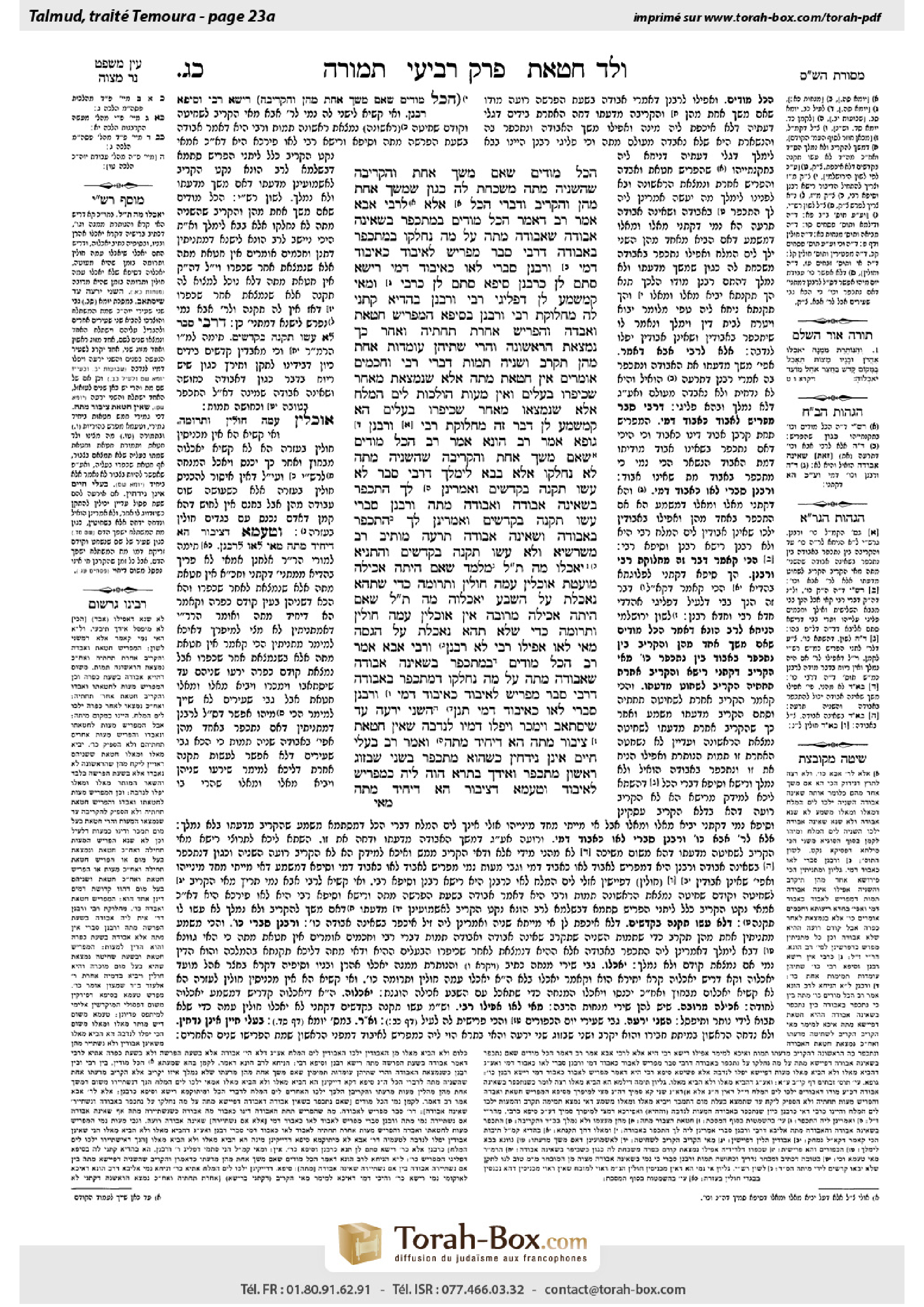
Temurah 23a: Talmud study for Daf Yomi
Daf Yomi is the daily study of one Talmud folio. Explore 37 tractates with scans, Hebrew text, Sefaria English and AI-generated French translations where annotated.
Passage selection and English or AI-generated French translation are available where the scan has annotations. Daf Study is independent of Torah-Box and Sefaria.
Browse Temurah · תמורה · All tractatesTemurah 23a text and translations
This page of Temurah includes the Aramaic text, an English translation and an AI-generated French translation, alongside the scan above.
תמורה כ״ג א · Aramaic and Hebrew text
הַכֹּל מוֹדִים שֶׁאִם מָשַׁךְ אַחַת וְהִקְרִיבָהּ שֶׁהַשְּׁנִיָּה מֵתָה, מַשְׁכַּחַתְּ לָהּ כְּגוֹן שֶׁמָּשַׁךְ אַחַת מֵהֶן וְהִקְרִיב, וְדִבְרֵי הַכֹּל.
אֶלָּא לְרַבִּי אַבָּא אָמַר רַב, דְּאָמַר: הַכֹּל מוֹדִים בְּמִתְכַּפֵּר בְּשֶׁאֵינָהּ אֲבוּדָה — שֶׁאֲבוּדָה מֵתָה. עַל מָה נֶחְלְקוּ? בְּמִתְכַּפֵּר בַּאֲבוּדָה, דְּרַבִּי סָבַר: מַפְרִישׁ לְאִיבּוּד כְּאִיבּוּד דָּמֵי, וְרַבָּנַן סָבְרִי: לָאו כְּאִיבּוּד דָּמֵי.
רֵישָׁא סְתַם לַן כְּרַבָּנַן, סֵיפָא סְתַם לַן כְּרַבִּי.
וּמַאי קָמַשְׁמַע לַן, דִּפְלִיגִי רַבִּי וְרַבָּנַן? בְּהֶדְיָא קָתָנֵי לַהּ מַחְלוֹקֶת רַבִּי וְרַבָּנַן בְּסֵיפָא: הַמַּפְרִישׁ חַטָּאת וְאָבְדָה, וְהִפְרִישׁ אַחֶרֶת תַּחְתֶּיהָ, וְאַחַר כָּךְ נִמְצֵאת הָרִאשׁוֹנָה, וַהֲרֵי שְׁתֵּיהֶן עוֹמְדוֹת — אַחַת מֵהֶן תִּקְרַב, וּשְׁנִיָּה תָּמוּת, דִּבְרֵי רַבִּי. וַחֲכָמִים אוֹמְרִים: אֵין חַטָּאת מֵתָה אֶלָּא שֶׁנִּמְצֵאת מֵאַחַר שֶׁכִּיפְּרוּ בְּעָלִים, וְאֵין מָעוֹת הוֹלְכוֹת לְיָם הַמֶּלַח אֶלָּא שֶׁנִּמְצְאוּ מֵאַחַר שֶׁכִּיפְּרוּ בְּעָלִים!
הָא קָמַשְׁמַע לַן, דָּבָר זֶה מַחְלוֹקֶת רַבִּי וְרַבָּנַן.
גּוּפָא, אָמַר רַב הוּנָא, אָמַר רַב: הַכֹּל מוֹדִים שֶׁאִם מָשַׁךְ אַחַת וְהִקְרִיבָהּ — שֶׁהַשְּׁנִיָּה מֵתָה. לֹא נֶחְלְקוּ אֶלָּא בְּבָא לִימָּלֵךְ, דְּרַבִּי סָבַר: לֹא עָשׂוּ תַּקָּנָה בְּקָדָשִׁים, וְאָמְרִינַן לָךְ הִתְכַּפֵּר בְּשֶׁאֵינָהּ אֲבוּדָה, וַאֲבוּדָה מֵתָה. וְרַבָּנַן סָבְרִי: עָשׂוּ תַּקָּנָה בַּקֳּדָשִׁים, וְאָמְרִינַן לָךְ הִתְכַּפֵּר בַּאֲבוּדָה, וְשֶׁאֵינָהּ אֲבוּדָה תִּרְעֶה.
מוֹתֵיב רַב מְשַׁרְשְׁיָא: וְלֹא עָשׂוּ תַּקָּנָה בַּקֳּדָשִׁים? וְהָתַנְיָא: ״יֹאכְלוּ״, מָה תַּלְמוּד לוֹמַר? מְלַמֵּד שֶׁאִם הָיְתָה אֲכִילָה מוּעֶטֶת, אוֹכְלִין עִמָּהּ חוּלִּין וּתְרוּמָה, כְּדֵי שֶׁתְּהֵא נֶאֱכֶלֶת עַל הַשָּׂבָע.
״יֹאכְלוּהָ״, מָה תַּלְמוּד לוֹמַר? שֶׁאִם הָיְתָה אֲכִילָה מְרוּבָּה, אֵין אוֹכְלִין עִמָּהּ חוּלִּין וּתְרוּמָה, כְּדֵי שֶׁלֹּא תְּהֵא נֶאֱכֶלֶת עַל הַגַּסָּה.
מַאי לַָאו אֲפִילּוּ רַבִּי? לָא, רַבָּנַן.
וְרַבִּי אַבָּא אָמַר רַב: הַכֹּל מוֹדִים בְּמִתְכַּפֵּר בְּשֶׁאֵינָהּ אֲבוּדָה, שֶׁאֲבוּדָה מֵתָה. עַל מָה נֶחְלְקוּ? דְּמִתְכַּפֵּר בַּאֲבוּדָה, דְּרַבִּי סָבַר: מַפְרִישׁ לְאִיבּוּד כְּאִיבּוּד דָּמֵי, וְרַבָּנַן סָבְרִי: לָאו כְּאִיבּוּד דָּמֵי.
תְּנַן: הַשֵּׁנִי יִרְעֶה עַד שֶׁיִּסְתָּאֵב, וְיִמָּכֵר, וְיִפְּלוּ דָּמָיו לִנְדָבָה, שֶׁאֵין חַטַּאת צִיבּוּר מֵתָה. הָא דְּיָחִיד — מֵתָה.
וְאָמַר רַב: בַּעֲלֵי חַיִּים אֵינָן נִידְחִין, כְּשֶׁהוּא מִתְכַּפֵּר בְּשֵׁנִי שֶׁבְּזוּג רִאשׁוֹן מִתְכַּפֵּר, וְאִידַּךְ בָּתְרָא הֲוָה לֵיהּ כְּמַפְרִישׁ לְאִיבּוּד, וְטַעְמָא דְּצִיבּוּר, הָא דְּיָחִיד מֵתָה.
Temurah 23a · English translation
All concede, even the Rabbis, that if the owner did not consult the court about which animal to sacrifice, but instead he took one of the animals and sacrificed it, he has demonstrated a lack of concern for the fate of the remaining animal, and that therefore the second animal is left to die. Consequently, you find that both clauses of the mishna are consistent with the opinion of the Rabbis, as one may interpret the latter clause as referring to a case where the owner took one of the two sums of money, used it to purchase an animal, and sacrificed the animal, and in such a case, all agree that the other sum of money is cast into the Dead Sea.
But according to that which Rabbi Abba says that Rav says, the mishna cannot be interpreted in this manner. As Rabbi Abba said: All concede that in a case where one achieves atonement through the one that was not lost, the one that was lost is left to die. With regard to what case do the Rabbis and Rabbi Yehuda HaNasi disagree? They disagree with regard to the case of one who achieves atonement with the one that was lost. As Rabbi Yehuda HaNasi holds that if one designates a sin offering instead of one that was lost, it is considered like the lost sin offering. Accordingly, just as the lost animal is left to die if the second sin offering was sacrificed, the replacement animal is left to die if the original animal was sacrificed. And the Rabbis hold that if one designates a sin offering instead of one that was lost, it is not considered like the lost animal. Rather, if the original animal is sacrificed, the replacement animal is left to graze, as it was never lost.
Therefore, one must say that according to this explanation, the tanna taught us the first clause of the mishna in an unattributed manner in accordance with the opinion of the Rabbis, and he taught us the latter clause in an unattributed manner in accordance with the opinion of Rabbi Yehuda HaNasi.
The Gemara asks: And what is the tanna teaching us by teaching its clauses in accordance with different opinions? Presumably, he is teaching us that Rabbi Yehuda HaNasi and the Rabbis disagree about this matter. But the tanna already teaches the dispute between Rabbi Yehuda HaNasi and the Rabbis explicitly in the latter clause: In the case of one who designates his sin offering and the animal was lost, and he designated another animal in its stead, and thereafter the first sin offering was found, and both of the animals stand fit for sacrifice, one of them shall be sacrificed and the other shall be left to die; this is the statement of Rabbi Yehuda HaNasi. And the Rabbis say: A sin offering is not left to die unless it was found after its owner achieved atonement; and the money is not taken to the Dead Sea unless it was found after its owner achieved atonement.
The Gemara answers: This is what the tanna is teaching us in the latter clause, that this matter that was presented in a contradictory manner between the first and second clauses of the mishna is actually a dispute between Rabbi Yehuda HaNasi and the Rabbis.
§ The Gemara returns to the matter itself, which was cited above: Rav Huna says that Rav says: All concede that if the owner did not consult the court about which animal to sacrifice but instead took one of the animals and sacrificed it, the second animal is left to die. They disagree only in a case where the owner comes to consult the court. As Rabbi Yehuda HaNasi holds: The Sages did not care to enact a protective ordinance with regard to consecrated items, and it was of no concern to them that one of the animals would be left to die. And therefore, we say to the owner: Go achieve atonement with the sin offering that was not lost, and the one that was lost shall be left to die. And the Rabbis hold: The Sages enacted a protective ordinance with regard to consecrated items, and we therefore say to the owner: Go achieve atonement with the sin offering that was lost, and the one that was not lost shall be left to graze.
Rav Mesharshiyya raises an objection: And is there such an opinion that the Sages did not care to enact a protective ordinance with regard to consecrated items, to prevent them from being left to die? But isn’t it taught in a baraita with regard to a verse that deals with the remainder of a meal offering: “And that which is left thereof shall Aaron and his sons eat; it shall be eaten without leaven in a holy place; in the court of the Tent of Meeting they shall eat it” (Leviticus 6:9). Why must the verse state at the end the apparently redundant expression: “They shall eat”? The verse teaches that if the remainder constitutes a small amount for consumption, the priests eat non-sacred food and teruma with it, so that the remainder will be eaten while satiated.
Furthermore, why must the verse state: “They shall eat it”? The verse teaches that if the remainder constitutes a large amount for consumption, e.g., there are many remainders from the meal offerings, then one does not eat non-sacred food or teruma with it, so that it will not be eaten in an excessive manner. Otherwise, one might fail to consume the entire remainder, and some of it would be rendered leftover from an offering after the time allotted for its consumption [notar].
Rav Mesharshiyya concludes his objection: This baraita teaches that an ordinance was enacted in order to prevent the remainder of a meal offering from being rendered notar. The same reasoning should apply to other consecrated items, including a sin offering. What, is it not that this baraita is stated even according to the opinion of Rabbi Yehuda HaNasi? The Gemara responds: No, this baraita is stated specifically according to the opinion of the Rabbis.
And Rabbi Abba says that Rav says: All concede that in a case where one achieves atonement through the one that was not lost, the one that was lost is left to die. With regard to what case do the Rabbis and Rabbi Yehuda HaNasi disagree? They disagree with regard to a case where one achieves atonement with the one that was lost. As Rabbi Yehuda HaNasi holds that if one designates a sin offering instead of one that was lost, it is considered like the lost sin offering. Therefore, the second animal is left to die. And the Rabbis hold that if one designates a sin offering instead of one that was lost, it is not considered like the lost animal. Accordingly, the second animal is left to graze.
The Gemara objects to the explanation of Rabbi Abba in the name of Rav: We learned in a mishna (Yoma 62a): On Yom Kippur, a pair of goats is brought to the Temple, where lots are drawn to determine which goat is sent to Azazel as the scapegoat, and which goat is sacrificed as a sin offering. If the scapegoat died after the lots were drawn for both goats, another pair of goats is brought and lots are drawn for the second pair. This means that there are two goats that were selected as the sin offering, i.e., the remaining goat from the first pair and the goat selected from the second pair. One of these is sacrificed; and the second goat shall graze until it becomes blemished, and it shall then be sold, and the money received from its sale will be allocated for communal gift offerings. This is because a communal sin offering is not left to die. One may infer from the mishna that under similar circumstances, the sin offering of an individual is left to die.
The Gemara continues its objection: And Rav says with regard to this mishna: Living animals are not rejected. In other words, the sin offering from the first pair is not disqualified on account of the death of the first scapegoat. And therefore, when he achieves atonement, he may even achieve atonement with the second goat of the first pair. And the other sin offering from the latter pair is like an animal designated instead of an offering that was lost, as the second pair was brought due to the death of the first scapegoat. And the mishna states that the reason the remaining sin offering is not left to die is that it is a communal sin offering, but if it were the sin offering of an individual, it would be left to die.
Temurah 23a · Traduction française (IA)
Tous reconnaissent, même les Rabbins, que si le propriétaire n’a pas consulté le tribunal pour savoir quel animal sacrifier, mais qu’il en a pris un et l’a sacrifié, il a montré qu’il ne se souciait pas du sort de l’animal restant ; celui-ci est donc laissé à mourir. Il s’ensuit que les deux clauses de la Michna sont conformes à l’opinion des Rabbins, car on peut interpréter la dernière clause comme portant sur le cas où le propriétaire a pris l’une des deux sommes d’argent, l’a utilisée pour acheter un animal et a sacrifié cet animal. Dans un tel cas, tous reconnaissent que l’autre somme est jetée dans la mer Morte.
Mais, selon ce que Rabbi Abba rapporte au nom de Rav, la Michna ne peut pas être interprétée ainsi. En effet, Rabbi Abba a dit : Tous reconnaissent que, dans le cas où l’on obtient l’expiation grâce à celui qui n’avait pas été perdu, celui qui avait été perdu est laissé à mourir. Sur quel cas les Rabbins et Rabbi Yehouda HaNassi sont-ils en désaccord ? Ils sont en désaccord sur le cas où l’on obtient l’expiation grâce à celui qui avait été perdu. Rabbi Yehouda HaNassi considère que si l’on désigne un sacrifice expiatoire à la place de celui qui avait été perdu, ce sacrifice est considéré comme le sacrifice expiatoire perdu. Par conséquent, de même que l’animal perdu est laissé à mourir si le second sacrifice expiatoire est sacrifié, l’animal de remplacement est laissé à mourir si l’animal initial est sacrifié. Les Rabbins, eux, considèrent que si l’on désigne un sacrifice expiatoire à la place de celui qui avait été perdu, il n’est pas considéré comme l’animal perdu. Par conséquent, si l’animal initial est sacrifié, l’animal de remplacement est laissé au pâturage, puisqu’il n’a jamais été perdu.
Il faut donc dire que, selon cette explication, le tanna a enseigné la première clause de la Michna de manière anonyme, conformément à l’opinion des Rabbins, et la dernière clause de manière anonyme, conformément à l’opinion de Rabbi Yehouda HaNassi.
La Guemara demande : Que nous enseigne le tanna en présentant les clauses conformément à des opinions différentes ? Il enseigne sans doute que Rabbi Yehouda HaNassi et les Rabbins sont en désaccord sur cette question. Mais le tanna expose déjà explicitement leur désaccord dans la dernière clause : Dans le cas où quelqu’un désigne un animal comme sacrifice expiatoire, que cet animal est perdu et qu’il en désigne un autre à sa place, puis que le premier sacrifice expiatoire est retrouvé et que les deux animaux sont aptes à être sacrifiés, l’un doit être sacrifié et l’autre laissé à mourir ; telle est la déclaration de Rabbi Yehouda HaNassi. Les Rabbins disent : Un sacrifice expiatoire n’est laissé à mourir que s’il est retrouvé après que son propriétaire a obtenu l’expiation ; et l’argent n’est jeté dans la mer Morte que s’il est retrouvé après que son propriétaire a obtenu l’expiation.
La Guemara répond : Voici ce que le tanna nous enseigne dans la dernière clause : ce qui est présenté de manière contradictoire dans les première et deuxième clauses de la Michna fait en réalité l’objet d’un désaccord entre Rabbi Yehouda HaNassi et les Rabbins.
§ La Guemara revient à la question elle-même, citée plus haut : Rav Houna rapporte au nom de Rav que tous reconnaissent que si le propriétaire n’a pas consulté le tribunal pour savoir quel animal sacrifier, mais qu’il en a pris un et l’a sacrifié, le second animal est laissé à mourir. Leur désaccord porte uniquement sur le cas où le propriétaire vient consulter le tribunal. Rabbi Yehouda HaNassi considère que les Sages n’ont pas jugé nécessaire d’instituer une mesure de protection pour les biens consacrés et qu’ils ne se souciaient pas du fait que l’un des animaux soit laissé à mourir. Nous disons donc au propriétaire : Va obtenir l’expiation avec le sacrifice expiatoire qui n’avait pas été perdu, et que celui qui avait été perdu soit laissé à mourir. Les Rabbins, eux, considèrent que les Sages ont institué une mesure de protection pour les biens consacrés. Nous disons donc au propriétaire : Va obtenir l’expiation avec le sacrifice expiatoire qui avait été perdu, et que celui qui n’avait pas été perdu soit laissé au pâturage.
Rav Mesharshiyya soulève une objection : Peut-on soutenir que les Sages n’ont pas jugé nécessaire d’instituer une mesure de protection pour les biens consacrés afin d’éviter qu’ils soient laissés à mourir ? Pourtant, n’est-il pas enseigné dans une baraïta, à propos d’un verset qui traite du reste d’une offrande végétale : « Aaron et ses fils mangeront ce qui en restera ; on le mangera sans levain, dans un lieu saint ; ils le mangeront dans le parvis de la Tente d’assignation » (Lévitique 6:9). Pourquoi le verset ajoute-t-il à la fin l’expression apparemment redondante : « Ils le mangeront » ? Le verset enseigne que si le reste constitue une petite quantité à consommer, les prêtres mangent avec lui des aliments non consacrés et de la terouma, afin de le consommer à satiété.
En outre, pourquoi le verset dit-il : « Ils le mangeront » ? Le verset enseigne que si le reste constitue une grande quantité à consommer, par exemple s’il y a de nombreux restes d’offrandes végétales, on ne mange avec lui ni aliments non consacrés ni terouma, afin de ne pas le consommer en trop grande quantité. Sinon, on risquerait de ne pas consommer tout le reste, et une partie deviendrait le reste interdit d’une offrande après le délai imparti pour sa consommation [notar].
Rav Mesharshiyya conclut son objection : Cette baraïta enseigne qu’une mesure a été instituée pour empêcher que le reste d’une offrande végétale ne devienne du notar. Le même raisonnement devrait s’appliquer aux autres biens consacrés, y compris à un sacrifice expiatoire. N’est-ce pas que cette baraïta est également énoncée selon l’opinion de Rabbi Yehouda HaNassi ? La Guemara répond : Non, cette baraïta est énoncée spécifiquement selon l’opinion des Rabbins.
Et Rabbi Abba rapporte au nom de Rav que tous reconnaissent que, dans le cas où l’on obtient l’expiation grâce à celui qui n’avait pas été perdu, celui qui avait été perdu est laissé à mourir. Sur quel cas les Rabbins et Rabbi Yehouda HaNassi sont-ils en désaccord ? Ils sont en désaccord sur le cas où l’on obtient l’expiation grâce à celui qui avait été perdu. Rabbi Yehouda HaNassi considère que si l’on désigne un sacrifice expiatoire à la place de celui qui avait été perdu, ce sacrifice est considéré comme le sacrifice expiatoire perdu. Le second animal est donc laissé à mourir. Les Rabbins, eux, considèrent que si l’on désigne un sacrifice expiatoire à la place de celui qui avait été perdu, il n’est pas considéré comme l’animal perdu. Par conséquent, le second animal est laissé au pâturage.
La Guemara objecte à l’explication de Rabbi Abba au nom de Rav : Nous avons appris dans une Michna (Yoma 62a) : Le jour de Yom Kippour, on amène au Temple une paire de boucs, et l’on tire au sort pour déterminer lequel sera envoyé à Azazel comme bouc émissaire et lequel sera sacrifié en sacrifice expiatoire. Si le bouc émissaire meurt après que le sort a été tiré pour les deux boucs, on amène une autre paire de boucs et l’on tire au sort pour cette seconde paire. Il y a alors deux boucs désignés comme sacrifices expiatoires : le bouc restant de la première paire et le bouc désigné dans la seconde paire. L’un est sacrifié ; l’autre est laissé au pâturage jusqu’à ce qu’il devienne atteint d’un défaut, puis il est vendu, et le produit de la vente est affecté aux offrandes volontaires communautaires. En effet, un sacrifice expiatoire communautaire n’est pas laissé à mourir. On peut déduire de la Michna que, dans des circonstances similaires, le sacrifice expiatoire d’un particulier est laissé à mourir.
La Guemara poursuit son objection : Rav dit à propos de cette Michna que les animaux vivants ne sont pas rejetés. Autrement dit, le sacrifice expiatoire de la première paire n’est pas disqualifié par la mort du premier bouc émissaire. Par conséquent, lorsqu’on obtient l’expiation, on peut même l’obtenir grâce au second bouc de la première paire. L’autre sacrifice expiatoire, celui de la seconde paire, est comme un animal désigné à la place d’une offrande qui avait été perdue, puisque cette seconde paire a été amenée à cause de la mort du premier bouc émissaire. Or la Michna indique que si le sacrifice expiatoire restant n’est pas laissé à mourir, c’est parce qu’il s’agit d’un sacrifice expiatoire communautaire ; s’il s’agissait du sacrifice expiatoire d’un particulier, il serait laissé à mourir.
Traduction française générée par IA à partir de l’édition anglaise de Sefaria. Vérifie toujours un passage avec le texte source.
Text from Sefaria: William Davidson Edition - Vocalized Aramaic (CC BY NC); William Davidson Edition - English (CC BY NC).