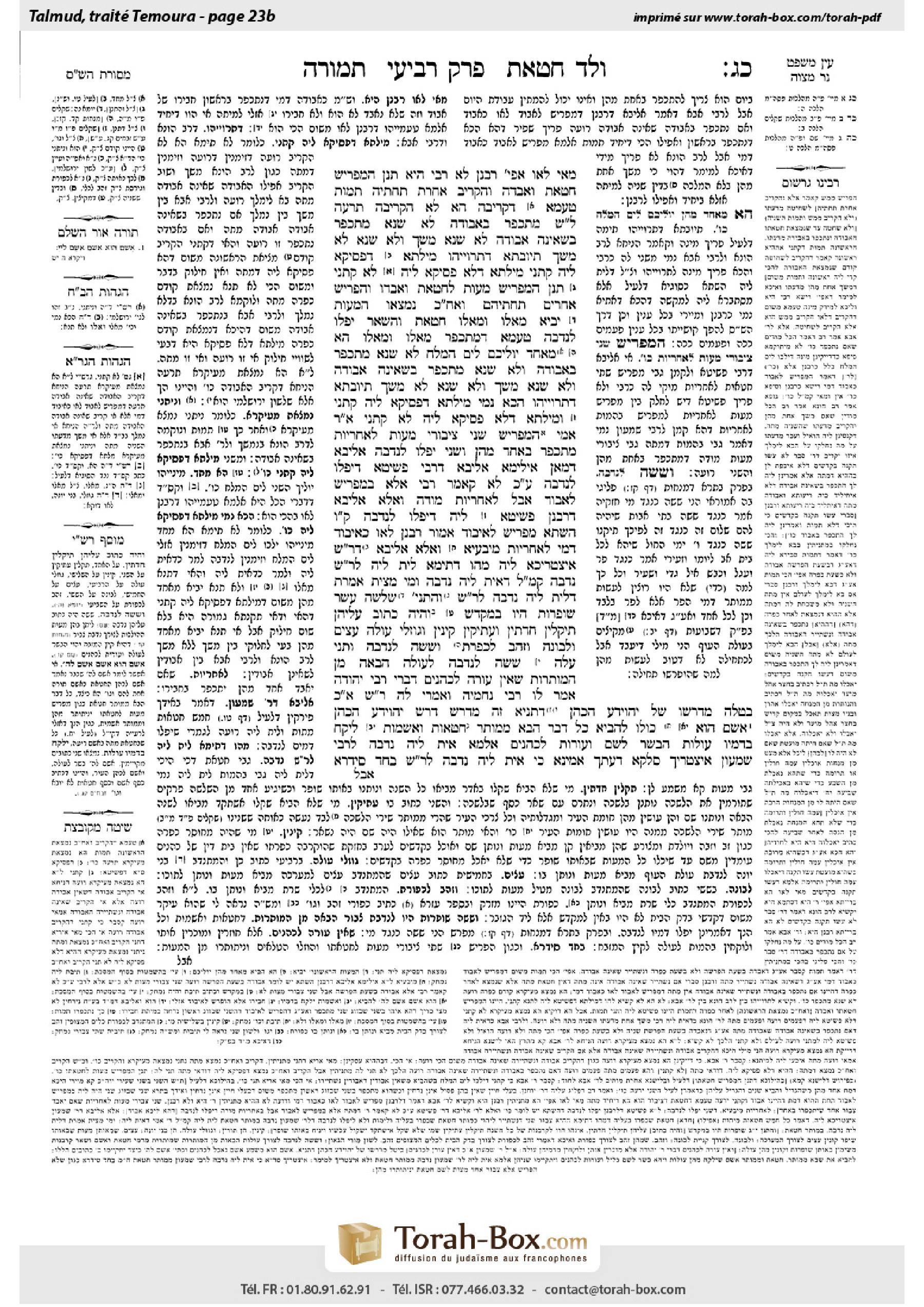
Temurah 23b: Talmud study for Daf Yomi
Daf Yomi is the daily study of one Talmud folio. Explore 37 tractates with scans, Hebrew text, Sefaria English and AI-generated French translations where annotated.
Passage selection and English or AI-generated French translation are available where the scan has annotations. Daf Study is independent of Torah-Box and Sefaria.
Browse Temurah · תמורה · All tractatesTemurah 23b text and translations
This page of Temurah includes the Aramaic text, an English translation and an AI-generated French translation, alongside the scan above.
תמורה כ״ג ב · Aramaic and Hebrew text
מַאי לַָאו אֲפִילּוּ רַבָּנַן? לָא, רַבִּי הִיא.
תְּנַן: הַמַּפְרִישׁ חַטָּאת וְאָבְדָה, וְהִקְרִיב אַחֶרֶת תַּחְתֶּיהָ — תָּמוּת.
טַעְמָא (דִּקְרֵיבָה) [מִשּׁוּם דְּהִקְרִיבָהּ], הָא לֹא הִקְרִיבָהּ — תִּרְעֶה, לָא שְׁנָא מִתְכַּפֵּר בַּאֲבוּדָה, לָא שְׁנָא מִתְכַּפֵּר בְּשֶׁאֵינָהּ אֲבוּדָה, לָא שְׁנָא מָשַׁךְ, וְלָא שְׁנָא לֹא מָשַׁךְ.
תְּיוּבְתָּא דְּתַרְוַיְיהוּ!
מִילְּתָא דִּפְסִיקָא לֵיהּ — קָתָנֵי, מִילְּתָא דְּלָא פְּסִיקָא לֵיהּ — לָא קָתָנֵי.
תְּנַן: הַמַּפְרִישׁ מָעוֹת לְחַטָּאת, וְאָבְדוּ, וְהִפְרִישׁ אֲחֵרִים תַּחְתֵּיהֶם, וְאַחַר כָּךְ נִמְצְאוּ הַמָּעוֹת — יָבִיא מֵאֵלּוּ וּמֵאֵלּוּ חַטָּאת, וְהַשְּׁאָר יִפְּלוּ לִנְדָבָה.
טַעְמָא דְּמִתְכַּפֵּר מֵאֵלּוּ וּמֵאֵלּוּ, הָא מֵאֶחָד — יוֹלִיכֵם לְיָם הַמֶּלַח.
לָא שְׁנָא מִתְכַּפֵּר בַּאֲבוּדָה, וְלָא שְׁנָא מִתְכַּפֵּר בְּשֶׁאֵינָהּ אֲבוּדָה, וְלָא שְׁנָא מָשַׁךְ, וְלָא שְׁנָא לֹא מָשַׁךְ — תְּיוּבְתָּא דְּתַרְוַיְיהוּ! הָכָא נָמֵי: מִילְּתָא דִּפְסִיקָא לֵיהּ קָתָנֵי, וּמִילְּתָא דְּלָא פְּסִיקָא לֵיהּ לָא קָתָנֵי.
אָמַר רַבִּי אַמֵּי: הַמַּפְרִישׁ שְׁנֵי צִיבּוּרֵי מָעוֹת לְאַחְרָיוּת, מִתְכַּפֵּר בְּאֶחָד מֵהֶן, וְשֵׁנִי יִפְּלוּ לִנְדָבָה.
אַלִּיבָּא דְּמַאן? אִילֵימָא אַלִּיבָּא דְּרַבִּי — פְּשִׁיטָא דְּיִפְּלוּ לִנְדָבָה, עַד כַּאן לָא קָאָמַר רַבִּי אֶלָּא בְּמַפְרִישׁ לְאִבּוּד, אֲבָל לְאַחְרָיוּת מוֹדֶה.
וְאֶלָּא אַלִּיבָּא דְּרַבָּנַן, פְּשִׁיטָא לֵיהּ דְּיִפְּלוּ לִנְדָבָה, קַל וָחוֹמֶר: הַשְׁתָּא מַפְרִישׁ לְאִיבּוּד אֲמוּר רַבָּנַן לָאו כְּאִיבּוּד דָּמֵי, לְאַחְרָיוּת מִיבַּעְיָא?!
וְאֶלָּא, אַלִּיבָּא דְּרַבִּי שִׁמְעוֹן אִיצְטְרִיכָא לֵיהּ, מַהוּ דְּתֵימָא לֵית לֵיהּ לְרַבִּי שִׁמְעוֹן נְדָבָה, קָא מַשְׁמַע לַן דְּאִית לֵיהּ נְדָבָה.
וּמִי מָצֵית אָמְרַתְּ דְּלֵית לֵיהּ נְדָבָה לְרַבִּי שִׁמְעוֹן? וְהָתַנְיָא: שְׁלֹשָׁה עָשָׂר שׁוֹפָרוֹת הָיוּ בַּמִּקְדָּשׁ, וְהָיָה כָּתוּב עֲלֵיהֶן: ״תִּיקְלִין חַדְתִין״ וְ״עַתִּיקִין״, ״קִינִּין״ וְ״גוֹזְלֵי עוֹלָה״, ״עֵצִים״ וּ״לְבוֹנָה״ וְ״זָהָב לְכַפֹּרֶת״, וְשִׁשָּׁה לִנְדָבָה.
וְתָנֵי עֲלַהּ: שִׁשָּׁה לִנְדָבָה — לְעוֹלָה הַבָּאָה מִן הַמּוֹתָרוֹת, שֶׁאֵין עוֹרָהּ לַכֹּהֲנִים, דִּבְרֵי רַבִּי יְהוּדָה.
אָמַר לוֹ רַבִּי נְחֶמְיָה, וְאָמְרִי לַהּ רַבִּי שִׁמְעוֹן: אִם כֵּן, בָּטְלָה מִדְרָשׁוֹ שֶׁל יְהוֹיָדָע הַכֹּהֵן. דְּתַנְיָא: זֶה מִדְּרַשׁ דָּרַשׁ יְהוֹיָדָע הַכֹּהֵן — ״אָשָׁם הוּא״ כּוּלּוֹ, לְהָבִיא כׇּל דָּבָר הַבָּא מִמּוֹתַר חַטָּאוֹת וַאֲשָׁמוֹת, לִיקַּח בְּדָמָיו עוֹלוֹת — הַבָּשָׂר לַשֵּׁם, וְעוֹרוֹת לַכֹּהֲנִים.
אַלְמָא אִית לֵיהּ נְדָבָה לְרַבִּי שִׁמְעוֹן, אִיצְטְרִיךְ, סָלְקָא דַעְתָּךְ אָמֵינָא: כִּי אִית לֵיהּ נְדָבָה לְרַבִּי שִׁמְעוֹן בְּחַד סִידְרָא,
Temurah 23b · English translation
The Gemara concludes: What, is it not that this mishna is stated even in accordance with the opinion of the Rabbis? If so, the mishna is teaching that even according to the Rabbis, an offering designated in the stead of a lost animal is considered like the lost animal, which would contradict the statement of Rabbi Abba. The Gemara responds: No, it is stated only in accordance with the opinion of Rabbi Yehuda HaNasi.
The Gemara poses a challenge to the explanations of both Rav Huna and Rabbi Abba from that which we learned in the mishna: In the case of one who designates a sin offering, and the animal was lost, and he designated another in its stead and sacrificed it, and the first animal was subsequently found, that is a sin offering whose owner achieved atonement with another animal, and it shall be left to die.
The Gemara infers: The reason that the original animal is left to die is that the second animal was already sacrificed, but if the owner did not sacrifice the second animal before the original animal was found, then the original animal is left to graze. The mishna apparently indicates that there is no difference whether he achieves atonement with the sin offering that was lost and there is no difference whether he achieves atonement with the sin offering that was not lost. It can likewise be inferred from the mishna that there is no difference whether he took the animal and sacrificed it without consulting the court and there is no difference whether he did not take the animal and sacrifice it without consulting the court. In all cases, if the owner had not yet achieved atonement then the remaining animal is left to graze.
If so, this is a conclusive refutation of the opinions of both of them, since according to Rav Huna everyone agrees that an animal is left to die if the owner took one of the animals without consulting the court; and according to Rabbi Abba everyone agrees that if the owner achieved atonement with the second animal, the lost animal is left to die.
The Gemara responds: One should not infer in that manner from the mishna. Rather, the tanna of the mishna taught a matter that was absolute, i.e., a case where the second animal was sacrificed before the original animal was found, as the lost animal is always left to die. He did not teach a matter that was not absolute, i.e., a matter that depends on some other factor, e.g., whether the owner took the animal without consulting the court, or whether the owner achieved atonement with the lost animal.
The Gemara poses another difficulty from that which we learned in the mishna: In the case of one who designates money for purchase of his sin offering, and the money was lost, and he designated other money in its stead, and thereafter the original money was found, he should bring a sin offering from a combination of this original money and that money designated in its stead, and the remainder shall be allocated for communal gift offerings.
The Gemara infers: The reason that the remainder is allocated for communal gift offerings is that he atones by bringing a sin offering from a combination of this original money and that money designated in its stead, but if the owner brought a sin offering from one of the two sums of money, he must take the other money and cast it into the Dead Sea.
The mishna apparently indicates that there is no difference whether he achieves atonement with the money that was lost and there is no difference whether he achieves atonement with the money that was not lost, and there is no difference whether he took the money and brought a sin offering without consulting the court and there is no difference whether he did not take the money without consulting the court. In all cases, the other money is cast into the Dead Sea. If so, this is a conclusive refutation of the opinions of both Rav Huna and Rabbi Abba, as the mishna does not conform to either explanation. The Gemara responds: Here too, the tanna taught a matter that was absolute, i.e., a case where the owner achieved atonement with one of the two sums of money, but he did not teach a matter that was not absolute.
§ With regard to designating money for purchasing a sin offering, Rabbi Ami says: In the case of one who designates two piles of money as a guarantee, so that in the event that one pile is lost he will purchase his sin offering with the other pile, he achieves atonement with one of them, and the second pile is allocated for communal gift offerings.
The Gemara asks: In accordance with whose opinion is this statement? If we say that it is in accordance with the opinion of Rabbi Yehuda HaNasi, it is obvious that the second pile of money is allocated for communal gift offerings, as Rabbi Yehuda HaNasi says that the surplus money is cast into the Dead Sea only in a case where one designated the money instead of money that was lost. But if one separated the two sums of money at the same time as a guarantee, Rabbi Yehuda HaNasi concedes that the unused money is allocated for gift offerings.
Rather, you will say that it is in accordance with the opinion of the Rabbis. But if so, isn’t it obvious that the unused money is allocated for communal gift offerings, due to the following a fortiori inference: Now that the Rabbis say with regard to one who designates money to replace money that was lost that it is not considered like the lost money and is not cast into the Dead Sea, is it necessary to teach that money designated as a guarantee is allocated for communal gift offerings and is not cast into the sea?
Rather, it was necessary for Rabbi Ami to teach this halakha according to the opinion of Rabbi Shimon, who holds that whenever the owner achieved atonement with another sin offering the remaining animal is left to die, even if it was initially designated as a guarantee. Lest you say that just as Rabbi Shimon does not hold that an animal is left to graze if the owner achieved atonement with another animal, he also does not maintain that the unused money is allocated for communal gift offerings, Rabbi Ami teaches us that even Rabbi Shimon holds that if one separates additional money as a guarantee, the unused money is allocated for communal gift offerings.
The Gemara asks: But how can you say that one might think that Rabbi Shimon does not hold that the unused money is allocated for communal gift offerings? Isn’t it taught in a mishna (Shekalim 18a): There were thirteen collection horns in the Temple, and the intended use of the funds was written upon each one, as follows: New shekels, for shekels given for the current year; and old shekels, for shekels given belatedly for the previous year; pairs of birds, whose funds were used to purchase obligatory bird offerings, e.g., for a woman who gave birth; and fledglings designated for voluntary burnt offerings; wood for the arrangement on the altar; and frankincense that accompanied meal offerings; and gold donated for the Ark Cover. And the remaining six horns were designated for the purchase of communal gift offerings.
And it is taught with regard to that mishna: The funds contained in the six horns designated for communal gift offerings were used to purchase burnt offerings that come from the surplus funds which had been allocated for the purchase of sin offerings or guilt offerings and were not needed for those purposes. Such burnt offerings were brought in the absence of other offerings, so that the altar would not remain idle. Unlike other burnt offerings, the hides of these offerings were not given to the priests; rather, they were sold, and the money received from their sale was allocated for additional communal gift offerings. This is the statement of Rabbi Yehuda.
Rabbi Neḥemya said to him, and some say it was Rabbi Shimon who said to Rabbi Yehuda: If so, the teaching of Jehoiada the High Priest has been negated. As it is taught in the aforementioned mishna: This teaching was taught by Jehoiada the High Priest: There is an apparent contradiction in a verse. On the one hand, the verse states: “It is a guilt offering” (Leviticus 5:19), indicating that the meat of this guilt offering is eaten by the priests, as is the halakha with regard to all guilt offerings. On the other hand, the same verse concludes: “He is certainly guilty before the Lord,” which indicates that the entire offering is for God, like a burnt offering. Rather, the verse comes to include the following halakha: With regard to anything that comes from surplus funds designated for sin offerings or guilt offerings, those funds should be used to purchase burnt offerings. The meat of these burnt offerings is entirely for God, and the hides are given to the priests, as is the halakha with regard to burnt offerings.
The Gemara concludes: Apparently, Rabbi Shimon does hold that surplus funds which were designated for sin offerings are allocated for communal gift offerings. The statement of Rabbi Ami is therefore unnecessary even according to the opinion of Rabbi Shimon. The Gemara responds: It was necessary for Rabbi Ami to teach this halakha, as it might enter your mind to say: When Rabbi Shimon holds that surplus money which was designated for a sin offering is allocated for communal gift offerings, that applies only in a case where the surplus is from one set of money, e.g., one allocated funds to purchase a goat and the price of goats depreciated, and therefore there is now a surplus from the money that was set aside.
Temurah 23b · Traduction française (IA)
La Guemara conclut : Quoi ? N’est-ce pas que cette Michna est enseignée même conformément à l’opinion des Sages ? Si tel est le cas, la Michna enseigne que, même selon les Sages, une offrande désignée à la place d’un animal perdu est considérée comme l’animal perdu, ce qui contredirait la déclaration de Rabbi Abba. La Guemara répond : Non, elle est enseignée uniquement conformément à l’opinion de Rabbi Yehouda HaNassi.
La Guemara oppose aux explications de Rav Houna et de Rabbi Abba ce que nous avons appris dans la Michna : dans le cas de celui qui désigne un animal comme sacrifice expiatoire, puis perd cet animal, en désigne un autre à sa place et le sacrifie, et retrouve ensuite le premier animal, il s’agit d’un sacrifice expiatoire dont le propriétaire a obtenu l’expiation grâce à un autre animal ; le premier animal doit être laissé mourir.
La Guemara déduit que si l’animal initial est laissé mourir, c’est parce que le second animal a déjà été sacrifié. Mais si le propriétaire n’a pas sacrifié le second animal avant que le premier soit retrouvé, le premier est laissé au pâturage. La Michna semble indiquer qu’il n’y a aucune différence entre le cas où il obtient l’expiation grâce au sacrifice expiatoire qui a été perdu et celui où il l’obtient grâce au sacrifice expiatoire qui n’a pas été perdu. On peut également déduire de la Michna qu’il n’y a aucune différence entre le cas où il a pris l’animal et l’a sacrifié sans consulter le tribunal et celui où il ne l’a pas pris et ne l’a pas sacrifié sans consulter le tribunal. Dans tous les cas, si le propriétaire n’a pas encore obtenu l’expiation, l’animal restant est laissé au pâturage.
Si tel est le cas, cela réfute définitivement leurs deux opinions : selon Rav Houna, tous reconnaissent qu’un animal est laissé mourir si le propriétaire en a pris un sans consulter le tribunal ; et selon Rabbi Abba, tous reconnaissent que si le propriétaire a obtenu l’expiation grâce au second animal, l’animal perdu est laissé mourir.
La Guemara répond : Il ne faut pas déduire cela de la Michna. Le tanna de la Michna a plutôt enseigné un cas certain, à savoir celui où le second animal a été sacrifié avant que le premier soit retrouvé, car l’animal perdu est toujours laissé mourir. Il n’a pas enseigné un cas qui n’est pas certain, c’est-à-dire un cas qui dépend d’un autre facteur, par exemple si le propriétaire a pris l’animal sans consulter le tribunal ou s’il a obtenu l’expiation grâce à l’animal perdu.
La Guemara soulève une autre difficulté à partir de ce que nous avons appris dans la Michna : dans le cas de celui qui met de l’argent de côté pour acheter son sacrifice expiatoire, perd cet argent, en met d’autre de côté à sa place, puis retrouve l’argent initial, il doit apporter un sacrifice expiatoire acheté avec une combinaison de l’argent initial et de l’argent mis de côté à sa place ; le reste sera affecté aux offrandes volontaires communautaires.
La Guemara déduit que si le reste est affecté aux offrandes volontaires communautaires, c’est parce qu’il obtient l’expiation en apportant un sacrifice expiatoire acheté avec une combinaison de l’argent initial et de l’argent mis de côté à sa place. Mais si le propriétaire a apporté un sacrifice expiatoire acheté avec l’une des deux sommes, il doit prendre l’autre somme et la jeter dans la mer Morte.
La Michna semble indiquer qu’il n’y a aucune différence entre le cas où il obtient l’expiation grâce à l’argent qui a été perdu et celui où il l’obtient grâce à l’argent qui n’a pas été perdu ; elle semble également indiquer qu’il n’y a aucune différence entre le cas où il a pris l’argent et apporté un sacrifice expiatoire sans consulter le tribunal et celui où il n’a pas pris l’argent sans consulter le tribunal. Dans tous les cas, l’autre somme est jetée dans la mer Morte. Si tel est le cas, cela réfute définitivement les opinions de Rav Houna et de Rabbi Abba, car la Michna ne correspond à aucune de leurs explications. La Guemara répond : Ici aussi, le tanna a enseigné un cas certain, à savoir celui où le propriétaire a obtenu l’expiation grâce à l’une des deux sommes, mais il n’a pas enseigné un cas qui n’est pas certain.
§ À propos de l’argent mis de côté pour acheter un sacrifice expiatoire, Rabbi Ami dit : dans le cas de celui qui met de côté deux tas d’argent comme garantie, afin de pouvoir acheter son sacrifice expiatoire avec l’autre tas si l’un des deux est perdu, il obtient l’expiation grâce à l’un d’eux, et le second tas est affecté aux offrandes volontaires communautaires.
La Guemara demande : Selon l’opinion de qui cette déclaration est-elle formulée ? Si l’on dit qu’elle suit l’opinion de Rabbi Yehouda HaNassi, il est évident que le second tas d’argent est affecté aux offrandes volontaires communautaires, car Rabbi Yehouda HaNassi dit que l’argent excédentaire n’est jeté dans la mer Morte que lorsqu’on a mis de l’argent de côté à la place d’une somme perdue. Mais si l’on a mis les deux sommes de côté en même temps comme garantie, Rabbi Yehouda HaNassi reconnaît que l’argent inutilisé est affecté aux offrandes volontaires.
Il faut plutôt dire que cette déclaration suit l’opinion des Sages. Mais alors, n’est-il pas évident que l’argent inutilisé est affecté aux offrandes volontaires communautaires, selon le raisonnement a fortiori suivant : si les Sages disent, au sujet de celui qui met de l’argent de côté pour remplacer une somme perdue, que cet argent n’est pas considéré comme l’argent perdu et n’est pas jeté dans la mer Morte, faut-il vraiment enseigner que l’argent mis de côté comme garantie est affecté aux offrandes volontaires communautaires et n’est pas jeté dans la mer ?
Il était plutôt nécessaire que Rabbi Ami enseigne cette halakha selon l’opinion de Rabbi Shimon, qui soutient que, chaque fois que le propriétaire obtient l’expiation grâce à un autre sacrifice expiatoire, l’animal restant est laissé mourir, même s’il avait été initialement désigné comme garantie. De peur que tu ne dises que, de même que Rabbi Shimon ne soutient pas qu’un animal est laissé au pâturage si le propriétaire obtient l’expiation grâce à un autre animal, il ne soutient pas non plus que l’argent inutilisé est affecté aux offrandes volontaires communautaires, Rabbi Ami nous enseigne que même Rabbi Shimon soutient que, si l’on met de l’argent supplémentaire de côté comme garantie, l’argent inutilisé est affecté aux offrandes volontaires communautaires.
La Guemara demande : Mais comment peut-on dire que l’on pourrait penser que Rabbi Shimon ne soutient pas que l’argent inutilisé est affecté aux offrandes volontaires communautaires ? N’est-il pas enseigné dans une Michna (Shekalim 18a) : Il y avait dans le Temple treize troncs de collecte, et l’usage prévu des fonds était inscrit sur chacun d’eux, comme suit : les nouveaux sicles, pour les sicles versés au titre de l’année en cours ; les anciens sicles, pour les sicles versés en retard au titre de l’année précédente ; les couples d’oiseaux, dont les fonds servaient à acheter des offrandes obligatoires d’oiseaux, par exemple pour une femme ayant accouché ; les pigeonneaux destinés aux holocaustes volontaires ; le bois pour l’autel ; l’encens qui accompagnait les offrandes de farine ; et l’or donné pour le propitiatoire. Les six autres troncs étaient destinés à l’achat d’offrandes volontaires communautaires.
Et il est enseigné au sujet de cette Michna : les fonds contenus dans les six troncs destinés aux offrandes volontaires communautaires servaient à acheter des holocaustes financés par les sommes excédentaires affectées à l’achat de sacrifices expiatoires ou de sacrifices de culpabilité, et qui n’étaient pas nécessaires à ces fins. Ces holocaustes étaient offerts en l’absence d’autres offrandes, afin que l’autel ne reste pas inactif. Contrairement aux autres holocaustes, leurs peaux n’étaient pas données aux prêtres ; elles étaient plutôt vendues, et l’argent obtenu de leur vente était affecté à des offrandes volontaires communautaires supplémentaires. Telle est la déclaration de Rabbi Yehouda.
Rabbi Neḥemya lui dit — et certains disent que c’est Rabbi Shimon qui l’a dit à Rabbi Yehouda : Si tel est le cas, l’enseignement de Yehoyada, le Grand Prêtre, est annulé. Car il est enseigné dans la Michna citée plus haut : Cet enseignement a été transmis par Yehoyada, le Grand Prêtre : un verset semble présenter une contradiction. D’une part, le verset dit : « C’est un sacrifice de culpabilité » (Lévitique 5:19), ce qui indique que la viande de ce sacrifice de culpabilité est mangée par les prêtres, conformément à la halakha applicable à tous les sacrifices de culpabilité. D’autre part, le même verset se termine ainsi : « Il est certainement coupable devant le Seigneur », ce qui indique que l’offrande entière est destinée à Dieu, comme un holocauste. Le verset vient plutôt inclure la halakha suivante : tout ce qui provient des fonds excédentaires affectés aux sacrifices expiatoires ou aux sacrifices de culpabilité doit servir à acheter des holocaustes. La viande de ces holocaustes est entièrement destinée à Dieu, et leurs peaux sont données aux prêtres, conformément à la halakha applicable aux holocaustes.
La Guemara conclut : Apparemment, Rabbi Shimon soutient bien que les fonds excédentaires affectés aux sacrifices expiatoires sont destinés aux offrandes volontaires communautaires. La déclaration de Rabbi Ami est donc superflue, même selon l’opinion de Rabbi Shimon. La Guemara répond : Il était nécessaire que Rabbi Ami enseigne cette halakha, car on pourrait penser ceci : lorsque Rabbi Shimon soutient que l’argent excédentaire affecté à un sacrifice expiatoire est destiné aux offrandes volontaires communautaires, cela ne s’applique qu’au cas où l’excédent provient d’une seule somme d’argent, par exemple si quelqu’un a mis des fonds de côté pour acheter un bouc et que le prix des boucs a baissé, de sorte qu’il y a maintenant un excédent sur la somme mise de côté.
Traduction française générée par IA à partir de l’édition anglaise de Sefaria. Vérifie toujours un passage avec le texte source.
Text from Sefaria: William Davidson Edition - Vocalized Aramaic (CC BY NC); William Davidson Edition - English (CC BY NC).