Temurah 24a: Talmud study for Daf Yomi
Daf Yomi is the daily study of one Talmud folio. Explore 37 tractates with scans, Hebrew text, Sefaria English and AI-generated French translations where annotated.
Passage selection and English or AI-generated French translation are available where the scan has annotations. Daf Study is independent of Torah-Box and Sefaria.
Browse Temurah · תמורה · All tractatesTemurah 24a text and translations
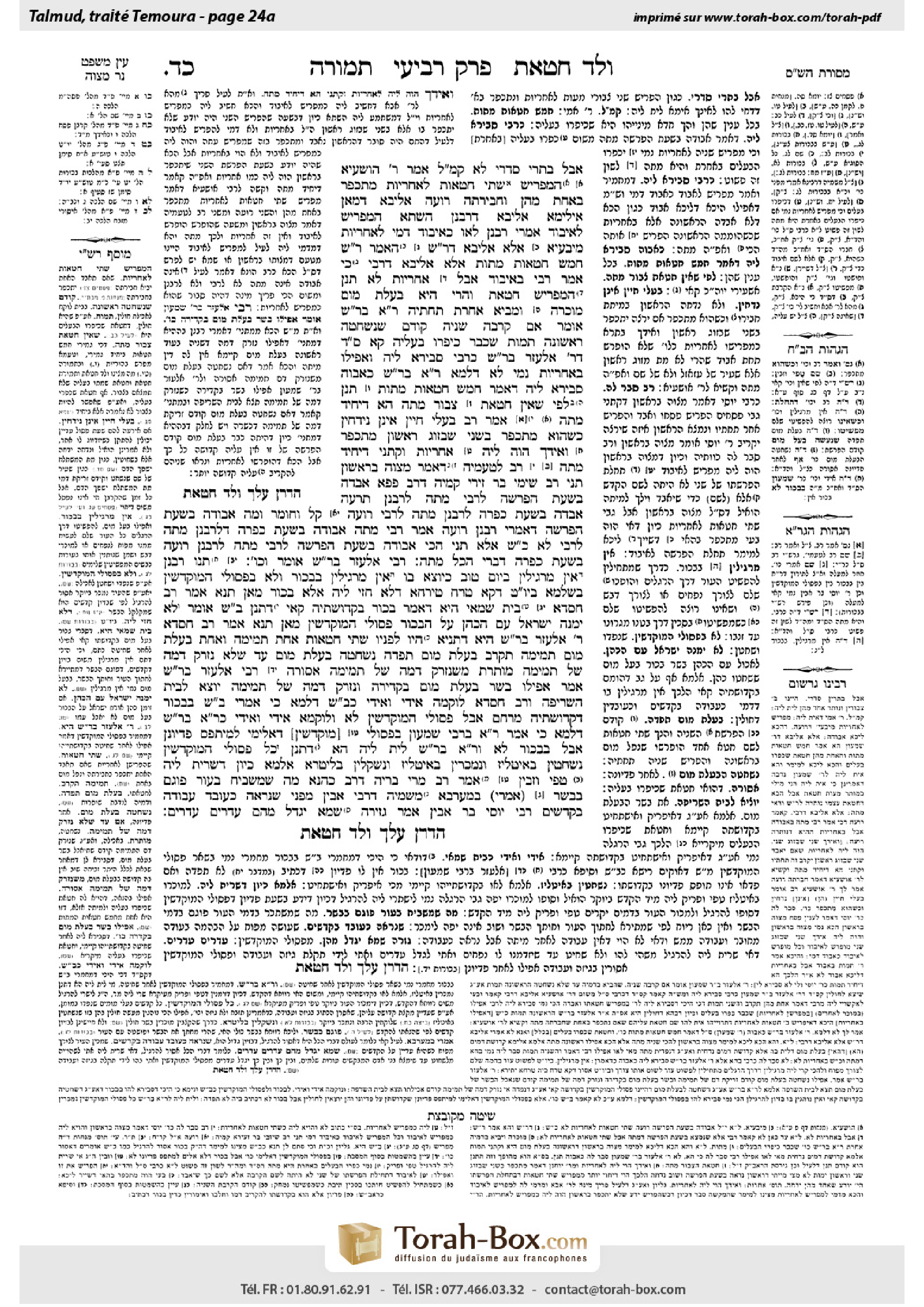
This page of Temurah includes the Aramaic text, an English translation and an AI-generated French translation, alongside the scan above.
תמורה כ״ד א · Aramaic and Hebrew text
אֲבָל בִּתְרֵי סִדְרֵי לָא, קָא מַשְׁמַע לַן.
אָמַר רַבִּי הוֹשַׁעְיָא: הַמַּפְרִישׁ שְׁתֵּי חַטָּאוֹת לְאַחְרָיוּת, מִתְכַּפֵּר בְּאַחַת מֵהֶן, וַחֲבֶירְתָּהּ רוֹעָה.
אַלִּיבָּא דְּמַאן? אִילֵימָא אַלִּיבָּא דְּרַבָּנַן — הַשְׁתָּא הַמַּפְרִישׁ לְאִיבּוּד, אָמְרִי רַבָּנַן לָאו כְּאִיבּוּד דָּמֵי, לְאַחְרָיוּת מִיבַּעְיָא?!
אֶלָּא אַלִּיבָּא דְּרַבִּי שִׁמְעוֹן, הָאָמַר רַבִּי שִׁמְעוֹן: חָמֵשׁ חַטָּאוֹת מֵתוֹת!
אֶלָּא, אַלִּיבָּא דְּרַבִּי, כִּי אָמַר רַבִּי בְּאִיבּוּד — אֲבָל אַחְרָיוּת לָא.
תְּנַן: הַמַּפְרִישׁ חַטָּאת, וַהֲרֵי הִיא בַּעֲלַת מוּם — מוֹכְרָהּ, וּמֵבִיא אַחֶרֶת תַּחְתֶּיהָ. רַבִּי אֶלְעָזָר בְּרַבִּי שִׁמְעוֹן אוֹמֵר: אִם קָרְבָה שְׁנִיָּה קוֹדֶם שֶׁנִּשְׁחֲטָה רִאשׁוֹנָה — תָּמוּת, שֶׁכְּבָר כִּיפְּרוּ בְּעָלֶיהָ.
קָא סָלְקָא דַעְתָּךְ דְּרַבִּי אֶלְעָזָר בְּרַבִּי שִׁמְעוֹן כְּרַבִּי סְבִירָא לֵיהּ, וַאֲפִילּוּ בְּאַחְרָיוּת נָמֵי!
לָא, דִּלְמָא רַבִּי אֶלְעָזָר בְּרַבִּי שִׁמְעוֹן כַּאֲבוּהּ סְבִירָא לֵיהּ, דְּאָמַר: חָמֵשׁ חַטָּאוֹת מֵתוֹת.
תְּנַן: לְפִי שֶׁאֵין חַטַּאת צִבּוּר מֵתָה, הָא דְּיָחִיד מֵתָה.
אָמַר רַב: בַּעֲלֵי חַיִּין אֵינָן נִידְחִין, כְּשֶׁהוּא מִתְכַּפֵּר בְּשֵׁנִי שֶׁבְּזוּג רִאשׁוֹן מִתְכַּפֵּר, וְאִידַּךְ הָוֵה לֵיהּ אַחְרָיוּת, וְקָתָנֵי דְּיָחִיד מֵתָה!
רַב לְטַעְמֵיהּ, דְּאָמַר: מִצְוָה בָּרִאשׁוֹן.
תָּנֵי רַב שִׁימִי בַּר זֵירִי קַמֵּיהּ דְּרַב פָּפָּא: אָבְדָה בִּשְׁעַת הַפְרָשָׁה — לְרַבִּי מֵתָה, לְרַבָּנַן תִּרְעֶה. אָבְדָה בִּשְׁעַת כַּפָּרָה — לְרַבָּנַן מֵתָה, לְרַבִּי רוֹעֶה.
קַל וָחוֹמֶר: וּמָה אֲבוּדָה בִּשְׁעַת הַפְרָשָׁה, דְּאָמְרִי רַבָּנַן רוֹעָה, אָמַר רַבִּי מֵתָה — אֲבוּדָה בִּשְׁעַת כַּפָּרָה, דִּלְרַבָּנַן מֵתָה, לְרַבִּי לֹא כׇּל שֶׁכֵּן?
אֶלָּא תָּנֵי הָכִי: אֲבוּדָה בִּשְׁעַת הַפְרָשָׁה — לְרַבִּי מֵתָה, לְרַבָּנַן רוֹעָה. בִּשְׁעַת כַּפָּרָה — דִּבְרֵי הַכֹּל מֵתָה.
רַבִּי אֶלְעָזָר בְּרַבִּי שִׁמְעוֹן אוֹמֵר וְכוּ׳.
תָּנוּ רַבָּנַן: אֵין מַרְגִּילִין בְּיוֹם טוֹב, כְּיוֹצֵא בוֹ — אֵין מַרְגִּילִין בִּבְכוֹר, וְלֹא בִּפְסוּלֵי הַמּוּקְדָּשִׁין.
בִּשְׁלָמָא בְּיוֹם טוֹב — דְּקָא טָרַח טִירְחָא דְּלָא חֲזֵי לֵיהּ, אֶלָּא בְּכוֹר — מַאן תְּנָא?
אָמַר רַב חִסְדָּא: בֵּית שַׁמַּאי הִיא, דְּאָמַר: בְּכוֹר בִּקְדוּשְּׁתֵיהּ קָאֵי, דִּתְנַן: בֵּית שַׁמַּאי אוֹמְרִים: לֹא יִמָּנֶה יִשְׂרָאֵל עִם הַכֹּהֵן עַל הַבְּכוֹר.
פְּסוּלֵי הַמּוּקְדָּשִׁין, מַאן תַּנָּא? אָמַר רַב חִסְדָּא: רַבִּי אֶלְעָזָר בְּרַבִּי שִׁמְעוֹן הִיא, דְּתַנְיָא: הָיוּ לְפָנָיו שְׁתֵּי חַטָּאוֹת, אַחַת תְּמִימָה וְאַחַת בַּעֲלַת מוּם — תְּמִימָה תִּקְרַב, בַּעֲלַת מוּם תִּפָּדֶה.
נִשְׁחֲטָה בַּעֲלַת מוּם, עַד שֶׁלֹּא נִזְרַק דָּמָהּ שֶׁל תְּמִימָה — מוּתֶּרֶת; מִשֶּׁנִּזְרַק דָּמָהּ שֶׁל תְּמִימָה — אֲסוּרָה.
רַבִּי אֶלְעָזָר בְּרַבִּי שִׁמְעוֹן אֹמֵר: אֲפִילּוּ בְּשַׂר בַּעֲלַת מוּם בַּקְּדֵירָה, וְנִזְרַק דָּמָהּ שֶׁל תְּמִימָה — יוֹצֵא לְבֵית הַשְׂרֵיפָה.
וְרַב חִסְדָּא, לוֹקְמַהּ אִידֵּי וְאִידֵּי כְּבֵית שַׁמַּאי!
דִּלְמָא כִּי אָמְרִי בֵּית שַׁמַּאי — בִּבְכוֹר, דִּקְדוּשְּׁתֵיהּ מֵרֶחֶם, אֲבָל פְּסוּלֵי הַמּוּקְדָּשִׁין — לָא.
וְלוֹקְמַאּ אִידֵּי וְאִידֵּי כְּרַבִּי אֶלְעָזָר בְּרַבִּי שִׁמְעוֹן!
דִּלְמָא כִּי אָמַר רַבִּי אֶלְעָזָר בְּרַבִּי שִׁמְעוֹן — בִּפְסוּלֵי מוּקְדָּשִׁין, דְּאַלִּימִי לְמִיתְפַּס פִּדְיוֹנָן, אֲבָל בִּבְכוֹר — לָא.
וְרַבִּי אֶלְעָזָר בְּרַבִּי שִׁמְעוֹן, לֵית לֵיהּ הָא דִּתְנַן: כׇּל פְּסוּלֵי הַמּוּקְדָּשִׁין נִשְׁחָטִין בָּאִיטְלִיז וְנִמְכָּרִין בָּאִיטְלִיז וְנִשְׁקָלִין בְּלִיטְרָא? אַלְמָא, כֵּיוָן דְּשָׁרֵית לֵיהּ טָפֵי וְזָבֵין!
אָמַר רַב מָרִי בְּרֵיהּ דְּרַב כָּהֲנָא: מַה שֶׁמַּשְׁבִּיחַ בָּעוֹר — פּוֹגֵם בְּבָשָׂר.
אָמְרִי בְּמַעְרְבָא מִשְּׁמֵיהּ דְּרַבִּי אָבִין: מִפְּנֵי שֶׁנִּרְאֶה כְּעוֹבֵד עֲבוֹדָה בְּקָדָשִׁים.
רַבִּי יוֹסֵי בַּר אָבִין אָמַר: גְּזֵירָה שֶׁמָּא יְגַדֵּל מֵהֶם עֲדָרִים עֲדָרִים.
הֲדַרַן עֲלָךְ וְלַד חַטָּאת.
Temurah 24a · English translation
But in a case where one designates two distinct sets of money, such as an additional set of money as a guarantee, Rabbi Shimon does not state that the surplus money is allocated for communal gift offerings. Rabbi Ami therefore teaches us that even in this case, Rabbi Shimon agrees that the surplus money is allocated for communal gift offerings.
§ Rabbi Hoshaya says: In the case of one who designates two animals as sin offerings as a guarantee, so that if one animal is lost he will achieve atonement with the other animal, he achieves atonement with one of them, and the other is left to graze until it develops a blemish. It is then sold, and the money received from its sale is used to purchase communal gift offerings.
The Gemara asks: In accordance with whose opinion does Rabbi Hoshaya state this halakha? If we say that it is in accordance with the opinion of the Rabbis, then it is unnecessary. The Gemara explains: Now that in a case where one designates a sin offering instead of one that was lost, the Rabbis say that it is not considered like the lost animal, and it is therefore left to graze, is it necessary to state that in a case where one designates an additional sin offering as a guarantee, the second animal is left to graze?
Rather, you will say that Rabbi Hoshaya states this halakha in accordance with the opinion of Rabbi Shimon. But didn’t Rabbi Shimon say that there are five sin offerings that are left to die, one of which is a sin offering whose owner has achieved atonement with another animal? If so, even in a case where one designated an additional animal as a guarantee, once the owner has achieved atonement the remaining animal is left to die.
Rather, Rabbi Hoshaya states this halakha in accordance with the opinion of Rabbi Yehuda HaNasi. Rabbi Hoshaya is teaching that when Rabbi Yehuda HaNasi said that a sin offering whose owner achieved atonement with another animal is left to die, that applies only in a case where one designated the second animal instead of a lost sin offering. But in a case where one initially designated an additional sin offering as a guarantee, Rabbi Yehuda HaNasi does not hold that the remaining offering is left to die.
The Gemara poses a challenge to this explanation: We learned in the mishna (22b): In the case of one who designates a sin offering and the animal is blemished, he sells the animal and brings another sin offering in its stead with the money received in its sale. Rabbi Elazar, son of Rabbi Shimon, says: If the second animal is sacrificed before the first is slaughtered for non-sacred consumption, the first animal shall be left to die, as it is considered an animal whose owner already achieved atonement with another animal.
The Gemara continues: It enters your mind to say that Rabbi Elazar, son of Rabbi Shimon, holds in accordance with the opinion of Rabbi Yehuda HaNasi, who says that if one achieved atonement with one sin offering, the remaining animal is left to die. Likewise, even if the remaining animal is no longer sacred, it is left to die if the owner achieved atonement with the other animal. And if so, even if one initially designated an additional sin offering as a guarantee, the remaining animal should also be left to die. Consequently, the statement of Rabbi Hoshaya cannot be in accordance with the opinion of Rabbi Yehuda HaNasi.
The Gemara responds: No, perhaps Rabbi Elazar, son of Rabbi Shimon, does not hold in accordance with the opinion of Rabbi Yehuda HaNasi. Rather, he holds in accordance with the opinion of his father, Rabbi Shimon, who said that there are five sin offerings left to die, one of which is a sin offering whose owner achieved atonement with another animal. Since Rabbi Shimon does not qualify this statement, he evidently maintains that the remaining sin offering is always left to die, even when it is no longer sacred. If so, the statement of Rabbi Hoshaya can be in accordance with the opinion of Rabbi Yehuda HaNasi.
The Gemara poses a challenge to the statement of Rabbi Hoshaya: We learned in a mishna (Yoma 62a): With regard to the lottery involving the two goats brought on Yom Kippur, if after the lots were drawn for both goats, the scapegoat died, another pair of goats is brought and lots are drawn for the second pair. With regard to the two goats selected to be the sin offering, i.e., the remaining goat from the first pair and the goat selected from the second, one is sacrificed and the second goat shall graze until it becomes blemished, after which it is sold and the money received is allocated for communal gift offerings. This is because a communal sin offering is not left to die. One may infer from the mishna that under similar circumstances, the sin offering of an individual is left to die.
The Gemara continues: And as the mishna does not specify which of the two goats is brought as the sin offering, Rav says that living animals are not rejected. In other words, the sin offering from the first pair is not disqualified on account of the death of the first scapegoat. And therefore, when he achieves atonement, he may achieve atonement even with the second goat of the first pair. The Gemara explains the difficulty: And the other goat that was selected as the sin offering from the second pair is like one that was initially consecrated as a guarantee, as it was not consecrated to replace a lost offering. And yet the mishna teaches that in a comparable case involving the sin offering of an individual, it is left to die. This apparently contradicts the ruling of Rabbi Hoshaya.
The Gemara responds: Rav conforms to his standard line of reasoning, as he said: It is a mitzva to sacrifice the first offering that was designated. Consequently, when the second sin offering is consecrated, it is already known that it will not be sacrificed. It is therefore considered like an animal designated instead of one that was lost. But in a case where one initially designates an additional sin offering as a guarantee, he is permitted to achieve atonement with either animal ab initio. Therefore, the one that is not sacrificed is left to graze.
§ With regard to the dispute between Rabbi Yehuda HaNasi and the Rabbis, Rav Shimi bar Ziri taught the following baraita before Rav Pappa: In a case where a sin offering was lost at the time when one designated a sin offering in its stead, and one found the lost sin offering before sacrificing the replacement, there is a dispute between tanna’im. According to Rabbi Yehuda HaNasi, the offering that is not sacrificed is left to die, and according to the Rabbis it shall be left to graze. If the first sin offering was lost at the time when one achieved atonement with another animal, then according to the Rabbis the first sin offering is left to die, and according to Rabbi Yehuda HaNasi it is left to graze.
Rav Pappa said to Rav Shimi bar Ziri: This cannot be correct, due to an a fortiori inference: And what, if in the case of a sin offering that was lost at the time when its owner designated an animal in its stead, where the Rabbis say that the offering that is not sacrificed is left to graze, and yet Rabbi Yehuda HaNasi says it is left to die, then in the case of a sin offering that was lost at the time when its owner achieved atonement with another animal, where according to the Rabbis the remaining animal is left to die, is it not all the more so true that according to Rabbi Yehuda HaNasi it is left to die?
Rather, teach the baraita in this manner: If a sin offering was lost at the time when one designated an animal in its stead, and the owner found the lost sin offering before sacrificing the replacement, according to Rabbi Yehuda HaNasi the offering that is not sacrificed is left to die, and according to the Rabbis it is left to graze. If the first sin offering was lost at the time when one achieved atonement with another animal, all agree that it is left to die.
§ The mishna teaches: In the case of one who designates a sin offering and the animal is blemished, he sells the animal and must bring another sin offering with the money received from its sale. Rabbi Elazar, son of Rabbi Shimon, says: If the second animal is sacrificed before the first is slaughtered for non-sacred consumption, the first animal shall be left to die. Although it was sold and rendered non-sacred, its status is that of a sin offering whose owner already achieved atonement with another animal.
The Sages taught: One may not flay the skin of an animal from its feet on a Festival. Although it is permitted to slaughter and skin an animal on a Festival, one may not do so in such a manner to retain the hide intact to enable it to function as a vessel, e.g., a water skin. Similarly, one may not flay a firstborn kosher animal from its feet even on a weekday, and even if the animal is blemished, nor may one flay from the feet disqualified consecrated animals that have been redeemed, as flaying from the feet is considered degrading.
The Gemara asks: Granted, everyone agrees that one may not flay an animal from its feet on a Festival, as one who does so exerts effort that is not fit for the Festival. But with regard to a firstborn offering, who is the tanna who taught that flaying from its feet is prohibited?
Rav Ḥisda said: It is the opinion of Beit Shammai, who say that a firstborn animal retains its sanctity even after it becomes blemished. As we learned in a mishna (Bekhorot 32b) that Beit Shammai say: An Israelite may not be granted a portion of a blemished firstborn animal along with a priest. Just as Beit Shammai prohibit an Israelite from partaking of even a blemished firstborn animal, they prohibit flaying the skin of a firstborn animal from its feet.
The Gemara asks: With regard to disqualified consecrated animals, who is the tanna who taught that one may not flay them from their feet? Rav Ḥisda says: It is the opinion of Rabbi Elazar, son of Rabbi Shimon. As it is taught in a baraita: If there were two sin offerings before him, where one was designated as a guarantee for the other should it become lost or disqualified, and one was unblemished and one became blemished after it was designated, then the unblemished animal shall be sacrificed and the blemished animal shall be redeemed.
The baraita continues: If the blemished animal was slaughtered after it was redeemed, and this occurred before the blood of the unblemished animal was sprinkled upon the altar, then the meat of the blemished animal is permitted. But if it was slaughtered after the blood of the unblemished animal was sprinkled on the altar, it is prohibited to derive benefit from the blemished animal, as it has the status of a sin offering whose owner achieved atonement with another animal.
Rabbi Elazar, son of Rabbi Shimon, says: Even if the meat of the blemished animal is already cooking in the pot, and the blood of the unblemished sin offering was then sprinkled on the altar, it is prohibited to derive benefit from the meat of the blemished animal, and it goes to the place designated for burning disqualified offerings, as it is considered a sin offering whose owner achieved atonement with another animal. Just as Rabbi Elazar, son of Rabbi Shimon, prohibits the meat of a disqualified sin offering that was redeemed and slaughtered, he likewise prohibits one from flaying it from its feet.
The Gemara objects: And let Rav Ḥisda establish both this halakha and that halakha in accordance with the opinion of Beit Shammai. Why does Rav Ḥisda establish the prohibition against flaying disqualified consecrated animals from the feet specifically in accordance with the opinion of Rabbi Elazar, son of Rabbi Shimon? Presumably, just as Beit Shammai prohibit flaying a firstborn from its feet, they also prohibit one from doing so to disqualified consecrated animals.
The Gemara explains: Perhaps when Beit Shammai said that a firstborn animal retains its sanctity even after it is blemished, they said that only with regard to a firstborn, whose sanctity is attained from the womb, i.e., from birth. But with regard to disqualified consecrated animals, perhaps Beit Shammai do not hold that they retain their sanctity after they become blemished and are redeemed.
The Gemara objects from the other angle: But let Rav Ḥisda establish both this halakha and that halakha in accordance with the opinion of Rabbi Elazar, son of Rabbi Shimon. Presumably, just as Rabbi Elazar, son of Rabbi Shimon, prohibits one from flaying disqualified consecrated animals from the feet, he also prohibits one from doing so to firstborn animals.
The Gemara explains: Perhaps when Rabbi Elazar, son of Rabbi Shimon, said that the sanctity of a blemished consecrated animal remains even if it was already redeemed and is cooking in the pot, he said this only with regard to disqualified consecrated animals, whose sanctity is strong enough to apply to the redemption money paid for these animals. But in the case of a blemished firstborn animal, which cannot be redeemed, Rabbi Elazar, son of Rabbi Shimon, does not hold that it retains its sanctity even after it is blemished.
The Gemara objects: But does Rabbi Elazar, son of Rabbi Shimon, not hold in accordance with that which we learned in a mishna (Bekhorot 31a): All disqualified consecrated animals that have been redeemed may be slaughtered in the butchers’ market and sold in the butchers’ market, where there are many buyers, and their meat is weighed by the litra, like non-sacred meat. Apparently, once you permit the sale of disqualified consecrated meat in the manner of non-sacred meat, one may increase the sale price and sell it at a greater profit. Since the Temple treasury stands to gain from such a sale, it is permitted to handle the disqualified consecrated meat in the manner of non-sacred meat. Here, too, as an animal that may be flayed from its feet would be sold for a higher price, the flaying from the feet of disqualified consecrated animals should be permitted, as the Temple treasury stands to gain from that sale.
Rav Mari, son of Rav Kahana, says in response: That which improves the hide damages the meat. If one is careful to remove the entire hide without cutting it, he will inevitably cut away some of the meat, thereby lowering the proceeds from the meat. Consequently, the ability to flay a disqualified consecrated animal from its feet does not increase its overall sale price.
In the West, Eretz Yisrael, they said in the name of Rabbi Avin another reason it is prohibited to flay disqualified consecrated animals from their feet: It is because it appears as though one is performing labor with sacrificial animals, which is prohibited.
Rabbi Yosei bar Avin says: The prohibition against flaying disqualified consecrated animals from the feet is a rabbinic decree, lest one delay slaughtering the animals until he finds someone to purchase the hide, and in doing so, he will raise many flocks of disqualified consecrated animals, which will likely lead to a transgression of the prohibitions of shearing or working disqualified consecrated animals.
Temurah 24a · Traduction française (IA)
Mais lorsqu’une personne désigne deux sommes d’argent distinctes, par exemple une somme supplémentaire à titre de garantie, Rabbi Shimon ne dit pas que le surplus est affecté aux offrandes volontaires communautaires. Rabbi Ami nous enseigne donc que, même dans ce cas, Rabbi Shimon convient que le surplus est affecté aux offrandes volontaires communautaires.
§ Rabbi Hoshaya dit : Dans le cas d’une personne qui désigne deux animaux comme sacrifices expiatoires à titre de garantie, afin que, si l’un des animaux est perdu, elle puisse obtenir l’expiation grâce à l’autre, elle obtient l’expiation grâce à l’un d’eux, et l’autre est laissé au pâturage jusqu’à ce qu’il développe un défaut. Il est alors vendu, et le produit de sa vente sert à acheter des offrandes volontaires communautaires.
La Guemara demande : Selon l’opinion de qui Rabbi Hoshaya enseigne-t-il cette halakha ? Si l’on dit qu’il s’agit de l’opinion des Rabbins, cela est superflu. La Guemara explique : Puisque, dans le cas où une personne désigne un sacrifice expiatoire à la place d’un animal perdu, les Rabbins disent qu’il n’est pas considéré comme l’animal perdu et qu’il est donc laissé au pâturage, est-il nécessaire de préciser que, lorsqu’une personne désigne un sacrifice expiatoire supplémentaire à titre de garantie, le second animal est laissé au pâturage ?
Il faut donc plutôt dire que Rabbi Hoshaya enseigne cette halakha selon l’opinion de Rabbi Shimon. Mais Rabbi Shimon n’a-t-il pas dit qu’il y a cinq sacrifices expiatoires qu’on laisse mourir, dont celui dont le propriétaire a obtenu l’expiation grâce à un autre animal ? Si tel est le cas, même lorsqu’une personne a désigné un animal supplémentaire à titre de garantie, dès que le propriétaire a obtenu l’expiation, l’animal restant est laissé à mourir.
Il faut plutôt dire que Rabbi Hoshaya enseigne cette halakha selon l’opinion de Rabbi Yehuda HaNasi. Rabbi Hoshaya enseigne que lorsque Rabbi Yehuda HaNasi a dit qu’un sacrifice expiatoire dont le propriétaire a obtenu l’expiation grâce à un autre animal est laissé à mourir, cela ne s’applique que si l’on a désigné le second animal à la place d’un sacrifice expiatoire perdu. Mais si l’on a désigné dès le départ un sacrifice expiatoire supplémentaire à titre de garantie, Rabbi Yehuda HaNasi ne considère pas que l’offrande restante doit être laissée à mourir.
La Guemara soulève une difficulté contre cette explication : Nous avons appris dans la Michna (22b) : Dans le cas d’une personne qui désigne un sacrifice expiatoire dont l’animal est atteint d’un défaut, elle vend l’animal et apporte à sa place un autre sacrifice expiatoire avec le produit de la vente. Rabbi Elazar, fils de Rabbi Shimon, dit : Si le second animal est sacrifié avant que le premier soit abattu pour être consommé comme viande profane, le premier animal doit être laissé à mourir, car il est considéré comme un animal dont le propriétaire a déjà obtenu l’expiation grâce à un autre animal.
On pourrait penser que Rabbi Elazar, fils de Rabbi Shimon, suit l’opinion de Rabbi Yehuda HaNasi, qui dit que si quelqu’un obtient l’expiation grâce à un sacrifice expiatoire, l’animal restant est laissé à mourir. De même, même si l’animal restant n’est plus consacré, il est laissé à mourir si le propriétaire a obtenu l’expiation grâce à l’autre animal. Dans ce cas, même si quelqu’un a désigné dès le départ un sacrifice expiatoire supplémentaire à titre de garantie, l’animal restant devrait lui aussi être laissé à mourir. Par conséquent, la déclaration de Rabbi Hoshaya ne peut pas être conforme à l’opinion de Rabbi Yehuda HaNasi.
La Guemara répond : Non, peut-être que Rabbi Elazar, fils de Rabbi Shimon, ne suit pas l’opinion de Rabbi Yehuda HaNasi. Il suit plutôt l’opinion de son père, Rabbi Shimon, qui a dit qu’il y a cinq sacrifices expiatoires qu’on laisse mourir, dont celui dont le propriétaire a obtenu l’expiation grâce à un autre animal. Puisque Rabbi Shimon ne précise pas de restriction, il estime manifestement que le sacrifice expiatoire restant est toujours laissé à mourir, même lorsqu’il n’est plus consacré. Ainsi, la déclaration de Rabbi Hoshaya peut être conforme à l’opinion de Rabbi Yehuda HaNasi.
La Guemara soulève une difficulté contre la déclaration de Rabbi Hoshaya : Nous avons appris dans une Michna (Yoma 62a) : Concernant le tirage au sort des deux boucs apportés à Yom Kippour, si, après le tirage au sort pour les deux boucs, le bouc émissaire meurt, on apporte une autre paire de boucs et on tire au sort pour cette seconde paire. Parmi les deux boucs choisis comme sacrifices expiatoires, c’est-à-dire le bouc restant de la première paire et celui choisi dans la seconde paire, l’un est sacrifié et le second est laissé au pâturage jusqu’à ce qu’il développe un défaut ; il est alors vendu, et le produit de la vente est affecté aux offrandes volontaires communautaires. En effet, on ne laisse pas mourir un sacrifice expiatoire communautaire. On peut déduire de la Michna que, dans des circonstances semblables, le sacrifice expiatoire d’un particulier est laissé à mourir.
La Guemara poursuit : Comme la Michna ne précise pas lequel des deux boucs est apporté comme sacrifice expiatoire, Rav dit que les animaux vivants ne sont pas rejetés. Autrement dit, le sacrifice expiatoire de la première paire n’est pas disqualifié par la mort du premier bouc émissaire. Ainsi, lorsqu’il obtient l’expiation, il peut l’obtenir même grâce au second bouc de la première paire. La Guemara explique la difficulté : l’autre bouc, choisi comme sacrifice expiatoire dans la seconde paire, est comme un animal consacré dès le départ à titre de garantie, puisqu’il n’a pas été consacré pour remplacer une offrande perdue. Pourtant, la Michna enseigne que, dans un cas comparable concernant le sacrifice expiatoire d’un particulier, on le laisse mourir. Cela semble contredire la décision de Rabbi Hoshaya.
La Guemara répond : Rav suit son raisonnement habituel, car il a dit qu’il est une mitsva de sacrifier la première offrande qui a été désignée. Par conséquent, dès que le second sacrifice expiatoire est consacré, on sait déjà qu’il ne sera pas sacrifié. Il est donc considéré comme un animal désigné à la place d’un animal perdu. Mais si quelqu’un désigne dès le départ un sacrifice expiatoire supplémentaire à titre de garantie, il est permis d’obtenir l’expiation grâce à l’un ou l’autre animal dès le départ. L’animal qui n’est pas sacrifié est donc laissé au pâturage.
§ À propos du désaccord entre Rabbi Yehuda HaNasi et les Rabbins, Rav Shimi bar Ziri enseigna la baraïta suivante devant Rav Pappa : Dans le cas où un sacrifice expiatoire a été perdu au moment où l’on en désigne un autre à sa place, et où l’on retrouve le sacrifice expiatoire perdu avant de sacrifier son remplaçant, il y a un désaccord entre les tannaïm. Selon Rabbi Yehuda HaNasi, l’offrande qui n’est pas sacrifiée est laissée à mourir, tandis que, selon les Rabbins, elle est laissée au pâturage. Si le premier sacrifice expiatoire a été perdu au moment où l’on a obtenu l’expiation grâce à un autre animal, les Rabbins disent que le premier sacrifice expiatoire est laissé à mourir, et Rabbi Yehuda HaNasi dit qu’il est laissé au pâturage.
Rav Pappa dit à Rav Shimi bar Ziri : Cela ne peut pas être exact, en vertu d’un raisonnement a fortiori : si, dans le cas d’un sacrifice expiatoire perdu au moment où son propriétaire désigne un animal à sa place, les Rabbins disent que l’offrande qui n’est pas sacrifiée est laissée au pâturage, tandis que Rabbi Yehuda HaNasi dit qu’elle est laissée à mourir, alors, dans le cas d’un sacrifice expiatoire perdu au moment où son propriétaire obtient l’expiation grâce à un autre animal, où, selon les Rabbins, l’animal restant est laissé à mourir, n’est-il pas d’autant plus vrai que, selon Rabbi Yehuda HaNasi, il est laissé à mourir ?
Il faut donc enseigner la baraïta de la manière suivante : Si un sacrifice expiatoire a été perdu au moment où l’on désigne un animal à sa place, et que le propriétaire retrouve le sacrifice expiatoire perdu avant de sacrifier son remplaçant, selon Rabbi Yehuda HaNasi, l’offrande qui n’est pas sacrifiée est laissée à mourir, et, selon les Rabbins, elle est laissée au pâturage. Si le premier sacrifice expiatoire a été perdu au moment où l’on a obtenu l’expiation grâce à un autre animal, tous conviennent qu’il est laissé à mourir.
§ La Michna enseigne : Dans le cas d’une personne qui désigne un sacrifice expiatoire dont l’animal est atteint d’un défaut, elle vend l’animal et doit apporter un autre sacrifice expiatoire avec le produit de la vente. Rabbi Elazar, fils de Rabbi Shimon, dit : Si le second animal est sacrifié avant que le premier soit abattu pour être consommé comme viande profane, le premier animal doit être laissé à mourir. Bien qu’il ait été vendu et soit devenu profane, il a le statut d’un sacrifice expiatoire dont le propriétaire a déjà obtenu l’expiation grâce à un autre animal.
Les Sages ont enseigné : Il est interdit d’écorcher un animal en partant des pattes pendant une fête. Bien qu’il soit permis d’abattre et d’écorcher un animal pendant une fête, il est interdit de procéder ainsi pour conserver la peau intacte et en faire un ustensile, par exemple une outre. De même, il est interdit d’écorcher en partant des pattes un animal casher premier-né, même un jour de semaine et même si l’animal est atteint d’un défaut ; il est également interdit d’écorcher ainsi des animaux consacrés disqualifiés qui ont été rachetés, car cette manière de les écorcher est considérée comme dégradante.
La Guemara demande : Il est admis que tous conviennent qu’il est interdit d’écorcher un animal en partant des pattes pendant une fête, car celui qui le fait accomplit un travail qui ne convient pas à la fête. Mais, concernant une offrande de premier-né, quel est le tanna qui enseigne qu’il est interdit de l’écorcher en partant des pattes ?
Rav Ḥisda dit : C’est l’opinion de Beit Shammai, qui disent qu’un animal premier-né conserve sa sainteté même après avoir développé un défaut. En effet, nous avons appris dans une Michna (Bekhorot 32b) que Beit Shammai disent : On ne peut pas attribuer à un Israélite une part d’un animal premier-né atteint d’un défaut, avec un prêtre. De même que Beit Shammai interdisent à un Israélite de consommer même un animal premier-né atteint d’un défaut, ils interdisent d’écorcher en partant des pattes un animal premier-né.
La Guemara demande : Concernant les animaux consacrés disqualifiés, quel est le tanna qui enseigne qu’il est interdit de les écorcher en partant des pattes ? Rav Ḥisda dit : C’est l’opinion de Rabbi Elazar, fils de Rabbi Shimon. En effet, il est enseigné dans une baraïta : Si deux sacrifices expiatoires se trouvaient devant lui, l’un ayant été désigné comme garantie de l’autre au cas où celui-ci serait perdu ou disqualifié, et que l’un était sans défaut tandis que l’autre avait développé un défaut après avoir été désigné, l’animal sans défaut doit être sacrifié et l’animal atteint d’un défaut doit être racheté.
La baraïta poursuit : Si l’animal atteint d’un défaut a été abattu après son rachat, avant que le sang de l’animal sans défaut soit aspergé sur l’autel, sa viande est permise. Mais s’il a été abattu après que le sang de l’animal sans défaut a été aspergé sur l’autel, il est interdit de tirer profit de l’animal atteint d’un défaut, car il a le statut d’un sacrifice expiatoire dont le propriétaire a obtenu l’expiation grâce à un autre animal.
Rabbi Elazar, fils de Rabbi Shimon, dit : Même si la viande de l’animal atteint d’un défaut est déjà en train de cuire dans une marmite lorsque le sang du sacrifice expiatoire sans défaut est aspergé sur l’autel, il est interdit de tirer profit de cette viande, et elle est envoyée à l’endroit réservé à la combustion des offrandes disqualifiées, car elle est considérée comme un sacrifice expiatoire dont le propriétaire a obtenu l’expiation grâce à un autre animal. De même que Rabbi Elazar, fils de Rabbi Shimon, interdit la viande d’un sacrifice expiatoire disqualifié qui a été racheté et abattu, il interdit également de l’écorcher en partant des pattes.
La Guemara objecte : Rav Ḥisda ne pourrait-il pas établir ces deux halakhot selon l’opinion de Beit Shammai ? Pourquoi Rav Ḥisda établit-il spécifiquement, selon l’opinion de Rabbi Elazar, fils de Rabbi Shimon, l’interdiction d’écorcher en partant des pattes les animaux consacrés disqualifiés ? On peut supposer que, de même que Beit Shammai interdisent d’écorcher en partant des pattes un premier-né, ils interdisent aussi de le faire pour des animaux consacrés disqualifiés.
La Guemara explique : Peut-être que, lorsque Beit Shammai ont dit qu’un animal premier-né conserve sa sainteté même après avoir développé un défaut, ils ne l’ont dit qu’au sujet d’un premier-né, dont la sainteté est acquise dès le ventre maternel, c’est-à-dire dès la naissance. Mais, concernant les animaux consacrés disqualifiés, peut-être Beit Shammai ne considèrent-ils pas qu’ils conservent leur sainteté après avoir développé un défaut et avoir été rachetés.
La Guemara objecte de l’autre côté : Rav Ḥisda ne pourrait-il pas établir ces deux halakhot selon l’opinion de Rabbi Elazar, fils de Rabbi Shimon ? On peut supposer que, de même que Rabbi Elazar, fils de Rabbi Shimon, interdit d’écorcher en partant des pattes les animaux consacrés disqualifiés, il interdit aussi de le faire pour les animaux premiers-nés.
La Guemara explique : Peut-être que, lorsque Rabbi Elazar, fils de Rabbi Shimon, a dit que la sainteté d’un animal consacré atteint d’un défaut subsiste même s’il a déjà été racheté et cuit dans une marmite, il ne l’a dit qu’au sujet des animaux consacrés disqualifiés, dont la sainteté est suffisamment forte pour s’appliquer à l’argent versé pour leur rachat. Mais, dans le cas d’un animal premier-né atteint d’un défaut, qui ne peut pas être racheté, Rabbi Elazar, fils de Rabbi Shimon, ne considère pas qu’il conserve sa sainteté après avoir développé un défaut.
La Guemara objecte : Mais Rabbi Elazar, fils de Rabbi Shimon, ne suit-il pas ce que nous avons appris dans une Michna (Bekhorot 31a) : Tous les animaux consacrés disqualifiés qui ont été rachetés peuvent être abattus et vendus au marché des bouchers, où se trouvent de nombreux acheteurs, et leur viande peut être pesée à la litra, comme de la viande profane. Apparemment, dès lors que l’on permet de vendre de la viande d’animaux consacrés disqualifiés comme de la viande profane, on peut augmenter le prix de vente et la vendre avec un bénéfice supérieur. Puisque le trésor du Temple peut tirer profit d’une telle vente, il est permis de traiter la viande d’animaux consacrés disqualifiés comme de la viande profane. Ici aussi, puisqu’un animal écorché en partant des pattes se vendrait plus cher, il devrait être permis d’écorcher ainsi les animaux consacrés disqualifiés, car le trésor du Temple peut tirer profit de cette vente.
Rav Mari, fils de Rav Kahana, répond : Ce qui améliore la peau abîme la viande. Si l’on prend soin d’enlever toute la peau sans la couper, on enlève inévitablement aussi une partie de la viande, ce qui réduit le produit de la vente de la viande. Par conséquent, la possibilité d’écorcher en partant des pattes un animal consacré disqualifié n’augmente pas le prix total de sa vente.
En Occident, c’est-à-dire en Eretz Yisrael, on a donné au nom de Rabbi Avin une autre raison pour laquelle il est interdit d’écorcher en partant des pattes les animaux consacrés disqualifiés : cela donne l’impression qu’on effectue un travail avec des animaux sacrificiels, ce qui est interdit.
Rabbi Yosei bar Avin dit : L’interdiction d’écorcher en partant des pattes les animaux consacrés disqualifiés est un décret rabbinique, de peur que l’on retarde leur abattage en attendant de trouver quelqu’un pour acheter la peau. Ce faisant, on élèverait de nombreux troupeaux d’animaux consacrés disqualifiés, ce qui risquerait d’entraîner la transgression des interdictions de tondre ces animaux ou de les faire travailler.
Traduction française générée par IA à partir de l’édition anglaise de Sefaria. Vérifie toujours un passage avec le texte source.
Text from Sefaria: William Davidson Edition - Vocalized Aramaic (CC BY NC); William Davidson Edition - English (CC BY NC).