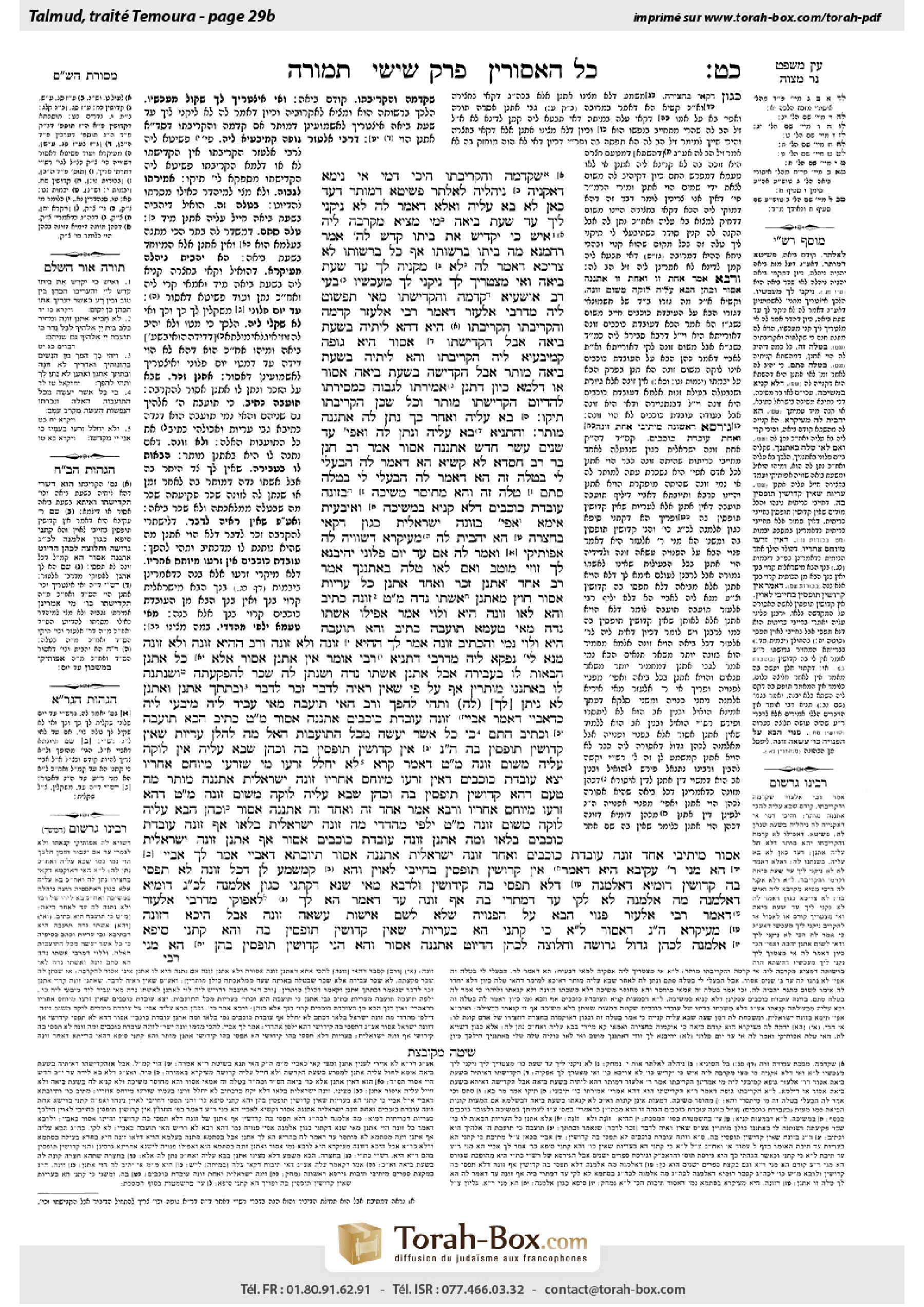
Temurah 29b: Talmud study for Daf Yomi
Daf Yomi is the daily study of one Talmud folio. Explore 37 tractates with scans, Hebrew text, Sefaria English and AI-generated French translations where annotated.
Passage selection and English or AI-generated French translation are available where the scan has annotations. Daf Study is independent of Torah-Box and Sefaria.
Browse Temurah · תמורה · All tractatesTemurah 29b text and translations
This page of Temurah includes the Aramaic text, an English translation and an AI-generated French translation, alongside the scan above.
תמורה כ״ט ב · Aramaic and Hebrew text
שֶׁקָּדְמָה וְהִקְרִיבַתּוּ. הֵיכִי דָּמֵי? אִי נֵימָא דְּאַקְנְיֵהּ נִיהֲלַיהּ לְאַלְתַּר — פְּשִׁיטָא דְּמוּתָּר, דְּעַד כָּאן לֹא בָּא עָלֶיהָ!
וְאֶלָּא, דַּאֲמַר לַהּ: ״לָא נִיקְּנֵי לִיךְ עַד שְׁעַת בִּיאָה״, מִי מָצְיָא מַקְרְבָה לֵיהּ? ״אִישׁ כִּי יַקְדִּישׁ אֶת בֵּיתוֹ קֹדֶשׁ לַה׳״ אֲמַר רַחֲמָנָא, מָה בֵּיתוֹ בִּרְשׁוּתוֹ, אַף כֹּל בִּרְשׁוּתוֹ!
לָא צְרִיכָא, דַּאֲמַר לַהּ: ״לָא (מִקַּנְיָה) [נִיקְּנֵי] לָךְ עַד שְׁעַת בִּיאָה, וְאִי מִצְטְרִיךְ לָךְ נִיקְּנֵי לָךְ מֵעַכְשָׁיו״.
בָּעֵי רַב אוֹשַׁעְיָא: קָדְמָה וְהִקְדִּישַׁתּוּ, מַאי? תִּפְשׁוֹט לֵיהּ מִדְּרַבִּי אֶלְעָזָר, דְּאָמַר רַבִּי אֶלְעָזָר: קָדְמָה וְהִקְרִיבַתּוּ. הִקְרִיבַתּוּ הִיא דְּהָא לֵיתֵיהּ בִּשְׁעַת בִּיאָה, אֲבָל הִקְדִּישַׁתּוּ — אָסוּר!
הִיא גּוּפַהּ קָמִיבַּעְיָא לֵיהּ: הִקְרִיבַתּוּ, (וְהָא) [דְּהָא] לֵיתֵיהּ בִּשְׁעַת בִּיאָה — מוּתָּר, אֲבָל הִקְדִּישַׁתּוּ בִּשְׁעַת בִּיאָה — אָסוּר.
אוֹ דִּלְמָא, כֵּיוָן דִּתְנַן ״אֲמִירָתוֹ לַגָּבוֹהַּ כִּמְסִירָתוֹ לְהֶדְיוֹט״, הִקְדִּישַׁתּוּ מוּתָּר, וְכׇל שֶׁכֵּן הִקְרִיבַתּוּ? תֵּיקוּ.
בָּא עָלֶיהָ וְאַחַר כָּךְ נָתַן לָהּ אֶתְנַנָּה — מוּתָּר, וְהָתַנְיָא: בָּא עָלֶיהָ וְנָתַן לָהּ, וַאֲפִילּוּ עַד שְׁנֵים עָשָׂר חֹדֶשׁ — אֶתְנַנָּה אָסוּר!
אָמַר רַב חָנָן בַּר רַב חִסְדָּא: לָא קַשְׁיָא, הָא דְּאָמַר לַהּ ״הִבָּעֲלִי לִי בְּטָלֶה זֶה״, הָא דְּאָמַר לַהּ ״הִבָּעֲלִי לִי בְּטָלֶה״ סְתָם.
״טָלֶה זֶה״, וְהָא מְחוּסַּר מְשִׁיכָה! בְּזוֹנָה גּוֹיָה, דְּלָא קָנְיָא בִּמְשִׁיכָה. וְאִיבָּעֵית אֵימָא: אֲפִילּוּ בְּזוֹנָה יִשְׂרְאֵלִית, כְּגוֹן דְּקָאֵי בַּחֲצֵרַהּ.
הָא יַהֲבֵיהּ לַהּ מֵעִיקָּרָא, דְּשַׁוְּויֵהּ לַהּ אַפּוֹתֵיקֵי, וַאֲמַר לַהּ: ״אִם עַד יוֹם פְּלוֹנִי יָהֵיבְנָא לָךְ זוּזֵי — מוּטָב, וְאִם לָאו — טָלֶה בְּאֶתְנַנִּךְ״.
אָמַר רַב: אֶחָד אֶתְנַן זָכָר, וְאֶחָד אֶתְנַן כׇּל עֲרָיוֹת אָסוּר, חוּץ מֵאֶתְנַן אִשְׁתּוֹ נִדָּה.
מַאי טַעְמָא? ״זוֹנָה״ כְּתִיב, וְהָא לָאו זוֹנָה הִיא.
וְלֵוִי אָמַר: אֲפִילּוּ אִשְׁתּוֹ נִדָּה. מַאי טַעְמָא? ״תּוֹעֵבָה״ כְּתִיב, וְהָא תּוֹעֵבָה הִיא.
וְלֵוִי נָמֵי, וְהָכְתִיב ״זוֹנָה״! אָמַר לָךְ: הָהִיא ״זוֹנָה״, וְלֹא זוֹנֶה. וְרַב, הָהִיא זוֹנָה וְלֹא זוֹנֶה מְנָא לֵיהּ?
נָפְקָא לֵיהּ מִדְּרַבִּי, דְּתַנְיָא: רַבִּי אוֹמֵר: אֵין אֶתְנַן אָסוּר אֶלָּא (כׇּל) אֶתְנַן [כׇּל עֲרָיוֹת] הַבָּאוֹת לוֹ בַּעֲבֵירָה, אֲבָל אֶתְנַן אִשְׁתּוֹ נִדָּה, וְשֶׁנָּתַן לָהּ שָׂכָר לְהַפְקָעָתָהּ, וְשֶׁנָּתְנָה לוֹ [הִיא] בְּאֶתְנַנּוֹ — מוּתָּרִין.
אַף עַל פִּי שֶׁאֵין רְאָיָה לַדָּבָר, זֵכֶר לַדָּבָר: ״וּבְתִתֵּךְ אֶתְנָן וְאֶתְנַן לֹא נִיתַּן [לָךְ] (לָהּ) וַתְּהִי לְהֶפֶךְ״.
וְרַב, הַאי ״תּוֹעֵבָה״ מַאי עָבֵיד לֵיהּ? מִיבְּעֵי לֵיהּ כִּדְאַבָּיֵי, דְּאָמַר אַבָּיֵי: זוֹנָה גּוֹיָה — אֶתְנַנָּה אָסוּר.
מַאי טַעְמָא? כְּתִיב הָכָא ״תּוֹעֵבָה״, וּכְתִיב הָתָם ״כִּי כׇּל אֲשֶׁר יַעֲשֶׂה מִכֹּל הַתּוֹעֵבוֹת הָאֵל״, מָה לְהַלָּן עֲרָיוֹת שֶׁאֵין קִדּוּשִׁין תּוֹפְסִין בָּהּ, הָכִי נָמֵי אֵין קִדּוּשִׁין תּוֹפְסִין בָּהּ.
וְכֹהֵן שֶׁבָּא עָלֶיהָ — אֵין לוֹקֶה עָלֶיהָ מִשּׁוּם זוֹנָה, מַאי טַעְמָא? דְּאָמַר קְרָא: ״לֹא יְחַלֵּל זַרְעוֹ״ — מִי שֶׁזַּרְעוֹ מְיוּחָס אַחֲרָיו, יָצָא גּוֹיָה דְּאֵין זַרְעוֹ מְיוּחָס אַחֲרָיו.
זוֹנָה יִשְׂרְאֵלִית — אֶתְנַנָּה מוּתָּר, מָה טַעַם? דְּהָא קִדּוּשִׁין תּוֹפְסִין בָּהּ, וְכֹהֵן שֶׁבָּא עָלֶיהָ — לוֹקֶה מִשּׁוּם זוֹנָה, מַאי טַעְמָא? דְּהָא זַרְעוֹ מְיוּחָס אַחֲרָיו.
וְרָבָא אָמַר: אֶחָד זֶה וְאֶחָד זֶה, אֶתְנַנָּה אָסוּר, וְכֹהֵן הַבָּא עָלֶיהָ לוֹקֶה מִשּׁוּם זוֹנָה. מַאי טַעְמָא? יָלְפִי מֵהֲדָדֵי — מָה זוֹנָה יִשְׂרְאֵלִית בְּלָאו, אַף זוֹנָה גּוֹיָה בְּלָאו, וּמָה אֶתְנַן זוֹנָה גּוֹיָה אָסוּר, אַף אֶתְנַן זוֹנָה יִשְׂרְאֵלִית אָסוּר.
מֵיתִיבִי: אֶחָד זוֹנָה גּוֹיָה וְאֶחָד זוֹנָה יִשְׂרְאֵלִית — אֶתְנַנָּה אָסוּר. תְּיוּבְתָּא דְּאַבָּיֵי! אָמַר לָךְ אַבָּיֵי: הָא מַנִּי? רַבִּי עֲקִיבָא הִיא, דְּאָמַר: אֵין קִדּוּשִׁין תּוֹפְסִין בְּחַיָּיבֵי לָאוִין.
וְהָא קָמַשְׁמַע לַן, דְּכׇל זוֹנָה לָא תָּפְסִי בַּהּ קִדּוּשִׁין, דּוּמְיָא דְּאַלְמָנָה דְּלָא תָּפְסִי בַּהּ קִידּוּשִׁין.
וּלְרָבָא, מַאי שְׁנָא דְּקָתָנֵי ״כְּגוֹן אַלְמָנָה לְכֹהֵן גָּדוֹל״? דּוּמְיָא דְּאַלְמָנָה — מָה אַלְמָנָה לָא לָקֵי עַד דְּמַתְרִי בֵּהּ, אַף זוֹנָה — עַד דְּאָמַר ״הֵא לִךָ״.
לְאַפּוֹקֵי מִדְּרַבִּי אֶלְעָזָר, דְּאָמַר רַבִּי אֶלְעָזָר: פָּנוּי הַבָּא עַל פְּנוּיָה שֶׁלֹּא לְשֵׁם אִישׁוּת — עֲשָׂאָהּ זוֹנָה, אֲבָל הֵיכָא דְּזוֹנָה מֵעִיקָּרָא — הָכִי נָמֵי דְּאָסוּר.
לִישָּׁנָא אַחְרִינָא: כִּי קָתָנֵי הָא — בַּעֲרָיוֹת שֶׁאֵין קִדּוּשִׁין תּוֹפְסִין בָּהּ.
וְהָא קָתָנֵי סֵיפָא: אַלְמָנָה לְכֹהֵן גָּדוֹל, גְּרוּשָׁה וַחֲלוּצָה לְכֹהֵן הֶדְיוֹט — אֶתְנַנָּה אָסוּר, וְהָא הָנֵי קִדּוּשִׁין תּוֹפְסִין בָּהֶן! הָא מַנִּי?
Temurah 29b · English translation
This is referring to a case where the prostitute first sacrificed the lamb as an offering, before she engaged in intercourse with the man who gave it her. In this case, the lamb is not considered payment to a prostitute. The Gemara asks: What are the circumstances? If we say that the man transferred ownership of the lamb to her immediately, and only afterward engaged in intercourse with her, it is obvious that this lamb is permitted to be sacrificed on the altar, as it belongs to her and up to that point the man had not yet engaged in intercourse with her. Therefore, the lamb is not considered payment at all.
But rather, this must be referring to a case where he said to her: The lamb shall be acquired by you only at the time of intercourse, and yet she went ahead and sacrificed it beforehand. But in this case, can she legally sacrifice the lamb? The Merciful One states: “And when a man shall sanctify his house to be holy to the Lord” (Leviticus 27:14), which teaches that just as his house is in his possession, so too any item that a person wishes to sanctify must be in his possession. In this case, by contrast, the lamb does not belong to her until they engage in intercourse.
The Gemara responds: No, it is necessary in a case where he said to her: The lamb shall be acquired by you only at the time of intercourse, but if you need it in the meantime, acquire it for yourself from now. The baraita teaches that in such a case the lamb is permitted to be sacrificed on the altar.
§ Rav Oshaya raises a dilemma: If she first consecrated the lamb before they engaged in intercourse but had not yet sacrificed it, what is the halakha? The Gemara suggests: Resolve the dilemma from that which Rabbi Elazar said, as Rabbi Elazar said above: The baraita is referring to a case where the prostitute first sacrificed the lamb as an offering. It can be inferred that it is not considered payment only if she actually sacrificed it, as the lamb is not extant at the time of intercourse. But if she merely consecrated it and had not yet sacrificed it, the lamb is prohibited, i.e., it is considered payment to a prostitute and therefore prohibited to be sacrificed upon the altar.
The Gemara responds: Rav Oshaya raises this inference itself as a dilemma, as follows: May one infer from Rabbi Elazar’s statement that it is only if she sacrificed it before their intercourse and it is no longer in existence at the time of intercourse that it is permitted; but if she had merely consecrated it at the time of intercourse, the lamb is prohibited.
Or perhaps one can argue otherwise: Since we learned in a mishna (Kiddushin 28b) that a declaration to the Most High, i.e., consecrating an item through speech, is equivalent to transferring an item to an ordinary person, therefore if she verbally consecrated the lamb before she engaged in intercourse with the man, it should be permitted to be sacrificed on the altar, as once she has dedicated the animal to God it no longer belongs to her. And all the more so the animal should be permitted if she actually sacrificed it. No answer is found, and the Gemara states that the dilemma shall stand unresolved.
§ The baraita teaches: If he engaged in intercourse with her and afterward gave her payment, her payment is permitted. The Gemara asks: But isn’t it taught in another baraita: If he engaged in intercourse with her and afterward gave her payment, her payment is prohibited to be sacrificed on the altar, and this is the case even if he gave it to her as much as twelve months later.
Rav Ḥanan bar Rav Ḥisda said: It is not difficult, as this second baraita is referring to a situation where he set aside a particular lamb and said to her before engaging in intercourse: Engage in intercourse with me for this lamb. In this case that lamb is considered hers as soon as they engage in intercourse, even if it was not actually given to her until much later. Therefore, it is prohibited to be sacrificed on the altar as payment to a prostitute. By contrast, that first baraita is referring to a case where he said to her: Engage in intercourse with me for a lamb, without specification. Since he did not designate a lamb for her services at the time, the lamb he gives her later is not considered payment.
The Gemara objects: Even if he said to her: Engage in intercourse with me for this lamb, it should not be prohibited for sacrifice on the altar, as it lacks the formal act of acquisition of pulling, without which she does not acquire the animal. The Gemara explains that this baraita is referring to a gentile prostitute, who does not acquire by pulling, as this method of acquisition cannot be performed by gentiles. And if you wish, say instead that this baraita is referring even to a Jewish prostitute, such as a case where the lamb is located in her courtyard, and she acquires it by means of her domain.
The Gemara asks: If the lamb is in her courtyard, why does the baraita state that he gave it to her after twelve months? He gave it to her at the outset, before they engaged in intercourse, and she acquired it at that time via her courtyard. The Gemara answers that the baraita is referring to a case where he established the lamb for her as designated payment, and said to her: If by such and such a day I give you money as your payment, all is well, and you will return the lamb to me. And if I have not given you money by that date, then the lamb itself shall be your payment.
§ The Gemara continues to discuss the definition of payment to a prostitute that is prohibited to be sacrificed on the altar. Rav says: Both the payment given for intercourse of a male with a male, and the payment given for intercourse with any of those with whom relations are forbidden, have the status of payment to a prostitute and are therefore prohibited. Such an animal may not be used as a sacrifice, except for payment to one’s menstruating wife.
What is the reason that payment to one’s menstruating wife is permitted? The reason is that it is written “prostitute,” with regard to this prohibition: “You shall not bring the hire of a prostitute or the price of a dog into the House of the Lord your God, for both of them are an abomination to the Lord your God” (Deuteronomy 23:19), and this woman, his menstruating wife, is not a prostitute.
And Levi says: Even the payment for intercourse with one’s menstruating wife is considered payment to a prostitute and is prohibited to be sacrificed on the altar. What is the reason? It is written “abomination” in the above verse, and this intercourse with one’s menstruating wife is also called an abomination, as it is written with regard to those with whom relations are forbidden, including a menstruating wife: “For whoever shall do any of these abominations” (Leviticus 18:29).
The Gemara objects: And according to the opinion of Levi as well, isn’t it written “prostitute,” with regard to this payment, and one’s wife is not a prostitute. The Gemara answers that Levi could have said to you: That term teaches that this prohibition applies only to a female prostitute who receives payment from a man, and not to a male prostitute who is paid by a woman. The Gemara further asks: And according to the opinion of Rav, who derives from the word “prostitute” that one’s menstruating wife is excluded, from where does he derive that halakha that the prohibition applies only to a female prostitute who receives payment from a man and not to a male prostitute who receives payment from a woman?
The Gemara explains that Rav derives it from that which Rabbi Yehuda HaNasi said. As it is taught in a baraita that Rabbi Yehuda HaNasi says: The only payment to a prostitute that is prohibited for sacrifice on the altar is any payment given to one with whom intercourse is a transgression for him and is never permitted. But with regard to an animal given as payment by a husband to his menstruating wife for intercourse, and payment that he gave to a prostitute as a fee for her neglect of other paid labor that she could have been performing at that time, but not as payment for intercourse, and an animal that a woman gave him as his payment, all these are permitted to be sacrificed on the altar.
Rabbi Yehuda HaNasi adds: Even though there is no proof for the matter, that an animal given by a woman to a man for services rendered is not considered payment to a prostitute, nevertheless there is an allusion to the matter in the verses: “To all prostitutes gifts are given; but you have given your gifts to all your lovers, and have bribed them to come unto you from every side in your harlotries. And the contrary is in you from other women, in that you did solicit to prostitution, and you were not solicited; and in that you gave hire, and no hire is given to you, thus you are contrary” (Ezekiel 16:33–34). This indicates that it is contrary to the manner of prostitution for the woman to pay the man to engage in intercourse with her.
The Gemara asks: And Rav, this word “abomination” (Deuteronomy 23:19), from which Levi derives his ruling that an animal given by a husband for intercourse with his menstruating wife is considered payment to a prostitute, what does he do with it? The Gemara answers that Rav requires this word for that which Abaye said. As Abaye said: With regard to a gentile prostitute, her payment is prohibited.
What is the reason? It is written here, with regard to payment to a prostitute, “abomination,” and it is written there, with regard to forbidden sexual relations: “For whoever shall do any of these abominations” (Leviticus 18:29). Just as there the verse is referring to those with whom relations are forbidden and with whom betrothal does not take effect, so too, the prohibition of payment to a prostitute is referring to a woman with whom betrothal does not take effect, including a gentile.
And Abaye further stated with regard to a gentile prostitute: A priest who engaged in intercourse with her is not flogged for engaging in intercourse with her due to the prohibition with regard to priests: “They shall not take a woman who is a prostitute” (Leviticus 21:7). What is the reason? It is because the verse states: “And he shall not profane his seed among his people” (Leviticus 21:15). This verse indicates that the prohibition of profaning his seed applies only to a priest who engages in intercourse with a woman whose offspring are attributed to him, i.e., a Jew, where the lineage of the children is determined by the identity of the father. This excludes a priest who engaged in intercourse with a gentile woman, whose offspring are not attributed to him, but to her, as their child is a gentile.
Abaye further stated: With regard to one who engages in intercourse with an unmarried Jewish prostitute, her payment is permitted to be sacrificed on the altar. What is the reason? It is that betrothal takes effect with her, and payment is prohibited only in the case of a prostitute with whom betrothal is ineffective. And a priest who engaged in intercourse with her is flogged due to the prohibition against engaging in intercourse with a prostitute. What is the reason? It is because his offspring from this relationship are attributed to him.
And Rava says: With regard to both this, a gentile prostitute, and that, a Jewish prostitute, her payment is prohibited, and a priest who engaged in intercourse with her is flogged due to the prohibition against having intercourse with a prostitute. What is the reason? It is that these two cases are derived from one another: Just as engaging in intercourse with a Jewish prostitute is forbidden to a priest by a prohibition, so too his engaging in intercourse with a gentile prostitute is forbidden by a prohibition. And just as payment to a gentile prostitute is prohibited, so too payment to a Jewish prostitute is prohibited.
The Gemara raises an objection to the opinion of Abaye from a baraita: With regard to both a gentile prostitute and a Jewish prostitute, their payment is prohibited. This is apparently a conclusive refutation of the opinion of Abaye. The Gemara explains that Abaye could have said to you: In accordance with whose opinion is this baraita? It is in accordance with the opinion of Rabbi Akiva, who said: Betrothal does not take effect with regard to those liable for violating prohibitions.
And this baraita teaches us that according to the opinion of Rabbi Akiva the halakha of payment to a prostitute applies to every prostitute with whom betrothal does not take effect, similar to the case of widow who is paid for engaging in intercourse with a High Priest, with whom betrothal does not take effect. This case is mentioned in the last clause of the baraita, cited below in the Gemara.
The Gemara objects: And according to the opinion of Rava, what is different about the case specified in the continuation of the baraita, where it teaches: For example, a widow who is paid for engaging in intercourse with a High Priest? In Rava’s opinion even payment to an unmarried woman is considered payment to a prostitute. The Gemara answers that this teaches that even one who engaged in intercourse with an unmarried woman is similar in this regard to a widow who engages in intercourse with a High Priest: Just as in the case of a widow who engages in intercourse with a High Priest, they are flogged only if witnesses warned them that the act is prohibited and is punishable, so too with regard to one who engages in intercourse with a prostitute, it is not considered payment unless he says to her: This lamb is for you for services rendered, indicating that the intercourse is an act of prostitution.
The Gemara adds that this serves to exclude the opinion of Rabbi Elazar, as Rabbi Elazar says: With regard to any unmarried man who engaged in intercourse with an unmarried woman not for the sake of marriage, he has thereby caused her to become a prostitute. Rava, in contrast, holds that intercourse with an unmarried woman once does not render her a prostitute, unless he specifies that it is an act of prostitution by saying: This lamb is for services rendered. But Rava concedes that in a case where this woman was a prostitute from the outset, so too her payment is automatically prohibited even if she is unmarried.
The Gemara cites another version of Abaye’s answer to the objection from the baraita that teaches that payment to both a gentile prostitute and a Jewish prostitute is prohibited: When that baraita is taught, it is referring to those with whom relations are forbidden and with whom betrothal does not take effect. By contrast, when Abaye said that payment to a Jewish prostitute is not prohibited, he was referring to a case where betrothal does take effect.
The Gemara objects: But isn’t it taught in the last clause of the baraita: For example, a widow who is paid for engaging in intercourse with a High Priest, or a divorcée or a woman who has performed ḥalitza [ḥalutza] who is paid for engaging in intercourse with an ordinary priest, her payment is prohibited? But these are cases where betrothal takes effect. The Gemara answers: In accordance with whose opinion is this baraita?
Temurah 29b · Traduction française (IA)
Cela se rapporte au cas où la prostituée a d’abord offert l’agneau en sacrifice, avant d’avoir des relations avec l’homme qui le lui avait donné. Dans ce cas, l’agneau n’est pas considéré comme le paiement d’une prostituée. La Guemara demande : De quelles circonstances s’agit-il ? Si l’on suppose que l’homme lui a transféré la propriété de l’agneau immédiatement, puis a eu des relations avec elle seulement ensuite, il est évident que cet agneau peut être offert sur l’autel, puisqu’il lui appartient et qu’à ce moment-là, l’homme n’avait pas encore eu de relations avec elle. L’agneau n’est donc pas considéré comme un paiement.
Mais il faut plutôt parler d’un cas où il lui a dit : « L’agneau ne t’appartiendra qu’au moment de nos relations », et où elle l’a néanmoins offert en sacrifice auparavant. Mais, dans ce cas, peut-elle légalement offrir l’agneau ? Le Miséricordieux déclare : « Lorsqu’un homme consacrera sa maison pour qu’elle soit sainte pour l’Éternel » (Lévitique 27:14), ce qui enseigne que, de même que sa maison est en sa possession, tout objet qu’une personne souhaite consacrer doit également être en sa possession. En l’occurrence, l’agneau ne lui appartient pas avant qu’ils aient des relations.
La Guemara répond : Non, il faut parler d’un cas où il lui a dit : « L’agneau ne t’appartiendra qu’au moment de nos relations, mais, si tu en as besoin entre-temps, acquiers-le pour toi dès maintenant. » La baraïta enseigne que, dans un tel cas, l’agneau peut être offert sur l’autel.
§ Rav Oshaya soulève une question : Quelle est la halakha si elle a d’abord consacré l’agneau avant qu’ils aient des relations, mais ne l’a pas encore offert en sacrifice ? La Guemara propose de résoudre cette question à partir de ce que Rabbi Elazar a dit, car Rabbi Elazar a dit plus haut que la baraïta se rapporte au cas où la prostituée a d’abord offert l’agneau en sacrifice. On peut en déduire que l’agneau n’est pas considéré comme un paiement uniquement si elle l’a effectivement offert en sacrifice, puisqu’il n’existe plus au moment des relations. Mais si elle l’a seulement consacré sans encore l’offrir en sacrifice, l’agneau est interdit, c’est-à-dire qu’il est considéré comme le paiement d’une prostituée et ne peut donc pas être offert sur l’autel.
La Guemara répond : Rav Oshaya soulève précisément cette déduction comme une question : Peut-on déduire de la déclaration de Rabbi Elazar que l’agneau n’est permis que si elle l’a offert en sacrifice avant leurs relations et qu’il n’existe donc plus au moment de celles-ci, tandis que, si elle l’avait seulement consacré au moment des relations, l’agneau serait interdit ?
Ou peut-être peut-on soutenir le contraire : puisque nous avons appris dans une Michna (Kiddouchin 28b) qu’une déclaration adressée au Très-Haut, c’est-à-dire la consécration d’un objet par la parole, équivaut au transfert d’un objet à une personne ordinaire, si elle a consacré verbalement l’agneau avant d’avoir des relations avec l’homme, il devrait être permis de l’offrir sur l’autel, car dès qu’elle a dédié l’animal à Dieu, celui-ci ne lui appartient plus. À plus forte raison, l’animal devrait-il être permis si elle l’a effectivement offert en sacrifice. Aucune réponse n’est apportée et la Guemara conclut que la question demeure sans solution.
§ La baraïta enseigne : S’il a eu des relations avec elle, puis lui a donné un paiement, celui-ci est permis. La Guemara demande : Mais n’est-il pas enseigné dans une autre baraïta que, s’il a eu des relations avec elle, puis lui a donné un paiement, celui-ci ne peut pas être offert sur l’autel, même s’il le lui a donné jusqu’à douze mois plus tard ?
Rav Ḥanan bar Rav Ḥisda a dit : Il n’y a pas de difficulté, car cette seconde baraïta se rapporte à une situation où il a mis de côté un agneau précis et lui a dit avant leurs relations : « Aie des relations avec moi pour cet agneau. » Dans ce cas, cet agneau est considéré comme lui appartenant dès qu’ils ont des relations, même s’il ne le lui remet effectivement que bien plus tard. Il ne peut donc pas être offert sur l’autel, puisqu’il constitue le paiement d’une prostituée. En revanche, la première baraïta se rapporte à un cas où il lui a dit : « Aie des relations avec moi pour un agneau », sans en préciser un. Comme il ne lui a pas désigné d’agneau en paiement de ses services à ce moment-là, celui qu’il lui donne plus tard n’est pas considéré comme un paiement.
La Guemara objecte : Même s’il lui a dit : « Aie des relations avec moi pour cet agneau », celui-ci ne devrait pas être interdit sur l’autel, puisqu’il manque l’acte formel d’acquisition consistant à tirer l’animal, sans lequel elle ne l’acquiert pas. La Guemara explique que cette baraïta se rapporte à une prostituée non juive, qui n’acquiert pas par traction, car ce mode d’acquisition ne peut pas être accompli par les non-Juifs. Et si tu veux, dis plutôt que cette baraïta se rapporte même à une prostituée juive, par exemple si l’agneau se trouve dans sa cour et qu’elle l’acquiert par l’intermédiaire de son domaine.
La Guemara demande : Si l’agneau se trouve dans sa cour, pourquoi la baraïta dit-elle qu’il le lui a donné après douze mois ? Il le lui a donné dès le début, avant qu’ils aient des relations, et elle l’a alors acquis par l’intermédiaire de sa cour. La Guemara répond que la baraïta se rapporte à un cas où il a désigné l’agneau comme paiement pour elle et lui a dit : « Si, d’ici tel jour, je te donne de l’argent en paiement, tout va bien et tu me rendras l’agneau. Mais si je ne t’ai pas donné d’argent à cette date, l’agneau lui-même constituera ton paiement. »
§ La Guemara poursuit l’examen de la définition du paiement d’une prostituée qu’il est interdit d’offrir sur l’autel. Rav dit : Le paiement donné pour des relations entre deux hommes, ainsi que le paiement donné pour des relations avec l’une des personnes avec lesquelles les relations sont interdites, ont tous deux le statut de paiement d’une prostituée et sont donc interdits. Un tel animal ne peut pas être offert en sacrifice, à l’exception du paiement versé à son épouse qui a ses règles.
Pourquoi le paiement versé à son épouse qui a ses règles est-il permis ? Parce que l’interdiction emploie le terme « prostituée » : « Tu ne feras pas entrer dans la Maison de l’Éternel ton Dieu le salaire d’une prostituée ni le prix d’un chien, car tous deux sont une abomination pour l’Éternel ton Dieu » (Deutéronome 23:19), et cette femme, son épouse qui a ses règles, n’est pas une prostituée.
Et Levi dit : Même le paiement pour des relations avec son épouse qui a ses règles est considéré comme le paiement d’une prostituée et ne peut pas être offert sur l’autel. Pourquoi ? Le verset cité plus haut emploie le terme « abomination », et ces relations avec son épouse qui a ses règles sont elles aussi qualifiées d’abomination, comme il est écrit au sujet de ceux avec qui les relations sont interdites, y compris une épouse qui a ses règles : « Quiconque commettra l’une de ces abominations » (Lévitique 18:29).
La Guemara objecte : Et, selon l’opinion de Levi aussi, le verset ne parle-t-il pas d’une « prostituée » à propos de ce paiement ? Or, son épouse n’est pas une prostituée. La Guemara répond que Levi aurait pu te dire : Ce terme enseigne que l’interdiction ne s’applique qu’à une prostituée qui reçoit un paiement d’un homme, et non à un prostitué payé par une femme. La Guemara demande encore : Et selon l’opinion de Rav, qui déduit du terme « prostituée » que son épouse qui a ses règles est exclue, d’où tire-t-il la halakha selon laquelle l’interdiction ne s’applique qu’à une prostituée qui reçoit un paiement d’un homme, et non à un prostitué qui reçoit un paiement d’une femme ?
La Guemara explique que Rav la déduit de ce qu’a dit Rabbi Yehuda HaNasi. En effet, il est enseigné dans une baraïta que Rabbi Yehuda HaNasi dit : Le seul paiement d’une prostituée qu’il est interdit d’offrir sur l’autel est celui versé à une personne avec laquelle les relations constituent pour lui une transgression et ne sont jamais permises. En revanche, sont permis sur l’autel un animal donné en paiement par un mari à son épouse qui a ses règles pour avoir des relations, le paiement donné à une prostituée pour qu’elle renonce à d’autres travaux rémunérés qu’elle aurait pu accomplir à ce moment-là, mais non en paiement des relations, et un animal qu’une femme lui a donné en paiement.
Rabbi Yehuda HaNasi ajoute : Bien qu’il n’existe aucune preuve à ce sujet — à savoir qu’un animal donné par une femme à un homme en paiement de services rendus n’est pas considéré comme le paiement d’une prostituée —, il y en a néanmoins une allusion dans les versets : « À toutes les prostituées, on donne des présents ; mais toi, tu as donné tes présents à tous tes amants et tu les as soudoyés pour qu’ils viennent vers toi de toutes parts dans tes prostitutions. Et en cela tu as agi à l’inverse des autres femmes : tu t’es prostituée sans qu’on te sollicite, tu as donné un salaire sans qu’on t’en donne ; ainsi, tu as été à l’inverse des autres » (Ézéchiel 16:33-34). Cela indique qu’il est contraire à l’usage de la prostitution que la femme paie l’homme pour avoir des relations avec elle.
La Guemara demande : Et Rav, que fait-il du terme « abomination » (Deutéronome 23:19), dont Levi déduit qu’un animal donné par un mari pour avoir des relations avec son épouse qui a ses règles est considéré comme le paiement d’une prostituée ? La Guemara répond que Rav a besoin de ce terme pour ce qu’a dit Abaye. En effet, Abaye a dit qu’en ce qui concerne une prostituée non juive, son paiement est interdit.
Pourquoi ? Le verset relatif au paiement d’une prostituée emploie ici le terme « abomination », et le verset relatif aux relations interdites l’emploie là : « Quiconque commettra l’une de ces abominations » (Lévitique 18:29). De même que, là, le verset parle de personnes avec lesquelles les relations sont interdites et avec lesquelles les kidouchin ne prennent pas effet, de même, l’interdiction du paiement d’une prostituée concerne une femme avec laquelle les kidouchin ne prennent pas effet, notamment une non-Juive.
Abaye a également déclaré à propos d’une prostituée non juive : Un prêtre qui a eu des relations avec elle ne reçoit pas la flagellation au titre de l’interdiction visant les prêtres : « Ils ne prendront pas pour épouse une femme prostituée » (Lévitique 21:7). Pourquoi ? Parce que le verset dit : « Il ne profanera pas sa descendance au sein de son peuple » (Lévitique 21:15). Ce verset indique que l’interdiction de profaner sa descendance ne s’applique qu’au prêtre qui a des relations avec une femme dont les enfants lui sont attribués, c’est-à-dire une Juive, car la filiation des enfants est déterminée par l’identité du père. Cela exclut le prêtre qui a des relations avec une femme non juive, dont les enfants ne lui sont pas attribués, mais le sont à leur mère, puisque leur enfant est non juif.
Abaye a également déclaré : Celui qui a des relations avec une prostituée juive non mariée peut offrir son paiement sur l’autel. Pourquoi ? Parce que les kidouchin prennent effet avec elle, et que le paiement n’est interdit que dans le cas d’une prostituée avec laquelle les kidouchin ne prennent pas effet. Et un prêtre qui a eu des relations avec elle reçoit la flagellation en raison de l’interdiction d’avoir des relations avec une prostituée. Pourquoi ? Parce que sa descendance issue de cette relation lui est attribuée.
Et Rava dit : Dans les deux cas, celui d’une prostituée non juive comme celui d’une prostituée juive, son paiement est interdit, et un prêtre qui a eu des relations avec elle reçoit la flagellation en raison de l’interdiction d’avoir des relations avec une prostituée. Pourquoi ? Ces deux cas se déduisent l’un de l’autre : de même qu’avoir des relations avec une prostituée juive est interdit à un prêtre par une interdiction, de même avoir des relations avec une prostituée non juive lui est interdit par une interdiction. Et de même que le paiement d’une prostituée non juive est interdit, celui d’une prostituée juive l’est également.
La Guemara soulève une objection contre l’opinion d’Abaye à partir d’une baraïta : Le paiement d’une prostituée non juive comme celui d’une prostituée juive est interdit. Cela constitue apparemment une réfutation définitive de l’opinion d’Abaye. La Guemara explique qu’Abaye aurait pu te dire : De quelle opinion cette baraïta relève-t-elle ? De celle de Rabbi Akiva, qui a dit que les kidouchin ne prennent pas effet avec les personnes passibles de sanction pour avoir transgressé des interdictions.
Cette baraïta nous enseigne que, selon l’opinion de Rabbi Akiva, la halakha relative au paiement d’une prostituée s’applique à toute prostituée avec laquelle les kidouchin ne prennent pas effet, comme dans le cas d’une veuve payée pour avoir des relations avec un Grand Prêtre, avec lequel les kidouchin ne prennent pas effet. Ce cas est mentionné dans la dernière partie de la baraïta, citée plus loin dans la Guemara.
La Guemara objecte : Et selon l’opinion de Rava, qu’est-ce qui distingue le cas mentionné dans la suite de la baraïta, où il est enseigné : « Par exemple, une veuve payée pour avoir des relations avec un Grand Prêtre » ? Selon Rava, même le paiement d’une femme non mariée est considéré comme le paiement d’une prostituée. La Guemara répond que cela enseigne que, même pour celui qui a des relations avec une femme non mariée, la règle est semblable à celle d’une veuve qui a des relations avec un Grand Prêtre : de même que, dans le cas d’une veuve qui a des relations avec un Grand Prêtre, ils ne reçoivent la flagellation que si des témoins les ont avertis que l’acte est interdit et passible de cette peine, de même, dans le cas de celui qui a des relations avec une prostituée, le paiement n’est considéré comme tel que s’il lui dit : « Cet agneau est pour toi en paiement de tes services », indiquant ainsi que les relations constituent un acte de prostitution.
La Guemara ajoute que cela exclut l’opinion de Rabbi Elazar, car Rabbi Elazar dit : Tout homme non marié qui a des relations avec une femme non mariée sans intention de l’épouser l’a ainsi rendue prostituée. Rava, au contraire, considère que des relations avec une femme non mariée, même une seule fois, ne la rendent pas prostituée, à moins qu’il ne précise qu’il s’agit d’un acte de prostitution en disant : « Cet agneau est en paiement de tes services. » Mais Rava reconnaît que, si cette femme était prostituée dès le départ, son paiement est automatiquement interdit, même si elle n’est pas mariée.
La Guemara cite une autre version de la réponse d’Abaye à l’objection tirée de la baraïta, qui enseigne que le paiement d’une prostituée non juive comme celui d’une prostituée juive est interdit : lorsque cette baraïta est enseignée, elle se rapporte aux personnes avec lesquelles les relations sont interdites et avec lesquelles les kidouchin ne prennent pas effet. En revanche, lorsqu’Abaye a dit que le paiement d’une prostituée juive n’est pas interdit, il parlait d’un cas où les kidouchin prennent effet.
La Guemara objecte : Mais n’est-il pas enseigné dans la dernière partie de la baraïta : « Par exemple, une veuve payée pour avoir des relations avec un Grand Prêtre, ou une divorcée ou une femme ayant accompli la ḥalitsa [ḥalutza], payée pour avoir des relations avec un prêtre ordinaire ; leur paiement est interdit » ? Or, ce sont des cas où les kidouchin prennent effet. La Guemara répond : De quelle opinion cette baraïta relève-t-elle ?
Traduction française générée par IA à partir de l’édition anglaise de Sefaria. Vérifie toujours un passage avec le texte source.
Text from Sefaria: William Davidson Edition - Vocalized Aramaic (CC BY NC); William Davidson Edition - English (CC BY NC).