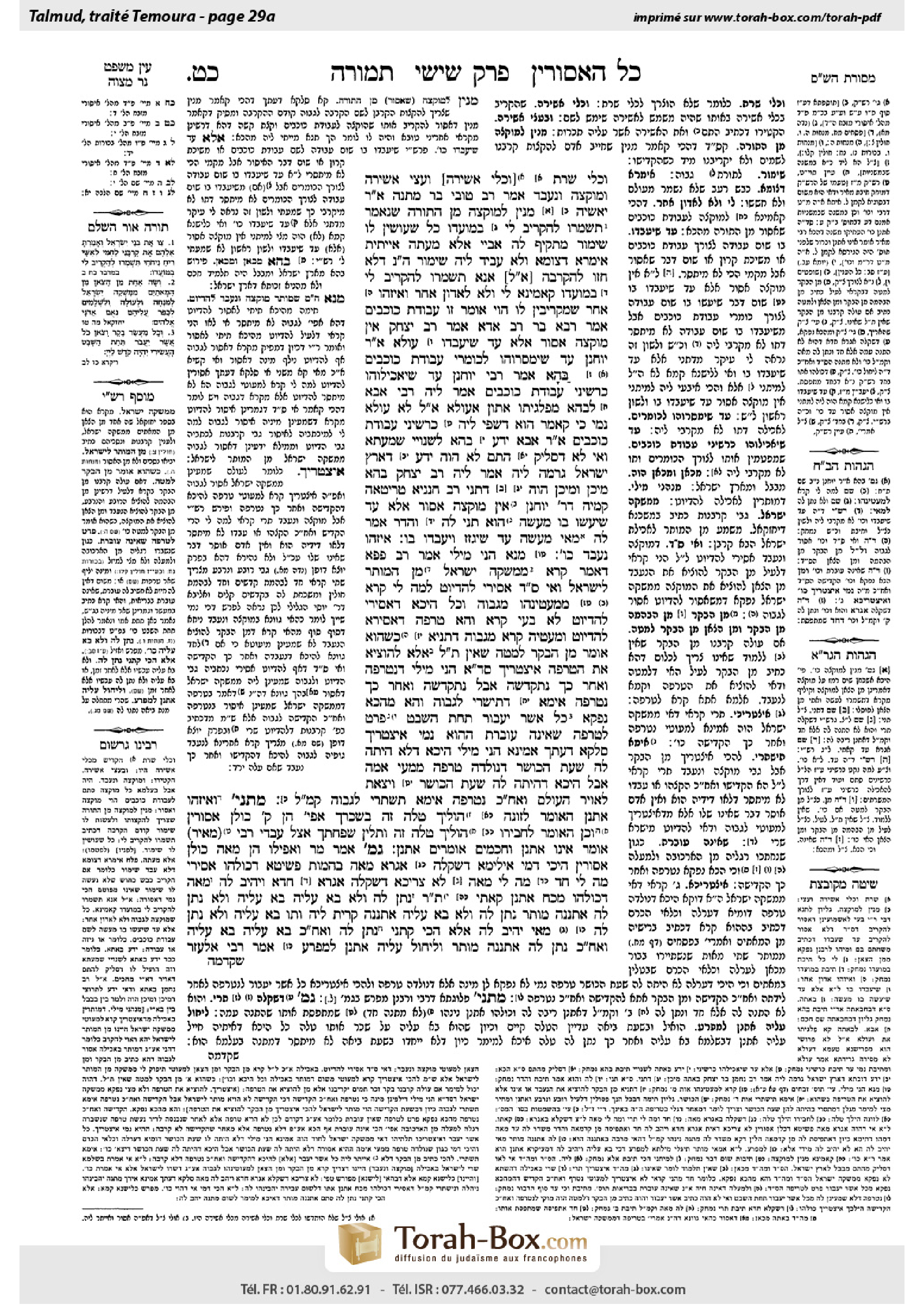
Temurah 29a: Talmud study for Daf Yomi
Daf Yomi is the daily study of one Talmud folio. Explore 37 tractates with scans, Hebrew text, Sefaria English and AI-generated French translations where annotated.
Passage selection and English or AI-generated French translation are available where the scan has annotations. Daf Study is independent of Torah-Box and Sefaria.
Browse Temurah · תמורה · All tractatesTemurah 29a text and translations
This page of Temurah includes the Aramaic text, an English translation and an AI-generated French translation, alongside the scan above.
תמורה כ״ט א · Aramaic and Hebrew text
וּכְלִי שָׁרֵת, וּכְלִי אֲשֵׁירָה, וַעֲצֵי אֲשֵׁירָה, וּמוּקְצֶה, וְנֶעֱבָד.
אָמַר רַב טוֹבִי בַּר מַתְנָה, אָמַר רַבִּי יֹאשִׁיָּה: מִנַּיִן לְמוּקְצֶה מִן הַתּוֹרָה? שֶׁנֶּאֱמַר ״תִּשְׁמְרוּ לְהַקְרִיב לִי בְּמוֹעֲדוֹ״ — כֹּל שֶׁעוֹשִׂין לוֹ שִׁימּוּר.
מַתְקֵיף לַהּ אַבָּיֵי: אֶלָּא מֵעַתָּה, (אייתית) [אַיְיתִי] אִימְּרָא דְּצוֹמָא, וְלָא עָבֵיד לֵיהּ שִׁימּוּר, הָכִי נָמֵי דְּלָא חֲזֵי לְהַקְרָבָה? אֲמַר לֵיהּ: אֲנָא ״תִּשְׁמְרוּ לְהַקְרִיב לִי בְּמוֹעֲדוֹ״ קָאָמֵינָא — ״לִי״ וְלֹא לְאָדוֹן אַחֵר, וְאֵיזֶהוּ אַחֵר שֶׁמַּקְרִיבִין לוֹ? הֱוֵי אוֹמֵר: זוֹ עֲבוֹדָה זָרָה.
אָמַר רָבָא בַּר רַב אַדָּא, אָמַר רַב יִצְחָק: אֵין מוּקְצֶה אָסוּר אֶלָּא עַד שֶׁיַּעַבְדוּ [בּוֹ]. עוּלָּא אָמַר רַבִּי יוֹחָנָן: עַד שֶׁיִּמְסְרוּהוּ לְכוּמְרֵי עֲבוֹדָה זָרָה.
בָּהָא אָמַר רַבִּי יוֹחָנָן: עַד שֶׁיַּאֲכִילוּהוּ כַּרְשִׁינֵי עֲבוֹדָה זָרָה. אֲמַר לֵיהּ רַבִּי אַבָּא לְבָהָא: מִפַּלְגִיתוּ אַתּוּן אַעוּלָּא? אֲמַר לֵיהּ: לָא, עוּלָּא נָמֵי כִּי קָאָמַר — הוּא דְּשָׁפֵי לֵיהּ כַּרְשִׁינֵי עֲבוֹדָה זָרָה.
אָמַר רַבִּי אַבָּא: יָדַע בְּהָא לְשַׁנּוֹיֵי שְׁמַעְתָּא, וְאִי לָא דְּסָלֵיק הָתָם — לָא הֲוָה יָדַע, דְּאֶרֶץ יִשְׂרָאֵל גְּרַמָה לֵיהּ. אֲמַר לֵיהּ רַב יִצְחָק: בָּהָא מִיכָּן וּמִיכָּן הֲוָה.
דְּתָנֵי רַב חֲנַנְיָא טְרִיטָאָה קַמֵּיהּ דְּרַבִּי יוֹחָנָן: אֵין מוּקְצֶה אָסוּר אֶלָּא עַד שֶׁיַּעֲשׂוּ בּוֹ מַעֲשֶׂה, הוּא תָּנֵי לַהּ (וַהֲדַר) [וְהוּא] אָמַר לַהּ: מַאי ״מַעֲשֶׂה״? — עַד שֶׁיִּגָּזֵז וְיַעַבְדוּ בּוֹ.
אֵיזֶהוּ נֶעֱבָד כּוּ׳. מְנָא הָנֵי מִילֵּי?
אָמַר רַב פָּפָּא: דְּאָמַר קְרָא ״מִמַּשְׁקֵה יִשְׂרָאֵל״, מִן הַמּוּתָּר לְיִשְׂרָאֵל, וְאִי סָלְקָא דַעְתָּךְ אֲסִירִי לְהֶדְיוֹט, לְמָה לִי קְרָא (מעטינהו) [לְמַעֹטִינְהוּ] מִגָּבוֹהַּ?
וְכֹל הֵיכָא דַּאֲסִירִי לְהֶדְיוֹט — לָא בָּעֵי קְרָא? וְהָא טְרֵפָה, דַּאֲסִירָא לְהֶדְיוֹט, וּמַעֲטֵיהּ קָרָא מִגָּבוֹהַּ!
דְּתַנְיָא: כְּשֶׁהוּא אוֹמֵר ״מִן הַבָּקָר״ לְמַטָּה, שֶׁאֵין תַּלְמוּד לוֹמַר, אֶלָּא לְהוֹצִיא אֶת הַטְּרֵפָה.
אִיצְטְרִיךְ, סָלְקָא דַעְתָּךְ אֲמִינָא: הָנֵי מִילֵּי — דְּנִטְרְפָה וְאַחַר כָּךְ נִתְקַדְּשָׁה, אֲבָל נִתְקַדְּשָׁה וְאַחַר כָּךְ נִטְרְפָה — אֵימָא (דתישרי) [דְּתִישְׁתְּרֵי] לְגָבוֹהַּ.
וְהָא מֵהָכָא נָפְקָא, ״כֹּל אֲשֶׁר יַעֲבוֹר תַּחַת הַשָּׁבֶט״, פְּרָט לִטְרֵפָה שֶׁאֵינָהּ עוֹבֶרֶת.
הָהוּא נָמֵי אִיצְטְרִיךְ, סָלְקָא דַעְתָּךְ אָמֵינָא: הָנֵי מִילֵּי הֵיכָא דְּלֹא הָיְתָה לָהּ שְׁעַת הַכּוֹשֶׁר, דְּנוֹלְדָה טְרֵפָה מִמְּעֵי אִמָּהּ, אֲבָל הֵיכָא דְּהָיְתָה לָהּ שְׁעַת הַכּוֹשֶׁר, וְיָצָאת לַאֲוִיר הָעוֹלָם, וְאַחַר כָּךְ נִטְרְפָה — אֵימָא תִּשְׁתְּרֵי לְגָבוֹהַּ, קָא מַשְׁמַע לַן.
מַתְנִי׳ וְאֵיזֶהוּ אֶתְנַן? — הָאוֹמֵר לְזוֹנָה ״הֵולִיךְ טָלֶה זֶה בִּשְׂכָרֵךְ״, אֲפִילּוּ הֵן מֵאָה, כּוּלָּן אֲסוּרִין. וְכֵן הָאוֹמֵר לַחֲבֵירוֹ ״הֵולָיךְ טָלֶה זֶה וְתָלִין שִׁפְחָתְךָ אֵצֶל עַבְדִּי״ — רַבִּי מֵאִיר אוֹמֵר: אֵינוֹ אֶתְנַן, וַחֲכָמִים אוֹמְרִים: אֶתְנַן.
גְּמָ׳ אָמַר מָר: וַאֲפִילּוּ הֵן מֵאָה, כּוּלָּן אֲסוּרִין. הֵיכִי דָמֵי? אִילֵּימָא דְּשָׁקְלָה אַגְרַאּ מֵאָה בְּהֵמוֹת — פְּשִׁיטָא דְּכוּלְּהוּ אֲסִירִי, מָה לִי חַד, מָה לִי מְאָה!
לָא צְרִיכָא, דְּשָׁקְלָה אַגְרַאּ חֲדָא, וְיָהֵיב לַהּ מְאָה, דְּכוּלְּהוּ מִכֹּחַ אֶתְנַן קָאָתוּ.
תָּנוּ רַבָּנַן: נָתַן לָהּ וְלֹא בָּא עָלֶיהָ, בָּא עָלֶיהָ וְלֹא נָתַן לָהּ — אֶתְנַנָּה מוּתָּר. נָתַן לָהּ וְלֹא בָּא עָלֶיהָ, ״אֶתְנַנָּה״ קָרֵית לֵיהּ? וְתוּ, בָּא עָלֶיהָ וְלֹא נָתַן לָהּ, מַאי יָהֵיב לַהּ?
אֶלָּא הָכִי קָתָנֵי: נָתַן לָהּ, וְאַחַר כָּךְ בָּא עָלֶיהָ; בָּא עָלֶיהָ, וְאַחַר כָּךְ נָתַן לָהּ — אֶתְנַנָּה מוּתָּר. וְלֵיחוּל עֲלֵיהּ אֶתְנַן לְמַפְרֵעַ? אָמַר רַבִּי אֶלְעָזָר:
Temurah 29a · English translation
and the prohibition against sacrificing without service vessels; and the prohibition against utilizing vessels that had been previously used for the service of a tree worshipped as idolatry [asheira]; and the prohibition against using the wood of an asheira, as God commanded Gideon to sacrifice the burnt offering with the wood of an asheira that he will cut down (Judges 6:26); and the prohibition of sacrificing an animal set aside for idolatry; and the prohibition against using an animal that was worshipped as an idol.
§ The Gemara continues to discuss the halakha of an animal set aside for idol worship. Rav Tovi bar Mattana says that Rabbi Yoshiya says: From where is the halakha of set-aside derived in the Torah? As it is stated with regard to the offerings: “My food that is presented to Me for offerings made by fire, of a pleasing aroma to Me, you shall safeguard it to sacrifice to Me in its due season” (Numbers 28:2), which refers to anything that is safeguarded. The Gemara initially assumes that Rabbi Yoshiya meant that any sacrifice must be safeguarded, i.e., set aside and not sacrificed immediately after its consecration.
Abaye objects to this: If that is so, then in a case where one brought a lamb that was weak as an offering, and its owner clearly did not safeguard it, so too will you say that it is unfit for sacrifice? Nowhere is it stated that an animal is disqualified for the altar because it has not been treated well. Rabbi Yoshiya said to Abaye: You misunderstood my intention; I say that the verse: “You shall safeguard it to sacrifice to Me in its due season,” should be interpreted as follows: You shall safeguard it only for Me, but not to another master. And which is this other master to which one could sacrifice? You must say that this is an object of idol worship.
The Gemara continues to discuss the definition of an animal that has been set aside for idolatry. Rava bar Rav Adda says that Rav Yitzḥak says: An animal that has been set aside for idol worship is prohibited, i.e., still considered set aside, only until it has been used for work by the attendants of that idolatry. But once it has been used it is no longer prohibited, as it will not be sacrificed to the idol afterward. Ulla says that Rabbi Yoḥanan says: An animal that has been set aside for idol worship is prohibited only until it has been handed over to the attendants of idol worship for fattening for it to be eaten, even if it has not been used for any form of work. But after it has been handed over it is not prohibited, as it will not be sacrificed.
The Sage Baha says that Rabbi Yoḥanan says: A set-aside animal is prohibited only until its owner feeds it vetches of idolatry after it has been given to the attendants of idolatry. Rabbi Abba said to Baha: Do you dispute the statement of Ulla, who defined set-aside differently according the opinion of Rabbi Yoḥanan? Baha said to Rabbi Abba: No, I do not disagree with Ulla, as Ulla too, when he stated his definition, also was referring to a case where they fed it vetches of idolatry.
Rabbi Abba said: Baha knows how to explain this halakha, but had he not ascended from Babylonia to there, Eretz Yisrael, he would not have known this explanation, as Eretz Yisrael caused him to grow wise. Rav Yitzḥak said to Rabbi Abba: That is not the case, as Baha was from here and there, i.e., he became wise because he studied Torah in both places.
The Gemara continues to discuss the issue of set-aside. Rabbi Ḥananya Terita taught before Rabbi Yoḥanan: An animal that has been set aside for idolatry is prohibited only until an action has been performed upon it. He taught it and then said its explanation: What is the meaning of an action? It means until it is sheared and used for labor by the attendants of the idol.
§ The mishna teaches: Which is the animal that is worshipped as idolatry? It is any animal that one worships. The mishna proceeds to state: The consumption of both this, the animal designated for idol worship, and that, the animal worshipped, is permitted. The Gemara asks: From where are these matters derived?
Rav Pappa said that the verse states, with regard to offerings: “And one lamb of the flock, out of two hundred, from the well-watered pastures of Israel, for a meal offering, and for a burnt offering, and for peace offerings, to make atonement for them” (Ezekiel 45:15). The expression: “From the well-watered pastures of Israel,” means that one brings offerings only from that which is permitted to Israel. And if it enters your mind that a set-aside animal and one worshipped as idolatry are prohibited in consumption to an ordinary person, why do I need a verse to exclude them from sacrifice to the Most High, as that would be obvious. Rather, they must be permitted in consumption to an ordinary person.
The Gemara asks: And is it true that anywhere that an item is prohibited to an ordinary person, a verse is not necessary to teach that it may not be used as a sacrifice? But there is the case of an animal with a condition that will cause it to die within twelve months [tereifa], which is prohibited in consumption to an ordinary person, and yet a verse excludes it from sacrifice to the Most High.
As it is taught in a baraita: It was previously derived from the verse: “You shall bring your offering from the cattle, even from the herd or from the flock” (Leviticus 1:2), that certain animals are prohibited to be sacrificed on the altar (see 28a). When it says below, in the next verse: “If his offering is a burnt offering of the herd,” there is apparently no need for the verse to state this, as it was already stated earlier. Rather, this serves to exclude a tereifa from being brought as an offering.
The Gemara answers: In this case the derivation was necessary, as it might enter your mind to say: This statement, that a tereifa may not be sacrificed, applies where it became a tereifa and afterward was consecrated as an offering. But if it was consecrated and only afterward became a tereifa, I would say that it should be permitted to the Most High, despite the fact that it is prohibited in consumption. Consequently, the derivation from the verse is necessary.
The Gemara asks: But isn’t the halakha, that an animal which became a tereifa after it was consecrated is prohibited to be sacrificed, derived from here, a verse that deals with the animal tithe: “And all the tithe of the herd or the flock, whatsoever passes under the rod, the tenth shall be holy to the Lord” (Leviticus 27:32). The phrase: “Whatsoever passes under the rod,” indicates that the halakha of animal tithe applies only to an animal that can pass under the rod, excluding a tereifa, e.g., if its leg was cut above the knee, which cannot pass under the rod. From this paradigm case of a tereifa, the exception is expanded to apply to all tereifot.
The Gemara answers: That derivation from animal tithe was also necessary, as it might enter your mind to say: This statement, that a tereifa may not be sacrificed, applies where it did not have a period of fitness to be sacrificed before it became a tereifa, e.g., where it was born a tereifa from its mother’s womb. But in a case where it had a period of fitness and emerged into the air of the world and only afterward became a tereifa, I would say that it should be permitted to the Most High. Therefore, the phrase: “Whatsoever passes under the rod,” teaches us that even such an animal is prohibited to be sacrificed on the altar.
MISHNA: And which is the case of an animal used as payment to a prostitute, which is prohibited as a sacrifice? It is the case of one who says to a prostitute: Here is this lamb as your fee. Even if they were one hundred lambs that he gave her, all of them are considered as payment to a prostitute and are prohibited. And likewise, in the case of one who says to another: Here is this lamb and in return your maidservant will lie with my slave and engage in intercourse with him, Rabbi Meir says: Its halakhic status is not that of payment to a prostitute, and the Rabbis say: Its halakhic status is that of payment to a prostitute.
GEMARA: The Master said in the mishna: And even if they were one hundred lambs, all of them are considered as payment to a prostitute, and are prohibited. The Gemara asks: What are the circumstances? If we say that this is referring to a prostitute who takes one hundred animals as payment for her services, it is obvious that all one hundred animals are prohibited, as what difference is it to me if she was paid one lamb or if she was paid one hundred lambs? What, then, is the novelty of the mishna here?
The Gemara answers: No, it is necessary in a case where the prostitute takes one lamb as payment, and he gave her one hundred lambs. The mishna is teaching that in this case the extra lambs are not considered a gift. Rather, all the lambs are prohibited, as they all come from the source of a payment to a prostitute.
The Gemara continues to discuss the issue of payment to a prostitute. The Sages taught in a baraita: If a man gave her an animal as payment but did not engage in intercourse with her, or if he engaged in intercourse with her but did not give her payment, her payment is permitted. The Gemara asks: In a case where he gave her an animal as payment but did not engage in intercourse with her, do you call this her payment? It cannot be considered payment unless the act of intercourse was actually performed. And furthermore, in the second case, where he engaged in intercourse with her but did not give her payment, what did he give her that it is called a permitted payment?
Rather, this is what the baraita is teaching: If he gave her payment and only afterward, when some time had elapsed, engaged in intercourse with her; or if he engaged in intercourse with her and only afterward gave her payment, in these two cases her payment is permitted. The Gemara asks: But in the case where he gave her the lamb and later engaged in intercourse with her, let the status of payment to a prostitute take effect upon it retroactively. Rabbi Elazar says:
Temurah 29a · Traduction française (IA)
et l'interdiction de sacrifier sans les ustensiles du service ; et l'interdiction d'utiliser des ustensiles qui avaient été utilisés précédemment pour le service d'un arbre adoré comme idole [asheira] ; et l'interdiction d'utiliser le bois d'une asheira, comme Dieu a ordonné à Gédéon de sacrifier l'holocauste avec le bois d'une asheira qu'il abattrait (Juges 6:26) ; et l'interdiction de sacrifier un animal mis de côté pour l'idolâtrie ; et l'interdiction d'utiliser un animal qui a été adoré comme idole.
§ La Guemara continue d'examiner la halakha concernant un animal mis de côté pour l'adoration des idoles. Rav Tovi bar Mattana rapporte que Rabbi Yoshiya dit : D'où la Torah dérive-t-elle la halakha de la mise de côté ? Comme il est dit à propos des offrandes : « Ma nourriture, qui m'est présentée en offrandes faites par le feu, d'une odeur agréable pour Moi, vous la garderez pour la sacrifier à Moi en son temps » (Nombres 28:2), ce qui fait référence à tout ce qui est gardé. La Guemara suppose initialement que Rabbi Yoshiya voulait dire que toute offrande doit être gardée, c'est-à-dire mise de côté et non sacrifiée immédiatement après sa consécration.
Abaye objecte : Si c'est ainsi, alors dans le cas où l'on a apporté un agneau faible en offrande, et que son propriétaire ne l'a clairement pas gardé, direz-vous également qu'il est inapte au sacrifice ? Nulle part il n'est dit qu'un animal est disqualifié pour l'autel parce qu'il n'a pas été bien traité. Rabbi Yoshiya dit à Abaye : Vous avez mal compris mon intention ; je dis que le verset : « Vous la garderez pour la sacrifier à Moi en son temps », doit être interprété comme suit : Vous la garderez seulement pour Moi, mais pas pour un autre maître. Et quel est ce maître à qui l'on pourrait sacrifier ? Vous devez dire que c'est un objet d'adoration idolâtre.
La Guemara continue d'examiner la définition d'un animal mis de côté pour l'idolâtrie. Rava bar Rav Adda rapporte que Rav Yitzḥak enseigne : Un animal mis de côté pour l'adoration des idoles est interdit, c'est-à-dire qu'il est considéré comme tel, uniquement jusqu'à ce qu'il ait été utilisé pour le travail par les serviteurs de cette idolâtrie. Mais une fois qu'il a été utilisé, il n'est plus interdit, car il ne sera pas sacrifié à l'idole par la suite. Oula rapporte que Rabbi Yoḥanan enseigne : Un animal mis de côté pour l'adoration des idoles est interdit uniquement jusqu'à ce qu'il ait été remis aux serviteurs de l'adoration des idoles pour être engraissé en vue d'être mangé, même s'il n'a pas été utilisé pour une forme quelconque de travail. Mais après qu'il a été remis, il n'est plus interdit, car il ne sera pas sacrifié.
Le Sage Baha rapporte que Rabbi Yoḥanan enseigne : Un animal mis de côté est interdit uniquement jusqu'à ce que son propriétaire lui ait donné à manger des fèves destinées à l'idolâtrie, après qu'il a été remis aux serviteurs de l'idolâtrie. Rabbi Abba dit à Baha : Contestez-vous l'énoncé d'Oula, qui a défini le statut de « mis de côté » différemment selon l'opinion de Rabbi Yoḥanan ? Baha répond à Rabbi Abba : Non, je ne suis pas en désaccord avec Oula, car Oula aussi, lorsqu'il a énoncé sa définition, faisait également référence à un cas où on lui a donné à manger des fèves destinées à l'idolâtrie.
Rabbi Abba dit : Baha sait expliquer cette halakha, mais s'il n'était pas monté de Babylone là-bas, en Terre d'Israël, il n'aurait pas connu cette explication, car la Terre d'Israël l'a rendu sage. Rav Yitzḥak dit à Rabbi Abba : Ce n'est pas le cas, car Baha était d'ici et de là, c'est-à-dire qu'il est devenu sage parce qu'il a étudié la Torah dans les deux endroits.
La Guemara continue d'examiner la question de la mise de côté. Rabbi Ḥananya Terita a enseigné devant Rabbi Yoḥanan : Un animal mis de côté pour l'idolâtrie est interdit uniquement jusqu'à ce qu'une action ait été accomplie sur lui. Il a enseigné cette règle, puis en a donné l'explication : Quelle est la signification d'une action ? Cela signifie jusqu'à ce qu'il soit tondue et utilisé pour le travail par les serviteurs de l'idole.
§ La Michna enseigne : Quel est l'animal adoré comme idole ? C'est tout animal que l'on adore. La Michna poursuit en précisant : La consommation de celui-ci, l'animal désigné pour l'adoration des idoles, et de celui-là, l'animal adoré, est permise. La Guemara demande : D'où ces règles sont-elles dérivées ?
Rav Pappa a dit que le verset déclare, à propos des offrandes : « Et un agneau du troupeau, sur deux cents, des pâturages arrosés d'Israël, pour une offrande de farine, et pour un holocauste, et pour des sacrifices de paix, pour faire expiation pour eux » (Ézéchiel 45:15). L'expression : « Des pâturages arrosés d'Israël », signifie que l'on apporte des offrandes seulement à partir de ce qui est permis à Israël. Et si vous pensez qu'un animal mis de côté et un animal adoré comme idole sont interdits en consommation pour une personne ordinaire, pourquoi ai-je besoin d'un verset pour les exclure du sacrifice au Très-Haut, car cela serait évident. Plutôt, ils doivent être permis en consommation pour une personne ordinaire.
La Guemara demande : Est-il vrai que partout où un objet est interdit à une personne ordinaire, un verset n'est pas nécessaire pour enseigner qu'il ne peut pas être utilisé comme sacrifice ? Mais il y a le cas d'un animal atteint d'une affection qui causera sa mort dans les douze mois [tereifa], qui est interdit à la consommation pour une personne ordinaire, et pourtant un verset l'exclut du sacrifice au Très-Haut.
Comme il est enseigné dans une baraïta : Il a été précédemment déduit du verset : « Vous apporterez votre offrande du bétail, soit du troupeau, soit du troupeau » (Lévitique 1:2), que certains animaux sont interdits d'être sacrifiés sur l'autel (voir 28a). Quand il est dit plus bas, dans le verset suivant : « Si son offrande est un holocauste du troupeau », il n'apparaît pas nécessaire que le verset le dise, car cela avait déjà été dit plus tôt. Plutôt, cela sert à exclure un tereifa d'être apporté en offrande.
La Guemara répond : Dans ce cas, la déduction était nécessaire, car il pourrait vous venir à l'esprit de dire : Cette déclaration, selon laquelle une tereifa ne peut pas être sacrifiée, s'applique lorsque l'animal est devenu tereifa puis a été consacré comme offrande. Mais s'il a été consacré et n'est devenu tereifa que par la suite, je dirais qu'il doit être permis au Très-Haut, malgré le fait qu'il soit interdit à la consommation. Par conséquent, la déduction tirée du verset est nécessaire.
La Guemara demande : Mais n'est-il pas de la halakha qu'un animal devenu tereifa après sa consécration est interdit au sacrifice, et que cela est déduit d'ici, d'un verset qui traite de la dîme du bétail : « Et toute la dîme du troupeau ou du petit bétail, tout ce qui passe sous la perche, la dixième partie sera sainte pour l'Éternel » (Lévitique 27:32) ? L'expression : « Tout ce qui passe sous la perche », indique que la halakha de la dîme du bétail ne s'applique qu'à un animal capable de passer sous la perche, excluant une tereifa, par exemple si sa jambe a été coupée au-dessus du genou, ce qui ne peut pas passer sous la perche. À partir de ce cas paradigmatique de tereifa, l'exception est étendue pour s'appliquer à toutes les tereifot.
La Guemara répond : Cette déduction tirée de la dîme du bétail était également nécessaire, car il pourrait vous venir à l'esprit de dire : Cette déclaration, selon laquelle une tereifa ne peut pas être sacrifiée, s'applique lorsque l'animal n'avait pas eu de période de capacité à être sacrifié avant de devenir tereifa, par exemple s'il est né tereifa du sein de sa mère. Mais dans un cas où il avait eu une période de capacité et était sorti dans l'air du monde et n'est devenu tereifa que par la suite, je dirais qu'il doit être permis au Très-Haut. Par conséquent, l'expression : « Tout ce qui passe sous la perche », nous enseigne que même un tel animal est interdit au sacrifice sur l'autel.
MICHNA : Et quel est le cas d'un animal utilisé comme paiement à une prostituée, qui est interdit comme sacrifice ? C'est le cas de celui qui dit à une prostituée : Voici cet agneau comme votre salaire. Même s'il lui a donné cent agneaux, tous sont considérés comme paiement à une prostituée et sont interdits. Et de même, dans le cas de celui qui dit à un autre : Voici cet agneau et en échange votre servante couchera avec mon esclave et aura des rapports avec lui, Rabbi Meïr dit : Son statut halakhique n'est pas celui d'un paiement à une prostituée, et les Sages disent : Son statut halakhique est celui d'un paiement à une prostituée.
GUEMARA : Le Maître a dit dans la Michna : Et même s'il y avait cent agneaux, tous sont considérés comme le paiement d'une prostituée et sont interdits. La Guemara demande : Quelles sont les circonstances ? Si nous disons que cela fait référence à une prostituée qui reçoit cent animaux en paiement de ses services, il est évident que les cent animaux sont interdits, car quelle différence y a-t-il pour moi entre le fait qu'elle ait été payée d'un agneau ou de cent agneaux ? Quelle est alors la nouveauté de la Michna ici ?
La Guemara répond : Non, il est nécessaire de le préciser dans un cas où la prostituée reçoit un agneau en paiement, mais où l'homme lui en a donné cent. La Michna enseigne que dans ce cas, les agneaux supplémentaires ne sont pas considérés comme un don. Au contraire, tous les agneaux sont interdits, car ils proviennent tous de la source d'un paiement à une prostituée.
La Guemara continue d'examiner la question du paiement à une prostituée. Les Sages ont enseigné dans une baraïta : Si un homme lui a donné un animal en paiement mais n'a pas eu de rapports sexuels avec elle, ou s'il a eu des rapports sexuels avec elle mais ne lui a pas donné de paiement, son paiement est permis. La Guemara demande : Dans le cas où il lui a donné un animal en paiement mais n'a pas eu de rapports sexuels avec elle, peut-on appeler cela son paiement ? Cela ne peut être considéré comme un paiement que si l'acte sexuel a été réellement accompli. De plus, dans le second cas, où il a eu des rapports sexuels avec elle mais ne lui a pas donné de paiement, qu'est-ce qu'il lui a donné pour que cela soit appelé un paiement permis ?
Plutôt, c'est ce que la baraïta enseigne : S'il lui a versé le prix et seulement par la suite, après un certain délai, a eu des rapports avec elle ; ou s'il a eu des rapports avec elle et seulement par la suite lui a versé le prix, dans ces deux cas, le prix qu'elle reçoit est permis. La Guemara demande : Mais dans le cas où il lui a donné l'agneau et a eu des rapports avec elle plus tard, que le statut de salaire d'une prostituée prenne effet rétroactivement sur lui. Rabbi Elazar dit :
Traduction française générée par IA à partir de l’édition anglaise de Sefaria. Vérifie toujours un passage avec le texte source.
Text from Sefaria: William Davidson Edition - Vocalized Aramaic (CC BY NC); William Davidson Edition - English (CC BY NC).