Temurah 28b: Talmud study for Daf Yomi
Daf Yomi is the daily study of one Talmud folio. Explore 37 tractates with scans, Hebrew text, Sefaria English and AI-generated French translations where annotated.
Passage selection and English or AI-generated French translation are available where the scan has annotations. Daf Study is independent of Torah-Box and Sefaria.
Browse Temurah · תמורה · All tractatesTemurah 28b text and translations
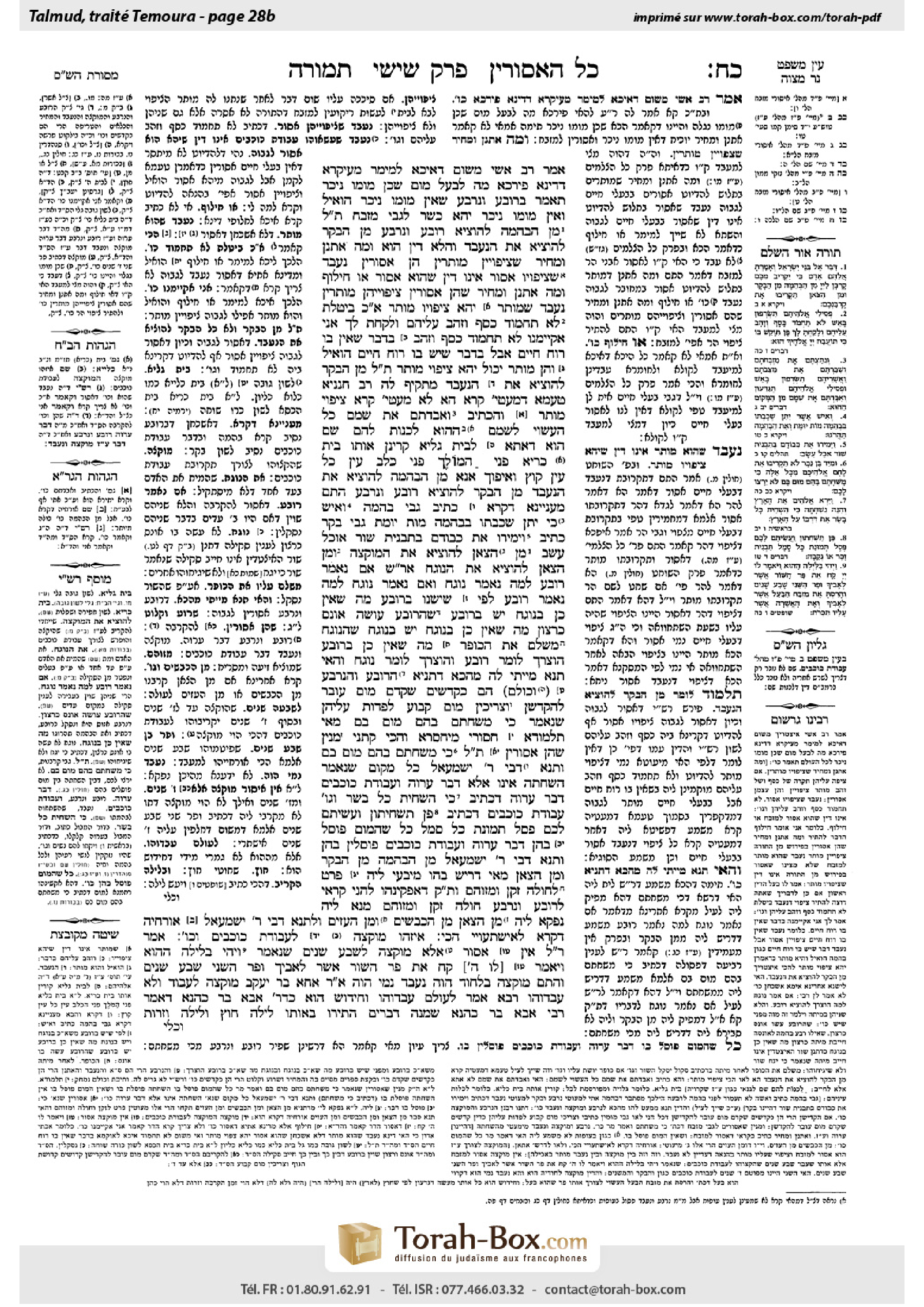
This page of Temurah includes the Aramaic text, an English translation and an AI-generated French translation, alongside the scan above.
תמורה כ״ח ב · Aramaic and Hebrew text
אָמַר רַב אָשֵׁי: מִשּׁוּם דְּאִיכָּא לְמֵימַר מֵעִיקָּרָא דְּדִינָא פִּירְכָא — מָה לְבַעַל מוּם שֶׁכֵּן מוּמוֹ נִיכָּר.
תֹּאמַר בְּרוֹבֵעַ וְנִרְבָּע, שֶׁאֵין מוּמוֹ נִיכָּר, הוֹאִיל וְאֵין מוּמוֹ נִיכָּר יְהֵא כָּשֵׁר לְגַבֵּי מִזְבֵּחַ — תַּלְמוּד לוֹמַר ״מִן הַבְּהֵמָה״, לְהוֹצִיא רוֹבֵעַ וְנִרְבָּע.
מִן הַבָּקָר — לְהוֹצִיא אֶת הַנֶּעֱבָד, וַהֲלֹא דִין הוּא: וּמָה אֶתְנַן וּמְחִיר שֶׁצִּיפּוּיָין מוּתָּרִין — הֵן אֲסוּרִין, נֶעֱבָד שֶׁצִּיפּוּיוֹ אָסוּר — אֵינוֹ דִּין שֶׁהוּא אָסוּר?
אוֹ חִילּוּף, וּמָה אֶתְנַן וּמְחִיר שֶׁהֵן אֲסוּרִין — צִיפּוּיֵיהֶן מוּתָּרִין, נֶעֱבָד שֶׁמּוּתָּר — יְהֵא צִיפּוּיוֹ מוּתָּר?
אִם כֵּן בִּיטַּלְתָּ ״לֹא תַחְמוֹד כֶּסֶף וְזָהָב עֲלֵיהֶם וְלָקַחְתָּ לָךְ״!
אֲנִי אֲקַיְּימֶנּוּ: ״לֹא תַּחֲמוֹד כֶּסֶף וְזָהָב״ — בְּדָבָר שֶׁאֵין בּוֹ רוּחַ חַיִּים, אֲבָל בְּדָבָר שֶׁיֵּשׁ בּוֹ רוּחַ חַיִּים, הוֹאִיל (וְהֵן) [וְהוּא] מוּתָּר — יָכוֹל יְהֵא צִיפּוּי מוּתָּר? תַּלְמוּד לוֹמַר ״מִן הַבָּקָר״ — לְהוֹצִיא אֶת הַנֶּעֱבָד.
מַתְקֵיף לַהּ רַב חֲנַנְיָא: טַעְמָא דְּמַעֲטֵיהּ קְרָא, הָא לָא מַעֲטֵיהּ קְרָא — צִיפּוּי מוּתָּר? וְהָכְתִיב ״וְאִבַּדְתֶּם אֶת שְׁמָם״ — כֹּל הֶעָשׂוּי לִשְׁמָם!
הָהוּא לְכַנּוֹת לָהֶם שֵׁם הוּא דַּאֲתָא: לְ״בֵית גַּלְיָא״ קוֹרִין אוֹתוֹ ״בֵּית כַּרְיָא״, ״פְּנֵי מֶלֶךְ״ — ״פְּנֵי כֶלֶב״, ״עֵין כֹּל״ — ״עֵין קוֹץ״.
וְאֵיפוֹךְ אֲנָא: ״מִן הַבְּהֵמָה״ — לְהוֹצִיא אֶת הַנֶּעֱבָד, ״מִן הַבָּקָר״ — לְהוֹצִיא רוֹבֵעַ וְנִרְבָּע!
הָתָם מֵעִנְיָינָא דִּקְרָא, כְּתִיב גַּבֵּי בְּהֵמָה ״וְאִישׁ כִּי יִתֵּן שְׁכׇבְתּוֹ בִּבְהֵמָה מוֹת יוּמָת״, גַּבֵּי בָּקָר כְּתִיב ״וַיָּמִירוּ אֶת כְּבוֹדָם בְּתַבְנִית שׁוֹר אוֹכֵל עֵשֶׂב״.
״מִן הַצֹּאן״ — לְהוֹצִיא אֶת הַמּוּקְצֶה, ״וּמִן הַצֹּאן״ — לְהוֹצִיא אֶת הַנּוֹגֵחַ. אָמַר רַבִּי שִׁמְעוֹן: אִם נֶאֱמַר רוֹבֵעַ — לָמָּה נֶאֱמַר נוֹגֵחַ? וְאִם נֶאֱמַר נוֹגֵחַ — לָמָּה נֶאֱמַר רוֹבֵעַ?
לְפִי שֶׁיֶּשְׁנוֹ בָּרוֹבֵעַ, מָה שֶׁאֵין כֵּן בַּנּוֹגֵחַ. יֵשׁ בָּרוֹבֵעַ, שֶׁהָרוֹבֵעַ עוֹשֶׂה אוֹנֶס כְּרָצוֹן, מַה שֶׁאֵין כֵּן בַּנּוֹגֵחַ.
יֵשׁ בַּנּוֹגֵחַ, שֶׁהַנּוֹגֵחַ מְשַׁלֵּם אֶת הַכּוֹפֶר, מָה שֶׁאֵין כֵּן בָּרוֹבֵעַ. הוּצְרַךְ לוֹמַר רוֹבֵעַ, וְהוּצְרַךְ לוֹמַר נוֹגֵחַ.
וְהַאי תַּנָּא מַיְיתֵי לַהּ מֵהָכָא, דְּתַנְיָא: הָרוֹבֵעַ וְהַנִּרְבָּע (וְכוּלָּם) [וְכוּ׳]. הֵם כְּקָדָשִׁים שֶׁקָּדַם מוּם עוֹבֵר לְהֶקְדֵּשָׁן.
וּצְרִיכִין מוּם קָבוּעַ לִפְדּוֹת עֲלֵיהֶן, שֶׁנֶּאֱמַר: ״כִּי מׇשְׁחָתָם בָּהֶם מוּם בָּם״.
מַאי תַּלְמוּדָא? חַסּוֹרֵי מִיחַסְּרָא, וְהָכִי קָתָנֵי: מִנַּיִן שֶׁהֵן אֲסוּרִין? תַּלְמוּד לוֹמַר ״כִּי מׇשְׁחָתָם בָּהֶם מוּם בָּם״, וְתָנָא דְּבֵי רַבִּי יִשְׁמָעֵאל: כָּל מָקוֹם שֶׁנֶּאֱמַר ׳הַשְׁחָתָה׳ — אֵינוֹ אֶלָּא דְּבַר עֶרְוָה וַעֲבוֹדָה זָרָה.
דְּבַר עֶרְוָה — דִּכְתִיב ״כִּי הִשְׁחִית כׇּל בָּשָׂרוְגוֹ׳״, עֲבוֹדָה זָרָה — דִּכְתִיב ״פֶּן תַּשְׁחִיתוּן וַעֲשִׂיתֶם לָכֶם פֶּסֶל תְּמוּנַת כׇּל סָמֶל״, כָּל שֶׁהַמּוּם פּוֹסֵל בָּהֶן — דְּבַר עֶרְוָה וַעֲבוֹדָה זָרָה פּוֹסְלִין בָּהֶן.
וְתָנָא דְּבֵי רַבִּי יִשְׁמָעֵאל, ״מִן הַבְּהֵמָה מִן הַבָּקָר וּמִן הַצֹּאן״ מַאי דָרֵישׁ בְּהוּ? מִיבְּעֵי לֵיהּ פְּרָט לְחוֹלֶה, זָקֵן, וּמְזוֹהָם.
וְתַנָּא קַמָּא, דְּאַפְּקִינְהוּ לְהָנֵי קְרָאֵי לְרוֹבֵעַ וְנִרְבָּע, חוֹלֶה, זָקֵן, וּמְזוֹהָם מְנָא לֵיהּ? נָפְקָא לֵיהּ ״מִן הַצֹּאן, מִן הַכְּבָשִׂים וּמִן הָעִזִּים״. וּלְתַנָּא דְּבֵי רַבִּי יִשְׁמָעֵאל, אוֹרְחֵיהּ דִּקְרָא לְאִישְׁתַּעוֹיֵי הָכִי.
אֵיזֶהוּ מוּקְצֶה לַעֲבוֹדָה זָרָה וְכוּ׳. אָמַר רֵישׁ לָקִישׁ: אֵין אָסוּר אֶלָּא מוּקְצֶה לְשֶׁבַע שְׁנַיִם.
שֶׁנֶּאֱמַר: ״וַיְהִי בַּלַּיְלָה הַהוּא וַיֹּאמֶר [לוֹ ה׳] קַח אֶת פַּר הַשּׁוֹר אֲשֶׁר לְאָבִיךָ וּפַר הַשֵּׁנִי שֶׁבַע שָׁנִים״.
וְהָתָם מוּקְצֶה בִּלְחוּד הֲוָה? נֶעֱבָד נָמֵי הֲוָה! אָמַר רַב אַחָא בַּר יַעֲקֹב: מוּקְצֶה לַעֲבוֹד, וְלֹא עֲבָדוּהוּ. רָבָא אָמַר: לְעוֹלָם עֲבָדוּהוּ, וְחִידּוּשׁ הוּא, כִּדְרַבִּי אַבָּא בַּר כָּהֲנָא, דְּאָמַר רַבִּי אַבָּא בַּר כָּהֲנָא: שְׁמֹנָה דְּבָרִים הִתִּירוּ בְּאוֹתוֹ לַיְלָה — חוּץ, וְלַיְלָה, וְזָרוּת,
Temurah 28b · English translation
Rav Ashi said: One cannot derive the halakha of an animal that copulated with a person and an animal that was the object of bestiality by an a fortiori inference from a blemished animal, because one can say that the refutation of the a fortiori inference is found in the basic case itself, i.e., there is a problem with this comparison: What is notable about a blemished animal? It is notable in that its blemish is conspicuous, and it should perhaps be disqualified for this reason.
Shall you say the same with regard to an animal that copulated with a person and an animal that was the object of bestiality, whose blemish is not conspicuous? Since its blemish is not conspicuous, one can claim that it should be fit for the altar, despite the fact that a transgression was performed with it. Therefore the verse states: “From the cattle,” to exclude an animal that copulated with a person and an animal that was the object of bestiality from eligibility to be brought as an offering.
§ The Gemara returns to discuss the baraita that interprets the verse: “You shall bring your offering from the cattle, even from the herd or from the flock” (Leviticus 1:2). The phrase “from the herd” serves to exclude an animal that is worshipped. The Gemara asks: Why is this verse necessary? Could this not be derived through an a fortiori inference: And if an animal given as payment to a prostitute for services rendered or given as payment for the price of a dog, which is more lenient in that their coating, i.e., the decorative part added to the animal, is permitted to be used on the altar, e.g., for fashioning golden plates for the altar, and yet they themselves are prohibited, then with regard to an animal that is worshipped, which is more stringent in that even its coating is prohibited, is it not logical that it itself should be prohibited to the Temple?
The Gemara responds: Or perhaps one can reverse this reasoning: And if animals used as payment to a prostitute or as the price of a dog, whose halakhot are stringent, as they themselves are prohibited to be sacrificed on the altar, and yet their coating is permitted, with regard to an animal that is worshipped, whose halakha is more lenient, as it is permitted to be sacrificed upon the altar, since the Torah does not explicitly state that it may not be sacrificed, certainly its coating should be permitted for use in the Temple.
The Gemara rejects this a fortiori inference with the claim that if so, you have nullified the requirement of the verse: “The graven images of their gods shall you burn with fire; you shall not covet the silver or the gold that is on them, nor take it to you” (Deuteronomy 7:25). This verse is clearly referring to the coatings of items worshipped, in addition to the idols themselves.
The Gemara refutes this claim: I shall establish the clause: “You shall not covet the silver or the gold that is on them,” as referring to a coating of an entity that is not alive. But with regard to the coating of an entity that is alive, since such entities themselves are permitted to be sacrificed on the altar, one might have thought that even its coating should be permitted. Therefore, the verse states: “From the herd,” to exclude an animal that is worshipped. Once it has been derived that a worshipped living creature is prohibited to be sacrificed on the altar, it follows that its coating is also prohibited.
Rav Ḥananya objects to this: According to this explanation, the only reason that the coating of an animal that was worshipped is prohibited is that the verse excluded it, from which it may be inferred that if the verse had not excluded it, then the coating would be permitted. But isn’t it written that idolatry must be entirely eradicated: “And you shall break down their altars, and dash in pieces their pillars, and burn their Asherim with fire; and you shall hew down the graven images of their gods; and you shall destroy their name out of that place” (Deuteronomy 12:3). This teaches that not only must the idols themselves be destroyed, but also everything made in their name, including their coating, must be destroyed.
The Gemara answers: That phrase: “And you shall destroy their name,” does not teach this halakha. Rather, it comes to teach that one should give a derogatory nickname to idol worship, and not call them by their original names. For example, if idolaters refer to a place of worship as: House of Elevation [beit galya], one calls it: House of Annihilation [beit karya]. If the place is called: Face of the Molekh [penei haMolekh], one calls it: Face of a Dog [penei kelev], and if it is called: All-seeing Eye [ein kol], one calls it: Eye of a Thorn [ein kotz].
The baraita teaches that the phrase “from the cattle” (Leviticus 1:2) excludes an animal that copulated with a person and an animal that was the object of bestiality from eligibility to be brought as an offering, while the phrase “from the herd” excludes an animal worshipped as an object of idolatry. The Gemara asks: But perhaps I can reverse these derivations, as follows: The phrase “from the cattle” serves to exclude an animal that was worshipped, and the phrase “from the herd” serves to exclude an animal that copulated with a person and an animal that was the object of bestiality.
The Gemara answers: There, with regard to the phrase “from the cattle [behema],” the derivation is based on the context of the verse, as the halakha of an animal that copulated with a person and an animal that was the object of bestiality is written with regard to a domesticated animal: “And if a man lie with a beast [behema], he shall surely be put to death, and you shall slay the beast. And if a woman approach any beast [behema] and lie down with it, you shall kill the woman, and the beast” (Leviticus 20:15–16). By contrast, the prohibition of idol worship is written with regard to an animal of the herd: “They made a calf in Horeb, and worshipped a molten image. Thus they exchanged their glory for the likeness of an ox that eats grass” (Psalms 106:19–20).
§ The baraita further teaches that the phrase “from the flock” (Leviticus 1:2) serves to exclude an animal set aside for idol worship, while the conjunction “or” at the beginning of the phrase “or from the flock” (Leviticus 1:2) serves to exclude an animal that gored and killed a person. Rabbi Shimon said: If it is stated that an animal that copulated with a person is disqualified as a sacrifice, why is it stated that an animal that gored is disqualified? And if it is stated that an animal that gored is disqualified, why is it stated that an animal that copulated with a person is disqualified? How do the transgressions differ?
Rabbi Shimon explains: It is because there is a stringency pertaining to an animal that copulated with a person that does not pertain to one that gored, and vice versa. Rabbi Shimon elaborates: There is a stringency pertaining to an animal that copulated with a person, as with regard to an animal that copulated with a person, the Torah renders an animal that is a victim of forced copulation like one that acted willfully, which is not so with regard to an animal that gored, which is exempt if others induced it to gore.
By contrast, there is a stringency pertaining to an animal that gored, as with regard to an animal that gored, its owner pays a ransom; which is not so with regard to the owner of an animal that copulated with a person. Therefore, the Torah had to state that an animal that copulated with a person is disqualified, and it also had to state that an animal that gored is disqualified.
§ The baraita teaches that the prohibition of sacrificing an animal that copulated with a person and an animal that was the object of bestiality on the altar is derived from the phrase “from the cattle.” The Gemara notes: And this tanna cites that halakha from here, as it is taught in a baraita: With regard to an animal that copulated with a person and an animal that was the object of bestiality that were consecrated, they are considered like sacrificial animals whose temporary blemish preceded their consecration.
The baraita continues: And animals with a temporary blemish cannot be sacrificed at present, nor can they be redeemed. Rather, they require a permanent blemish for one to redeem them on account of that blemish, as it is stated with regard to the disqualification of blemished animals from the altar: “Neither from the hand of a foreigner shall you offer the bread of your God of any of these, because their corruption is in them, there is a blemish in them; they shall not be accepted for you” (Leviticus 22:25).
The Gemara asks: What is the biblical derivation here? How is this verse relevant to an animal that copulated with a person and an animal that was the object of bestiality? The Gemara answers that the baraita is incomplete and this is what it is teaching: From where is it derived that an animal that copulated with a person and an animal that was the object of bestiality are prohibited to be sacrificed? The verse states: “Because their corruption is in them, there is a blemish in them,” and the school of Rabbi Yishmael taught a principle with regard to the derivation of verses: Anywhere that the term corruption is stated, it is a reference only to a matter of sexual immorality and idol worship.
Corruption refers to a matter of sexual immorality, as it is written with regard to the generation of the flood, which was steeped in sexual immorality: “And God saw the earth, and, behold, it was corrupt; for all flesh had corrupted its way upon the earth” (Genesis 6:12). Corruption also refers to idol worship, as it is written: “Lest you deal corruptly, and make you a graven image even the form of any figure” (Deuteronomy 4:16). Since the term corruption is also used with regard to blemished animals, the following may be derived: In any case in which a blemish disqualifies an animal from the altar, a matter of sexual immorality, such as an animal that copulated with a person or an animal that was the object of bestiality, or their use as an object of idol worship, also disqualifies them.
The Gemara asks: And according to the tanna of the school of Rabbi Yishmael, who says that the disqualifications of an animal that copulated with a person and an animal that was the object of bestiality, the set-aside, and the worshipped animal, are derived from the case of blemished animals, what does he derive from the verse: “From the cattle, even from the herd or from the flock” (Leviticus 1:2), which is the source of these disqualifications according to the earlier baraita? The Gemara answers that he requires these three terms to exclude sick, old, and filthy animals, which may not be sacrificed.
The Gemara asks: And the first tanna, who derives from these verses the halakha of an animal that copulated with a person and an animal that was the object of bestiality, from where does he derive the ruling that sick, the old, and filthy are disqualified from being sacrificed on the altar? The Gemara answers: He derives it from the verse: “And if his offering be of the flock, whether of the sheep or of the goats” (see Leviticus 1:10). The Gemara comments: And according to the tanna of the school of Rabbi Yishmael, that these halakhot are not derived from that verse, it is because it is the manner of the verse to say this, i.e., to state the general category of flock before specifying sheep and goats.
§ The mishna teaches: Which is the animal that is set-aside? It is an animal that is set aside for idol worship. Reish Lakish says: Only an animal that has been set aside for seven years is prohibited to be sacrificed on the altar, i.e., one that is set aside to be used for idol worship at the end of seven years.
As it is stated with regard to Gideon: “And it came to pass the same night, that the Lord said to him: Take your father’s bullock, and the second bullock of seven years, and throw down the altar of Baal that your father has, and cut down the Asherah that is by it; and build an altar to the Lord your God…and take the second bullock, and sacrifice a burnt offering with the wood of the Asherah that you shall cut down” (Judges 6:25–26). This indicates that it was common practice to prepare a bullock for seven years as an object of idol worship.
The Gemara asks: And there, was that bullock prohibited merely as set-aside? It was also actually worshipped. Rav Aḥa bar Ya’akov says: This bullock was set aside to be worshipped, but in practice, they did not worship it. Rava says: Actually, they did worship it, and therefore it should have been prohibited as idolatry. But this case is a novelty, in accordance with a statement of Rabbi Abba bar Kahana. As Rabbi Abba bar Kahana says: Eight prohibited matters were permitted to Gideon on that night when he destroyed his father’s idolatry (see Judges, chapter 6): The prohibition against slaughtering sacrificial animals outside the Tabernacle; and the prohibition against sacrificing offerings at night; and the prohibition of non-priests performing the service, as Gideon was not a priest;
Temurah 28b · Traduction française (IA)
Rav Ashi a dit : On ne peut pas déduire la halakha d'un animal qui a copulé avec un être humain et d'un animal qui a été l'objet d'un acte de bestialité par un raisonnement a fortiori à partir d'un animal défectueux, car on peut dire que la réfutation du raisonnement a fortiori se trouve dans le cas de base lui-même, c'est-à-dire qu'il y a un problème avec cette comparaison : Qu'est-ce qui est remarquable à propos d'un animal défectueux ? Il est remarquable en ce que son défaut est apparent, et il devrait peut-être être disqualifié pour cette raison.
Diriez-vous la même chose à propos d'un animal qui a copulé avec un être humain et d'un animal qui a été l'objet d'un acte de bestialité, dont le défaut n'est pas apparent ? Puisque son défaut n'est pas apparent, on peut affirmer qu'il devrait être apte pour l'autel, malgré le fait qu'une transgression ait été commise avec lui. Par conséquent, le verset énonce : « Du bétail », afin d'exclure un animal qui a copulé avec un être humain et un animal qui a été l'objet d'un acte de bestialité de l'éligibilité à être offert en sacrifice.
§ La Guemara revient à discuter la baraïta qui interprète le verset : « Vous apporterez votre offrande du bétail, soit du troupeau, soit du petit bétail » (Lévitique 1:2). L'expression « du troupeau » sert à exclure un animal qui est adoré. La Guemara demande : Pourquoi ce verset est-il nécessaire ? Ne pourrait-on pas le déduire par un raisonnement a fortiori : Et si un animal donné en paiement à une prostituée pour services rendus ou donné en paiement pour le prix d'un chien, qui est plus indulgent en ce que son revêtement, c'est-à-dire la partie décorative ajoutée à l'animal, est permis d'être utilisé sur l'autel, par exemple pour fabriquer des plaques d'or pour l'autel, et pourtant eux-mêmes sont interdits, alors à propos d'un animal qui est adoré, qui est plus strict en ce que même son revêtement est interdit, n'est-il pas logique que lui-même soit interdit au Temple ?
La Guemara répond : Peut-être peut-on inverser ce raisonnement : Si les animaux utilisés comme salaire d’une prostituée ou comme prix d’un chien, dont les halakhot sont strictes, car ils sont eux-mêmes interdits d’être sacrifiés sur l’autel, et pourtant leur revêtement est permis, a fortiori, s’agissant d’un animal adoré, dont la halakha est plus indulgente, car il est permis de le sacrifier sur l’autel, puisque la Torah ne stipule pas explicitement qu’il ne peut pas l’être, son revêtement devrait certainement être permis pour un usage dans le Temple.
La Guemara rejette ce raisonnement a fortiori en affirmant que, si c’était le cas, vous auriez annulé l’exigence du verset : « Vous brûlerez au feu les images gravées de leurs dieux ; vous ne convoiterez pas l’argent ou l’or qui est dessus, ni ne le prendrez pour vous » (Deutéronome 7:25). Ce verset fait clairement référence aux revêtements des objets adorés, en plus des idoles elles-mêmes.
La Guemara réfute cette affirmation : J’établirai la clause : « Vous ne convoiterez pas l’argent ou l’or qui est dessus », comme se référant au revêtement d’une entité qui n’est pas vivante. Mais s’agissant du revêtement d’une entité vivante, puisque de telles entités sont elles-mêmes permises d’être sacrifiées sur l’autel, on aurait pu penser que même leur revêtement devrait être permis. Par conséquent, le verset énonce : « Du troupeau », afin d’exclure un animal adoré. Une fois qu’il a été déduit qu’une créature vivante adorée est interdite d’être sacrifiée sur l’autel, il s’ensuit que son revêtement est également interdit.
Rav Ḥananya objecte à cette explication : Selon cette interprétation, la seule raison pour laquelle le revêtement d'un animal qui a été adoré est interdit est que le verset l'a exclu, d'où l'on peut déduire que si le verset ne l'avait pas exclu, le revêtement aurait été permis. Mais n'est-il pas écrit que l'idolâtrie doit être entièrement éradiquée : « Et vous démolirez leurs autels, et vous briserez leurs piliers, et vous brûlerez leurs Asherim au feu ; et vous abattrez les images gravées de leurs dieux ; et vous détruirez leur nom de cet endroit » (Deutéronome 12:3) ? Cela enseigne que non seulement les idoles elles-mêmes doivent être détruites, mais aussi tout ce qui a été fait en leur nom, y compris leur revêtement, doit être détruit.
La Guemara répond : Cette phrase : « Et vous détruirez leur nom », n'enseigne pas cette halakha. Elle vient plutôt enseigner qu'il faut donner un surnom péjoratif à l'adoration des idoles, et ne pas les appeler par leurs noms d'origine. Par exemple, si les idolâtres désignent un lieu de culte par : Maison de l'Élévation [beit galya], on l'appelle : Maison de l'Anéantissement [beit karya]. Si le lieu est appelé : Visage du Molekh [penei haMolekh], on l'appelle : Visage d'un Chien [penei kelev], et s'il est appelé : Œil Tout-Voyant [ein kol], on l'appelle : Œil d'un Épine [ein kotz].
La baraïta enseigne que l'expression « du bétail » (Lévitique 1:2) exclut de l'éligibilité à être offert en sacrifice un animal qui a copulé avec un être humain et un animal qui a été l'objet d'un acte de bestialité, tandis que l'expression « du troupeau » exclut un animal adoré comme objet d'idolâtrie. La Guemara demande : Mais peut-être que je peux inverser ces déductions, comme suit : L'expression « du bétail » sert à exclure un animal qui a été adoré, et l'expression « du troupeau » sert à exclure un animal qui a copulé avec un être humain et un animal qui a été l'objet d'un acte de bestialité.
La Guemara répond : Là, concernant l'expression « du bétail [behema] », la déduction est fondée sur le contexte du verset, car la halakha d'un animal qui a copulé avec un être humain et d'un animal qui a été l'objet d'un acte de bestialité est prescrite à propos d'un animal domestiqué : « Et si un homme couche avec une bête [behema], il sera certainement mis à mort, et vous tuerez la bête. Et si une femme s'approche de toute bête [behema] et couche avec elle, vous tuerez la femme, et la bête » (Lévitique 20:15–16). En revanche, l'interdiction de l'adoration des idoles est prescrite à propos d'un animal du troupeau : « Ils firent un veau à Horeb, et adorèrent une image fondue. Ainsi ils échangèrent leur gloire pour la ressemblance d'un bœuf qui mange l'herbe » (Psaumes 106:19–20).
§ La baraïta enseigne par ailleurs que l'expression « du troupeau » (Lévitique 1:2) sert à exclure un animal mis de côté pour le culte des idoles, tandis que la conjonction « ou » au début de l'expression « ou du troupeau » (Lévitique 1:2) sert à exclure un animal qui a donné un coup de corne et tué un homme. Rabbi Chimon a dit : Si l'on énonce qu'un animal qui a copulé avec un homme est inapte au sacrifice, pourquoi énonce-t-on qu'un animal qui a donné un coup de corne est inapte ? Et si l'on énonce qu'un animal qui a donné un coup de corne est inapte, pourquoi énonce-t-on qu'un animal qui a copulé avec un homme est inapte ? En quoi les transgressions diffèrent-elles ?
Rabbi Chimon explique : C'est parce qu'il existe une rigueur concernant un animal qui a copulé avec un homme qui ne s'applique pas à celui qui a donné un coup de corne, et vice versa. Rabbi Chimon précise : Il existe une rigueur concernant un animal qui a copulé avec un homme, car, en ce qui concerne un tel animal, la Torah assimile un animal qui a été la victime d'une copulation forcée à un animal qui a agi volontairement, ce qui n'est pas le cas d'un animal qui a donné un coup de corne, lequel est exempté si d'autres l'ont incité à donner un coup de corne.
En revanche, il existe une rigueur concernant un animal qui a donné un coup de corne, car, en ce qui concerne un tel animal, son propriétaire paie une rançon ; ce qui n'est pas le cas du propriétaire d'un animal qui a copulé avec un homme. Par conséquent, la Torah a dû énoncer qu'un animal qui a copulé avec un homme est inapte, et elle a également dû énoncer qu'un animal qui a donné un coup de corne est inapte.
§ La baraïta enseigne que l'interdiction de sacrifier sur l'autel un animal qui a copulé avec un homme et un animal qui a été l'objet d'une bestialité est dérivée de l'expression « du bétail ». La Guemara note : Et ce tanna cite cette halakha d'ici, car il est enseigné dans une baraïta : En ce qui concerne un animal qui a copulé avec un homme et un animal qui a été l'objet d'une bestialité qui ont été sanctifiés, ils sont considérés comme des animaux de sacrifice dont la tache temporaire a précédé leur sanctification.
La baraïta continue : Et les animaux ayant une tache temporaire ne peuvent pas être sacrifiés actuellement, ni être rachetés. Plutôt, ils nécessitent une tache permanente pour qu'on puisse les racheter en raison de cette tache, car il est dit au sujet de l'inaptitude des animaux tachés à l'autel : « Tu n'offriras point le pain de ton Dieu de la main d'un étranger, à cause de leur corruption qui est en eux, il y a une tache en eux ; ils ne seront point agréés pour vous » (Lévitique 22:25).
La Guemara demande : Quelle est la déduction biblique ici ? En quoi ce verset est-il pertinent pour un animal qui a copulé avec un homme et un animal qui a été l'objet d'une bestialité ? La Guemara répond que la baraïta est incomplète et qu'elle enseigne ceci : D'où est-il déduit qu'un animal qui a copulé avec un homme et un animal qui a été l'objet d'une bestialité sont interdits au sacrifice ? Le verset énonce : « À cause de leur corruption qui est en eux, il y a une tache en eux », et l'école de Rabbi Yichmaël a enseigné un principe concernant la déduction des versets : Partout où le terme corruption est mentionné, il ne fait référence qu'à une question d'immoralité sexuelle et d'idolâtrie.
La corruption fait référence à une question d'immoralité sexuelle, car il est écrit au sujet de la génération du déluge, qui était plongée dans l'immoralité sexuelle : « Et Dieu vit la terre, et voici, elle était corrompue ; car toute chair avait corrompu sa voie sur la terre » (Genèse 6:12). La corruption fait également référence à l'idolâtrie, car il est écrit : « De peur que vous ne vous corrompiez, et que vous ne fassiez une image taillée, même la forme de toute figure » (Deutéronome 4:16). Puisque le terme corruption est également utilisé au sujet des animaux tachés, on peut en déduire : Dans tout cas où une tache rend un animal inapte à l'autel, une question d'immoralité sexuelle, telle qu'un animal qui a copulé avec un homme ou un animal qui a été l'objet d'une bestialité, ou leur utilisation comme objet d'idolâtrie, les rend également inaptes.
La Guemara demande : Et selon le tanna de l'école de Rabbi Yishmaël, qui dit que les disqualifications d'un animal qui a copulé avec un homme et d'un animal qui a été l'objet d'une bestialité, de l'animal mis de côté et de l'animal adoré, sont dérivées du cas des animaux défectueux, que déduit-il du verset : « Du bétail, que ce soit du troupeau ou du petit bétail » (Lévitique 1:2), qui est la source de ces disqualifications selon la baraïta précédente ? La Guemara répond qu'il a besoin de ces trois termes pour exclure les animaux malades, âgés et souillés, qui ne peuvent pas être sacrifiés.
La Guemara demande : Et le premier tanna, qui déduit de ces versets la halakha concernant un animal qui a copulé avec un homme et un animal qui a été l'objet d'une bestialité, d'où déduit-il la règle selon laquelle les malades, les âgés et les souillés sont disqualifiés pour être sacrifiés sur l'autel ? La Guemara répond : Il le déduit du verset : « Et si son offrande est du petit bétail, que ce soit des brebis ou des chèvres » (voir Lévitique 1:10). La Guemara commente : Et selon le tanna de l'école de Rabbi Yishmaël, le fait que ces halakhot ne soient pas déduites de ce verset, c'est parce que c'est la manière du verset de s'exprimer, c'est-à-dire d'énoncer la catégorie générale du petit bétail avant de spécifier les brebis et les chèvres.
§ La Michna enseigne : Quel est l'animal mis de côté ? C'est un animal mis de côté pour le culte des idoles. Reish Lakish dit : Seul un animal qui a été mis de côté pendant sept ans est interdit au sacrifice sur l'autel, c'est-à-dire un animal mis de côté pour être utilisé pour le culte des idoles à la fin de sept ans.
Comme il est écrit à propos de Gédéon : « Et il arriva cette même nuit que l’Éternel lui dit : Prends le taureau de ton père, et le second taureau de sept ans, et renverse l’autel de Baal que ton père a, et abats l’asherah qui est auprès de lui ; et bâtis un autel à l’Éternel, ton Dieu… et prends le second taureau, et offre un holocauste avec le bois de l’asherah que tu abattras » (Juges 6:25-26). Cela indique qu’il était d’usage courant de préparer un taureau pendant sept ans en tant qu’objet de culte idolâtre.
La Guemara demande : Et là, ce taureau était-il interdit uniquement en tant que mis de côté ? Il était en réalité adoré. Rav Aha bar Yaakov dit : Ce taureau était mis de côté pour être adoré, mais en pratique, ils ne l’adoraient pas. Rava dit : En réalité, ils l’adoraient, et par conséquent, il aurait dû être interdit en tant qu’idolâtrie. Mais ce cas est une nouveauté, conformément à une déclaration de Rabbi Abba bar Kahana. Comme Rabbi Abba bar Kahana le dit : Huit interdits ont été permis à Gédéon cette nuit où il a détruit l’idolâtrie de son père (voir Juges, chapitre 6) : L’interdiction d’abattre des animaux sacrificiels en dehors du Tabernacle ; et l’interdiction d’offrir des sacrifices la nuit ; et l’interdiction pour des non-prêtres d’accomplir le service, car Gédéon n’était pas un prêtre ;
Traduction française générée par IA à partir de l’édition anglaise de Sefaria. Vérifie toujours un passage avec le texte source.
Text from Sefaria: William Davidson Edition - Vocalized Aramaic (CC BY NC); William Davidson Edition - English (CC BY NC).