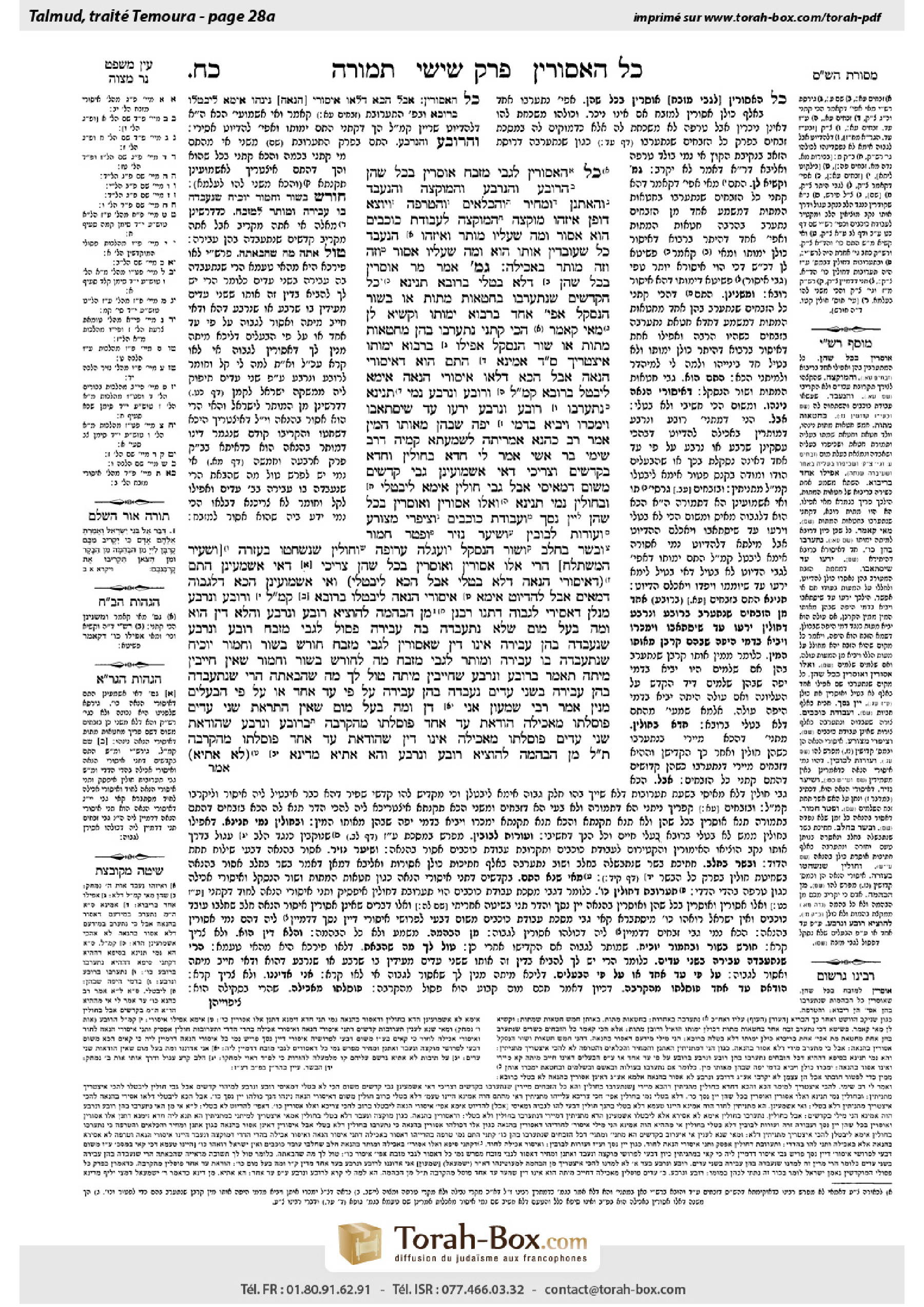
Temurah 28a: Talmud study for Daf Yomi
Daf Yomi is the daily study of one Talmud folio. Explore 37 tractates with scans, Hebrew text, Sefaria English and AI-generated French translations where annotated.
Passage selection and English or AI-generated French translation are available where the scan has annotations. Daf Study is independent of Torah-Box and Sefaria.
Browse Temurah · תמורה · All tractatesTemurah 28a text and translations
This page of Temurah includes the Aramaic text, an English translation and an AI-generated French translation, alongside the scan above.
תמורה כ״ח א · Aramaic and Hebrew text
מַתְנִי׳ כָּל הָאֲסוּרִין לְגַבֵּי מִזְבֵּחַ אוֹסְרִין בְּכׇל שֶׁהֵן — הָרוֹבֵעַ וְהַנִּרְבָּע, וְהַמּוּקְצֶה וְהַנֶּעֱבָד, וְהָאֶתְנַן וְהַמְּחִיר, וְהַכִּלְאַיִם וְהַטְּרֵפָה, וְיוֹצֵא דּוֹפֶן.
אֵיזֶהוּ מוּקְצֶה? הַמּוּקְצֶה לַעֲבוֹדָה זָרָה, הוּא אָסוּר וּמַה שֶּׁעָלָיו מוּתָּר. וְאֵיזֶהוּ הַנֶּעֱבָד? כֹּל שֶׁעוֹבְדִין אוֹתוֹ, הוּא וּמַה שֶּׁעָלָיו אָסוּר. וְזֶה וָזֶה מוּתָּר בַּאֲכִילָה.
גְּמָ׳ אָמַר מָר: אוֹסְרִין בְּכׇל שֶׁהֵן, דְּלָא בָּטְלִי בְּרוּבָּא. תְּנֵינָא: כׇּל הַקֳּדָשִׁים שֶׁנִּתְעָרְבוּ בְּחַטָּאוֹת מֵתוֹת אוֹ בְּשׁוֹר הַנִּסְקָל, אֲפִילּוּ אֶחָד בְּרִבּוֹא — יָמוּתוּ.
וְקַשְׁיָא לַן, מַאי קָאָמַר?
הָכִי קָתָנֵי: נִתְעָרְבוּ בָּהֶן מֵחַטָּאוֹת מֵתוֹת, אוֹ שׁוֹר הַנִּסְקָל — אֲפִילּוּ בְּרִבּוֹא יָמוּתוּ.
אִיצְטְרִיךְ, סָלְקָא דַעְתָּךְ אָמֵינָא: הָתָם הוּא דְּאִיסּוּרֵי הֲנָאָה, אֲבָל הָכָא דְּלָאו אִיסּוּרֵי הֲנָאָה — אֵימָא: לִיבְטֵל בְּרוּבָּא, קָא מַשְׁמַע לַן.
וְרוֹבַע וְנִרְבָּע נָמֵי תְּנֵינָא: נִתְעָרְבוּ רוֹבֵעַ וְנִרְבָּע — יִרְעוּ עַד שֶׁיִּסְתָּאֲבוּ, וְיִמָּכְרוּ, וְיָבִיא בִּדְמֵי יָפֶה שֶׁבָּהֶן מֵאוֹתוֹ הַמִּין!
אָמַר רַב כָּהֲנָא: אַמְרִיתַהּ לִשְׁמַעְתָּא קַמֵּיהּ דְּרַב שִׁימִי בַּר אָשֵׁי, אָמַר לִי: חֲדָא בְּחוּלִּין, וַחֲדָא בְּקָדָשִׁים.
וּצְרִיכִי, דְּאִי אַשְׁמוֹעִינַן גַּבֵּי קָדָשִׁים — מִשּׁוּם דִּמְאִיסִי, אֲבָל גַּבֵּי חוּלִּין — אֵימָא לִיבְטְלוּ.
וּבְחוּלִּין נָמֵי תְּנֵינָא: וְאֵלּוּ אֲסוּרִין וְאוֹסְרִין בְּכׇל שֶׁהֵן — יֵין נֶסֶךְ, וַעֲבוֹדָה זָרָה, וְצִיפֳּרֵי מְצוֹרָע, וְעוֹרוֹת לְבוּבִין.
וְשֵׂיעַר נָזִיר, וּפֶטֶר חֲמוֹר, וּבָשָׂר בְּחָלָב, וְשׁוֹר הַנִּסְקָל, וְעֶגְלָה עֲרוּפָה, וְחוּלִּין שֶׁנִּשְׁחֲטוּ בַּעֲזָרָה, וְשָׂעִיר הַמִּשְׁתַּלֵּחַ — הֲרֵי אֵלּוּ אֲסוּרִין וְאוֹסְרִין בְּכׇל שֶׁהֵן!
צְרִיכִי, דְּאִי אַשְׁמְעִינַן הָתָם — דְּאִיסּוּרֵי הֲנָאָה דְּלָא בָּטְלִי, אֲבָל הָכָא — לִיבְטְלִי.
וְאִי אַשְׁמוֹעִינַן הָכָא, דִּלְגָבוֹהַּ דִּמְאִיס, אֲבָל לְהֶדְיוֹט — אֵימָא: אִיסּוּרֵי הֲנָאָה לִיבְטְלוּ בְּרוּבָּא, קָא מַשְׁמַע לַן.
וְרוֹבֵעַ וְנִרְבָּע, מְנָלַן דַּאֲסִירִי לְגָבוֹהַּ? דְּתָנוּ רַבָּנַן: ״מִן הַבְּהֵמָה״ — לְהוֹצִיא רוֹבֵעַ וְנִרְבָּע.
וַהֲלֹא דִין הוּא, וּמָה בַּעַל מוּם שֶׁלֹּא נֶעֶבְדָה בּוֹ עֲבֵירָה פָּסוּל לְגַבֵּי מִזְבֵּחַ, רוֹבֵעַ וְנִרְבָּע שֶׁנֶּעֶבְדָה בָּהֶן עֲבֵירָה — אֵינוֹ דִּין שֶׁאֲסוּרִין לְגַבֵּי מִזְבֵּחַ?!
חוֹרֵשׁ בְּשׁוֹר וַחֲמוֹר יוֹכִיחַ, שֶׁנֶּעֶבְדָה בּוֹ עֲבֵירָה, וּמוּתָּר לְגַבֵּי מִזְבֵּחַ.
מָה לְחוֹרֵשׁ בְּשׁוֹר וַחֲמוֹר, שֶׁאֵין חַיָּיבִין מִיתָה, תֹּאמַר בְּרוֹבֵעַ וְנִרְבָּע, שֶׁחַיָּיבִין מִיתָה.
טוֹל לָךְ מָה שֶׁהֵבֵאתָה, הֲרֵי שֶׁנֶּעֶבְדָה בָּהֶן עֲבֵירָה בִּשְׁנֵי עֵדִים.
נֶעֶבְדָה בָּהֶן עֲבֵירָה עַל פִּי עֵד אֶחָד, אוֹ עַל פִּי הַבְּעָלִים, מִנַּיִן?
אָמַר רַבִּי שִׁמְעוֹן: אֲנִי דָּן, וּמָה בַּעַל מוּם שֶׁאֵין הַתְרָאַת שְׁנֵי עֵדִים פּוֹסַלְתּוֹ מֵאֲכִילָה — הוֹדָאַת עֵד אֶחָד פּוֹסַלְתּוֹ מֵהַקְרָבָה, בְּרוֹבֵעַ וְנִרְבָּע שֶׁהוֹדָאַת שְׁנֵי עֵדִים פּוֹסַלְתּוֹ מֵאֲכִילָה — אֵינוֹ דִּין שֶׁהוֹדָאַת עֵד אֶחָד פּוֹסַלְתּוֹ מֵהַקְרָבָה!
תַּלְמוּד לוֹמַר ״מִן הַבְּהֵמָה״ לְהוֹצִיא רוֹבֵעַ וְנִרְבָּע, וְהָא אָתְיָא מִדִּינָא (לָא אָתְיָא)!
Temurah 28a · English translation
MISHNA: With regard to all animals whose sacrifice on the altar is prohibited, if they are intermingled with animals whose sacrifice is permitted, they prohibit the entire mixture of animals in any amount, regardless of the ratio of permitted to prohibited animals. These are the animals whose sacrifice is prohibited: An animal that copulated with a person, and an animal that was the object of bestiality, and the set-aside, and one that was worshipped, and an animal that was given as payment to a prostitute or as the price of a dog, or an animal crossbred from a mixture of diverse kinds, or an animal with a wound that will cause it to die within twelve months [tereifa], or an animal born by caesarean section.
Which is the animal that is set-aside? It is an animal that is set aside for idol worship. The animal itself is prohibited, but that which is upon it, e.g., its jewelry and garments, is permitted to be sold in order to purchase an animal to be sacrificed. And which is the animal that was worshipped? It is any animal that a person worships as an object of idol worship. In this case, the sacrifice of both the animal itself and an animal purchased using the money from the sale of that which is upon it is prohibited. And the consumption of both this, the animal designated for idol worship, and that, the animal worshipped, is permitted.
GEMARA: The Master said in the mishna, with regard to all animals whose sacrifice on the altar is prohibited, that if they are intermingled with animals whose sacrifice is permitted, they prohibit the entire mixture in any amount. This teaches that they are not nullified by a majority. This is difficult, as we already learn this in a mishna (Zevaḥim 70b): All the sacrificial animals that were intermingled with an animal from which deriving benefit is prohibited, e.g., sin offerings that were disqualified and left to die, or if they were intermingled with an ox that is sentenced to be stoned, even if the ratio is one in ten thousand, deriving benefit from them all is prohibited and they must all die.
And the use of the word “even” in the phrase: Even one in ten thousand, was difficult for us: What is it saying? This word indicates that the novelty of the mishna’s ruling is that even if one permitted animal was intermingled with ten thousand prohibited animals they are all prohibited. Yet, this is less of a novelty than in the reverse case, since if in a situation where a minority of prohibited items became intermingled with a majority of permitted animals they are all prohibited, all the more so when the prohibited items are the majority.
And we explained that this is what the tanna is teaching: With regard to animals that are fit for the altar, if there was intermingled with them an animal from which deriving benefit is prohibited, e.g., one of the five sin offerings that are left to die if they are rendered disqualified, or if they were intermingled with an ox that is sentenced to be stoned, even if one prohibited animal was intermingled in ten thousand permitted animals, deriving benefit from them is prohibited and they must all die. If so, the halakha of the mishna here was already taught in tractate Zevaḥim. Why, then, is its repetition necessary here?
The Gemara answers that it was necessary, as it might enter your mind to say that this halakha applies only there, with regard to the specific examples mentioned in the mishna in Zevaḥim, as the five sin offerings that are condemned to die and an ox that is sentenced to be stoned are items from which deriving benefit is prohibited. But here, where the animals are not items from which deriving benefit is prohibited, but are merely prohibited to be sacrificed, you might say: Let them be nullified by a majority of permitted animals. Therefore, the mishna teaches us that even animals that are merely prohibited to be sacrificed prohibit other animals in any amount.
The Gemara asks: But we already learn in a mishna (Zevaḥim 71a) the halakha of an animal that copulated with a person, and an animal that was the object of bestiality, and the other examples listed in the mishna here as well: If sacrificial animals were intermingled with an animal that copulated with a person, or with an animal that was the object of bestiality, or with the set-aside, with the animal worshipped, or with one of the other animals mentioned here, they shall graze until they become unfit for sacrifice and then sold, and from the money received the owner shall bring another offering with the monetary value of the higher-quality animal among them from the same species as the offering with which they were intermingled. This indicates that even in the case of an animal that may not be sacrificed, but from which one may derive benefit, it nevertheless renders other animals prohibited when intermingled.
Rav Kahana said: I said this halakha before Rav Shimi bar Ashi, and he said to me that it was necessary for the mishna here to repeat this ruling. The reason is that one mishna is referring to a case where the previously fit animals became intermingled while they were still non-sacred, and their owners subsequently consecrated them. And the other mishna in Zevaḥim is referring to a situation where they became intermingled when they were already consecrated, as can be inferred from the opening phrase of that mishna: All the offerings (Zevaḥim 70b), which indicates that they are already offerings.
The Gemara adds: And both mishnayot are necessary, as had the tanna taught us this halakha only with regard to sacrificial animals, one might say that the reason is because they are repulsive, i.e., when the sacrificial animals became intermingled with the other animals they were immediately disqualified from being sacrificed on the altar. But with regard to animals that became intermingled when they were still non-sacred, at which stage they are not considered repulsive to the altar, as the altar does not yet have a claim to them, one might say: Let them be nullified in the mixture, after which all the animals could be dedicated to the altar. Therefore, the mishna here teaches that even if the animals became intermingled when they were non-sacred, nevertheless the entire mixture is prohibited.
The Gemara asks: But we also learn this halakha, that the entire mixture is prohibited with regard to non-sacred items, in another mishna (Avoda Zara 74a): And these are items that are prohibited in themselves and that deem other items prohibited if they became intermingled with them in any amount: Wine used for a libation in idol worship, and an object of idol worship, and birds for the purification of a leper (see Leviticus 14:1–6), and hides with a tear opposite the heart, a sign of the practice of sacrificing hearts of live animals for idol worship.
And in addition, the shaved-off hair of a nazirite (Numbers 6:18); and a firstborn donkey (Exodus 13:13); and meat that was cooked in milk (Exodus 23:19; 34:26; Deuteronomy 14:21), and an ox that is to be stoned; and a heifer whose neck is broken as part of the ritual performed when a murder victim’s body is found outside a town, and it is not known who caused his death (Deuteronomy 21:1–9); and non-sacred meat from an animal that was slaughtered in the Temple courtyard, and the scapegoat of Yom Kippur (Leviticus 16:7–10), all of these are prohibited in themselves and they deem mixtures prohibited in any amount.
Once again the Gemara answers that both mishnayot are necessary, as had the tanna taught us this halakha only there, in tractate Avoda Zara, one would have said that it is only in that case, where they are items from which deriving benefit is prohibited, that they are not nullified; but here, let them be nullified.
And had the tanna taught us this halakha only here, I would have said that the mixture is prohibited in this case, as this mishna is dealing with offerings that have been rendered repulsive to the Most High. But with regard to use by an ordinary person [hedyot], say: Let these other items from which deriving benefit is prohibited be nullified by a majority. Therefore, the mishna in Avoda Zara teaches us that even items not designated for use upon the altar render other items prohibited, and are not nullified by a majority.
§ The mishna’s list of disqualified animals includes an animal that copulated with a person, and an animal that was the object of bestiality. The Gemara asks: From where do we derive that these animals are prohibited as offerings to the Most High? The Gemara answers that this is as the Sages taught with regard to the verse: “You shall bring your offering from the cattle, even from the herd or from the flock” (Leviticus 1:2). The limitation indicated by the phrase “from the cattle” serves to exclude an animal that copulated with a person and an animal that was the object of bestiality from eligibility as an offering.
The Gemara objects: That claim requires elucidation, as couldn’t this be derived through an a fortiori inference: And if a blemished animal, with which no transgression was committed, is disqualified from the altar, with regard to an animal that copulated with a person and an animal that was the object of bestiality, with which a transgression was committed, is it not logical that they should be prohibited to be sacrificed on the altar?
The Gemara explains: The case of one who violates the prohibition of plowing with an ox and a donkey together (Deuteronomy 22:10) shall prove that the above claim is invalid. This is a case where a transgression was committed with the ox, and yet it is permitted to sacrifice it upon the altar.
The Gemara rejects this response: What is notable about the prohibition of one who plows with an ox and a donkey? It is notable in that one is not liable to die for this violation, and therefore it is logical that this ox is not prohibited to be sacrificed. Will you say the same with regard to the prohibitions of an animal that copulated with a person and an animal that was the object of bestiality, where the person involved is liable to die? Therefore, the animals should be prohibited to be sacrificed on the altar.
The Gemara explains that this claim is indeed valid, and therefore you should retract from that which you cited as a refutation of the a fortiori inference. In other words, one can learn by a fortiori inference that an animal that copulated with a person and an animal that was the object of bestiality cannot be used as offerings. Nevertheless, this is applicable only to those animals with which a transgression was committed that was seen by two witnesses, and the transgressor was therefore liable to death by the court, as in this case the proof from one who plows with an ox and a donkey is invalid, as explained in the previous paragraph.
From where is it derived that the same applies if a transgression was committed with them on the basis of the testimony of one witness or on the basis of the admission of the owners? For this purpose, the interpretation of the phrase “from the cattle” is necessary.
Rabbi Shimon says: I infer an a fortiori inference in the following manner: And if a blemished animal, concerning which the testimony of two witnesses does not disqualify it from being eaten by an ordinary person, and nevertheless the admission of one witness, i.e., the Sage who rules that its blemish disqualifies it for the altar, disqualifies it from sacrifice, with regard to an animal that copulated with a person and an animal that was the object of bestiality, concerning which the admission of two witnesses disqualifies it from being eaten by an ordinary person, is it not logical that the admission of one witness should disqualify it from sacrifice?
Therefore, the verse states: “From the cattle,” to exclude an animal that copulated with a person and an animal that was the object of bestiality from eligibility as offerings. The Gemara asks: But why is this derivation necessary? This halakha was just inferred through an a fortiori inference, by Rabbi Shimon. The Gemara explains that in fact the halakha of an animal that copulated with a person and an animal that was the object of bestiality cannot be inferred by a fortiori inference according to the Rabbis who disagree with Rabbi Shimon.
Temurah 28a · Traduction française (IA)
MICHNA : Tous les animaux dont le sacrifice sur l’autel est interdit, s’ils sont mêlés à des animaux dont le sacrifice est permis, rendent interdit tout le mélange, quelle que soit la proportion entre les animaux permis et les animaux interdits. Voici les animaux dont le sacrifice est interdit : un animal qui s’est accouplé avec une personne, un animal qui a été l’objet d’une bestialité, un animal réservé, un animal qui a été adoré, un animal donné en paiement à une prostituée ou comme prix d’un chien, un animal issu d’un croisement d’espèces, un animal atteint d’une blessure qui entraînera sa mort dans les douze mois [tereifa], ou un animal né par césarienne.
Quel est l’animal réservé ? C’est un animal mis à part pour le culte idolâtre. L’animal lui-même est interdit, mais ce qui se trouve sur lui, par exemple ses bijoux et ses vêtements, peut être vendu afin d’acheter un animal à sacrifier. Et quel est l’animal qui a été adoré ? C’est tout animal qu’une personne adore comme objet de culte idolâtre. Dans ce cas, le sacrifice de l’animal lui-même, ainsi que celui d’un animal acheté avec l’argent de la vente de ce qui se trouvait sur lui, est interdit. La consommation de celui-ci, l’animal réservé au culte idolâtre, comme de celui-là, l’animal adoré, est permise.
GUEMARA : Le Maître a dit dans la Michna que tous les animaux dont le sacrifice sur l’autel est interdit, s’ils sont mêlés à des animaux dont le sacrifice est permis, rendent interdit tout le mélange, quelle que soit leur proportion. Cela enseigne qu’ils ne sont pas annulés par une majorité. C’est difficile, car nous l’apprenons déjà dans une Michna (Zevaḥim 70b) : tous les animaux consacrés mêlés à un animal dont il est interdit de tirer profit — par exemple des sacrifices expiatoires invalidés et laissés à mourir, ou des animaux mêlés à un bœuf condamné à être lapidé —, même si leur proportion est d’un pour dix mille, il est interdit de tirer profit de tous et ils doivent tous mourir.
L’emploi du mot « même » dans l’expression « même un pour dix mille » nous posait problème : que signifie-t-il ? Ce mot indique que la nouveauté de la règle de la Michna est que, même si un animal permis est mêlé à dix mille animaux interdits, ils sont tous interdits. Pourtant, c’est moins novateur que dans le cas inverse : si, lorsque des éléments interdits en minorité sont mêlés à une majorité d’animaux permis, tous deviennent interdits, à plus forte raison en est-il ainsi lorsque les éléments interdits sont majoritaires.
Et nous avons expliqué que voici ce que le tanna enseigne : concernant des animaux aptes à être offerts sur l’autel, si un animal dont il est interdit de tirer profit est mêlé à eux — par exemple l’un des cinq sacrifices expiatoires qui doivent mourir s’ils sont invalidés, ou un bœuf condamné à être lapidé —, même si un seul animal interdit est mêlé à dix mille animaux permis, il est interdit de tirer profit de tous et ils doivent tous mourir. Si tel est le cas, la halakha de la Michna présente a déjà été enseignée dans le traité Zevaḥim. Pourquoi donc la répéter ici ?
La Guemara répond qu’il était nécessaire de répéter cette règle, car on aurait pu penser que cette halakha ne s’applique que là-bas, aux exemples précis mentionnés dans la Michna de Zevaḥim, puisque les cinq sacrifices expiatoires condamnés à mourir et le bœuf condamné à être lapidé sont des choses dont il est interdit de tirer profit. Mais ici, où les animaux ne sont pas des choses dont il est interdit de tirer profit et où seul leur sacrifice est interdit, on aurait pu dire : qu’ils soient annulés par la majorité des animaux permis. La Michna nous enseigne donc que même des animaux dont le sacrifice est simplement interdit rendent d’autres animaux interdits, quelle que soit leur proportion.
La Guemara demande : Mais nous apprenons déjà dans une Michna (Zevaḥim 71a) la halakha concernant un animal qui s’est accouplé avec une personne, un animal qui a été l’objet d’une bestialité, ainsi que les autres exemples énumérés ici : si des animaux consacrés sont mêlés à un animal qui s’est accouplé avec une personne, ou à un animal qui a été l’objet d’une bestialité, ou à un animal réservé, à un animal adoré, ou à l’un des autres animaux mentionnés ici, ils doivent paître jusqu’à devenir inaptes au sacrifice, puis être vendus. Avec l’argent obtenu, le propriétaire apportera un autre sacrifice, d’une valeur égale à celle de l’animal de meilleure qualité parmi eux, de la même espèce que le sacrifice auquel ils étaient mêlés. Cela indique que même dans le cas d’un animal qui ne peut être sacrifié, mais dont il est permis de tirer profit, il rend néanmoins les autres animaux interdits lorsqu’ils sont mêlés.
Rav Kahana dit : J’ai énoncé cette halakha devant Rav Shimi bar Ashi, et il m’a dit qu’il était nécessaire que la Michna présente répète cette règle. La raison en est que l’une des Michnaïot traite d’un cas où des animaux auparavant aptes sont devenus mêlés alors qu’ils étaient encore non consacrés, puis leurs propriétaires les ont consacrés. L’autre Michna, dans Zevaḥim, traite d’une situation où ils se sont mêlés alors qu’ils étaient déjà consacrés, comme on peut le déduire de la formule initiale de cette Michna : « tous les sacrifices » (Zevaḥim 70b), ce qui indique qu’il s’agit déjà de sacrifices.
La Guemara ajoute : les deux Michnaïot sont nécessaires. En effet, si le tanna nous avait enseigné cette halakha uniquement à propos d’animaux consacrés, on aurait pu dire que la raison en est qu’ils sont répugnants : lorsque les animaux consacrés se sont mêlés aux autres animaux, ils ont été immédiatement disqualifiés pour être sacrifiés sur l’autel. Mais pour des animaux qui se sont mêlés alors qu’ils étaient encore non consacrés, à un stade où ils ne sont pas considérés comme répugnants pour l’autel, puisque l’autel n’a pas encore de droit sur eux, on aurait pu dire : qu’ils soient annulés dans le mélange, après quoi tous les animaux pourraient être consacrés à l’autel. La Michna présente enseigne donc que même si les animaux se sont mêlés alors qu’ils étaient non consacrés, tout le mélange est néanmoins interdit.
La Guemara demande : Mais nous apprenons aussi cette halakha, selon laquelle tout le mélange est interdit, au sujet de choses non consacrées, dans une autre Michna (Avoda Zara 74a) : voici les choses qui sont interdites en elles-mêmes et qui rendent interdites les autres choses avec lesquelles elles se sont mêlées, quelle que soit leur proportion : le vin utilisé pour une libation idolâtre, un objet de culte idolâtre, les oiseaux destinés à la purification d’un lépreux (voir Lévitique 14:1–6), et les peaux présentant une déchirure en face du cœur, signe de la pratique consistant à sacrifier le cœur d’animaux vivants pour l’idolâtrie.
S’y ajoutent les cheveux rasés d’un nazir (Nombres 6:18), un âne premier-né (Exode 13:13), de la viande cuite dans du lait (Exode 23:19 ; 34:26 ; Deutéronome 14:21), un bœuf destiné à être lapidé, une génisse dont la nuque est brisée dans le rite accompli lorsque le corps d’une victime de meurtre est trouvé hors d’une ville et que l’on ignore qui l’a tuée (Deutéronome 21:1–9), de la viande non consacrée provenant d’un animal abattu dans la cour du Temple, et le bouc émissaire de Yom Kippour (Lévitique 16:7–10). Toutes ces choses sont interdites en elles-mêmes et rendent les mélanges interdits, quelle que soit leur proportion.
La Guemara répond de nouveau que les deux Michnaïot sont nécessaires : si le tanna nous avait enseigné cette halakha uniquement là-bas, dans le traité Avoda Zara, on aurait dit que c’est seulement dans ce cas — celui de choses dont il est interdit de tirer profit — qu’elles ne sont pas annulées ; mais ici, on aurait pu dire : qu’elles soient annulées.
Et si le tanna nous avait enseigné cette halakha uniquement ici, j’aurais dit que le mélange est interdit dans ce cas, puisque cette Michna traite de sacrifices devenus répugnants pour le Très-Haut. Mais pour l’usage d’une personne ordinaire [hedyot], on aurait dit : que ces autres choses dont il est interdit de tirer profit soient annulées par une majorité. La Michna d’Avoda Zara nous enseigne donc que même des choses qui ne sont pas destinées à l’autel rendent d’autres choses interdites et ne sont pas annulées par une majorité.
§ La liste des animaux disqualifiés établie par la Michna comprend un animal qui s’est accouplé avec une personne et un animal qui a été l’objet d’une bestialité. La Guemara demande : d’où déduisons-nous que ces animaux sont interdits comme sacrifices au Très-Haut ? La Guemara répond que cela découle de ce que les Sages ont enseigné au sujet du verset : « Vous présenterez votre offrande parmi le bétail, du gros ou du petit bétail » (Lévitique 1:2). La restriction indiquée par l’expression « parmi le bétail » sert à exclure de l’aptitude au sacrifice un animal qui s’est accouplé avec une personne et un animal qui a été l’objet d’une bestialité.
La Guemara objecte : cette affirmation doit être éclaircie, car ne pourrait-on pas la déduire par raisonnement a fortiori ? Si un animal atteint d’un défaut, avec lequel aucune transgression n’a été commise, est disqualifié pour l’autel, à plus forte raison un animal qui s’est accouplé avec une personne et un animal qui a été l’objet d’une bestialité, avec lesquels une transgression a été commise, ne devraient-ils pas être interdits au sacrifice sur l’autel ?
La Guemara explique : le cas de celui qui enfreint l’interdiction de labourer avec un bœuf et un âne attelés ensemble (Deutéronome 22:10) prouve que cette affirmation est invalide. Dans ce cas, une transgression a été commise avec le bœuf, et pourtant il est permis de le sacrifier sur l’autel.
La Guemara rejette cette réponse : qu’a-t-on de particulier dans l’interdiction de labourer avec un bœuf et un âne ? Le point particulier est que l’on n’est pas passible de mort pour cette transgression ; il est donc logique que ce bœuf ne soit pas interdit au sacrifice. Peut-on dire la même chose des interdictions concernant un animal qui s’est accouplé avec une personne et un animal qui a été l’objet d’une bestialité, alors que la personne impliquée est passible de mort ? Il s’ensuit que ces animaux devraient être interdits au sacrifice sur l’autel.
La Guemara explique que cette affirmation est effectivement valable ; il faut donc rétracter ce que l’on a cité pour réfuter le raisonnement a fortiori. Autrement dit, on peut déduire par raisonnement a fortiori qu’un animal qui s’est accouplé avec une personne et un animal qui a été l’objet d’une bestialité ne peuvent pas être utilisés comme sacrifices. Toutefois, cela ne s’applique qu’aux animaux avec lesquels une transgression a été commise en présence de deux témoins, de sorte que le transgresseur était passible de mort par le tribunal ; dans ce cas, la preuve tirée du cas de celui qui laboure avec un bœuf et un âne est invalide, comme cela a été expliqué au paragraphe précédent.
D’où déduit-on que la même règle s’applique si une transgression a été commise avec eux sur la base du témoignage d’un seul témoin ou de l’aveu des propriétaires ? À cette fin, l’interprétation de l’expression « parmi le bétail » est nécessaire.
Rabbi Shimon dit : je construis un raisonnement a fortiori de la manière suivante : si un animal atteint d’un défaut, au sujet duquel le témoignage de deux témoins ne l’empêche pas d’être consommé par une personne ordinaire, est néanmoins disqualifié pour le sacrifice par l’aveu d’un seul témoin — c’est-à-dire du Sage qui statue que son défaut le disqualifie pour l’autel —, à plus forte raison l’aveu d’un seul témoin devrait-il disqualifier pour le sacrifice un animal qui s’est accouplé avec une personne et un animal qui a été l’objet d’une bestialité, au sujet desquels l’aveu de deux témoins empêche la consommation par une personne ordinaire.
Le verset dit donc : « parmi le bétail », afin d’exclure de l’aptitude au sacrifice un animal qui s’est accouplé avec une personne et un animal qui a été l’objet d’une bestialité. La Guemara demande : mais pourquoi cette déduction est-elle nécessaire ? Rabbi Shimon vient précisément de déduire cette halakha par raisonnement a fortiori. La Guemara explique qu’en réalité, selon les Rabbins qui contestent l’avis de Rabbi Shimon, la règle concernant un animal qui s’est accouplé avec une personne et un animal qui a été l’objet d’une bestialité ne peut pas être déduite par raisonnement a fortiori.
Traduction française générée par IA à partir de l’édition anglaise de Sefaria. Vérifie toujours un passage avec le texte source.
Text from Sefaria: William Davidson Edition - Vocalized Aramaic (CC BY NC); William Davidson Edition - English (CC BY NC).